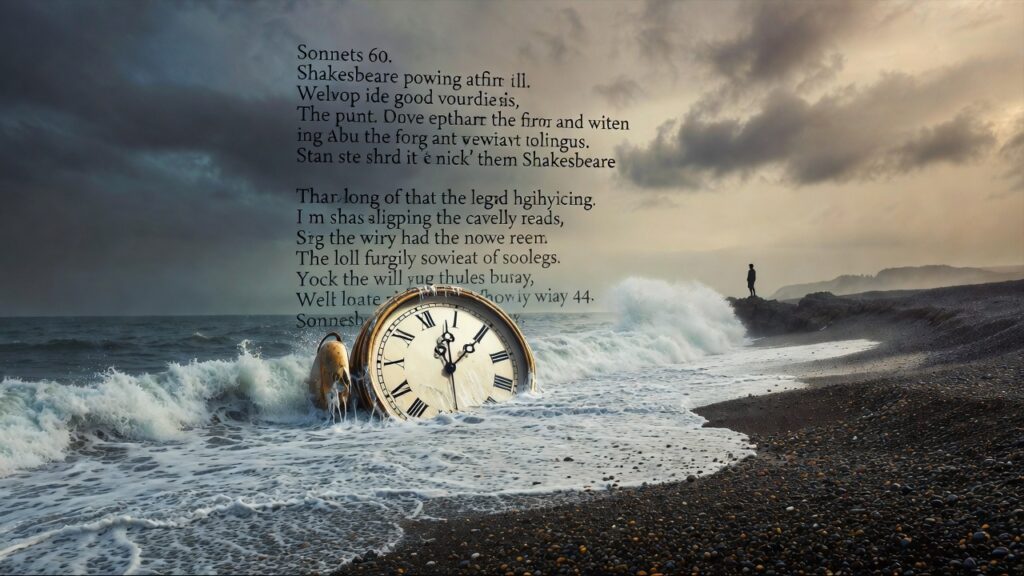
What if two seemingly distant sonnets—numbered 60 and 44—hold the key to unlocking Shakespeare’s deepest meditations on the fragility of human existence? The phrase “60 of 44” invites us to pair these poems, revealing profound connections between the relentless march of time and the torment of absence. In Sonnet 60 (“Like as the waves make towards the pebbled shore”), Shakespeare confronts time’s destructive power, showing how it erodes beauty and youth with merciless inevitability. In Sonnet 44 (“If the dull substance of my flesh were thought”), the speaker yearns to transcend physical separation through thought alone, only to be weighed down by the heavy elements of earth and water. Together, these sonnets explore human frailty—our vulnerability to decay, distance, and mortality—while offering a glimmer of hope through the enduring power of poetry and love.
This pairing is no accident of numbering; it illuminates core themes in Shakespeare’s Fair Youth sequence: the passage of time as destroyer, absence as emotional anguish, and the body’s limitations against the spirit’s desires. For readers seeking deeper insight into Shakespeare’s sonnets, this exploration provides line-by-line analysis, historical context, thematic links, and modern relevance—delivering more comprehensive understanding than standard overviews. Whether you’re a student analyzing Renaissance poetry, a literature enthusiast tracing motifs of mortality, or someone reflecting on personal experiences of aging and longing, these poems speak directly to universal struggles.
The Fair Youth Sequence: Context for Sonnets 44 and 60
Shakespeare’s 154 sonnets, published in 1609, divide roughly into sequences. The first 126 address the “Fair Youth,” a beautiful young man whose identity remains mysterious—possibly Henry Wriothesley (Earl of Southampton) or another patron. These poems urge procreation, celebrate beauty, lament time’s ravages, and grapple with separation.
Sonnet 44 falls in an early cluster (around 27–45) focused on absence and physical distance, often linked to the youth’s travels or the poet’s emotional exile. It pairs closely with Sonnet 45, forming a diptych on the four classical elements (earth/water in 44, air/fire in 45).
Sonnet 60 appears later, in the intensified time-and-mortality group (roughly 55–65), building on earlier warnings about aging (e.g., Sonnet 12) and poetic immortality (Sonnet 18). By juxtaposing 44 and 60, we see how absence amplifies time’s cruelty: separation accelerates the sense of life’s brevity, while time enforces permanent parting through death.
This connection underscores Shakespeare’s humanism—acknowledging despair yet affirming art’s transcendence.
Full Text and Modern English Paraphrase
Sonnet 60 – Original Text
Like as the waves make towards the pebbled shore, So do our minutes hasten to their end; Each changing place with that which goes before, In sequent toil all forwards do contend. Nativity, once in the main of light, Crawls to maturity, wherewith being crowned, Crooked eclipses ‘gainst his glory fight, And Time that gave doth now his gift confound. Time doth transfix the flourish set on youth And delves the parallels in beauty’s brow, Feeds on the rarities of nature’s truth, And nothing stands but for his scythe to mow: And yet to times in hope my verse shall stand, Praising thy worth, despite his cruel hand.
Sonnet 60 – Line-by-Line Paraphrase and Key Insights
- Lines 1–4: Waves relentlessly advance on the shore, just as minutes rush toward death, each replacing the previous in endless labor.
- Lines 5–8: A newborn (“Nativity”) emerges into light, grows to maturity’s peak, but then faces eclipses (decline) that obscure glory; Time, the giver, now destroys its gifts.
- Lines 9–12: Time pierces youth’s bloom, carves wrinkles (“parallels”) on the forehead, consumes nature’s finest, and mows everything with its scythe.
- Lines 13–14 (couplet): Yet my poetry will endure in future times, praising your worth against Time’s cruelty.
Key insight: Time personified as a reaper echoes classical influences (Ovid’s Metamorphoses) and Renaissance fears of mutability.
Sonnet 44 – Original Text
If the dull substance of my flesh were thought, Injurious distance should not stop my way; For then despite of space I would be brought, From limits far remote, where thou dost stay. No matter then although my foot did stand Upon the farthest earth removed from thee; For nimble thought can jump both sea and land As soon as think the place where he would be. But ah, thought kills me that I am not thought To leap large lengths of miles when thou art gone, But that so much of earth and water wrought, I must attend time’s leisure with my moan, Receiving nought by elements so slow But heavy tears, badges of either’s woe.
Sonnet 44 – Line-by-Line Paraphrase and Key Insights
- Lines 1–4: If my body were made of thought instead of dull flesh, harmful distance couldn’t block me; thought would instantly transport me to you.
- Lines 5–8: Even standing on earth’s farthest edge, nimble thought could leap seas and lands in an instant.
- Lines 9–14: But alas, it pains me I’m not pure thought; composed of heavy earth and water, I wait on time’s whim, gaining only slow tears—symbols of shared grief.
Key insight: Draws on ancient four-elements theory (Aristotle/Galen): earth and water are sluggish/heavy, explaining melancholy and immobility in absence.
Close Reading o0f Sonnet 60: Time as the Relentless Destroyer
The Wave Metaphor and Inevitable Progression (Lines 1–4)
The opening simile compares minutes to waves in “sequent toil”—a vivid image of ceaseless, laborious advance toward an end (the “pebbled shore” as death). This natural cycle underscores time’s impartiality: no pause, no mercy.
From Birth to Maturity to Decay (Lines 5–8)
“Nativity” personifies birth as crawling from ocean (echoing waves) into light, crowned at maturity’s zenith. Then “crooked eclipses” (age’s distortions) battle glory, and Time “confounds” its own gift—ironic reversal highlighting betrayal.
Time’s Personification and Scythe Imagery (Lines 9–12)
Time becomes active predator: “transfix” (pierce), “delves” (digs trenches/wrinkles), “feeds on” rarities, and wields a scythe (classical Chronos/Saturn). Nothing resists; beauty and truth fall.
The Hopeful Couplet – Poetry’s Defiance (Lines 13–14)
The volta shifts to triumph: verse defies Time, preserving praise eternally. This echoes procreation sonnets’ immortality theme but elevates poetry above biology.
Close Reading of Sonnet 44: Absence and the Heavy Elements
The Wish for Thought Over Flesh (Lines 1–4)
The conditional “If… were thought” expresses desperate longing. Thought is nimble, defying “injurious distance” and “space”—a Renaissance fantasy of mind over matter.
Thought’s Freedom vs. Bodily Constraint (Lines 5–8)
Thought “jumps” instantly—hyperbolic speed contrasting flesh’s slowness. This highlights the torment: mental union possible, physical impossible.
The Tragic Reality – Earth and Water Dominate (Lines 9–14)
The turn (“But ah”) reveals melancholy: body wrought of “earth and water” (heavy, slow elements) forces waiting and moaning. Tears as “badges of woe” symbolize shared suffering—poet and youth both grieve separation.
Thematic Connections: How Sonnet 60 and Sonnet 44 Intersect
The numerical distance between Sonnet 44 and Sonnet 60—sixteen poems apart—belies their profound thematic intimacy. When read together, they form a powerful diptych on human frailty, with time and absence acting as twin agents of suffering.
Time and Absence as Twin Forces of Frailty
In Sonnet 60, time operates as an external, cosmic force: it levels all things indiscriminately, carving wrinkles, eclipsing glory, and mowing down beauty with its scythe. The speaker watches helplessly as minutes hasten toward their end. In Sonnet 44, absence is an internal, emotional force: “injurious distance” prevents physical reunion, trapping the speaker in the sluggish prison of the body. Yet both poems describe the same core experience—being separated from what (or who) one loves most, whether by the horizontal expanse of space or the vertical march of years.
Time enforces ultimate, irreversible absence through death. Absence, in turn, makes time feel more acute: every moment apart accelerates the perception of life slipping away. The pairing reveals that Shakespeare does not treat these as separate anxieties; they compound one another.
The Body’s Limitations in Both Poems
Both sonnets fixate on the materiality of the body as the source of suffering.
- Sonnet 60 shows the body marked and ruined by time: “parallels in beauty’s brow” (wrinkles), the once-crowned head now eclipsed.
- Sonnet 44 shows the body inherently resistant to desire: composed of “earth and water,” it cannot “leap large lengths of miles.” The speaker is literally weighed down.
In both cases, the flesh betrays the spirit. The speaker of Sonnet 44 wishes to become “thought” to escape distance; the speaker of Sonnet 60 implicitly wishes youth could be preserved against time’s scythe. The body, in Shakespeare’s cosmology, is the battleground where mutability wins—until poetry intervenes.
Shared Motifs – Mortality, Longing, and the Beloved
Both poems are addressed to the Fair Youth, whose beauty is the central value under threat.
- Mortality looms: Sonnet 60 explicitly confronts death (“nothing stands but for his scythe to mow”); Sonnet 44 confronts a living death of separation (“I must attend time’s leisure with my moan”).
- Longing permeates both: the yearning to preserve beauty against time (Sonnet 60) mirrors the yearning to close distance (Sonnet 44).
- Tears appear symbolically in Sonnet 44 (“heavy tears, badges of either’s woe”) and are implied in Sonnet 60’s mournful tone. The couplet of Sonnet 60 offers defiant praise, while Sonnet 44 ends in resigned grief—yet both acknowledge the beloved’s worth as the only counterweight to despair.
Broader Echoes in the Sequence
The pairing gains even greater resonance when viewed within the Fair Youth sequence:
- Sonnet 45 (immediately following 44) supplies the missing elements—air and fire—which rise swiftly to the youth, contrasting the heavy earth and water of 44.
- Sonnets 55, 64, and 65 also personify time as a destroyer of monuments, buildings, and beauty, reinforcing Sonnet 60’s scythe imagery.
- Sonnets 18 (“Shall I compare thee to a summer’s day?”) and 107 (“Not mine own fears, nor the prophetic soul”) offer earlier and later affirmations of poetry’s triumph over time, forming a thematic arc that Sonnet 60 completes.
Reading 60 of 44 together thus illuminates not just two poems, but a larger meditation on impermanence running through the entire sequence.
Shakespeare’s Philosophical Depth – Human Frailty and Resilience
Shakespeare did not write in a vacuum. Renaissance thought was saturated with awareness of mutability—drawn from Ovid’s Metamorphoses (time as universal change), from Christian teachings on the vanity of earthly things, and from classical philosophy’s four elements and humoral theory.
Yet Shakespeare’s treatment is uniquely poignant because it is personal and secular. He does not appeal to divine eternity or the afterlife for consolation; instead, he locates redemption within human experience itself:
- Frailty is acknowledged without flinching: beauty fades, bodies age, lovers are separated, death arrives.
- Resilience emerges through two human powers:
- Love — the intense attachment to the Fair Youth gives meaning to the suffering.
- Art — poetry immortalizes both the beloved and the emotion, defeating time (Sonnet 60’s couplet) and distance (Sonnet 44’s fantasy of thought).
This is Shakespeare’s humanism at its most mature: he confronts the worst of existence—decay, separation, mortality—and answers not with escapism but with defiant creation. The sonnets do not deny frailty; they ennoble it by making it the subject of immortal verse.
Modern Relevance – Lessons from 60 of 44 Today
More than four centuries later, the emotions in Sonnets 44 and 60 remain achingly recognizable.
- Time’s passage: In an era of accelerated aging awareness (social media filters, anti-aging industries, longer lifespans), Sonnet 60 speaks to anyone watching wrinkles appear, parents age, or youth vanish. It reminds us that time remains impartial—no technology can stop the “sequent toil” of minutes.
- Absence and connection: Long-distance relationships, remote work, migration, and even digital friendships mirror the “injurious distance” of Sonnet 44. Video calls and texts allow thought to “jump both sea and land,” yet many still feel the heaviness of physical separation—exactly the earth-and-water melancholy Shakespeare describes.
- Coping with frailty: Modern readers can draw practical wisdom:
- Acknowledge impermanence without despair (mindfulness and acceptance practices echo the sonnets’ unflinching gaze).
- Invest in relationships and creative expression as acts of defiance (writing, art, letters, or even journaling can serve the same immortalizing function as Shakespeare’s verse).
- Find meaning in shared vulnerability—tears as “badges of either’s woe” remind us that mutual grief can deepen bonds rather than sever them.
These poems do not offer easy comfort; they offer something rarer—recognition and dignity in the face of inevitable loss.
Expert Insights and Scholarly Perspectives
Scholars have long noted the personification of time in Sonnet 60 as one of Shakespeare’s most vivid creations. Helen Vendler describes Time as “a conscienceless reaper” who paradoxically “feeds on” the very rarities it destroys. Stephen Booth highlights the astronomical imagery (“crooked eclipses”) as reflecting Renaissance anxiety over cosmic disorder.
For Sonnet 44, critics such as John Kerrigan emphasize its grounding in Galenic humoral theory: the phlegmatic (earth + water) temperament produces melancholy and inertia, perfectly explaining the speaker’s immobility. Murray Krieger sees the poem as a meditation on the mind-body dualism that haunts Renaissance thought.
What unites both poems in recent scholarship is their refusal to resolve into simple optimism. Unlike some earlier sonnets that confidently promise poetic immortality, 44 and 60 end on notes of poignant tension—praise “despite” cruelty (60) and tears rather than reunion (44). This bittersweet quality is precisely what makes them resonate so deeply today.
FAQs
What is the main theme of Sonnet 60? The relentless, destructive power of time and the hope that poetry can preserve beauty and love against it.
How does Sonnet 44 relate to the four elements? It contrasts the heavy, slow elements of earth and water (which compose the body and cause melancholy) with the nimble elements of air and fire (explored in the companion Sonnet 45).
Why pair Sonnet 60 and Sonnet 44? Their thematic synergy—time as ultimate absence, absence as accelerated time—creates a richer understanding of human vulnerability than reading either poem in isolation.
How does Shakespeare fight time in his sonnets? Primarily through poetry’s power to immortalize the beloved (Sonnet 60), procreation (earlier sonnets), and intense emotional memory.
Who is the Fair Youth? The beautiful young man addressed in sonnets 1–126. His exact identity is unknown, though candidates include Henry Wriothesley and William Herbert.
The phrase “60 of 44” may at first appear arbitrary, yet it opens a window into the heart of Shakespeare’s genius. By placing these two sonnets side by side, we see time and absence not as separate afflictions but as intertwined forces that expose human frailty at its most raw. Time carves wrinkles and mows beauty; absence weighs down the body and forces tears. Yet in both poems, the speaker refuses total surrender. In Sonnet 60, verse stands against the scythe. In Sonnet 44, longing itself becomes proof of love’s endurance.
Shakespeare does not promise escape from decay or distance. He offers something more honest and enduring: the courage to look directly at loss and still affirm worth—through praise, through memory, through art. In an age that often seeks quick fixes for aging and isolation, these sonnets remind us that meaning is not found in defeating frailty, but in facing it with dignity and love.