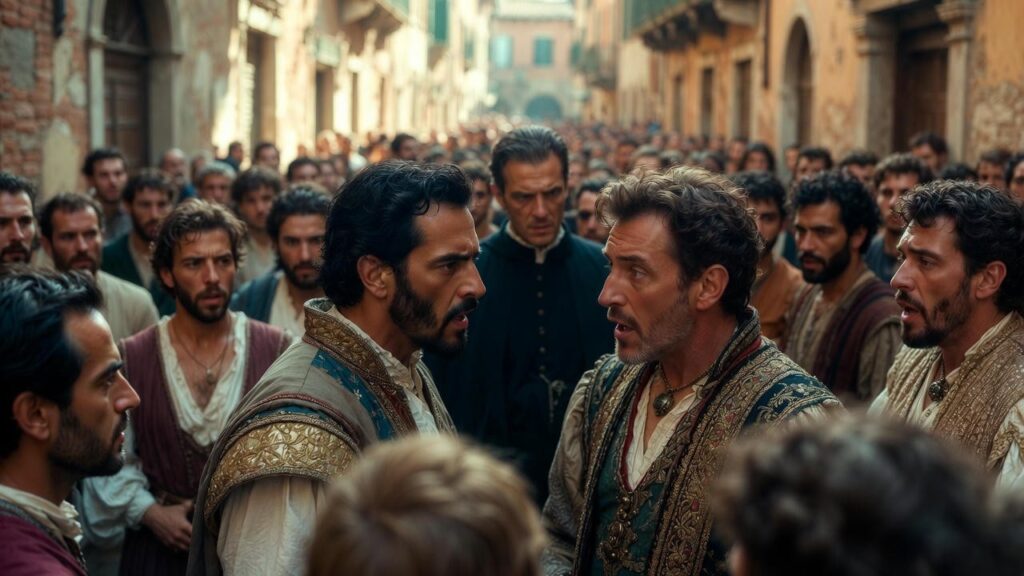
Imagine a sun-drenched street in Verona erupting into chaos. Servants trade insults—“Do you bite your thumb at us, sir?”—and within moments, swords clash, citizens join the fray, and the city’s most powerful nobles draw steel against one another. This explosive opening scene in William Shakespeare’s Romeo and Juliet is no mere dramatic flourish. It vividly illustrates the social system of Romeo and Juliet—a rigid, hierarchical world where ancient grudges, patriarchal authority, and class divisions dictate every aspect of life. In this toxic environment, individual desires, especially the passionate love of two young people, stand little chance of survival.
While the play is often celebrated as the ultimate tale of romantic love, Shakespeare masterfully reveals that Romeo and Juliet’s tragedy is not solely the result of fate or youthful impulsiveness. Instead, it is the oppressive social structure of Verona—built on interminable family vendettas, strict patriarchal control (particularly over women), and entrenched class hierarchies—that forces the lovers into secrecy, exile, and ultimately death. By examining these societal forces through close textual analysis, historical context, and scholarly insight, we can better understand why their love, though genuine and profound, was doomed from the start.
This article delves deeply into the social system that shapes the play, exploring how feuds perpetuate violence, how patriarchy constrains autonomy, and how class reinforces division. For students, educators, theater enthusiasts, and lifelong Shakespeare readers, understanding these elements not only enriches appreciation of the play but also illuminates Shakespeare’s timeless critique of societies that prioritize collective honor and tradition over individual happiness.
The Renaissance Setting: Verona as a Microcosm of Elizabethan Society
Shakespeare sets Romeo and Juliet in Renaissance Verona, but the city functions as a mirror for late-16th-century England. Though drawing from Italian sources (particularly Arthur Brooke’s 1562 poem The Tragicall Historye of Romeus and Juliet), Shakespeare infuses the play with social tensions familiar to his Elizabethan audience.
Verona retains feudal characteristics: powerful noble families like the Montagues and Capulets wield near-autonomous authority, while the Prince (Escalus) represents a weak central government struggling to maintain order. This reflects England’s own transition from medieval feudalism toward a more centralized monarchy under the Tudors. Honor culture dominates, especially among men, where reputation is defended through violence—a code Shakespeare both depicts and critiques.
Religion plays a complex role. The Catholic Church, represented by Friar Laurence, attempts to mediate secular conflicts but ultimately becomes complicit in the tragedy through secretive interventions. Law, embodied by the Prince’s edicts against street fighting, proves ineffective against deep-rooted family loyalty.
Key Social Institutions in Conflict with Individual Desire
At the heart of the play lies a fundamental clash between collective institutions and personal desire:
- Family loyalty demands absolute allegiance, superseding romantic love.
- Public order requires civility and peace, yet private passions ignite public chaos.
- Religion offers spiritual guidance but cannot override societal norms without risk.
Shakespeare uses these tensions to highlight how rigid social institutions crush youthful idealism. As literary scholar Jill Levenson notes in her Oxford edition of the play, Verona’s society “exemplifies a world in which the old order resists change, with tragic consequences for the young.”
The Role of Family Feuds and the Code of Honor
The Prologue famously declares the lovers “star-crossed,” but it immediately grounds their misfortune in society: “From ancient grudge break to new mutiny.” The feud between the Montagues and Capulets is not explained—its origins are irrelevant. What matters is its perpetuation across generations, infecting every level of society.
The Ancient Grudge: How Inter-Family Hatred Perpetuates Violence
The opening brawl (Act 1, Scene 1) begins with servants—Samson and Gregory of the Capulets—boasting and provoking their Montague counterparts. This demonstrates how the feud trickles down: even lower-status household members internalize and enact upper-class rivalries. By the time Benvolio and Tybalt arrive, followed by Lords Montague and Capulet, the conflict has escalated dangerously. The Prince’s exasperated rebuke—“Three civil brawls, bred of an airy word”—underscores the senselessness of the violence.
This cycle directly impacts Romeo and Juliet. Their love emerges in defiance of the feud, yet secrecy becomes necessary from the moment they learn each other’s identities (“My only love sprung from my only hate!” – Juliet, Act 1, Scene 5). The secret marriage orchestrated by Friar Laurence is an attempt to heal the rift, but the feud’s momentum proves unstoppable.
Honor and Masculine Violence as Social Expectations
Verona’s honor code is deeply gendered and toxic. Men are expected to defend family reputation through aggression. Tybalt embodies this ideal—quick to anger, eager to duel, labeling Romeo a “villain” merely for attending the Capulet feast. Mercutio, though not a family member, shares this worldview, mocking Tybalt as the “King of Cats” and drawing his sword when Romeo refuses to fight.
Romeo initially rejects this code, attempting peace (“I do protest I never injured thee, / But love thee better than thou canst devise” – Act 3, Scene 1). Yet after Mercutio’s death, social pressure overwhelms him: “O sweet Juliet, / Thy beauty hath made me effeminate.” He kills Tybalt in a moment of rage, accepting exile as punishment. This sequence illustrates how the honor system forces even peace-minded individuals into violence.
Impact on the Lovers
The feud exiles Romeo, separates the couple, and prevents open communication. Juliet’s lament—“My only love sprung from my only hate”—captures the personal devastation caused by collective hatred. Their deaths finally end the grudge, but only after irreparable loss, underscoring Shakespeare’s critique: reconciliation comes too late when society prioritizes vengeance over forgiveness.
Patriarchy and Gender Roles: Constraining Women’s Autonomy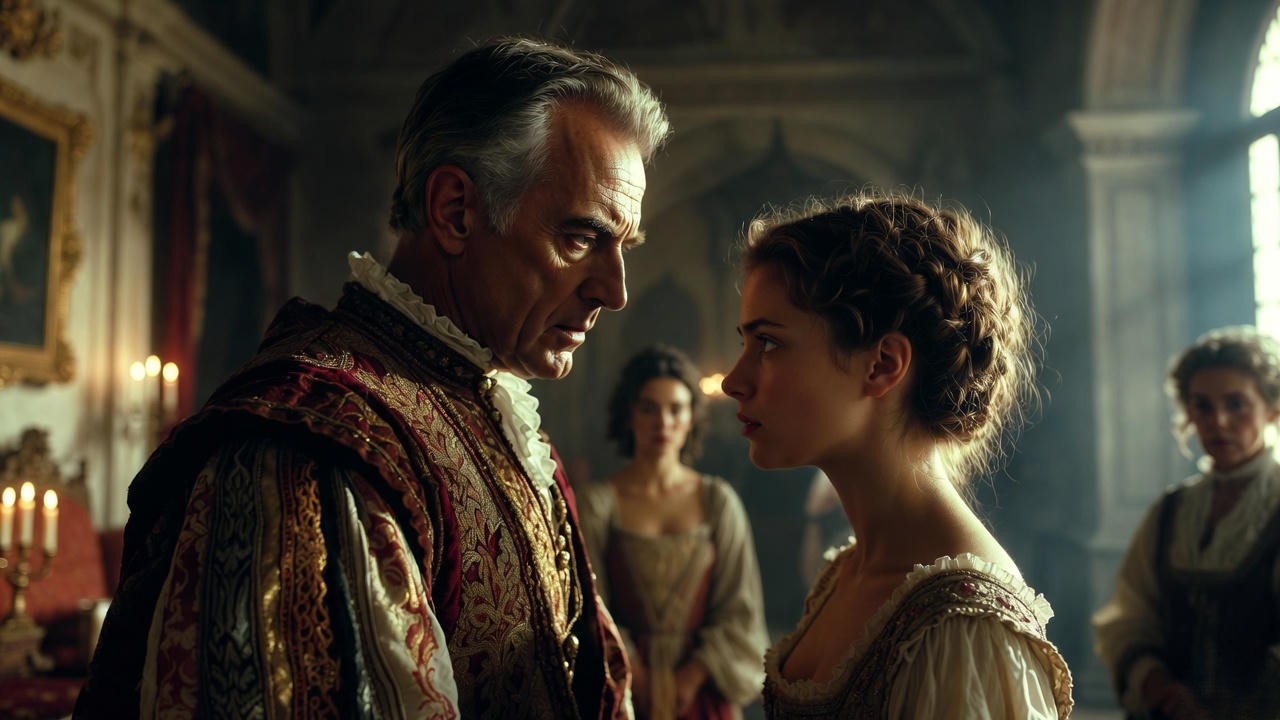
Perhaps no element of Verona’s social system is more suffocating than its patriarchal structure. In Renaissance society—both the fictional Verona and Shakespeare’s England—authority flowed from the male head of household downward. Fathers, husbands, and male kin held near-absolute power over women’s lives, particularly in matters of marriage, inheritance, and public behavior. Romeo and Juliet exposes this patriarchy not merely as background but as a primary engine of the tragedy.
Patriarchal Control in Veronese Families
Lord Capulet initially appears lenient, even affectionate, toward his only child. When Paris first seeks Juliet’s hand (Act 1, Scene 2), Capulet cautions that she is too young—“She hath not seen the change of fourteen years”—and urges Paris to “win her heart.” Yet this apparent moderation masks absolute paternal authority. Once the feud escalates and Tybalt is slain, Capulet abruptly advances the marriage to Paris as a means of restoring household order and Juliet’s spirits (Act 3, Scene 4). By Act 3, Scene 5, when Juliet refuses, Capulet erupts into tyrannical rage:
“Hang thee, young baggage! Disobedient wretch! I tell thee what: get thee to church o’ Thursday, Or never after look me in the face… My fingers itch.”
This outburst reveals the brutal reality: a daughter’s consent is desirable but never required. Her body, her future, and her obedience belong to her father until transferred to a husband.
Lord Montague exercises similar (though less dramatized) control over Romeo, but the play emphasizes how patriarchy disproportionately victimizes women. Juliet’s isolation is profound: she has no legal recourse, no independent resources, and no socially acceptable path to defy her father openly.
Arranged Marriages and Female Obedience
In Elizabethan and Renaissance Italian society, marriages among the nobility were strategic alliances designed to consolidate wealth, status, and political power. Romantic love was a secondary consideration at best. Juliet, at just thirteen, is already on the marriage market. Lady Capulet informs her daughter that “younger than you… / Here in Verona, ladies of esteem, / Are made already mothers” (Act 1, Scene 3), normalizing child marriage and maternal duty.
Paris represents the ideal patriarchal match: noble, wealthy, and approved by Capulet. Juliet’s personal feelings are irrelevant. When she resists, every adult authority figure—father, mother, even the Nurse—pressures her toward submission. This collective enforcement illustrates how patriarchy is not merely individual male dominance but a systemic norm upheld by the entire community, including women socialized into compliance.
The Nurse and Lady Capulet as Products of the System
The Nurse and Lady Capulet provide poignant examples of women shaped—and ultimately limited—by patriarchal expectations.
The Nurse, Juliet’s closest confidante, initially supports the secret romance with Romeo, reminiscing fondly about her own youth and offering practical advice. Yet when Capulet threatens disownment, the Nurse abruptly shifts allegiance, advising Juliet to marry Paris: “I think it best you married with the County. / O, he’s a lovely gentleman! / Romeo’s a dishclout to him” (Act 3, Scene 5). Her pragmatism reflects survival within the system: romantic idealism is a luxury the powerless cannot afford.
Lady Capulet, meanwhile, embodies emotional detachment born of subordination. Her marriage to the much older Capulet appears loveless; she refers to Juliet as “the hopeful lady of my earth” rather than with maternal warmth. When Juliet pleads for help against the forced marriage, Lady Capulet coldly replies, “Talk not to me, for I’ll not speak a word. / Do as thou wilt, for I have done with thee.” Both women, having internalized patriarchal values, cannot shield Juliet from its consequences.
Shakespeare’s Feminist Critique
Modern scholars widely recognize Romeo and Juliet as containing one of Shakespeare’s earliest feminist critiques. Juliet displays remarkable agency—declaring her love independently (“Romeo, doff thy name”), orchestrating the secret marriage, and masterminding the sleeping-potion plan. Yet every act of independence drives her deeper into isolation and danger precisely because the social system offers no legitimate space for female autonomy.
As feminist critic Coppélia Kahn argues in Man’s Estate: Masculine Identity in Shakespeare (1981), the play exposes how patriarchal insistence on female chastity and obedience paradoxically creates the conditions for tragedy. Had Juliet been free to marry openly, or even to refuse Paris without fear of disownment, the desperate deceptions might never have been necessary.
This critique resonates powerfully today, inviting comparisons to cultures where arranged marriages, honor-based control, and limited female agency persist.
Class Hierarchy and Social Order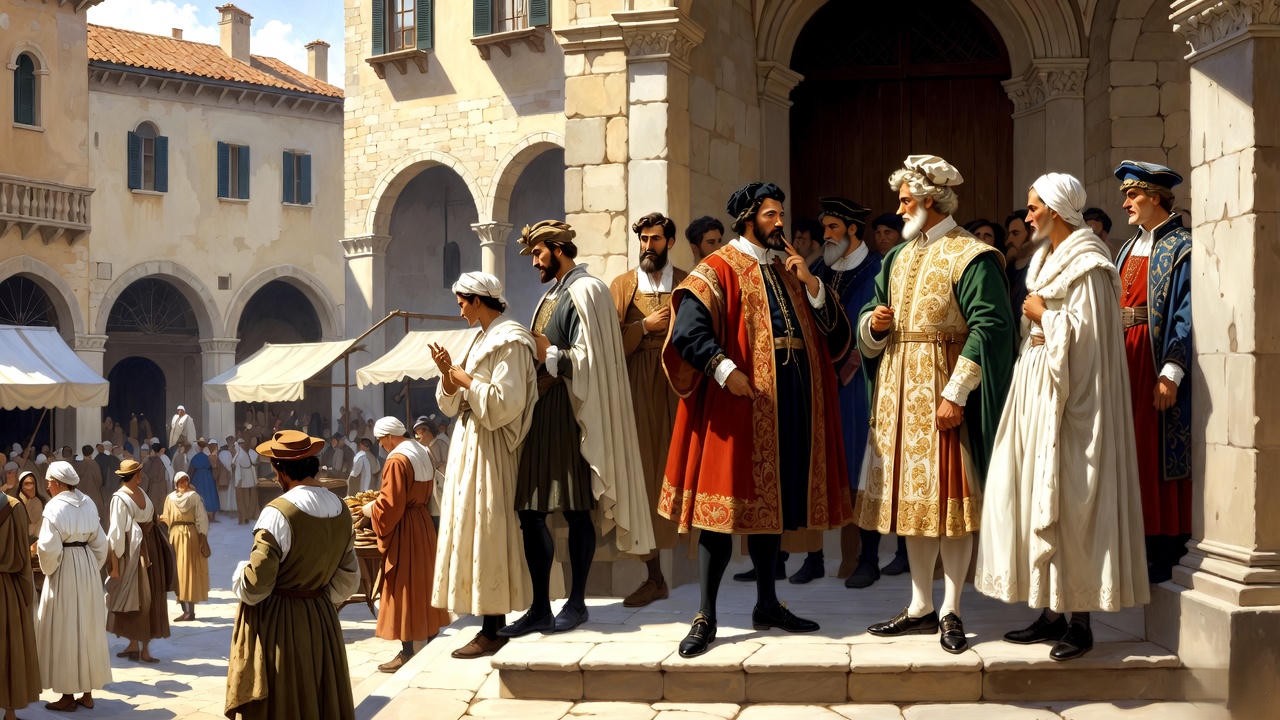
Class distinctions in Verona reinforce both the feud and the tragedy. Shakespeare carefully delineates social strata through language, behavior, and access to power.
Class Divisions in Verona: Nobles, Servants, and Outsiders
The ruling class—Montagues, Capulets, and Prince Escalus—speaks primarily in blank verse, signifying education and status. Servants like Samson, Gregory, and Peter speak in prose, often bawdy and aggressive, mirroring their masters’ rivalries but without the same consequences.
The Prince occupies the apex, attempting (ineffectually) to impose order from above. His repeated threats of death for further violence (“If ever you disturb our streets again, / Your lives shall pay the forfeit of the peace” – Act 1, Scene 1) highlight the limits of centralized authority against entrenched noble privilege.
Below the nobility lie figures like the Apothecary, whose crushing poverty makes him vulnerable to moral compromise. Romeo easily persuades him to sell illegal poison for fifty ducats: “My poverty, but not my will, consents” (Act 5, Scene 1).
How Class Reinforces the Feud and Tragedy
Class dynamics amplify the feud’s destructiveness. Servants initiate street violence, escalating conflicts their masters must then resolve through duels. Meanwhile, the lovers—trapped in noble families—bear obligations that lower-class characters do not. A servant could perhaps elope without triggering civic crisis; Romeo and Juliet cannot.
The Apothecary scene underscores how poverty intersects with noble tragedy. Mantua’s laws forbid selling poison, yet economic desperation overrides ethics, enabling Romeo’s suicide. Class thus provides both the motive (noble honor) and the means (impoverished complicity) for catastrophe.
Language and Behavior as Class Markers
Shakespeare masterfully uses linguistic register to signal hierarchy:
- Nobles: Elevated blank verse and elaborate metaphor.
- Servants: Prose, malapropisms, crude humor.
- Friar Laurence: Verse with moral and philosophical depth, marking his educated but non-noble status.
This stratification reminds audiences that social order is performative as well as structural—everyone plays their assigned role until the system collapses under its own contradictions.
How These Elements Collectively Doom the Lovers
The tragedy of Romeo and Juliet is not the result of a single societal flaw but the deadly convergence of family feuds, patriarchal oppression, and class rigidity. These forces intersect at every critical juncture, transforming a youthful romance into a cascade of irreversible disasters.
The Fatal Intersection: Feud + Patriarchy + Class = Tragedy
Trace the chain of events step by step:
- The feud creates the initial barrier. Romeo and Juliet fall in love at first sight, but discovering their family names forces immediate secrecy (Act 1, Scene 5). An open courtship is impossible without risking violence.
- Patriarchy accelerates the crisis. After Romeo kills Tybalt and is exiled, Lord Capulet—seeking to restore household stability and assert control—forces Juliet into an imminent marriage with Paris. This patriarchal decree leaves her no acceptable outlet for refusal.
- Class dynamics limit options. As nobles, the lovers cannot simply flee and live anonymously; their status makes them recognizable and binds them to family obligations. Lower-class characters like the Nurse or the Apothecary operate on pragmatic survival, not romantic idealism.
- Secrecy breeds miscommunication. The secret marriage and Friar Laurence’s clandestine plan rely on perfect timing. When the message about Juliet’s feigned death fails to reach exiled Romeo (delayed by plague quarantine—a reminder of broader societal vulnerabilities), he believes her truly dead.
- Honor and patriarchy seal the fate. Romeo purchases poison from the impoverished Apothecary and confronts Paris at the tomb, killing him in an honor-bound duel. Juliet, awakening to this carnage and patriarchal betrayal (no future without Romeo in this society), takes her own life.
Had any one element been absent—if the families were reconciled, if Juliet possessed marital autonomy, or if class allowed escape—the outcome might have differed. Instead, the interlocking systems amplify youthful impulsiveness into catastrophe.
Shakespeare’s Message: Society’s Failure to Adapt
The play’s final scene drives home the indictment. The Prince condemns the families: “See what a scourge is laid upon your hate, / That heaven finds means to kill your joys with love” (Act 5, Scene 3). Reconciliation arrives only through the deaths of the younger generation—the very people the social order claimed to protect.
Shakespeare suggests that rigid adherence to outdated codes—vengeful honor, absolute paternal power, stratified hierarchy—stifles renewal. As critic Northrop Frye observed, the lovers represent “a new world trying to be born” within an old, decaying one. Their destruction warns that societies ignoring individual humanity court self-destruction.
Modern Relevance and Legacy
Why does the social system of Romeo and Juliet continue to captivate audiences more than four centuries later? Because its core conflicts remain painfully relevant.
Honor-based violence persists in various forms, from gang rivalries to so-called “honor killings” in certain cultures. Patriarchal control over women’s bodies and choices echoes in debates over reproductive rights, forced marriages, and gender-based oppression worldwide. Class divisions still shape opportunity and justice, often determining who bears the consequences of systemic failure.
Adaptations—from West Side Story (ethnic and class conflict) to Baz Luhrmann’s 1996 film (modern gang culture)—testify to the play’s adaptability. Shakespeare’s critique transcends Verona, inviting every generation to examine its own social rigidities and ask: What ancient grudges do we perpetuate? Whose autonomy do we suppress? At what cost?
Romeo and Juliet is far more than a love story gone wrong. Through the oppressive social system of Verona—its endless feuds, patriarchal tyranny, and class barriers—Shakespeare reveals how collective structures can crush individual potential. The lovers’ passion illuminates the darkness of a society that values honor over humanity, obedience over agency, and tradition over change.
Their deaths force a belated reconciliation, but the true tragedy lies in its necessity. As we revisit the play, we are challenged to recognize similar forces in our own world and to imagine societies flexible enough to allow love, youth, and difference to flourish without demanding blood as payment.
Revisit Romeo and Juliet not just for its poetry or romance, but for its urgent warning: rigid social systems doom not only star-crossed lovers, but the future itself.
Key Quotes: Pivotal Lines Illustrating the Social System
| Quote | Act/Scene | Speaker | Significance |
|---|---|---|---|
| “From ancient grudge break to new mutiny, / Where civil blood makes civil hands unclean.” | Prologue | Chorus | Establishes the feud as the foundational social ill. |
| “Do you bite your thumb at us, sir?” | Act 1, Scene 1 | Samson | Shows how class-infused servants perpetuate noble rivalries. |
| “My only love sprung from my only hate!” | Act 1, Scene 5 | Juliet | Captures the personal devastation of inherited enmity. |
| “Hang thee, young baggage! Disobedient wretch!” | Act 3, Scene 5 | Lord Capulet | Reveals patriarchal rage when female obedience is challenged. |
| “I think it best you married with the County… Romeo’s a dishclout to him.” | Act 3, Scene 5 | Nurse | Illustrates how even supportive women enforce patriarchal norms under pressure. |
| “My poverty, but not my will, consents.” | Act 5, Scene 1 | Apothecary | Highlights class desperation enabling noble tragedy. |
| “O brother Montague, give me thy hand.” | Act 5, Scene 3 | Lord Capulet | Bitter reconciliation achieved only through loss. |
| “For never was a story of more woe / Than this of Juliet and her Romeo.” | Act 5, Scene 3 | Prince | Frames the entire tragedy within societal failure. |
What is the main social issue in Romeo and Juliet?
The primary social issue is the destructive interplay of family feuds, patriarchal authority, and class hierarchy, which collectively prevent individual choice and perpetuate violence.
How does patriarchy affect Juliet specifically?
Patriarchy strips Juliet of marital autonomy, forcing her into secrecy and desperation when her father demands she marry Paris against her will.
Why does the family feud doom Romeo and Juliet?
The feud necessitates secrecy, leads to Romeo’s exile after Tybalt’s death, and creates an environment where open love is impossible.
Is class important in Romeo and Juliet’s tragedy?
Yes—noble status binds the lovers to family obligations, while lower-class poverty (e.g., the Apothecary) provides the means for suicide.
How does Shakespeare critique society in the play?
Through ironic reconciliation only after catastrophe, Shakespeare indicts rigid honor codes, gender oppression, and class divisions that prioritize tradition over human life.