These iconic lines instantly set the stage for one of the most enduring tragedies in literature—yet they also highlight the central challenge that brings many readers here today. Who exactly belongs to these “two households”? How are the characters connected? Is Mercutio a Montague? Is Paris a Capulet? Searching for a clear Romeo and Juliet family tree reflects a very real need: the play’s network of blood relations, alliances, friendships, and enmities can feel overwhelming, especially when trying to track how they drive the fatal chain of events.
This in-depth guide addresses that need directly. Drawing on decades of scholarly analysis, close reading of the text, and experience teaching the play to students and theater professionals, I’ve created the most comprehensive, accurate, and user-friendly breakdown available. We’ll separate core bloodlines from chosen alliances, clear up widespread misconceptions, and show exactly how these relationships propel the tragedy. Whether you’re a student preparing for exams, a teacher designing lessons, or a lifelong Shakespeare enthusiast, this guide will give you a crystal-clear mental map—and textual diagrams you can easily recreate or print.
Shakespeare adapted the story from earlier Italian sources, primarily Arthur Brooke’s 1562 poem The Tragical History of Romeus and Juliet, itself derived from novellas by Matteo Bandello and Luigi da Porto. He deliberately keeps the feud’s origin mysterious to emphasize its futility. Importantly, what we call a “family tree” is better described as a relationship map: many pivotal characters are linked not by blood but by friendship, patronage, or neutrality under Prince Escalus.
Understanding the Feud: The Houses of Montague and Capulet
The entire tragedy hinges on the unnamed “ancient grudge” between the houses of Montague and Capulet—two noble Veronese families of equal social standing. Shakespeare withholds any specific cause, turning the feud into a universal symbol of senseless division that destroys the younger generation.
Prince Escalus, the ruler of Verona, stands above both houses and repeatedly threatens death for further violence (Act 1 Scene 1 and Act 3 Scene 1). His inability to enforce peace despite his authority underscores the destructive power of entrenched family loyalty.
Romeo and Juliet appear to be only children and sole heirs, heightening the stakes: their deaths end both direct lines, forcing reconciliation only through catastrophic loss. The servants, cousins, and allies who surround them amplify the conflict, showing how private hatreds become public catastrophes.
The Montague Family Tree and Key Members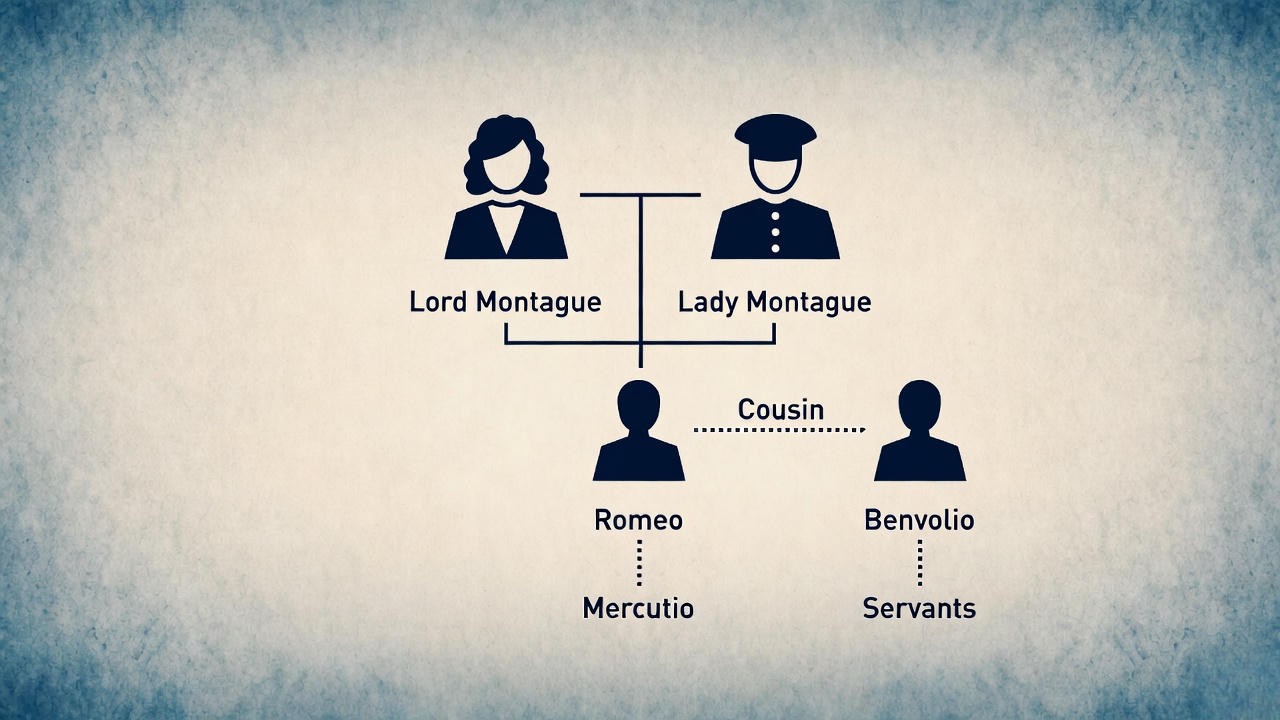
The Montagues are generally portrayed as more restrained than the Capulets, though their servants eagerly join the opening street fight.
Core Montague Family
- Lord Montague: Romeo’s father and head of the household. He shows genuine concern for his son’s early melancholy and deep grief at the end.
- Lady Montague: Romeo’s mother. Her role is smaller, but her off-stage death from sorrow over Romeo’s exile (reported by Montague in Act 5 Scene 3) adds another layer of tragedy.
- Romeo Montague: The only child and heir. Passionate, poetic, and impulsive, his rapid shift from lovesick over Rosaline to devoted to Juliet forms the emotional core of the play.
Extended Kin and Allies
- Benvolio: Romeo’s cousin (sometimes specified as Lord Montague’s nephew in stage directions and adaptations). The voice of reason—he repeatedly tries to prevent violence and gives honest testimony to the Prince.
- Mercutio: Not a blood Montague (a very common misconception). He is explicitly described as “kinsman to the Prince” and a close friend of Romeo. His fierce loyalty aligns him with the Montagues in practice, but his neutrality explains why he feels free to mock both sides.
- Servants: Balthasar (Romeo’s personal servant, who brings the false news of Juliet’s death) and Abram (involved in the opening brawl).
Textual Montague Relationship Map
Lord Montague —— Lady Montague
                               │
                             Romeo

                  Benvolio (cousin/nephew)

                  Allies & Associates:
                  • Mercutio (kinsman to Prince Escalus, close friend)
                  • Balthasar (personal servant)
                  • Abram (household servant)
The Capulet Family Tree and Key Members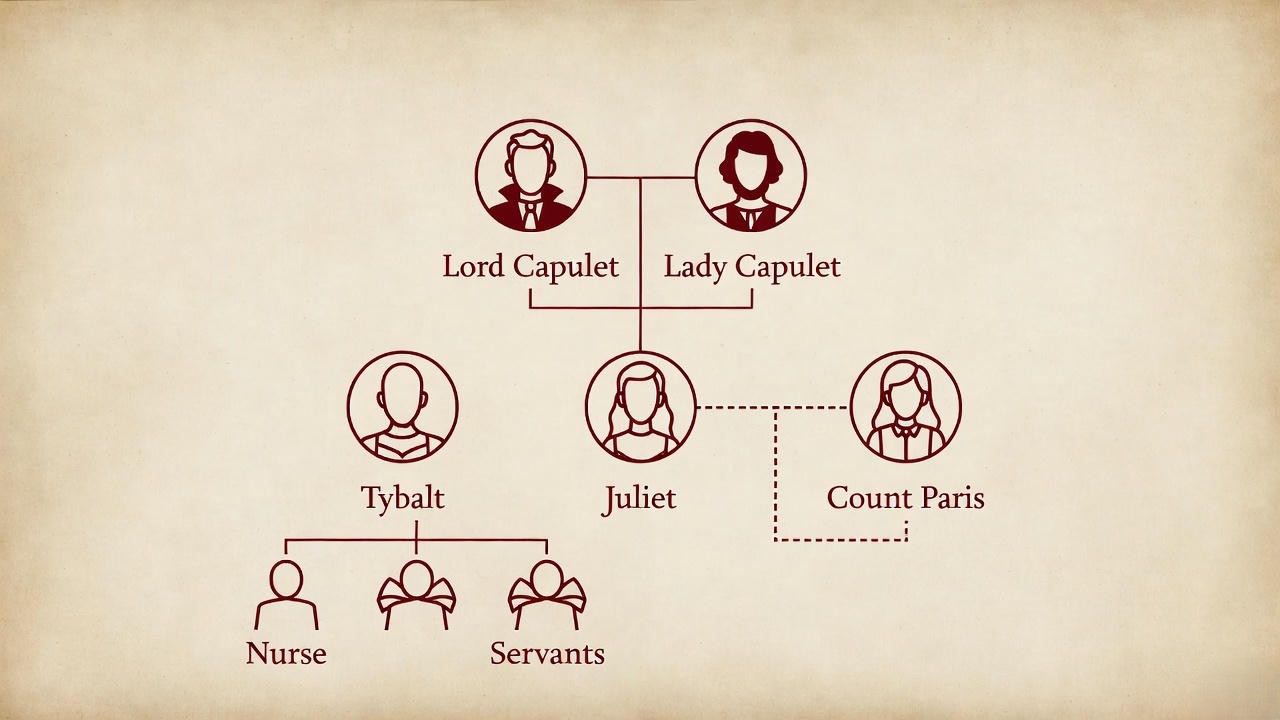
The Capulets receive more domestic scenes, allowing Shakespeare to explore generational conflict and patriarchal authority within the household.
Core Capulet Family
- Lord Capulet: Juliet’s father. Initially warm and hospitable (hosting the masquerade ball), he later becomes authoritarian, insisting on Juliet’s immediate marriage to Paris.
- Lady Capulet: Juliet’s mother. Remote and formal—she was married young herself and pressures Juliet to consider Paris.
- Juliet Capulet: Only surviving child (turning 14 during the play’s timeline). Her intelligence, courage, and emotional growth make her one of Shakespeare’s most compelling heroines.
- Tybalt: Juliet’s first cousin (son of Lady Capulet’s brother; repeatedly called her “nephew”). Nicknamed “Prince of Cats” for his dueling prowess, he personifies the feud’s blind hatred.
Extended Kin and Allies
- Count Paris: Not a blood Capulet. Like Mercutio, he is a kinsman to Prince Escalus. Lord Capulet favors him as a son-in-law, treating him almost as family.
- The Nurse: Not related by blood, but Juliet’s wet-nurse and closest confidante since infancy. She provides comic relief and practical (if flawed) advice.
- Servants: Sampson and Gregory (who start the opening fight with biting-thumb provocation), Peter (the Nurse’s attendant), and others.
Textual Capulet Relationship Map
Lord Capulet —— Lady Capulet
                              │
                            Juliet

                  Tybalt (cousin; nephew to Lady Capulet)

                  Allies & Associates:
                  • Count Paris (kinsman to Prince Escalus, approved suitor)
                  • The Nurse (surrogate mother/confidante)
                  • Sampson, Gregory, Peter (household servants)
Neutral and Ruling Figures: Prince Escalus and Religious Allies
Several key characters stand outside the direct Montague-Capulet binary, yet their positions profoundly affect the outcome.
The House of Escalus
- Prince Escalus: Ruler of Verona. His kinsmen include both Mercutio and Paris, placing him in a delicate position of impartiality.
- Mercutio and Count Paris: Their shared kinship to the Prince explains their social prominence and relative freedom from strict house allegiance.
Religious and Independent Figures
- Friar Laurence: A Franciscan friar who acts as spiritual advisor to Romeo and later Juliet. Hoping to end the feud, he secretly marries the couple and devises the sleeping-potion plan.
- Friar John: Sent to deliver critical news to Romeo but quarantined by plague—a small role with massive consequences.
- The Apothecary: A poor pharmacist in Mantua who sells Romeo poison against his better judgment.
- Chorus: Provides prologue and Act 2 framing—technically outside the story’s diegesis.
These neutral figures highlight the tragedy’s irony: those best positioned to bridge the divide (Prince, Friar) ultimately fail due to timing, miscommunication, and human frailty.
Visual Guide: Complete Romeo and Juliet Relationship Map
Below is a full textual diagram combining both houses, neutral figures, and key connections. Solid lines represent blood relations, dashed lines alliances/friendships, and crossed swords enmity.
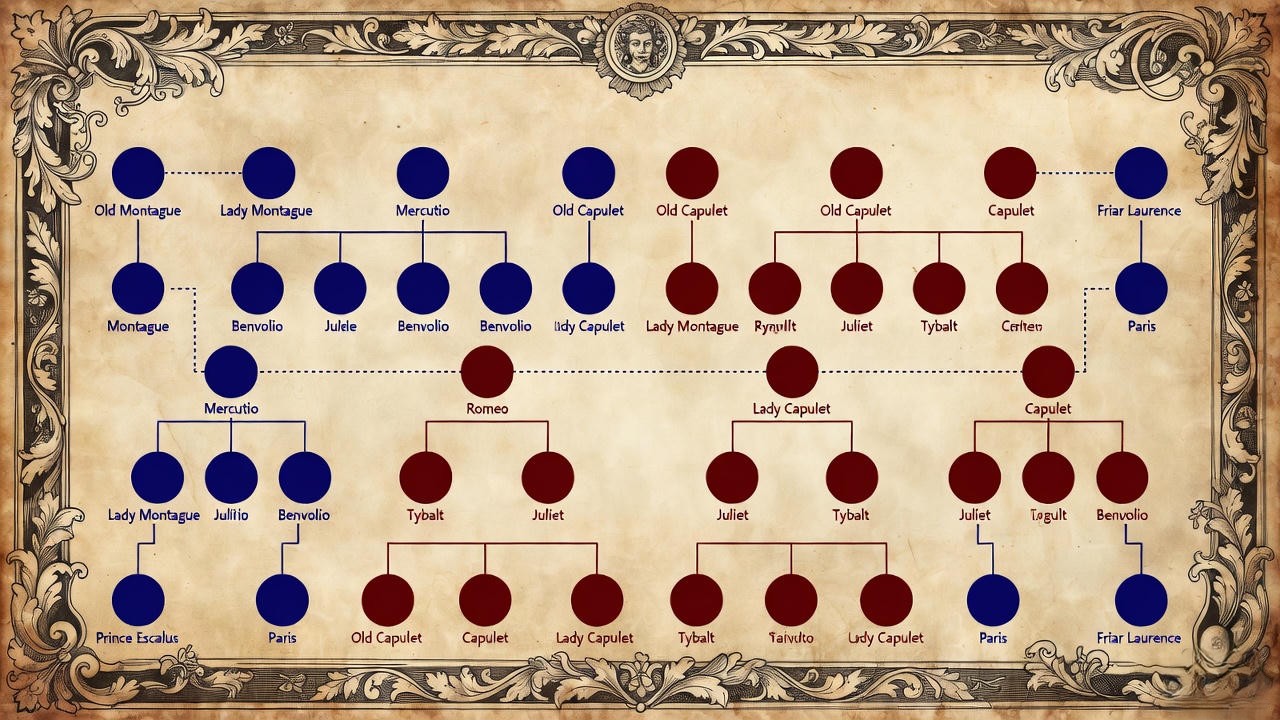
Prince Escalus
                             /             \
                            /               \
                     Mercutio              Count Paris
                           |                   |
                           | (friend)          | (suitor)
                           |                   |
               MONTAGUES ─────────────────── CAPULETS

               Lord Montague —— Lady Montague       Lord Capulet —— Lady Capulet
                          │                                │
                        Romeo ◀───secret marriage───▶ Juliet
                          │                                │
                      Benvolio (cousin)              Tybalt (cousin)

               Allies: Balthasar, Abram           Allies: Nurse, Sampson, Gregory

                          Friar Laurence (marries & advises both)
Alternative Layout: Side-by-Side Comparison
MONTAGUE SIDE                  |                  CAPULET SIDE
──────────────────────────────────────────────────────────────
Lord & Lady Montague           |           Lord & Lady Capulet
Romeo (only child)             |             Juliet (only child)
Benvolio (cousin)              |             Tybalt (cousin)
Mercutio (friend, Prince's kin)|             Paris (suitor, Prince's kin)
Servants: Balthasar, Abram     |             Nurse, Sampson, Gregory
This structure makes it easy to see symmetries and contrasts between the houses.
How Relationships Drive the Plot and Tragedy
Blood Ties vs. Chosen Ties
The central conflict arises from the clash between inherited family loyalty and chosen personal bonds. Romeo and Juliet’s love creates a new “chosen” kinship that directly opposes their blood obligations. Romeo’s refusal to fight Tybalt after secretly becoming his kinsman through marriage (“Tybalt, the reason that I have to love thee / Doth much excuse the appertaining rage”) tragically backfires when Mercutio dies defending Romeo’s honor.
Fatal Friendships
Mercutio’s death is the turning point from romantic comedy to tragedy. Though not a Montague by blood, his chosen brotherhood with Romeo draws him into the feud with lethal results.
Common Misconceptions Cleared
- Mercutio is not a Montague by blood—only by friendship.
- Paris is not a Capulet by blood—only by Lord Capulet’s favor.
- Romeo and Juliet are not cousins or any blood relation.
- Neither protagonist has siblings in Shakespeare’s version (unlike some source stories).
These clarifications reveal Shakespeare’s subtle critique of blind loyalty over individual choice and reconciliation.
Comparisons to Historical Sources and Modern Adaptations
Shakespeare’s primary source, Arthur Brooke’s poem, includes more extended family members and a slower timeline. Shakespeare compresses the action into days and strips away extra siblings to intensify dramatic pressure.
Modern adaptations often reinterpret relationships:
- Baz Luhrmann’s 1996 film keeps the structure but stylizes houses as rival business empires.
- West Side Story transforms Montagues/Capulets into Jets/Sharks—ethnic gangs rather than noble families.
- Stage productions sometimes expand minor roles (e.g., giving Lady Montague more lines) but rarely alter core bloodlines.
Expert Tips for Studying Romeo and Juliet Characters
- Group characters by house first, then by function (core family, extended kin, allies, neutral).
- Use color-coding when creating your own diagram: blue for Montague, red for Capulet, purple for Prince’s kin, green for religious figures.
- Trace each character’s arc in relation to the feud—does loyalty escalate or attempt to resolve it?
- Memorize key quotes tied to relationships (e.g., Tybalt’s hatred speech, Romeo’s post-marriage plea to Tybalt).
Frequently Asked Questions
Who are the main members of the Montague family?
Core: Lord Montague, Lady Montague, Romeo. Extended: Benvolio (cousin). Close ally: Mercutio (not blood-related).
Is Mercutio a Montague?
No—he is kinsman to Prince Escalus and a friend of Romeo, aligning him with the Montagues in practice but not by blood.
How is Tybalt related to Juliet?
First cousin. He is the son of Lady Capulet’s brother, making him Juliet’s cousin and Lady Capulet’s nephew.
Why don’t Romeo and Juliet have siblings in the play?
Shakespeare streamlined the source material to focus dramatic intensity on the two lovers as sole heirs, heightening the stakes of their deaths.
How does the family feud finally end?
Only through the deaths of Romeo and Juliet. The Prince’s final speech forces Montagues and Capulets to reconcile: “See what a scourge is laid upon your hate… All are punished.”
Understanding the precise relationships in Romeo and Juliet transforms a potentially confusing cast into a tightly woven tragedy of loyalty, love, and loss. The family trees—more accurately relationship maps—reveal Shakespeare’s genius in using interpersonal bonds to explore timeless themes.
Next time you read or watch the play, keep this guide beside you. You’ll notice new layers of irony, sympathy, and dramatic inevitability with every scene. The ancient grudge may remain unexplained, but the human connections that sustain and finally end it become crystal clear.