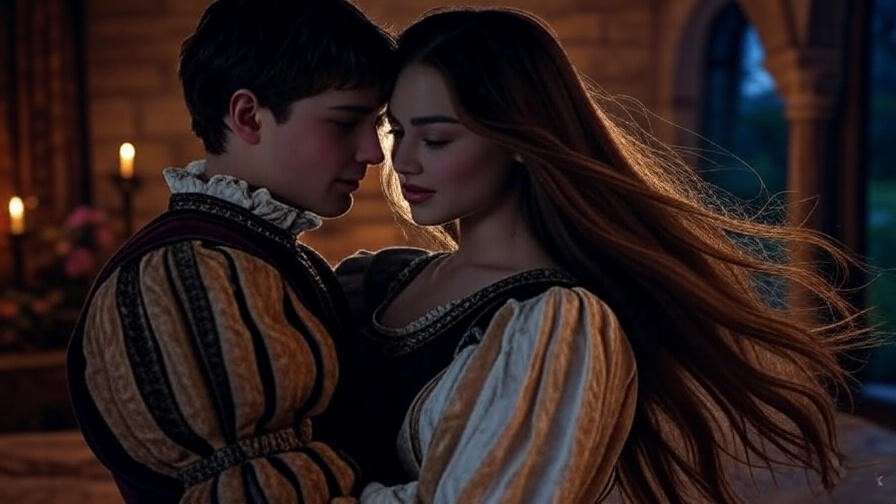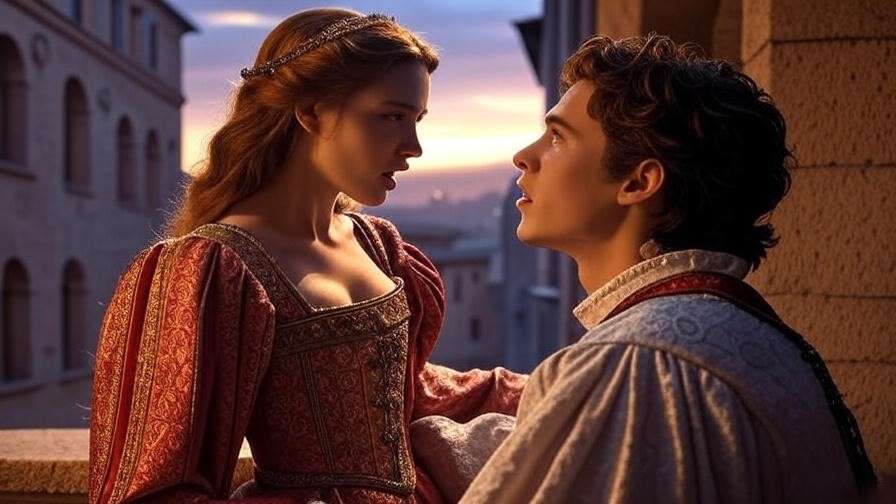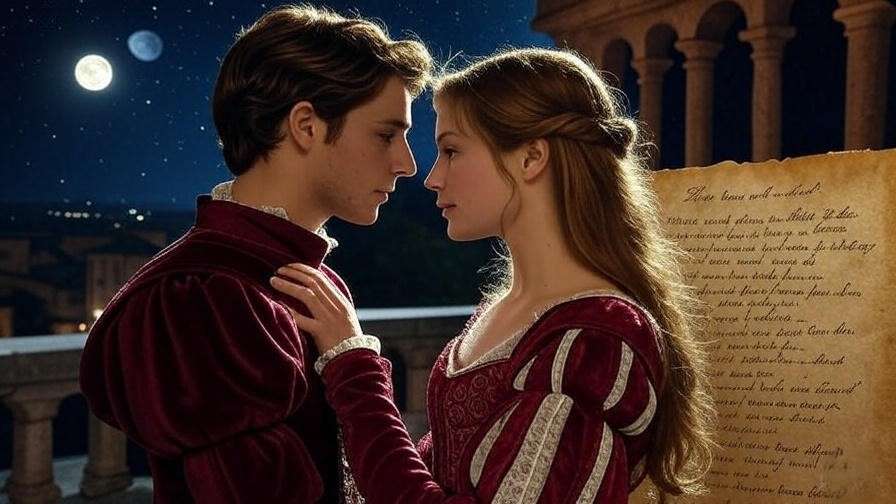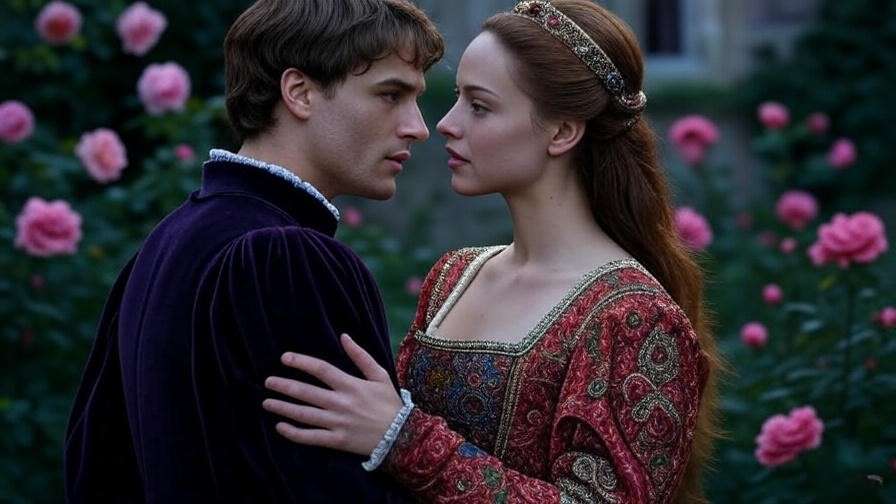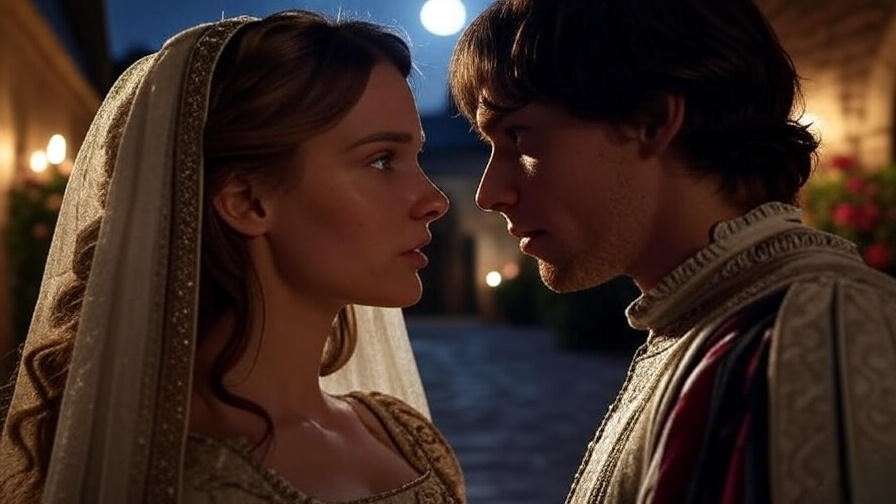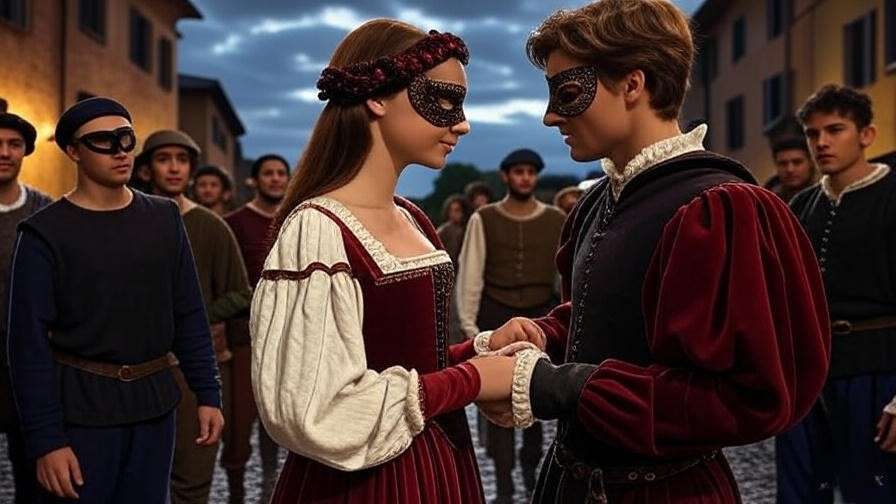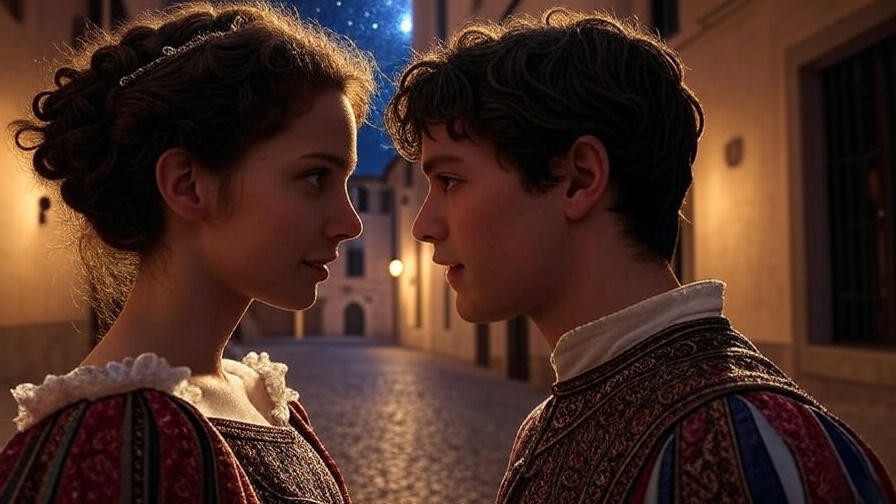
Imagine a moonlit night in Verona, where two young lovers stand separated by a stone balcony, their whispered vows hanging in the air like forbidden magic. “But soft! What light through yonder window breaks? It is the east, and Juliet is the sun.” These immortal words from William Shakespeare’s Romeo and Juliet have ignited imaginations for over four centuries, inspiring countless artists to translate the play’s raw passion, youthful impulsiveness, and heartbreaking tragedy into visual form. Romeo and Juliet artwork stands as one of the most enduring testaments to Shakespeare’s genius, turning poetic dialogue into vivid, emotional imagery that resonates across generations.
Whether you’re a literature student analyzing the balcony scene, an art enthusiast exploring Pre-Raphaelite masterpieces, a teacher seeking engaging visuals for the classroom, or simply someone captivated by tales of star-crossed love, this comprehensive guide delves into the most iconic Romeo and Juliet paintings and illustrations. From the lush, romantic Victorian canvases to earlier Romantic interpretations and modern echoes, these works not only illustrate the tragedy but deepen our appreciation of its themes: forbidden desire, fate’s cruelty, and the intensity of first love.
Shakespeare’s tragedy, first performed around 1597, draws from earlier Italian novellas, yet its universal appeal lies in the lovers’ fervent, doomed romance. Artists, especially in the 19th century, found fertile ground here. The Pre-Raphaelite Brotherhood and their followers—obsessed with medieval romance, brilliant color, and emotional truth—gravitated toward the play, producing some of the era’s most celebrated literary paintings. This article explores their evolution, spotlights landmark works with detailed analysis, and explains how these visuals enhance understanding of Shakespeare’s text. By the end, you’ll have the tools to appreciate these artworks fully, whether for personal enjoyment, academic study, or creative inspiration.
The Historical Evolution of Romeo and Juliet in Visual Art
Shakespeare’s plays have long been a favorite subject for visual artists, but Romeo and Juliet emerged as particularly compelling in the 18th and 19th centuries, when Romanticism emphasized emotion, nature, and individual passion over classical restraint.
Early Illustrations and 18th-19th Century Beginnings
The earliest visual depictions appeared in book illustrations and theatrical engravings. In the late 18th century, John Boydell’s Shakespeare Gallery commissioned artists to create grand paintings for engraving, including scenes from Romeo and Juliet. These works often focused on dramatic moments like the balcony encounter or the tomb scene, rendered in neoclassical style with balanced compositions and heroic poses.
Henry Fuseli, a key Romantic figure, brought a more dreamlike, intense quality to his interpretations. His shadowy, exaggerated figures captured the play’s supernatural undertones—fate as an almost tangible force—setting the stage for later, more emotive treatments.
The Pre-Raphaelite Brotherhood and Victorian Romanticism
The Pre-Raphaelite Brotherhood, founded in 1848 by Dante Gabriel Rossetti, William Holman Hunt, and John Everett Millais, rejected what they saw as the artificiality of academic art. They sought “truth to nature,” using vivid colors, meticulous detail, and literary subjects to evoke deep feeling. Shakespeare ranked among their “Immortals,” and Romeo and Juliet aligned perfectly with their ideals: youthful beauty, medieval-inspired settings, sensuality, and tragic love.
Pre-Raphaelite artists and associates like Ford Madox Brown and Frank Dicksee infused the play with rich symbolism—roses for love, moonlight for illusion, tombs for inevitability—while emphasizing emotional authenticity. Their works shifted from mere illustration to profound visual poetry, making the tragedy feel immediate and personal.
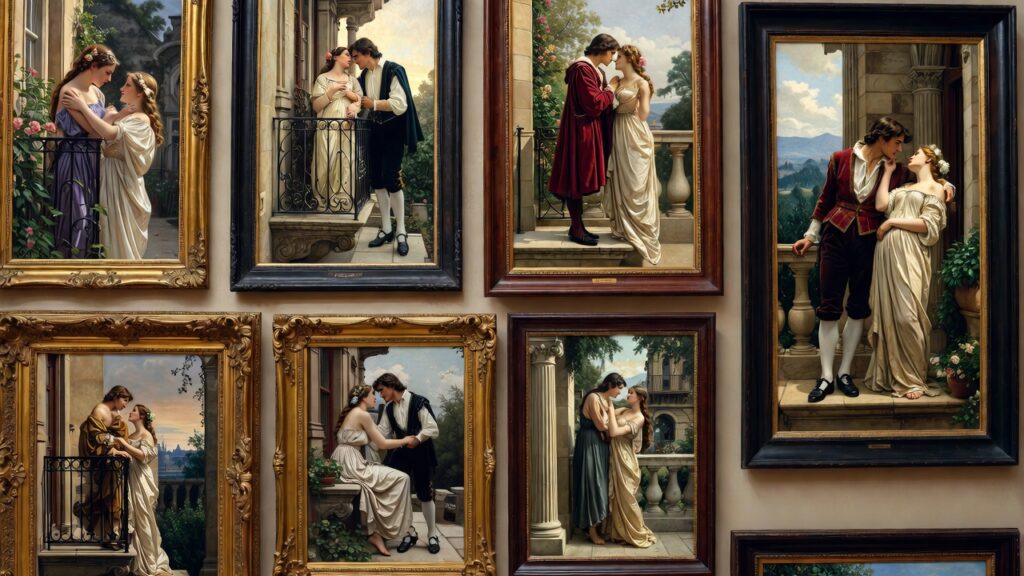
Iconic Paintings of the Balcony Scene – The Heart of the Passion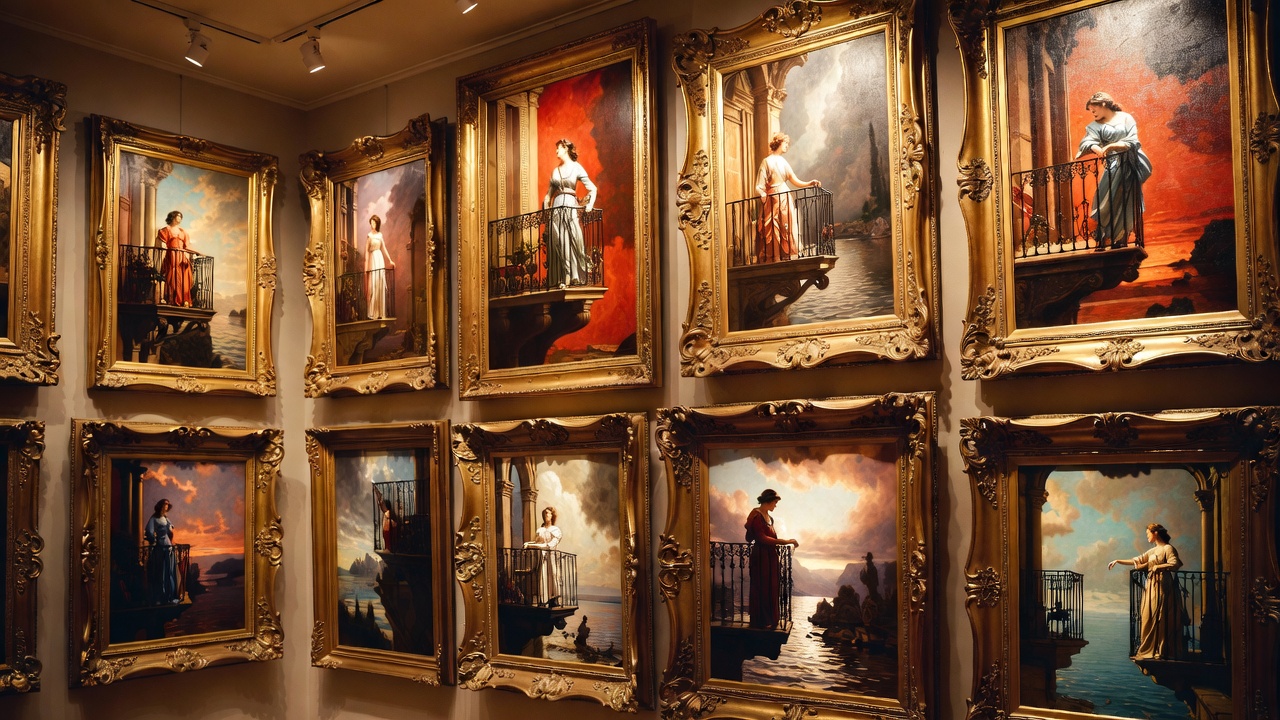
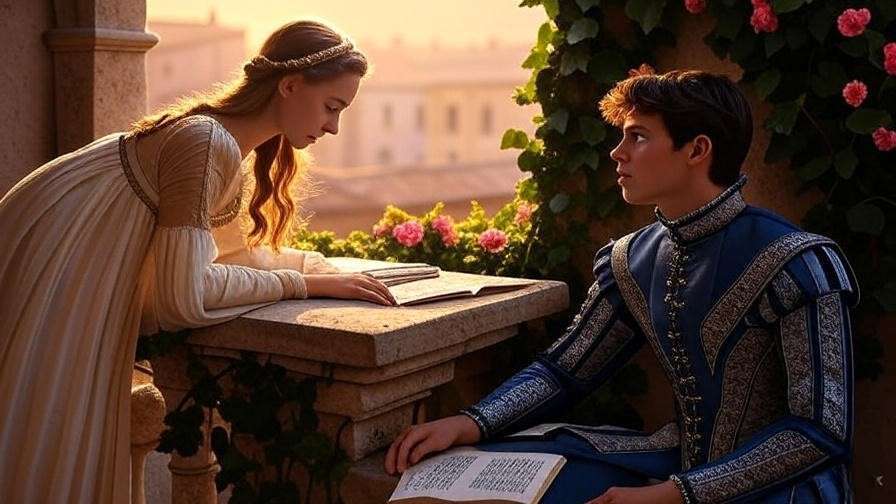
The balcony scene (Act 2, Scene 2) remains the most depicted moment, symbolizing the lovers’ first unguarded declaration of love amid danger.
Frank Dicksee’s Romeo and Juliet (1884) – Britain’s Most Romantic Artwork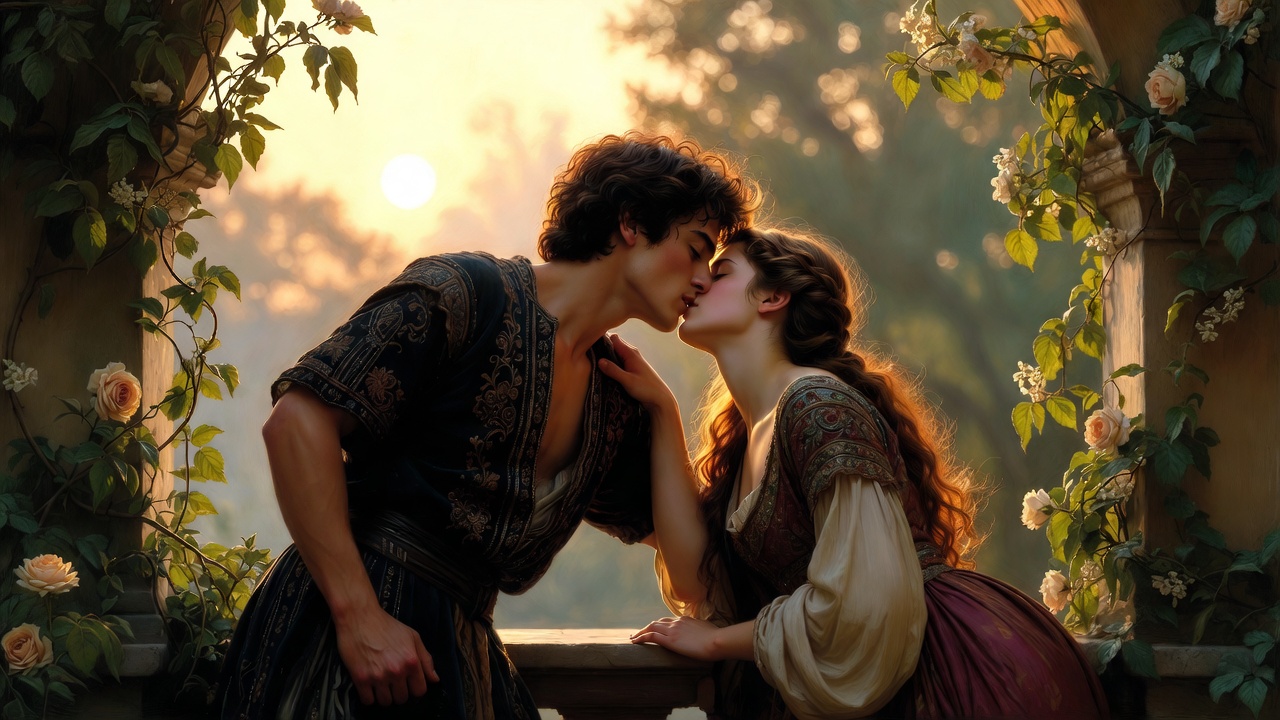
Sir Frank Dicksee’s oil on canvas masterpiece, housed at Southampton City Art Gallery, captures the farewell at dawn after the lovers’ wedding night. Romeo clings to the balustrade, stealing one last kiss from Juliet as he prepares to descend. The composition glows with warm golden light filtering through vines, highlighting the couple’s entwined forms and tender expressions. Dicksee’s Pre-Raphaelite influences shine in the lush textures—silken fabrics, blooming flowers—and vibrant palette that conveys overwhelming passion tempered by impending separation.
This painting, originally an illustration for a luxury edition of the play, was voted Britain’s most romantic artwork in polls. It balances sensuality with melancholy, perfectly embodying Romeo’s line: “Farewell! Farewell! one kiss, and I’ll descend.”
Ford Madox Brown’s Romeo and Juliet (1869-70)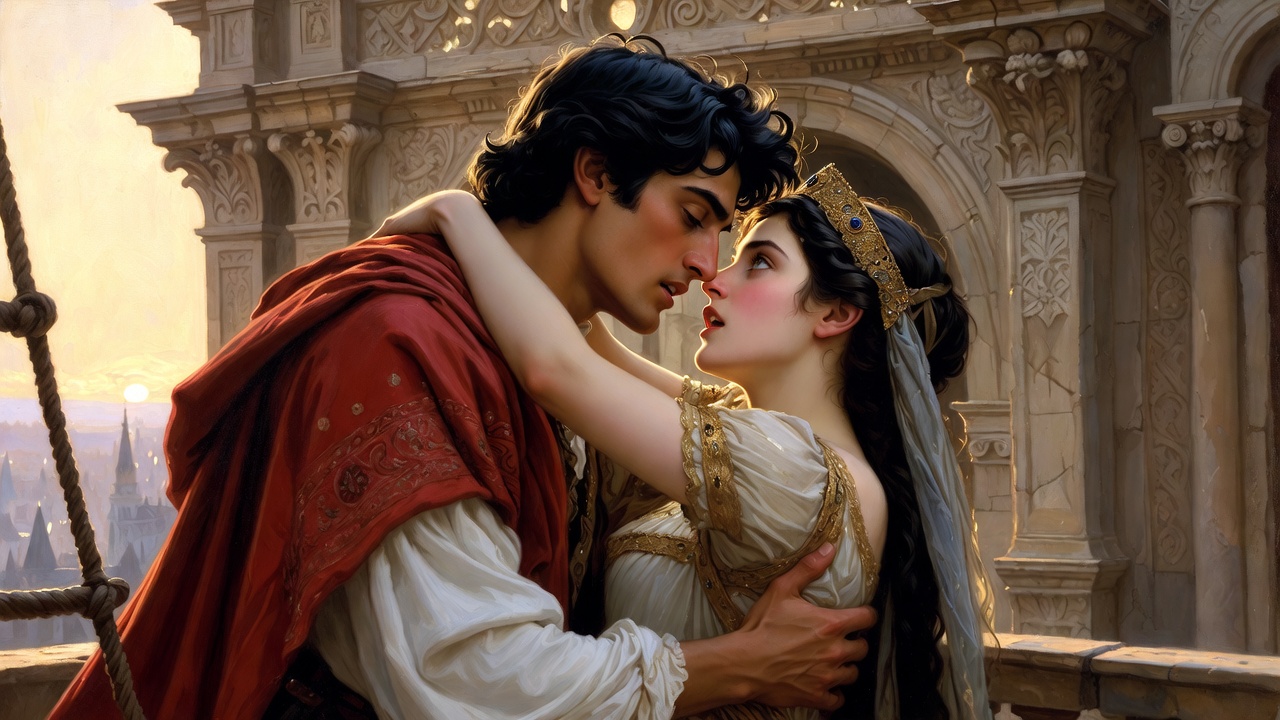
Brown’s version, now at the Delaware Art Museum, depicts the same dawn parting but with vertiginous intensity. Romeo and Juliet share a passionate embrace on a narrow balcony, Romeo’s red cloak billowing like flames of desire. The composition squeezes the lovers into tight space, heightening urgency—Lady Capulet’s approach looms. Brown’s Pre-Raphaelite precision renders every detail: the golden dawn light on Juliet’s face, the city’s distant silhouette, the symbolic rope ladder. Critics noted the exacting detail sometimes hinders imagination, yet it amplifies the scene’s emotional fire.
Other Notable Balcony Interpretations
Francesco Hayez’s 1823 The Last Kiss offers an Italian Romantic take: an intense embrace at dawn, emphasizing physical closeness and urgency. Julius Kronberg’s 1886 version adds dramatic flair with swirling fabrics and shadowed architecture. These variations highlight how artists adapt the scene—some focus on tenderness, others on peril—while preserving its core: love defying division.
Tragic Climax Scenes – Death, Fate, and Reconciliation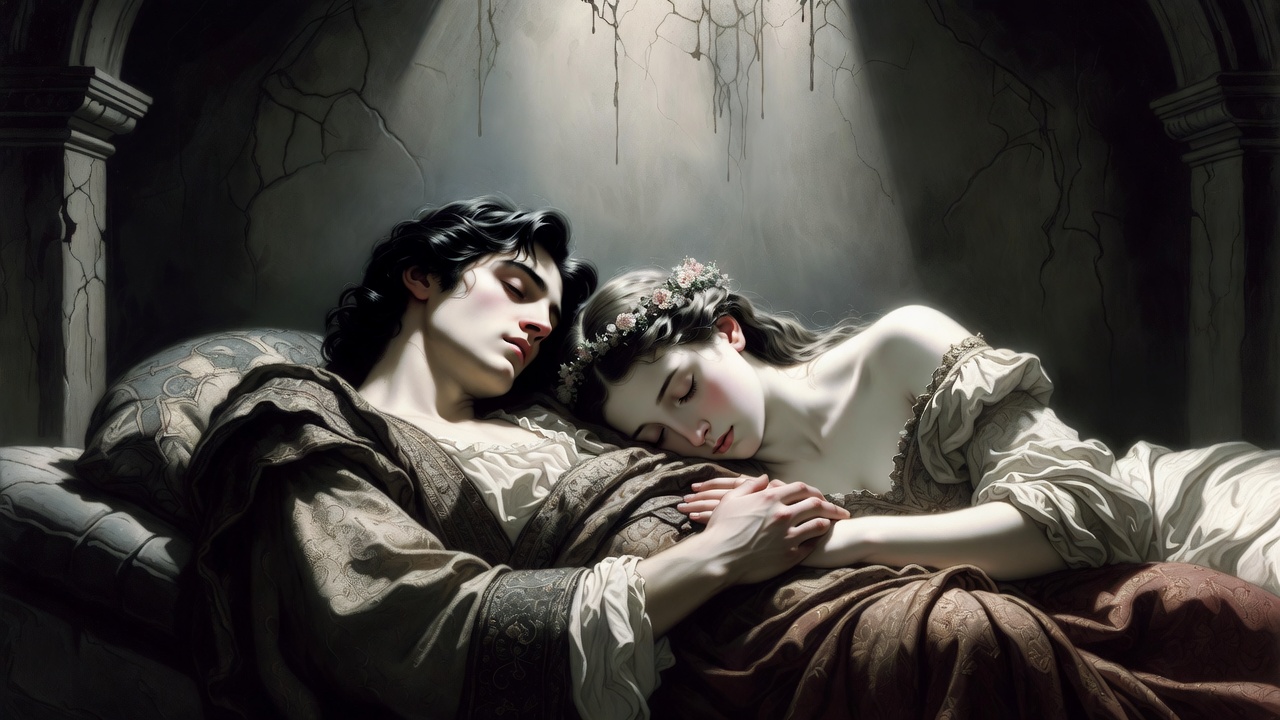
Artists also gravitated to the tomb, where deception, poison, and suicide converge.
Frederic, Lord Leighton’s The Feigned Death of Juliet (1856-58)
Leighton’s work captures Juliet’s potion-induced sleep in the Capulet tomb, her pale form luminous against dark surroundings. Dramatic lighting and classical composition underscore deception’s tragedy—beauty preserved in death-like repose. (Note: Location often associated with Art Gallery of South Australia collections or similar.)
John Everett Millais and the Final Reconciliation
Millais’s small tableau shows the grieving families uniting over the lovers’ bodies, symbolizing reconciliation through loss. Pre-Raphaelite color and tight framing convey healing amid sorrow.
Francesco Hayez’s The Last Kiss (1823)
This earlier Romantic piece blends balcony passion with tragic foreshadowing, the lovers locked in embrace as light breaks.
Portraits and Symbolic Depictions – Juliet and Romeo as Individuals
While group scenes dominate Romeo and Juliet artwork, several artists chose to isolate the characters, offering intimate portraits that reveal inner turmoil, beauty, and vulnerability. These works shift focus from action to emotion, allowing viewers to contemplate the lovers’ individual psyches.
John William Waterhouse’s Juliet (The Blue Necklace) (1898)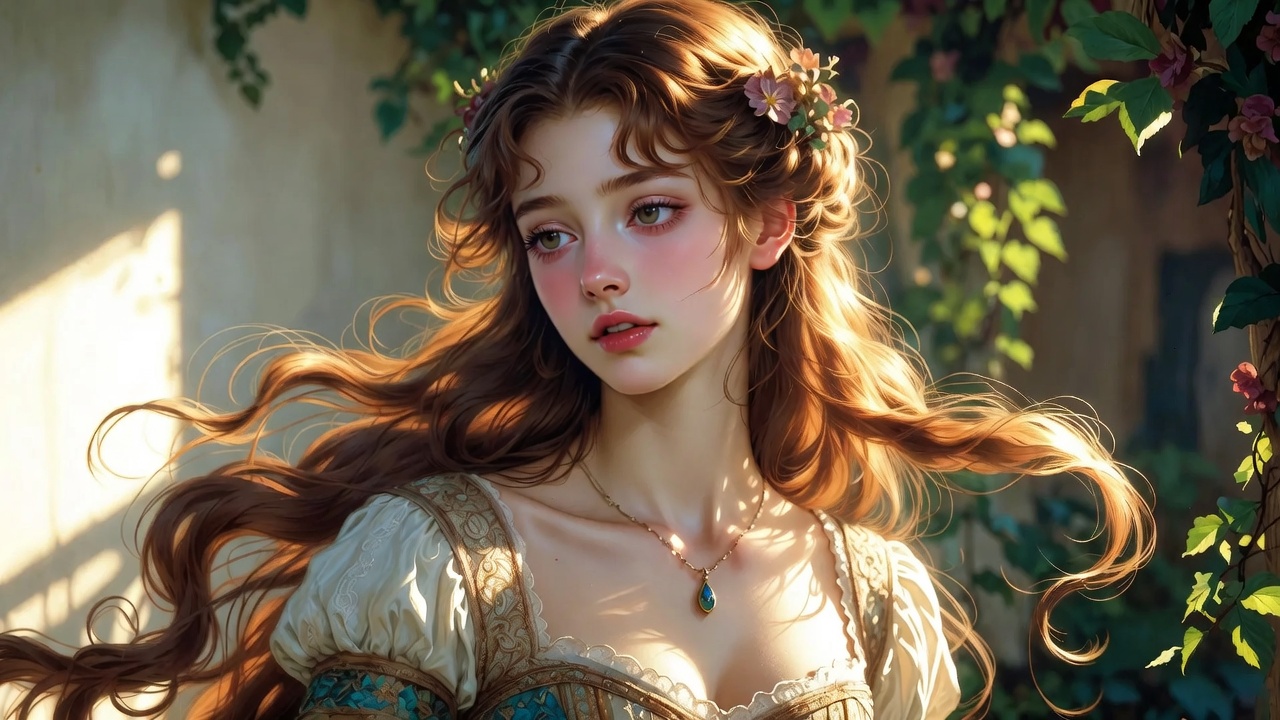
John William Waterhouse, a late Pre-Raphaelite and Romantic painter, created this evocative portrait of Juliet standing alone on a bridge or balcony-like structure, clutching a luxurious blue necklace. The painting (oil on canvas, approximately 72 x 48 cm) captures Juliet in a moment of anxious introspection—her curly hair framing a face filled with melancholy and apprehension. The architectural grid behind her (brick walls, parapet, distant townscape) symbolizes confinement and the barriers of her world, while the blue river below reinforces separation from freedom or her lover.
Waterhouse’s signature style—soft lighting, rich fabrics, and emotional depth—infuses Juliet with a timeless, almost ethereal quality. Exhibited at London’s New Gallery in 1898, the work emphasizes Juliet’s agency and inner conflict rather than passive beauty. It invites reflection on her courage in defying family and fate, making it a powerful standalone depiction of the heroine.
Surreal and Modern Twists
In the 20th century, artists reinterpreted the tragedy through new lenses. Salvador Dalí produced a rare series of 10 offset lithographs in 1975 for a limited-edition Romeo and Juliet. These surreal illustrations transform Shakespeare’s text into dreamlike visions: melting forms, elongated figures, and symbolic distortions that echo Dalí’s signature style. One piece might depict the lovers entwined amid floating clocks or fractured architecture, blending passion with the absurdity of fate. Though ultra-rare today (often in private collections), Dalí’s series adds a psychological layer, portraying love as both ecstatic and nightmarish—perfect for exploring how modern surrealism reframes classical tragedy.
Contemporary digital artists, graphic novelists, and illustrators continue the tradition, often blending Pre-Raphaelite aesthetics with anime, street art, or film influences (e.g., Baz Luhrmann’s 1996 adaptation). These works keep the story visually alive for new generations.
How These Artworks Enhance Understanding of Shakespeare’s Themes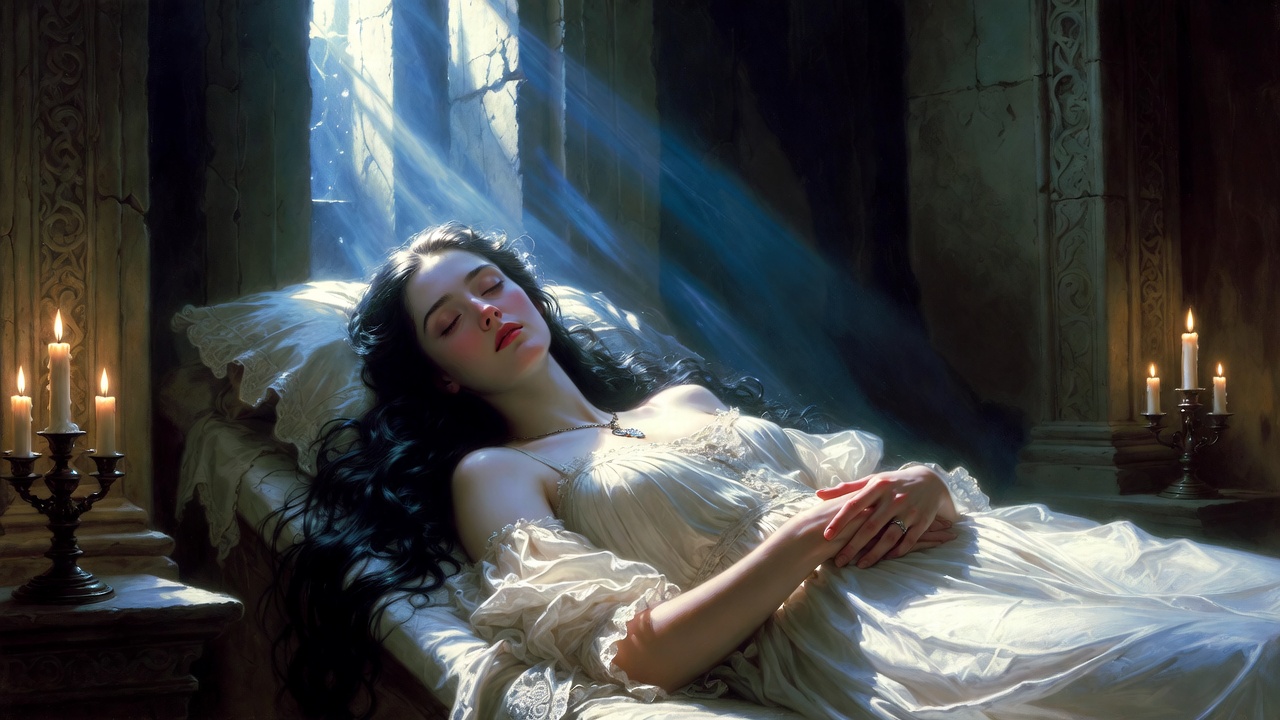
The greatest value of Romeo and Juliet artwork lies in how it illuminates the play’s core ideas beyond words.
Visualizing Passion, Youth, and Impulsiveness
Paintings amplify the erotic urgency of youthful love. Dicksee and Brown’s balcony scenes convey physical closeness and desperate longing through body language, flushed skin, and dramatic lighting—elements that make the lovers’ impulsiveness feel palpable. These visuals remind us that Romeo and Juliet are teenagers driven by overwhelming emotion, not calculated reason.
Symbolism in Romeo and Juliet Artwork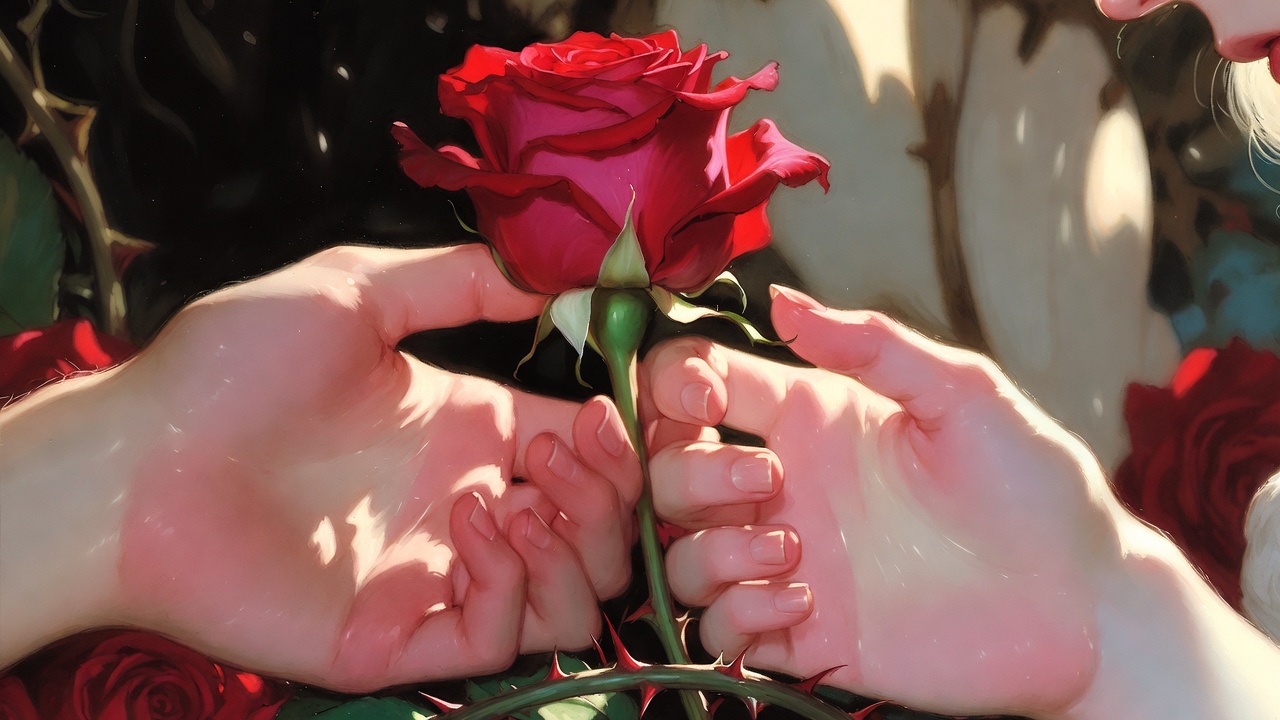
Recurring motifs deepen interpretation:
- Light and dark: Moonlight in balcony scenes symbolizes illusion and hidden romance; tomb darkness represents death’s finality.
- Roses and thorns: Often implied in floral borders, evoking beauty laced with pain.
- Poison and potions: Leighton’s Juliet highlights deceptive sleep as a visual metaphor for fate’s tricks.
- Separation vs. union: Balconies and barriers underscore division, while embraces signal fleeting unity.
Artists use these symbols to make abstract themes concrete, aiding students and readers in grasping Shakespeare’s layered poetry.
The Role of Fate and Tragedy in Visual Form
Many works foreshadow doom: Brown’s billowing cloak hints at flames of destruction; Leighton’s luminous Juliet appears already entombed. These choices emphasize inevitability—fate as an artistic force—while the final reconciliation scenes (e.g., Millais) offer cathartic hope, mirroring the play’s bittersweet close.
Modern and Contemporary Romeo and Juliet Artwork
Shakespeare’s tragedy remains a visual touchstone. Film posters from Franco Zeffirelli (1968) and Baz Luhrmann (1996) versions feature dramatic stills that echo Victorian intensity. Graphic novels like Gareth Hinds’ adaptation use sequential art to capture pacing and emotion. Street art and fan illustrations on platforms like DeviantArt or Instagram often remix iconic poses with contemporary flair—Juliet in streetwear, Romeo with modern tattoos—proving the story’s timeless appeal.
Ballet productions (Prokofiev’s score) inspire costume and set designs that draw directly from Pre-Raphaelite palettes. These adaptations show how Romeo and Juliet artwork evolves, blending historical reverence with fresh expression.
Where to See These Masterpieces Today
Many originals are accessible in public collections:
- Frank Dicksee’s Romeo and Juliet (1884) – Southampton City Art Gallery, UK.
- Ford Madox Brown’s Romeo and Juliet (1869-70) – Delaware Art Museum, Wilmington, USA (a premier Pre-Raphaelite collection).
- Frederic, Lord Leighton’s The Feigned Death of Juliet (1856-58) – Art Gallery of South Australia, Adelaide.
- John Everett Millais’ reconciliation tableau – Manchester Art Gallery or similar UK institutions.
- High-resolution digital views: Art UK, Google Arts & Culture, Wikimedia Commons, and museum websites offer zoomable images for detailed study.
Tips for Appreciating and Using Romeo and Juliet Artwork
- For students and teachers: Pair Dicksee’s balcony painting with Act 2, Scene 2; analyze color and composition to discuss mood. Use Leighton’s Juliet to explore dramatic irony.
- For artists and illustrators: Study Pre-Raphaelite techniques—layered glazes for luminosity, natural detail—for your own literary art. Experiment with modern twists on classic poses.
- For enthusiasts: Create mood boards with these images to revisit the play. Share favorites on social media or join Shakespeare/art forums to discuss interpretations.
Romeo and Juliet artwork transforms Shakespeare’s words into living images of passion and tragedy. From the tender urgency of Dicksee’s farewell kiss to the haunting repose in Leighton’s tomb, these paintings and illustrations capture the play’s emotional core—youthful fire extinguished by fate, yet eternally resonant. They invite us to see the lovers not just as characters but as archetypes of human longing.
Revisit the text with these visuals in mind, and the tragedy feels newly urgent. Explore the museums, view the high-res scans, and let the art deepen your connection to one of literature’s greatest love stories. What is your favorite Romeo and Juliet depiction? Share in the comments below.
FAQs
What is the most famous painting of Romeo and Juliet? Frank Dicksee’s 1884 balcony scene is widely regarded as the most iconic, often voted Britain’s most romantic artwork.
Why do so many artists focus on the balcony scene? It embodies pure, unguarded passion amid danger—the perfect dramatic and romantic moment for visual capture.
Are there any modern Romeo and Juliet artworks worth knowing? Salvador Dalí’s 1975 surreal lithographs offer a dreamlike reinterpretation; contemporary graphic novels and digital art keep evolving the theme.
How has Pre-Raphaelite art influenced depictions of Shakespeare’s lovers? Their emphasis on vivid color, emotional intensity, and literary fidelity set the standard for romantic, detailed Shakespeare illustrations.
Where can I find high-quality images of these paintings? Check Art UK, Google Arts & Culture, Delaware Art Museum, Southampton City Art Gallery, and Wikimedia Commons for free, detailed views.