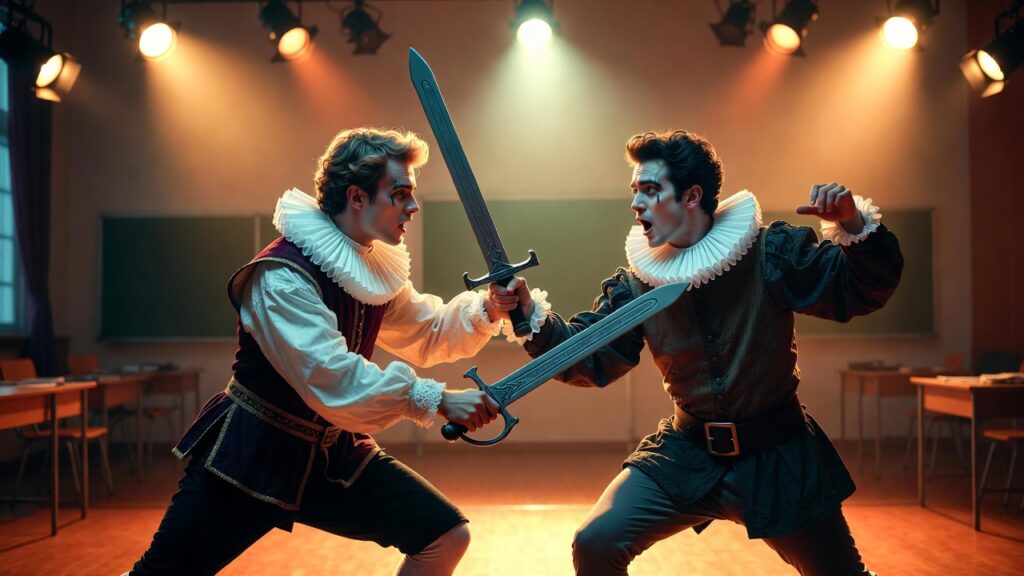
Imagine the heat of a Verona street on a sweltering afternoon: insults fly like sparks, swords flash, and what begins as a petty quarrel erupts into tragedy. This is the electrifying world of William Shakespeare’s fight scenes—moments of raw energy that have captivated audiences for over 400 years. For teachers, drama directors, and students searching for fight in a school scripts, Shakespeare’s plays deliver some of the most compelling, poetically charged conflict sequences in all of literature. These scenes are not mere violence; they are carefully crafted dramatic explosions that reveal character, advance plot, and explore timeless themes like honor, revenge, and the devastating cost of unchecked anger.
In school settings, staging these fights offers a powerful way to bring Shakespeare’s text to life. Reluctant readers suddenly lean forward during a duel; classroom discussions deepen when students experience the physicality behind the poetry. Yet educators face real challenges: how to make these scenes exciting and educational while ensuring safety, appropriateness, and alignment with curriculum goals. This comprehensive guide draws on Shakespearean scholarship, stage combat expertise from organizations like the Royal Shakespeare Company (RSC) and the Society of American Fight Directors (SAFD), and practical insights from school productions to provide everything you need. Whether you’re planning a full production, a classroom reading, or an analytical essay, you’ll find ready-to-use excerpts, staging tips, thematic breakdowns, and resources to create meaningful, memorable experiences.
Shakespeare’s fight scenes stand out because they blend high-stakes action with profound language. The duels and brawls are never gratuitous—they drive the narrative and illuminate human nature. In today’s educational landscape, where engaging students with classic literature can be difficult, these moments offer a bridge: the thrill of conflict paired with opportunities to discuss conflict resolution, toxic masculinity, and the consequences of feuds—lessons as relevant now as in Elizabethan England.
Why Shakespeare’s Fight Scenes Are Perfect for School Settings
Shakespeare’s plays feature violence that is stylized, poetic, and purposeful, making them far more suitable for young performers than many modern scripts with graphic depictions. The fights serve the story, not shock value, allowing educators to focus on literary depth while incorporating movement and drama.
Balancing Excitement and Educational Value
Action-packed sequences instantly hook students who might otherwise find dense Elizabethan language intimidating. A well-choreographed brawl turns passive reading into active participation, boosting comprehension and retention. Themes of honor, loyalty, and the cycle of violence tie directly into English literature standards, while also opening doors to discussions on social issues like bullying or gang conflicts. Students learn empathy by embodying characters whose rash decisions lead to irreversible harm.
Moreover, performing these scenes develops essential skills: public speaking through heightened dialogue, physical coordination via stage combat, and critical thinking through analysis of how violence reflects character flaws.
Safety and Appropriateness in Modern Schools
Unlike contemporary media that often glorifies graphic violence, Shakespeare’s fights are theatrical illusions—described in verse rather than shown in gory detail. This allows adaptation to suit age groups and school policies. Focus on choreography rather than realism: use foam swords, controlled movements, and emphasis on the emotional buildup.
Importantly, these scenes provide teachable moments about real-world violence. Frame discussions around how feuds escalate and why de-escalation matters—aligning with anti-bullying programs. Always prioritize consent, clear boundaries, and supervision to create a safe space.
Historical Context – Elizabethan Street Fights and Duels
Shakespeare wrote during a time when street violence was alarmingly common in London. Tudor proclamations repeatedly banned carrying weapons and public fighting, yet duels and gang-like brawls persisted, often tied to honor codes among young men. The rapier, a fashionable status symbol, appeared in elite circles, while everyday quarrels involved knives, sticks, or fists.
Plays like Romeo and Juliet mirrored these realities: the Capulets and Montagues’ feud echoes real family or gang rivalries, and the street brawl in Act 1, Scene 1 reflects the volatile atmosphere audiences knew well. Understanding this context enriches performances—students grasp why characters react so intensely and how Shakespeare critiques the destructive nature of such codes.
Top Shakespeare Fight Scenes Ideal for Student Performances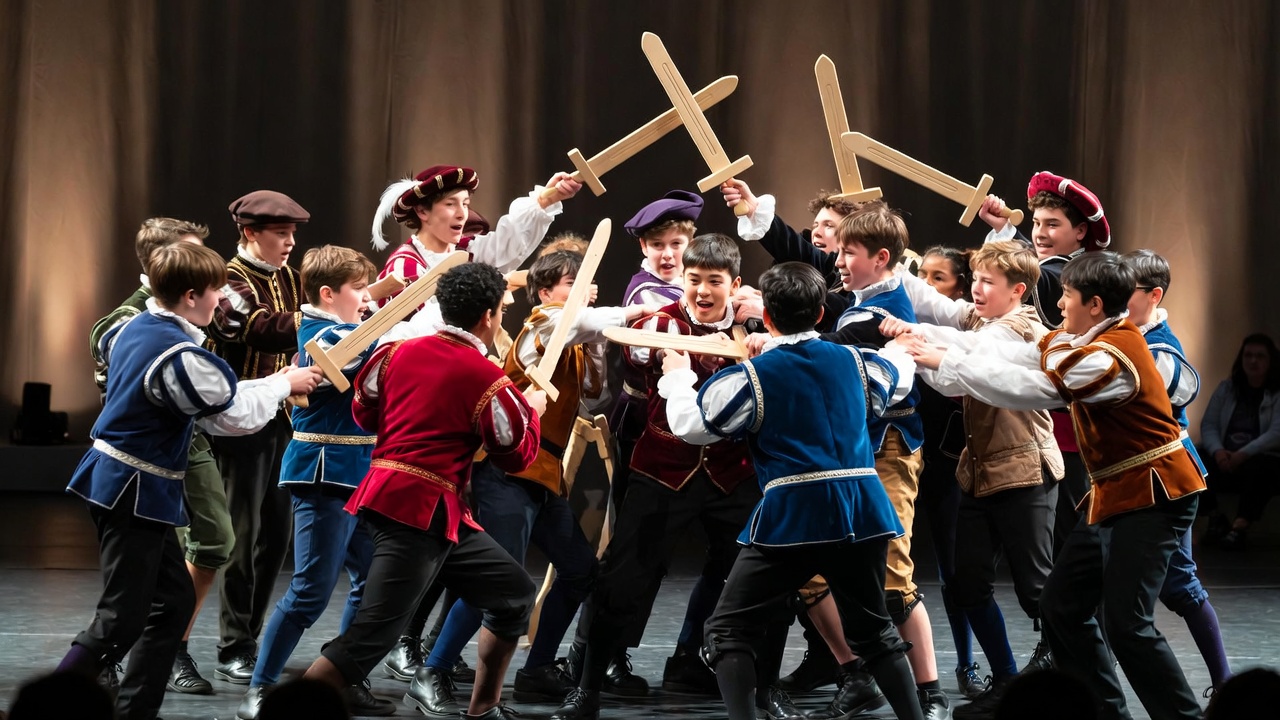
Shakespeare offers a range of fight scenes varying in complexity, cast size, and tone. Here are the most school-friendly, with reasons for their suitability.
Romeo and Juliet – The Quintessential School Fight Script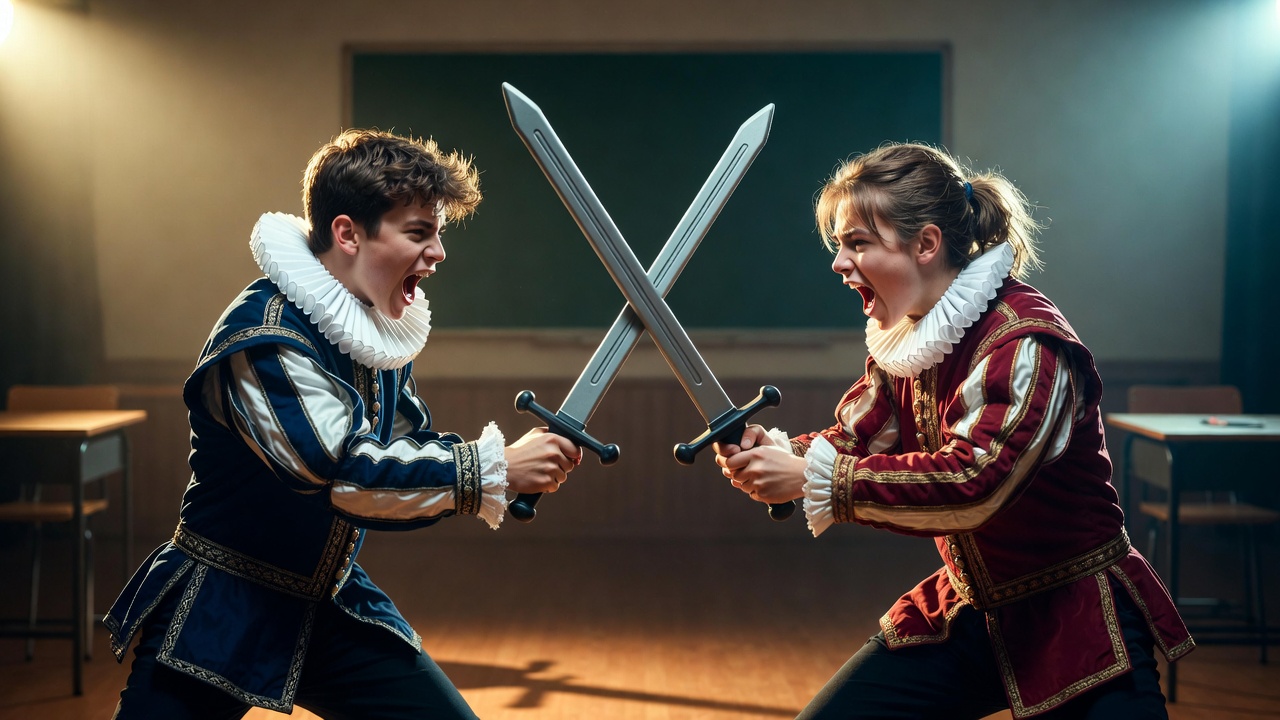
No play better captures youthful impulsivity and tragic consequences than Romeo and Juliet. Its fights are dynamic, emotionally charged, and frequently performed in schools.
- Act 1, Scene 1: The Servants’ Brawl A group melee that introduces the feud. Ideal for large casts (Montague and Capulet servants clash with words and swords). Easy to stage with minimal props; focuses on escalating tension through insults. Key excerpt (modern paraphrase for clarity): Sampson: “I bite my thumb at you, sir!” (an Elizabethan insult equivalent to a provocative gesture). This scene teaches ensemble work and the absurdity of inherited hatred.
- Act 3, Scene 1: Mercutio vs. Tybalt / Romeo vs. Tybalt The play’s turning point—often called the most explosive duel sequence. Mercutio’s witty banter turns deadly; Romeo’s intervention leads to tragedy. High drama with clear stakes. Excerpt (original lines): Mercutio: “Ask for me tomorrow, and you shall find me a grave man.” (His dying pun underscores the scene’s irony.) Why school-friendly: It highlights impulsivity’s cost, perfect for discussions on peer pressure and revenge.
Hamlet – The Climactic Duel
Act 5, Scene 2 features a formal fencing match between Hamlet and Laertes, rigged with poison. Intellectual and physical tension build to multiple deaths. Staging tips: Emphasize rules of the bout, betrayal, and tragic inevitability. Suitable for advanced high school groups due to emotional depth.
Other Strong Options for Schools
- Macbeth: Final duel (Macbeth vs. Macduff, Act 5) explores ambition’s downfall. Intense but contained.
- Henry IV, Part 1: Prince Hal vs. Hotspur—coming-of-age honor clash.
- A Midsummer Night’s Dream: Comic scuffles (Lysander/Demetrius, Helena/Hermia) with no weapons—great for middle school.
- Julius Caesar: Mob violence and assassination—group dynamics and rhetoric.
Comparison Table (for quick reference):
| Scene | Cast Size | Difficulty | Key Themes | Age Suitability |
|---|---|---|---|---|
| R&J Act 1, Sc 1 | Large | Low | Feud, group conflict | Middle/High |
| R&J Act 3, Sc 1 | Small-Med | Medium | Revenge, impulsivity | High |
| Hamlet Act 5, Sc 2 | Small | High | Betrayal, fate | Advanced High |
| Midsummer Comic Fights | Med | Low | Jealousy, comedy | Middle |
| Macbeth Final Duel | Small | Medium | Ambition, tyranny | High |
How to Stage Shakespeare Fight Scenes Safely in School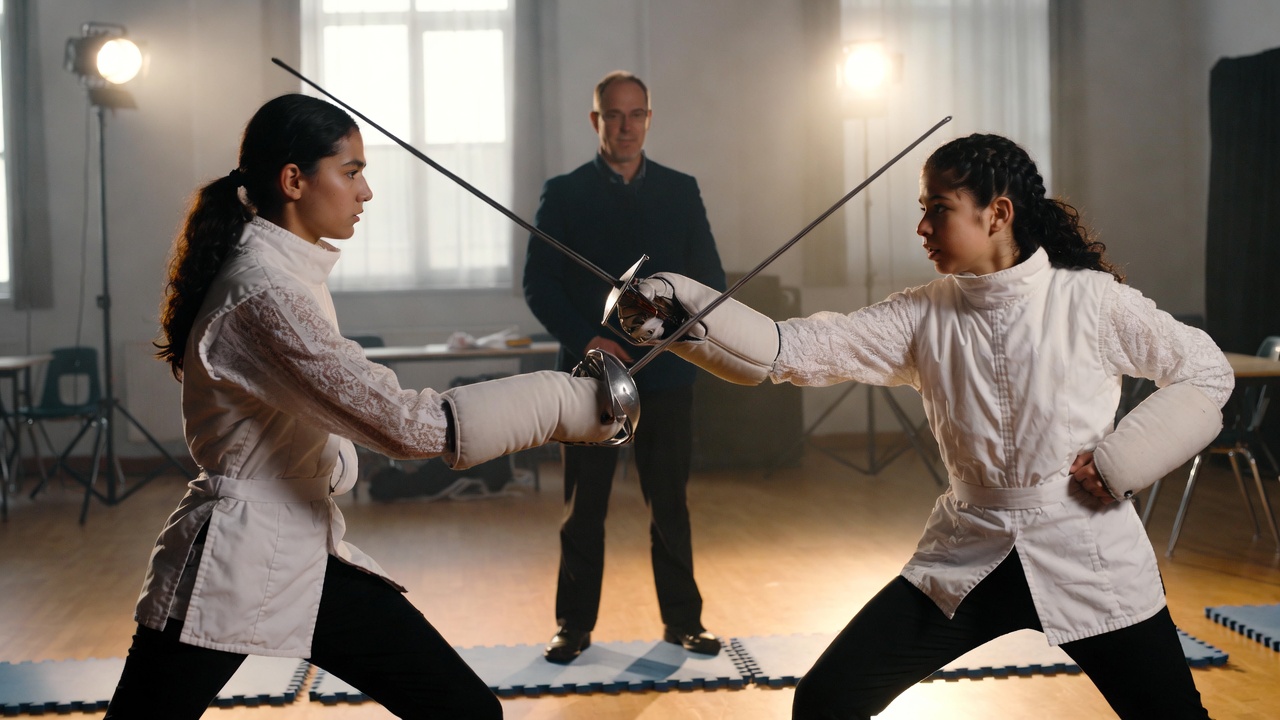
Bringing Shakespeare’s fight scenes to the stage requires careful planning to prioritize safety, clarity, and dramatic impact. The goal is always illusion: the audience must believe in the danger without any real risk to performers. Professional stage combat training emphasizes technique over force, and schools can achieve excellent results with basic principles and minimal resources.
Basics of Stage Combat for Beginners
Stage combat is a disciplined performance skill that creates the appearance of violence through controlled, rehearsed movements. Key principles include:
- Safety Distance — Maintain at least an arm’s length plus weapon length between actors at all times.
- Sell the Reaction — The person “receiving” the blow reacts more dramatically than the one delivering it.
- Slow-to-Fast Rehearsal — Begin every sequence in slow motion, gradually increasing speed only when movements are perfect.
- Clear Communication — Use verbal cues (“and… strike!”) and eye contact to coordinate timing.
- No Contact — Most school productions avoid any actual contact with weapons or bodies.
Recommended starting resources:
- The Society of American Fight Directors (SAFD) offers free introductory videos and safety guidelines online.
- The Royal Shakespeare Company’s “Fighting Shakespeare” series provides excellent examples of stylized combat.
- Books such as Stage Combat: Fights, Weapons, and Choreography by William Hobbs remain foundational.
Always designate a fight captain (teacher, older student, or trained volunteer) responsible for monitoring safety throughout rehearsals and performances.
Choreographing Key Scenes Step-by-Step
Let’s use the most iconic school-friendly fight: Romeo and Juliet Act 3, Scene 1 (Mercutio vs. Tybalt, then Romeo vs. Tybalt).
- Preparation (1–2 rehearsals)
- Assign roles and discuss character motivations.
- Watch professional versions (RSC 2018 production or Zeffirelli 1968 film clip—available on educational platforms).
- Mark “safe zones” on the floor where actors may stand during the fight.
- Insult Exchange & Build-Up
- Focus first on the verbal sparring. Mercutio’s witty taunts (“Good king of cats!”) should escalate tension.
- Actors practice exaggerated gestures (finger pointing, stepping forward aggressively) without weapons.
- Weapon Introduction
- Use lightweight foam or wooden training rapiers (widely available from theater supply companies for $15–30 each).
- Teach three basic moves: parry (block), thrust (stab motion), and slash (side cut).
- Choreograph in phrases: e.g., Tybalt thrusts → Mercutio parries → Mercutio counters with a slash.
- The Fatal Blow
- Mercutio is “stabbed under Romeo’s arm” — stage this with Romeo stepping between the fighters at the exact moment.
- Use a slow-motion “pass” where Tybalt’s blade clearly passes behind Romeo and “touches” Mercutio’s side (no contact).
- Mercutio reacts dramatically, clutching his side and delivering his famous line: “A plague o’ both your houses!”
- Romeo vs. Tybalt
- Romeo, fueled by grief, fights with fury. Choreograph a short, intense exchange ending in Tybalt’s death.
- Final “killing” blow: Romeo thrusts, Tybalt reacts by staggering backward and falling.
- Polish & Safety Check
- Run the sequence at performance speed only after 5–10 slow-motion repetitions.
- Video record rehearsals to spot unsafe moments.
- Build in “safety words” (e.g., “hold!”) if anyone feels uncomfortable.
This entire sequence can be staged effectively in 4–6 rehearsals for high school students with no prior experience.
Adapting for Different Age Groups and Cast Sizes
- Middle School (11–14 years) Focus on verbal sparring and comic/physical comedy fights (A Midsummer Night’s Dream lovers’ quarrel or Romeo and Juliet Act 1, Scene 1). Avoid edged weapons; use exaggerated slaps, pushes, and falls on mats. Emphasize humor and absurdity of conflict.
- High School (15–18 years) Full duels are appropriate with proper training. Romeo and Juliet Act 3, Scene 1 or Hamlet’s final bout work beautifully. Allow more emotional depth and faster pacing.
- Small Casts Reduce group scenes to key characters or use narration to describe off-stage action. Focus on one-on-one duels.
- Large Casts Street brawls shine here—divide students into Montague and Capulet sides for maximum energy and inclusion.
Literary Analysis – What These Fights Really Mean
Shakespeare’s fight scenes are never just action; they are windows into character psychology, societal values, and philosophical questions.
Themes of Honor, Revenge, and Consequences
In Romeo and Juliet, the duels expose the destructive power of inherited hatred and personal pride. Tybalt fights to defend family honor; Mercutio dies defending his friend’s reputation; Romeo kills in revenge, sealing the tragedy. Students quickly see parallels to modern cycles of retaliation—whether in schoolyard disputes or larger conflicts.
In Hamlet, the final duel is a microcosm of the entire play: a formal contest corrupted by deceit, mirroring the poisoned relationships throughout Denmark.
Language and Insults as Weapons
Elizabethan audiences delighted in verbal fencing as much as physical. Insults are carefully crafted:
- “Boy” (Tybalt to Romeo) is a grave insult implying cowardice and inferiority.
- Mercutio’s puns (“grave man,” “plague o’ both your houses”) turn death into dark comedy.
- Fencing terminology (“passado,” “point,” “stock”) peppers the dialogue, showing characters’ expertise and bravado.
Analyzing these exchanges reveals how words can wound as deeply as swords—especially relevant in discussions of cyberbullying or verbal aggression today.
Connections to Modern Issues
- Feuds → gang violence, family conflicts, online tribalism
- Duels → toxic masculinity, pressure to “prove” oneself
- Consequences → restorative justice, de-escalation training
These connections make Shakespeare feel urgent and relatable, helping students see classics as living texts.
Practical Tips and Ready-to-Use Resources for Teachers and Directors
- Quick-Start Lesson Plan
- Pre-reading: Discuss Elizabethan honor codes (10 min).
- Read scene aloud, assigning parts (20 min).
- Watch professional clip (10 min).
- Choreograph basic sequence in small groups (30–40 min).
- Perform and debrief: What choices led to tragedy? (15 min).
- Safe, Low-Cost Props Foam swords (Amazon/Theater Supply), wooden dowels wrapped in tape, or even rolled-up newspapers for early rehearsals.
- Recommended Viewing
- RSC’s Romeo and Juliet (2018) fight scenes on YouTube (educational clips).
- Folger Shakespeare Library’s “Stage It!” series.
- BBC Shakespeare Retold adaptations for modern context.
- Expert Insight Fight director and RSC veteran Bret Yount notes: “The best stage fights are 90% reaction and 10% action. Let the audience see the fear, anger, and regret in the performers’ eyes—that’s where the real drama lives.”
Common Challenges and Solutions
Even with the best intentions, staging Shakespeare’s fight scenes in a school environment can present hurdles. Here are the most common issues educators and directors encounter, along with practical, field-tested solutions.
- Challenge: Student discomfort with physical contact or simulated violenceSolution: Offer opt-out options without penalty—some students can narrate, direct, or handle sound/lighting instead. Frame the violence as historical/artistic rather than realistic. Start with non-contact versions (e.g., exaggerated gestures and sound effects only) and gradually introduce props as comfort grows. Many students who are initially hesitant become enthusiastic once they understand the choreography is controlled and safe.
- Challenge: Limited budget, time, or access to props/trainingSolution: Embrace minimalism—Shakespeare’s original stage had almost no scenery or special effects. Use imagination: wooden dowels or pool noodles wrapped in aluminum foil become convincing rapiers. Rehearse in short, focused blocks (20–30 minutes per session) rather than long marathons. Leverage free online resources: YouTube channels from theater education programs, Folger Library digital texts, and RSC learning zone videos provide excellent models.
- Challenge: Gender balance or non-traditional castingSolution: Shakespeare’s theater was all-male, so cross-gender casting is historically authentic and dramatically effective. A female Tybalt can be just as menacing; a male Juliet can bring fresh nuance. Focus on character intention rather than gender stereotypes. Many successful school productions have featured gender-swapped duels without losing impact.
- Challenge: Parents or administrators concerned about “promoting violence”Solution: Communicate clearly in advance. Provide a rationale document explaining educational goals: exploring consequences of conflict, practicing de-escalation through analysis, and developing empathy. Invite stakeholders to rehearsals. Highlight how the scenes culminate in tragedy—reinforcing that violence solves nothing.
- Challenge: Uneven skill levels among studentsSolution: Pair stronger performers with beginners during choreography. Use “buddy systems” so experienced students model technique. Break sequences into small, repeatable units. Celebrate progress over perfection—Shakespeare rewards effort and interpretation more than technical polish.
Shakespeare’s fight scenes—those explosive moments of steel, fury, and poetry—offer far more than spectacle. When thoughtfully staged in schools, they transform passive readers into active interpreters, reluctant participants into confident performers, and abstract themes into visceral experiences.
A classroom that watches Mercutio fall, hears Romeo’s anguished cry, and feels the weight of consequences is a classroom where literature lives. These duels and brawls teach young people that words can wound, anger can blind, and choices matter—lessons that extend far beyond the stage.
Whether you’re directing a full production, choreographing a single scene for English class, or simply analyzing the text with movement in mind, the tools and insights in this guide will help you create safe, engaging, and profoundly meaningful work. The next time a student asks why Romeo draws his sword or why Hamlet accepts the poisoned rapier, hand them a foam blade and let them discover the answer in action.
Now it’s your turn: choose a scene, gather your cast, and bring Shakespeare’s dynamic conflicts to life. Your students—and perhaps even you—may never look at these plays the same way again.
If you’ve staged one of these fights or adapted them in a unique way, share your experience in the comments below. We’d love to hear how “fight in a school scripts” came alive in your classroom or auditorium.
FAQs
Q: Is Romeo and Juliet too violent for middle school students? A: The full play contains mature themes, but individual fight scenes (especially Act 1, Scene 1) can be adapted for younger audiences by focusing on verbal sparring, comic timing, and minimal physicality. Always preview content and align with school guidelines.
Q: How do I choreograph a duel if I have no stage combat experience? A: Start with free online tutorials from reputable sources (RSC, SAFD basics). Keep movements simple, slow, and exaggerated. Prioritize safety and reaction over speed. Many successful school productions are created by teachers learning alongside students.
Q: What props are safest for school performances? A: Foam swords or dulled training rapiers are ideal. Avoid anything metal or sharp. For very young groups, use soft pool noodles or even imaginary weapons with strong sound effects.
Q: Can these scenes be used for non-performance classroom activities? A: Absolutely. Have students choreograph and film short sequences on phones to demonstrate understanding of character motivation. Or stage a “tableau” freeze-frame of key moments to analyze tension and body language.
Q: Are there modern adaptations that keep the fight scenes but update the language? A: Yes—West Side Story (musical and film) is the most famous, preserving the essence of Romeo and Juliet’s conflicts. For classroom use, look at “No Fear Shakespeare” editions or BBC’s Shakespeare Retold series for accessible versions.