Imagine two teenagers, deeply in love, navigating the awkward, exhilarating world of young romance—just like Shakespeare’s star-crossed lovers, Romeo and Juliet, whose passion defied rigid societal boundaries. In the modern United States, similar young couples sometimes face a harsh reality: criminal charges for consensual acts simply because one partner is below the state’s age of consent. This is where Romeo and Juliet laws—also known as close-in-age exemptions—come into play. These provisions aim to protect teens in peer relationships from overly punitive statutory rape laws, preventing lifelong consequences like sex offender registration for what is often innocent, mutual exploration.
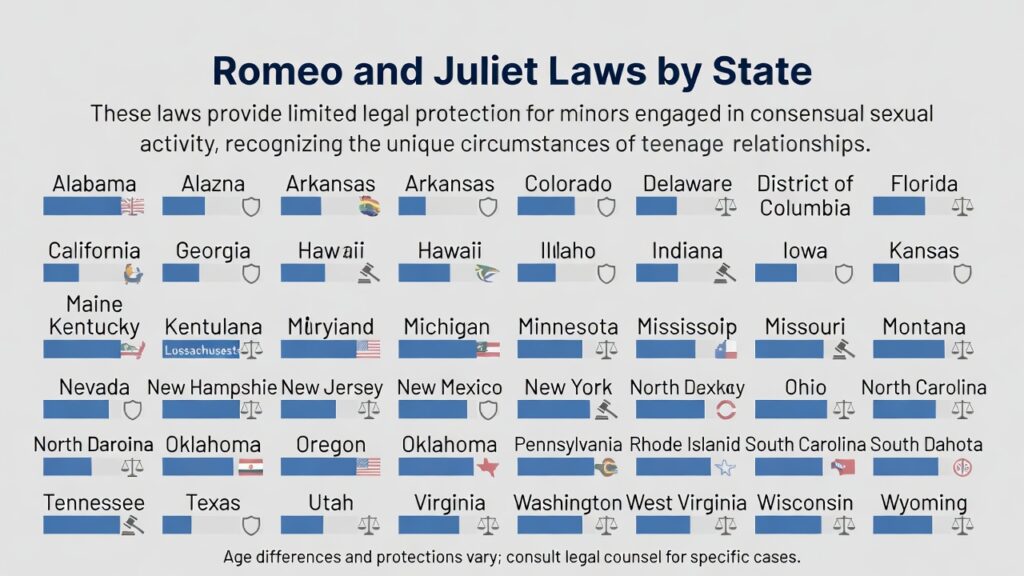
What states have Romeo and Juliet laws? The answer varies significantly across the country, as there is no federal Romeo and Juliet law—regulation falls entirely to individual states. As of 2026, roughly 30 or more states offer some form of close-in-age exception, defense, or penalty reduction, while others enforce strict liability with little to no relief for small age gaps. These laws reflect a balance between protecting minors from exploitation and recognizing that not every close-in-age consensual encounter deserves felony-level punishment.
This comprehensive guide provides an up-to-date overview of U.S. age of consent laws, details on Romeo and Juliet protections (including allowed age differences and restrictions), and practical insights for parents, educators, teens, or anyone researching this sensitive topic. Note: This article is for informational purposes only and is not legal advice. Laws can change, interpretations vary by case, and you should always consult a qualified attorney or official state resources for specific situations.
What Are Romeo and Juliet Laws? Understanding the Basics
The term “Romeo and Juliet laws” draws directly from Shakespeare’s tragedy of youthful, forbidden love. Legally, these are close-in-age exemptions or affirmative defenses built into statutory rape or unlawful sexual conduct statutes. Their primary goal is to avoid criminalizing consensual sexual activity between minors or near-minors who are similar in age and maturity.
Without such protections, a 17-year-old could face felony charges, imprisonment, fines, and mandatory sex offender registration for a relationship with a 15- or 16-year-old partner—even if fully consensual and non-exploitative. Romeo and Juliet provisions typically:
- Provide a full exemption (activity is legal if criteria met).
- Offer an affirmative defense (charges can be defeated in court).
- Reduce penalties (e.g., misdemeanor instead of felony, no registration requirement).
Key common elements include:
- A limited age gap (usually 2–5 years, sometimes tiered by age).
- Consensual activity only—no coercion, authority positions (e.g., teacher-student), or abuse.
- Minimum ages for the younger partner (often 13–16).
- Applicability to both heterosexual and same-sex relationships (post-Lawrence v. Texas in 2003).
Misconceptions abound: These are not blanket “free passes.” Larger gaps, positions of trust, or non-consensual elements disqualify protections. Some states apply them narrowly, while others are more lenient.
Age of Consent Across the U.S.: The Foundation
The age of consent—the minimum age at which a person can legally consent to sexual activity—ranges from 16 to 18 across states. Below this age, consent is generally irrelevant under statutory rape laws (strict liability in many jurisdictions).
Here’s a quick reference table of ages of consent as of 2026 (based on current statutes; always verify with official sources):
- Age 16 (most common, ~30+ states): Alabama, Alaska, Arkansas, Connecticut, District of Columbia, Georgia, Hawaii, Indiana, Iowa, Kansas, Kentucky, Maine, Maryland, Massachusetts, Michigan, Minnesota, Mississippi, Montana, Nebraska, Nevada, New Hampshire, New Jersey, New Mexico, North Carolina, Ohio, Oklahoma, Pennsylvania, Rhode Island, South Carolina, South Dakota, Vermont, Washington, West Virginia.
- Age 17 (~8 states): Colorado, Illinois, Louisiana, Missouri, New York, Texas, Wyoming.
- Age 18 (~12 states): Arizona, California, Delaware, Florida, Idaho, North Dakota, Oregon, Tennessee, Utah, Virginia, Wisconsin.
Federal law plays a limited role (e.g., prohibiting transport across state lines for sexual purposes under the Mann Act if involving minors), but primary enforcement is state-level.
States with Romeo and Juliet Laws: Detailed State-by-State Breakdown
Approximately 30+ states incorporate some close-in-age protection, though forms differ: full decriminalization, defenses, or mitigated penalties. Allowed gaps typically range from 2–5 years, with tiered rules in some cases (e.g., smaller gaps for younger teens).
Below is a summarized state-by-state overview (grouped by age of consent for clarity). Details draw from statutes, legal analyses, and reliable sources like Wikipedia summaries and state codes.
States with Age of Consent 16 (Many with Strong Exemptions)
- Alabama: 2-year gap exemption.
- Alaska: 3-year gap.
- Arkansas: Limited close-in-age provisions.
- Connecticut: 2-year gap for certain acts.
- Georgia: 4-year gap (robust protection).
- Hawaii: Close-in-age considerations.
- Indiana: Dating relationship + 4-year or less gap.
- Iowa: Limited exemptions.
- Kansas: Close-in-age defenses in some cases.
- Maine: Provisions for small gaps.
- Maryland: Close-in-age relief.
- Massachusetts: Limited.
- Michigan: Affirmative defense for small gaps.
- Minnesota: Tiered exemptions.
- Mississippi: Some protections.
- Montana: Close-in-age.
- Nevada: Limited.
- New Hampshire: Misdemeanor only if under 4 years for penetration (13–15).
- New Jersey: Close-in-age.
- New Mexico: Provisions.
- North Carolina: Limited.
- Ohio: Partners under 18 if both 13+.
- Pennsylvania: Close-in-age for 16+.
- Rhode Island: 16–17 with 14–15.
- South Carolina: Some exemptions.
- Vermont: Close-in-age.
- Washington: Tiered (e.g., 4 years for 14–15).
- West Virginia: Provisions.
States with Age of Consent 17 (Often Robust Protections)
- Colorado: Up to 10 years for 15–16, 4 years for under 15 (very lenient in tiers).
- Illinois: No full exemption, but some reductions.
- Texas: Strong 3-year defense (younger at least 14/15; no registration if qualifies).
- New York: No specific Romeo and Juliet law; some reduced penalties for small gaps on certain charges.
States with Age of Consent 18 (Mixed or Limited)
- Florida: Unique—16–17 can consent with partners up to 23; registration relief possible.
- Oregon: 3-year exemption in some cases.
- Others (e.g., California, Arizona): Often no formal law, but prosecutorial discretion or misdemeanor treatment for small gaps.
For a visual quick-reference, many sources recommend consulting interactive maps or official state legislature sites for the latest.
States Without Romeo and Juliet Laws or With Strict Rules
About 20 states lack formal close-in-age exemptions or apply strict liability:
- California: No formal Romeo and Juliet law; small-g
- Delaware: 4-year gap in some, but strict overall.
- ap cases may be misdemeanors but still prosecutable.
- Arizona: Limited or none in many contexts.
- Idaho, Utah, Virginia, Wisconsin, and others: Often no broad exemption; reliance on discretion.
In these states, even a 1–2 year gap can lead to charges, though prosecutors may decline or reduce in practice. Risks include felony records and registration.
Key Factors That Influence Romeo and Juliet Protections
- Age Gaps and Tiers: Common 2–4 years; some tiered (e.g., smaller for younger teens).
- Minimum Ages: Often 13–16 for younger partner.
- Restrictions: No authority figures, no force/coercion, no prior offenses.
- Consequences Avoided: Prevents felony downgrades, avoids registration.
- Real-World Example: A 18-year-old and 16-year-old in Texas (3-year gap) may qualify for defense if consensual.
Important Considerations and Risks
Laws evolve—2026 updates may include tweaks for equity or protection. Federal overlaps (e.g., child pornography laws) can apply. Always prioritize education, open communication, and legal consultation if facing issues.
Frequently Asked Questions (FAQs)
Do all states have Romeo and Juliet laws? No—about 30+ do in some form; others lack or limit them.
What is the most common age gap allowed? 2–4 years, varying by state and age.
Does California have Romeo and Juliet laws? No formal one; small gaps may reduce charges.
Can both partners be charged if both are minors? Rarely—focus on older partner; mutual consent often protects.
How do these laws affect sex offender registration? Qualifying cases often avoid it (e.g., Texas, Florida relief).
Are there Romeo and Juliet laws for same-sex relationships? Yes, generally applicable post-2003 rulings.
Is there a federal Romeo and Juliet law? No—state-only.
What if the relationship crosses state lines? Federal laws may apply; consult experts.
Can laws change in 2026 or later? Yes—monitor state legislatures.
Should I seek legal help for a specific case? Always—professional advice is essential.
Romeo and Juliet laws represent a compassionate evolution in U.S. jurisprudence, echoing Shakespeare’s plea against punishing youthful passion with tragedy. They safeguard consensual teen relationships while targeting true exploitation. By understanding your state’s rules—age of consent, close-in-age exemptions, and restrictions—you can better navigate this complex landscape.