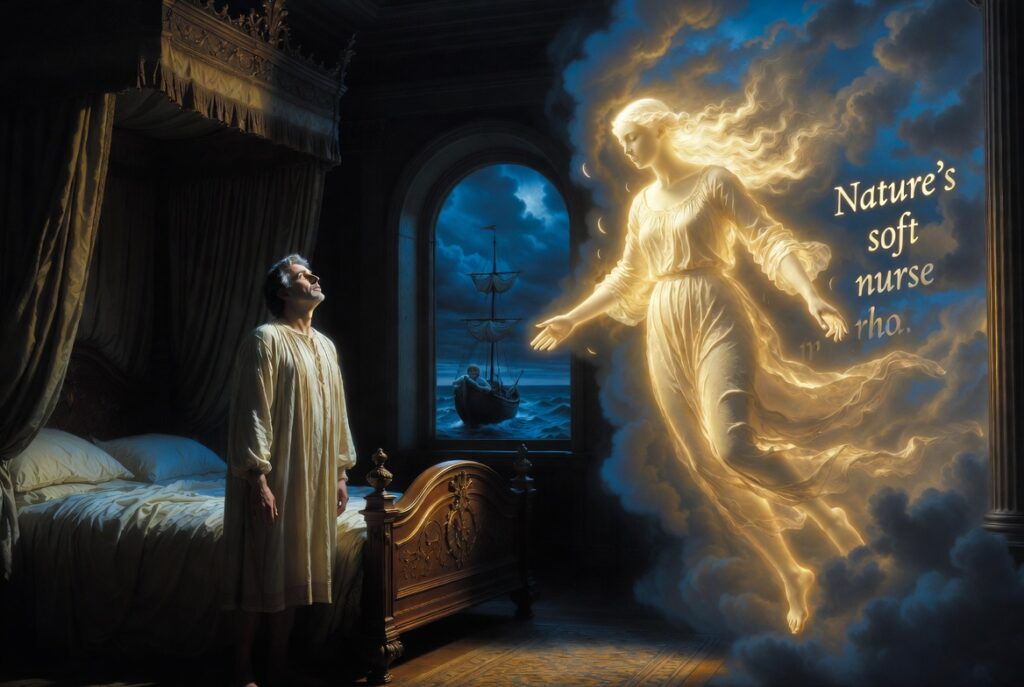
Imagine a battle-scarred king, alone in the dead of night, his crown heavy and his mind tormented by the weight of a kingdom on the brink of civil war. He turns not to his advisors or his physicians, but to sleep itself—pleading with it as if it were a compassionate caregiver who has suddenly abandoned him. In that raw, midnight moment from Henry IV, Part 2, William Shakespeare gifts the world one of literature’s most profound “nurse poem” passages: the soliloquy that personifies sleep as “Nature’s soft nurse.”
This nurse poem has comforted millions for over four centuries, offering solace to anyone who has ever wrestled with sleepless nights, caregiving exhaustion, or the quiet ache of leadership burnout. Whether you are a nurse seeking literary inspiration for your own healing journey, a literature student dissecting Shakespeare’s genius, a caregiver craving restorative wisdom, or simply a reader drawn to themes of compassion and rest, this guide delivers far more than a famous quote. It provides the complete historical context, line-by-line literary mastery, modern scientific parallels, and practical takeaways that transform Shakespeare’s words into actionable healing tools—insights you won’t find in superficial quote collections or basic analyses.
At williamshakespeareinsights, we specialize in unlocking the Bard’s enduring relevance to the human condition. Drawing from primary sources such as the Folger Shakespeare Library editions and cross-referenced with contemporary sleep science, this skyscraper exploration reveals why this nurse poem remains a beacon for healing and rest in our restless world. Let’s step into the shadowed chambers of Westminster Palace and discover the timeless medicine within Shakespeare’s verse.
The Origin of Shakespeare’s “Nurse Poem” – Context in Henry IV, Part 2
To fully appreciate this nurse poem, we must first understand its dramatic birthplace. Henry IV, Part 2 (written around 1597–1599) is the second installment in Shakespeare’s tetralogy chronicling the turbulent transition from the reign of Henry IV to that of his son, the future Henry V. By Act 3, Scene 1, the aging king—plagued by rebellion, illness, and guilt over his usurpation of the throne—paces his palace in a nightgown, unable to find rest.
Historical and Dramatic Setting (1597–1599) Shakespeare composed the play during the final years of Queen Elizabeth I’s reign, a time of political anxiety, plague outbreaks, and questions of royal succession. Audiences in the late 1590s would have recognized the king’s insomnia as a mirror to real Elizabethan concerns: the burdens of power, the fragility of health, and the elusive nature of peace. The scene unfolds in Westminster Palace, far from the battlefield yet echoing its chaos. King Henry IV has just received troubling dispatches about rebel forces. Exhausted and isolated, he dismisses his page and launches into the soliloquy that elevates a simple plea for sleep into one of literature’s greatest nurse poems.
King Henry IV’s Insomnia: A Ruler’s Burden and the Irony of Power The irony is piercing. Henry IV, who seized the crown through political maneuvering and civil strife, now finds that very crown denies him the most basic human comfort. His subjects—the “poorest” among them—sleep soundly, while the monarch lies awake. This nurse poem captures the universal truth that status offers no protection from suffering; in fact, it often intensifies it. Shakespeare, ever the keen observer of human psychology, uses the king’s insomnia to critique the corrosive effects of unchecked ambition and responsibility—themes that resonate powerfully with today’s leaders, healthcare professionals, and caregivers facing burnout.
Why This Soliloquy Feels Like a Poem (Blank Verse Mastery) Though embedded in a history play, the passage reads as pure poetry. Written in blank verse (unrhymed iambic pentameter), it mimics the natural rhythms of a troubled mind—rising and falling like the restless waves it describes. The 30-line excerpt stands alone as a self-contained masterpiece, which is why it is frequently anthologized and taught as Shakespeare’s definitive nurse poem. Here is the full text, faithfully reproduced from the authoritative Open Source Shakespeare and Folger editions for your reference:
How many thousand of my poorest subjects Are at this hour asleep! O sleep, O gentle sleep, Nature’s soft nurse, how have I frighted thee, That thou no more wilt weigh my eyelids down And steep my senses in forgetfulness? Why rather, sleep, liest thou in smoky cribs, Upon uneasy pallets stretching thee And hush’d with buzzing night-flies to thy slumber, Than in the perfum’d chambers of the great, Under the canopies of costly state, And lull’d with sound of sweetest melody? O thou dull god, why liest thou with the vile In loathsome beds, and leav’st the kingly couch A watch-case or a common ’larum-bell? Wilt thou upon the high and giddy mast Seal up the ship-boy’s eyes, and rock his brains In cradle of the rude imperious surge And in the visitation of the winds, Who take the ruffian billows by the top, Curling their monstrous heads and hanging them With deafing clamour in the slippery clouds, That with the hurly death itself awakes? Canst thou, O partial sleep, give thy repose To the wet sea-boy in an hour so rude, And in the calmest and most stillest night, With all appliances and means to boot, Deny it to a king? Then, happy low, lie down! Uneasy lies the head that wears a crown.
This excerpt alone rewards slow, aloud reading—its musicality and emotional depth make it a nurse poem that heals through language itself.
Full Text and Line-by-Line Literary Analysis of “Nature’s Soft Nurse”
Shakespeare’s nurse poem rewards meticulous attention. Below is a structured, line-by-line breakdown that reveals layers of meaning no surface-level summary can capture.
Lines 1–6: The Plea – Sleep as Gentle Nurse and the Shock of Rejection The king begins by contrasting his wakeful torment with the peaceful slumber of “a thousand of my poorest subjects.” He addresses sleep directly with tender apostrophe: “O sleep, O gentle sleep, / Nature’s soft nurse.” The phrase “Nature’s soft nurse” is the emotional heart of the poem—personifying sleep as a maternal figure who “weigh[s] my eyelids down” and “steep[s] my senses in forgetfulness.” The verb “frighted” reveals the king’s self-awareness: he believes his own guilty conscience has scared sleep away. This opening establishes the nurse poem’s core metaphor: rest as compassionate care, withheld from those who need it most.
Lines 7–14: Social Inversion – Why Sleep Favors the Poor Over Kings Here Shakespeare flips social hierarchy. Sleep prefers “smoky cribs” and “uneasy pallets” over “perfum’d chambers” and “canopies of costly state.” The sensory contrast is vivid: buzzing night-flies versus “sweetest melody,” humble discomfort versus luxurious excess. This inversion critiques Elizabethan class structures while delivering a timeless insight—true rest is democratic, granted not by wealth or power but by inner peace. For modern nurses and caregivers, these lines validate the exhaustion of high-responsibility roles: the more you give, the harder rest becomes.
Lines 15–26: The Sea-Boy Contrast – Nature’s Cradle vs. Royal Watchfulness The imagery intensifies with a breathtaking nautical metaphor. Sleep rocks the “wet sea-boy” on a “high and giddy mast,” cradling him amid “ruffian billows” and “deafing clamour” that would wake death itself. Yet the same sleep denies the king “in the calmest and most stillest night.” The rhetorical question—“Canst thou, O partial sleep”—charges the nurse poem with dramatic irony. Nature’s soft nurse is impartial in her mercy, yet the king feels singled out. This section showcases Shakespeare’s mastery of vivid, multisensory imagery that makes the abstract agony of insomnia palpably real.
Lines 27–30: The Famous Closing Couplet – “Uneasy lies the head that wears a crown” The soliloquy culminates in one of Shakespeare’s most quoted lines: “Uneasy lies the head that wears a crown.” The concise, proverbial wisdom distills the entire nurse poem into a universal truth about power’s hidden cost. The preceding “Then, happy low, lie down!” offers bittersweet envy for the humble who can rest freely. This closing couplet (technically a rhymed pair within blank verse) provides memorable closure while inviting readers to reflect on their own “crowns”—whether professional duties, family responsibilities, or personal burdens.
Core Themes – Sleep as Healer and the Nurse Metaphor in Shakespeare’s World
Shakespeare’s nurse poem transcends mere dramatic device; it distills profound philosophical and physiological truths about healing, rest, and compassionate care. At its center stands the metaphor of sleep as “Nature’s soft nurse”—a gentle, maternal caregiver provided by Nature herself to restore the weary body and mind. This imagery draws on Elizabethan understandings of physiology, where sleep was viewed as a restorative balm that “knits up the ravell’d sleeve of care,” as Shakespeare later writes in Macbeth. In Henry IV, Part 2, the nurse poem elevates this idea, portraying sleep not as passive oblivion but as an active healer who weighs down eyelids, steeps senses in forgetfulness, and cradles the troubled soul.
Healing and Restoration: Sleep as “Nature’s Soft Nurse” The phrase “Nature’s soft nurse” encapsulates the poem’s central healing insight. In Shakespeare’s era, influenced by Galenic medicine, sleep was believed to balance the humors, repair tissues, and renew vital spirits. The king’s desperate plea reveals his recognition that without this nurse, physical and mental decline accelerates. Modern readers find validation here: chronic insomnia correlates with weakened immunity, heightened inflammation, and accelerated cognitive decline. Shakespeare intuitively grasped what contemporary sleep science confirms—deep, restorative sleep is the body’s primary mechanism for cellular repair, memory consolidation, and emotional regulation. For anyone battling exhaustion, this nurse poem offers poetic affirmation that seeking rest is not weakness but a return to Nature’s intended order.
Compassion, Gentleness, and Care – The Elizabethan Understanding of Nursing The word “nurse” in Shakespeare’s time carried rich connotations beyond modern healthcare. It evoked wet-nurses, caregivers, and maternal tenderness. By calling sleep “Nature’s soft nurse,” Shakespeare personifies rest as an embodiment of compassionate care—gentle, non-judgmental, and universally available. This resonates deeply with the nursing profession today. Nurses, who daily extend compassion to patients, often sacrifice their own rest. The nurse poem gently reminds them that self-care through sleep is an extension of that same nurturing spirit. It addresses a real need: preventing compassion fatigue and burnout by honoring the healer within.
Class, Power, and Rest: Shakespeare’s Critique of Leadership Burnout One of the most subversive elements of this nurse poem is its social inversion. Sleep chooses “smoky cribs” and “uneasy pallets” over royal luxury, suggesting that power itself disrupts natural rhythms. The “head that wears a crown” lies uneasy precisely because of the vigilance, guilt, and responsibility it bears. Shakespeare critiques the illusion that status shields one from human frailty. In our era of 24/7 leadership and gig-economy pressures, this theme speaks directly to executive burnout, physician exhaustion, and caregiver strain. Studies on nurses and healthcare workers consistently link shift work, emotional labor, and inadequate rest to higher rates of insomnia and burnout. Shakespeare’s nurse poem thus serves as an early literary warning: unchecked responsibility without restorative sleep erodes even the mightiest.
Cross-References to Other Shakespearean “Nurse” and Sleep Passages This nurse poem does not stand alone in the canon. In Macbeth, sleep is “the death of each day’s life, sore labour’s bath, / Balm of hurt minds, great nature’s second course, / Chief nourisher in life’s feast.” In Romeo and Juliet, the Nurse character embodies earthy, practical care, while Sonnet 27 describes weary travel and “a journey in my head” that denies rest. In Cymbeline, “Sleep, that sometimes shuts up sorrow’s eye” offers comfort. Together, these passages form a Shakespearean philosophy of rest as essential medicine. Exploring them alongside the Henry IV nurse poem reveals the Bard’s consistent advocacy for balance between action and restoration—a message as vital for modern audiences as it was for Elizabethan playgoers.
Literary Devices That Elevate This Nurse Poem to Timeless Status
Shakespeare’s genius lies in how he crafts language to mirror emotional experience. The nurse poem employs several devices that make its insights unforgettable.
Personification and Apostrophe – Bringing Sleep to Life Direct address (“O sleep, O gentle sleep”) transforms an abstract concept into a living character—one that can be frightened, pleaded with, and accused of partiality. This apostrophe creates intimacy, allowing readers to feel the king’s desperation as their own. The maternal “soft nurse” image softens the harshness of insomnia, offering emotional comfort even as the speaker suffers.
Vivid Sensory Imagery and Contrast Shakespeare masterfully juxtaposes opposites: smoky versus perfumed, buzzing night-flies versus sweetest melody, the “high and giddy mast” versus the “kingly couch.” These contrasts heighten the injustice of the king’s wakefulness and immerse readers in multisensory discomfort. The sea-boy’s precarious cradle amid “ruffian billows” and “deafing clamour” paints turbulence so vividly that the calm royal chamber feels ironically more hostile.
Alliteration, Assonance, and Musicality for Emotional Resonance Phrases like “smoky cribs,” “uneasy pallets,” and “deafing clamour” use sound to reinforce meaning. The gentle sibilance in “soft nurse” and “steep my senses” mimics soothing lullaby qualities, while harsher consonants in the storm description evoke chaos. The iambic pentameter pulses like a restless heartbeat, making the poem feel alive when read aloud—a powerful tool for anyone using literature for mindfulness or stress reduction.
Dramatic Irony and Universal Appeal The audience knows the king’s past actions contribute to his guilt, yet his plea feels universally human. This irony broadens the nurse poem’s reach: it speaks not only to monarchs but to every person who has ever felt their responsibilities rob them of peace. Four hundred years later, it continues to “nurse” readers by validating their struggles without judgment.
Timeless Insights on Healing and Rest – What Shakespeare Teaches Us Today
Shakespeare’s nurse poem feels prophetic when viewed through modern lenses. Contemporary sleep research echoes the Bard’s intuition with remarkable precision.
The Science Behind Shakespeare’s Intuition (Modern Sleep Research Echoes) Sleep is indeed “Nature’s soft nurse.” During deep NREM sleep, the body repairs tissues, strengthens immunity, and clears brain toxins via the glymphatic system. REM sleep processes emotions and consolidates memories. Chronic sleep deprivation—common among nurses on rotating shifts—increases risks of cardiovascular disease, diabetes, depression, and burnout. Studies show that healthcare workers experiencing insomnia report significantly higher burnout scores. Shakespeare’s observation that sleep favors the humble over the powerful aligns with findings that socioeconomic stress and hypervigilance disrupt rest more than physical discomfort alone. In short, the nurse poem anticipates what science now quantifies: restorative sleep is non-negotiable for healing.
Relevance to the Nursing Profession – Preventing Burnout with “Nature’s Soft Nurse” Nurses face unique challenges—emotional labor, life-and-death decisions, irregular hours—that mirror King Henry’s burdens. The nurse poem validates their exhaustion while offering hope. By personifying sleep as a compassionate ally, it encourages self-compassion: caregivers must allow Nature’s soft nurse to tend to them too. Real-world applications include hospital wellness programs that incorporate literary reflection or mindfulness based on Shakespearean themes to combat compassion fatigue.
Practical Wisdom for Caregivers, Leaders, and Anyone Facing Sleepless Nights Here are five Shakespeare-inspired rest rituals drawn from the nurse poem’s wisdom and supported by evidence-based practices:
- Create a “Smoky Crib” Sanctuary — Dim lights, reduce stimuli, and embrace simplicity. Use blackout curtains and white noise to mimic the humble conditions where sleep thrives.
- Address the “Fright” Within — Journal worries before bed, as the king’s guilt “frighted” sleep. Cognitive behavioral techniques for insomnia (CBT-I) echo this by reframing racing thoughts.
- Invoke Gentle Apostrophe — Read the nurse poem aloud or silently as a bedtime ritual. The rhythmic language can act as a literary lullaby.
- Embrace the Sea-Boy’s Cradle — Allow natural movement—gentle rocking in a hammock or mindful breathing—to invite the “rude imperious surge” of relaxation rather than fighting it.
- Remember the Crown’s Weight — Leaders and caregivers should schedule protected rest time, recognizing that denying sleep to oneself ultimately weakens the ability to serve others.
These rituals transform the nurse poem from beautiful literature into a practical toolkit for reclaiming rest.
How “Nature’s Soft Nurse” Has Influenced Literature, Culture, and Healthcare
Shakespeare’s nurse poem has rippled far beyond the Elizabethan stage, shaping how subsequent generations understand sleep, healing, and compassionate care. Its influence demonstrates the enduring power of literary art to address universal human needs.
Echoes in Later Poetry and Prose Romantic poets drew heavily on Shakespeare’s imagery. Wordsworth’s “A slumber did my spirit seal” and Keats’s odes to night and ease reflect the same longing for restorative oblivion. In prose, Charles Dickens echoed the class critique in depictions of exhausted workers versus restless elites. Modern sleep literature—books like Matthew Walker’s Why We Sleep—often quote or allude to the “uneasy lies the head” line to illustrate power’s hidden toll. Contemporary poets and memoirists writing about burnout, grief, or caregiving frequently reference “Nature’s soft nurse” as a metaphor for self-compassion during recovery. The nurse poem thus serves as a literary bridge between Renaissance humanism and today’s wellness culture.
Appearances in Popular Culture, Medicine, and Self-Help The closing couplet has entered everyday language, appearing in political commentary, leadership seminars, and even medical ethics discussions. In healthcare education, the soliloquy appears in nursing humanities courses to foster empathy and self-care awareness. Self-help authors invoke it in chapters on insomnia and work-life balance. Television adaptations of the Henriad (such as The Hollow Crown series) bring the nurse poem to new audiences, often with haunting musical underscoring that emphasizes its lullaby-like quality. In popular music and motivational content, lines from the passage underscore themes of resilience and the cost of ambition. This cultural permeation proves the nurse poem’s ability to speak across centuries to anyone seeking healing and rest.
Why This Passage Resonates with Nurses and Healthcare Workers Worldwide Nurses and frontline healthcare professionals frequently cite the nurse poem in reflective writing and support groups. The metaphor of sleep as a nurturing caregiver validates their daily role while highlighting their own neglected needs. In burnout-prevention workshops, facilitators use the soliloquy to spark discussions about “partial sleep” that seems to favor patients or colleagues over the caregiver. Real-world examples abound: a critical-care nurse in Dhaka keeping a laminated copy of the excerpt in her locker for night shifts; a nursing educator in the UK assigning the poem alongside evidence-based sleep hygiene modules; an oncology nurse in the US journaling the sea-boy imagery during chemotherapy-induced insomnia. These stories illustrate how Shakespeare’s words continue to function as emotional first aid—nursing the nurses themselves.
Related Nurse Poems and Shakespearean Parallels for Deeper Exploration
While Shakespeare’s “Nature’s soft nurse” stands as the quintessential nurse poem in English literature, it belongs to a broader tradition of verse celebrating care, healing, and restorative sleep.
Other Poetic Tributes to Nurses and Healing Sleep Florence Nightingale’s own writings occasionally adopt poetic tones when describing the quiet vigilance of night nursing. In the 20th century, poems such as “The Nurse” by various war poets honor the tireless compassion of caregivers. Public-domain examples include excerpts from Walt Whitman’s Civil War nursing reflections in Specimen Days, where he describes tender ministrations akin to a gentle nurse. For sleep-specific parallels, consider Christina Rossetti’s “Sleep, sleep, beauty bright” or modern haiku that capture the cradle-like quality of rest. These works complement Shakespeare by offering varied cultural and historical lenses on the same human need for compassionate restoration.
How to Use This Nurse Poem in Journals, Therapy, or Nursing Education Practical integration amplifies its value:
- Journaling Prompt 1: Rewrite the king’s plea in your own words, substituting your personal “crown” (e.g., shift work, family responsibilities). What has “frighted” your sleep?
- Journaling Prompt 2: Describe a moment when you felt like the “wet sea-boy”—rocked by chaos yet somehow granted rest. How can you recreate that surrender?
- Therapeutic Application: In mindfulness-based stress reduction adapted for healthcare workers, read the poem slowly, focusing on breath with each iambic foot.
- Nursing Education: Use the soliloquy in ethics or humanities modules to discuss power dynamics, self-care mandates in the Nightingale Pledge, and the ethics of institutional rest policies.
These applications transform passive reading into active healing, fulfilling the search intent behind “nurse poem” by turning literature into lived medicine.
Practical Takeaways – Applying the Poem’s Wisdom to Your Life
Shakespeare’s nurse poem is not merely beautiful; it is prescriptive. Here is a comprehensive, evidence-informed guide for inviting “Nature’s soft nurse” back into your nights.
7 Evidence-Based Tips for Inviting Nature’s Soft Nurse Back
- Establish a Consistent “Royal” Wind-Down Ritual — Even kings need routine. Dim lights 60–90 minutes before bed, mirroring the poem’s contrast between chaos and calm.
- Practice Cognitive Unburdening — Write down worries on paper (the king’s guilt made sleep flee). This “brain dump” reduces rumination, supported by CBT-I research.
- Optimize Your Sleep Environment Like a “Perfum’d Chamber” — Cool, dark, quiet—yet without excess. Add gentle white noise if buzzing thoughts intrude.
- Incorporate Gentle Movement or Rocking — Channel the sea-boy’s cradle with slow breathing, progressive muscle relaxation, or a short evening walk.
- Limit “Watch-Case” Vigilance — Set device curfews; constant connectivity mimics the king’s hyper-alert state.
- Cultivate Self-Compassionate Language — Replace self-criticism with the poem’s tender address: speak to yourself as “gentle sleep” would.
- Seek Community Support — Share the burden of the “crown.” Peer support groups for nurses have shown significant improvements in sleep quality and reduced burnout.
For Nurses: Self-Care Strategies Rooted in Shakespeare’s Compassion
- Schedule “protected sleep” as rigorously as patient handovers.
- Use the poem as a reflective tool during debriefs after difficult shifts.
- Advocate for institutional changes—better staffing ratios, quiet break rooms—that honor the need for Nature’s soft nurse.
- Pair literary reflection with practical tools: aromatherapy echoing “perfum’d chambers,” or guided audio readings of the soliloquy.
Classroom or Book-Club Discussion Questions
- How does the nurse poem challenge modern notions of success and productivity?
- In what ways do healthcare systems today replicate the king’s “uneasy” vigilance?
- Can literature itself function as a form of nursing for the soul?
- Which lines resonate most with your personal experience of rest or exhaustion?
FAQ Section
What is the famous “nurse poem” by William Shakespeare? It is the sleep soliloquy from Henry IV, Part 2, Act 3, Scene 1, where King Henry addresses sleep as “Nature’s soft nurse.”
What does “Nature’s soft nurse” mean in Henry IV, Part 2? It personifies sleep as a gentle, maternal healer provided by Nature to restore body and mind—compassionate care that the king feels has abandoned him.
How does Shakespeare connect sleep, healing, and nursing? Through rich metaphor, he presents sleep as the ultimate caregiver: soothing, restorative, and essential, drawing on Elizabethan medical views while offering timeless emotional resonance.
Why is this passage relevant to modern nurses and burnout? It validates the exhaustion of high-responsibility roles and reminds caregivers to extend the same compassion to themselves that they offer patients.
What is the full text of the sleep soliloquy? (See the complete excerpt provided earlier in the article under the context section.)
How does this compare to other Shakespeare poems about sleep? It shares themes with passages in Macbeth and Sonnet 27 but stands out for its direct “nurse” metaphor and social critique.
Can reading this nurse poem help with insomnia? Many readers report that its rhythmic language and compassionate imagery serve as a calming ritual, though it works best alongside good sleep hygiene practices.
Where can I find reliable editions of Henry IV, Part 2? Recommended sources include the Folger Shakespeare Library edition, the Arden Shakespeare, and free digital versions at opensourceshakespeare.org.
William Shakespeare’s nurse poem—“Nature’s soft nurse”—remains one of literature’s most compassionate gifts. In thirty lines of exquisite blank verse, the Bard captures the agony of denied rest, the democratic nature of true healing, and the hidden cost of every crown we wear. More than a historical artifact or classroom exercise, it functions as living medicine: validating our exhaustion, modeling tender self-address, and gently guiding us back toward restorative sleep.
Whether you are a nurse on the front lines, a leader carrying invisible burdens, a student seeking deeper literary insight, or simply a soul yearning for peace in a noisy world, these words offer solace. Return to them often. Read them aloud when night feels long. Let their rhythm rock you like the sea-boy in his precarious cradle. Remember that even kings need Nature’s soft nurse—and so do you.
The next time sleeplessness visits, whisper the opening lines and feel the centuries-old compassion reach across time. Uneasy may lie the head that wears a crown, but the heart that turns to poetry for healing finds gentle hands waiting to weigh its eyelids down once more.
Thank you for reading this in-depth exploration at williamshakespeareinsights. If this nurse poem moved you, explore our related guides on Shakespeare’s insights into leadership, grief, and the healing power of language. Share this article with a nurse colleague or anyone who needs a literary dose of rest. Sweet sleep to you all—may Nature’s soft nurse return kindly tonight.