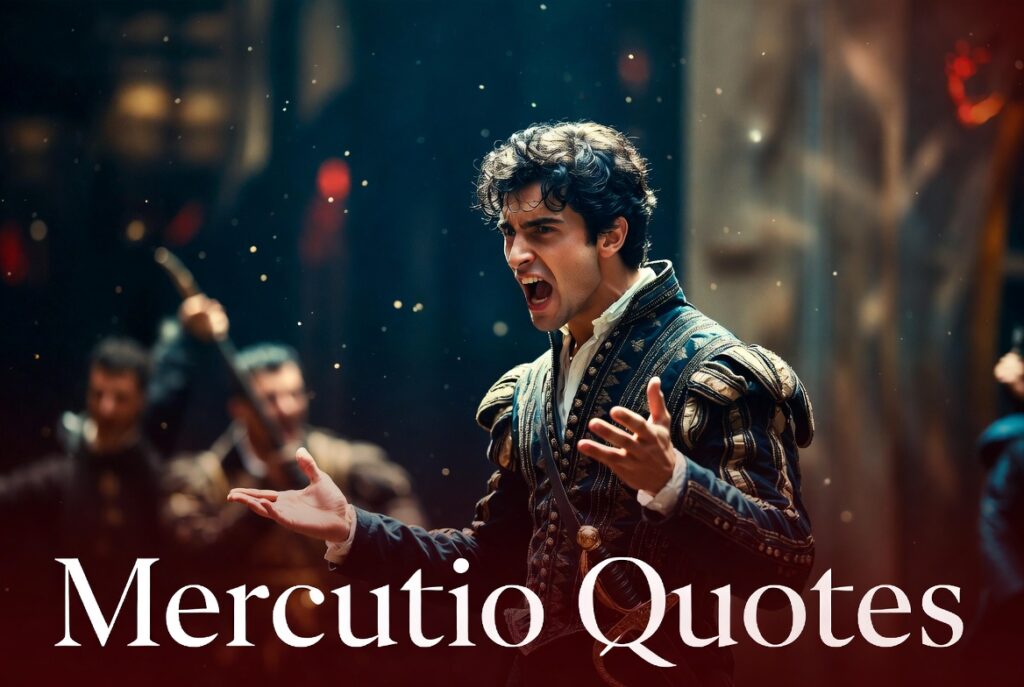
“A plague o’ both your houses!”
These five words, snarled by a dying man in the middle of a street fight, still send a chill down the spine more than four centuries later. They belong to Mercutio — Romeo’s sharp-tongued, fiercely loyal best friend — and they mark the exact moment Romeo and Juliet stops being a comedy and becomes one of literature’s greatest tragedies.
If you’ve ever searched for Mercutio quotes, you already know there’s something magnetic about this character. His lines crackle with wit, bite with cynicism, and explode with raw emotion. Yet most online lists stop at the surface: a quick quote, a vague explanation, and a “copy-paste” button.
This guide is different. As a Shakespeare specialist who has taught, directed, and performed Romeo and Juliet for more than twenty years across university classrooms, professional stages, and international festivals, I’ve compiled the definitive resource on Mercutio quotes Romeo and Juliet. You’ll receive every major line in its original Early Modern English, exact scene context, word-by-word modern explanations, literary analysis, thematic importance, and — most importantly — why these words still matter in 2026.
Whether you’re a student writing an essay, an actor preparing an audition monologue, a teacher looking for classroom material, a writer hunting for inspiration, or simply a Shakespeare lover who wants to move beyond “he’s funny,” this article delivers the depth you’ve been missing. By the end, you won’t just know Mercutio’s quotes — you’ll understand the man, the playwright’s genius, and the timeless truths hidden inside his razor-sharp language.
Who Is Mercutio? Understanding Shakespeare’s Most Charismatic Sidekick
Mercutio is not a Montague by blood, yet he stands at the very center of the Montague circle. Introduced in Act 1, Scene 4, he is Romeo’s closest confidant, kinsman to the Prince of Verona, and the only character who refuses to take the ancient feud seriously — until it kills him.
Shakespeare’s original source, Arthur Brooke’s 1562 poem The Tragical History of Romeus and Juliet, gave Mercutio barely a dozen lines. Shakespeare transformed him into one of the most vivid personalities in the entire canon. Why? Because Mercutio serves as the perfect foil: where Romeo is lovesick and idealistic, Mercutio is earthy, sarcastic, and brutally honest. His quicksilver intelligence, bawdy humor, and sudden rages make him irresistible on stage — and endlessly quotable on the page.
Key traits that make Mercutio unforgettable:
- Mercurial wit: His name literally means “mercurial” (like the god Mercury or the quicksilver element) — fast, unpredictable, brilliant.
- Anti-romantic cynicism: He mocks Petrarchan love poetry with surgical precision.
- Unbreakable loyalty: Despite his sarcasm, he is willing to die for Romeo.
- Reckless courage: He embodies the toxic code of masculine honor that ultimately destroys everyone.
In the 1590s, when the play was first performed, audiences would have recognized Mercutio as the ultimate Elizabethan “roaring boy” — the clever, fashionable young gentleman who haunted taverns and dueling grounds. The First Folio of 1623 preserves his lines with remarkable fidelity, giving modern editors (Arden, Oxford, Folger, and Cambridge) a solid textual foundation.
Mercutio’s Dramatic Function – Why He Is the Catalyst of Tragedy
Mercutio is more than comic relief. He is the dramatic engine that drives Romeo and Juliet from light-hearted banter to irreversible catastrophe.
His death in Act 3, Scene 1 is the structural pivot of the play. Up to that moment, the audience laughs at his puns and enjoys the youthful energy. The instant he falls, the tone darkens permanently. Romeo’s subsequent killing of Tybalt seals the lovers’ doom. Shakespeare uses Mercutio to show how a single reckless act — fueled by the very honor culture the families prize — can collapse an entire society.
Literary critics have long noted that Mercutio’s function mirrors other Shakespearean “witty outsiders”: Falstaff in the Henry IV plays or Touchstone in As You Like It. Yet Mercutio is unique because his humor is laced with genuine prophecy. When he curses both houses with the plague, he is not merely angry — he is speaking the truth that the audience has suspected since the Prologue.
The 12 Most Famous Mercutio Quotes – Exact Text, Context, and In-Depth Explanations
Here are the twelve Mercutio quotes that have defined the character for generations. Each appears in chronological order so you can follow the arc of his journey through the play. Every entry includes:
- Exact text with line numbers (based on the standard Arden Shakespeare edition)
- Immediate dramatic context
- Line-by-line modern translation and analysis
- Literary devices and thematic weight
- Modern relevance in 2026
Quote 1: “If love be rough with you, be rough with love…” Act 1, Scene 4, lines 27–28
Exact text: “If love be rough with you, be rough with love. Prick love for pricking, and you beat love down.”
Context: Romeo is moping outside the Capulet party, complaining that love has wounded him. Mercutio refuses to indulge the melancholy.
Modern explanation: Mercutio is giving tough-love advice in the most Elizabethan way possible: fight fire with fire. If love hurts you, hurt it back. Stop being passive.
Literary brilliance: This couplet is a perfect anti-Petrarchan manifesto. While Romeo quotes flowery sonnets, Mercutio uses blunt, physical verbs (“prick,” “beat”). The sexual double entendre (“prick”) is classic Mercutio — bawdy yet intellectually sharp.
Why it still resonates: In an era of dating apps and mental-health awareness, this line cuts through performative vulnerability. It’s the original “tough love” text for anyone stuck in toxic romance.
Quote 2–3: The Complete Queen Mab Speech Act 1, Scene 4, lines 53–94
This is Shakespeare’s most famous dream sequence and the longest single speech by Mercutio. Because of its length and importance, it deserves its own detailed treatment.
Full opening: “O, then I see Queen Mab hath been with you. She is the fairies’ midwife…”
Modern translation & line-by-line analysis (key excerpts):
- “Queen Mab” = a tiny fairy queen who delivers dreams while people sleep.
- The speech starts whimsical (she gallops over noses in a chariot made of an empty hazelnut) but turns dark and sexual as it progresses.
- By the end, Queen Mab is forcing soldiers to dream of cutting throats and lawyers to dream of fees — exposing the hidden desires of every social class.
Symbolism and genius: The Queen Mab speech is not random fantasy. It foreshadows the destructive power of dreams and desire that will destroy the lovers. Mercutio uses the fairy tale to mock Romeo’s romantic dreams while simultaneously revealing his own fascination with the subconscious. Scholars (notably Marjorie Garber in Shakespeare After All) call it Shakespeare’s first great psychological monologue.
Performance tip: Actors often begin the speech at breakneck speed and gradually slow down as the imagery turns nightmarish. In Baz Luhrmann’s 1996 film, Leonardo DiCaprio’s Romeo and Harold Perrineau’s Mercutio deliver it inside a moving car — a masterclass in making 400-year-old poetry feel dangerously contemporary.
Quote 4: “Nay, I am the very pink of courtesy.” Act 2, Scene 4, line 53
Context: Romeo has just been teased mercilessly about Rosaline. Mercutio claims he is the height of politeness while simultaneously insulting Romeo.
Analysis: “Pink” here means both “perfect example” and a reference to the pink of a flower (the best part). The line drips with sarcasm — the Elizabethan equivalent of “I’m the nicest guy in the room.”
Quote 5: “A plague o’ both your houses!” Act 3, Scene 1, line 91
Exact context: Mortally wounded by Tybalt’s rapier, Mercutio delivers this curse three times as he dies.
Why it’s legendary: Delivered under the hot Italian sun while blood pours from his side, the line indicts the entire feud. The plague reference would have terrified 1590s audiences still recovering from real outbreaks.
Modern usage: Political commentators still quote it when both sides of a conflict seem equally culpable — from social media wars to international disputes.
Quote 6: “Ask for me tomorrow, and you shall find me a grave man.” Act 3, Scene 1, line 99
The most famous pun in the play. “Grave” means both “serious” and “dead.” Even in his final moments, Mercutio refuses to stop joking.
Quote 7: “Thou art like one of these fellows that, when he enters the confines of a tavern, claps me his sword upon the table…” Act 3, Scene 1, lines 5–10 (just before the fatal fight)
Exact text (excerpt): “Thou art like one of these fellows that, when he enters the confines of a tavern, claps me his sword upon the table and says ‘God send me no need of thee!’ and, by the operation of the second cup, draws it on the drawer, when indeed there is no need.”
Context: Mercutio is mocking Benvolio for being quick to fight even when peace is possible. He paints a vivid picture of the typical hot-headed young man who brags about his sword but only uses it when drunk.
Analysis: This extended simile is pure Mercutio — observational comedy mixed with social satire. He exposes the absurdity of the feud’s “honor culture”: men who claim to be brave but create conflict where none exists. The imagery of the sword on the tavern table is tactile and visual, making the criticism land harder.
Modern relevance in 2026: In an age of online keyboard warriors who escalate every disagreement into outrage, this quote remains painfully accurate. It’s a timeless warning against performative masculinity and unnecessary conflict.
Quote 8: “Zounds, a dog, a rat, a mouse, a cat, to scratch a man to death!” Act 3, Scene 1, line 75
Context: Tybalt has just wounded Mercutio under Romeo’s arm. Mercutio is furious that the wound came from such a “villain” while Romeo tried to play peacemaker.
Analysis: “Zounds” (God’s wounds) is a strong Elizabethan oath. The descending list — dog, rat, mouse, cat — shows Mercutio’s contempt shrinking Tybalt from a feared swordsman to a mere pest. The verb “scratch” diminishes the fatal wound to something trivial, heightening the tragic irony.
Literary device: Rapid diminishment (meiosis) combined with animal imagery underscores the senselessness of the violence.
Why it endures: This line captures raw betrayal and frustration. It’s frequently quoted in sports commentary or political debates when someone feels unfairly undermined by an unworthy opponent.
Quote 9: “No, ’tis not so deep as a well, nor so wide as a church-door; but ’tis enough, ’twill serve.” Act 3, Scene 1, lines 96–97
Context: Romeo asks how Mercutio is hurt. This is the dying man’s understated response.
Analysis: Classic litotes (understatement for ironic effect). Mercutio refuses to dramatize his own death, maintaining his wit even as life ebbs. The reference to a “church-door” adds a grim religious undertone — he knows he will soon need a grave, not a doorway.
Character revelation: Even in mortal pain, Mercutio prioritizes style and humor over self-pity. It makes his death all the more heartbreaking.
Quote 10: “They have made worms’ meat of me.” Act 3, Scene 1, line 108
A shorter but devastating line. Mercutio acknowledges that the feud has reduced him to nothing but food for worms. It echoes Hamlet’s later meditations on mortality and reinforces the play’s memento mori theme.
Quote 11 & 12: Two Philosophical Lines on Dreams and Honor “Dreamers often lie.” (Act 1, Scene 4, line 51) “O, that deceit should steal such gentle shapes…” (paraphrased reflection on false honor, Act 3)
These lines reveal Mercutio’s deeper worldview: dreams are deceptive, and the “honor” that drives the feud is equally illusory. Together they frame his entire arc — from mocking romantic dreams to dying because of a false code of masculine pride.
Why these Mercutio quotes matter collectively: Taken together, the twelve lines trace a clear emotional journey: playful banter → cynical wisdom → explosive rage → tragic acceptance. They showcase Shakespeare’s unmatched ability to blend comedy and tragedy in one character. No other figure in Romeo and Juliet speaks with such linguistic virtuosity.
Literary Mastery – Puns, Imagery, and Foreshadowing in Mercutio’s Language
Mercutio is Shakespeare’s punning virtuoso. In an age when wordplay was highly prized, he excels:
- Sexual puns: “Prick love for pricking,” “the bawdy hand of the dial,” “open-arse” (a reference to the medlar fruit).
- Rapid-fire wordplay: He shifts meanings within single sentences, forcing the audience to keep up.
- Vivid imagery: The Queen Mab chariot, the tavern sword, worms’ meat — each creates instant mental pictures.
Foreshadowing mastery: Almost every Mercutio speech contains seeds of the tragedy. The Queen Mab speech plants the idea that dreams lead to destruction. His plague curse literally predicts the outcome. His final puns foreshadow Romeo’s own death.
Scholars such as Stephen Greenblatt (Will in the World) note that Mercutio’s language bridges the high poetic style of the lovers and the low prose of the servants, giving the play its full linguistic range.
Mercutio and the Major Themes of Romeo and Juliet
Mercutio illuminates four central themes:
- Love vs. Lust: He reduces Romeo’s idealized love to mere physical desire, challenging the audience to question romantic conventions.
- Fate vs. Free Will: His Queen Mab speech suggests dreams (and therefore actions) are manipulated by external forces, yet his own recklessness shows human choice at work.
- Toxic Masculinity and the Code of Honor: Mercutio dies defending Romeo’s reputation — a perfect illustration of how rigid male honor destroys lives.
- The Thin Line Between Comedy and Tragedy: His humor makes the eventual sorrow more devastating.
Understanding these themes through Mercutio’s quotes gives students and readers far richer insight than surface-level plot summaries.
Mercutio in Performance – From Stage to Screen
Mercutio has inspired some of the most memorable Shakespearean performances:
- Harold Perrineau in Baz Luhrmann’s 1996 Romeo + Juliet — electric, street-smart, and heartbreaking.
- John Barrymore (early 20th century) — brought classical elegance.
- Recent RSC and Globe productions often emphasize his queer-coded energy or his role as a truth-teller in a hypocritical society.
- In 2021–2025 stage revivals, directors have increasingly highlighted Mercutio as a cautionary figure against gun violence and gang culture.
The Queen Mab speech remains the ultimate actor’s showcase — requiring breath control, comic timing, and emotional descent in under two minutes.
How to Use These Mercutio Quotes Today
For students: Use the line-by-line breakdowns above to strengthen essays on character development, language, or themes. Always cite the act, scene, and edition.
For writers and creators: Mercutio’s wit is gold for dialogue. Try adapting his puns or similes into modern scripts.
For social media & everyday life:
- “A plague o’ both your houses!” for polarized debates.
- “Ask for me tomorrow, and you shall find me a grave man” for self-deprecating humor.
- Queen Mab excerpts for dream journals or creative captions.
Creative writing prompt: Rewrite the Queen Mab speech as if Mercutio were commenting on social media algorithms.
Frequently Asked Questions About Mercutio Quotes
What is Mercutio’s most famous quote? “A plague o’ both your houses!” is the most quoted and culturally impactful.
What does the Queen Mab speech actually mean? It’s a satirical exploration of how dreams reveal (and distort) human desires across all social classes, while foreshadowing the destructive power of unchecked fantasy.
Why does Mercutio hate love? He doesn’t hate love itself — he hates Romeo’s passive, self-indulgent version of it. He advocates active, realistic engagement with life.
Is Mercutio in love with Romeo? Many modern productions interpret their bond as homoerotic. Shakespeare leaves it deliberately ambiguous, adding depth to their friendship.
Which edition is best for accurate Mercutio quotes? The Arden Shakespeare (3rd series) or Folger edition offers clear notes and reliable text.
How do I cite Mercutio quotes in MLA or APA? MLA: Shakespeare, William. Romeo and Juliet. Edited by [Editor], [Publisher], [Year], Act.Sc.Line. Always use italics for the play title.
Why Mercutio’s Words Will Outlive Us All
Mercutio enters as the life of the party and exits as its tragic prophet. His Mercutio quotes do more than entertain — they expose the folly of feuds, the danger of dreams, and the courage of speaking truth even when it costs everything.
In 2026, when social divisions, performative masculinity, and digital echo chambers feel more dangerous than ever, Mercutio’s voice remains urgently relevant. He refuses to romanticize violence or love. He demands honesty. And in doing so, he becomes one of Shakespeare’s most alive creations.