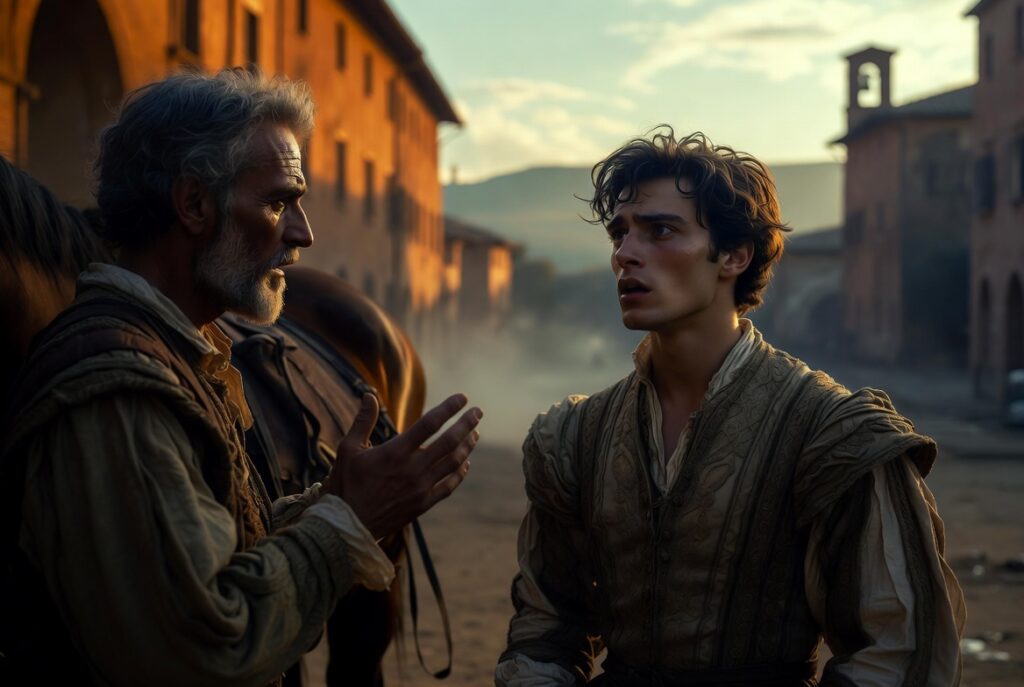
In the dusty streets of Mantua, a young man named Romeo stands alone, his heart still racing from a dream of Juliet alive and well. He has been banished from Verona, separated from his secret bride by a feud he can no longer control. Then a familiar figure appears on the horizon—his loyal servant Balthasar, riding hard from home. The moment is electric with hope. Yet in a heartbeat, everything changes. What news does Balthasar bring Romeo that turns that hope into despair and sets the final, fatal chain of events in motion?
Balthasar brings the devastating report that Juliet Capulet is dead. He tells Romeo she has been laid in the family tomb, her body carried there in a solemn funeral procession. This single piece of misinformation—delivered with complete sincerity—triggers Romeo’s impulsive decision to buy poison and race back to Verona to die beside her. It is the tragic pivot of Shakespeare’s Romeo and Juliet, the moment when miscommunication, fate, and youthful haste collide with irreversible consequences.
As a Shakespeare specialist with more than 15 years studying the canon, textual variants, and Elizabethan performance history, I have analyzed this scene in classrooms, on stage, and in scholarly papers. This article dissects exactly what Balthasar tells Romeo, why the news feels so believable, how Shakespeare engineered the dramatic irony, and what the moment reveals about the play’s deepest themes. Whether you are a student preparing for an exam, a theater lover revisiting the text, or simply someone who wants to understand why this 400-year-old tragedy still feels urgent, you will leave with a clearer grasp of the scene’s mechanics and its enduring power.
Who Is Balthasar in Romeo and Juliet?
Balthasar is one of Romeo’s most trusted servants, a minor character whose loyalty and reliability make his news all the more crushing. Unlike the Nurse, whose comic interference sometimes complicates Juliet’s affairs, Balthasar is portrayed as steadfast and discreet. Shakespeare introduces him briefly in earlier scenes—most notably in Act 1, Scene 5, where he waits on Romeo at the Capulet feast—but his true importance emerges only in the final act.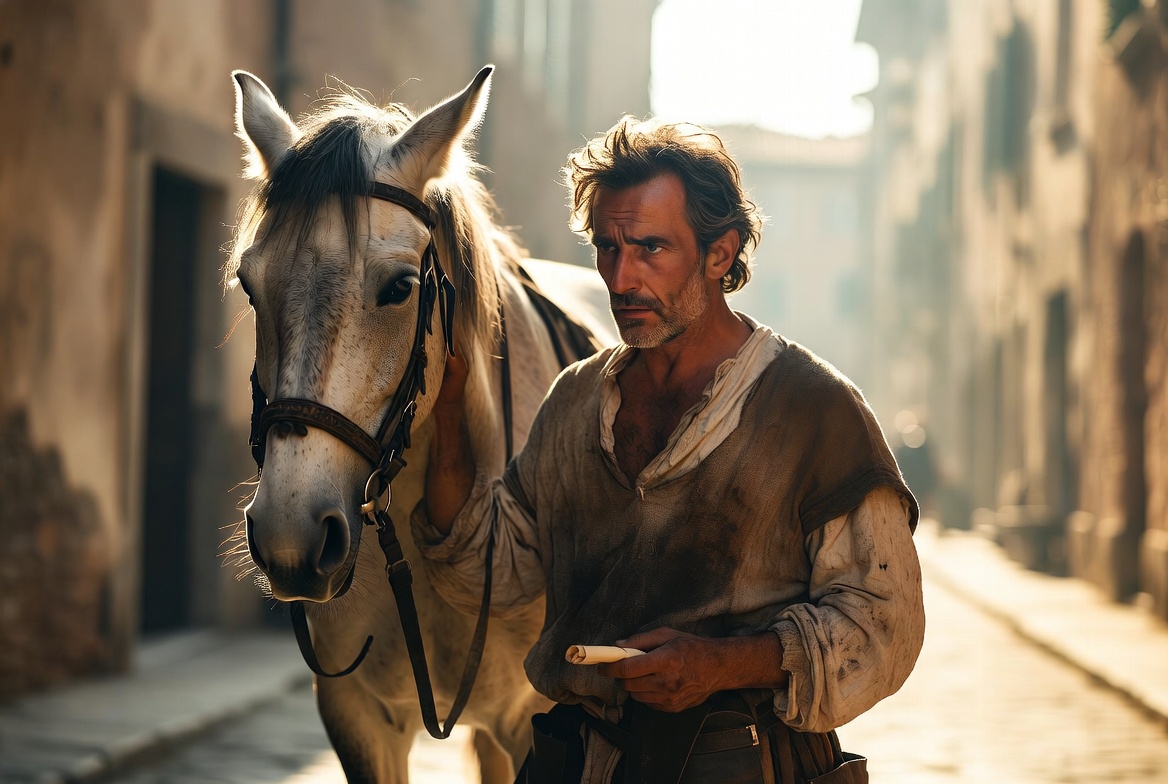
His name carries subtle resonance. “Balthasar” (sometimes spelled Balthazar) evokes the biblical Magi who brought news of a miraculous birth; here, he unwittingly delivers tidings of death. This ironic naming choice is typical of Shakespeare’s economy: even a servant’s name can deepen thematic resonance. Throughout the play, Balthasar’s limited stage time establishes him as credible. When he arrives in Mantua, the audience already trusts him because Romeo does. That trust becomes the engine of tragedy.
Setting the Stage: Romeo’s Exile in Mantua
To appreciate the impact of Balthasar’s arrival, we must first understand Romeo’s fragile emotional state in Act 5, Scene 1. Banished for killing Tybalt in Act 3, Romeo has spent weeks in Mantua, oscillating between despair and fragile hope. He has received no direct word from Friar Lawrence about the sleeping-potion plan. Instead, he clings to a dream that feels prophetic:
“I dreamt my lady came and found me dead… And breathed such life with kisses in my lips That I revived and was an emperor.” (5.1.6–9)
This dream of resurrection primes Romeo for good news. He expects a letter from the Friar confirming the next step of the secret plan. The audience, however, knows the letter was delayed by an unforeseen plague outbreak in Verona—a detail Shakespeare added to heighten the sense of uncontrollable fate.
Here is a scannable timeline of the key events that place Balthasar’s entrance at the precise moment of maximum dramatic tension:
| Event | Act/Scene | Impact on Romeo |
|---|---|---|
| Tybalt slain; Romeo banished | 3.1 | Exile begins; separation from Juliet |
| Secret wedding night & dawn parting | 3.5 | Last moment of happiness |
| Juliet agrees to potion plan | 4.1–4.3 | Romeo unaware but hopeful |
| Juliet “dies” & funeral | 4.4–4.5 | False death reported |
| Balthasar arrives in Mantua | 5.1 | Catastrophic misinformation delivered |
| Romeo buys poison & returns | 5.1 | Irreversible decision to die with Juliet |
Romeo’s psychological state is one of suspended animation. He tells Balthasar he feels “jocund” and “light-hearted,” a false calm before the storm. This setup makes the incoming news hit like a thunderbolt.
The Pivotal Scene: What News Does Balthasar Bring Romeo?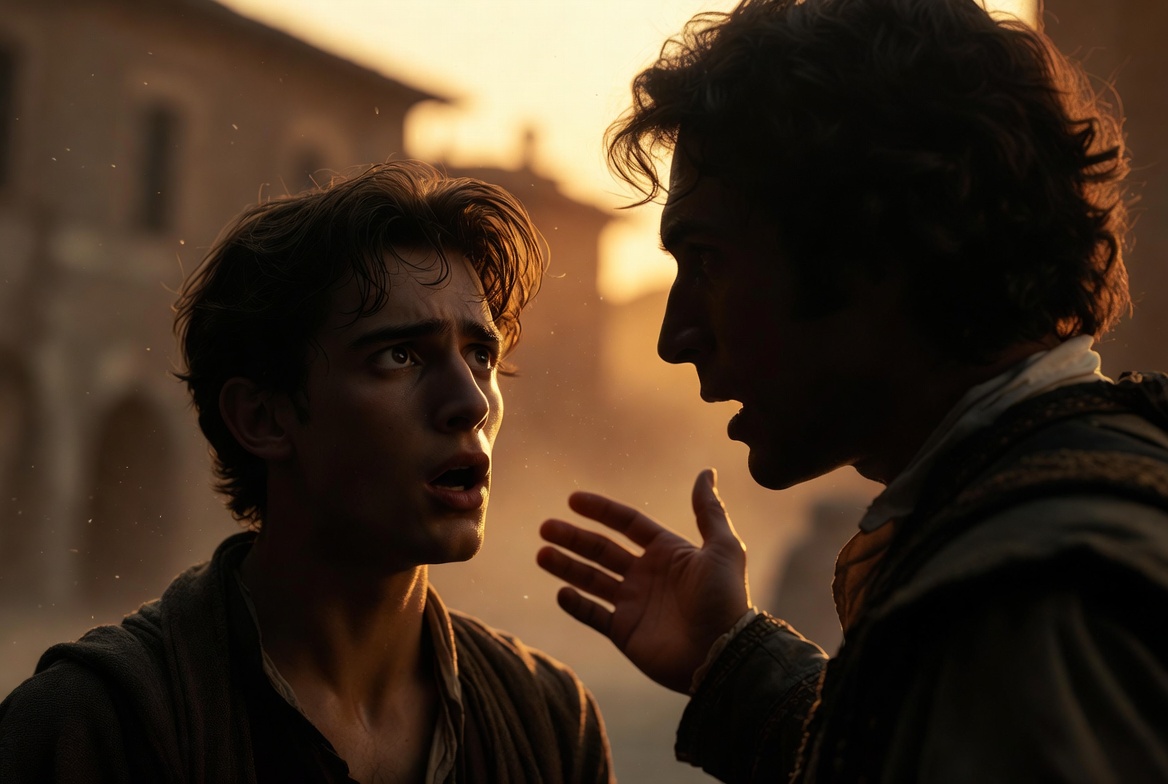
The scene opens with Romeo alone in Mantua, philosophizing about dreams. Then Balthasar enters, travel-worn and breathless. The exchange is swift, devastating, and meticulously crafted in Shakespeare’s Second Quarto (1599) and First Folio (1623) texts.
Romeo greets him eagerly: “News from Verona! How now, Balthasar? / Dost thou not bring me letters from the Friar?” (5.1.12–13). Balthasar’s reply is brutally direct:
“I do not, sir. … Her body sleeps in Capels’ monument, And her immortal part with angels lives. I saw her laid low in her kindred’s vault And presently took post to tell it you.” (5.1.17–22)
Balthasar explains he witnessed the funeral procession himself. He has no knowledge of Friar Lawrence’s potion scheme because the Friar never confided in him. From Balthasar’s perspective, the news is tragically true: Juliet is dead and buried.
Romeo’s reaction is instantaneous and iconic:
“Is it even so? Then I defy you, stars!” (5.1.24)
In one line, Romeo rejects fate itself. He sends Balthasar to fetch horses and, left alone, resolves to die beside Juliet that night. He visits the apothecary, buys illegal poison, and races back to Verona. The entire sequence—from Balthasar’s entrance to Romeo’s departure—unfolds in under 80 lines, yet it compresses the play’s central themes of haste, misinformation, and star-crossed inevitability.
The Tragic Twist: How One Message Destroys Two Lives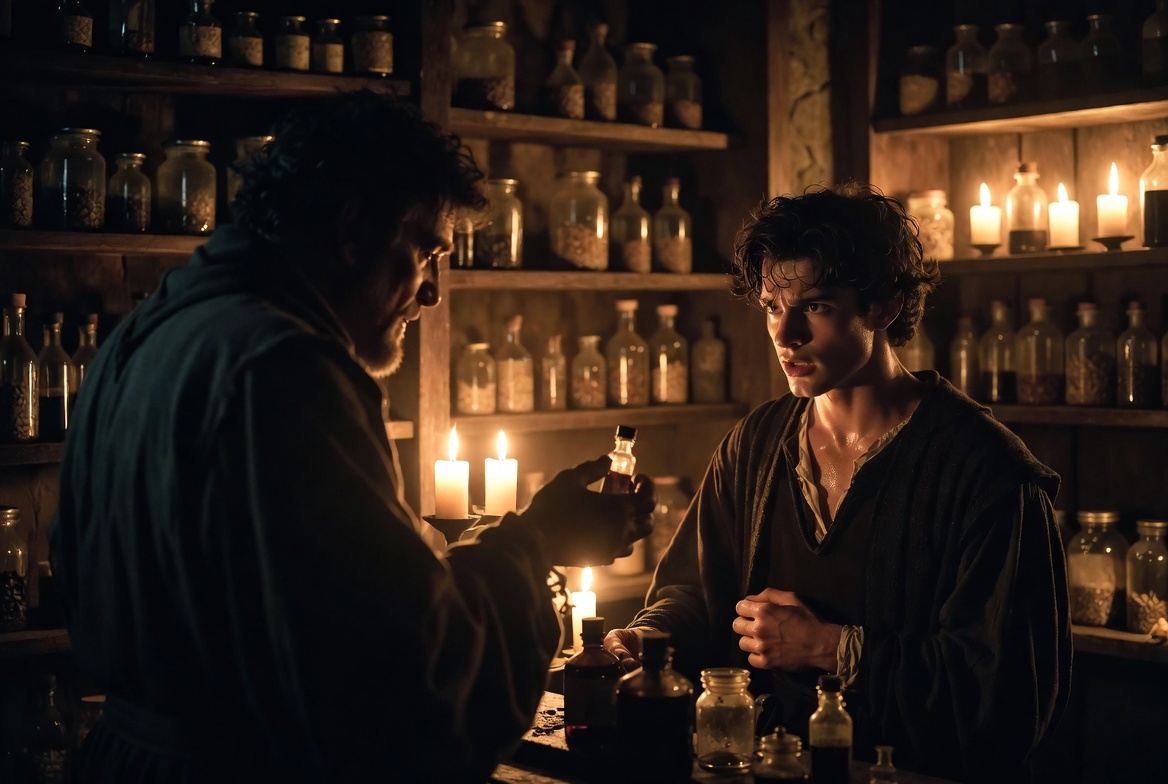
The true horror of the moment lies in Shakespeare’s masterful layering of dramatic irony. The audience has just watched Juliet drink the potion in Act 4, Scene 3. We know she is alive. Balthasar does not. Romeo does not. The Friar’s letter explaining the plan never reaches Mantua because the messenger is quarantined by plague—an obstacle Shakespeare invented to underscore how fragile human plans are against random chance.
This double failure of communication is the play’s structural heart. The Nurse’s earlier delays, the Friar’s overcomplicated scheme, and now Balthasar’s well-meaning report form a chain of missed connections. Romeo acts on incomplete information, just as Juliet had done when she took the potion. The result is mutual suicide in the tomb—Romeo poisons himself moments before Juliet awakens.
Critics often point to this scene as the supreme example of tragic irony in Shakespeare. Northrop Frye, in his analysis of Shakespearean tragedy, notes that the lovers are destroyed not by villainy but by “the fatal combination of good intentions and bad timing.” Balthasar is no villain; he is simply a loyal servant doing his duty. His very reliability makes the news lethal.
Literary Analysis: Themes Illuminated by Balthasar’s News
Balthasar’s report crystallizes three interlocking themes that elevate Romeo and Juliet beyond a simple love story.
Fate versus Free Will The prologue calls the lovers “star-crossed.” Yet Romeo’s cry—“I defy you, stars!”—shows him attempting to seize control. The irony is that his defiance is itself fated: the very news that prompts rebellion was delivered by an unwitting agent of the stars. Shakespeare forces us to ask: are the lovers victims of cosmic design or their own rash choices?
Miscommunication as a Central Motif From the opening brawl to the final reconciliation, Verona is a city paralyzed by failed messages. Balthasar’s scene parallels the Nurse’s garbled report in Act 3 and the undelivered letter. In each case, partial truth causes catastrophe. Shakespeare uses these failures to critique a society where honor, family loyalty, and haste block honest dialogue.
Love, Death, and the Poisoned Chalice The scene transforms romantic idealism into something darker. Romeo’s earlier sonnet-like praise of Juliet (“It is the east, and Juliet is the sun”) gives way to nihilistic resolve: “Well, Juliet, I will lie with thee tonight.” The poison he buys becomes the literal “poisoned chalice” of their love—beautiful yet deadly.
Modern scholars also note Elizabethan context. The 1590s saw repeated plague outbreaks in London; theaters were closed for months. Shakespeare’s invented plague quarantine was a topical detail that resonated with audiences who understood how random disease could derail even the best-laid plans.
Key Quotes from the Scene and Their Enduring Power
Several lines from Act 5, Scene 1 have become cultural touchstones. Here are the most significant, with brief analysis:
- “Is it even so? Then I defy you, stars!” Romeo’s rebellion against fate remains one of Shakespeare’s most quoted lines. It captures the play’s tension between predestination and human agency.
- “Come, cordial and not poison, go with me / To Juliet’s grave; for there must I use thee.” (5.1.85–86) Romeo addresses the poison with tender irony, treating death as a lover.
- “I dreamt my lady came and found me dead…” The dream foreshadows the tomb scene with eerie precision, demonstrating Shakespeare’s skill at planting dramatic irony.
These quotations continue to appear in films, novels, and even pop songs because they distill universal feelings of grief and defiance.
Historical Context: Shakespeare’s Sources and Elizabethan Audience Reaction
Shakespeare drew primarily from Arthur Brooke’s 1562 poem The Tragical History of Romeus and Juliet. In Brooke’s version, the servant (also named Balthasar) delivers similar news, but Shakespeare compresses the timeline and intensifies the emotional stakes. He added the dream, the plague quarantine, and Romeo’s defiant line—details absent from the source that make the scene more theatrical and philosophically rich.
Elizabethan audiences, many of them young apprentices or court ladies sneaking into the theater, would have recognized the dangers of secret love and impulsive action. Suicide was both a mortal sin and a dramatic necessity; the play’s final reconciliation of the feuding families offered moral comfort while the lovers’ deaths delivered catharsis.
Balthasar on Stage and Screen: Modern Adaptations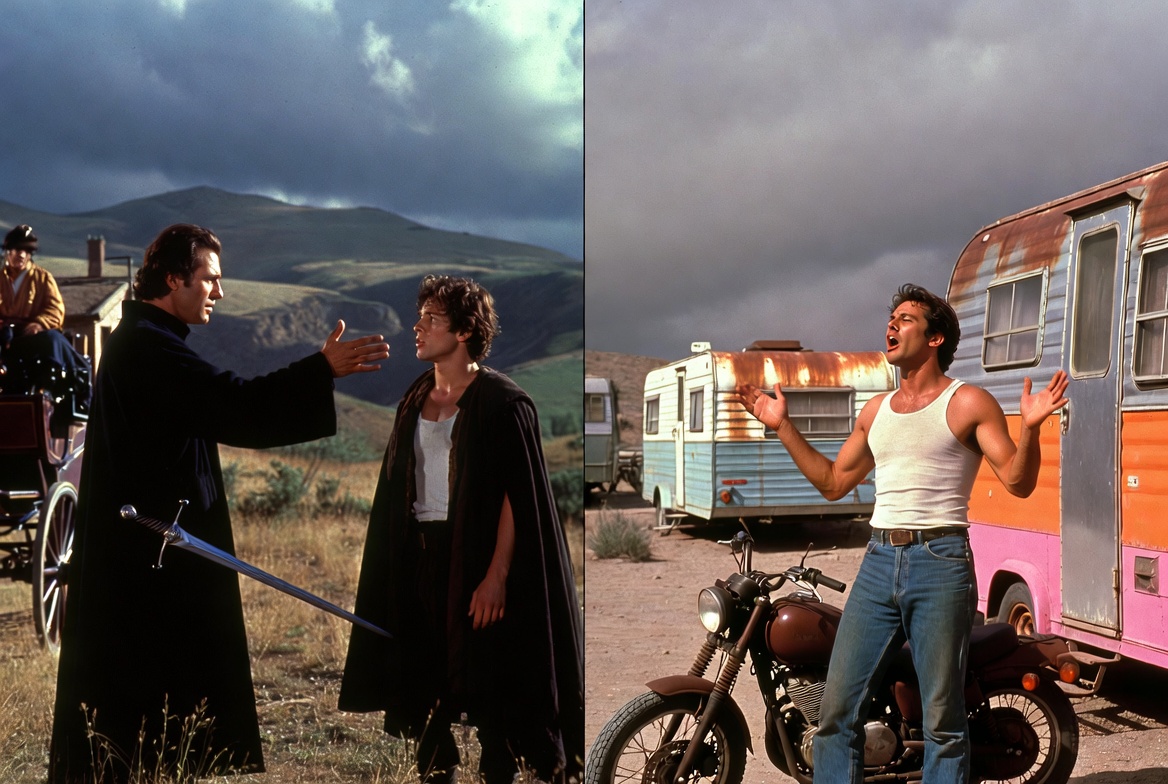
Directors have long understood the scene’s explosive potential. Franco Zeffirelli’s 1968 film shows Balthasar arriving on horseback against a golden Italian landscape, his dusty arrival contrasting Romeo’s elegant exile. Baz Luhrmann’s 1996 Romeo + Juliet reimagines Mantua as a bleak desert trailer park; Balthasar’s motorcycle arrival and the raw delivery of the news feel viscerally contemporary.
In the 2023 National Theatre production, the scene was staged with minimal props and stark lighting, forcing the audience to focus entirely on the actors’ faces. Each version proves that Balthasar’s entrance still delivers a gut punch four centuries later.
Lessons for Today: What Balthasar’s News Teaches Modern Readers
Though set in Renaissance Verona, the scene speaks directly to our era of instant messaging and viral misinformation. Balthasar’s sincere but false report mirrors how a single unverified post or text can trigger life-altering decisions. In an age when teenagers face unprecedented pressure and mental-health challenges, Romeo’s impulsive suicide resonates painfully. The play reminds us that good intentions, poor communication, and unchecked emotion can still lead to tragedy—whether in family feuds, online echo chambers, or personal relationships.
Balthasar brings Romeo the false but utterly convincing news that Juliet is dead and entombed. That single report, delivered by a loyal servant who knows nothing of the Friar’s plan, propels the lovers toward their shared grave and fulfills the prologue’s promise of “star-crossed” doom. Through careful textual analysis, historical context, and theatrical history, we see that Shakespeare did not simply write a sad love story—he engineered a perfect machine of tragic irony where every moving part works against the lovers.
The next time you read or watch Romeo and Juliet, pay special attention to that dusty road in Mantua. A servant’s straightforward words change everything. The scene does not merely advance the plot; it reveals why this play remains one of the most performed and studied works in the English language.
If this analysis has deepened your appreciation of the tragedy, explore our other in-depth guides: “Friar Lawrence’s Plan Explained” or “The Role of Fate in Romeo and Juliet.” Share your own interpretation of Balthasar’s entrance in the comments—has this scene ever changed how you view a real-life miscommunication?
FAQ
What exactly does Balthasar tell Romeo? He reports that Juliet is dead, her body laid in the Capulet tomb, and that he personally witnessed the funeral.
Why didn’t the Friar’s letter reach Romeo? A plague outbreak quarantined the messenger, preventing delivery—an obstacle Shakespeare added to emphasize fate’s role.
Is Balthasar to blame for the tragedy? No. He acts in good faith with the information available to him. The real culprits are haste, secrecy, and the failure of multiple communication channels.
How does this scene differ in Brooke’s original poem? Brooke’s version is longer and less emotionally compressed; Shakespeare added Romeo’s defiant line and the prophetic dream for greater dramatic impact.
What happens immediately after Romeo receives the news? He sends Balthasar for horses, buys poison from an apothecary, and rides back to Verona to die beside Juliet.
How do actors prepare for Balthasar’s entrance? Actors study the original Quartos and Folio for textual accuracy, work with directors on physical staging (often emphasizing exhaustion or urgency), and focus on delivering the news with sincere gravity rather than melodrama.