In the tempest of human emotion, few works capture the raw fury of betrayal, the collapse of authority, and the shattering of family bonds quite like the King Lear play. Picture an aging monarch, once all-powerful, dividing his kingdom among his three daughters based on flattery—only to be cast out into a raging storm, stripped of dignity, and driven to madness by the very children he trusted. Written by William Shakespeare around 1605–1606, this towering Shakespearean tragedy remains one of the most devastating explorations of human frailty ever staged. Whether you’re a student dissecting the text for exams, a teacher preparing lessons, an actor tackling the title role, or simply a reader drawn to timeless stories of power and regret, this comprehensive guide delivers exactly what you need: a complete summary, nuanced character analysis, deep thematic exploration, and fresh insights into why King Lear still feels urgently relevant in 2026.
Far more than a dusty classic, the King Lear play addresses universal problems that continue to haunt us—toxic family dynamics, the loneliness of aging, the abuse of political power, and the terrifying realization that those we love most may betray us. In this skyscraper-level resource, you’ll find everything from an act-by-act plot breakdown (with spoiler warnings) to scholarly context, performance history, and practical takeaways for modern life. By the end, you’ll not only understand Shakespeare’s masterpiece but also see how its lessons illuminate today’s headlines, personal relationships, and societal fractures.
Historical and Literary Context of the King Lear Play
To fully appreciate the King Lear play, it’s essential to understand the world that shaped it. Shakespeare composed the tragedy during the early years of King James I’s reign, a time of intense political anxiety in Jacobean England. The 1603 union of the English and Scottish crowns had raised urgent questions about succession, divine right, and the stability of monarchy—concerns Shakespeare wove directly into the fabric of the drama.
When and Why Shakespeare Wrote King Lear
Scholars date the King Lear play to 1605–1606, shortly after Shakespeare’s company, the King’s Men, began performing at the Blackfriars indoor theater. The playwright was at the height of his tragic period, following Hamlet, Othello, and Macbeth. Many experts believe the play was written in response to contemporary events: the aging Queen Elizabeth I’s death in 1603 left a vacuum of power, while the 1605 Gunpowder Plot exposed deep religious and political divisions. Shakespeare, ever the keen observer of court intrigue, transformed these tensions into a mythic tale of a kingdom torn apart by filial ingratitude and royal folly.
Sources and Influences
The King Lear play is not entirely original in plot. Shakespeare drew heavily from Raphael Holinshed’s Chronicles of England, Scotland, and Ireland (1587), which recounts the legendary British king Leir who divides his realm among his daughters. An even earlier anonymous play, The True Chronicle History of King Leir (published 1605 but performed earlier), provided a happier ending that Shakespeare deliberately rejected for his bleaker vision. Additional influences include the story of the blind king in Sir Philip Sidney’s Arcadia and contemporary ballads about ungrateful children. What Shakespeare added— the devastating storm scenes, the Fool’s piercing wisdom, and the parallel Gloucester subplot—elevated the source material into profound tragedy.
Political Climate in Jacobean England
The early 1600s were marked by debates over absolute monarchy and the “divine right of kings.” James I openly championed this doctrine, yet the King Lear play subtly questions it: what happens when a ruler’s authority is based on nothing more substantial than words and flattery? The play’s exploration of chaos following a king’s abdication would have resonated powerfully with audiences who had just witnessed a change of dynasty.
Quarto vs. Folio Texts – Key Differences and Modern Editorial Choices
The King Lear play survives in two primary early texts: the 1608 Quarto and the 1623 First Folio. The Quarto is longer and includes passages cut from the Folio, while the Folio tightens the pacing and removes some politically sensitive lines. Modern editors often publish conflated versions or choose one text over the other. Recent scholarship, including the Arden Shakespeare Third Series (2020s editions) and the Folger Library’s digital resources, emphasizes that these textual variants reflect Shakespeare’s own revisions—proof of his relentless craftsmanship. Understanding these differences helps readers and directors appreciate the play’s evolution rather than treating it as a fixed artifact.
This historical foundation reveals the King Lear play not as a remote Elizabethan relic but as a living document forged in crisis—much like our own era of political upheaval and generational conflict.
Complete Act-by-Act Plot Summary of the King Lear Play
Spoiler Warning: This section provides a full, detailed summary of the entire King Lear play, including the devastating conclusion. If you prefer to experience the tragedy unspoiled, consider reading or watching a performance first, then return here for analysis.
Shakespeare structures the King Lear play in five acts, interweaving the main Lear storyline with the parallel Gloucester subplot to create a devastating double tragedy. The action unfolds across Britain, moving from the royal court to the wild heath and finally to the battlefield.
Act 1 – The Division of the Kingdom and the Seeds of Catastrophe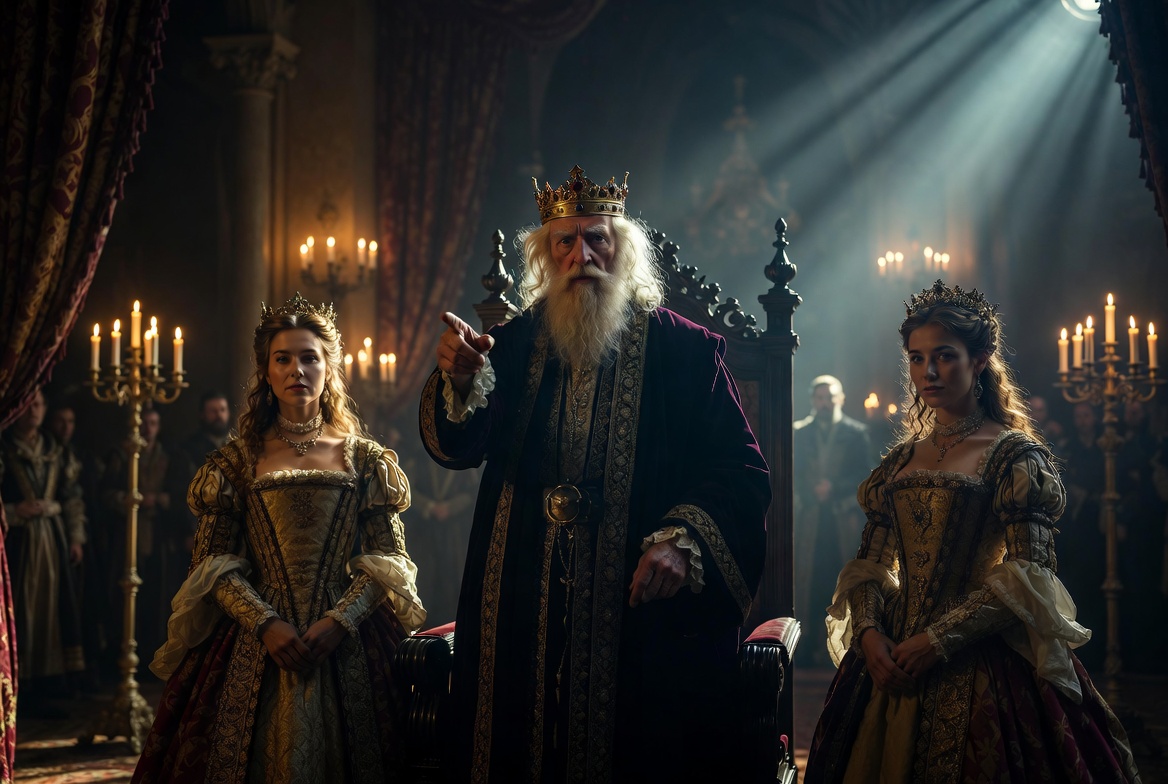
The play opens in King Lear’s palace with a public ceremony of power transfer. Lear, an elderly ruler weary of governing, announces he will divide his kingdom into three parts for his daughters Goneril, Regan, and Cordelia—based on which daughter professes the greatest love for him. Goneril and Regan deliver extravagant, insincere speeches of devotion and receive lavish portions. Cordelia, the youngest and most honest, refuses to flatter: “I love your Majesty / According to my bond; no more nor less.” Enraged by what he perceives as ingratitude, Lear disowns her and banishes her with nothing. The Earl of Kent, loyal to the core, protests and is himself banished for his honesty.
Simultaneously, in the Gloucester subplot, the Earl of Gloucester discusses his two sons: the legitimate Edgar and the bastard Edmund. Edmund, resentful of his status, forges a letter implicating Edgar in a plot against their father. Gloucester is deceived, declaring Edgar a traitor.
Lear’s folly sets the tragedy in motion: he retains only the title of king and 100 knights, intending to alternate residence between Goneril and Regan. Already, the daughters begin plotting to strip him of even this remnant of authority. The act ends with Edmund’s scheming and Cordelia’s departure to France with the King of France, who values her integrity over any dowry.
Act 2 – Exile, Betrayal, and the Gathering Storm
Tensions escalate as Lear arrives at Gloucester’s castle to stay with Regan and her husband Cornwall. Goneril has already reduced his retinue; Regan proves even crueler, insisting he dismiss all but a handful of followers. When Lear erupts in rage, both daughters lock him out as a violent storm brews. Meanwhile, Edmund’s machinations reach their peak: he stages a fake fight with Edgar, wounds himself, and convinces Gloucester that Edgar tried to murder him. Edgar flees, disguised as the mad beggar “Poor Tom.”
Kent, still loyal despite his banishment, returns in disguise and is placed in the stocks for defending Lear. The act closes with Lear, rejected by both elder daughters, venturing into the gathering storm—symbolizing the chaos he has unleashed.
Act 3 – The Heath, Madness, and the Power of the Elements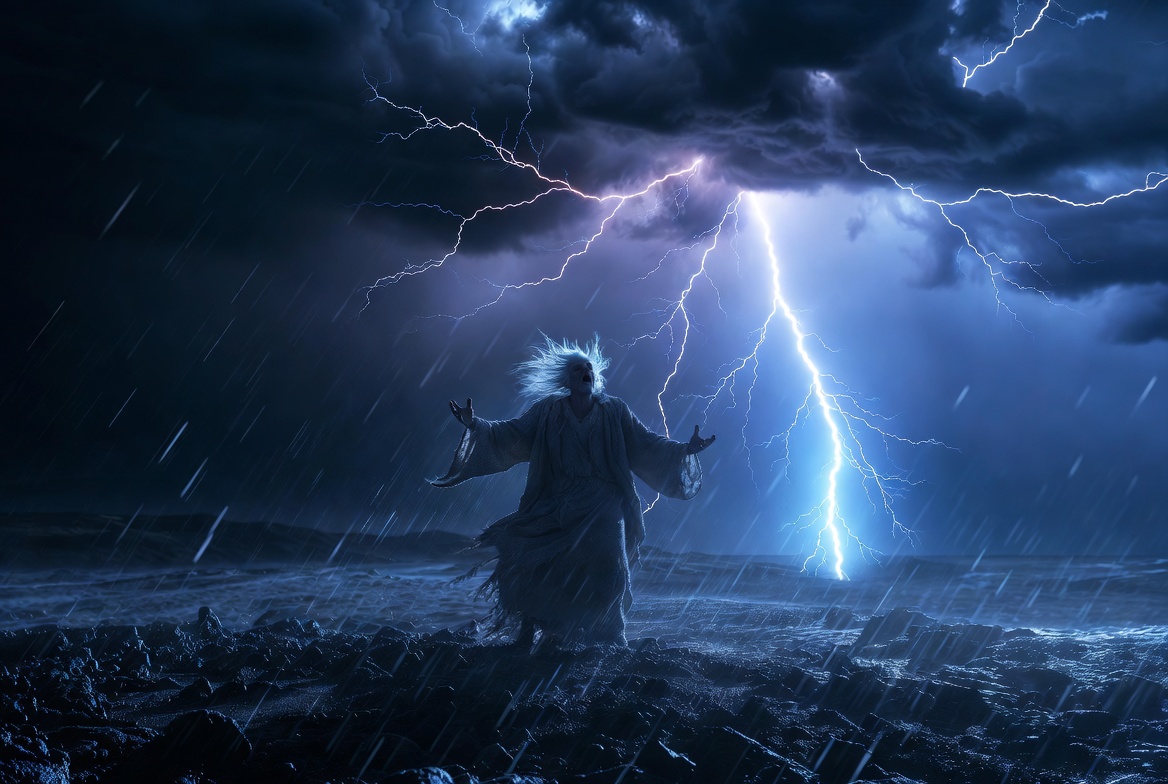
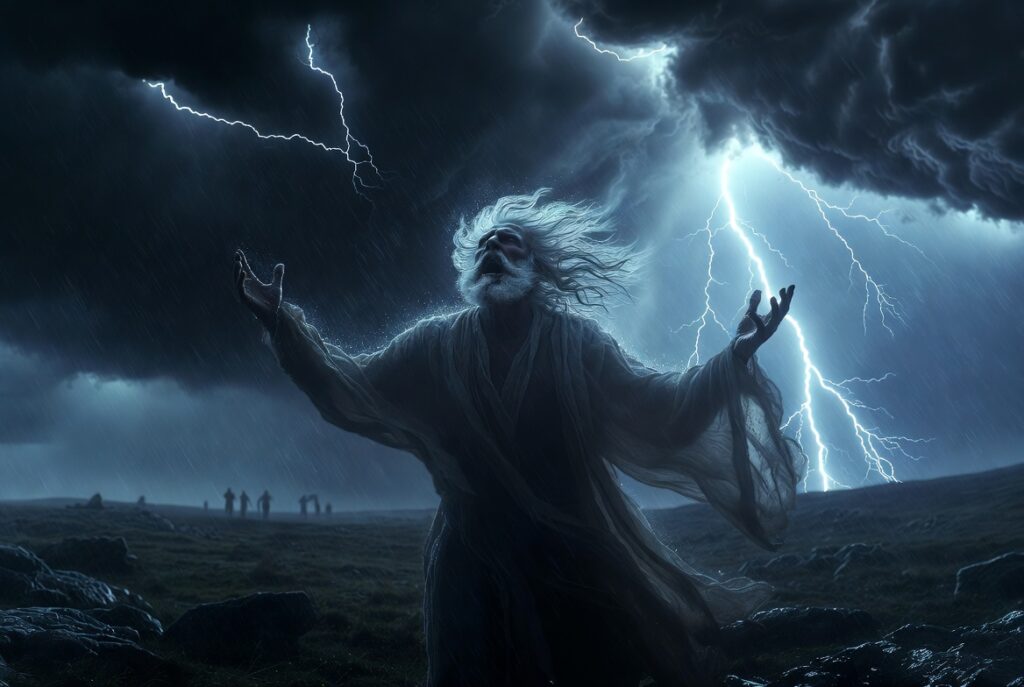
The storm scenes form the emotional and thematic core of the King Lear play. Exposed to the raging tempest on the heath, King Lear rails against the elements, which he sees as allies of his ungrateful daughters: “Blow, winds, and crack your cheeks! rage! blow!” He begins to lose his sanity, recognizing too late the difference between true loyalty and hollow flattery. The disguised Kent finds him and leads him to a hovel for shelter.
Inside, they encounter Edgar as Poor Tom, whose feigned madness mirrors Lear’s growing real insanity. The Fool delivers some of Shakespeare’s most piercing lines, blending bitter humor with profound truth: “Thou hadst little wit in thy bald crown when thou gav’st thy golden one away.” Gloucester, risking his own safety, joins them and reveals that Goneril and Regan have ordered his eyes put out if he helps Lear.
In a parallel horror, Cornwall and Regan capture Gloucester at the castle. They brutally gouge out his eyes in one of the most shocking scenes in all of Shakespeare. The blinded Gloucester learns too late that Edmund betrayed him and that Edgar is innocent. The act ends with the storm still raging and the forces of chaos fully unleashed.
Act 4 – Blindness, Insight, and the Road to Dover
“Blindness” becomes both literal and metaphorical in this act of the King Lear play. The now sightless Gloucester, guided by the disguised Edgar (still as Poor Tom), journeys toward Dover, intending to leap from the cliffs in despair. Edgar prevents the suicide by a clever trick, teaching his father that “the worst is not / So long as we can say ‘This is the worst.’”
Meanwhile, Cordelia returns from France with an invading army to rescue her father. Lear, now completely mad, is found crowned with weeds and flowers, ranting about injustice and hypocrisy. When reunited with Cordelia, he slowly regains a fragile sanity and begs her forgiveness. In the political sphere, Albany (Goneril’s husband) grows disgusted with his wife’s cruelty, while Goneril and Regan compete viciously for the affections of the ambitious Edmund. The act builds toward the final confrontation, with armies gathering and personal vendettas reaching their peak.
Act 5 – The Final Reckoning and Shakespeare’s Most Devastating Ending
The concluding act of the King Lear play delivers blow after blow. The British forces (led by Edmund, Goneril, and Regan) defeat Cordelia’s army. Lear and Cordelia are captured. Edmund secretly orders their execution.
In rapid succession, the villains turn on one another: Goneril poisons Regan out of jealousy, then stabs herself when her treachery is exposed. Edgar reveals his identity and mortally wounds Edmund in single combat. The dying Edmund repents too late and tries to countermand the death order, but it is futile.
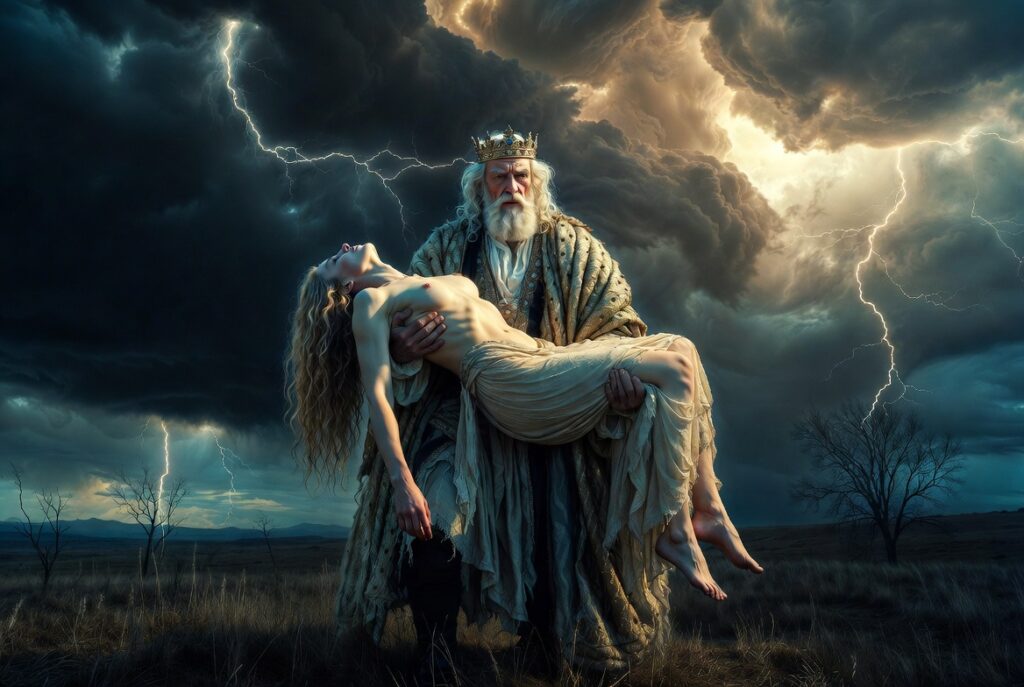
The final scene is among the most heartbreaking in world literature. Lear enters carrying the dead body of Cordelia, uttering the repeated, anguished cry: “Howl, howl, howl, howl!” He dies of a broken heart, believing for one fleeting moment that Cordelia still breathes. Kent, Albany, and Edgar survive, but the stage is littered with corpses. Edgar’s closing lines offer a somber note of endurance: “The weight of this sad time we must obey, / Speak what we feel, not what we ought to say.”
No other Shakespeare tragedy ends with such unrelenting desolation. The King Lear play refuses easy consolation, forcing audiences to confront the full cost of human folly and cruelty.
In-Depth Character Analysis – The Heart of the King Lear Play
The greatness of the King Lear play lies in its richly drawn characters, each embodying different facets of the human condition under extreme pressure.
King Lear – The Tragic Hero’s Journey from Hubris to Humility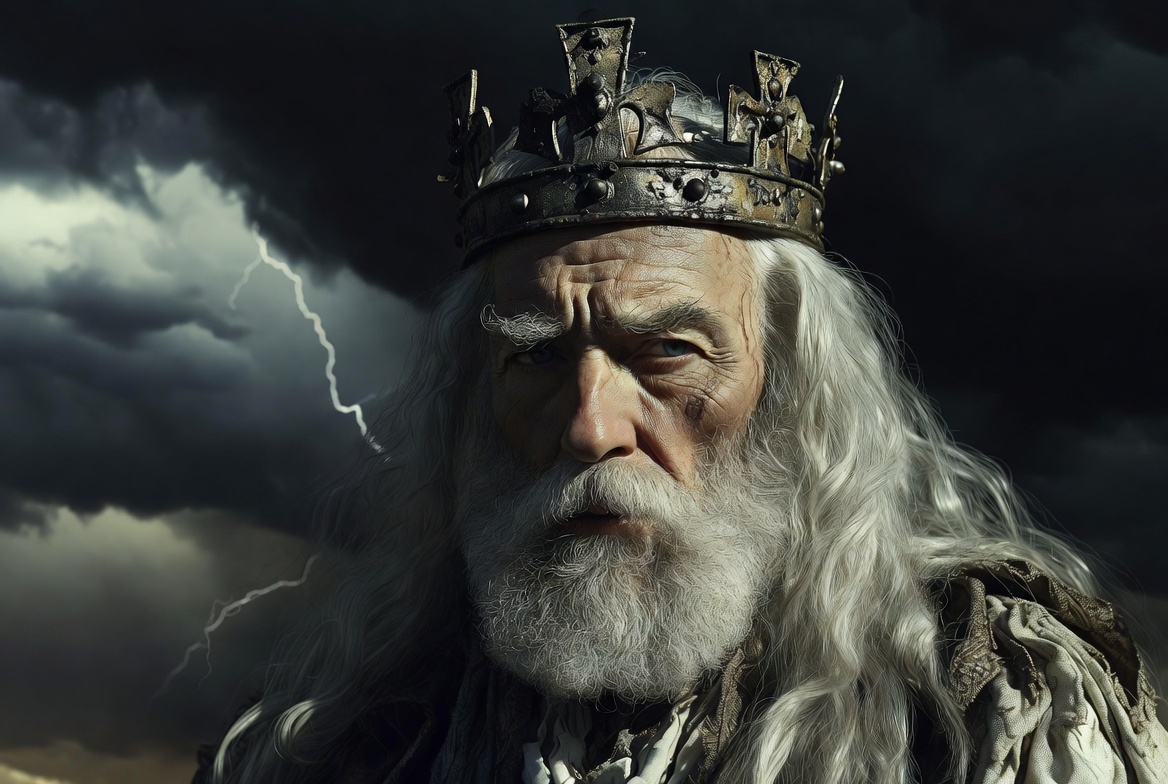
Lear begins as the archetypal tragic hero: imperious, impulsive, and blind to his own flaws. His demand for public declarations of love reveals deep insecurity beneath royal authority. Through suffering on the heath, he undergoes a painful education. Stripped of power, he learns empathy for the poor (“I have ta’en / Too little care of this”), recognizes his own foolishness, and finally achieves genuine love and humility in his reconciliation with Cordelia. His journey from hubris to self-knowledge makes him one of Shakespeare’s most complex protagonists.
The Three Daughters – Cordelia, Goneril, and Regan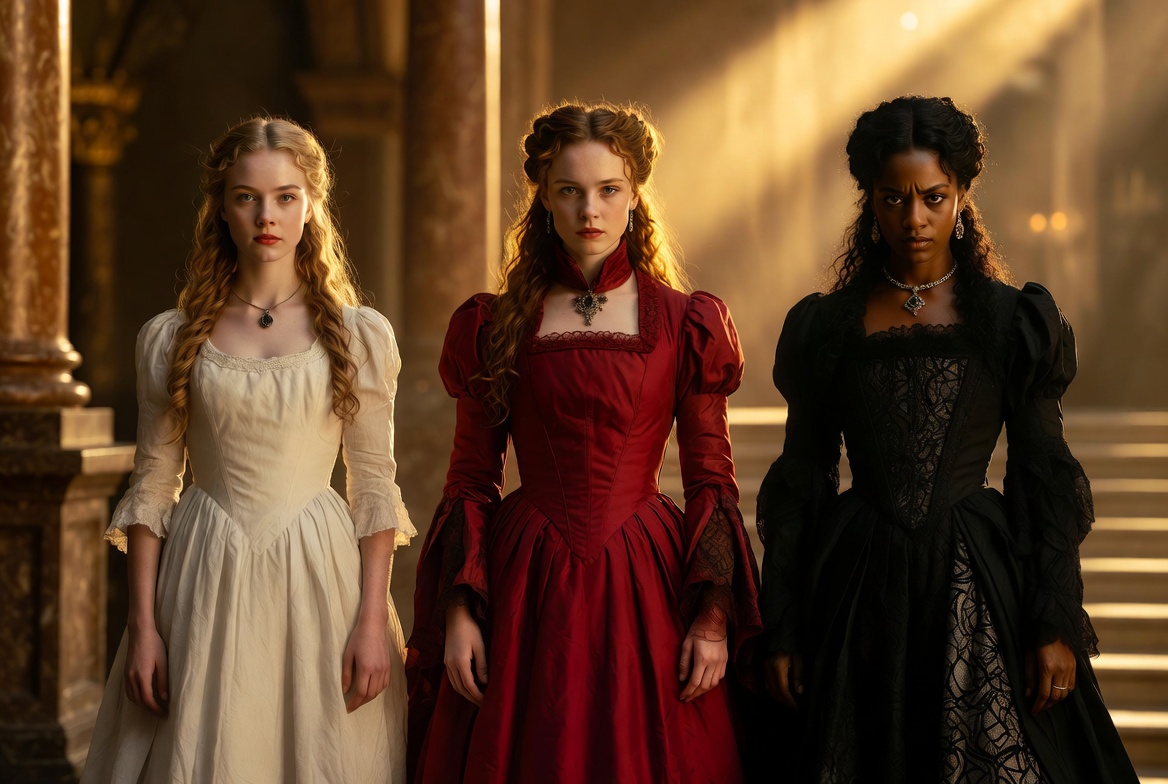
Cordelia represents authentic love and moral integrity. Her plain speech costs her everything yet ultimately redeems her father. In stark contrast, Goneril and Regan embody ruthless ambition and hypocrisy. Their flattery in Act 1 quickly gives way to calculated cruelty. Shakespeare carefully differentiates them: Goneril is more calculating and politically astute, while Regan delights in sadistic violence (she urges the blinding of Gloucester with glee). The sisters’ rivalry over Edmund underscores their moral corruption.
The Gloucester Subplot – Edgar, Edmund, and the Parallel Tragedy of Fatherly Blindness
The Gloucester storyline mirrors and intensifies the main plot. Gloucester is as gullible and hasty as Lear. His bastard son Edmund is one of Shakespeare’s most charismatic villains—intelligent, eloquent, and utterly amoral. Edmund’s famous soliloquy (“Thou, nature, art my goddess”) rejects societal legitimacy in favor of raw ambition. Edgar, initially naïve, grows through adversity into a figure of quiet strength and forgiveness. The parallel structure reinforces the play’s central theme: flawed fathers and treacherous or loyal children.
The Fool – Wisdom in Folly and Shakespeare’s Most Poignant Clown
The Fool is Lear’s conscience and emotional anchor. His songs and riddles cut through pretense with devastating clarity. Disappearing midway through the play (after Act 3), his absence marks Lear’s complete descent into madness. Many scholars interpret the Fool as a representation of Cordelia’s spirit or as Shakespeare’s own voice commenting on the action.
Supporting Figures: Kent, Albany, Cornwall, and the French King
Kent exemplifies unwavering loyalty, disguising himself to serve the king he loves. Albany evolves from weakness to moral courage, while Cornwall is pure brutality. The King of France, though minor, highlights the contrast between genuine worth and material value by marrying Cordelia without a dowry.
Character Comparison Table
| Character | Key Trait | Arc | Thematic Role |
|---|---|---|---|
| King Lear | Hubris → Humility | From rage to forgiveness | Fragility of power & self-knowledge |
| Cordelia | Honesty & Love | Steadfast loyalty | True vs. false affection |
| Goneril/Regan | Cruelty & Ambition | Increasing depravity | Betrayal & moral decay |
| Edmund | Cynical ambition | Partial repentance (too late) | Nature vs. custom |
| Edgar | Naïveté → Resilience | Growth through disguise | Redemption & endurance |
| The Fool | Bitter wisdom | Disappears mid-play | Truth-telling in chaos |
Major Themes Explored in the King Lear Play
The King Lear play is thematically dense, offering layers that reward repeated readings and viewings.
Power, Authority, and the Fragility of Kingship
Lear’s division of the kingdom exposes how authority depends on perception rather than inherent right. Once power is relinquished, chaos ensues. The play questions divine right and warns against rulers who prioritize flattery over competence.
Family Betrayal and the Breakdown of Natural Bonds
“Nothing will come of nothing” – the play relentlessly examines how the natural bond between parent and child can be destroyed by ingratitude and greed. The double father-child tragedy amplifies the horror of familial collapse.
Madness – Real, Feigned, and Societal
Lear’s madness is both personal and symbolic of a world turned upside down. Edgar’s feigned insanity allows him to survive and comment on society’s ills. Shakespeare suggests that true wisdom sometimes appears as madness in a corrupt world.
Justice, Injustice, and the Silence of the Gods
One of the most disturbing aspects of the King Lear play is its apparent nihilism. Good characters suffer terribly, and the heavens seem indifferent. The absence of divine intervention forces audiences to confront a universe without easy moral order.
Appearance vs. Reality and the Limits of Sight
The recurring motif of eyesight and blindness culminates in Gloucester’s literal blinding and Lear’s metaphorical awakening. “I stumbled when I saw,” Gloucester realizes—highlighting how outward vision can deceive while suffering brings inner clarity.
Aging, Gratitude, and the Inevitability of Suffering
Lear’s journey forces reflection on how society treats the elderly. The play asks painful questions about gratitude, duty, and what remains when power and youth fade.
Contemporary scholarship has added fresh perspectives: eco-critics see the storm as nature’s revenge on human hubris, while trauma studies examine the psychological toll of betrayal and loss.
Major Themes Explored in the King Lear Play (continued)
Appearance vs. Reality and the Limits of Sight (continued) The play repeatedly equates physical sight with moral and emotional insight. Lear’s initial “blindness” to his daughters’ true natures costs him everything. Gloucester’s literal blinding paradoxically grants him clearer vision of Edmund’s villainy and Edgar’s loyalty. These motifs culminate in Lear’s line, “Ay, every inch a king,” spoken in rags and madness—revealing that true kingship lies not in robes or retinues but in suffering and self-awareness.
Aging, Gratitude, and the Inevitability of Suffering In an era of rapidly aging populations, this theme feels especially urgent. Lear expects gratitude for the kingdom he bestows, yet receives betrayal. The play forces readers to confront uncomfortable questions: How do we treat our parents as they lose power? What debt do children owe? Shakespeare offers no simple answers, only the raw reality that suffering is woven into the human condition.
These themes interlock to create a tragedy of profound philosophical depth. Feminist readings highlight the misogynistic undertones in the portrayal of Goneril and Regan, while Marxist interpretations examine class dynamics between the king and the “poor naked wretches” on the heath. Eco-critical approaches see the storm as a warning about humanity’s fractured relationship with nature. Post-2000 scholarship, including works by Stephen Greenblatt and Jonathan Dollimore, continues to uncover new layers, proving the King Lear play’s inexhaustible richness.
Symbolism, Imagery, and Literary Devices That Make King Lear Timeless
Shakespeare’s mastery of language elevates the King Lear play beyond plot into poetic brilliance.
The Storm as External and Internal Chaos
The central storm in Act 3 is one of literature’s most powerful symbols. It mirrors Lear’s inner turmoil while representing the larger breakdown of cosmic and social order. “Let the great gods, / That keep this dreadful pudder o’er our heads, / Find out their enemies now” — Lear’s invocation shows nature itself participating in the judgment he seeks.
Eyes, Blindness, and the Metaphor of Insight
Beyond the literal blinding of Gloucester, imagery of sight permeates the text. References to “eyes,” “seeing,” and “nothing” create a dense web of meaning. The play suggests that true vision often requires the loss of physical sight or worldly power.
Animals and Beast Imagery
Shakespeare reduces humanity to its most primal state. Lear calls his daughters “pelican daughters” (who supposedly feed on their parents’ blood) and declares unaccommodated man “no more but such a poor, bare, forked animal.” Animal metaphors strip away civilization’s veneer, exposing raw instinct beneath courtly manners.
The Role of the Fool’s Rhymes and Proverbs
The Fool’s songs and paradoxes function as a Greek chorus, distilling complex ideas into memorable verse. Lines like “The hedge-sparrow fed the cuckoo so long / That it had its head bit off by its young” deliver bitter truths about parental folly.
Dramatic Irony and Tragic Structure
Dramatic irony abounds: the audience knows Cordelia’s love is genuine while Lear cannot see it; we watch Edmund’s schemes succeed while characters remain deceived. The structure builds relentlessly toward catastrophe, with each small betrayal compounding into total ruin.
10 Most Powerful Quotes from the King Lear Play with Analysis
- “Nothing will come of nothing.” (Lear, Act 1) – Establishes the theme of value and reciprocity.
- “I am a man / More sinned against than sinning.” (Lear, Act 3) – Marks the beginning of self-awareness.
- “As flies to wanton boys are we to th’ gods; / They kill us for their sport.” (Gloucester, Act 4) – Captures the play’s bleak cosmic vision.
- “Thou art a soul in bliss; but I am bound / Upon a wheel of fire.” (Lear to Cordelia, Act 4) – Conveys the agony of belated reconciliation.
- “Howl, howl, howl, howl!” (Lear, Act 5) – The rawest expression of grief in Shakespeare.
- “Ripeness is all.” (Edgar, Act 5) – A stoic acceptance of fate.
- “The weight of this sad time we must obey…” (Edgar, closing lines) – Offers the only consolation: endurance through honest speech.
These quotes continue to resonate in literature, film, and everyday discourse, demonstrating the King Lear play’s linguistic power.
Critical Reception and Performance History Through the Centuries
The King Lear play has had one of the most dramatic reception histories in English literature. Nahum Tate’s 1681 adaptation with a happy ending (Cordelia survives and marries Edgar) dominated the stage for over 150 years because audiences found Shakespeare’s original too painful. Romantic critics like Charles Lamb argued the play was too sublime for performance, better read than staged.
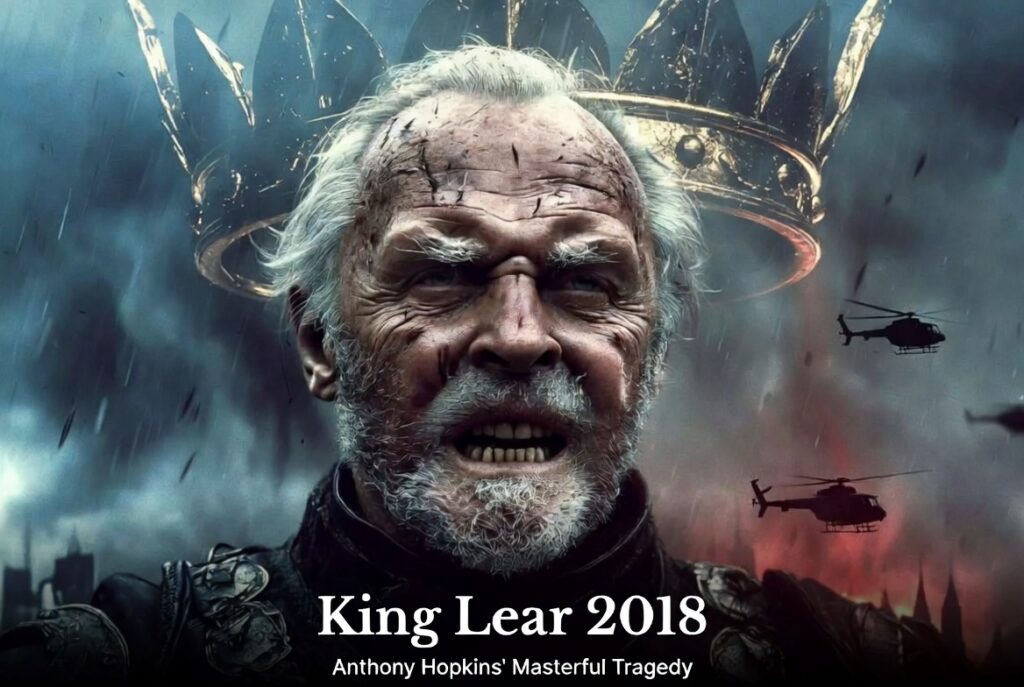
The 20th century restored the original text. Peter Brook’s 1962 RSC production, influenced by Jan Kott’s Shakespeare Our Contemporary, presented a bleak, absurdist vision that captured post-WWII despair. Iconic performances include Laurence Olivier (1946 and 1983), Ian McKellen (2007), and Anthony Hopkins in the 2018 BBC film. Kathryn Hunter became the first woman to play Lear in a major professional production in 1997, opening new interpretive doors. Recent decades have seen diverse casting, gender-swapped versions, and productions emphasizing mental health and elder abuse.
Scholarly views have evolved from A.C. Bradley’s character-focused analysis to postmodern readings that embrace the play’s nihilism. Today, trauma-informed and disability studies approaches examine the blinding scene and Lear’s madness with fresh sensitivity.
Why Shakespeare’s King Lear Play Still Matters in 2026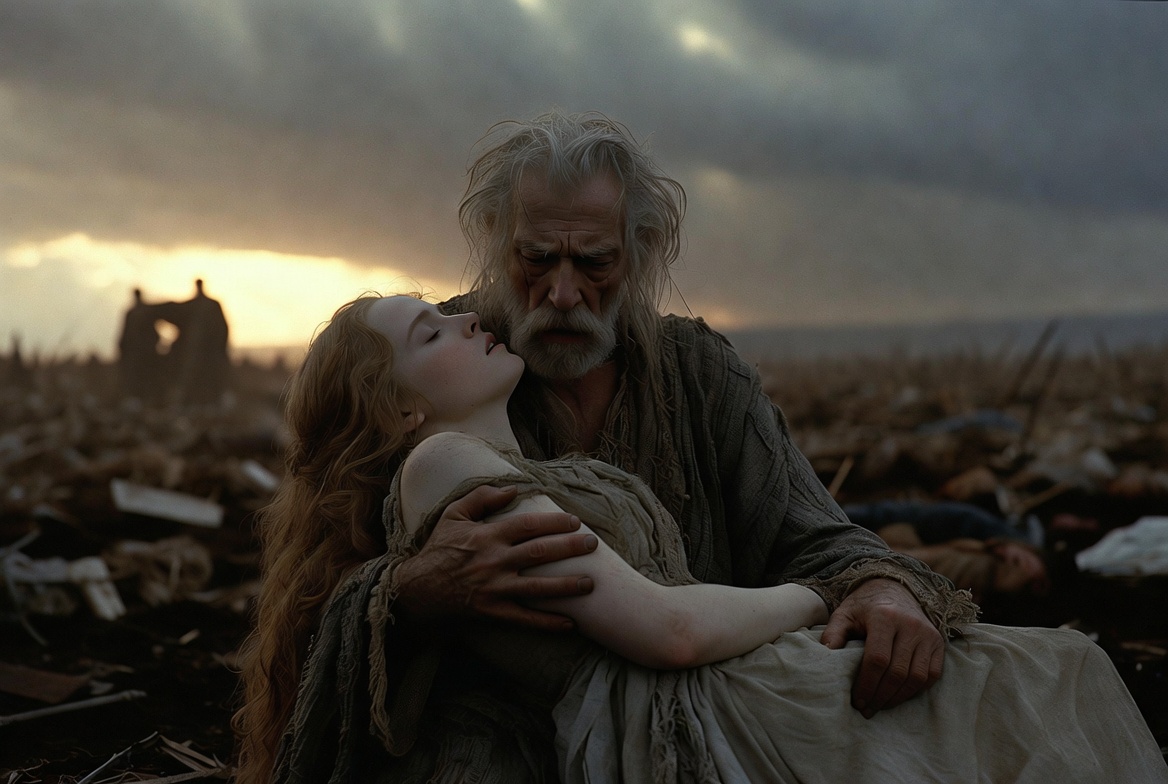
In 2026, the King Lear play feels more urgent than ever. Aging populations worldwide face questions of inheritance, caregiving, and dignity in later life. Political leaders cling to power or divide nations with reckless rhetoric, echoing Lear’s fatal division. Social media storms of public shaming parallel the literal tempest that exposes hypocrisy.
The play speaks directly to toxic family dynamics, where flattery masks resentment and genuine love is punished. It warns against leaders who value loyalty oaths over competence. In an age of climate crisis, the uncontrollable storm reminds us of nature’s indifferent power when human order collapses.
Modern adaptations keep the story alive: Akira Kurosawa’s Ran (1985) transposes the tale to feudal Japan with stunning visual impact; recent stage revivals incorporate diverse perspectives; graphic novels and young-adult retellings introduce new generations to the tragedy.
Ultimately, King Lear offers hard-won wisdom: honesty matters, power is fleeting, and suffering can forge compassion. It teaches us to “speak what we feel, not what we ought to say” before it is too late.
Study Guide and Essay Tips for Students and Teachers
10 Essential Essay Questions with Thesis Frameworks
- “To what extent is King Lear responsible for his own downfall?” Thesis example: While external betrayal accelerates the tragedy, Lear’s hubris and demand for flattery initiate the catastrophe.
- Discuss the significance of the Gloucester subplot. Thesis: The parallel plot intensifies the main themes while providing structural balance and thematic reinforcement.
How to Analyze King Lear for Exams (A-Level, AP Literature, IB)
- Focus on textual evidence: Always link quotations to themes and character development.
- Consider context: Jacobean politics, gender roles, and performance history add depth.
- Explore ambiguity: The play resists simple moral readings—embrace its complexity.
Recommended Resources
- Primary: Arden Shakespeare Third Series or Folger Edition
- Criticism: Stephen Greenblatt’s Will in the World, A.C. Bradley’s Shakespearean Tragedy
- Free online: MIT Shakespeare, Internet Shakespeare Editions
- Films: 2018 BBC with Anthony Hopkins; Ran (1985)
Discussion Questions for Book Clubs/Classrooms
- Which character do you find most tragic and why?
- How would the play change if Cordelia had flattered her father?
- What does King Lear suggest about the role of forgiveness?
Frequently Asked Questions About the King Lear Play
Is King Lear based on a true story? No. It draws from legendary British history recorded in Holinshed’s Chronicles and earlier plays, but Shakespeare invented the devastating tragic elements.
Why is the ending so bleak? Shakespeare deliberately rejects comforting resolutions to confront audiences with the full consequences of human actions. The nihilistic close forces deeper reflection on justice, love, and suffering.
What is the difference between the Quarto and Folio? The 1608 Quarto is longer and includes unique passages; the 1623 Folio is tighter with some cuts. Modern productions often blend both.
Who is the most tragic character? Opinions vary: many argue Lear for his profound suffering and growth; others cite Cordelia for her unjust death or Gloucester for his brutal blinding.
How long does it take to read or perform? Reading: 4–6 hours depending on pace. Full uncut performance: approximately 3.5–4 hours.
Best modern film adaptations?
- Ran (Akira Kurosawa, 1985)
- BBC King Lear (2018) with Anthony Hopkins
- Peter Brook’s 1971 film
Is King Lear Shakespeare’s greatest tragedy? Many scholars and theater professionals rank it alongside or above Hamlet for its emotional depth, philosophical weight, and theatrical power.
In the King Lear play, William Shakespeare holds up a merciless mirror to humanity’s capacity for cruelty, folly, and—rarely—redemption. From the divided kingdom to the storm-blasted heath and the final, heartbreaking tableau of a father cradling his dead daughter, the tragedy strips away illusions of power, loyalty, and cosmic justice. Yet in that very desolation lies its enduring value: it compels us to examine our own families, leaders, and selves with unflinching honesty.
Four centuries later, the storm still rages. Political divisions deepen, families fracture under pressure, and aging rulers (and citizens) grapple with diminishing authority. King Lear does not offer easy hope, but it does provide clarity. It teaches that true vision often comes through suffering, that flattery is poison, and that speaking truth—however costly—remains our best defense against chaos.
Whether you encounter the play on the page, stage, or screen, let it challenge you. Read it aloud with friends. Watch a powerful performance. Discuss its uncomfortable truths. In doing so, you join a centuries-long conversation about what it means to be human in a world where “the wheel is come full circle.”
The King Lear play remains essential because it refuses to look away from life’s harshest realities while still affirming the redemptive power of love, however brief or imperfect. As Edgar reminds us in the final lines, we must “speak what we feel.” In an age of performance and pretense, that may be the most radical—and necessary—lesson of all.