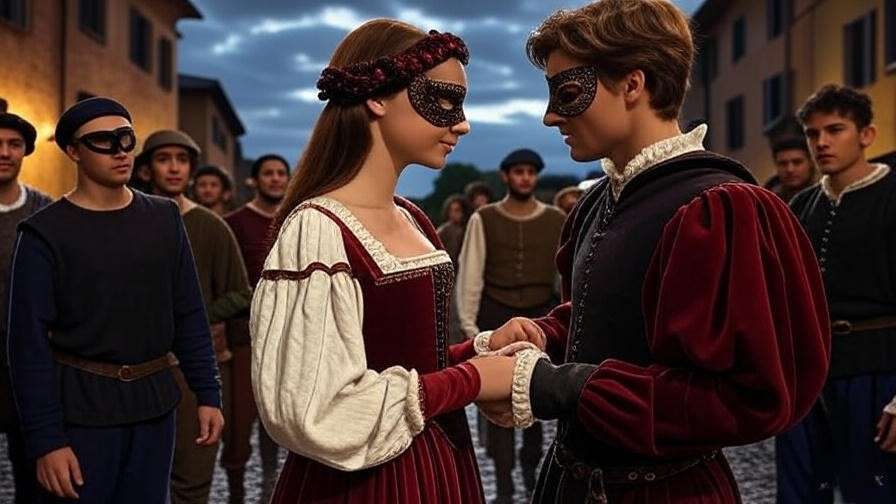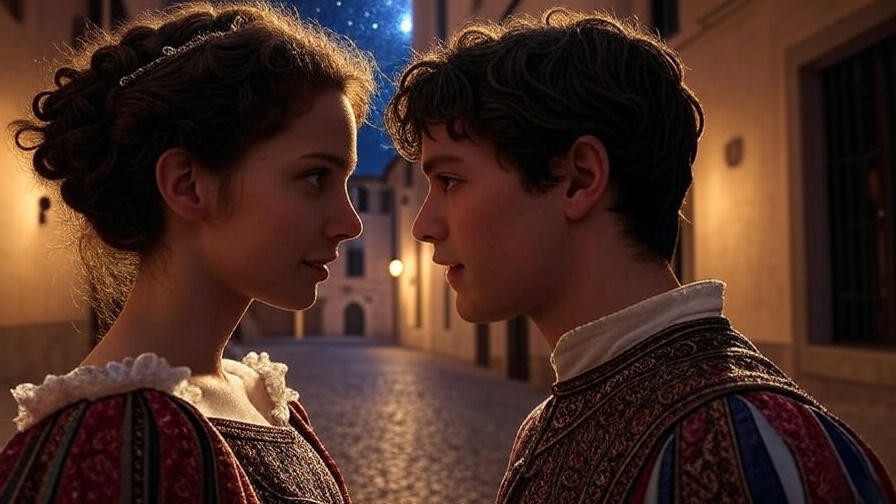
What do the soaring, poetic lines of William Shakespeare’s Romeo and Juliet and the rhythmic, train-chugging opening of Meredith Willson’s The Music Man have in common? At first glance, 16th-century London and 1912 River City, Iowa, seem worlds apart. Yet, both rely on a mathematically precise, heart-pounding rhythm to mesmerize an audience.
For modern actors, bridging the gap between classical verse and rapid-fire musical theater dialogue can feel like learning two entirely different languages. But what if mastering one unlocked the other? Whether you are a classical actor looking to conquer Broadway librettos, or a theater student hunting for a music man script pdf free download to practice your pacing, understanding stage rhythm is your ultimate cheat code.
Many contemporary performers treat musical theater dialogue and classical verse as distinct, separate entities. This often results in flat, disconnected performances where the inherent musicality of the spoken text is lost. The truth is, the foundational skills required to deliver a Shakespearean soliloquy are the exact same skills needed to nail a fast-talking Broadway pitch. By the end of this comprehensive guide, you will understand how to mark, breathe, and perform rhythmic text with absolute confidence.
The Heartbeat of the Stage: Understanding Iambic Pentameter
Before we can tackle the syncopated genius of modern musical theater, we must first understand the architectural foundation of rhythmic text: Shakespeare’s blank verse.
Why Shakespeare Wrote in Rhythm
William Shakespeare didn’t write in verse just to sound poetic; he did it out of sheer theatrical utility. The primary meter Shakespeare used is Iambic Pentameter. An “iamb” is a metrical foot consisting of one unstressed syllable followed by one stressed syllable (da-DUM). “Pentameter” means there are five of these feet in a single line, totaling ten syllables.
But, soft! what light through yonder window breaks? (da-DUM, da-DUM, da-DUM, da-DUM, da-DUM)
This specific rhythm was chosen because it mirrors the natural rhythm of the human heartbeat, as well as the natural cadence of the English language. For Elizabethan actors who had to memorize dozens of plays at a time with very little rehearsal, this rhythm acted as a mnemonic device. For the audience, the steady, pulsating beat created an unconscious emotional resonance, drawing them into the high stakes of the drama.
Beyond the Rhyme: Blank Verse as “Spoken Word”
A common misconception among early-career actors is that rhythm must equate to rhyming or a rigid, robotic delivery. In reality, Shakespeare’s blank verse is the 16th-century equivalent of modern “spoken word” poetry or rap.
Rhythm in a script is an emotional map left by the playwright. Shakespeare frequently broke his own metrical rules to give actors brilliant acting notes:
-
Missing syllables: If a line only has nine syllables, the playwright is literally building in a pause for a physical action, a breath, or a moment of hesitation.
-
Trochaic shifts: Reversing the beat to DA-dum signals sudden aggression, panic, or a shift in power.
Classical actors use a technique called scansion—the process of physically marking the stressed and unstressed syllables on their script—to decode this emotional map. Once you understand which words are meant to land on the downbeat, you can drive the scene forward with unstoppable momentum.
Enter Meredith Willson: The Shakespeare of Syncopation
Fast forward to 1957. Broadway is introduced to The Music Man, a masterpiece with a book, music, and lyrics by Meredith Willson. Willson did something revolutionary: he took the rhythmic, driving force of classical text and cranked it up to a syncopated, distinctly American tempo.
The Rhythmic Genius of The Music Man
The Music Man is largely considered one of the first mainstream musicals to heavily feature rhythmic “speak-singing.” Long before Lin-Manuel Miranda brought the complex internal rhymes of hip-hop to Hamilton, Meredith Willson was using spoken rhythm to create absolute musical magic.
Willson understood that in the world of salesmanship, the sound of the words is just as persuasive as the meaning of the words. He crafted dialogue that demanded a metronome-like precision from its actors. If you miss a beat, drop a consonant, or breathe in the wrong place, the entire illusion collapses.
Harold Hill vs. The Classical Monologue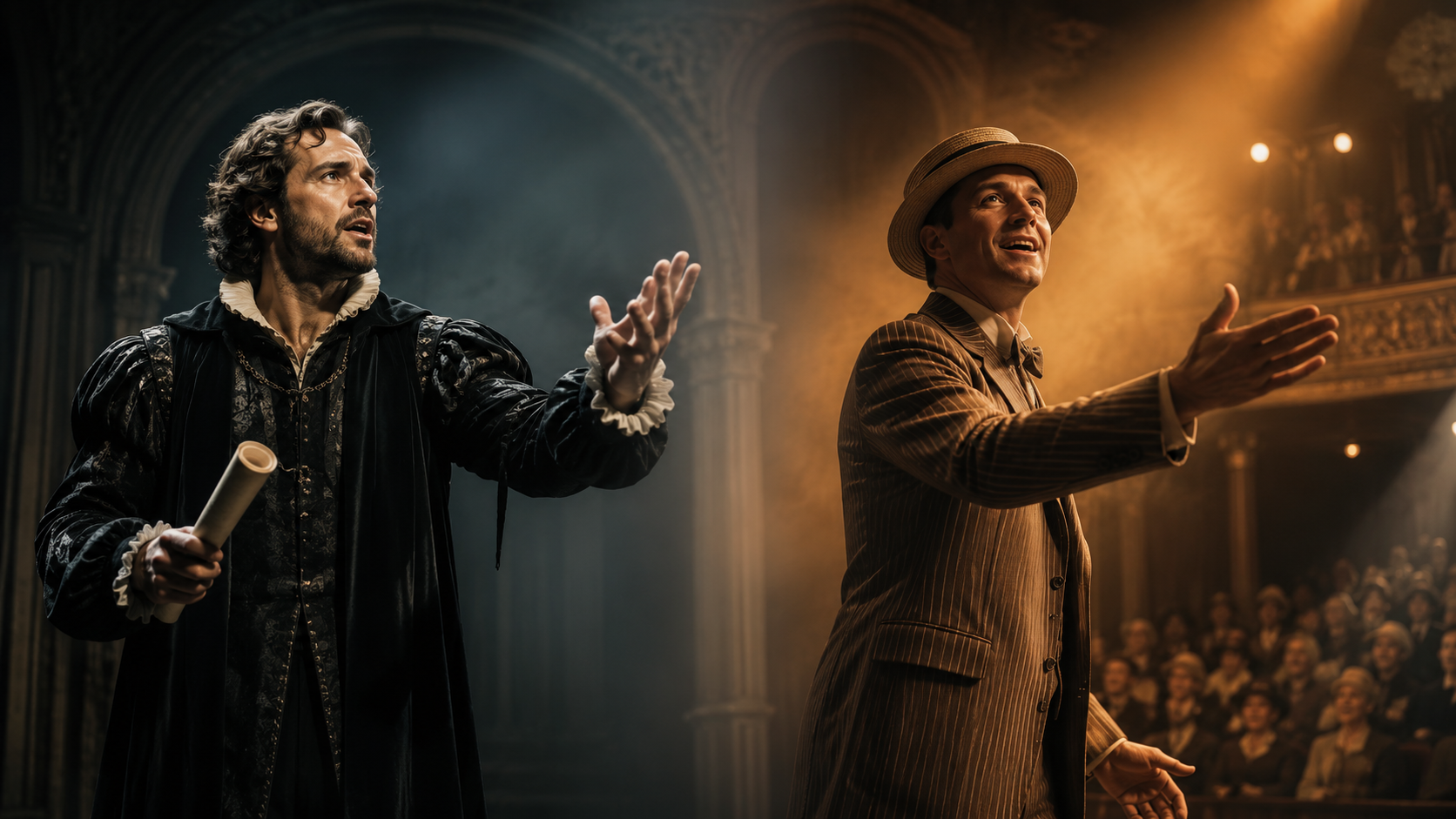
Let’s look at the show’s charismatic anti-hero, Professor Harold Hill. Hill is, in many ways, a Shakespearean orator. Compare Harold Hill to Marc Antony in Julius Caesar. Both characters step in front of a skeptical, potentially hostile crowd and use rhetoric, relentless pacing, and specific vocal rhythms to manipulate the masses.
In the famous “Ya Got Trouble” sequence, Harold Hill doesn’t sing a melody; he preaches on a precise rhythm. The underlying percussion in the orchestra acts exactly like Shakespeare’s metrical feet.
-
Shakespeare: “Friends, Romans, countrymen, lend me your ears!”
-
Willson: “Right here in River City! Trouble with a capital ‘T’ and that rhymes with ‘P’ and that stands for pool!”
Both lines require the actor to lean heavily on hard consonants, ride the momentum of the underlying beat, and push through to the end of the thought without dropping their energy. The syncopation in Willson’s work requires the actor to find the “pocket” of the rhythm—landing words slightly ahead of or behind the musical beat to create a sense of improvisational swagger.
Your Resource: The Music Man Script PDF Free Download
To truly master these techniques, you cannot simply listen to the original Broadway cast recording or watch the film adaptation. You must get the text in your hands.
Why You Need to Read the Text Out Loud
Listening to Robert Preston or Hugh Jackman perform the role is fantastic for inspiration, but it can be detrimental to your own artistic process. If you only learn by listening, you will inevitably mimic their breathing patterns and their vocal inflections.
To build your own performance, you must look at the words on the page. You need to see where Willson placed the punctuation, where the line breaks occur, and how the dialogue is visually structured. This is why having a physical or digital script is non-negotiable for serious study. You need a document you can mark up with a pencil, circling consonants, slashing breath marks, and underlining stressed syllables.
Where to Find Your Script Safely
Finding scripts online can sometimes be a legal gray area, but there are legitimate ways to access perusal copies for educational and practice purposes.
If you are searching for a music man script pdf free download, your best approach is to utilize educational theater resources. Companies like Music Theatre International (MTI), which holds the licensing rights to The Music Man, often provide digital perusal scripts or “Broadway Junior” libretto samples for educators and directors. Additionally, digital libraries and academic archives like Scribd or university theater portals frequently host script excerpts and full educational texts for students studying musical theater history.
When you download your PDF for educational study, treat it like a masterclass workbook. Print out the specific scenes we are about to discuss, and get your pencil ready.
How to Apply Classical Techniques to Broadway Scripts
Now that you have your script ready for study, it is time to bridge the gap between Elizabethan London and River City. The process of marking a musical theater libretto is surprisingly similar to analyzing classical verse. Here is a three-step technique to master any rhythmic dialogue.
Step 1: Scanning the Libretto
In Shakespearean study, scansion is the act of marking the stressed and unstressed syllables. You can apply this exact same methodology to Meredith Willson’s text. Take your printed script and a pencil. Read Harold Hill’s dialogue aloud, completely ignoring the musical notes or the cast recording. Speak it as if it were a regular monologue.
Listen to your own natural speech patterns. Where does the emphasis naturally fall?
-
Place a small slash (
/) over words that require emphasis (usually nouns, active verbs, and key descriptors). -
Place a small “u” (or a dot) over unstressed words (usually articles like “the,” “a,” or conjunctions).
When you scan The Music Man, you will quickly realize that Willson’s dialogue is heavily weighted on the downbeat. Hitting those stressed syllables precisely on the musical beat is what gives the dialogue its infectious, toe-tapping quality.
Step 2: The “Consonant Spine” Technique
Classical actors are trained to use hard consonants—specifically plosives like T, K, P, B, and D—to drive a line forward and ensure their voice reaches the back of the theater without shouting. In rhythmic musical theater, consonants are your percussion instruments.
Look at the opening train sequence, “Rock Island.” The salesmen simulate the sound of a moving train entirely through their diction.
“Cash for the merchandise, cash for the button hooks / Cash for the cotton goods, cash for the hard goods…”
The repeated, hard “C” in “Cash,” the sharp “T” in “cotton,” and the biting “K” in “hooks” act as the snare drum for the scene. If you soften your consonants, the train literally loses its steam. Highlight or circle the hard consonants in your script and practice over-enunciating them. This “consonant spine” gives your performance an irresistible, driving energy.
Step 3: Finding the Breath
One of the greatest challenges of performing fast-paced, rhythmic text is running out of air. In classical verse, a natural pause within a line is called a caesura. Actors use these built-in pauses to take a quick, silent catch-breath.
Harold Hill is notorious for his mile-a-minute pitches, which can leave an unprepared actor gasping for air and falling behind the conductor’s tempo. You must choreograph your breathing just as carefully as your physical movements.
-
Go through your script and mark your breaths with a large “V” or a double slash (
//). -
Never breathe in the middle of a thought or a rhythmic phrase. Find the punctuation marks, the natural shifts in logic, or the brief orchestral rests to snatch your breath.
-
Support your breath from your diaphragm. Rhythmic speaking requires intense core support to keep the vocal tone energized throughout a long, syncopated stanza.
3 Iconic Scenes to Practice Your Timing
Ready to put these techniques to the test? Open your downloaded script and navigate to these three masterclasses in rhythmic pacing.
Scene 1: “Rock Island” (The Warm-Up)
The Focus: Ensemble timing and passing the baton. This opening scene contains no music—only the spoken rhythm of traveling salesmen mimicking a train. It is the ultimate test of ensemble listening. Practice this scene by clapping the underlying tempo (chugga-chugga, chugga-chugga). Notice how one salesman’s line seamlessly overlaps or dovetails into the next. To succeed here, you must anticipate your cue; if you wait for the previous actor to finish speaking before you inhale, you are already late.
Scene 2: “Ya Got Trouble” (The Persuasion)
The Focus: Building momentum and hitting the punchlines. This is Harold Hill’s masterpiece of manipulation. The scene starts as a slow, conversational warning and builds into a frenzied revival meeting. Map out the emotional build. Use your scansion to identify the “target words” in each phrase. The rhythm should feel like a boulder rolling down a hill—gathering speed and weight. Pay special attention to how Willson uses rests (pauses) for comedic effect. Sometimes, the most powerful rhythm is the silence right before the punchline.
Scene 3: Marian and Mrs. Paroo (The Counter-Rhythm)
The Focus: Staccato vs. Legato. Look at the scene featuring the song “Piano Lesson / If You Don’t Mind My Saying So.” Marian Paroo, the intellectual librarian, speaks and sings with a smooth, flowing (legato) rhythm. Her mother, Mrs. Paroo, speaks in a bouncing, rhythmic Irish brogue (staccato). This scene is brilliant because it operates like a Shakespearean comedy duo (think Beatrice and Benedick from Much Ado About Nothing). Practice bouncing the differing rhythmic energies off a scene partner. The comedy arises from the friction between Marian’s smooth phrasing and her mother’s sharp, rhythmic interjections.
Frequently Asked Questions (FAQ)
To further guide your study, here are answers to some of the most common questions actors have when tackling rhythmic librettos.
Is The Music Man in the public domain?
No, The Music Man is not in the public domain. The theatrical rights, including the libretto and the musical score, are tightly protected by copyright law and are licensed by Music Theatre International (MTI). While you can often find a music man script pdf free download for perusal, educational, or classroom study purposes, you must officially license the show and rent the authorized materials to mount a public performance.
How hard is it to memorize rapid-fire dialogue like Harold Hill’s?
It looks incredibly intimidating on the page, but many actors find rhythmic dialogue easier to memorize than standard prose! Because the text relies heavily on an underlying beat and musicality, your body develops muscle memory. Just like Shakespeare’s iambic pentameter, the rhythm itself becomes a mnemonic device. If you drop a word, your ear will naturally tell you that the rhythm is “off.”
What is the best way to practice rhythmic dialogue at home?
The most effective practice routine involves three steps:
-
Tap the Beat: Walk around your room or tap a pencil on a desk to establish a steady, unyielding tempo.
-
Over-enunciate: Speak the text at this tempo while exaggerating every single consonant. It should feel ridiculous and sound robotic.
-
Speak at Half-Speed: Slow the tempo down by 50%. This forces you to connect with the meaning of the words, rather than just relying on the speed to get you through the scene. Once the meaning is anchored, bring it back up to tempo.
Take the Stage with Confidence
The dazzling speed of Broadway and the poetic depth of Shakespeare are not opposing forces; they are branches of the same theatrical tree. Masterful acting is rooted in rhythm. Whether you are delivering a heartbreaking classical soliloquy or selling seventy-six trombones to a crowd of skeptical Iowans, the heartbeat of the text is what connects you to the audience.
By treating a musical theater libretto with the same rigorous analytical respect as a piece of classical verse—marking your scansion, utilizing your consonants, and mapping your breath—you will unlock a level of dynamic performance that sets you apart in any audition room.
Grab your pencil, open your music man script pdf free download, and start marking the beat. The stage is yours. Let us know in the comments below which character you are currently studying, or which Shakespearean monologue you think shares the same electric energy as a Harold Hill pitch!