
Imagine the scratch of a sharpened goose-feather nib against rough parchment, the sharp, metallic tang of iron gall ink permeating the cold London air, and the erratic flicker of candlelight casting long shadows across a wooden desk. Modern readers and writers often view William Shakespeare’s dialogue as an unapproachable act of spontaneous, divine genius. We read his folios and marvel at the prose, completely missing the physical, tangible mechanics behind the magic. But to truly understand his brilliance, we must examine his primary tool. The secret to his enduring syntax lies in the quill sentence—a sentence whose rhythm, length, and dramatic flow were fundamentally shaped by the physical limitations of writing by hand in the late 16th century.
By analyzing how the tactile realities of Elizabethan writing tools influenced his rhetoric, we will uncover how Shakespeare crafted his greatest lines. For students, actors, and modern writers, understanding these mechanics provides profound insights into the architecture of the English language.
II. What Exactly is a “Quill Sentence”?
To appreciate the architecture of Shakespeare’s writing, we must first strip away the modern conveniences of word processors, ballpoint pens, and mechanical keyboards. Writing during the English Renaissance was a highly physical, labor-intensive act.
Defining the Term in a Historical Context
In the late 1500s and early 1600s, a playwright’s primary tool was the quill—typically a flight feather from a goose or swan, hardened by heat and meticulously carved with a penknife to create a nib. This tool dictated a specific rhythm. A quill can only hold a limited amount of ink before it must be re-dipped. This physical reality meant that a writer could only draft a few words—usually around five to seven—before being forced to pause.
A quill sentence is a thought structured explicitly around these natural, mechanical pauses. Instead of the endless, unbroken streams of consciousness possible on a modern laptop, the quill necessitated built-in commas, rhythmic breaks, and a flowing cadence that perfectly matched the capacity of the pen and, consequently, the capacity of human breath.
The Marriage of Thought and Tool
The friction of the quill against parchment forced a deliberate, measured pacing. Unlike the rapid-fire typing of modern keyboards, where the fingers can barely keep up with the mind, the quill forced the mind to pace itself to the speed of the hand.
This marriage of thought and tool birthed a unique rhetorical style. The physical limitation of the ink dip naturally aligned with the creation of blank verse—unrhymed iambic pentameter. The pacing required to dip the pen, form the letters with wet ink, and ensure the parchment didn’t blot, created a structural heartbeat that became the defining characteristic of Elizabethan stagecraft. The tool didn’t hinder Shakespeare’s genius; it provided the scaffolding for it.
III. The Anatomy of Shakespeare’s Quill Sentence
To deconstruct why a quill sentence is so effective, we must look at its grammatical and structural anatomy. Shakespeare did not just write words; he wrote oral architecture.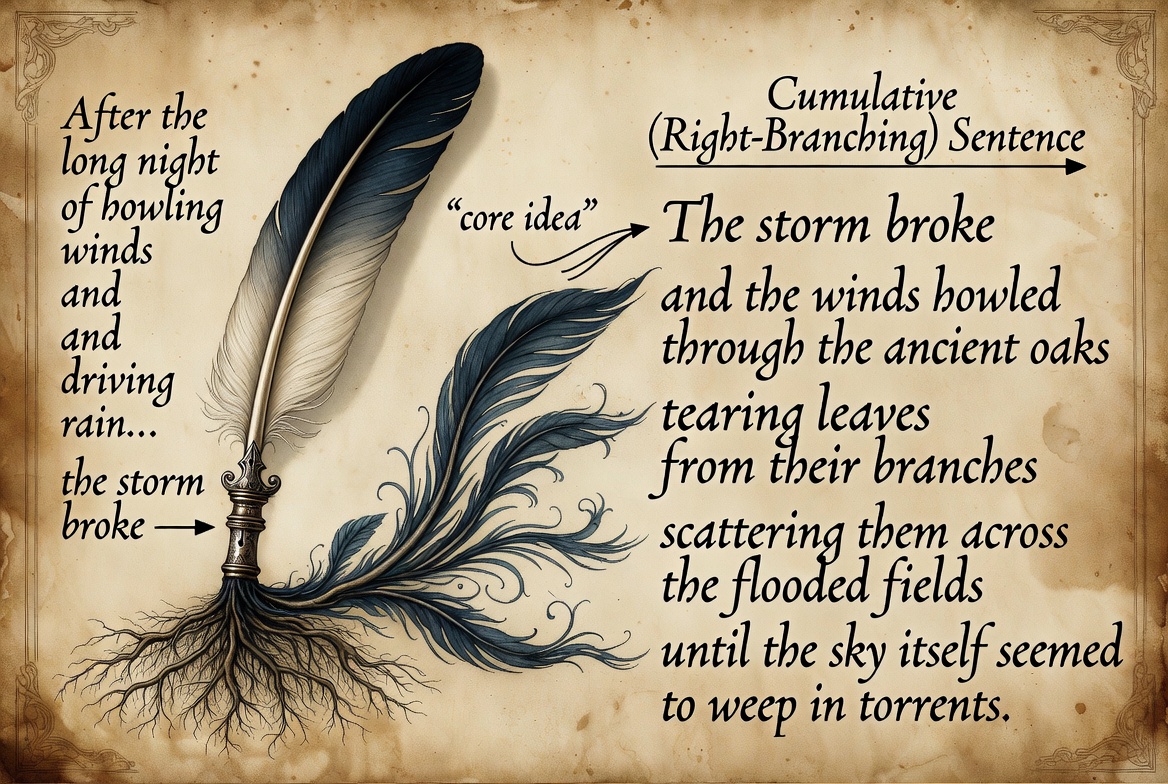
Iambic Pentameter and the Dipping of the Pen
Iambic pentameter consists of lines of ten syllables, broken into five “iambs” (a two-syllable pairing of an unstressed syllable followed by a stressed one: da-DUM da-DUM da-DUM da-DUM da-DUM).
Remarkably, a standard quill dip provided just enough ink to comfortably write a ten-syllable line before the ink began to thin. The rhythm of the iambic line mirrors the heartbeat, but it also mirrors the cyclical rhythm of the writer’s hand: dip, write, pause, dip, write, pause. Shakespeare weaponized this rhythm. When a character’s emotional state is stable, the ten-syllable quill sentence flows perfectly. When a character is panicked, grieving, or enraged, Shakespeare breaks the rhythm—and the physical flow of the quill—creating fragmented, jagged lines that immediately signal psychological distress to the audience.
Left-Branching vs. Right-Branching Sentences
Modern academic writing often relies on “left-branching” sentences, where subordinate clauses pile up before the main subject and verb are finally revealed. (e.g., Despite the heavy rain and the fact that the roads were completely flooded, the messenger arrived.)
Shakespeare’s quill sentence, however, relies heavily on “right-branching” or cumulative syntax. Because he was writing linearly and rapidly, he would state his main subject and verb immediately, and then let the rest of the sentence flow continuously from the nib, gathering descriptive clauses like a rolling snowball.
“The quality of mercy is not strained; / It droppeth as the gentle rain from heaven / Upon the place beneath.” (The Merchant of Venice)
The core thought (“The quality of mercy is not strained”) is established instantly. The quill then continues to add layers (“It droppeth… Upon the place…”). This structure is not just a stylistic choice; it is the natural byproduct of a mind generating ideas as the wet ink hits the page, building emotion and imagery as the sentence progresses.
The Power of the Caesura (The Mid-Line Pause)
A caesura is a strong pause within a line of verse, often indicated by punctuation like a comma, colon, or period. In the context of the quill sentence, the caesura represents the moment the pen is lifted.
Shakespeare used these physical pauses to create dramatic tension. By placing a full stop in the middle of a ten-syllable line rather than at the end, he created a jarring, syncopated rhythm. The actor is forced to stop, take a breath, and change their thought process mid-stream. The physical need for the playwright to pause translated directly into psychological tension on the stage.
IV. 4 Masterclasses in the Quill Sentence (Textual Analysis)
To truly demonstrate how this historical tool governed the greatest literature of the English Renaissance, we must examine the text itself. Across his canon, Shakespeare adapted the quill sentence to fit different genres, moods, and psychological states.
Hamlet – The Rhythm of the Soliloquy
Nowhere is the psychological weight of the quill sentence more evident than in the tragedy of the Prince of Denmark. Let us examine the most famous soliloquy in the English language: “To be, or not to be, that is the question.”
If you look at the structure of Hamlet’s speeches, particularly in the First Folio, the phrasing is heavily fragmented. The quill dips and pauses are frequent, creating a stuttering, hesitating cadence. The sentence structure perfectly captures a mind debating itself in real-time. The physical act of stopping the pen mirrors Hamlet’s inability to move forward with his revenge. Every comma and semi-colon acts as a roadblock of overthinking. The quill sentence here is not a flowing river, but a series of jagged, agonizing steps toward an impossible decision.
The Tempest – Fluidity and Magic
In stark contrast to the start-and-stop hesitation of Hamlet, The Tempest showcases the quill sentence at its most fluid and atmospheric. The sweeping, lyrical sentences of Prospero mirror the rolling waves and the magical, ethereal atmosphere of the island. The ink flows continuously, creating long, hypnotic passages of blank verse.
We also see the quill sentence used brilliantly to track character development. When examining the character of Miranda in The Tempest—particularly her journey from a dutiful daughter to Shakespeare’s radical heroine—we can observe a structural shift in her dialogue. Early in the play, her sentences are short, reactive, and punctuated frequently, reflecting her sheltered obedience. As she claims her agency, her quill sentences become longer, more assertive, and less reliant on the pauses dictated by her father’s dominant rhetoric.
Henry V – Rhetorical Momentum
When Shakespeare needed to rally an army, the quill sentence transformed into a percussive instrument. The St. Crispin’s Day speech in Henry V is a masterclass in escalating momentum.
“We few, we happy few, we band of brothers; / For he to-day that sheds his blood with me / Shall be my brother…”
Notice the rapid-fire succession of short, punchy clauses at the beginning: We few, we happy few, we band of brothers. The pen is striking the page like a drumbeat. As the King’s passion builds, the clauses grow longer and the dips of the quill become farther apart, creating a rising tide of rhetorical momentum that sweeps the exhausted soldiers—and the audience—into a frenzy of patriotic fervor.
Antony and Cleopatra – Opulent Clauses
To convey the unimaginable wealth and seductive power of the Egyptian queen, Shakespeare employed heavily “inked,” luxurious syntax. Enobarbus’s famous description of Cleopatra’s barge is an exercise in right-branching, cumulative excess:
“The barge she sat in, like a burnish’d throne, / Burn’d on the water: the poop was beaten gold; / Purple the sails, and so perfumed that / The winds were love-sick with them…”
The quill sentence here is laden with heavy adjectives and piling sub-clauses. The sentence structure itself feels expensive, dripping with sensory details. The continuous flow of ink mirrors the heavy, intoxicating atmosphere of the Nile, demonstrating how Shakespeare manipulated his writing tool to create not just sound, but texture.
V. How the Physical Quill Shaped Elizabethan Stagecraft
The impact of the quill sentence extended far beyond the manuscript; it was the foundational blueprint for how Elizabethan actors performed on the stage of the Globe Theatre.
Writing for the Actor’s Breath
In the modern era, punctuation is strictly a matter of grammatical correctness. In Shakespeare’s era, punctuation was highly performative. The commas, colons, and full stops found in original texts like the First Folio often reflect the literal moments Shakespeare had to lift his quill.
Fascinatingly, these physical pauses doubled as essential stage directions. Because the ink ran out right when a normal human breath would expire, the punctuation told the actors exactly when to breathe. A long, unpunctuated quill sentence required the actor to deliver the line with rushing, breathless urgency. A heavily punctuated line demanded a slow, deliberate, and measured delivery. The quill dictated the physical exertion of the actor.
The Speed of Production
We must also acknowledge the brutal reality of Renaissance theatrical deadlines. Shakespeare was not writing leisurely in an ivory tower; he was a shareholder in a fast-paced repertory company. They produced dozens of plays a year, and the playwright had to generate material at breakneck speed.
The quill sentence had to be hyper-efficient. There was no time for endless revisions or structural agonizing. The cumulative, right-branching sentence allowed Shakespeare to write forward continuously without losing his train of thought. He could establish his premise at the start of the sentence and embellish it on the fly, saving precious time while still producing deeply evocative dialogue.
VI. Writing Your Own “Quill Sentence”: Lessons for Modern Writers
While we have traded parchment and ink for glowing screens and blinking cursors, the underlying principles of the quill sentence remain remarkably relevant. Modern writers, copywriters, and novelists can drastically improve their prose by studying Shakespeare’s tactile methodology.
1. Slow Down to Speed Up
The friction of the quill forced deliberate word choices. Today, our fingers move so fast that we often type clichéd, uninspired filler words just to keep the momentum going.
-
The Lesson: Try drafting your most important passages longhand. The physical friction of a pen on paper forces your brain to slow down and consider each word before committing it to the page. You will find your vocabulary sharpens and your syntax becomes tighter.
2. Write for the Ear, Not Just the Eye
Shakespeare’s sentences were meant to be spoken, meaning they were naturally constrained by human lung capacity. Modern writing is often entirely visual, resulting in sprawling, breathless paragraphs that exhaust the reader’s mental voice.
-
The Lesson: Read your work aloud. If you find yourself running out of breath, your “quill” has run out of ink. Insert a full stop. Build rhythmic breaks into your paragraphs to give your reader a chance to inhale.
3. Embrace the Cumulative Sentence
As discussed, Shakespeare favored the right-branching sentence, stating his main point early and adding color as the sentence progressed.
-
The Lesson: Instead of burying your main subject at the end of a long, tangled web of introductory clauses, hit the reader with the core action immediately. Then, let the rest of the sentence gather descriptive details, mimicking the natural, forward-rolling momentum of the human thought process.
VII. Frequently Asked Questions (FAQs)
Did Shakespeare write exclusively with a quill? Yes. During the late 16th and early 17th centuries, the goose or swan feather quill was the universal writing instrument in England. Pencils (graphite) were discovered during Shakespeare’s lifetime but were not widely used for formal manuscript drafting, and metal-nibbed dip pens were not mass-produced until the 19th century.
How did the type of ink affect Shakespeare’s sentence structure? Elizabethan writers primarily used iron gall ink, made from oak galls, iron sulfate, and water. It was highly acidic and flowed quite wet. Because it required a moment to dry and absorb into the rag paper or parchment to prevent smudging, writers naturally adopted a rhythmic pacing—writing a short burst of text, lifting the pen, and continuing. This pacing is ingrained in the meter of his plays.
What is the longest sentence Shakespeare ever wrote? While debated depending on which edition’s punctuation you follow, one of the most famously long, continuous thoughts occurs in Polonius’s speeches in Hamlet, or some of the massive, labyrinthine legalistic arguments in Henry V. However, true to the quill sentence form, these long passages are heavily broken up by semi-colons and colons, acting as a series of connected shorter bursts rather than one uninterrupted grammatical marathon.
How do you write a modern quill sentence? To write a modern quill sentence, prioritize rhythm and breath over sheer length. State your subject and verb early, allow the sentence to gather descriptive clauses chronologically, and punctuate naturally where a speaker would need to pause for air.
VIII. Conclusion
The myth of William Shakespeare often obscures the craftsman at work. By examining the quill sentence, we strip away the intimidating aura of his genius and reveal something much more accessible and inspiring: a working writer adapting his profound thoughts to the physical limitations of his tools.
The rhythm of the dipping pen became the heartbeat of iambic pentameter. The friction of the nib created the structural pacing of Elizabethan stagecraft. The necessity to pause for ink gave us the dramatic caesuras that actors have relied upon for over four centuries. Shakespeare proves that the constraints of a medium do not limit creativity; they focus it. While our writing tools have evolved from hardened feathers to digital keyboards, the foundational rhythm of a great sentence remains forever tied to the human breath.