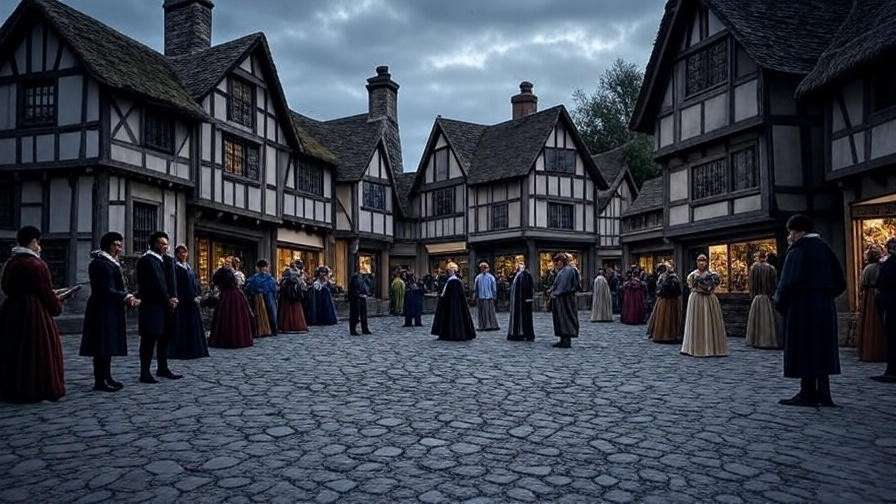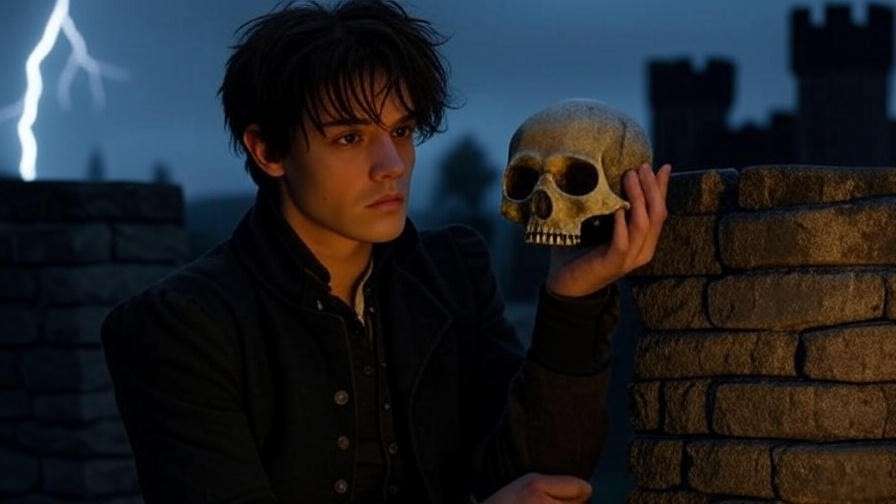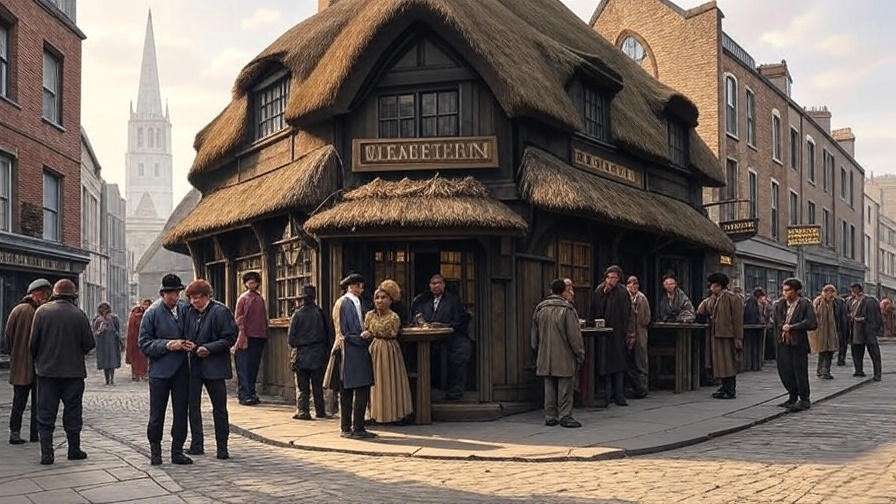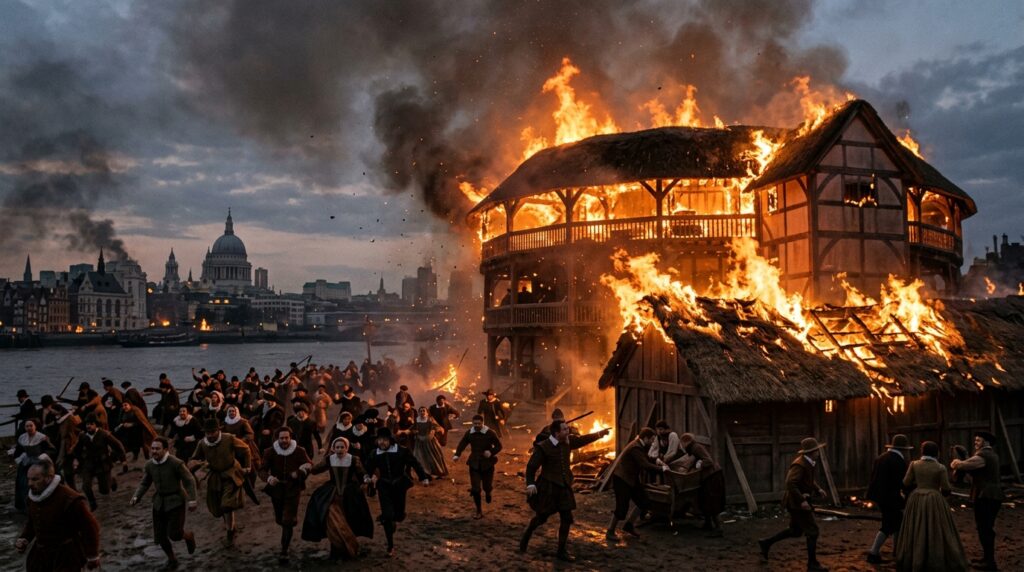
On a warm Tuesday afternoon on June 29, 1613, two massive iron cannons let loose a thunderous discharge across the Thames into the Southwark sky. Staged to mark the royal entrance of King Henry VIII inside the Globe Theatre, the theatrical effect was meant to awe the audience. Instead, a stray piece of burning wadding landed on the thatched roof above the gallery. Within minutes, smoke filled the open-air playhouse. Within an hour, the grandest stage of the English Renaissance was reduced to ash.
For centuries, literature enthusiasts, theatregoers, and students searching for accounts of the historic Hamlet fire have grappled with a persistent historical tangle: did Shakespeare’s iconic revenge tragedy burn the Globe to the ground, or did fire play a very different role in the history of the King’s Men?
The short answer is that while the catastrophic 1613 blaze occurred during a performance of Henry VIII, the legend of a Hamlet fire persists because of how deeply pyrotechnics, public tragedy, and infernal imagery are woven into the fabric of Hamlet itself.
Resolving this historical misattribution requires exploring how physical fire operated inside the high-stakes world of Elizabethan stagecraft, examining primary sources from that fateful afternoon in 1613, and analyzing how William Shakespeare used fire as a dominant psychological and metaphysical force within the text of Hamlet.
Misconceptions Cleared: The 1613 Globe Theatre Fire
To understand why casual readers frequently confuse the 1613 Globe tragedy with Hamlet, one must examine how historical memory collapses major cultural events over time. Hamlet (written around 1599–1601) was already a monumental theatrical hit by the time the Globe caught fire in 1613. It was performed repeatedly at the playhouse, at the royal court, and on tour at Oxford and Cambridge. Because of its massive cultural imprint, later generations often reflexively attached the Globe’s physical destruction to Shakespeare’s most famous masterpiece.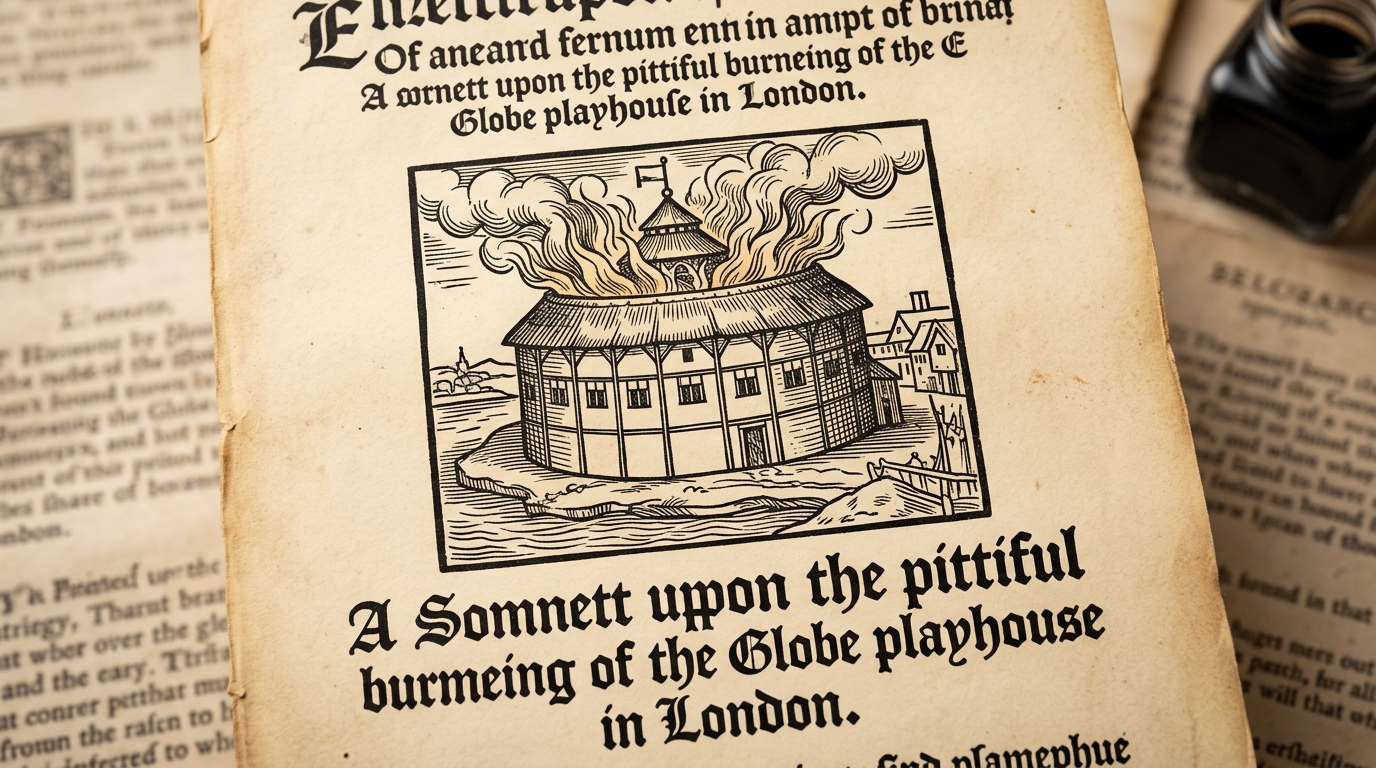
+-----------------------------------------------------------------------------------+
|                        THE GLOBE THEATRE FIRE: AT A GLANCE                        |
+------------------------------------+----------------------------------------------+
| Event Date                         | June 29, 1613                                |
| Play Being Performed               | All Is True (Henry VIII)                     |
| Cause of Ignition                  | Cannon wadding igniting thatched roof straw  |
| Casualty Count                     | 0 fatalities (1 man's pants set ablaze)     |
| Rebuilding Completed               | June 1614 (Rebuilt with a tiled roof)        |
+------------------------------------+----------------------------------------------+
What Really Happened on June 29, 1613?
On the day of the disaster, the King’s Men were staging a performance of All Is True, the play now cataloged in Shakespeare’s first folio as Henry VIII. In Act I, Scene 4, Cardinal Wolsey hosts a lavish banquet. To announce the dramatic entry of King Henry VIII in disguise, the stage crew fired two real chamber cannons (chambers) mounted on the roof over the tiring-house.
Rather than harmless blank charges, these early modern pyrotechnics used real black gunpowder held down by paper or wadding. When fired, a piece of glowing, unburnt wadding drifted upward, caught the breeze, and lodged inside the dry, thatched reed roof covering the surrounding galleries.
Sir Henry Wotton, a diplomat and writer who was present in the audience, recorded an eyewitness account in a letter to his nephew on July 2, 1613:
“Now, King Henry making a masque at the Cardinal Wolsey’s house, and certain chambers being shot off, some of the paper, or other stuff, wherewith they were stopped, did light on the thatch; where being thought at first but an innocent smoke, and the eyes of the spectators being more attentive to the show, it kindled inwardly, and ran round like a train, consuming within less than an hour the whole house to the very ground.”
Why the Hamlet Connection Persists
If historical records explicitly cite Henry VIII, why do searches and academic discussions regarding a Hamlet fire remain so prevalent? Three key factors explain this cultural overlap:
-
Repertoire Confusion: The King’s Men maintained an active, rotating repertoire system. A playhouse might put on Hamlet on Monday, The Alchemist on Tuesday, and Henry VIII on Wednesday. Audiences knew that Hamlet was a central fixture of the Globe’s stage, leading to popular confusion regarding which play was actually running on the afternoon of the fire.
-
The “Ur-Hamlet” and Pyrotechnic Spectacle: Early iterations of revenge plays in the 1580s and 1590s (including the lost pre-Shakespearean Ur-Hamlet) were famous for using heavy smoke, flash-powder, and stage sulfur to signify the entrance of demonic or ghostly entities from the underworld.
-
The 1614 Reconstruction: When the Globe was rebuilt the following year, the playhouse reopened with stricter fire guards, a stone base, and a tiled roof. The very first plays featured on the upgraded stage were established crowd-pleasers—chief among them, Shakespeare’s Hamlet.
The primary source that immortalized the event in public memory was a broadside ballad titled “A Sonnett upon the pittiful burneing of the Globe playhouse in London.” The ballad humorously noted that despite the speed of the blaze, the entire audience escaped unscathed save for one unfortunate theatergoer:
“Out ranne the knights, out ranne the lordes,
And skwiers out ranne in hast;
Out ranne the poore skriveiners too,
They thoughte their lives ware past…
Onely one man in hast was wrothe,
To save his breeches on fire,
But ere he would put out the same,
He burnt his breeches all with a flame,
Out with a bottle of ale!”
Real Pyrotechnics in Elizabethan & Jacobean Staging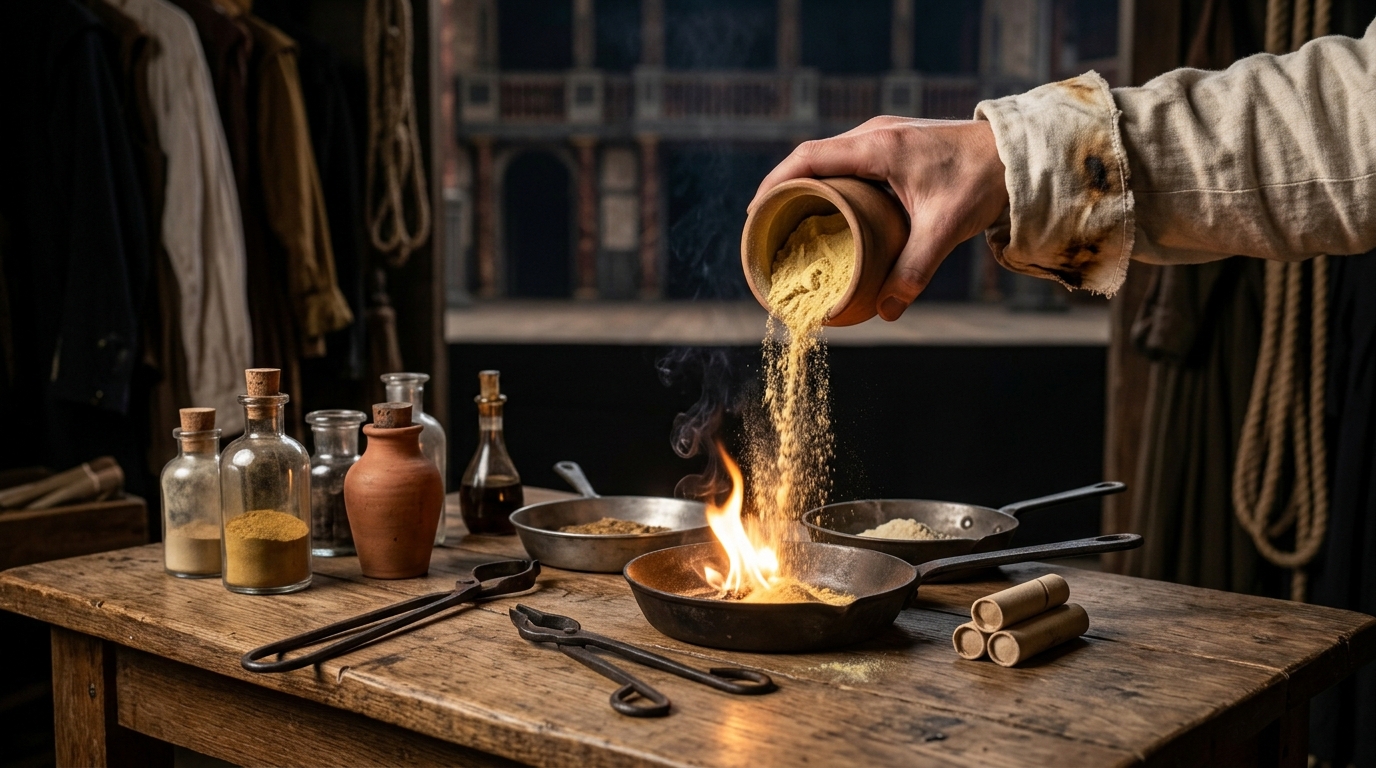
Understanding how early modern playhouses managed—and mismanaged—combustibles explains why stage fires were a constant threat in Shakespeare’s London. The Globe was not an isolated incident; it belonged to a broader landscape of early modern stage hazards.
+-----------------------------------------------------------------------------------+
|               EARLY MODERN LONDON PLAYHOUSES & FIRE RISK PROFILES                 |
+--------------------+-----------------------+-------------------+------------------+
| Playhouse          | Roof Type             | Primary Fuel      | Stage Effects    |
+--------------------+-----------------------+-------------------+------------------+
| The Globe (1599)   | Thatched Reeds        | Timber/Straw      | Cannons, Squibs  |
| The Rose (1587)    | Thatched Reeds        | Timber/Lath       | Smoke, Rosin     |
| Blackfriars (1608) | Indoor (Tile/Plaster) | Candles/Torches   | Flash Powders    |
| The Swan (1595)    | Thatched Reeds        | Timber            | Blank Charges    |
+--------------------+-----------------------+-------------------+------------------+
Stage Effects in the 1600s: Black Powder, Resin, and Squibs
The Elizabethan audience did not come to the theater merely to listen to poetry; they expected sensory spectacle. Stage technicians (then called tiremen or property-makers) utilized specialized chemical formulations to mimic supernatural occurrences:
-
Squibs: Small paper tubes stuffed with coarse black gunpowder, wood charcoal, and iron filings. When lit, they hissed loudly and spat bright sparks, commonly used to simulate lightning or demonic entrances.
-
Lycopodium Powder & Rosin: Fine plant spores or crushed pine resins blown through an open candle flame using hand bellows. This produced a sudden, bright flash of fire without generating lingering smoke—an ideal effect for subterranean trapdoor scenes.
-
Brimstone (Sulfur): Burned in shallow iron pans beneath the stage to create thick, pungent yellow smoke, signaling to the audience that a spirit was ascending directly from Purgatory or Hell.
Architectural Vulnerabilities of Southwark Playhouses
The playhouses constructed in Southwark outside the jurisdiction of the City of London Aldermen were structural tinderboxes. Designed by master carpenters like Peter Street (who built both the original Globe and the Fortune Theatre), these buildings relied on heavy oak framing timbers held together with wooden trunnels.
The galleries were sheltered by steeply pitched roofs covered in dried marsh reeds (thatch). In the heat of late June, after months of sun exposure, this thatch was bone-dry. Combined with galleries packed with up to 3,000 patrons consuming beer, pipe tobacco, and fried hazelnut snacks, the introduction of open-flame pyrotechnics carried high risks.
Did Hamlet Require Stage Fire?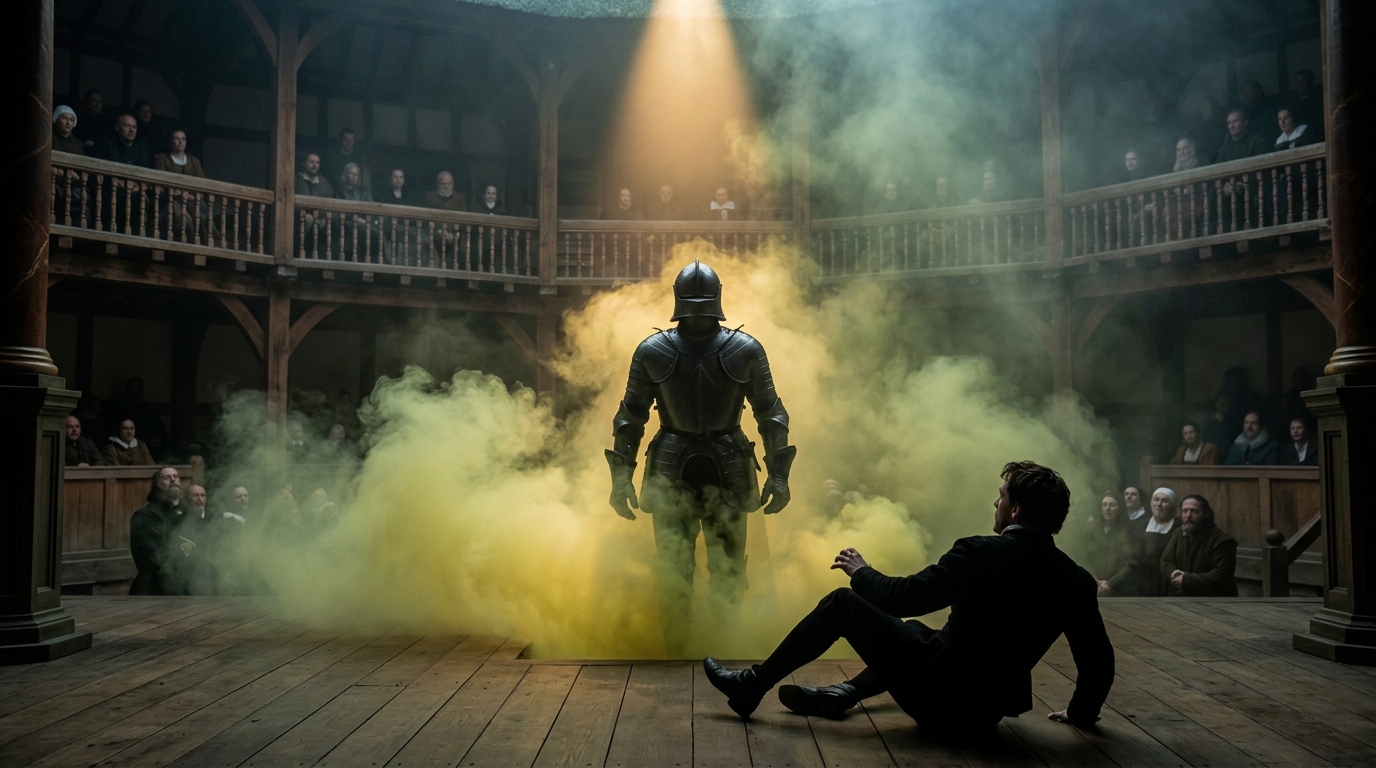
While Hamlet did not demand real cannon fire like Henry VIII, staging the play presented serious fire hazards during the ghost scenes in Act I.
When the Ghost of King Hamlet appears on the cold battlements of Elsinore, and later when it leads Hamlet down toward the lower levels of the stage (the hell beneath the trapdoor), stage directions and contemporary accounts point to the use of sulfur smoke and hidden lanterns.
To create the illusion of an apparition emerging from “sulfurous and tormenting flames,” technicians beneath the stage floor lit small iron braziers containing raw sulfur and dried rosemary. The resulting smoke drifted up through the trapdoor seams, surrounding the actor playing the Ghost (a role traditionally performed by Shakespeare himself) in a pale, pungent mist.
In indoor playhouses like Blackfriars, where the King’s Men performed during winter months, these effects had to be managed under the light of hundreds of tallow candles, multiplying the fire risk tenfold.
Fire as Metaphor and Imagery in Hamlet
Beyond physical stage accidents, the theme of fire saturates the language of Hamlet. Shakespeare uses fire not merely as a decorative description, but as a central metaphysical driver of the plot, representing divine judgment, unchecked passion, moral decay, and internal psychological torment.
+-----------------------------------------------------------------------------------+
|                     TEXTUAL ANALYSIS: FIRE MOTIFS IN HAMLET                       |
+-------------------+-------------------+-------------------+-----------------------+
| Act / Scene       | Speaker           | Exact Phrase      | Thematic Function     |
+-------------------+-------------------+-------------------+-----------------------+
| Act I, Scene 5    | Ghost of Hamlet   | "Sulfurous and    | Purgatorial punishment|
|                   |                   | tormenting flames"| and divine fire       |
+-------------------+-------------------+-------------------+-----------------------+
| Act III, Scene 4  | Hamlet            | "Rebellious hell, | Moral passion and     |
|                   |                   | If thou canst     | youth unchecked by    |
|                   |                   | mutine in a       | reason                |
|                   |                   | matron's bones"   |                       |
+-------------------+-------------------+-------------------+-----------------------+
| Act IV, Scene 7  | Claudius          | "Love is begun    | The decay of desire   |
|                   |                   | by time... spark  | over temporal duration|
|                   |                   | of fire"          |                       |
+-------------------+-------------------+-------------------+-----------------------+
| Act V, Scene 1    | Hamlet            | "Forty thousand   | Destructive,          |
|                   |                   | brothers could    | consuming emotional   |
|                   |                   | not... make up    | frenzy                |
|                   |                   | my sum"           |                       |
+-------------------+-------------------+-------------------+-----------------------+
“Sulfurous and Tormenting Flames”: The Ghost and Purgatory
The very first explicit introduction of fire in Hamlet occurs in Act I, Scene 5, when the Ghost speaks to prince Hamlet, describing his current state in the afterlife:
“I am thy father’s spirit,
Doom’d for a certain term to walk the night,
And for the day confin’d to fast in fires,
Till the foul crimes done in my days of nature
Are burnt and purg’d away.”
Here, Shakespeare invokes the Catholic theology of Purgatory—a controversial topic in Protestant Jacobean England. The Ghost describes fire as a refining agent, a violent cleanser required to burn away human sin. Shortly after, the Ghost adds:
“When I to sulfurous and tormenting flames
Must render up myself.”
This imagery sets the entire tragedy in motion. The fire of Purgatory demands a responding fire on Earth: the burning compulsion for revenge. Hamlet is not simply asked to perform a civic duty; he is commanded by an entity forged in spiritual fire to execute vengeance.
Internal Combustion: Fire of the Mind and Passion
As the play progresses, Shakespeare pivots the fire metaphor inward. Fire ceases to be an external afterlife penalty and becomes an internal psychological disease destroying Denmark’s court.
In Act III, Scene 4 (the closet scene), Hamlet confronts his mother, Gertrude, over her hasty marriage to Claudius. He describes unchecked sexual appetite and moral corruption through explosive fire imagery:
“Rebellious hell,
If thou canst mutine in a matron’s bones,
To flaming youth let virtue be as wax,
And melt in her own fire.”
To Hamlet, passion is a fire so intense that it melts moral reason like wax over a flame. This internal ignition is precisely what Hamlet fears in himself. He struggles constantly against his own emotional volatility, worried that his vengeful anger will burn away his capacity for logical thought and moral restraint.
“Fire in the Blood”: Polonius, Laertes, and Claudius
Hamlet is not the only character defined by fire imagery. Shakespeare distributes fire metaphors among the key figures surrounding the prince to highlight contrasting approaches to impulse and control:
-
Polonius: Warns Ophelia in Act I, Scene 3, to distrust Hamlet’s romantic declarations, dismissing them as temporary blazes: “I do know, when the blood burns, how prodigal the soul lends the tongue vows. These blazes, daughter, giving more light than heat… you must not take for fire.”
-
Claudius: Manipulates Laertes in Act IV, Scene 7, by exploiting his hot-headed anger following Polonius’s murder: “Love is begun by time, and I see, by passages of proof, time qualifies the spark and fire of it.” Claudius rekindles Laertes’s rage, turning his grief into a controlled, lethal weapon against Hamlet.
-
Laertes: Acts as Hamlet’s foil. Where Hamlet overthinks and delays, Laertes surrenders completely to his burning blood: “To this point I stand, that both the worlds I give to negligence, let come what comes; only I’ll be revenged most thoroughly for my father.”
Modern Stage Disasters and “Hamlet” Production History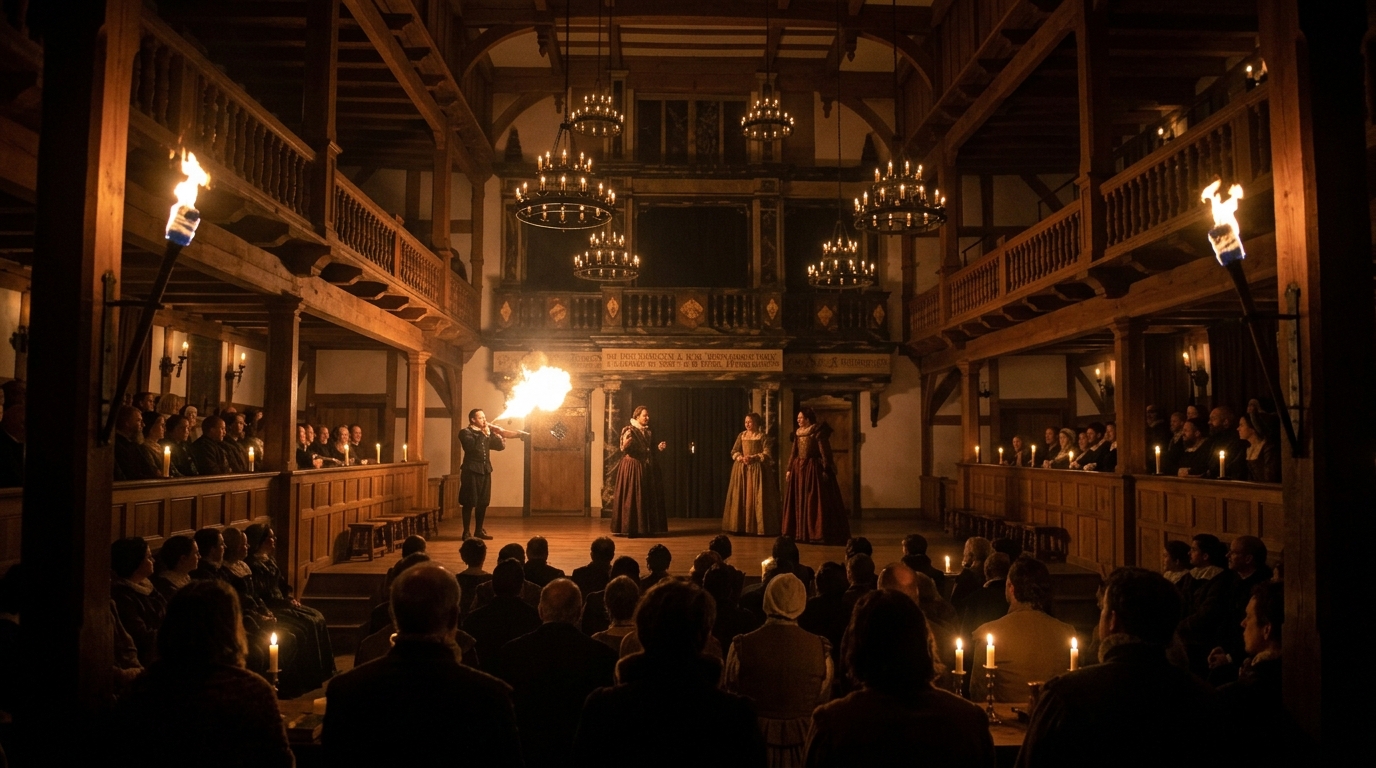
While the original 1613 Globe fire remains the most famous stage disaster in classical theatre, the legacy of fire safety—and fire hazards—continued to follow productions of Hamlet across the centuries.
+-----------------------------------------------------------------------------------+
|              HISTORICAL THEATRE FIRES IMPACTING SHAKESPEAREAN STAGES              |
+-----------------------------+---------------------+-------------------------------+
| Playhouse / Location        | Year of Fire        | Impact on Classical Repertoire|
+-----------------------------+---------------------+-------------------------------+
| Second Globe Theatre        | Demolished 1644     | Closed by Puritans in 1642;   |
|                             |                     | pulled down for housing       |
| King's Playhouse (Drury L.) | 1672                | Destroyed original Restoration|
|                             |                     | promptbooks for Hamlet        |
| Astley's Amphitheatre       | 1794, 1803, 1841    | Repeatedly burnt down due to  |
|                             |                     | pyrotechnic spectacles        |
| Brooklyn Theatre Fire       | 1876                | Catalyzed modern municipal    |
|                             |                     | stage safety laws nationwide  |
+-----------------------------+---------------------+-------------------------------+
The Evolution of Fire Safety in Classical Theatre
The destruction of early playhouses forced radical structural changes across European and American theatres. Following devastating 19th-century blazes like the Brooklyn Theatre Fire of 1876, safety regulators mandated technical innovations that permanently altered how Hamlet and other Shakespearean works were staged:
-
Safety Curtains (Iron Curtains): Heavy iron or asbestos drop-curtains designed to seal off the stage from the auditorium in the event of a fire, preventing flames from consuming the seating area.
-
Flame-Retardant Scenery: Sets, drapes, and costumes were treated with chemical mixtures (such as alum and ammonium phosphate) to prevent ignition from stage lighting.
-
Transition to Electrical Lighting: The replacement of open gas jets with incandescent electric bulbs in the late 1880s drastically reduced stage fire hazards, allowing directors to simulate supernatural effects using colored glass filters and focused electric beams rather than hazardous pyrotechnic compounds.
In contemporary revivals of Hamlet, production teams rely on ultrasonic fog generators, cold-spark LED arrays, and digital projection mapping to replicate the ghost’s “sulfurous flames” without endangering the actors or the venue.
Frequently Asked Questions
Q1: Did the Globe Theatre burn down during a performance of Hamlet?
Answer: No. The original Globe Theatre burned down on June 29, 1613, during a performance of Henry VIII (titled All Is True). The fire was caused when decorative stage cannons ignited the playhouse’s thatched roof. Hamlet was written and premiered over a decade earlier, around 1599–1601.
Q2: Were any audience members killed in the 1613 Globe Theatre fire?
Answer: Surprisingly, no fatalities were reported. Despite the playhouse containing an estimated 2,000 to 3,000 spectators at the time, the open-air design allowed the crowd to exit safely through the ground-level doors. Historical records note only one injury: a man whose pants caught fire, which he promptly doused with a bottle of ale.
Q3: Why is fire such an important motif inside the text of Hamlet?
Answer: Fire serves as both a literal and metaphorical engine in Hamlet. Literally, it represents the purgatorial flames from which the Ghost emerges to demand revenge. Metaphorically, Shakespeare uses fire to describe uncontrollable emotional states—such as Hamlet’s existential fury, Gertrude’s moral passion, and Laertes’s impulse for vengeance—which ultimately burn down the Royal House of Denmark.
Q4: How did Shakespeare’s company recover after the 1613 fire?
Answer: The King’s Men were financially robust and immediately financed the construction of the Second Globe Theatre on the same oak frame foundations. Rebuilt within a year and opened in June 1614, the new building featured a fire-resistant tile roof instead of straw thatch. It remained operational until London’s playhouses were forcibly shut down by the Puritan Parliament in 1642.
Retracing Shakespeare’s Flames
The story of the Hamlet fire bridges the gap between physical stage history and literary theory. While historical evidence clarifies that the tragic Globe fire of 1613 was sparked by the cannons of Henry VIII rather than Prince Hamlet’s tragic delays, the connection between Hamlet and fire remains unbroken.
From the sulfurous vapors swirling through the trapdoors of Elizabethan Southwark to the internal, consuming passions that destroy Denmark’s nobility, fire remains one of Shakespeare’s most potent theatrical tools. Understanding the real hazards of the early modern stage gives readers and playgoers a clearer view of how Shakespeare crafted his world—where a single spark on stage or inside the mind could burn an empire to the ground.