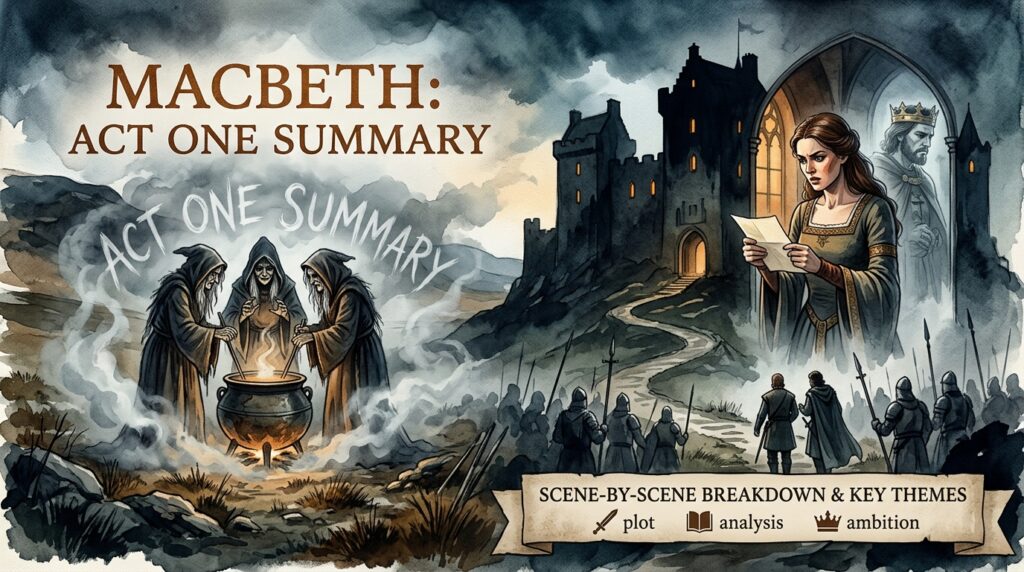
William Shakespeare’s Macbeth opens not with a noble speech or a grand celebration, but with crackling lightning, swirling fog, and three supernatural figures plotting a fateful meeting on a Scottish heath. This jarring opening establishes one of the most thrilling and psychological tragedies in Western literature. For students, educators, and theater enthusiasts alike, mastering this opening section is crucial to understanding the entire play. If you are searching for a comprehensive act one summary of macbeth, this definitive guide provides an expert scene-by-scene breakdown, key quote analyses, thematic explorations, and historical context to help you master Shakespeare’s dark masterpiece.
Executive Summary & Quick Reference
Act 1 serves as the crucial exposition and inciting incident of Macbeth. Over the course of seven intense scenes, Shakespeare moves the narrative from a rain-slicked battlefield to the quiet, claustrophobic halls of Macbeth’s castle at Inverness. We witness the rapid transformation of a heroic, loyal general into a conflicted, ambitious conspirator ready to commit regicide.
| Scene | Primary Location | Key Characters | Main Plot Point |
| 1.1 | An open heath | The Three Witches | The Witches set a plan to meet Macbeth after the battle. |
| 1.2 | Military camp at Forres | King Duncan, Malcolm, Captain, Ross | Duncan hears of Macbeth’s bravery and names him Thane of Cawdor. |
| 1.3 | A heath near Forres | Macbeth, Banquo, The Witches, Ross | The Witches deliver their prophecies; Macbeth receives his new title. |
| 1.4 | Palace at Forres | Duncan, Macbeth, Banquo, Malcolm | Duncan names Malcolm heir to the throne; Macbeth sees Malcolm as an obstacle. |
| 1.5 | Inverness (Macbeth’s Castle) | Lady Macbeth, Macbeth | Lady Macbeth reads Macbeth’s letter and invokes evil spirits to purge her mercy. |
| 1.6 | Outside Inverness | Duncan, Lady Macbeth, Banquo | Duncan arrives at Inverness; Lady Macbeth greets him with false warmth. |
| 1.7 | Inside Inverness | Macbeth, Lady Macbeth | Macbeth hesitates to kill Duncan; Lady Macbeth manipulates him into committing to the murder. |
Act 1, Scene-by-Scene Breakdown & Literary Analysis
                    THE PATH TO TREASON IN ACT 1

  [Scene 1 & 2]          [Scene 3 & 4]          [Scene 5, 6 & 7]
 Supernatural Prelude   Prophecy & Ambition     Domestic Conspiracy
   Witches Plan Meeting   Prophecies Delivered    Lady Macbeth Steps In
    Heroic Victory Reported   Thane Title Confirmed   Macbeth Hesitates
     Cawdor Executed       Malcolm Named Heir      Murder Plan Finalized
Act 1, Scene 1 — The Heath: Prophecy in the Storm
Scene Summary
The play opens on a desolate Scottish heath amidst thunder and lightning. Three Witches—often referred to as the Weird Sisters—gather in the storm. They speak in cryptic riddles, announcing that their meeting is drawing to a close and that they will meet again before sunset upon the heath to intercept Macbeth. Before disappearing into the murky air, they chant in unison a paradox that serves as the moral thesis of the entire tragedy: “Fair is foul, and foul is fair.”
Key Line Analysis
“Fair is foul, and foul is fair: / Hover through the fog and filthy air.” (1.1.10–11)
This famous couplet establishes the motif of moral inversion and deception that permeates the entire play. What appears good (“fair”) will turn out to be evil (“foul”), and what seems evil will be embraced as good. The “fog and filthy air” serves as both a literal atmospheric setting and a metaphor for the moral corruption about to cloud Scotland.
Expert Literary Insight
Shakespeare writes the Witches’ dialogue in trochaic tetrameter with rhyming couplets (e.g., “When the hurlyburly’s done, / When the battle’s lost and won”). This rhythmic structure contrasts sharply with the iambic pentameter spoken by the noble human characters. By breaking standard poetic form, Shakespeare signals to the audience that the Witches are inherently unnatural creatures who operate outside the divine order of the universe.
Act 1, Scene 2 — A Military Camp near Forres: The Heroic Executioner
Scene Summary
King Duncan of Scotland, his sons Malcolm and Donalbain, and his attendants meet a severely wounded Captain returning from the battlefront. The Captain reports on the ferocious war against the rebel Macdonwald, supported by the King of Norway. He describes how Macbeth, Thane of Glamis, fought with extraordinary valor. Macbeth cut a path through the enemy lines until he faced the traitor Macdonwald, whom he “unseam’d him from the nave to th’ chops” and beheaded on the battlements.
Noble Ross arrives shortly after to confirm that the Norwegian king was defeated, thanks to Macbeth and his fellow general, Banquo. King Duncan declares that the traitorous Thane of Cawdor shall be executed immediately, and his title transferred to Macbeth as a reward for his loyalty and courage.
       DUNCAN'S DECREE
  [ Traitor: Thane of Cawdor ] ---> Executed for Treason
  [ Hero: Macbeth of Glamis  ] ---> Rewarded with Cawdor Title
Key Line Analysis
“For brave Macbeth—well he deserves that name— / Disdaining fortune, with his brandish’d steel, / Which smoked with bloody execution…” (1.2.16–18)
This quote introduces Macbeth before he ever steps onto the stage. He is presented as a heroic defender of the realm, loyal to his king and capable of brutal violence in service of justice.
Expert Literary Insight
Pay close attention to the paradox of Macbeth’s character introduced here. His extreme violence is praised when used to defend the legitimate king (“O valiant cousin! worthy gentleman!”). However, this same capacity for ruthless killing will soon be turned against the state when motivated by personal ambition. The violence itself is neutral; its moral character depends entirely on whether it serves loyalty or treason.
Act 1, Scene 3 — A Heath near Forres: The Supernatural Soliciting
Scene Summary
The Three Witches reassemble on the heath after engaging in petty malice against a sailor’s wife. A drum sounds, signaling the arrival of Macbeth and Banquo as they return victorious from the battlefield. Upon spotting the uncanny figures, Banquo notes their withered appearance, unnatural beards, and wild attire.
The Witches address Macbeth with three distinct titles:
-
Thane of Glamis (his current inherited title)
-
Thane of Cawdor (his new title, which he does not yet know he has been granted)
-
King hereafter
Startled, Macbeth falls silent. Banquo presses the Witches to reveal his own destiny. The Witches issue a series of paradoxes for Banquo: he will be “Lesser than Macbeth, and greater,” and “Not so happy, yet much happier.” They conclude with the prophecy that Banquo will never be king himself, but his descendants will inherit the crown.
                  THE THREE PROPHECIES (1.3)

     MACBETH                        BANQUO
  1. Thane of Glamis             1. Lesser than Macbeth, yet greater
  2. Thane of Cawdor             2. Not so happy, yet much happier
  3. King Hereafter              3. Thou shalt get kings, though thou be none
The Witches vanish into thin air. Moments later, Ross and Angus arrive from King Duncan. Ross informs Macbeth that the King has bestowed upon him the title of Thane of Cawdor. Stunned that the second prophecy has come true so quickly, Macbeth succumbs to intense internal turmoil, contemplating the bloody path required to fulfill the third prophecy: taking the crown.
Key Line Analysis
“So foul and fair a day I have not seen.” (1.3.38)
Macbeth’s very first line in the play echoes the Witches’ chant from Scene 1 (“Fair is foul, and foul is fair”), instantly establishing a psychological connection between Macbeth and the supernatural forces temptingly lurking in his environment.
“And oftentimes, to win us to our harm, / The instruments of darkness tell us truths, / Win us with honest trifles, to betray ‘s / In deepest consequence.” (1.3.123–126)
Banquo delivers this crucial warning to Macbeth. He recognizes that evil forces do not always lie outright; instead, they use partial truths as bait to lure human beings into moral destruction.
Character Contrast: Macbeth vs. Banquo
Scene 3 establishes Banquo as Macbeth’s primary moral foil:
-
Macbeth is instantly captivated by the prophecy. His imagination immediately leaps to thoughts of regicide, causing his heart to knock against his ribs.
-
Banquo remains deeply skeptical, cautious, and morally grounded. He treats the Witches with suspicion, recognizing that supernatural temptors often seek to corrupt human souls.
Act 1, Scene 4 — The Palace at Forres: An Obstacle to the Crown
Scene Summary
At the royal palace, King Duncan receives word that the former Thane of Cawdor faced his execution with dignity, confessing his treason and asking for pardon. Duncan reflects on how difficult it is to read a man’s mind through his face, noting that Cawdor was a gentleman in whom he built “an absolute trust.”
Macbeth, Banquo, Ross, and Angus enter. Duncan expresses profound gratitude to Macbeth and Banquo, promising to nurture their careers. However, Duncan then makes a major political announcement: he officially names his eldest son, Malcolm, as the Prince of Cumberland, making Malcolm the designated heir to the Scottish throne.
Duncan announces that he will visit Macbeth’s castle at Inverness to celebrate. While Macbeth outwardly expresses joy at hosting the sovereign, he reveals his inner thoughts in a dark aside: Malcolm is now a direct physical obstacle between him and the throne.
       SCOTTISH SUCCESSION DYNAMICS
  [ King Duncan ]
        |---> Names [ Malcolm ] as Prince of Cumberland (Official Heir)
        |
        |---> Leaves [ Macbeth ] needing to step over or yield to Malcolm
Key Line Analysis
“There’s no art / To find the mind’s construction in the face.” (1.4.11–12)
Duncan speaks these words about the executed Thane of Cawdor just seconds before Macbeth walks through the door. This dramatic irony emphasizes Duncan’s tragic flaw: his utter inability to spot deceit in those closest to him.
“Stars, hide your fires; / Let not light see my black and deep desires.” (1.4.50–51)
Macbeth acknowledges the sinister nature of his ambition. He calls upon darkness to conceal his treacherous thoughts, contrasting the noble “light” of royalty with the “blackness” of regicide.
Act 1, Scene 5 — Inverness (Macbeth’s Castle): Unsex Me Here
Scene Summary
At Inverness, Lady Macbeth reads a letter sent by her husband describing his encounter with the Weird Sisters and the fulfillment of the first prophecy. She immediately embraces the ambition to make him king, but she worries about her husband’s moral disposition. She fears he is “too full o’ th’ milk of human kindness” to take the swift, violent action necessary to grab the crown.
A messenger arrives with news that King Duncan will sleep at Inverness that very night. Recognizing this as the ultimate opportunistic opening, Lady Macbeth delivers a terrifying soliloquy. She calls upon demonic spirits to “unsex” her—to strip away her feminine softness, empathy, and capacity for remorse, filling her from head to toe with cold cruelty.
When Macbeth arrives, Lady Macbeth warmly greets him and immediately asserts control over the situation. She tells him that King Duncan will never see tomorrow’s sun and instructs him to leave the management of the murder entirely to her.
                   LADY MACBETH'S PERSUASION STRATEGY

  [ Diagnostic ]  Identifies Macbeth's flaw: "too full o' th' milk of human kindness"
        |
  [ Invocation ]  Calls upon spirits to "unsex" her and remove feminine empathy
        |
  [ Execution  ]  Commands Macbeth: "Look like the innocent flower, but be the serpent under 't"
Key Line Analysis
“Yet do I fear thy nature; / It is too full o’ th’ milk of human kindness / To catch the nearest way.” (1.5.16–18)
Lady Macbeth characterizes moral compassion as “milk”—a nurturing, feminine trait that she views as a weakness standing in the way of ultimate power.
“Come, you spirits / That tend on mortal thoughts, unsex me here, / And fill me from the crown to the toe top-full / Of direst cruelty!” (1.5.40–43)
This iconic soliloquy demonstrates Lady Macbeth’s deliberate willingness to reject her humanity and traditional Jacobean gender expectations in pursuit of political power.
“Look like the innocent flower, / But be the serpent under ‘t.” (1.5.64–65)
This vivid metaphor reinforces the central motif of appearance vs. reality. She instructs her husband to maintain a polite, welcoming mask while hiding deadly malice beneath the surface.
Act 1, Scene 6 — Outside Inverness: The Victim Enters the Trap
Scene Summary
King Duncan, his sons, and his attending lords arrive outside Macbeth’s castle at Inverness. Duncan remarks on the pleasant, welcoming atmosphere of the estate, pointing out the sweet air and the swallows nesting along the walls. Banquo agrees, noting that the birds choose places where the air is gentle and pure.
Lady Macbeth emerges from the castle gates to greet the royal party. She presents a masterclass in hypocritical hospitality, showering the King with gracious speeches, humble offerings, and deep expressions of duty. Duncan thanks her for her warmth, inquires after Macbeth (who rode ahead of them), and lets her lead him inside to his death.
Key Line Analysis
“This castle hath a pleasant seat; the air / Nimbly and sweetly recommends itself / Unto our gentle senses.” (1.6.1–3)
This opening statement by Duncan is an example of dramatic irony. Duncan perceives Inverness as a peaceful sanctuary, blissfully unaware that the hosts he is praising are actively plotting his assassination within its walls.
Act 1, Scene 7 — Inside Inverness: Screwing Courage to the Sticking-Place
Scene Summary
While a feast in honor of the King takes place elsewhere in the castle, Macbeth sneaks away to a private room. He delivers a complex soliloquy (“If it were done when ’tis done…”) in which he weighs the consequences of killing Duncan.
Macbeth realizes that regicide is not a simple, clean act:
-
Karmic retribution: Violence breeds more violence, returning to plague the killer.
-
Double trust: As Duncan’s kinsman and host, Macbeth has a sacred duty to protect his guest, not murder him.
-
Duncan’s virtue: Duncan is a pure, benevolent ruler whose murder will cause angels to weep and outrage the heavens.
Macbeth concludes that he has no moral justification for the crime—only “vaulting ambition.” When Lady Macbeth enters, Macbeth firmly tells her that they will proceed no further in the plot.
Enraged, Lady Macbeth launches a fierce psychological attack on her husband. She calls him a coward, questions his masculinity, and accuses him of breaking a sacred promise to her. She declares that had she sworn to kill her own infant child, she would have “dash’d the brains out” rather than break her vow.
When Macbeth worries about the possibility of failure, she famously tells him to “screw your courage to the sticking-place, and we’ll not fail.” She lays out the details of the assassination plan:
-
She will get Duncan’s two chamber servants thoroughly drunk until they pass out.
-
Macbeth will use the servants’ daggers to murder the sleeping King.
-
They will smear the unconscious servants with Duncan’s blood to shift the blame.
Won over by her ruthless determination and tactical plan, Macbeth agrees to the murder.
                    MACBETH'S MORAL DILUTION (1.7)

  Soliloquy (Alone)              Manipulation                   Commitment
  -----------------             --------------                  ----------
  - Recognizes duty             - Lady Macbeth attacks          - Accepts the plan
  - Fearing judgment              his manhood & courage         - Agrees to frame
  - Calls off murder            - Outlines murder plan            innocent guards
Key Line Analysis
“I have no spur / To prick the sides of my intent, but only / Vaulting ambition, which o’erleaps itself / And falls on th’ other.” (1.7.25–28)
Macbeth explicitly identifies his primary tragic flaw (hamartia): unchecked ambition. He compares it to an overeager rider who tries to jump onto a horse too forcefully and falls over the other side.
“I dare do all that may become a man; / Who dares do more is none.” (1.7.46–47)
Macbeth offers a noble definition of manhood based on moral boundaries and honor. However, Lady Macbeth quickly reframes manhood as ruthless, unhesitating violence.
“False face must hide what the false heart doth know.” (1.7.82)
The act closes with Macbeth echoing the theme of deception. He fully commits to putting on a deceptive exterior to conceal his murderous intentions.
Central Themes Introduced in Act 1
1. Unchecked Ambition and Moral Decay
While Macbeth begins the play as a noble soldier, the prospect of royal power acts as a catalyst that exposes his dark desire for control. Act 1 illustrates how ambition, when detached from moral boundaries, quickly distorts reason and drives individuals to destroy the very order they once swore to protect.
2. Fate vs. Free Will
A central question introduced in Act 1 is whether the Witches control Macbeth’s fate or simply exploit a desire that was already lurking in his heart.
-
The Witches never command Macbeth to kill Duncan; they merely state that he will be king.
-
Macbeth’s subsequent decision to commit regicide is an act of free will, spurred on by his wife’s relentless coercion.
3. Appearance vs. Reality (“Fair is Foul”)
Throughout Act 1, reality is rarely what it appears to be:
-
The Witches speak in deceptive paradoxes.
-
The Thane of Cawdor appears loyal, but proves to be a traitor.
-
Inverness appears peaceful to Duncan, but is actually a deadly trap.
-
Macbeth and Lady Macbeth put on welcoming, dutiful expressions while planning a bloody murder.
                       APPEARANCE vs. REALITY IN ACT 1

      WHAT IS SEEN                          WHAT IS REAL
  --------------------                  --------------------
  - Inverness: Peaceful Castle      -->  - Inverness: A Death Trap
  - Macbeth: Heroic Thane           -->  - Macbeth: A Traitorous Plotter
  - Lady Macbeth: Warm Hostess     -->  - Lady Macbeth: Mastermind of Regicide
  - Prophecies: Golden Promises     -->  - Prophecies: Spiritual Traps
4. Gender Roles and Masculinity
Lady Macbeth actively rejects conventional Jacobean norms of womanhood—associated with motherly warmth, tenderness, and submission. She views mercy as a weakness and redefines masculinity as cold-blooded aggression. By challenging Macbeth’s manhood in Scene 7, she successfully manipulates him into committing a crime he intellectually knows is wrong.
Key Character Trajectories in Act 1
                     CHARACTER DEVELOPMENT TRACKER

  MACBETH          [ Heroic General ] --------> [ Tormented Conspirator ]
  LADY MACBETH     [ Dutiful Wife ]   --------> [ Ruthless Strategist ]
  BANQUO           [ Cautious Warrior] -------> [ Skeptical Observer ]
  KING DUNCAN      [ Beloved Ruler ]  --------> [ Naive Victim ]
-
Macbeth: Begins as a celebrated military hero defined by courage and honor. By the end of Act 1, his internal moral compass has been compromised by ambition and fear of dishonor, leaving him committed to regicide.
-
Lady Macbeth: Introduced as the psychological driver of the plot. She possesses the iron political will that Macbeth initially lacks, invoking supernatural forces to purge herself of remorse.
-
Banquo: Serves as Macbeth’s moral counterpart. Though tempted by the prophecy that his descendants will be kings, he refuses to compromise his moral integrity or act dishonorably.
-
King Duncan: Represents the ideal Jacobean monarch—generous, virtuous, and just. However, his total lack of suspicion and inability to judge character make him vulnerable to treason.
Important Motifs & Symbolism
1. Blood
In Scene 2, blood is a symbol of military honor, brave service, and patriotism (the “blooded Captain”). However, by Scene 7, blood becomes a sinister mark of treason, violence, and irrevocable guilt that will stain the hands of the killers for the rest of the play.
2. Weather and Darkness
Storms, thunder, fog, and pitch-black nights accompany every appearance of the supernatural or treacherous in Act 1. This chaotic weather reflects the moral discord and the breaking of the divine order caused by treason against the King.
3. Borrowed Robes
When Macbeth is named Thane of Cawdor in Scene 3, he asks, “Why do you dress me in borrow’d robes?” This motif of ill-fitting clothing recurs throughout the play, symbolizing titles, power, and authority that do not rightfully belong to the person wearing them.
Historical & Cultural Context: The Jacobean Worldview
Understanding the historical context of 1606 enhances our reading of Macbeth:
The Great Chain of Being and the Divine Right of Kings
Jacobean society believed in a rigid universal hierarchy created by God, known as The Great Chain of Being. The King sat at the top of the human hierarchy, ruling by Divine Right.
To assassinate a king was not merely a political crime; it was a cosmic sin against God that would throw all of nature into chaos. Shakespeare reflects this by showing the physical weather reacting violently to the plot against Duncan.
                   THE GREAT CHAIN OF BEING

                        [ GOD ]
                           |
                     [ ANGELS ]
                           |
                   [ KING DUNCAN ]  <--- Regicide disrupts universe
                           |
                    [ NOBLES / MAN ]
                           |
                    [ ANIMALS / PLANTS ]
The Gunpowder Plot of 1605
Just months before Macbeth was first performed, a group of Catholic conspirators (including Guy Fawkes) attempted to blow up King James I and the English Parliament in the Gunpowder Plot. Macbeth served as a direct political message to the nation: treason against a legitimate king leads to psychological agony, moral ruin, and inevitable death.
King James I and Witchcraft
King James I of England (formerly James VI of Scotland) was obsessed with the supernatural. He wrote a book titled Daemonologie (1597) defending the persecution of witches and believed that witches had personally plotted against his life.
By featuring the Three Witches prominently in Act 1, Shakespeare was directly appealing to the personal interests and fears of his royal patron.
Student Study Guide & High-Yield Summary Matrix
Quick-Study Scene Matrix
| Scene | Primary Focus | Major Quote | Theme Highlighted |
| 1.1 | Supernatural setup | “Fair is foul, and foul is fair” | Appearance vs. Reality |
| 1.2 | Macbeth’s bravery | “Unseam’d him from the nave to th’ chops” | Violence and Loyalty |
| 1.3 | Prophecies delivered | “The instruments of darkness tell us truths” | Fate vs. Free Will |
| 1.4 | Heir announced | “Stars, hide your fires; let not light see my deep desires” | Unchecked Ambition |
| 1.5 | Lady Macbeth’s plan | “Look like the innocent flower, but be the serpent under ‘t” | Deception and Gender |
| 1.6 | Duncan’s arrival | “This castle hath a pleasant seat…” | Dramatic Irony |
| 1.7 | The murder plot | “Screw your courage to the sticking-place” | Masculinity and Guilt |
Top 3 Essay Prompts for Practice
-
Role of the Supernatural: To what extent are the Three Witches responsible for Macbeth’s actions in Act 1, and to what extent is he driven by his own free will?
-
Manipulation and Gender: Analyze how Lady Macbeth uses Jacobean gender expectations to manipulate Macbeth in Scene 5 and Scene 7.
-
Dramatic Irony: How does Shakespeare use dramatic irony in Scenes 4 and 6 to build tension and highlight King Duncan’s tragic flaws?
Frequently Asked Questions (FAQ)
What is the main point of Macbeth Act 1?
Act 1 establishes the story’s core conflict. It introduces the Witches’ prophecy, shows Macbeth’s rise as a decorated military hero, and charts his swift psychological transition into a traitor as he and Lady Macbeth plot the murder of King Duncan.
Why does Macbeth hesitate to kill King Duncan in Act 1, Scene 7?
Macbeth hesitates because Duncan is his sovereign, his relative, and his guest. Furthermore, Duncan has been a fair, beloved ruler. Macbeth recognizes that killing him breaks sacred moral, feudal, and hospitality laws, which will bring karmic retribution and eternal damnation upon his own soul.
What does “Fair is foul, and foul is fair” mean?
This paradoxical phrase means that appearances are deceptive. What seems good, beautiful, or moral (“fair”) is actually evil and corrupt (“foul”), and vice versa. It serves as the primary moral theme for the entire play.
How does Lady Macbeth convince Macbeth to go through with the murder?
When Macbeth refuses to proceed in Scene 7, Lady Macbeth attacks his masculinity, calls him a coward, and claims he is breaking a promise to her. She then presents a clear tactical plan to frame Duncan’s personal guards, convincing Macbeth that they can commit the crime without getting caught.
Next Steps
Act 1 of Macbeth sets the stage for one of the greatest moral descents in dramatic literature. By combining supernatural temptation, political ambition, and psychological manipulation, Shakespeare creates a pressure-cooker environment where heroic potential yields to destructive ambition. As the act draws to a close, the plot is locked in place—King Duncan sits peacefully in his guest room, unaware that his host is stepping into the dark with a drawn dagger.