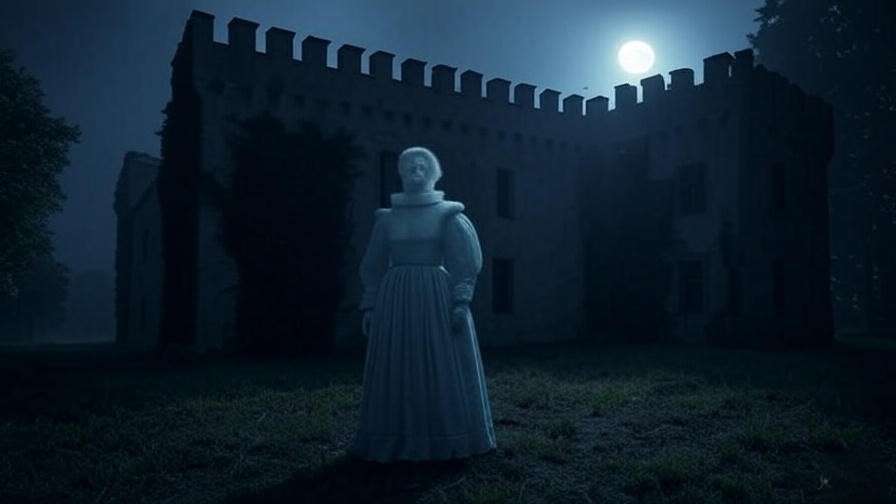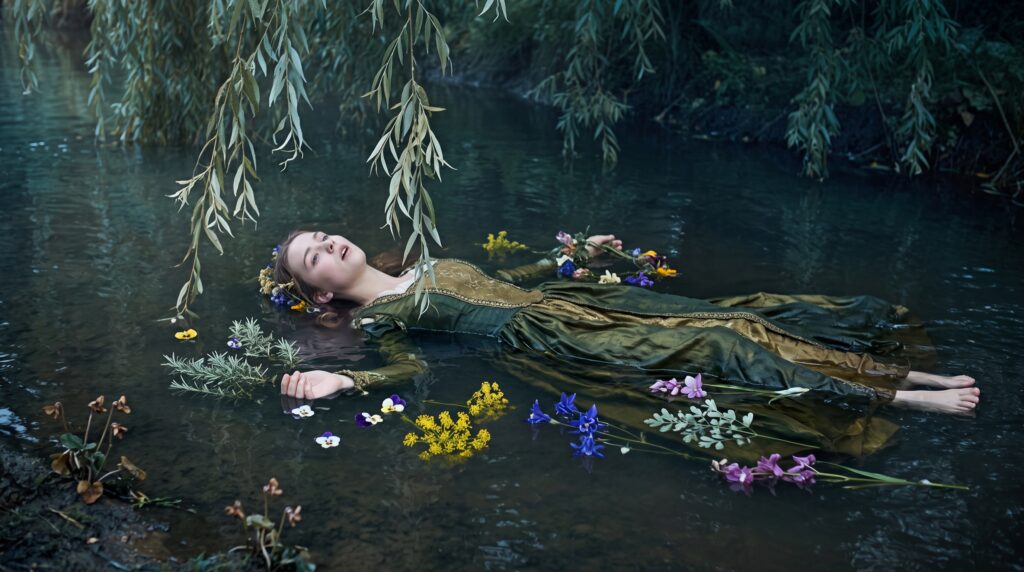
In the sprawling, blood-soaked tragedy of Elsinore, the most famous demise is one we never actually see. The death of Ophelia in Hamlet occurs entirely off-stage, yet it remains one of the most vividly analyzed, deeply debated, and visually iconic moments in all of English literature. For centuries, audiences, literary critics, and actors have grappled with the jarring contrast between the poetic, almost ethereal description of her drowning and the brutal reality of her psychological collapse.
Modern readers and theatergoers often struggle to reconcile these two opposing elements. How does a young noblewoman, crushed by the suffocating weight of court politics and patriarchal control, meet an end that sounds more like a dark fairytale than a gritty Elizabethan tragedy?
To truly understand this pivotal moment, we must look beyond the surface of Queen Gertrude’s beautiful elegy. Decoding this tragedy requires unpacking Ophelia’s rapid descent into madness, translating the dense botanical symbolism of her final moments, and examining the deliberate ambiguity William Shakespeare leaves regarding whether her death was a tragic accident or a calculated suicide.
The Catalyst: Ophelia’s Descent into Madness (Act 4, Scene 5)
To comprehend the death of Ophelia, one must first examine the psychological fracturing that precedes it. Unlike Hamlet, whose “antic disposition” is calculated and weaponized, Ophelia’s madness is a raw, agonizing break from reality. Her mental collapse is not an isolated event; it is the inevitable result of systematic isolation and trauma.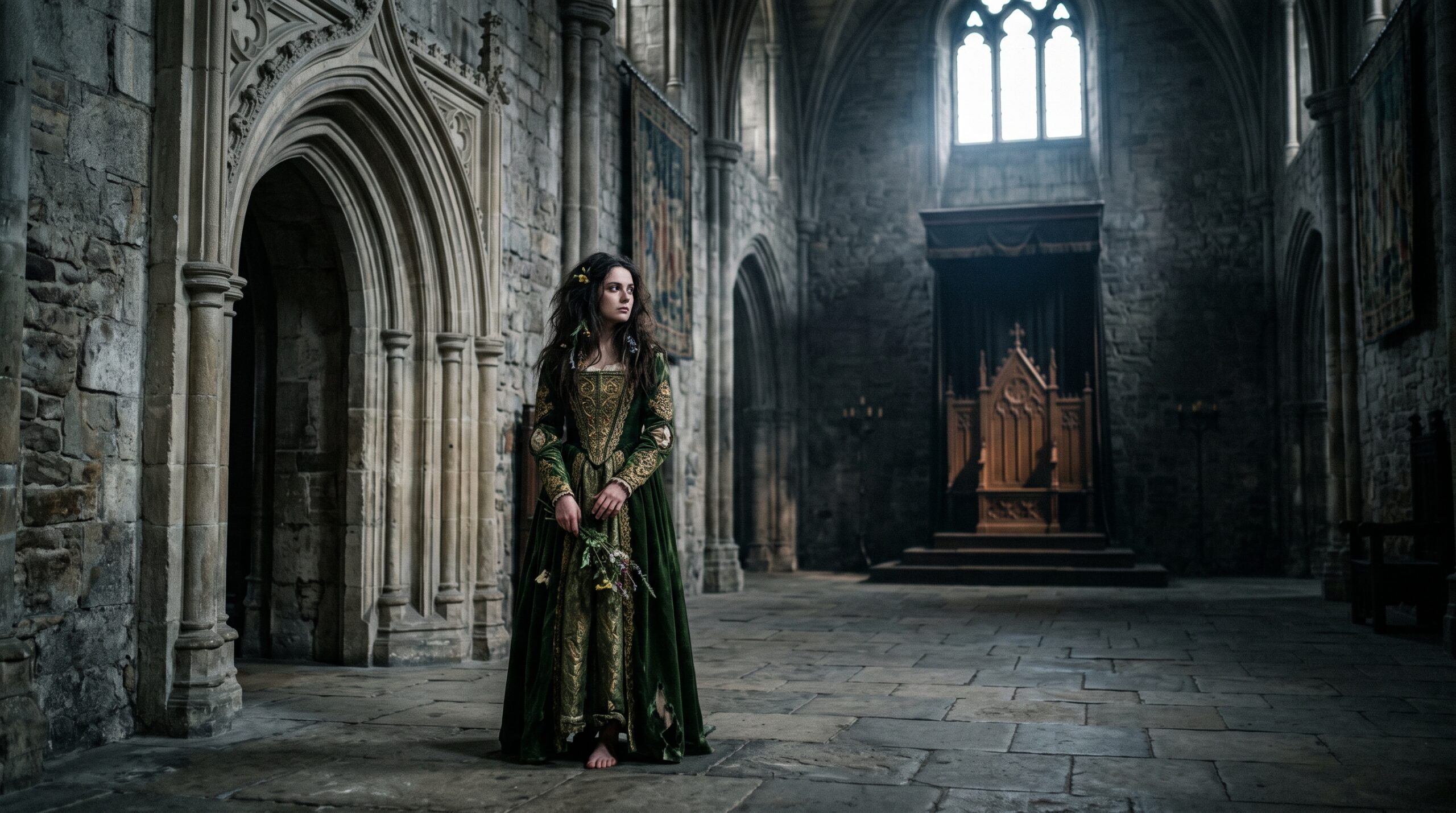
The Weight of Patriarchal Control
From the moment Ophelia is introduced in the play, her identity is entirely constructed by the men who surround her. She exists within a rigid patriarchal framework, functioning as a pawn for her father, Polonius, a sounding board for her brother, Laertes, and an object of fluctuating affection for Prince Hamlet.
Polonius dictates her behaviors and controls her romantic life, commanding her to sever ties with Hamlet. Laertes lectures her on the preservation of her chastity. Hamlet projects his profound disgust for women (stemming from his mother’s hasty remarriage) directly onto her. When these male figures are suddenly removed or turn against her, the external framework that defines her existence shatters. Without their direction, Ophelia is left psychologically unmoored in a dangerous court.
The Trauma of Polonius’s Murder
The sudden and violent death of her father acts as the primary catalyst for her break from reality. However, the tragedy is compounded exponentially by the identity of the killer: Hamlet, the man she loved. This cognitive dissonance—grieving her father while recognizing her former lover as his murderer—is a burden too immense for her fragile state to bear. Furthermore, Polonius is buried in secret, “in hugger-mugger,” denying Ophelia the closure of public mourning and proper grieving rites.
The “Nunnery” Scene and Hamlet’s Betrayal
Before her father’s death, Ophelia endures the deep trauma of Hamlet’s violent rejection in the famous “nunnery scene” (Act 3, Scene 1). By ordering her to “get thee to a nunnery,” Hamlet strips away her anticipated future as his wife and a royal consort. He publicly humiliating her and effectively destroys her social standing. This profound betrayal leaves her isolated; she has no mother to confide in, and the court treats her as a political tool rather than a human being in distress. Her subsequent madness is the only avenue through which she can finally speak her unfiltered truth to the corrupt rulers of Denmark.
Gertrude’s Elegiac Monologue: The Beautiful Drowning (Act 4, Scene 7)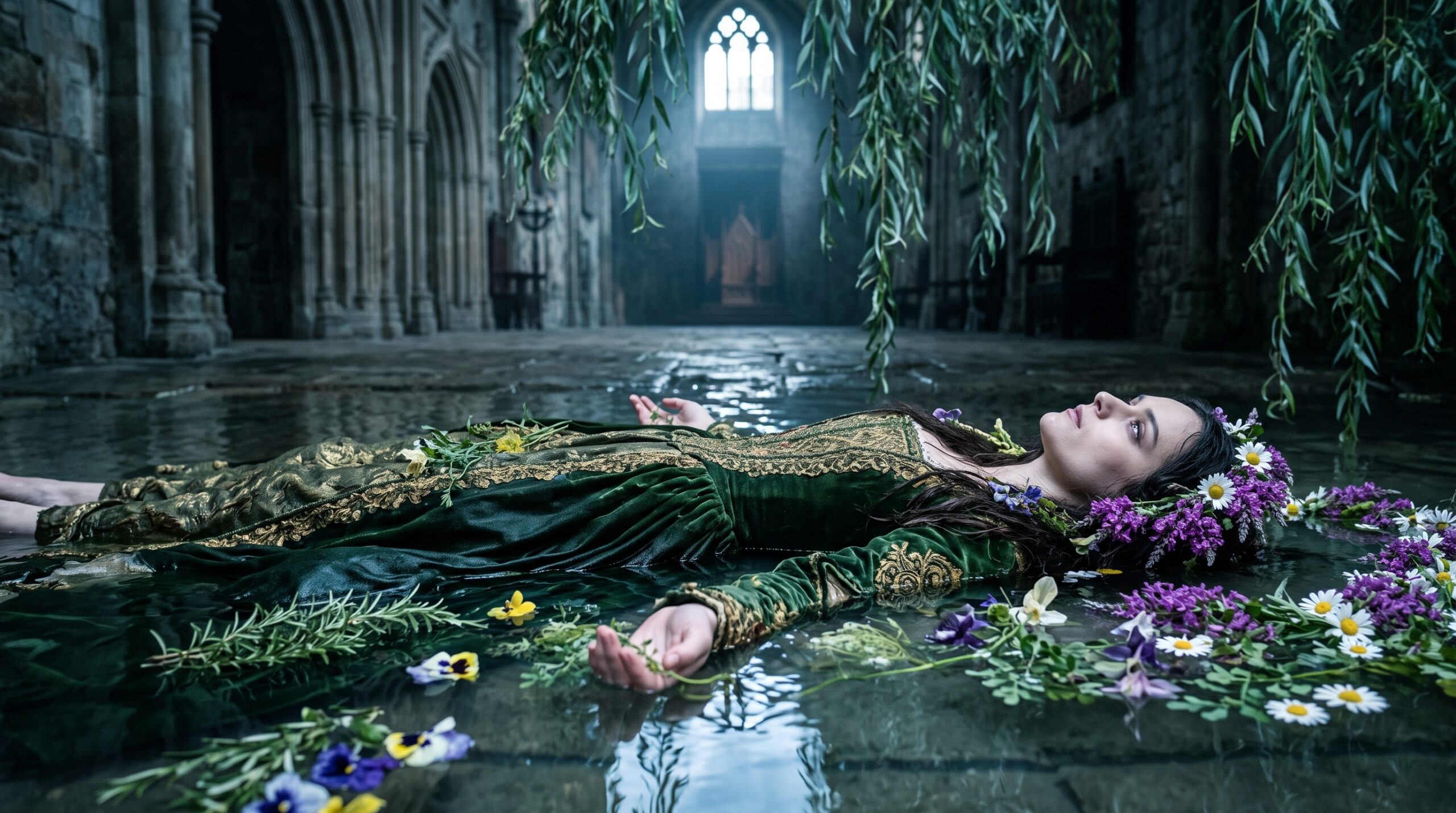
Ophelia’s death is not staged; it is reported. This structural choice by Shakespeare forces the audience to rely entirely on Queen Gertrude’s narrative. When Gertrude bursts into the room to deliver the news to Laertes and King Claudius, she delivers one of the most famous and lyrically stunning monologues in the Shakespearean canon.
The Willow Tree and the Glassy Stream
Gertrude begins with hauntingly pastoral imagery: “There is a willow grows aslant a brook, / That shows his hoar leaves in the glassy stream.”
She describes Ophelia climbing into the branches to hang garlands of flowers, only for an “envious sliver” (a malicious branch) to break. Ophelia falls into the weeping brook, but rather than panicking, she floats peacefully. Gertrude notes that Ophelia’s clothes spread wide, mermaid-like, bearing her up while she sings “snatches of old tunes,” completely unaware of her own peril. Eventually, her garments grow heavy with water and pull the poor wretch from her “melodious lay to muddy death.”
Why does Gertrude frame the drowning with such romantic, poetic language? Literary experts suggest several motives:
-
Softening the Blow: Gertrude may be attempting to pacify a deeply volatile and heavily armed Laertes by making his sister’s death sound peaceful and inevitable.
-
Obscuring the Truth (Covering up a Suicide): As a member of the royal family, Ophelia dying by suicide would be a massive scandal, resulting in her being denied Christian burial rites. By phrasing it as a tragic accident involving a broken branch, Gertrude might be politically spinning the event.
-
Maternal Sympathy: Gertrude is the only prominent female figure in Ophelia’s life. This speech may be her genuine, grief-stricken attempt to memorialize the girl she once hoped would be her daughter-in-law.
Why Shakespeare Keeps the Death Off-Stage
From a dramaturgical perspective, putting the death of Ophelia in Hamlet off-stage serves a powerful purpose. Staging a drowning in an Elizabethan theater (like the Globe) would have been logistically clumsy and potentially comical. By relying on descriptive verse, Shakespeare allows the audience’s imagination to paint a far more haunting and tragic picture. Furthermore, filtering the death through a second-hand account introduces the theme of unreliability, forcing the audience to immediately question whether they are hearing the absolute truth.
The Language of Flowers: Decoding the Symbolism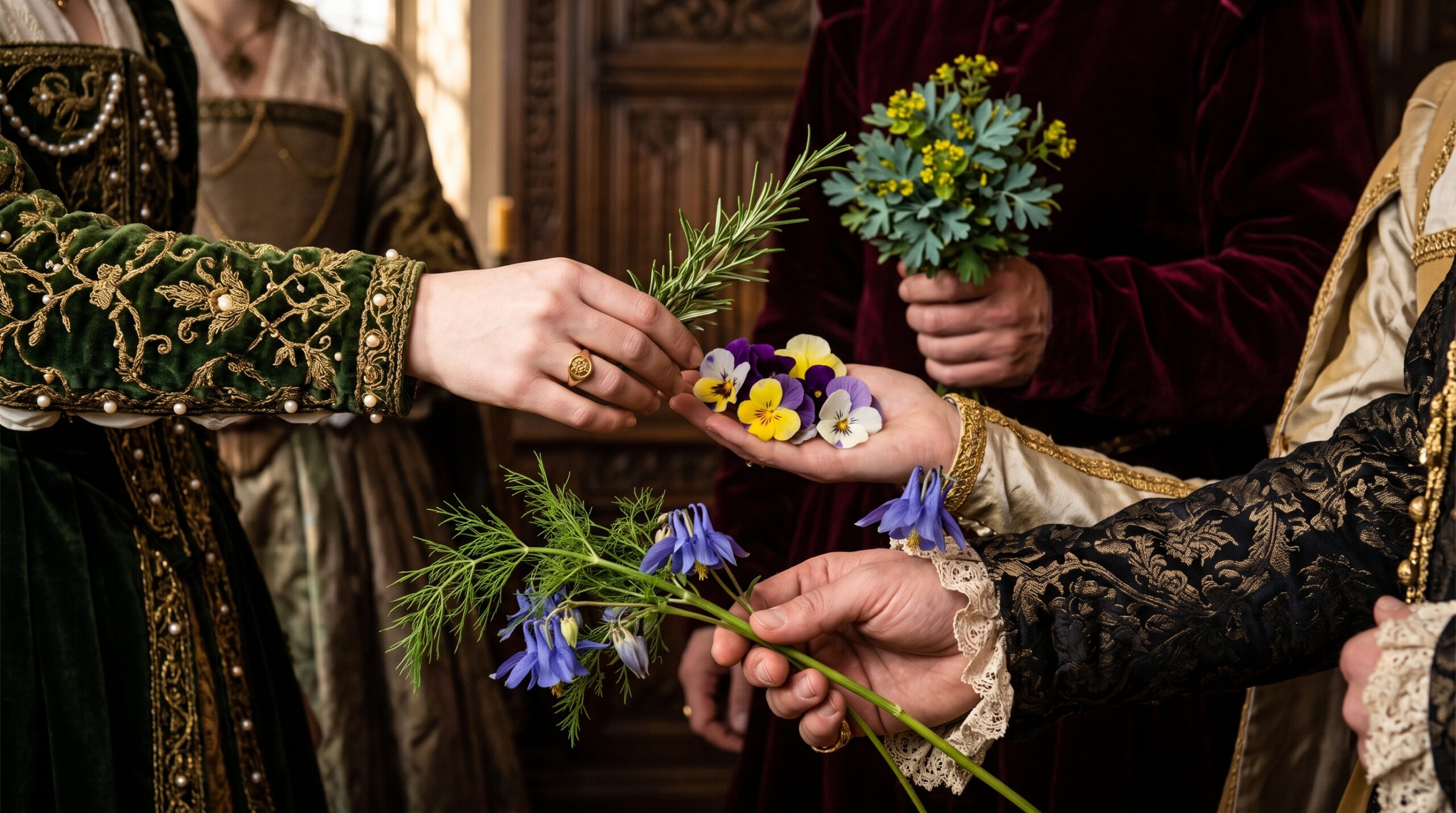
One cannot fully decode the death of Ophelia in Hamlet without translating the intricate botanical language she uses in her final scenes. In Elizabethan England, floriography (the language of flowers) was a well-understood cultural touchstone. Every plant carried specific symbolic weight. In her madness, Ophelia hands out flora to the members of the court. Because her mind is broken, the court dismisses her actions as “nothing,” but a closer analysis reveals that she is delivering devastating, highly accurate critiques of the corrupt ruling class.
The Distributed Flowers (Act 4, Scene 5)
When Ophelia wanders the halls of Elsinore, singing and distributing herbs and flowers, she assigns them to specific (though unnamed in the stage directions) characters. Here is a breakdown of her botanical accusations:
| Flower / Herb | Symbolic Meaning in Elizabethan Times | Likely Recipient & Hidden Message |
| Rosemary | Remembrance and mourning. | Laertes: A plea for him to remember their father and who she used to be before her mind fractured. |
| Pansies | Thoughts (from the French pensées). | Laertes: Urging him to think carefully about the political situation and not act purely on blind rage. |
| Fennel | Flattery and deceit. | King Claudius: A direct indictment of his manipulative nature and false kingship. |
| Columbines | Male adultery, foolishness, and ingratitude. | King Claudius: Highlighting his incestuous marriage and betrayal of his brother (Old King Hamlet). |
| Rue | Repentance, sorrow, and bitter regret. | Queen Gertrude (and herself): “Herb of grace o’ Sundays.” Ophelia suggests Gertrude must repent for her hasty marriage, while Ophelia keeps some for her own sorrow. |
| Daisy | Innocence and gentle deceit. | No one (or left on the floor): She picks it up but gives it to no one, symbolizing that true innocence has completely vanished from Elsinore court. |
The Death Garland (Act 4, Scene 7)
When Gertrude reports Ophelia’s drowning, she notes that the girl was weaving a garland of “fantastic garlands” composed of specific weeds and wildflowers: crow-flowers, nettles, daisies, and “long purples.”
These weeds carry dark connotations. Nettles represent stinging pain, and crow-flowers represent childishness. Most notably, Shakespeare includes “long purples,” deliberately mentioning that “liberal shepherds give a grosser name” (often associated with dead men’s fingers or phallic imagery). Even in death, Shakespeare intertwines Ophelia’s tragedy with the heavy, inescapable weight of the sexual purity and corruption thrust upon her by the men in her life.
The Missing Violets
Perhaps the most heartbreaking moment of botanical symbolism occurs when Ophelia states: “I would give you some violets, but they withered all when my father died.”
Violets represent faithfulness, loyalty, and fidelity. By explicitly stating that the violets have withered and died, Ophelia is delivering a profound thematic truth: in the state of Denmark, under the reign of Claudius, absolute loyalty and faithfulness no longer exist.
The Great Debate: Accident, Murder, or Suicide?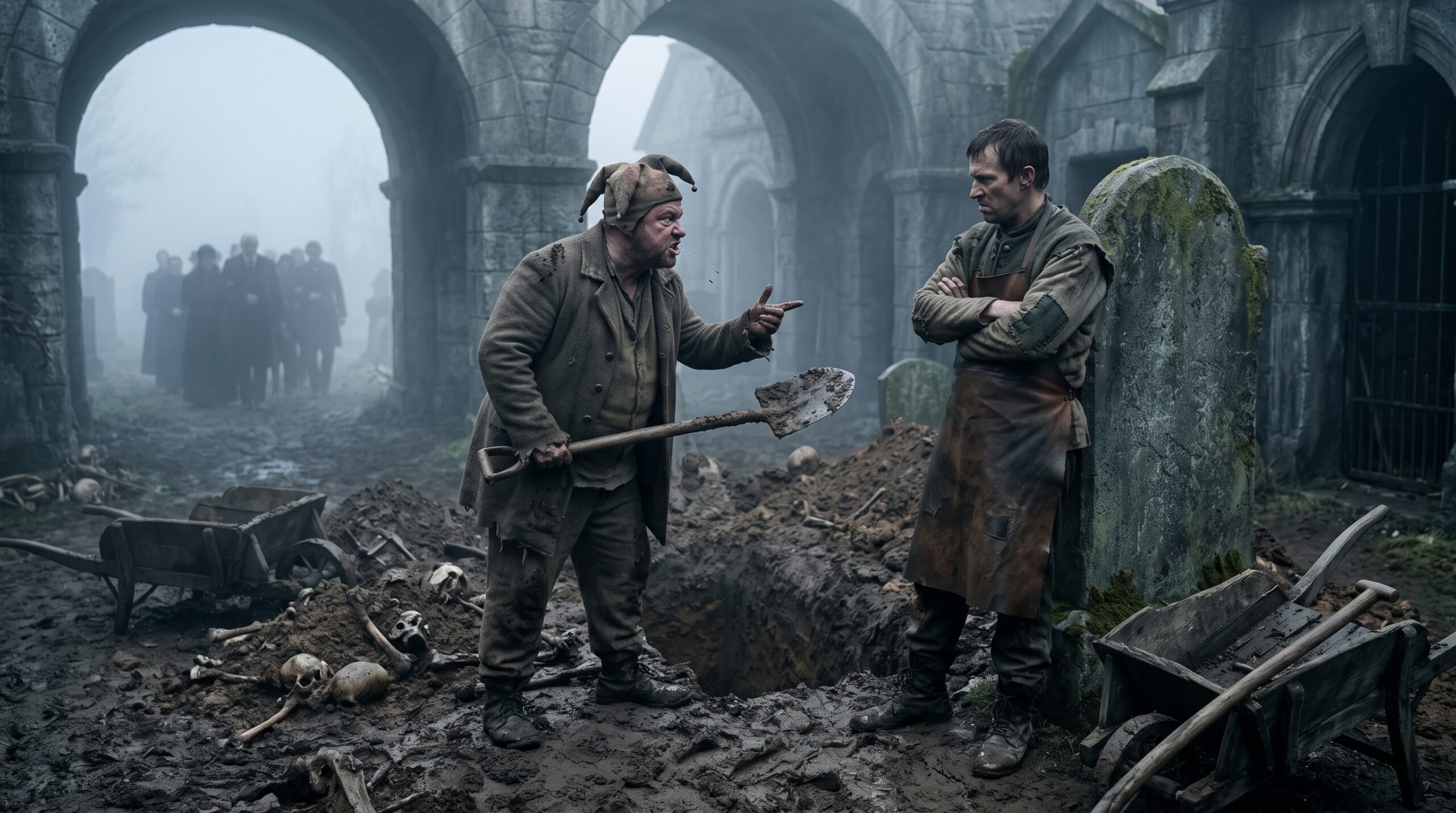
The exact nature of Ophelia’s demise remains one of literature’s most enduring mysteries. Did the heavy, waterlogged dresses pull an innocent girl under, or did she willingly allow herself to drown? Shakespeare deliberately creates a contradictory narrative, pitting the Queen’s account against the commoners’ perspective in the following act.
Textual Evidence for Accidental Drowning
If we take Queen Gertrude’s monologue at face value, the death of Ophelia in Hamlet was a tragic accident. Gertrude explicitly blames the physical environment: an “envious sliver” (a malicious willow branch) broke, plunging her into the brook. Furthermore, Gertrude describes Ophelia as being “incapable of her own distress.” In this interpretation, Ophelia’s madness has so deeply disconnected her from reality that the basic human survival instinct—the panic of drowning—fails to kick in. She simply sings until the water pulls her down.
Textual Evidence for Suicide (Act 5, Scene 1)
The romanticized veneer of Gertrude’s story is immediately shattered in the very next scene. Act 5 opens in a graveyard, where two Gravediggers (clowns) are digging Ophelia’s grave. They engage in a dark, legalistic debate regarding her right to a Christian burial.
The Gravedigger points out that if she drowned herself “wittingly” (intentionally), she is guilty of self-slaughter, a mortal sin in Elizabethan theology. The text makes it clear that the coroner (the “crowner”) has intervened on the King’s orders to allow her a burial in hallowed ground.
When the funeral procession arrives, the priest is overtly hostile. He states that her death was “doubtful” and that, were it not for the King’s overriding command, she should be buried in unsanctified ground with “shards, flints and pebbles” thrown onto her grave. He even refuses to sing a requiem for her. This sharp tonal shift suggests that the broader society views her death as a suicide, and that Gertrude’s story was merely a political cover-up orchestrated by the crown.
The Ambiguity as a Literary Device
Why did Shakespeare leave this unresolved? The ambiguity is entirely the point. The unresolved nature of her death mirrors the moral corruption, surveillance, and uncertainty of Denmark itself. By giving us two conflicting accounts, Shakespeare forces the audience to engage with the same epistemological crisis Hamlet faces: in a world of deception, how can we ever know the absolute truth?
The Cultural and Artistic Legacy
The visual and thematic impact of Ophelia’s death has transcended the text, heavily influencing visual arts, psychology, and modern pop culture.
John Everett Millais and the Pre-Raphaelite Vision
The modern visual conception of the death of Ophelia in Hamlet was largely cemented in 1852 by the British Pre-Raphaelite painter John Everett Millais. His masterpiece, Ophelia, depicts her floating face-up in a vibrant, hyper-realistic stream, her hands open in surrender, surrounded by meticulously painted, botanically accurate flowers. Millais transformed her tragedy into an ethereal, gothic aesthetic that romanticized female suffering, an image that still dictates how we visualize the character today.
Modern Interpretations in Theater and Film
Contemporary directors often push back against the romanticized “beautiful drowning” narrative. In Kenneth Branagh’s 1996 film adaptation, Ophelia (played by Kate Winslet) is shown thrashing and screaming in a padded cell, making her madness visceral and terrifying rather than merely poetic. Modern feminist critiques frequently re-examine Ophelia not just as a passive victim, but as a young woman whose madness is her only rebellion against a suffocating patriarchal society.
Expert Study Tips: Writing About Ophelia (E-E-A-T Section)
For students and literary analysts looking to craft high-level essays or thesis statements regarding Ophelia, keep these expert tips in mind:
-
Avoid the “Passive Victim” Trap: It is easy to reduce Ophelia to a helpless pawn. Instead, focus on how her madness grants her a subversive voice. In her “insanity,” she is able to criticize the King and Queen in ways that would result in execution for any sane character.
-
Contrast Her Grief with Hamlet’s: Both characters lose their fathers to murder. Compare how society expects Hamlet to grieve (revenge, political action) versus how it forces Ophelia to grieve (silence, isolation, resulting in internal collapse).
-
Analyze the Water Motif: Water in Shakespeare often symbolizes both destruction and purification. Explore how her drowning relates to the themes of spiritual rot and the need to cleanse the state of Denmark.
Frequently Asked Questions (FAQs)
Why did Ophelia go mad?
Ophelia’s madness is triggered by a combination of severe emotional traumas: the sudden and violent murder of her father, Polonius; the realization that her former lover, Hamlet, is the killer; Hamlet’s brutal rejection of her during the “nunnery scene”; and the lack of a strong support system to help her process her grief.
Did Ophelia jump or fall into the water?
Shakespeare intentionally leaves this ambiguous. Queen Gertrude reports that a branch broke while Ophelia was hanging flowers, suggesting an accident. However, the Gravediggers and the Priest in the following act strongly imply she took her own life, referring to her death as “doubtful” and debating her right to a Christian burial.
What does the willow tree symbolize in Ophelia’s death?
In literature and folklore, the weeping willow is a traditional symbol of forsaken love, sorrow, and mourning. By placing Ophelia in a willow tree just before her death, Shakespeare reinforces the tragic loss of her relationship with Hamlet and her profound, insurmountable grief.
Why couldn’t Ophelia have a proper Christian burial?
In Elizabethan theology, suicide (self-slaughter) was considered a mortal sin. Those who died by suicide were denied Christian burial rites and were often buried in unhallowed ground. Because Ophelia’s death was highly suspicious, the priest was reluctant to give her full rites, only doing so because King Claudius commanded it.
Conclusion
The death of Ophelia in Hamlet is far more than a beautiful, tragic set-piece. It is a masterclass in narrative ambiguity, rich botanical symbolism, and psychological horror. Whether she was pulled under by the weight of her waterlogged gowns or by the crushing weight of a corrupt, patriarchal society, Ophelia remains Shakespeare’s most haunting figure.
She is a character who speaks the loudest truths only after her mind is gone, and who manages to dominate the thematic narrative of the play even from beneath the glassy surface of a weeping brook. By decoding the circumstances of her demise, we gain a deeper, more profound understanding of the tragedy that consumes the entirety of Elsinore.