One of William Shakespeare’s most grotesque, darkly comedic jokes is not found in a comedy, but buried deep within his greatest tragedy, serving as a brilliant piece of political rebellion. If you are studying or performing the play, mastering hamlet act 4 scene 3 is absolutely essential. This brief but explosive scene takes place immediately following the brutal, accidental murder of Polonius. Tensions in the rotting state of Elsinore have reached a boiling point, and the cat-and-mouse game between a supposedly mad prince and a guilty king is about to turn deadly.
For many students, actors, and literature enthusiasts, this specific scene can be incredibly confusing. It is packed with morbid riddles, complex Elizabethan wordplay, and hidden political agendas. Beneath Hamlet’s seemingly insane ramblings about worms and beggars lies a profound philosophical breakdown of mortality, as well as a masterclass in psychological warfare.
This comprehensive guide will decode Hamlet’s famous “worm” speech, unravel King Claudius’s hidden, sinister trap, and explain exactly why this short, frenetic confrontation is the true structural and thematic turning point of Shakespeare’s masterpiece. By the end of this analysis, you will have a master-level understanding of the scene’s underlying themes, shifting character dynamics, and its most crucial quotes.
Act 4 Scene 3 Summary: What Actually Happens?
To understand the profound philosophical weight of this scene, we first need to establish the immediate plot mechanics. Act 4, Scene 3 is a scene of interrogation, evasion, and ultimately, banishment.
The Interrogation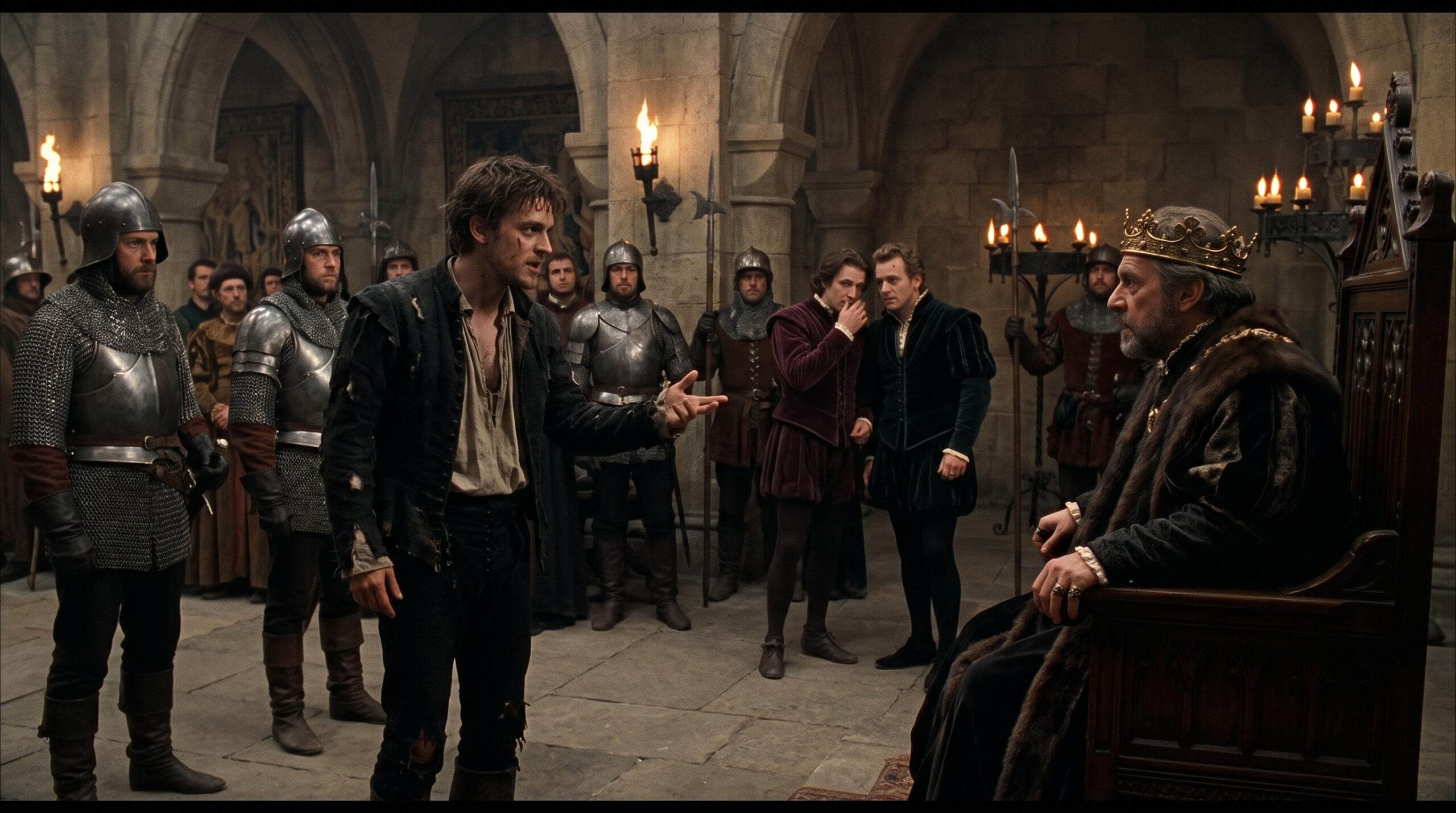
The scene opens with King Claudius speaking to his attendants. He is frantic, acknowledging the deep danger Hamlet poses to his reign, yet recognizing that he cannot simply arrest or execute the Prince because the Danish public loves him. Rosencrantz and Guildenstern enter, reporting that they cannot coax Hamlet into revealing where he has hidden Polonius’s corpse.
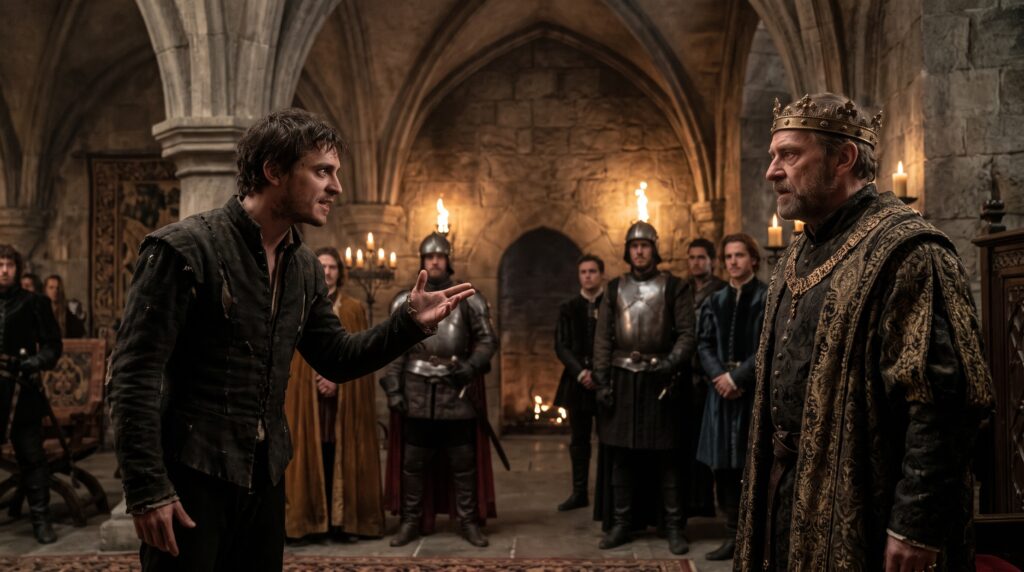
Hamlet is brought before the King under guard. Claudius demands an answer: “Now, Hamlet, where’s Polonius?” Instead of answering directly, Hamlet uses his “antic disposition” (his feigned madness) as a shield, taunting the King with riddles and refusing to grant Claudius the respect his royal title demands.
The Big Reveal
When pressed about the corpse, Hamlet coldly replies that Polonius is “At supper.” This leads into the famous, morbid diatribe about worms eating the bodies of kings and beggars alike. Claudius, losing his patience and his composure, demands a straight answer. Hamlet finally drops a crude hint: “if you find him not within this month, you shall nose him as you go up the stairs into the lobby.” Claudius immediately dispatches his guards to retrieve the body, confirming the gruesome reality of Hamlet’s crime.
The Exile to England
Seizing the opportunity to remove his nephew from Elsinore, Claudius informs Hamlet that, for his own “safety” following this murder, he must leave for England immediately. A ship is waiting, and the wind is fair. Hamlet accepts this sudden exile with an eerie, mocking calmness. He delivers one final, stinging insult to Claudius before departing, saying, “Farewell, dear mother.”
The Deadly Soliloquy
Once Hamlet is escorted away, Claudius is left alone on stage. Here, the King drops his diplomatic mask and reveals his true intentions to the audience. He has prepared letters for the King of England, a nation that currently pays tribute to Denmark. These letters contain a mandate for Hamlet’s immediate execution upon arrival. Claudius views Hamlet as a terminal disease in his blood, and only the Prince’s death will cure his anxiety.
Decoding the “Worm” Speech: Death as the Great Equalizer
The centerpiece of this scene—and arguably one of the most famous philosophical meditations in all of Shakespeare’s works—is Hamlet’s “worm” speech. It is a vital moment of character development that directly addresses the search intent for anyone trying to analyze the deeper meaning of the Prince’s dialogue.
“Not where he eats, but where he is eaten”
When Claudius asks where Polonius is, Hamlet’s reply that he is “at supper” is a horrifying double entendre. He clarifies: “Not where he eats, but where he is eaten. A certain convocation of politic worms are e’en at him.”
To understand this, we must look at the character of Polonius. Throughout the play, Polonius was a political “worm”—a sycophant who spent his life snooping, manipulating, and burrowing through the halls of power to serve the King. Hamlet is highlighting the ultimate irony: the man who spent his life whispering political secrets is now nothing more than a feast for literal, biological worms. The phrase “politic worms” suggests that even in the grave, the hierarchy of consumption continues, but nature has claimed the ultimate authority.
The King and the Beggar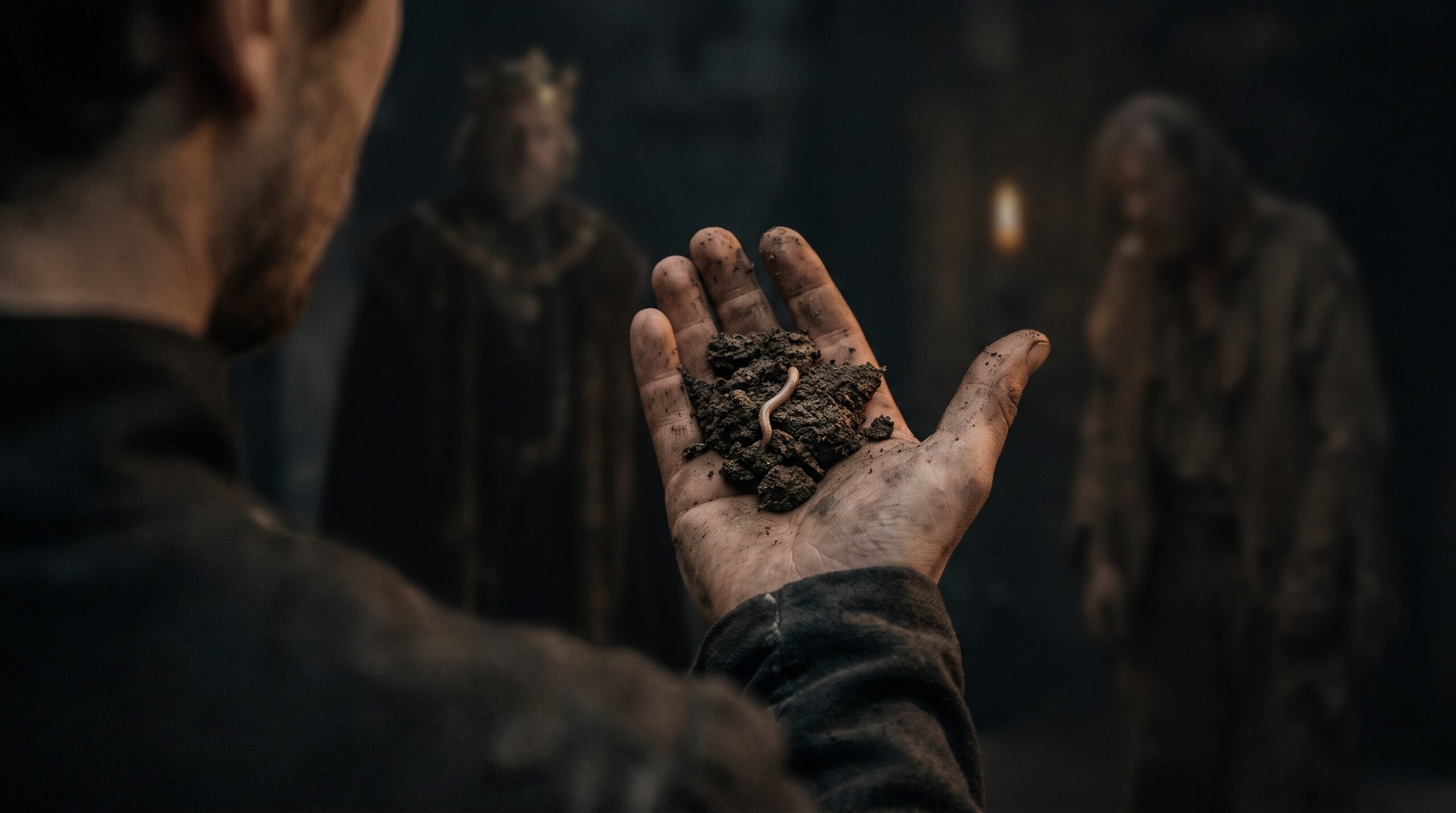
Hamlet pushes this morbid logic further to attack the foundation of Claudius’s power. He states: “Your fat king and your lean beggar is but variable service—two dishes, but to one table. That’s the end.”
In the Elizabethan era, society was strictly governed by the “Great Chain of Being,” a belief in a strict, God-given hierarchy where kings sat at the very top of the mortal realm, inherently superior to the commoners below them. To suggest that a King and a beggar are merely two different items on the same menu for maggots was a deeply subversive, treasonous thing to say. Hamlet is systematically stripping away the Divine Right of Kings. He is looking Claudius in the eye and reminding him that beneath his stolen crown, his velvet robes, and his royal titles, he is just meat waiting to rot.
A King’s Journey Through the Guts of a Beggar
Hamlet traces a macabre, biological circle of life to prove his point to his uncle:
-
A man uses a worm to catch a fish.
-
That worm previously fed on the buried corpse of a king.
-
A beggar then eats the fish that ate the worm.
-
Therefore, a king has moved through the digestive tract of a beggar.
This is not just a madman’s rambling; it is a calculated threat. Hamlet is demonstrating a profound existential nihilism, realizing that all political ambition ends in the dirt. This speech heavily foreshadowes the famous Gravedigger scene in Act 5 (where Hamlet holds the skull of Yorick), showing that Hamlet’s mind is becoming increasingly obsessed with the physical reality of death and decay.
The Political Chess Match: Claudius’s Dilemma and the Trap
While Hamlet dominates the philosophical dialogue, Act 4 Scene 3 is equally important for understanding King Claudius’s strategic mindset. Claudius is a master politician, and this scene showcases both his cunning and his vulnerability.
Why Doesn’t Claudius Just Kill Hamlet in Denmark?
A common question readers ask is: If Claudius knows Hamlet is a threat, and Hamlet has just committed murder, why doesn’t Claudius simply have him executed in Elsinore?
Claudius explicitly answers this in his opening lines. He notes that Hamlet is “loved of the distracted multitude.” The Danish public adores their young Prince. They judge by appearance rather than reason (“who like not in their judgment, but their eyes”). If Claudius were to put Hamlet on trial or execute him openly, it would likely spark a violent rebellion that could strip Claudius of his throne. Claudius is politically trapped. Letting Hamlet live is a daily threat to his life and his crown, but killing him publicly is political suicide.
The “Letters” to England
Claudius’s solution to this dilemma is geographically outsourced assassination. By sending Hamlet to England under the guise of protecting him from the legal fallout of Polonius’s death, Claudius appears to be a merciful uncle to the Danish court.
However, his closing soliloquy reveals the dark truth: “And, England, if my love thou hold’st at aught… thou mayst not coldly set / Our sovereign process, which imports at full, / By letters congruing to that effect, / The present death of Hamlet.”
Historically, England had periods of subjugation to Denmark (such as under King Cnut). Shakespeare uses this dynamic to frame the execution order as a geopolitical power play. Claudius is calling in a tribute, demanding the English King act as his personal headsman.
The Disease Metaphor
Claudius closes the scene by comparing Hamlet to a deadly infection: “For like the hectic in my blood he rages, / And thou must cure me.”
This ties directly into the overarching motif of disease, rot, and corruption that permeates the entire play. From the opening scene’s declaration that “something is rotten in the state of Denmark,” sickness is a constant theme. Claudius, ironically, is the true source of the nation’s rot (having murdered his brother and taken his wife), yet he views Hamlet as the fever that is slowly killing him.
Character Dynamics: Madness vs. Manipulation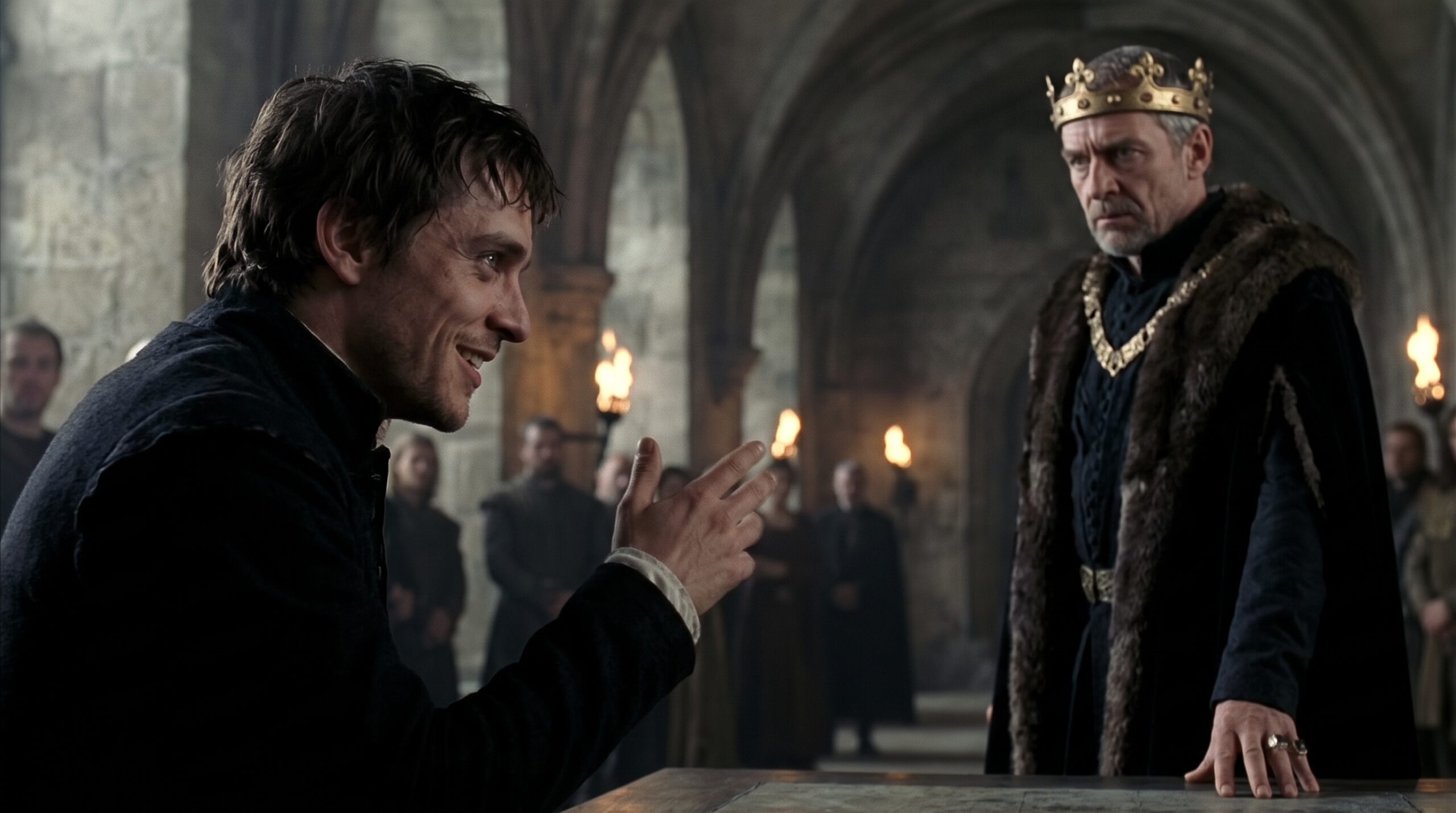
The tension in Act 4 Scene 3 relies heavily on the psychological warfare between the two central characters. Both men are hiding their true intentions behind carefully constructed masks.
Hamlet’s “Antic Disposition” at Its Peak
Is Hamlet truly mad in this scene, or is he just putting on a masterclass in manipulation? The brilliance of Shakespeare’s writing is that it leaves room for interpretation, but the evidence strongly suggests Hamlet is in full control of his faculties.
He uses his “insanity” as a license to speak treasonous truths without consequence. A sane prince who tells the King he will soon be eaten by worms would be arrested for treason. A “mad” prince can say the exact same thing, and the King is forced to swallow the insult. Hamlet’s wordplay is too sharp, his logic too circular, and his insults too targeted to be the ravings of a broken mind. He is weaponizing madness against his uncle.
Claudius’s Crumbling Facade
Conversely, this scene marks the beginning of Claudius’s unraveling. In Act 1, Claudius was presented as a smooth, confident diplomat, easily managing foreign affairs and holding court with charisma. By Act 4 Scene 3, he is a frantic, paranoid man. His dialogue is short, urgent, and laced with panic. Hamlet’s unpredictable behavior has stripped away Claudius’s royal composure, forcing the King to resort to cowardly, underhanded murder via a foreign proxy.
Key Themes Explored in Act 4, Scene 3
To elevate your literary analysis or essay, it is vital to connect the events of this scene to the broader themes of the tragedy.
-
Mortality and Decay: The scene forces the audience to confront the physical reality of death. While previous scenes dealt with ghosts and the spiritual afterlife, Hamlet’s fixation on corpses, maggots, and digestion strips death of its spiritual majesty, reducing it to mere biology.
-
Appearance vs. Reality: Almost nothing in this scene is as it seems. Hamlet acts insane, but is highly lucid and strategic. Claudius acts like a concerned uncle protecting his nephew, but is actually plotting his assassination. The entire interaction is a deadly facade.
-
Political Corruption: The rotting state of Denmark is mirrored in its leadership. Diplomacy is not used for peace, but for secret assassinations. The King’s primary concern is not justice for Polonius, but managing public relations and securing his own power.
Essential Quotes and Analysis from Act 4 Scene 3
Mastering this scene requires a deep understanding of its most famous lines. Here are the key quotes to memorize and analyze:
“Diseases desperate grown / By desperate appliance are relieved, / Or not at all.” — King Claudius
Analysis: Claudius justifies his extreme actions. A desperate disease (Hamlet’s madness and rebellion) requires a desperate cure (exile and execution). It reveals Claudius’s Machiavellian belief that the end justifies the means.
“A man may fish with the worm that hath eat of a king, and eat of the fish that hath fed of that worm.” — Hamlet
Analysis: The climax of Hamlet’s morbid philosophy. It serves as a veiled threat to Claudius, reminding the usurper king that his power is temporary and his ultimate fate is the same as the lowest peasant.
“Farewell, dear mother.” — Hamlet (To Claudius)
Analysis: When Claudius corrects him, saying “Thy loving father, Hamlet,” the Prince responds with razor-sharp logic: “My mother. Father and mother is man and wife, man and wife is one flesh, and so, my mother.” This is Hamlet’s ultimate parting insult. He refuses to acknowledge Claudius as his father or his King, instead mocking the incestuous nature of Claudius and Gertrude’s marriage. It is a brilliant, legally airtight insult delivered just before he is dragged into exile.
Frequently Asked Questions (FAQ)
Why does Hamlet call Claudius his mother?
Hamlet calls Claudius his mother as a deliberate, calculated insult. He uses the biblical logic that “man and wife are one flesh” to blur the lines between Claudius and Queen Gertrude. By doing so, he refuses to acknowledge Claudius’s patriarchal authority as King or stepfather, while simultaneously throwing the incestuous, hasty marriage back in Claudius’s face.
What is the true meaning of the “worm speech” in Hamlet?
The worm speech illustrates the concept of death as the great equalizer. Hamlet uses biological realism—the fact that worms eat dead bodies regardless of their social status—to dismantle the societal hierarchy. It is a philosophical realization that political ambition is ultimately meaningless, as kings and beggars all share the exact same fate in the dirt.
Why is Hamlet being sent to England?
On the surface, Claudius claims Hamlet is being sent to England for his own safety and to protect him from the legal consequences of murdering Polonius. In reality, Claudius has arranged a diplomatic trap. He has sent secret letters ordering the English monarch to execute Hamlet upon his arrival, thereby removing the threat to the Danish throne without inciting a public uprising in Elsinore.
Where does Hamlet finally say he hid Polonius’s body?
After stringing the King along with riddles about supper and worms, Hamlet eventually reveals that the body is hidden up the stairs in the lobby (the main hall of the castle). He tauntingly tells Claudius that if his guards don’t find him soon, they will “nose him” (smell his rotting corpse) as they walk up the stairs.
Conclusion
Act 4, Scene 3 of Shakespeare’s Hamlet is far more than a simple transitional scene bridging the gap between Polonius’s death and Hamlet’s eventual return to Denmark. It is a masterfully written, high-stakes game of political chess. Through the famous “worm speech,” Hamlet weaponizes dark humor and morbid philosophy to strip away Claudius’s royal armor, masking a deep, terrifying truth about human equality in death.
Simultaneously, we witness the complete moral collapse of King Claudius, whose desperation drives him to engineer a cowardly, cross-border assassination. By decoding the riddles and recognizing the hidden traps within this scene, we gain a much richer appreciation for Shakespeare’s genius in blending profound existential dread with gripping political thriller dynamics.
The stage is now set for tragedy. As Hamlet boards the ship to England, unaware of the death warrant sailing with him, the countdown to the play’s bloody, unforgettable finale begins.