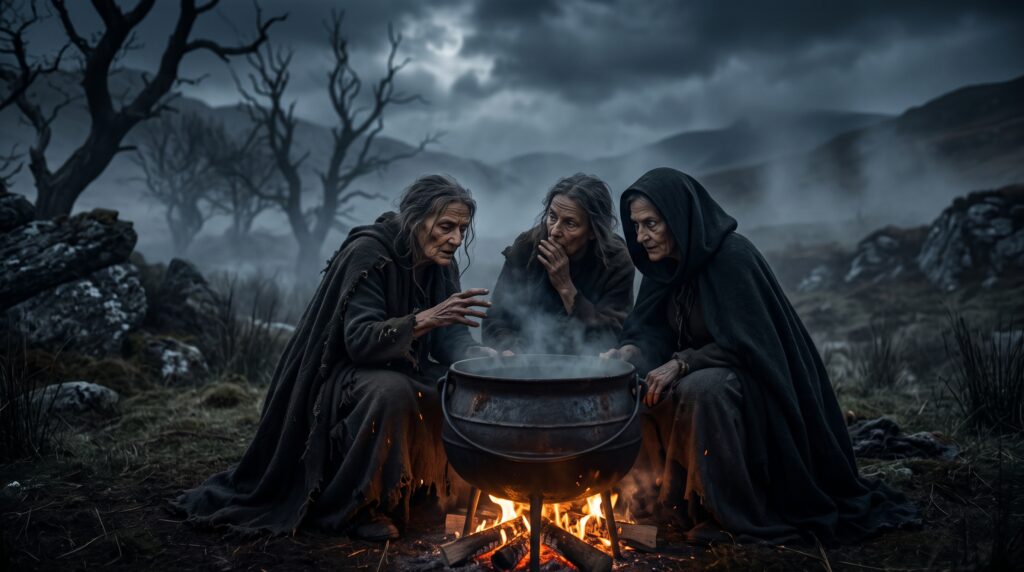
Thunder rolls across a desolate Scottish heath, signaling the arrival of literature’s most infamous architects of chaos. In William Shakespeare’s darkest tragedy, the Weird Sisters serve as the primary catalyst for murder, madness, and royal usurpation. For students, actors, and literary enthusiasts, analyzing Macbeth witches quotes is essential to unlocking the play’s core themes of unchecked ambition, equivocation, and the battle between fate and free will. These supernatural beings do not simply predict the future; they manipulate the very fabric of reality, speaking in hypnotic riddles that lure a noble warrior into becoming a tyrannical butcher.
To truly understand The Scottish Play, we must examine the language of its most mysterious characters. In this comprehensive guide, we will break down the 15 most iconic quotes from the witches in Macbeth, exploring their literary devices, historical context, and the hidden psychological triggers that drive Macbeth to his doom.
The Historical Context: Shakespeare, King James I, and the Supernatural
Before diving into the textual analysis, establishing the historical context is crucial for understanding why the Weird Sisters speak and act the way they do. When Shakespeare wrote Macbeth around 1606, he was writing for a new monarch: King James I of England (formerly King James VI of Scotland).
King James was notoriously obsessed with witchcraft. In 1597, he published Daemonologie, a philosophical dissertation on contemporary necromancy and the historical relationships between ancient demons and black magic. He even presided over the North Berwick witch trials. Shakespeare intentionally tailored the witches to reflect the monarch’s deep-seated fears, transforming them from the classical “Fates” of Holinshed’s Chronicles (Shakespeare’s historical source material) into grotesque, bearded hags who practice malicious folk magic, brew toxic potions, and disrupt the Great Chain of Being.
With this historical lens in place, let us analyze the incantations, prophecies, and apparitions that define their presence in the tragedy.
Act 1, Scene 1: The Incantation Begins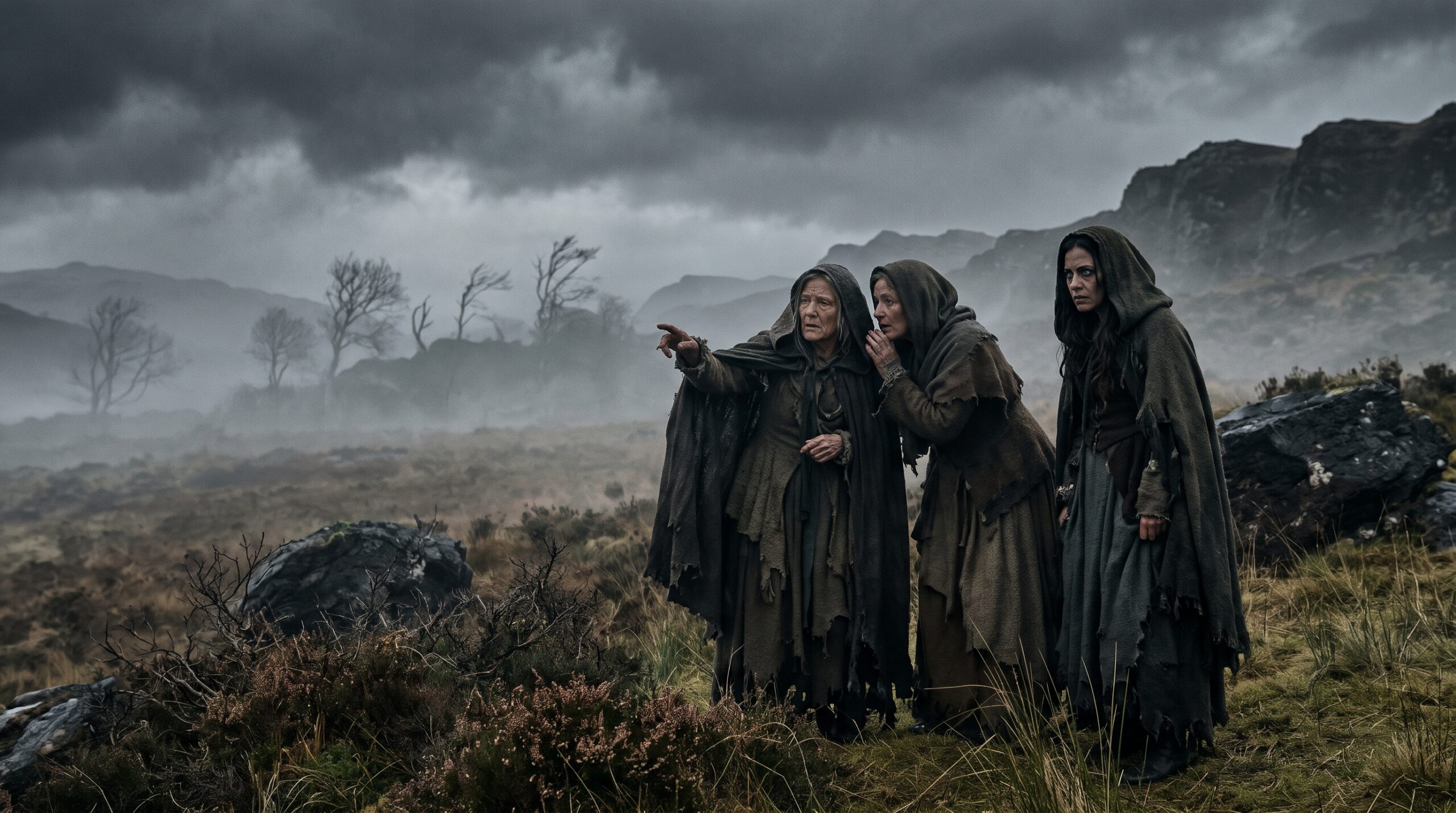
The play opens not with the titular character, but with the witches. This structural choice immediately establishes that supernatural forces will dictate the atmosphere of the narrative.
1. The Paradox of Morality
“Fair is foul, and foul is fair: / Hover through the fog and filthy air.” — All Witches (Act 1, Scene 1)
The Hidden Meaning: This is arguably the most famous line in the entire play, functioning as the thematic thesis for the narrative. Spoken in unison, it introduces a terrifying paradox: in the world of Macbeth, traditional morality is inverted. What appears good, pure, or “fair” (like Macbeth’s loyalty or King Duncan’s trust) is actually corrupt, toxic, or “foul.”
Linguistically, Shakespeare uses a chiasmus (a reversal of grammatical structures) to create a dizzying, chant-like rhythm. This blurring of lines between good and evil foreshadows Macbeth’s own moral decay. When Macbeth makes his first appearance in Scene 3, his very first line mirrors this exact sentiment: “So foul and fair a day I have not seen,” immediately linking his psyche to the witches’ dark magic before they even speak to him.
2. The Nature of Conflict
“When the hurlyburly’s done, / When the battle’s lost and won.” — Second Witch (Act 1, Scene 1)
The Hidden Meaning: The “hurlyburly” refers to the chaos of the ongoing Scottish rebellion against King Duncan. However, the phrase “lost and won” introduces the concept of equivocation—the use of ambiguous language to conceal the truth. Every victory in this play comes with a devastating loss. Macbeth will win the crown but lose his soul, his wife, and ultimately his head. The witches operate in this liminal space where binary concepts like victory and defeat are no longer mutually exclusive.
Act 1, Scene 3: The First Prophecies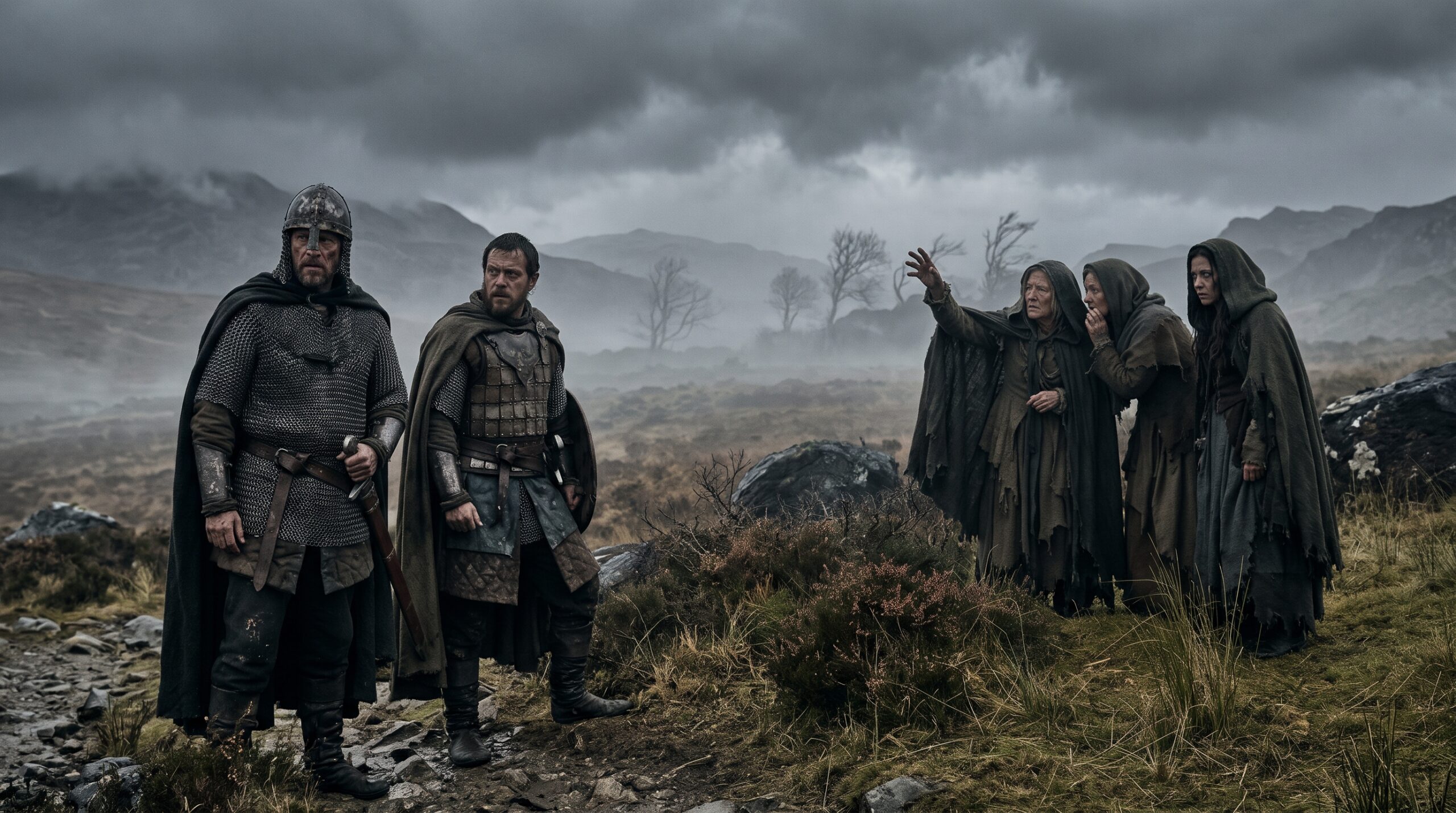
When the Weird Sisters finally encounter Macbeth and his fellow general, Banquo, their language shifts from abstract atmospheric chanting to targeted, psychological manipulation.
3. The Vindictive Hags
“A sailor’s wife had chestnuts in her lap, / And munch’d, and munch’d, and munch’d:—’Give me,’ quoth I: / ‘Aroint thee, witch!’ the rump-fed ronyon cries. / Her husband’s to Aleppo gone, master o’ the Tiger: / But in a sieve I’ll thither sail, / And, like a rat without a tail, / I’ll do, I’ll do, and I’ll do.” — First Witch (Act 1, Scene 3)
The Hidden Meaning: Before greeting Macbeth, the First Witch recounts a petty dispute over chestnuts. Because a sailor’s wife refused to share her food, the witch plans to torture her husband at sea. This quote is vital for understanding the scope of their power. They are incredibly vindictive and possess dark magic (sailing in a sieve, controlling the winds), but they have limits. The witch notes she will drain the sailor dry as hay, but explicitly states, “Though his bark cannot be lost, / Yet it shall be tempest-tost.”
This proves that while the witches can create horrific “tempests” (chaos and suffering), they do not have the power to destroy a ship (or a soul) outright. This is a crucial piece of evidence in the “fate vs. free will” debate: the witches can tempt and torment Macbeth, but they cannot force him to murder Duncan. Macbeth must make that choice himself.
4. The Triple Salutation
“All hail, Macbeth! hail to thee, thane of Glamis!” (First Witch) “All hail, Macbeth, hail to thee, thane of Cawdor!” (Second Witch) “All hail, Macbeth, thou shalt be king hereafter!” (Third Witch) — (Act 1, Scene 3)
The Hidden Meaning: This triple prophecy acts as the catalyst for the entire tragedy. It is structured brillianty: a statement of present fact (Glamis), a prophecy that is already true but unknown to Macbeth (Cawdor), and a future prediction that demands treason (King). By sandwiching the impossible prediction of kingship next to a truth (Cawdor, which King Duncan has just awarded to Macbeth off-stage), the witches instantly validate their own credibility in Macbeth’s mind. Once Ross arrives moments later to confirm Macbeth is the new Thane of Cawdor, the seed of usurpation takes permanent root in Macbeth’s ambitious mind.
The Paradoxes of Banquo (Act 1, Scene 3)
While Macbeth receives concrete titles (Cawdor, King), his companion Banquo is fed a diet of pure equivocation. The witches recognize Banquo’s inherent skepticism and respond with riddles that contrast Macbeth’s immediate, violent rise with Banquo’s enduring, passive legacy.
5. The Enigma of Greatness “Lesser than Macbeth, and greater.” — First Witch (Act 1, Scene 3)
The Hidden Meaning: This line plays on the concepts of earthly power versus moral integrity. In the short term, Banquo will be “lesser” because he will not wear the crown of Scotland. However, he is “greater” in character. He does not succumb to the dark temptations of the supernatural, maintaining his loyalty and honor even as Macbeth descends into tyranny.
6. The Illusion of Happiness “Not so happy, yet much happier.” — Second Witch (Act 1, Scene 3)
The Hidden Meaning: Macbeth will achieve his ultimate desire—the throne—but it will bring him only paranoia, insomnia, and despair. Banquo will suffer a violent death at the hands of Macbeth’s assassins (making him “not so happy”), yet he dies with a clean conscience, escaping the psychological torment that will eventually destroy Macbeth.
7. The Royal Lineage “Thou shalt get kings, though thou be none:” — Third Witch (Act 1, Scene 3)
The Hidden Meaning: Here, Shakespeare directly flatters his patron, King James I. James traced his ancestral lineage back to the historical figure of Banquo. By prophesying that Banquo will father a long line of kings, the witches are canonically legitimizing King James’s right to rule. This prophecy also triggers Macbeth’s deepest insecurity; realizing his own reign is a “fruitless crown,” Macbeth determines he must murder Banquo to alter the course of fate.
Hecate’s Intervention (Act 3, Scene 5)
Many scholars believe the character of Hecate (the goddess of witchcraft) and her accompanying scenes were added later by playwright Thomas Middleton to capitalize on the audience’s demand for musical, supernatural spectacles. Regardless of authorship, her lines provide critical insight into the psychological manipulation of the protagonist.
8. The Ultimate Vulnerability “And you all know, security / Is mortals’ chiefest enemy.” — Hecate (Act 3, Scene 5)
The Hidden Meaning: In Elizabethan English, “security” meant overconfidence or a false sense of safety. Hecate is outlining the exact strategy the witches will use to finalize Macbeth’s destruction. By giving him prophecies that make him feel invincible, they will strip away his caution. It is a profound psychological truth: hubris and arrogance leave a person entirely unguarded against their own ruin.
The Dark Rituals (Act 4, Scene 1)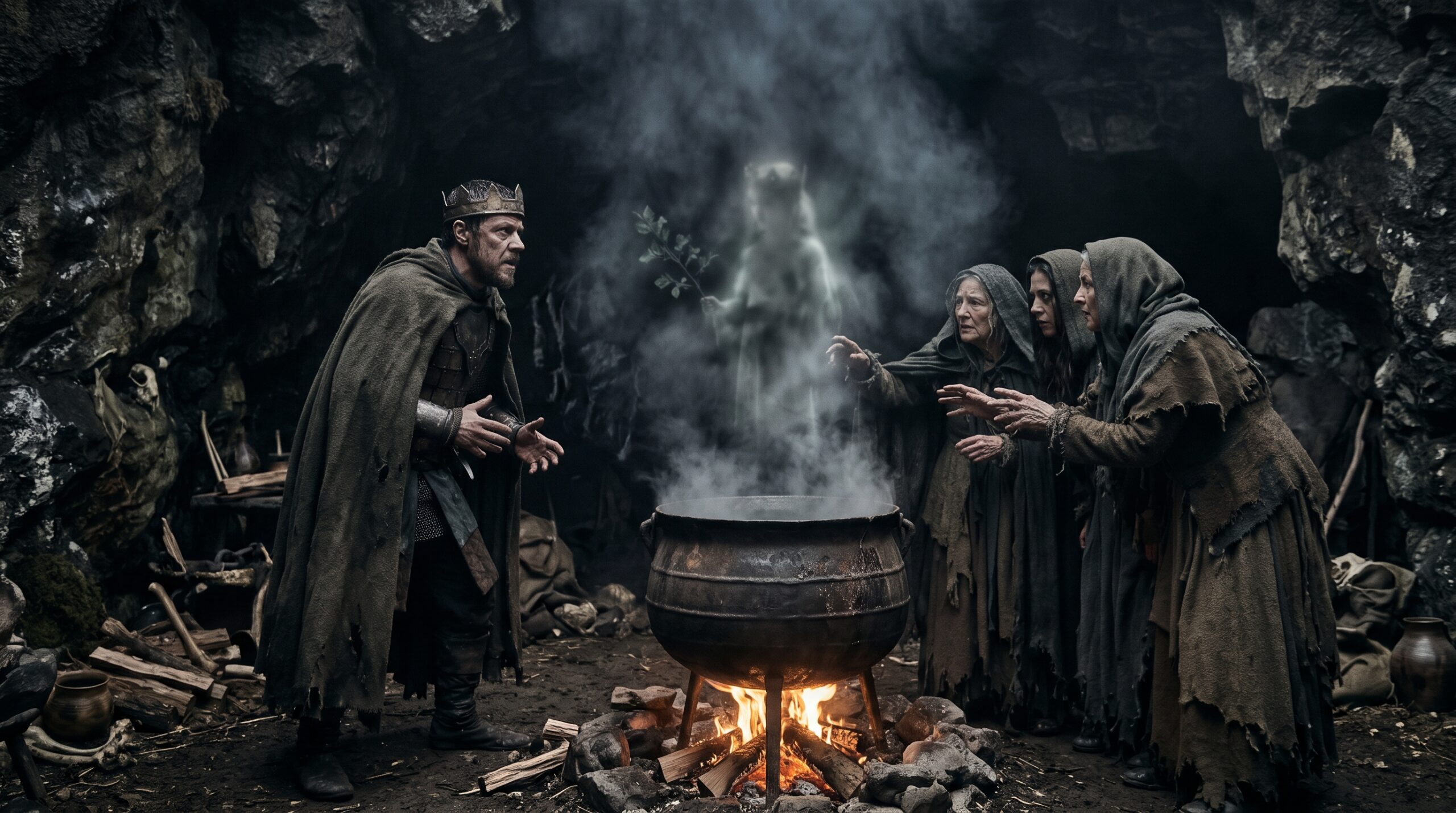
When Macbeth seeks out the witches a second time, they are preparing for his arrival with a grotesque magical working. This scene leans heavily into King James’s Daemonologie, showcasing the horrifying ingredients of black magic.
9. The Antiphon of Chaos “Double, double toil and trouble; / Fire burn, and cauldron bubble.” — All Witches (Act 4, Scene 1)
The Hidden Meaning: The trochaic tetrameter (a harsh, driving rhythmic meter heavily stressed on the first syllable) creates a hypnotic, spell-binding effect that sharply contrasts with the standard iambic pentameter spoken by the noble characters. The repetition of “double” suggests that whatever misery Macbeth has already caused, the witches are exponentially increasing it. The physical boiling of the cauldron mirrors the political boiling of Scotland under Macbeth’s tyrannical rule.
10. The Second Apparition: The Bloody Child
(Paraphrased from Act 4, Scene 1): Next, a bloodied infant appears, advising Macbeth to be bold and resolute, assuring him that no man born of a woman will ever have the power to harm him.
The Hidden Meaning: This is the play’s most devastating equivocation. To the Jacobean audience, “born of a woman” was synonymous with “any mortal human.” Macbeth interprets this as absolute invincibility. However, the visual of the bloody child is a literal clue to the riddle’s solution. Macduff was “from his mother’s womb untimely ripped” (delivered via a rudimentary, fatal Caesarean section). Because he was not “born” in the natural, traditional sense, he is the loophole in the prophecy. The witches give Macbeth the exact truth disguised as a comforting lie.
11. The Third Apparition: The Crowned Child with a Tree
(Paraphrased from Act 4, Scene 1): A child wearing a crown and holding a branch appears, telling Macbeth he will never be defeated until the great forest of Birnam Wood physically moves to his stronghold at Dunsinane Hill.
The Hidden Meaning: Once again, Macbeth’s literal interpretation of the prophecy proves to be his undoing. He believes that since forests cannot uproot themselves and march, his reign is secure forever. The crowned child holding a tree represents Malcolm (the rightful heir to the throne) and his tactical decision to have his advancing army camouflage themselves with branches cut from Birnam Wood. The witches prey on Macbeth’s lack of imagination, using the laws of nature to mask military strategy.
The Psychological Mirror of the Witches
When studying these Macbeth witches quotes, it becomes clear that Shakespeare did not simply use the Weird Sisters as cheap supernatural thrills. They are complex narrative devices that reflect the latent desires already lurking within the tragic hero.
The witches never once command Macbeth to commit murder. They do not hand him a dagger, nor do they force him into King Duncan’s chamber. Instead, they provide the spark of possibility, speaking in paradoxes and half-truths that allow Macbeth’s own dark ambitions to fill in the blanks. By understanding the linguistic manipulation, historical context, and psychological depth embedded within their chants, readers can fully appreciate why these three Scottish hags remain the most fascinating and terrifying architects of tragedy in the English language.