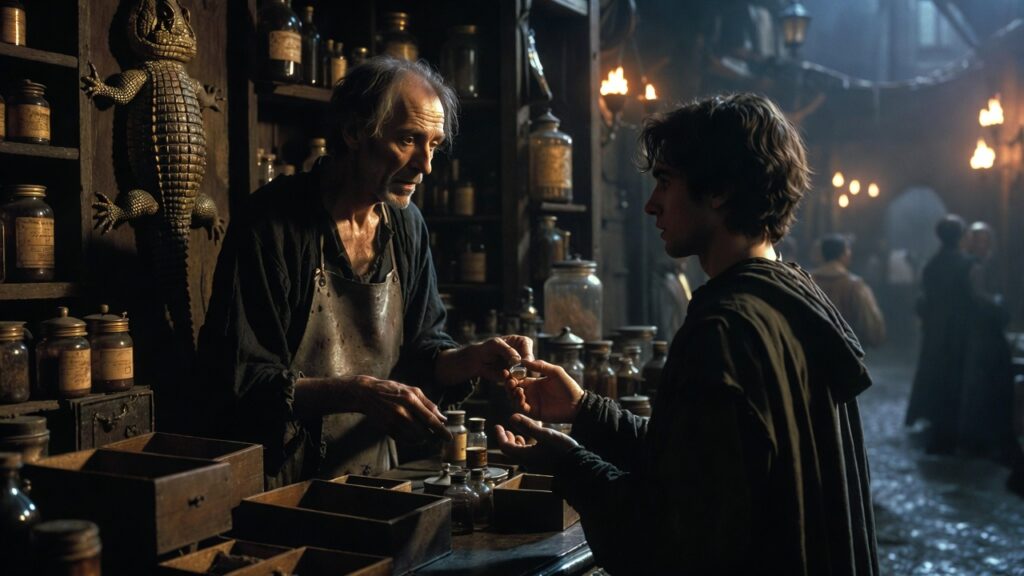
In the shadowy backstreets of Mantua, a gaunt figure hunches over a meager shop filled with dusty bottles and faded remedies. A desperate young man enters, gold in hand, seeking not healing but death. With just a few lines of dialogue and a single transaction, this obscure apothecary hands Romeo the poison that will end two lives and seal one of literature’s most enduring tragedies. The apothecary in Romeo and Juliet may appear for only a brief moment in Act 5, Scene 1, yet his role is far from minor—he is the final link in the chain of fate, miscommunication, and human frailty that dooms the star-crossed lovers.
William Shakespeare’s Romeo and Juliet is renowned for its exploration of love, feud, fate, and the destructive power of haste. While the titular characters and figures like Friar Laurence or the Nurse receive extensive attention, the Apothecary often receives only passing mention in summaries or student guides. This oversight is unfortunate, as Shakespeare invests this character with remarkable detail—Romeo devotes over a dozen lines to describing his wretched appearance and shop—making him a mirror for the play’s deeper themes. The Apothecary embodies societal neglect, the inversion of healing into harm, and the moral compromises born of desperation. Understanding his significance not only clarifies how the tragedy unfolds but also enriches appreciation of Shakespeare’s craftsmanship in using even peripheral figures to amplify central ideas.
This comprehensive analysis draws on close textual reading, historical context of Renaissance apothecaries, symbolic interpretations, and comparisons to other Shakespearean works. Whether you’re a student preparing an essay, a teacher seeking fresh classroom insights, or a literature enthusiast exploring the play’s layers, this article provides the depth missing from standard overviews—helping you grasp why this “minor” character is indispensable to the catastrophic ending.
Who Is the Apothecary? A Character Overview
The Apothecary appears solely in Act 5, Scene 1, a poor vendor of herbs, medicines—and illicit poisons—in the city of Mantua, where Romeo is exiled. Unlike the respected, guild-regulated apothecaries of Shakespeare’s England (who compounded remedies from plants and minerals), this figure operates on the fringes of legality and society. He is starving, his shop a pitiful display of pretense rather than prosperity.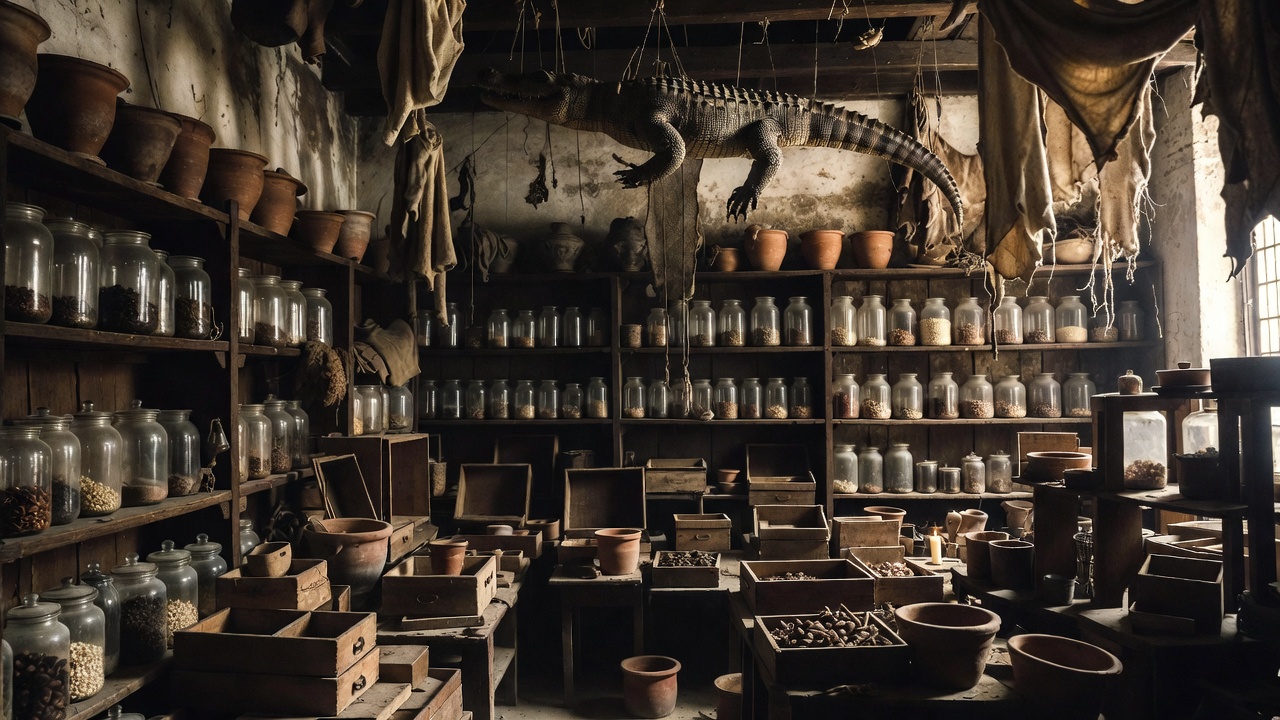
Romeo recalls spotting him earlier:
“I do remember an apothecary, And hereabouts he dwells, which late I noted In tatter’d weeds, with overwhelming brows, Culling of simples. Meagre were his looks. Sharp misery had worn him to the bones.” (5.1.37–41)
This vivid portrait—tattered clothes, gaunt face, “overwhelming brows”—paints a picture of extreme poverty. The shop reinforces the image:
“And in his needy shop a tortoise hung, An alligator stuff’d, and other skins Of ill-shaped fishes; and about his shelves A beggarly account of empty boxes, Green earthen pots, bladders and musty seeds, Remnants of packthread and old cakes of roses, Were thinly scatter’d, to make up a show.” (5.1.42–48)
These details are not mere decoration. The exotic but decayed items (a stuffed alligator was a common apothecary sign in the Renaissance, symbolizing exotic remedies) highlight fakery and desperation—a facade of competence masking emptiness. Shakespeare uses this description to foreshadow death: the Apothecary’s skeletal appearance echoes Romeo’s own emotional “wearing away” after hearing of Juliet’s supposed death.
Historically, apothecaries in Renaissance Europe were early pharmacists, blending herbs according to humoral theory (balancing the body’s “humors”). But poisons were tightly regulated—selling them carried severe penalties, including death in many Italian states. Shakespeare’s Apothecary thus represents the shadowy underside of this profession: the impoverished practitioner driven to crime by necessity.
The Pivotal Scene: Act 5, Scene 1 – Line-by-Line Breakdown
The scene opens with Romeo in Mantua, buoyed by a hopeful dream of Juliet reviving him with kisses. This ironic optimism shatters when Balthasar arrives with news: “Her body sleeps in Capel’s monument” (5.1.18). Misinformed about Friar Laurence’s plan, Romeo descends into despair.
In a soliloquy, he resolves:
“Well, Juliet, I will lie with thee tonight.” (5.1.34)
He recalls the Apothecary and hurries to the shop. The encounter is tense and economical—yet packed with meaning.
Romeo knocks: “What, ho! Apothecary!” The man emerges, wary. Romeo offers forty ducats for poison “Whose sale is present death in Mantua” (5.1.67). The Apothecary hesitates:
“Such mortal drugs I have, but Mantua’s law Is death to any he that utters them.” (5.1.66–67)
Romeo counters with a powerful appeal to shared desperation:
“The world is not thy friend, nor the world’s law; The world affords no law to make thee rich. Then be not poor, but break it, and take this.” (5.1.72–74)
The Apothecary’s reply is one of the play’s most poignant lines:
“My poverty, but not my will, consents.” (5.1.75)
He provides the poison—a “vial” strong enough to kill twenty men—and warns of its speed. Romeo pays, praising: “There is thy gold—worse poison to men’s souls” (5.1.80), inverting the blame onto corrupt society rather than the individual.
Romeo departs for Verona, and the scene ends with his reflection on the Apothecary’s honesty in death-dealing. This brief exchange accelerates the tragedy: without hesitation, Romeo now possesses the means to suicide, setting off the chain reaction in the tomb.
The Apothecary’s Role in Driving the Plot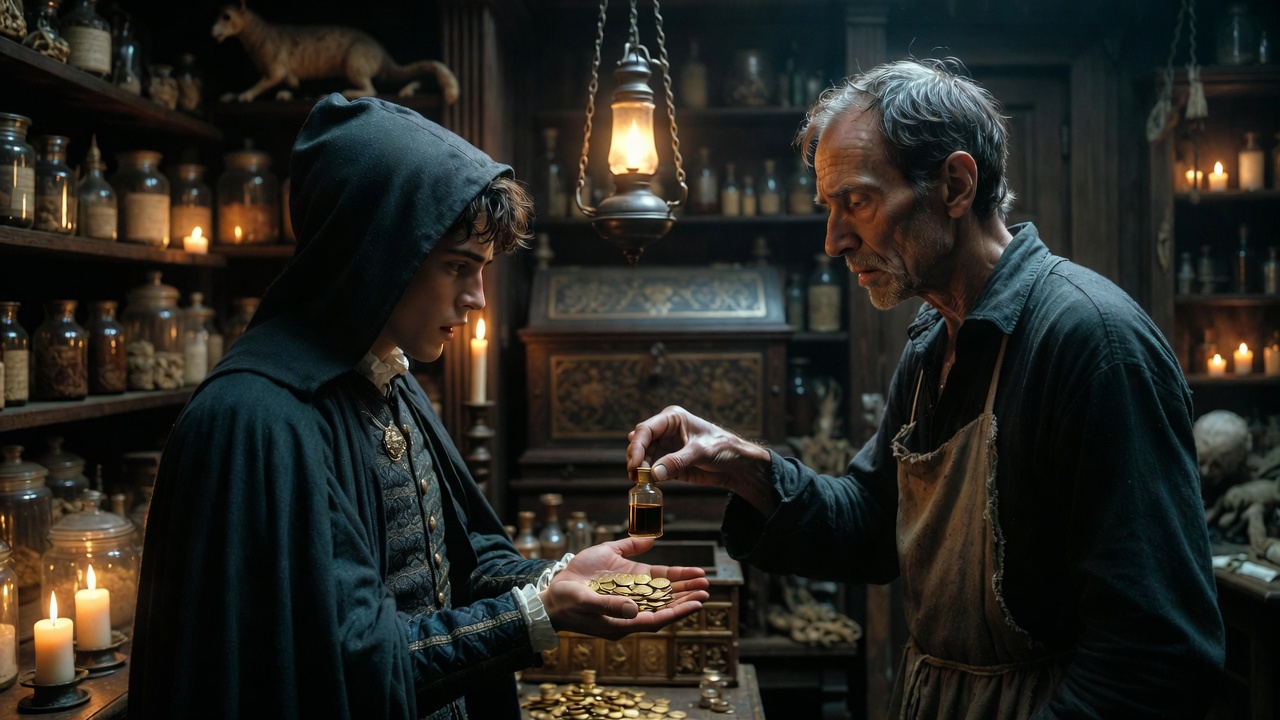
The Apothecary is the direct catalyst for the final catastrophe. Friar Laurence’s sleeping potion misfires due to failed communication (Friar John’s quarantine). Romeo, believing Juliet truly dead, buys poison instead of waiting. Without the Apothecary’s compliance, Romeo might have delayed, discovered the truth, or been intercepted—potentially averting the double suicide.
He forms a dark parallel to Friar Laurence: both dispense “potions,” one for feigned death and reunion, the other for real death and escape from pain. Laurence intends good but causes harm through flawed planning; the Apothecary intends no good but enables Romeo’s agency in tragedy. Together, they illustrate unintended consequences—how well-meaning or desperate acts poison love in a feud-torn world.
Symbolism and Deeper Meanings – Why Shakespeare Elevates This Minor Figure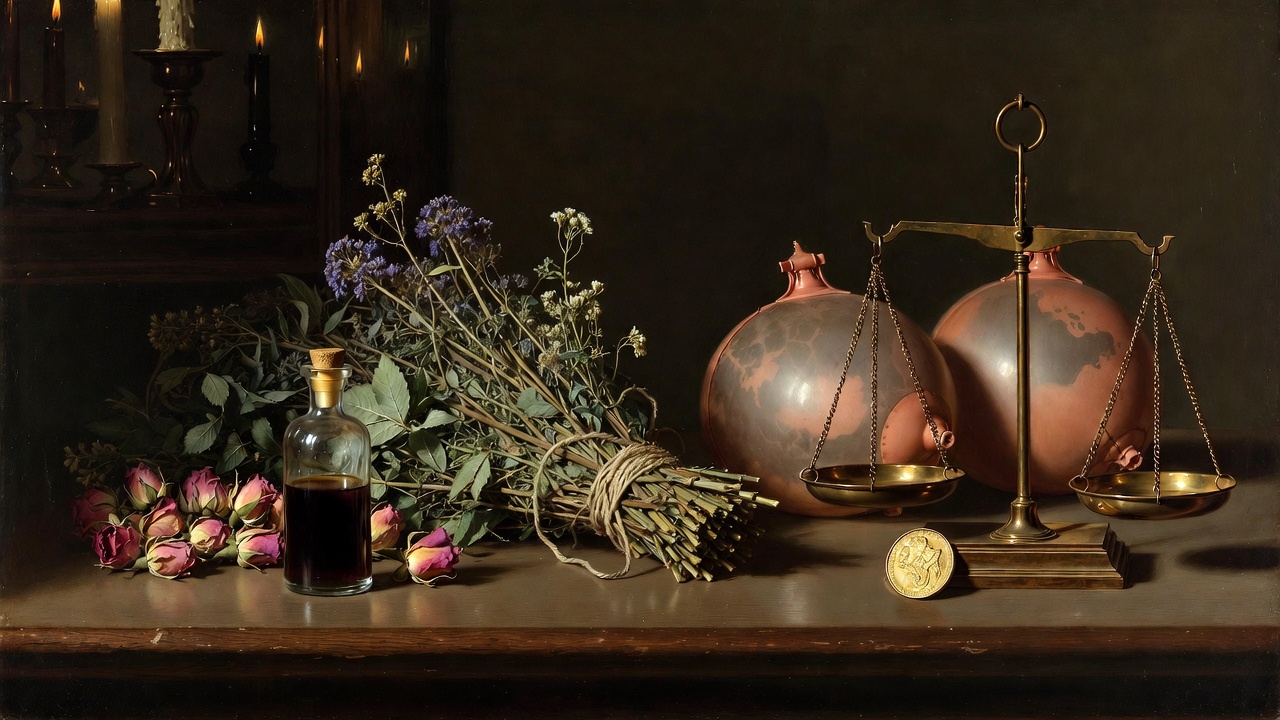
Shakespeare rarely wastes words, especially not sixteen lines of vivid description on a character who speaks only five. The Apothecary’s elaborate portrait serves multiple symbolic purposes that resonate throughout the tragedy.
First, he embodies poverty as a corrosive force. Romeo’s accusation—“There is thy gold—worse poison to men’s souls, / Doing more murders in this loathsome world / Than these poor compounds that thou mayst not sell” (5.1.80–82)—shifts blame from the seller to a society that creates desperate criminals through neglect. The Apothecary does not want to commit murder; he is compelled by economic necessity. This line echoes the play’s broader critique: the feud between Montagues and Capulets is itself a form of societal poison, destroying the young while older generations remain untouched until it is too late.
Second, the Apothecary represents the inversion of healing into destruction. Apothecaries were supposed to preserve life through herbal knowledge, yet this one trades in death. The motif of medicinal substances turning lethal runs through the entire play:
- Friar Laurence’s “distilling liquor” induces a death-like sleep intended to reunite the lovers.
- Juliet’s dagger becomes a “remedy” for her grief.
- Romeo’s poison, purchased from the Apothecary, is ironically called a “cordial” in his final speech: “O true apothecary! / Thy drugs are quick. Thus with a kiss I die” (5.3.119–120).
The word “cordial” (originally meaning “of the heart” or restorative) is twisted into bitter irony. Healing and harming blur together, reflecting how love itself—intended to nurture—becomes fatal in Verona’s toxic environment.
Third, the Apothecary mirrors Romeo’s own desperation. Both are “worn to the bones” by misery. Romeo’s impulsive decision to buy poison parallels the Apothecary’s reluctant decision to sell it. Each compromises his moral code under unbearable pressure. This parallel underscores one of the tragedy’s central insights: no single villain drives the catastrophe; rather, ordinary people, pushed to extremes, become instruments of destruction.
Finally, the Apothecary functions as a structural fulcrum in the theme of fate versus free will. The stars may have foretold doom, but human choices—Friar John’s quarantine, Romeo’s haste, the Apothecary’s consent—make that doom concrete. He is both an agent of fate (delivering the poison at precisely the needed moment) and a free moral actor (whose poverty-driven choice seals the outcome).
Historical and Cultural Context of Apothecaries in Shakespeare’s Time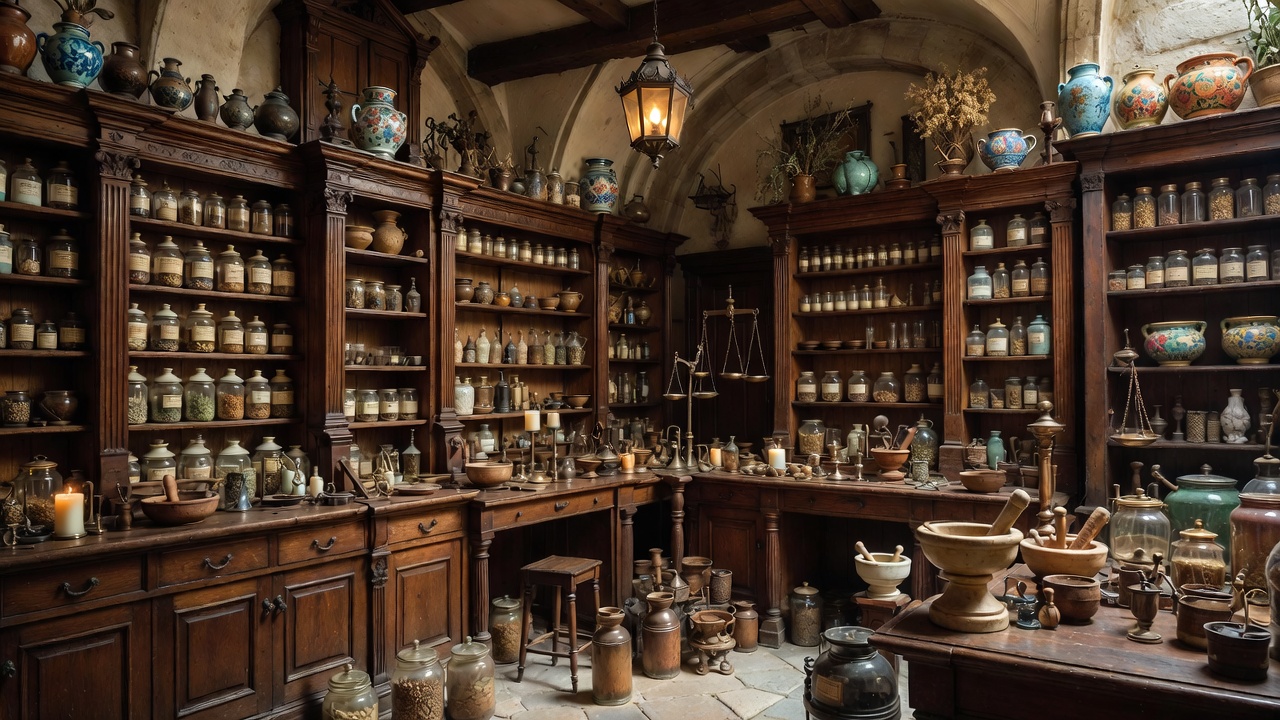
In the late 16th and early 17th centuries, apothecaries occupied an ambiguous social position. In England, they belonged to the Worshipful Society of Apothecaries (chartered in 1617, after Shakespeare’s death, but building on earlier guild traditions). They compounded medicines, prescribed simples (single herbs), and sold poisons under strict regulation. In Italy—where the play is set—similar guilds existed, but enforcement varied, especially in smaller cities like Mantua.
Selling poison without license carried severe penalties, often death, reflecting real Renaissance fears of poisoning as a covert weapon (the infamous “cantarella” rumors surrounding the Borgias). Shakespeare likely drew on these associations when crafting the Apothecary’s fear of “Mantua’s law / Is death to any he that utters them” (5.1.66–67).
The shop’s description also reflects contemporary stage conventions and medical culture. Stuffed alligators and exotic skins were common apothecary shop signs in London, intended to signal access to rare ingredients from the New World and East. The “musty seeds” and “old cakes of roses” evoke the musty reality behind the exotic façade—much like the decaying social order in Verona.
Shakespeare’s audience would have recognized the ethical tension: apothecaries were both respected healers and potential poisoners, a duality that mirrors the play’s moral ambiguity.
Comparisons to Other Shakespearean Minor Characters and Themes
The Apothecary belongs to a distinguished lineage of Shakespearean minor characters who, despite limited stage time, crystallize major themes.
- The Porter in Macbeth (Act 2, Scene 3) provides comic relief while symbolically opening Hell’s gate, paralleling the Apothecary’s role as gatekeeper to death.
- The Gravediggers in Hamlet (Act 5) philosophize about mortality in the midst of literal death preparation, much as the Apothecary’s shop visually prepares the audience for Romeo’s suicide.
- The Apothecary’s closest structural parallel is arguably the Clown who delivers the letter in King Lear—another marginal figure whose small action triggers irreversible catastrophe.
Unlike comic or philosophizing minor characters, however, the Apothecary accelerates tragedy without commentary or relief. His silence after the transaction (he never reappears) makes him a pure instrument—eerily efficient in fulfilling the plot’s grim necessity.
This pattern reflects Shakespeare’s recurring interest in how the marginalized expose the hypocrisy of the powerful. Beggars, fools, and outcasts repeatedly reveal truths that the nobility ignore—here, the Apothecary’s poverty indicts the same social order that condemns Romeo and Juliet’s love.
Modern Relevance and Lessons from the Apothecary
The Apothecary’s dilemma remains painfully contemporary. Economic desperation still drives people to illegal or unethical acts—whether selling drugs on the street, engaging in exploitative labor, or participating in black-market medicine during crises. The line “My poverty, but not my will, consents” could be spoken by countless individuals caught between survival and morality.
The scene also resonates in debates over medical ethics:
- Access to controlled substances (opioids, euthanasia drugs, abortion pills).
- Pharmaceutical pricing that leaves the poor vulnerable.
- The tension between profit and care in modern healthcare systems.
Psychologically, the encounter illustrates how acute despair can override rational judgment—for both buyer and seller. Romeo’s suicidal ideation and the Apothecary’s reluctant complicity show how grief and poverty can distort moral boundaries in parallel ways.
In literature classrooms today, the Apothecary offers rich discussion material for themes of social justice, structural inequality, and personal responsibility—questions that feel urgent in 2025.
The Lasting Impact of a “Minor” Character
The Apothecary in Romeo and Juliet may speak few lines and appear in only one scene, yet he is indispensable. Without him, the tragedy collapses. His shop of empty boxes and his gaunt frame are among Shakespeare’s most haunting images of poverty and moral compromise. His single act—handing over poison for gold—seals not only Romeo’s death but Juliet’s, the families’ reconciliation, and the play’s devastating commentary on love in a broken world.
Shakespeare’s genius lies precisely in this economy: a few carefully chosen details on a peripheral figure illuminate the entire tragedy. Revisiting Act 5, Scene 1 with attention to the Apothecary transforms him from footnote to fulcrum. He reminds us that in great literature, no character is truly minor when society itself is complicit in the catastrophe.
Key Quotes from the Apothecary Scene with Analysis
- “Sharp misery had worn him to the bones.” (Romeo, 5.1.41) → Establishes physical and emotional parallelism between Romeo and the Apothecary.
- “A beggarly account of empty boxes…” (Romeo, 5.1.45–48) → Symbolizes false appearances and societal neglect.
- “My poverty, but not my will, consents.” (Apothecary, 5.1.75) → The moral crux: external forces override personal ethics.
- “There is thy gold—worse poison to men’s souls…” (Romeo, 5.1.80) → Inverts blame onto corrupt wealth and law.
- “O true apothecary! / Thy drugs are quick.” (Romeo, 5.3.119) → Bitter praise; “true” ironically acknowledges honesty in death-dealing.
FAQs About the Apothecary in Romeo and Juliet
Why does Shakespeare describe the Apothecary in such detail? The extended description creates a vivid visual of poverty and foreshadows death, while symbolically linking the character to Romeo’s despair and society’s failures.
Is the Apothecary to blame for the deaths? No single character is solely to blame. He is a reluctant participant driven by poverty; the true catalysts are miscommunication, haste, and the feud itself.
What does “My poverty, but not my will, consents” mean? It means the Apothecary agrees to sell the poison not because he wants to, but because his desperate financial situation leaves him no choice.
How does the Apothecary compare to Friar Laurence? Both provide “potions”—one for life (disguised death), one for death. Laurence intends good but fails; the Apothecary intends no good but succeeds in enabling Romeo’s choice.
Why is the Apothecary’s shop described with exotic items like an alligator? These were real Renaissance apothecary shop displays meant to signal exotic remedies, but Shakespeare uses them ironically to highlight the gap between appearance and reality.
Does the Apothecary appear in any film adaptations? He is often cut or minimized, but notable portrayals include the 1968 Zeffirelli film (small role) and the 1996 Luhrmann version (played by M. Emmet Walsh as a seedy drug dealer).