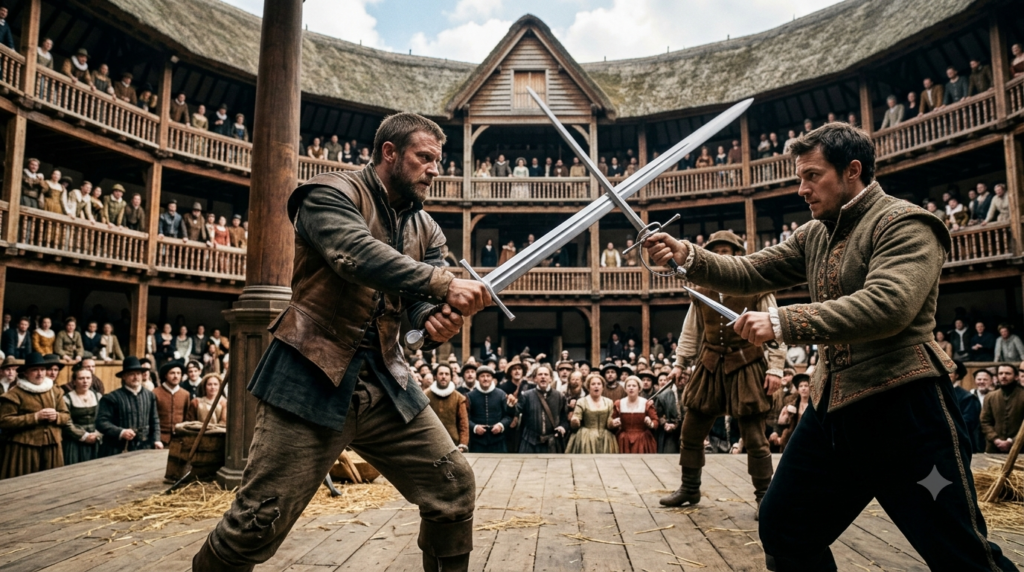
The year is 1599. You are squeezed shoulder-to-shoulder with apprentice tailors, wealthy merchants, and rowdy sailors in the open-air yard of the newly built Globe Theatre. The air is thick with the smell of roasted hazelnut shells, cheap ale, and river mud. Suddenly, the crowd falls silent. Two actors step onto the platform stage, their eyes locked. They do not carry the slender, elegant rapiers of the court. Instead, they unsheathe broad, gleaming blades of cold steel. When they clash, the ring of metal on metal is not a polite theatrical click; it is a resonant, bone-jarring crack.
For the Elizabethan playgoer, this was not mere dancing—it was a display of raw, dangerous martial arts. While modern audiences often associate Shakespearean drama with delicate, stylized fencing, the reality was far more visceral. At the heart of this theatrical violence stood a weapon of deep national pride: the english longsword.
To understand Shakespeare’s plays is to understand the weapons his characters carried. When a playwright wrote “They fight” in a manuscript, he was writing for an audience of martial connoisseurs who knew the difference between a foreign fad and a traditional cut. But did William Shakespeare himself actually understand the mechanics of the english longsword, or was he simply capitalizing on a popular theater trend? By examining the historical martial landscape of London, Shakespeare’s own technical vocabulary, and the physical realities of the King’s Men, we can uncover the truth about the playwright’s relationship with the deadly art of combat.
The Elizabethan Martial Landscape: Longsword vs. Rapier
To grasp the tension in Shakespeare’s stage directions, we must first understand the massive cultural and martial shift occurring in London at the end of the sixteenth century. This was a period of transition where old-school English pragmatism clashed head-on with continental sophistication.
       [ Traditional English School ]             [ Imported Italian School ]
             The English Longsword                      The Italian Rapier
         - Focus: Heavy Cuts & Grappling            - Focus: Linear Thrusts & Speed
         - Two-Handed, Double-Edged                 - One-Handed, Needle-Pointed
         - Symbolic of National Pride               - Symbolic of Courtly Fashion
What is the True English Longsword?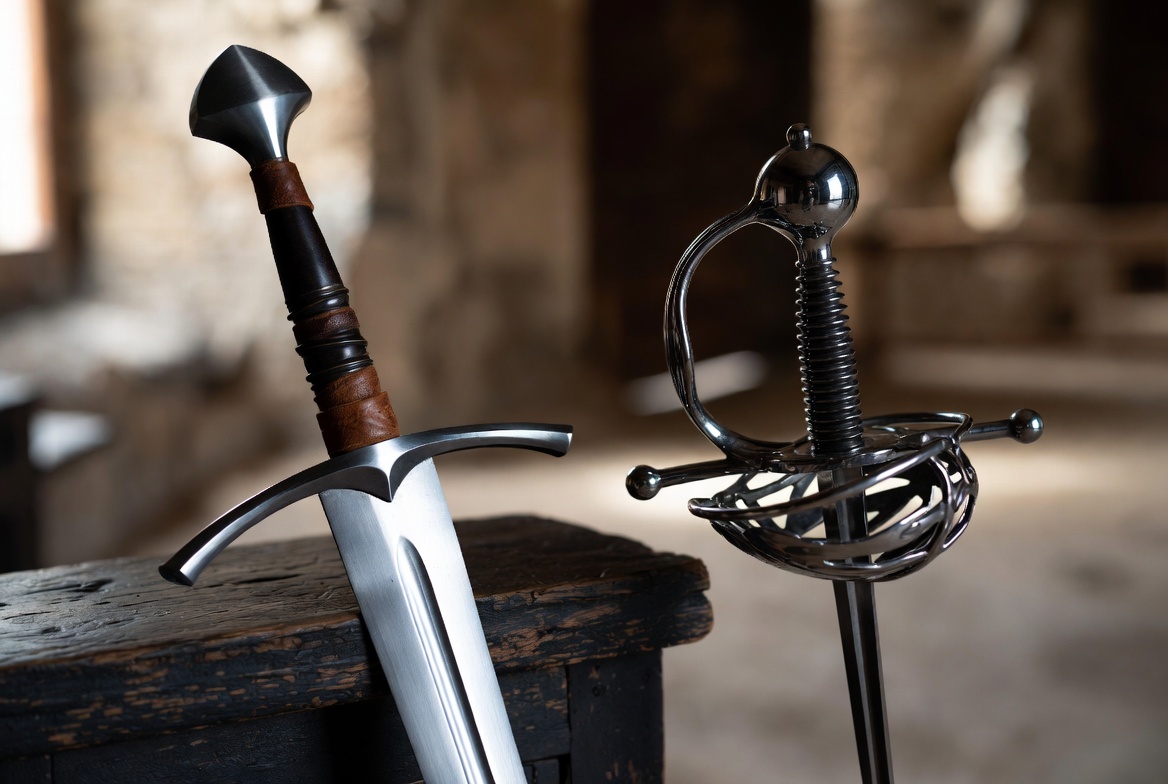
To the modern observer, the term “longsword” often conjures images of fantasy warriors swinging massive, sixty-pound iron bars. This is a complete myth. The historical English longsword was a highly refined, double-edged weapon designed for two-handed use, though balanced beautifully enough to be wielded in one hand if necessary.
-
Weight: Typically weighing between 2.5 and 3.5 pounds ($1.1 \text{ to } 1.6 \text{ kg}$).
-
Design: A long grip for leverage, a protective crossguard (quillons), and a heavy pommel to act as a counterweight.
-
Mechanics: It was not a clumsy hacking tool. It was an incredibly versatile instrument of defense that relied on leverage, spatial control, rapid cuts using the true and false edges, thrusts, and close-quarters wrestling (Ringen or “gripping”).
For centuries, this weapon, alongside the single-handed backsword and the quarterstaff, formed the bedrock of English self-defense. It was a weapon of utility, designed for the battlefield, judicial duels, and self-preservation in dark city alleys.
The Invasion of the Continental Rapier
By the 1580s, however, a new weapon had crossed the English Channel and taken the young aristocracy by storm: the Italian rapier. Unlike the longsword, which prioritized devastating cuts and versatile defense, the rapier was a long, slender, one-handed weapon optimized almost exclusively for the thrust.
The rapier came accompanied by complex, highly stylized foreign fencing manuals written by masters like Ridolfo Capo Ferro and Vincentio Saviolo. Suddenly, fighting was no longer just a rugged English craft; it was a science governed by geometry, mathematical lines, and elegant footwork. To the Elizabethan youth, carrying a rapier was the ultimate fashion statement—a sign of wealth, travel, and courtly sophistication.
The London Masters of Defense
This foreign invasion did not sit well with the local establishment. The London Masters of Defense, a powerful guild chartered by King Henry VIII, held a strict monopoly on the teaching of martial arts within the city. They viewed the Italian rapier with utter contempt, labeling it an impractical, cowardly weapon that encouraged sneaky, fatal thrusts rather than the honorable, defensive cuts of traditional English swordsmanship.
The Masters of Defense staged massive, highly publicized public examinations called “playing a prize.” To advance in rank (from Free Scholar to Provost, and finally to Master), a martial artist had to fight multiple opponents in a public arena, demonstrating mastery over a variety of weapons—foremost among them the English longsword. These prize plays were held in public spaces, including the very same open-air playhouses where Shakespeare’s theatrical contemporaries staged their dramas.
The Playwright’s Toolkit: Was Shakespeare a Trained Swordsman?
Given this intense martial environment, we must ask: how did William Shakespeare acquire his incredibly detailed knowledge of swordplay? Was he merely an observer, or did he have mud on his boots and calluses on his hands from actual combat training?
The Reality of Elizabethan Citizen Training
In Elizabeth’s England, violence was a daily reality, and basic martial proficiency was a legal obligation. Under royal proclamation, able-bodied men of certain classes were expected to own weapons and know how to use them for the defense of the realm.
Furthermore, fencing was the spectator sport of the era. Just as a modern writer naturally absorbs the terminology of football or basketball from daily culture, Shakespeare would have been surrounded by the jargon of the sword. The playhouses where his company performed were regularly rented out by the London Masters of Defense for their bloody, high-stakes prize fights. Shakespeare did not need to seek out combat knowledge; it was literally occurring on the very boards he walked to rehearse his plays.
The “Lost Years” and Mechanical Knowledge
Historians often point to Shakespeare’s “lost years” (1585–1592) as a period where he might have served as a soldier in the Low Countries or worked as an assistant in a noble household. If he did indeed see military service, his familiarity with the English longsword and the military billhook would have been forged in the crucible of camp life and skirmishes.
Even if we discount the soldier theory, Shakespeare’s texts reveal a grasp of martial terminology that goes far beyond a casual observer’s vocabulary. He does not just write “they fight”; he litters his dialogue with highly technical terms from both the traditional English and modern Italian schools:
-
“Passado” and “Punto Reverso”: Technical terms for forward steps and backhand thrusts from Italian manuals, used with pinpoint accuracy in Romeo and Juliet.
-
“Caranza” and “The Duello”: References to Spain’s complex, geometrical system of fencing (La Verdadera Destreza).
-
“In the Ward”: A highly specific English fencing term referring to defensive stances or guards, used metaphorically to describe standing on one’s guard against deception.
Shakespeare’s ability to weaponize these terms for character development—using traditional English terms for honest characters and overly complex Italian terms for showy, untrustworthy ones—proves that he understood the mechanical and cultural nuances of the weapons of his day.
The English Longsword Hidden in Shakespeare’s Plays
When we read Shakespeare’s plays today, we often miss the physical props that signaled massive social cues to his audience. The presence of an English longsword on stage was never accidental; it was a deliberate choice loaded with political, generational, and emotional meaning.
Romeo and Juliet: Old vs. New Generation Weapons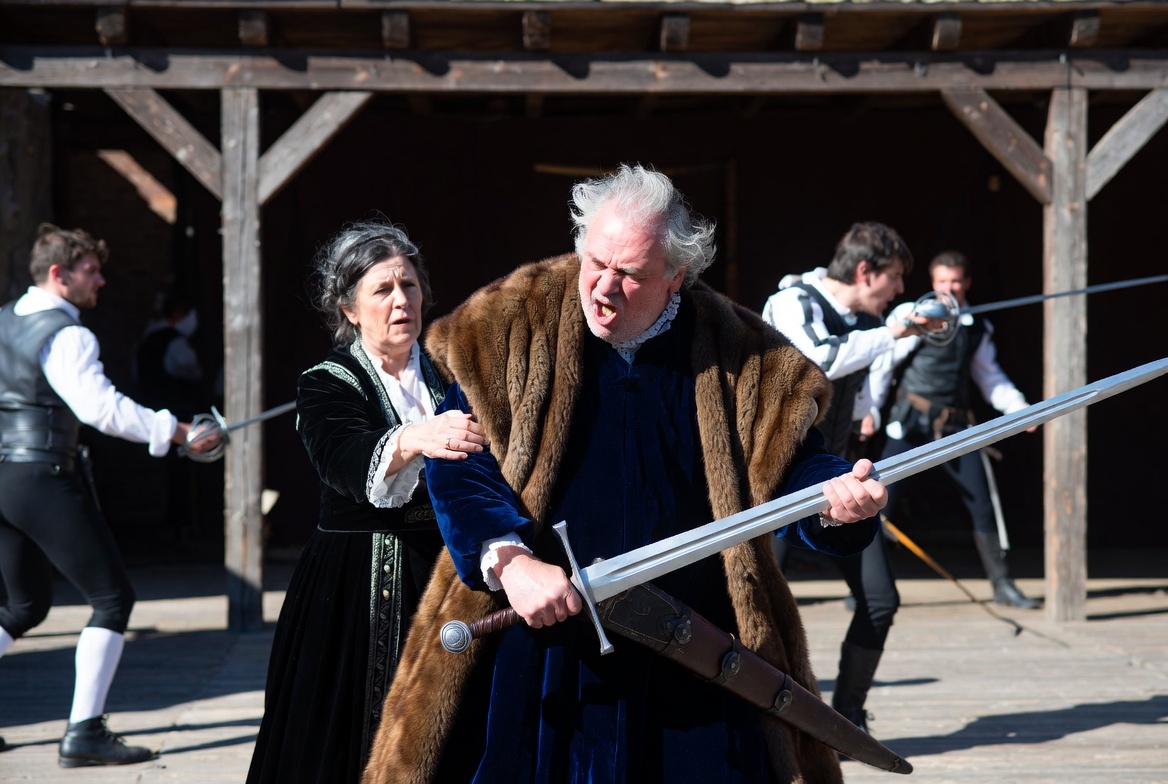
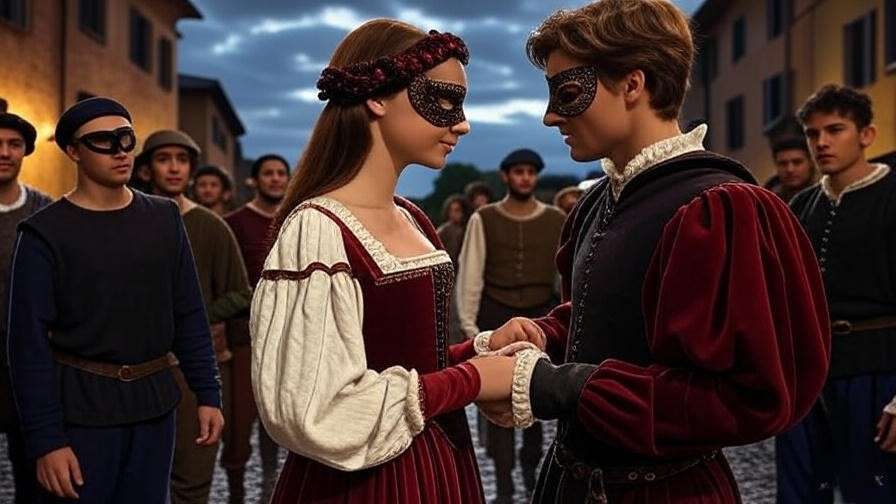
Perhaps the most brilliant dramatic use of the clash between old English steel and new Italian fashion occurs in the opening scene of Romeo and Juliet. As a street brawl erupts between the Montague and Capulet servants, the elderly Lord Capulet rushes onto the stage:
CAPULET: What noise is this? Give me my long sword, ho!
LADY CAPULET: A crutch, a crutch! why call you for a sword?
— (Act 1, Scene 1)
This exchange is highly comedic, but it is also a brilliant piece of historical commentary. Capulet, an old man trying to assert his authority, demands his heavy, old-fashioned english longsword. He is reaching for the weapon of his youth—a weapon of war, strength, and traditional honor. Meanwhile, his wife dryly points out that he is far too old for such physical exertions, suggesting a crutch is more appropriate.
                  [ GENERATIONAL WARFARE IN VERONA ]

     OLD GENERATION                          NEW GENERATION
     Lord Capulet                            Tybalt & Mercutio
     Weapon: English Longsword               Weapon: Italian Rapier
     Style: Broad, Powerful Cuts             Style: Swift, Technical Thrusts
     Values: Ancestral Honor, Force          Values: Personal Pride, Fashion
Contrast Capulet’s desperate grab for the longsword with the deadly elegance of Tybalt. Tybalt is the quintessential “fashion-monger” of the Italian school. Mercutio mocks him relentlessly for it, calling him a “button-holder” and complaining that he fights by the book of arithmetic:
“Ah, the immortal passado! the punto reverso! the hay!”
— (Act 2, Scene 4)
By contrasting the old longsword with the trendy rapier, Shakespeare illustrates the generational divide tearing Verona apart. The old men cling to a brutal, heavy past, while the young men duel with rapid, needle-thin point-work that leads to swift, senseless deaths.
The Brutal Medieval Realism of Macbeth and King Lear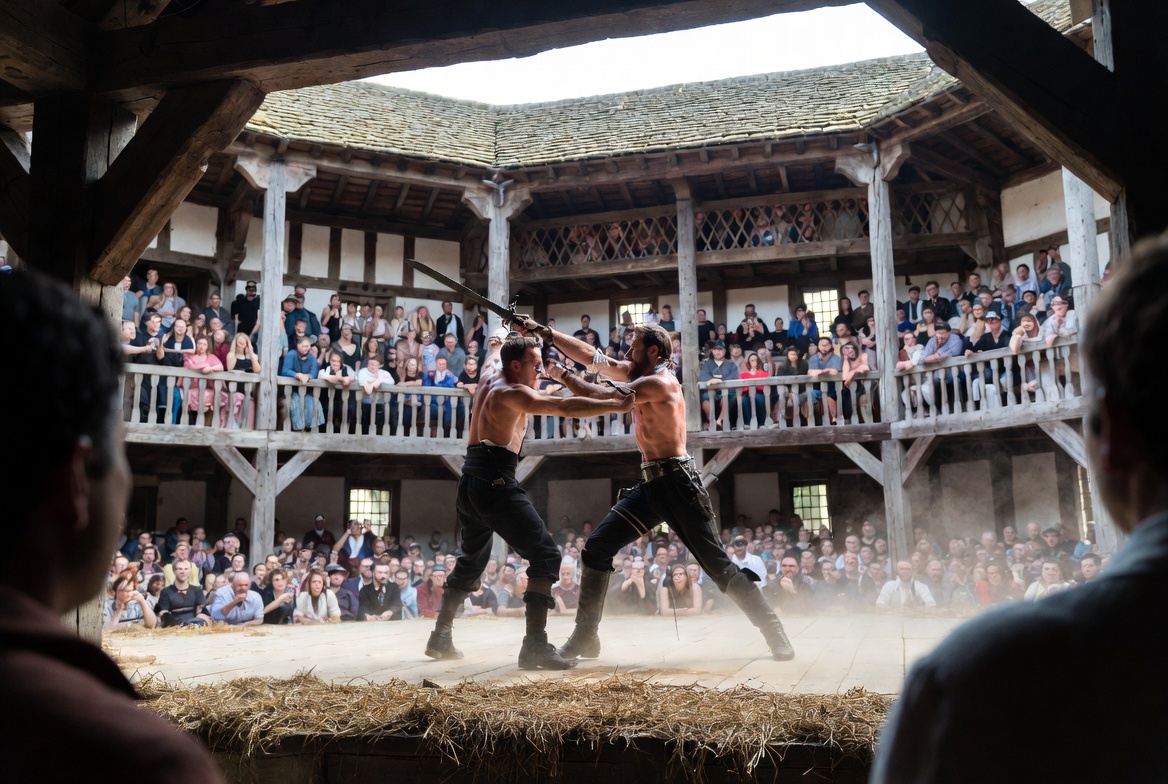
While the Italian rapier was perfect for the urban, civilian setting of Verona, it had absolutely no place in the grim, mud-soaked battlefields of medieval Scotland or ancient Britain. For plays like Macbeth and King Lear, the weapon of choice had to reflect the ancient, heavy-hitting realities of medieval warfare.
In the final act of Macbeth, the tyrant is cornered in his castle. He knows his end is near, yet he refuses to yield:
“They have tied me to a stake; I cannot fly, / But, bear-like, I must fight the course.”
— (Act 5, Scene 7)
When Macbeth faces Macduff, the combat is not a refined duel of touches. It is a grueling, exhausting fight of survival. To portray this realistically on the Elizabethan stage, the actors would have discarded the delicate rapiers and drawn heavy longswords or broadswords. The choreography would have involved powerful, two-handed blows, shield-bashes, and desperate grappling as both men sought to find a gap in the other’s defense.
The Strategic Nuance of Hamlet’s Final Duel
In Hamlet, the weapon choices are not just backdrop; they are central to the plot of the tragic finale. Claudius and Laertes conspire to poison Hamlet using a fencing wager as the perfect cover. The King bets six Barbary horses against six French rapiers and daggers, with all their elaborate carriages.
[ THE TRAP IN ELSINORE ]
Wager: Rapiers & Daggers (Italian Style)
Laertes' Weapon: Unbated (Sharp) & Poisoned
Hamlet's Weapon: Bated (Blunted) Stage Foil
Combat Dynamic: Close-quarters grappling allows Hamlet to seize the poisoned blade.
When the duel begins, the audience expects a refined display of modern French and Italian rapier play. However, as the tension escalates and Laertes wounds Hamlet with the poisoned, unbated (sharp) weapon, the fight rapidly deteriorates from an elegant, rule-bound courtly exhibition into a desperate, chaotic brawl.
The stage directions note: “In scuffling, they change rapiers.” This “scuffling” is not a random accidents; it is a highly technical martial arts maneuver known as disarming or locking (close-play), a foundational component of traditional English longsword and rapier manuals. To execute this on stage, the actors had to close the distance, seize the opponent’s hilt or wrist using their free hand, and twist the weapon away—a maneuver requiring deep physical trust, precise timing, and practical knowledge of leverage.
Realism vs. Showmanship: How the Fights Looked on Stage
How did these fights actually look to the untrained eye, and how did Shakespeare’s company manage to perform them day after day without losing their lead actors to real-world injuries?
The Actor-Swordsmen of the King’s Men
The actors of the Elizabethan stage were not merely performers who memorized lines; they were elite physical athletes.
-
Richard Tarlton: The most famous comic actor of the 1580s was a legally certified “Master of Defense” under the London Masters of Defense. He was highly skilled with the English longsword and was known to engage in real, high-stakes prize fights.
-
Richard Burbage: Shakespeare’s primary tragic lead—the original Hamlet, Othello, Richard III, and Lear—was widely celebrated for his intense, physically demanding stage combat. Audiences did not just come to hear Burbage deliver soliloquies; they came to watch him fight to the death.
Because the acting companies were small, tight-knit ensembles, these men trained together constantly. They understood each other’s physical limits, reaction times, and preferred guards, allowing them to perform complex, fast-paced choreography that looked incredibly dangerous but remained highly controlled.
+------------------+------------------------------------+-----------------------------------+
| Weapon Style     | Primary Techniques Used            | Common Stage Application          |
+------------------+------------------------------------+-----------------------------------+
| English Longsword| Double-handed cuts, pommel strikes,| Historical battles, heavy armor   |
|                  | grappling, and leverage-based locks| plays (Macbeth, King Lear)        |
+------------------+------------------------------------+-----------------------------------+
| Rapier & Dagger  | Linear thrusts, parries, circular  | Aristocratic duels, contemporary  |
|                  | footwork, and double-weapon guards | tragedies (Romeo & Juliet, Hamlet)|
+------------------+------------------------------------+-----------------------------------+
Were the Fights Safe?
Despite their training, the weapons used on stage were a constant source of hazard. While companies preferred to use “bated” (blunted) steel or iron swords for rehearsals and standard performances, accidents were commonplace.
The steel blades had to be heavy enough to ring out loudly when struck, meaning that even a blunt blow to the head or hand could break bones or cause severe concussions. To increase the spectacle without risking lives, actors used clever theatrical tricks:
-
Sound Effects: Stamping the wooden floorboards to exaggerate the impact of a foot lunge or a heavy blow.
-
Blunted Edges: Rounded tips and thickened edges to prevent puncture wounds during thrusts.
-
Proximity Play: Striking along pre-determined lines of attack that cleared the opponent’s body by a few safe inches, relying on the audience’s angle of perspective to make the blow look like a direct hit.
Historical FAQs: Setting the Record Straight on Shakespearean Fencing
To fully appreciate the martial arts of the Globe, we must dispel a few lingering historical myths.
Did actors actually get hurt performing with longswords?
Yes, frequently. Even with blunted weapons, stage combat in the sixteenth and seventeenth centuries was a high-risk endeavor. Contemporary diaries and court records document numerous instances where actors were accidentally blinded, lost fingers, or suffered deep flesh wounds during performances. The physical intensity required to satisfy an audience that regularly watched real prize fights meant that actors had to walk a incredibly thin line between safety and absolute realism.
Why did the rapier eventually replace the longsword in theater?
The shift was driven by both fashion and logistics. As the Jacobean era progressed, theater moved indoors to private, candle-lit venues like the Blackfriars Theatre. The heavy, sweeping cuts of the English longsword required massive physical space and bright, open-air lighting to be seen clearly and executed safely. The linear, precise, and compact movements of the rapier were much better suited for smaller indoor stages where space was at a premium and shadows could obscure broad, swinging attacks.
What terminology should modern directors look for in the text to identify weapon choices?
When staging a Shakespearean play, look closely at the verbs used in the dialogue. If characters speak of “cutting,” “slashing,” “cleaving,” or “hewing,” the text is calling for the broad, rotational mechanics of the English longsword or backsword. If the dialogue refers to “thrusts,” “passes,” “stabs,” or “pricking,” the scene is designed around the linear, point-driven choreography of the Italian rapier.