In William Shakespeare’s timeless tragedy Romeo and Juliet, the prologue famously declares: “Two households, both alike in dignity, / In fair Verona, where we lay our scene, / From ancient grudge break to new mutiny…” These opening lines immediately establish the central conflict—a bitter, generations-old feud between the Montagues and the Capulets that dooms the young lovers from the start. The family tree of Romeo and Juliet is more than a simple genealogy; it is the engine of the entire drama. Understanding who is related to whom reveals why blood ties ignite violence, why forbidden love is impossible, and how kinship drives every tragic turn.
Many readers—students tackling essays, teachers preparing lessons, theatergoers, or literature enthusiasts—find themselves confused by the web of cousins, kinsmen, servants, and allies. Who exactly is Tybalt to Juliet? Is Benvolio Romeo’s brother or cousin? How do figures like Mercutio and Paris connect to the core feud? This comprehensive guide maps out the family tree of Romeo and Juliet in detail, drawing directly from Shakespeare’s text (references to acts, scenes, and lines follow the standard Folio-based editions), historical Elizabethan context, and expert interpretations from sources like the Royal Shakespeare Company (RSC), Folger Shakespeare Library, and SparkNotes. By the end, you’ll have a crystal-clear picture that unlocks deeper insights into themes of fate, honor, generational conflict, and reconciliation.
The Core Feuding Families: Montagues vs. Capulets
Shakespeare deliberately portrays the Montagues and Capulets as mirror images: both are wealthy, noble Verona households “alike in dignity” (Prologue, line 1). Their social parity makes the feud all the more absurd and tragic—hatred persists not because of meaningful differences, but because of entrenched tradition and masculine honor codes.
The origin of the “ancient grudge” remains unexplained, emphasizing its irrational, self-perpetuating nature. In Elizabethan England, such family feuds echoed real noble rivalries, where honor demanded retaliation for any perceived slight. The play’s structure parallels the families: both have authoritative patriarchs, concerned matriarchs, and young heirs whose personal desires clash with familial duty.
Yet subtle contrasts emerge. The Montagues appear more introspective and melancholic, with Lord Montague worrying over Romeo’s mood (Act 1, Scene 1). The Capulets are more extroverted and authoritarian—Lord Capulet hosts lavish feasts and abruptly shifts from indulgent to tyrannical when crossed (Act 3, Scene 5). These dynamics amplify the tragedy: the lovers are trapped not just by enmity, but by the very structures meant to protect them.
House of Montague: Detailed Family Tree and Relationships
The Montague household is smaller and more intimate than the Capulets’, underscoring Romeo’s personal isolation amid the feud.
- Lord Montague — Romeo’s father and the patriarch. He is caring but somewhat distant, expressing concern for Romeo’s melancholy in Act 1, Scene 1: “Could we but learn from whence his sorrows grow, / We would as willingly give cure as know.” He restrains himself from fighting in the opening brawl, showing a desire for peace late in life.
- Lady Montague — Romeo’s mother. She appears briefly, restraining her husband during the street fight and expressing relief that Romeo avoided it. Her most poignant moment comes offstage: she dies of grief after Romeo’s banishment (reported in Act 5, Scene 3), highlighting maternal sorrow in a patriarchal world.
- Romeo Montague — The only named child and heir. As the protagonist, his impulsive passion drives the plot—from infatuation with Rosaline to instant devotion to Juliet. His Montague identity makes their love forbidden, yet he rejects the feud personally, refusing to fight Tybalt initially because Juliet makes him “kinsman” to his enemy.
- Benvolio — Romeo’s cousin (nephew to Lord and Lady Montague). His name means “good will,” fitting his role as peacemaker. In Act 1, Scene 1, he tries to defuse the brawl: “Part, fools! / Put up your swords.” As Romeo’s confidant, he offers rational advice and reports events to Montague.
The household includes servants like Abram and Balthasar (Romeo’s loyal page), but no extended blood relatives are named. This sparsity emphasizes Romeo’s emotional solitude—his “love” is introspective and all-consuming, contrasting with the more socially embedded Capulets.
House of Capulet: Detailed Family Tree and Relationships
The Capulet family is larger, more socially active, and rigidly patriarchal, reflecting greater emphasis on alliances, marriage, and honor.
- Lord Capulet — Juliet’s father and patriarch. Jovial and festive at first (hosting the masked ball), he becomes tyrannical when Juliet defies the arranged marriage to Paris: “Hang thee, young baggage! Disobedient wretch!” (Act 3, Scene 5). His age and status make him a figure of authority, yet his volatility accelerates the tragedy.
- Lady Capulet — Juliet’s mother. Distant and pragmatic, she married young (“Younger than you… I was your mother much upon these years” – Act 1, Scene 3) and pushes the Paris match for social advancement. Her grief over Tybalt’s death shows family loyalty, but she lacks warmth toward Juliet.
- Juliet Capulet — The only child and heir. At 13 (nearly 14), she matures rapidly from obedient daughter to defiant lover. Her isolation within the household—reliant on the Nurse—highlights her vulnerability.
- Tybalt — Nephew to Lady Capulet (thus Juliet’s first cousin) and a fiery Capulet kinsman. Known as the “Prince of Cats” for his dueling prowess, he embodies unchecked honor: “What, drawn, and talk of peace? I hate the word” (Act 1, Scene 1). His death at Romeo’s hands triggers banishment and the chain of disasters.
- Rosaline — Juliet’s unseen cousin (mentioned as a Capulet relative). Romeo’s initial infatuation with her adds irony—he pines for a Capulet before meeting Juliet.
- The Nurse — Not blood-related, but Juliet’s surrogate mother and confidante since infancy. She breastfed Juliet (“Thou wast the prettiest babe…”) and facilitates the romance, providing comic relief and tragic complicity.
This extended network shows how family pressures—marriage alliances, cousin loyalty—constrain Juliet far more than Romeo.
The Royal House of Escalus and Interconnected Allies
While the Montagues and Capulets dominate the foreground, Shakespeare weaves in the ruling family of Verona and their kinsmen to show how the private feud threatens public order. This broader network elevates the tragedy from a personal romance to a civic crisis.
- Prince Escalus — The ruler of Verona. He is impartial and authoritative, repeatedly attempting to quell the violence. In the opening scene, he warns both houses: “If ever you disturb our streets again, / Your lives shall pay the forfeit of the peace” (Act 1, Scene 1). His frustration peaks after Mercutio and Tybalt’s deaths, and he delivers the play’s moral judgment in the final scene: “See what a scourge is laid upon your hate, / That heaven finds means to kill your joys with love” (Act 5, Scene 3).
- Count Paris — A “noble kinsman” to the Prince and Juliet’s intended suitor. He is courteous, respectful, and genuinely fond of Juliet, making him a sympathetic figure rather than a villain. His betrothal to Juliet (arranged by Capulet) represents the kind of strategic marriage alliance common in Elizabethan nobility. Paris’s death at Romeo’s hands in the tomb is one of the play’s most poignant losses—another innocent casualty of the feud.
- Mercutio — Kinsman to the Prince and Romeo’s closest friend. Not directly related to either feuding house, he stands outside the blood feud yet becomes its most devastating victim. His famous Queen Mab speech (Act 1, Scene 4) showcases his wit and imagination, while his death cry—“A plague o’ both your houses!” (Act 3, Scene 1)—condemns the senseless hatred that claims him. Mercutio’s role as the Prince’s relative means his killing forces Escalus to act decisively, accelerating the tragedy.
These connections illustrate how the feud radiates outward, endangering Verona’s stability and drawing in neutral parties who pay the ultimate price.
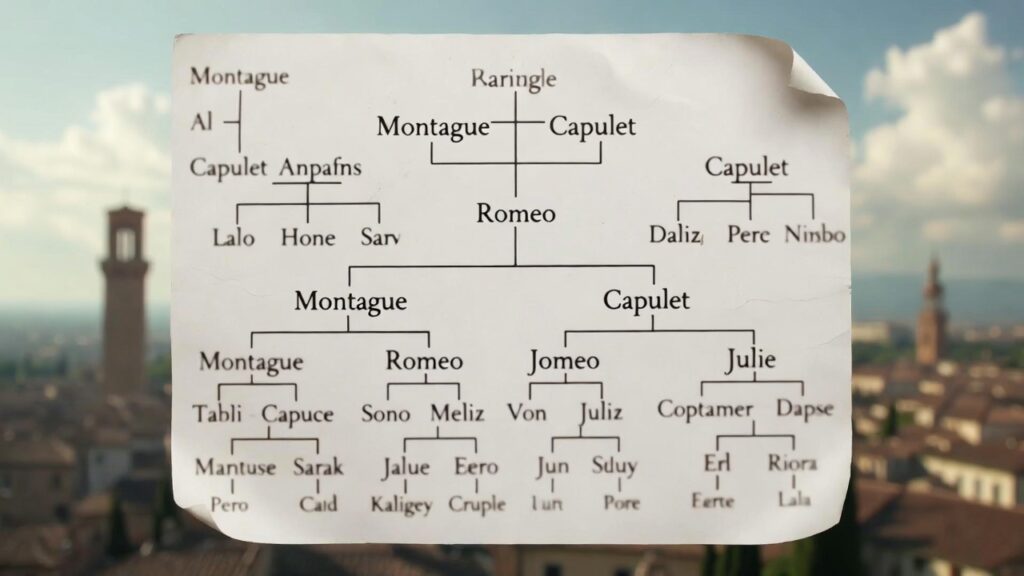
Visual Family Tree Representation
To make the relationships immediately clear, here is a textual breakdown of the most accurate family tree based on explicit textual evidence and widely accepted scholarly consensus (RSC, Folger, Arden editions). You can easily recreate this as a diagram for classroom use or personal study.
Montague Line
- Lord Montague └─ Lady Montague (wife) └─ Romeo (son)
- Benvolio (nephew to Lord & Lady Montague; cousin to Romeo)
Capulet Line
- Lord Capulet └─ Lady Capulet (wife) └─ Juliet (daughter)
- Tybalt (nephew to Lady Capulet; cousin to Juliet)
- Rosaline (cousin to Juliet; Capulet kinswoman)
Verona Ruling Line & Allies
- Prince Escalus ├─ Paris (kinsman to Prince) └─ Mercutio (kinsman to Prince)
Key Non-Blood Relationships
- The Nurse → surrogate mother to Juliet (employed by Capulets since Juliet’s birth)
- Friar Laurence → spiritual advisor and confidant to Romeo (and later Juliet)
- Balthasar → Romeo’s servant
- Peter → servant to the Nurse/Capulet household
Suggested Diagram Tips Use solid lines for direct blood relations (parent–child, uncle–nephew), dotted lines for marriage or extended kinship (e.g., Paris to Escalus), and gray dashed lines for close friendships or service ties (Romeo–Mercutio, Juliet–Nurse). Label each character with their key trait or fate (e.g., “Tybalt – slain by Romeo,” “Lady Montague – dies of grief”). This visual instantly reveals the asymmetry: the Capulets have more extended family, while Romeo’s circle is emotionally intimate but blood-limited.
Many educational sites offer downloadable PDFs, but they often oversimplify or include invented connections. The version above sticks strictly to what Shakespeare provides in dialogue and stage directions—no assumptions beyond “nephew,” “cousin,” and “kinsman.”
How Family Ties Drive the Tragedy: Thematic Analysis
The family tree is not decorative; it is the mechanism of doom. Shakespeare uses kinship to explore several enduring themes:
- Fate vs. Free Will The “star-crossed lovers” are doomed partly because they are born into opposing houses. Blood ties are presented as an inescapable force—“A pair of star-crossed lovers take their life” (Prologue). Yet characters repeatedly choose actions that worsen their fate (Romeo kills Tybalt in revenge for Mercutio, not family honor).
- Honor and Masculine Violence Tybalt fights to defend Capulet honor; Mercutio dies defending Romeo’s reputation; Romeo avenges Mercutio to preserve his own honor. The feud perpetuates itself through a toxic code of masculinity that equates restraint with cowardice.
- Generational Conflict Parents arrange marriages and demand obedience, while children seek autonomy. Lord Capulet’s rage at Juliet’s refusal (“My fingers itch” – Act 3, Scene 5) mirrors real Elizabethan tensions between patriarchal control and emerging individualism.
- Reconciliation Through Sacrifice Only the deaths of Romeo, Juliet, Paris, Mercutio, and Tybalt—plus the offstage grief-stricken deaths of Lady Montague and (implied) others—finally force the families to reconcile. The Prince’s closing lines (“For never was a story of more woe / Than this of Juliet and her Romeo”) remind us that love, not hatred, ultimately buries the grudge.
Expert Insights and Historical Context
Shakespeare drew on Arthur Brooke’s 1562 poem The Tragical History of Romeus and Juliet, but he significantly expanded the family dynamics. Brooke’s version includes more backstory for the feud; Shakespeare removes it, making the hatred feel arbitrary and absurd—closer to real Renaissance vendettas in Italy.
In Elizabethan England, noble families relied on strategic marriages and kinship alliances for power. Juliet’s arranged match with Paris reflects this reality, while the Nurse’s earthy, affectionate role contrasts with the emotional distance of Lady Capulet—a commentary on class and childcare in wealthy households.
Modern adaptations (Franco Zeffirelli’s 1968 film, Baz Luhrmann’s 1996 version) often visualize the family tree differently—Zeffirelli emphasizes Renaissance splendor, Luhrmann turns Verona into a modern urban warzone—but both retain the core truth: blood ties are the tragedy’s foundation.
Study Tips and Common Misconceptions
- Tip 1: Annotate your script with family labels every time “cousin,” “kinsman,” or names appear. It helps track motivation.
- Tip 2: When watching a performance, note how directors stage family entrances/exits to highlight alliances.
- Tip 3: Compare the family tree to other Shakespeare plays (The Merchant of Venice, King Lear) where kinship also drives conflict.
Common Misconceptions
- Romeo and Juliet are not distant cousins—there is no textual evidence of any blood connection between the houses.
- Benvolio is not Romeo’s brother; he is explicitly his cousin.
- The Nurse is not Juliet’s biological mother—she is a paid servant who wet-nursed her.
- Rosaline is a Capulet relative, making Romeo’s first love ironic and Juliet’s cousin.
Mastering the family tree of Romeo and Juliet transforms confusion into clarity. What at first appears to be a tangled web of names reveals itself as Shakespeare’s brilliant architecture: every relationship serves the tragedy, every blood tie tightens the noose around the lovers. By understanding these connections, you gain deeper insight into why the play remains one of the most powerful explorations of love, hate, and reconciliation in world literature.
Revisit the text with this guide in hand. Explore productions by the RSC or Folger editions for further nuance. The story endures because, beneath the poetry and passion, it is profoundly about family—and the terrible cost when families choose hate over understanding.
FAQs
Who is related to whom in Romeo and Juliet? The two central families are the Montagues (Romeo, his parents, cousin Benvolio) and the Capulets (Juliet, her parents, cousin Tybalt, cousin Rosaline). The Prince’s kinsmen (Paris and Mercutio) connect the feud to Verona’s ruling class.
Is Benvolio Romeo’s brother? No. Benvolio is Romeo’s cousin—nephew to Lord and Lady Montague.
How is Tybalt related to Juliet? Tybalt is Juliet’s first cousin (nephew to Lady Capulet).
Who is Rosaline in the family tree? Rosaline is Juliet’s cousin (a Capulet kinswoman). She is the woman Romeo initially loves before meeting Juliet.
Why don’t we see more Montague relatives? Shakespeare deliberately keeps the Montague family small to emphasize Romeo’s emotional isolation and personal tragedy, in contrast to the larger, more socially entangled Capulet household.