It is the ultimate irony of William Shakespeare’s greatest masterpiece. After hours of bloodshed, crippling philosophy, and brutal betrayal among the Danish royals, a Norwegian prince who barely appears on stage walks away with the entire kingdom. When examining the character of Fortinbras Hamlet transforms from an intimate psychological tragedy into a sweeping geopolitical epic. Many readers, students, and theatergoers assume this rogue prince is merely a background detail—a minor historical footnote included just to flesh out the world of Elsinore.
However, understanding Fortinbras is the absolute key to unlocking the central message of the play. He is the structural glue of the narrative, the ultimate foil to the tragic hero, and the catalyst for the story’s climax.
In this comprehensive guide, we will explore exactly who this mysterious Norwegian royal is, examine his critical role as a mirror to the Prince of Denmark, trace his movements through the timeline of the text, and uncover the thematic reasons why Shakespeare decided he must be the one to inherit the crown. Whether you are a student preparing an essay or a theater enthusiast digging into Elizabethan drama, this analysis will clarify the play’s ultimate triumph of pragmatic action over paralyzing thought.
Who is Fortinbras in Hamlet? (The Basics)
To understand why Fortinbras is essential to the play’s resolution, we must first look at the history that precedes Act 1, Scene 1. Shakespeare establishes a world where the sins of the fathers are directly inherited by their sons.
The Lineage and The Feud
Before the events of the play, King Hamlet (our protagonist’s father) engaged in a legally binding, high-stakes duel with King Fortinbras of Norway (our Norwegian prince’s father). King Hamlet was victorious, killing King Fortinbras and claiming significant Norwegian territories as his prize. This event notably happened on the exact day young Prince Hamlet was born, linking the two younger men by fate from the very beginning.
When the play opens, young Fortinbras is an aggrieved son dealing with the fallout. Much like Prince Hamlet, Fortinbras is mourning a deceased father, has lost his direct inheritance, and is watching his uncle (referred to as “Old Norway”) rule from the throne.
A Threat From the Margins
Despite never appearing on stage in the opening scenes, Fortinbras is the driving force behind the atmosphere of paranoia that grips Denmark. Before Hamlet even steps onto the stage, Horatio and the castle guards discuss the urgent military preparations happening across Elsinore. They reveal that young Fortinbras is gathering a rogue army of “lawless resolutes”—mercenaries—to forcibly take back the lands his father lost. He is introduced as a looming political and military threat, establishing the high stakes of this revenge tragedy.
The Ultimate Foil: Fortinbras vs. Hamlet vs. Laertes
In literary analysis, a “foil” is a character who contrasts with another character (usually the protagonist) to highlight particular qualities of the other. Shakespeare is a master of this technique, but in Hamlet, he goes a step further by providing a triad of vengeance.
Three Sons, Three Forms of Vengeance
Shakespeare gives his audience three distinct sons whose fathers are murdered during the course of the overarching narrative: Hamlet, Laertes, and Fortinbras. Each young man is burdened with the absolute duty of revenge, a cornerstone of Elizabethan drama. However, their approaches could not be more radically different. By comparing them, Shakespeare explores the spectrum of human reaction to grief and duty.
The Man of Thought (Hamlet)
Hamlet represents the extreme of intellect and philosophy. When tasked with killing King Claudius to avenge his father, he becomes paralyzed by morality, the ambiguity of the afterlife, and the psychological weight of consequence. His revenge is delayed by endless plotting, self-doubt, and the necessity of finding perfect, undeniable proof of guilt. His intellectual depth is his greatest asset, but it is ultimately fatal.
The Man of Passion (Laertes)
Laertes is the direct opposite of Hamlet. When he learns that his father, Polonius, has been killed, he does not pause to debate the theological implications. He immediately storms the castle with a mob, demands answers, and declares he would “cut his throat i’ th’ church” to get his revenge. Laertes is driven by unfiltered, impulsive rage. His passion blinds him, making him an easy pawn for King Claudius to manipulate.
The Man of Action (Fortinbras)
Fortinbras represents the golden mean of royal leadership: clinical, strategic action. He is not crippled by overthinking, nor is he blinded by sudden, explosive rage. He is driven by honor, military strategy, and political pragmatism. When his uncle stops him from attacking Denmark, Fortinbras pivots smoothly, redirecting his army to attack Poland over a meaningless, tiny patch of land. He fights simply because his honor demands it, demonstrating a decisive nature that Hamlet deeply envies.
The Sons of Vengeance
| Character | Father Killed By | Dominant Trait | Approach to Revenge | Ultimate Fate |
| Hamlet | Claudius | Intellect | Delay, philosophy, theatrical plotting | Death (Poison) |
| Laertes | Hamlet | Passion | Impulsive, immediate violence | Death (Poison) |
| Fortinbras | Old Hamlet | Action | Strategic military mobilization | Crown of Denmark |
Key Appearances: A Timeline of Fortinbras in the Play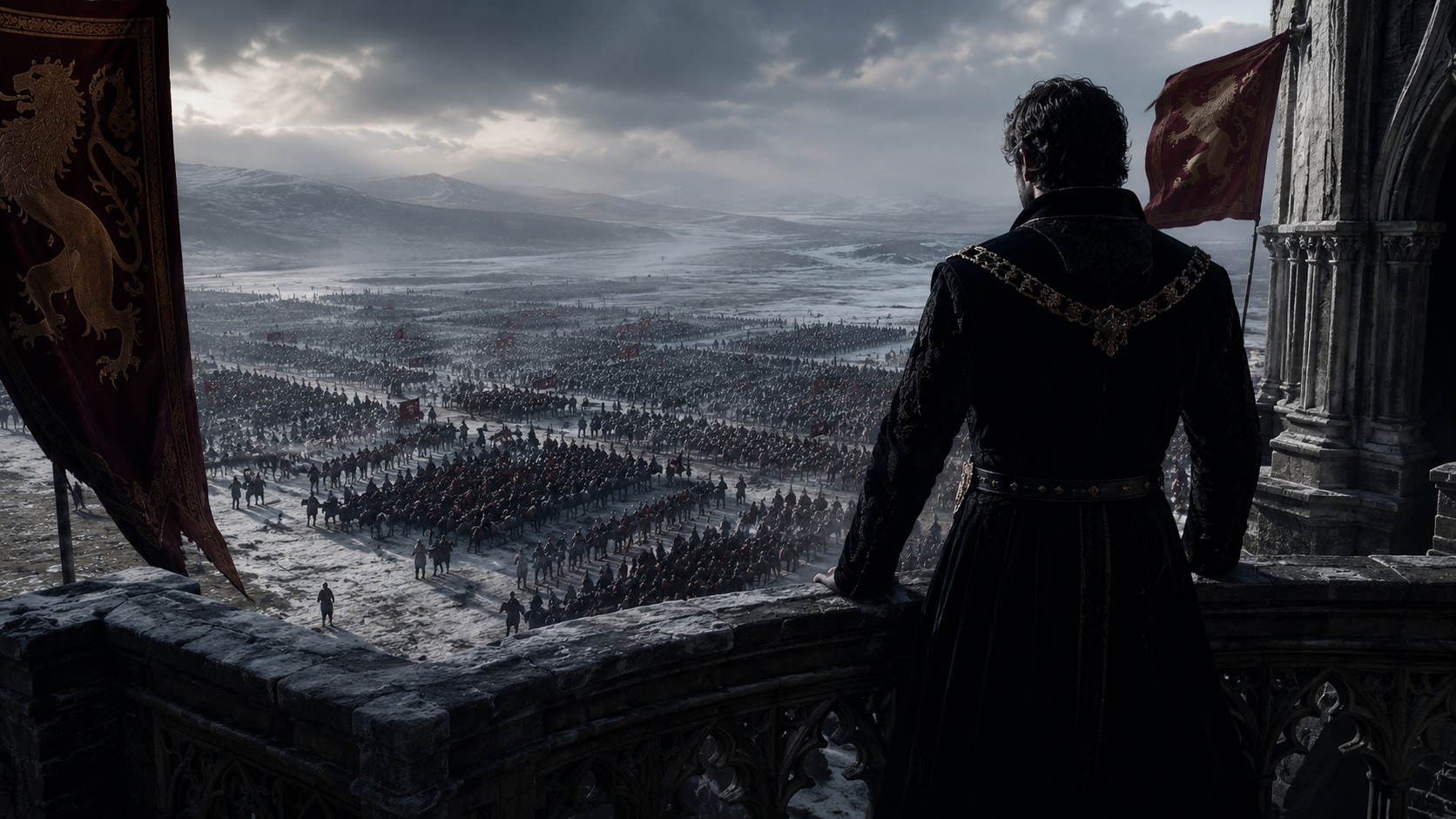
To grasp his impact, it is helpful to track exactly when and how Fortinbras influences the narrative, even from the periphery.
Act 1: The Rumors of War
As mentioned, Act 1 is defined by the shadow of Fortinbras. The changing of the guard, the strict watches, and the frantic casting of cannons are all direct responses to his impending invasion. Shakespeare uses Fortinbras to show that Denmark is a state under extreme external pressure, mirroring the internal rot and corruption taking place inside the castle walls.
Act 4, Scene 4: The Turning Point for Hamlet
This is arguably the most critical moment for understanding the dynamic between the two princes. Hamlet, being escorted to England, encounters Fortinbras’s army marching across the Danish landscape toward Poland. Hamlet asks a captain what they are fighting for, only to learn that the land is completely worthless—an “eggshell.”
This revelation triggers Hamlet’s final great soliloquy: “How all occasions do inform against me / And spur my dull revenge!” Watching Fortinbras risk thousands of lives and his own absolute safety for nothing more than honor deeply shames Hamlet. He realizes that he has a far greater cause (a murdered father, a stolen throne) yet has done nothing. Seeing the Man of Action ultimately catalyzes the Man of Thought to finally embrace his bloody destiny.
Act 5, Scene 2: The Triumphant Arrival
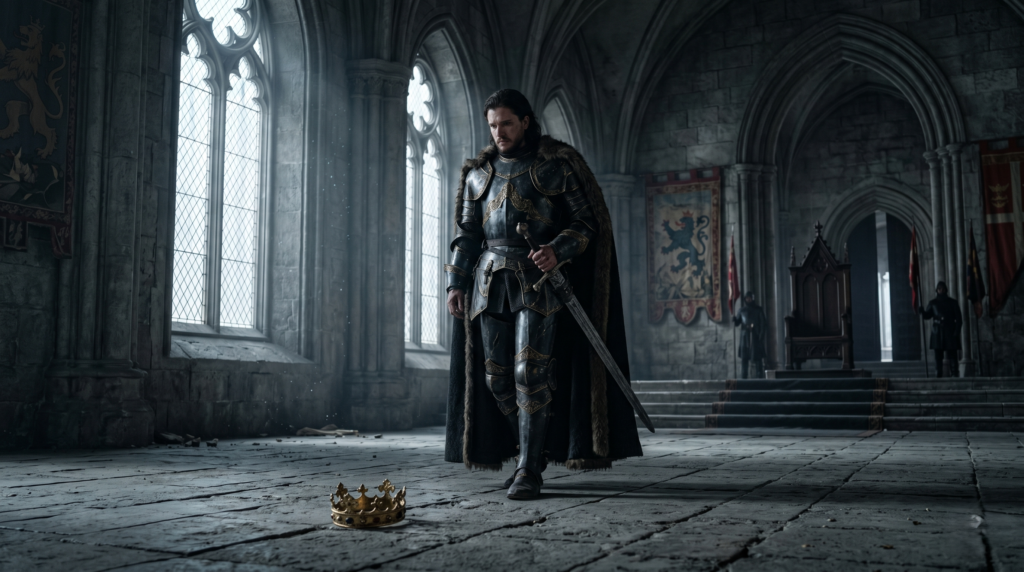
Fortinbras finally steps firmly into the spotlight at the very end of the play. He arrives victorious from Poland, only to find the Danish royal court massacred. Claudius, Gertrude, Laertes, and Hamlet are all dead. He acts as the cleanup crew, taking immediate charge of the horrific scene, claiming his rights to the kingdom, and ordering a soldier’s funeral for the fallen Prince.
Why Does Fortinbras Inherit the Crown?
The question of why a foreigner inherits Denmark is one of the most debated topics in literary circles. Shakespeare’s decision to end the tragedy this way serves several vital thematic and political purposes.
The Political Vacuum of Elsinore
From a purely pragmatic standpoint, the reality of monarchy dictates the ending. With the entire Danish royal line wiped out by poison and the sword, the state is completely vulnerable. There is no legitimate heir left in Elsinore. Fortinbras, possessing both royal blood and the only standing army in the room, steps into a natural political vacuum. The kingdom falls into his lap almost by default.
Hamlet’s Dying Prophecy
In his final moments, Hamlet uses his dying breaths to perform a crucial political act. He tells Horatio:
“But I do prophesy the election lights / On Fortinbras. He has my dying voice.”
This endorsement is incredibly significant. Hamlet, the ultimate man of thought, recognizes the flaws in his own nature. By giving Fortinbras his “dying voice” (his vote of approval for the throne), Hamlet admits that a country cannot be governed by paralyzed philosophers. Denmark needs a ruler who is decisive, strong, and unburdened by crippling introspection.
The Restoration of Order
In the Elizabethan worldview, the universe was governed by the Great Chain of Being. When a king was murdered (as King Hamlet was by Claudius), it disrupted the cosmic order, plunging the state into chaos and “rot.” A Shakespearean tragedy must end with a restoration of political and moral order. Fortinbras, an outsider untainted by the incestuous, treacherous corruption of Claudius’s court, brings a clean slate. He is the cure to the sickness that has plagued Denmark.
Fortinbras on Stage and Screen: To Cut or Not to Cut?
For modern theater directors and filmmakers, Fortinbras presents a unique pacing challenge, leading to wildly different interpretations of the text.
Why Directors Often Remove Him
In many famous adaptations—such as Laurence Olivier’s 1948 Academy Award-winning film or Franco Zeffirelli’s 1990 version starring Mel Gibson—Fortinbras is cut entirely. Directors often make this choice to streamline a very long play (an uncut Hamlet runs over four hours) and to focus exclusively on the intense, claustrophobic psychological drama of Hamlet’s family. Cutting the Norwegian subplot makes the story more intimate and accelerates the pacing.
What the Play Loses Without Him
However, removing Fortinbras fundamentally changes the genre of the play. Kenneth Branagh’s definitive 1996 uncut film adaptation brilliantly demonstrates this. By keeping Fortinbras (played fiercely by Rufus Sewell), Branagh restores the epic, geopolitical stakes of Shakespeare’s vision. Without the threat of invasion, the urgency of Claudius’s rule diminishes. Without the foil of the marching army, Hamlet’s Act 4 soliloquy loses its visual and thematic trigger. The play transforms from an isolated family squabble back into a narrative about the fate of an entire nation.
Study Guide: Key Fortinbras Quotes to Memorize
If you are writing an essay or preparing for an exam, integrating direct textual evidence is vital. Here are the most essential quotes relating to his character:
-
Quote: “Witness this army of such mass and charge / Led by a delicate and tender prince, / Whose spirit with divine ambition puffed / Makes mouths at the invisible event…” (Act 4, Scene 4)
-
Context: Hamlet speaking about Fortinbras.
-
Analysis: Hamlet admires the prince’s “divine ambition.” This quote perfectly encapsulates the foil dynamic, showing Hamlet marveling at someone willing to face the “invisible event” (death/the unknown) for the sake of action, something Hamlet is terrified to do.
-
-
Quote: “For me, with sorrow I embrace my fortune. / I have some rights of memory in this kingdom, / Which now to claim my vantage doth invite me.” (Act 5, Scene 2)
-
Context: Fortinbras claiming the throne of Denmark over the dead bodies of the royals.
-
Analysis: Notice the calculated, political nature of his speech. He expresses brief sorrow, but immediately pivots to seizing his advantage (“my vantage”). It is the ultimate display of ruthless, effective leadership.
-
Frequently Asked Questions (FAQs)
Does Fortinbras ever speak to Hamlet?
No, the two princes never meet face-to-face during the play. This physical separation makes their parallel connection even more profound. Hamlet only observes Fortinbras from afar, and Fortinbras only arrives to see Hamlet’s corpse.
Why is Fortinbras attacking Poland?
After his uncle (the King of Norway) discovers his plot to attack Denmark, Fortinbras is forbidden from doing so. To appease his nephew’s restless military energy, the King gives him permission and funds to attack Poland instead, over a tiny, worthless piece of land. It is a war fought purely for honor and reputation.
Is Fortinbras a good king?
The text leaves this ambiguous. He is undoubtedly a successful conqueror and a pragmatic leader. In his final moments, he orders military honors for Hamlet, showing a degree of respect and nobility. However, his willingness to sacrifice thousands of lives for an “eggshell” in Poland suggests he may be a ruthless ruler. Regardless of morality, he provides the stability that a ruined Denmark desperately needs.
The presence of Fortinbras in Hamlet is a testament to William Shakespeare’s unparalleled ability to weave complex thematic structures. He is far more than a convenient plot device waiting in the wings to clean up the mess in Act 5. He is the mirror that reflects the protagonist’s fatal flaws, exposing the severe dangers of intellectual paralysis.
While Hamlet thinks himself into an early grave, Fortinbras marches his way to a crown. He is the living embodiment of political pragmatism and military resolve. In the dark, corrupted universe of Elsinore, Shakespeare leaves us with a stark, enduring lesson: the survivors of history are rarely the deepest thinkers—they are the ones who are willing to act.