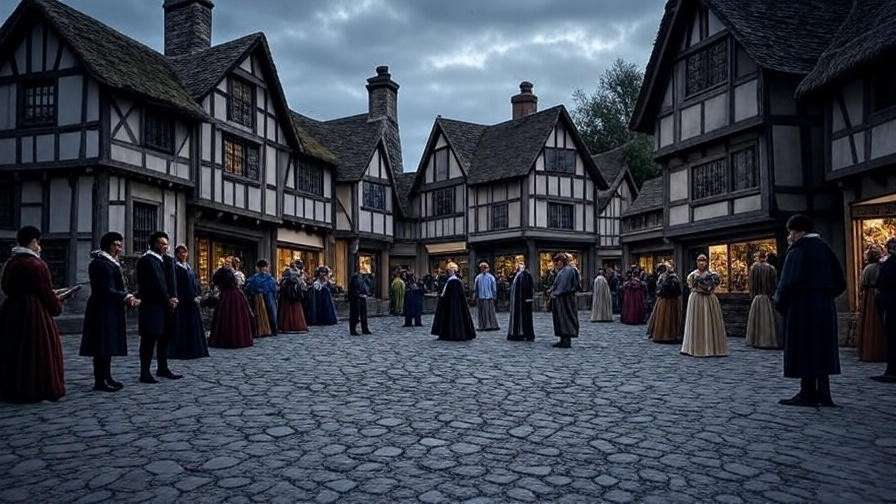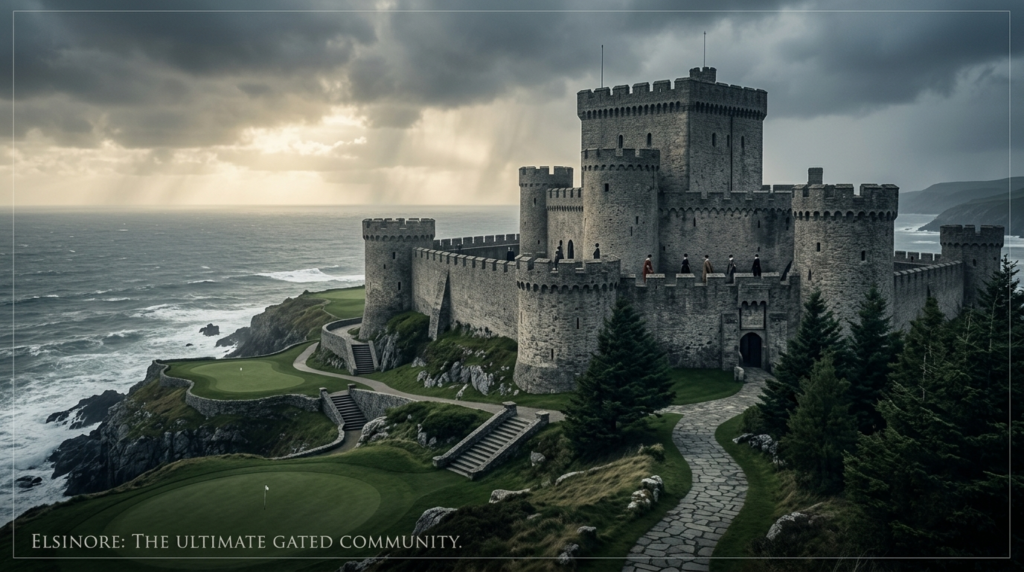
Imagine an exclusive, gated community where every manicured lawn hides a whispered secret, every boardroom meeting dictates a legacy, and a hyper-vigilant board of directors monitors your every move. Today, we call this a luxury enclave or an elite golf estate. However, four centuries ago, William Shakespeare mapped out this exact psychological landscape. While modern digital searches for a hamlet country club point toward sprawling fairways and high-end recreational sanctuaries, the phrase serves as a brilliant sociological metaphor for Elsinore Castle—the toxic, insular, and hyper-elite world of Denmark’s royal court.
For students, educators, and theatre enthusiasts alike, The Tragedy of Hamlet, Prince of Denmark can occasionally feel distant, buried beneath archaic syntax and dense Elizabethan conventions. The problem isn’t the text; it is the framing. By reinterpreting the play through the familiar, cutthroat dynamics of a modern elite social club, we unlock the intense psychological realism Shakespeare intended.
By examining Elsinore through this contemporary lens, we uncover five timeless themes regarding institutional surveillance, performative identity, legacy corruption, and emotional isolation. These dynamics are as vibrant and damaging on a modern country club green as they were on the stage of the Globe Theatre.
Elsinore as the Ultimate “Gated Community”: Why the Country Club Metaphor Works
To fully appreciate the tragedy of the play, one must first understand its setting. Elsinore is not a bustling medieval metropolis; it is a closed ecosystem. It operates under a unique, unspoken set of rules designed to preserve status, protect the brand of the monarchy, and keep the outside world firmly at bay.
The Illusion of Privilege vs. Total Isolation
To the casual observer standing outside the gates, the inhabitants of Elsinore enjoy unparalleled privilege. They are surrounded by wealth, fine art, political influence, and absolute security. Yet, Shakespeare intentionally structures the setting to feel suffocatingly small.
When Prince Hamlet famously proclaims that “Denmark’s a prison,” he is speaking to the profound claustrophobia of elite social circles. Every conversation is overheard, every action is analyzed for political leverage, and no one is permitted to simply leave. When Hamlet begs to return to his university life in Wittenberg, King Claudius and Queen Gertrude deny his request, forcing him to remain within the community’s boundaries where he can be watched. This dynamic mirrors the psychological trap of elite institutions: the more exclusive the space, the less freedom its members actually possess.
The “Members Only” Culture of Claudius’s Court
A country club thrives on gatekeeping—defining who belongs and who is an intruder. Following the sudden death of Old King Hamlet, Claudius establishes a new social hierarchy built on transactional loyalty.
[The Elsinore Inner Circle]
       |
       +---> Claudius (The Strategic Leader)
       |
       +---> Polonius (The Gatekeeper)
       |
       +---> Rosencrantz & Guildenstern (The Social Climbers)
In this re-engineered court, loyalty is bought and social standing is conditional. Figures like Polonius act as the ultimate gatekeepers, managing access to the executive suite. Meanwhile, genuine, non-transactional individuals like Horatio—Hamlet’s true friend from outside the aristocratic bubble—are treated with polite distance. They are allowed on the grounds, but they are never truly part of the “inner circle.”
5 Timeless Themes from the “Hamlet Country Club”
When an institution prioritizes its own preservation over truth and morality, its internal culture inevitably rots. By looking at the specific plot mechanics of Hamlet, we can isolate five core themes that demonstrate how this insular environment drives its characters to the brink of destruction.
1. The Panopticon of Elite Societies (Surveillance & Gossip)
In an exclusive social enclave, privacy is the first luxury to be sacrificed. Information is the ultimate currency, and gossip functions as a weapon. In Hamlet, Shakespeare constructs a literal panopticon where spying is normalized as a tool of governance.
Consider the layout of the play’s action:
-
Polonius spies on his own son: He dispatches Reynaldo to Paris to spread minor rumors about Laertes, purely to gauge his reputation among peers.
-
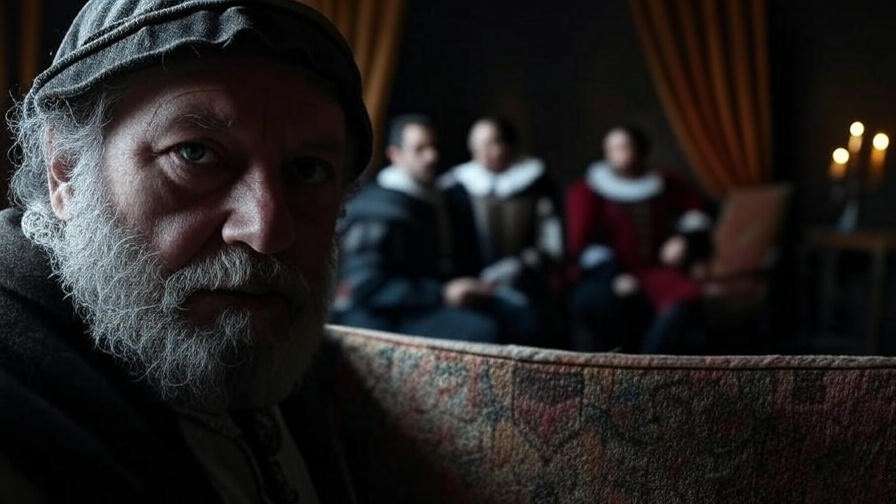
The King and Polonius spy on Hamlet: They use Ophelia as bait, hiding behind an arras (a heavy tapestry) to observe a deeply private emotional confrontation.
-
The Queen’s closet scene: Polonius once again conceals himself behind a curtain to monitor a mother-and-son conversation, a choice that ultimately costs him his life.
This relentless surveillance degrades the mental health of everyone involved. Trust becomes completely impossible. When Hamlet tells Ophelia, “Get thee to a nunnery,” he speaks with the bitter awareness that their intimacy is being staged for an unseen audience. Shakespeare’s timeless lesson here is clear: when a community values surveillance over authentic connection, it breeds a culture of paranoia that destroys its most vulnerable members.
2. Performance vs. Authenticity (The Cost of “Fitting In”)
To maintain standing within a high-status community, members are expected to wear a uniform—both literally and behaviorally. There is an unspoken dress code and an expected emotional decorum.
From the opening scenes, Hamlet consciously breaks this code. While Claudius’s court celebrates a hasty wedding and a new political era, dressed in festive attire, Hamlet stands apart in his “inky cloak.” When his mother asks why his grief “seems” so particular to him, Hamlet snaps back:
“Seems, madam? Nay, it is; I know not ‘seems.’
‘Tis not alone my inky cloak, good mother,
Nor customary suits of solemn black…”
Hamlet rejects the performative grief of the court, asserting that his internal reality (“that within which passeth show”) cannot be neatly categorized by the superficial etiquette of Elsinore.
Conversely, characters like Rosencrantz and Guildenstern represent the ultimate tragedy of assimilation. They entirely sacrifice their authentic identities to maintain their social standing. They smile when the King smiles, spy when the King asks, and speak in rehearsed, corporate platitudes. By choosing performance over authenticity, they lose their humanity, becoming disposable tools of the institution.
3. The Corruption of Nepotism and Legacy
An insular, elite community often functions through nepotism, ensuring that power, wealth, and influence remain concentrated within a select few families, regardless of merit or morality.
Claudius’s ascension to the throne is a masterclass in boardroom manipulation. Rather than allowing the crown to naturally pass to the rightful heir, Hamlet, Claudius maneuvers behind the scenes, securing the backing of the local nobility through deals and political compromise (“With taking goody and with barring goody”).
[Traditional Succession] ------------> Hamlet (Rightful Heir)
                                         ^
                                         | [Blocked By]
                                         v
[Boardroom Manipulation] ----------> Claudius & Polonius (Alliance)
This dynamic is reinforced by the alliance between Claudius and Polonius. Polonius uses his position as chief advisor to secure high-status opportunities for his children, Laertes and Ophelia. However, this legacy-driven framework treats family members as assets rather than individuals. Ophelia is explicitly ordered to break off her relationship with Hamlet because her marital status is a political chip to be played at the right strategic moment. Shakespeare demonstrates that when families view their children as extensions of an institutional brand, they trade genuine love for transactional utility.
4. The Marginalization of the Outsider
What happens when a member of an exclusive club refuses to play by the established rules? The institution responds by labeling them as unstable, dangerous, or unfit for society.
Hamlet’s adoption of an “antic disposition” (feigned madness) is a brilliant tactical response to this dynamic. Knowing that he cannot openly speak the truth about his father’s murder without being instantly silenced, he uses the guise of eccentricity to disrupt the court’s rigid etiquette. He insults the Prime Minister, mocks the King to his face, and exposes the sycophancy of courtiers like Osric.
However, the tragedy is that the environment inevitably punishes non-conformity. While Hamlet uses “madness” as a shield, Ophelia is genuinely broken by the system’s demands. Caught between her father’s commands, the King’s political schemes, and Hamlet’s erratic behavior, she has no safe space to process her profound grief. Lacking the political agency of a man, her genuine descent into madness becomes a devastating indictment of a rigid social structure that offers zero support to those who do not fit its mold.
5. The Inevitability of Institutional Collapse
A gated community can only ignore the decay within its walls for so long. When the foundation of an institution is built on a crime—in this case, fratricide and the usurpation of a throne—no amount of superficial polishing can prevent its ultimate downfall.
Shakespeare tracks this rot throughout the play, culminating in the total destruction of the royal lineage in Act V. The final scene does not feature a grand, heroic battle; it features a clumsy, chaotic sequence of accidental poisonings, toxic blades, and self-inflicted traps.
The “Hamlet Country Club” collapses under the weight of its own political games. Claudius’s poisoned cup, meant for Hamlet, kills his own queen. The poisoned sword, meant to guarantee Laertes’s victory, kills both competitors. In the end, the entire “estate” is left vulnerable to a hostile takeover by Fortinbras, an aggressive outsider from Norway who simply walks through the open gates and claims the ruins.
Practical Application: How to Use the “Country Club” Analogy for Essays and Analysis
For students or educators analyzing Hamlet, translating these themes into modern structural equivalents provides a highly effective framework for literary analysis. Use the following character matrix to map out the power dynamics within the text:
| Character | Traditional Royal Role | Modern “Country Club” Equivalent | Primary Institutional Motivation |
| Claudius | Usurping King | The Aggressive, Corrupt Club President | Protecting the brand; maintaining personal power at all costs. |
| Polonius | Lord Chamberlain | Overzealous Head of Security / Managing Director | Controlling information; managing access to the executive suite. |
| Hamlet | Disinherited Prince | The Cynical, Rebel Heir | Exposing the hypocrisy of the board; seeking truth. |
| Ophelia | Courtier’s Daughter | The Compliant Legacy Member | Fulfilling family expectations; maintaining social decorum. |
| Rosencrantz & Guildenstern | Attendant Courtiers | Sycophantic Social Climbers | Securing invitations to exclusive events; networking for status. |
Analytical Essay Prompts
-
On Surveillance: Analyze how the spatial layout of Elsinore creates a culture of performance. How do characters alter their speech when they suspect they are being overheard?
-
On Institutional Decay: Evaluate Marcellus’s famous line, “Something is rotten in the state of Denmark.” How does individual moral failure expand to infect an entire social ecosystem?
Why Shakespeare’s Social Commentary Matters Today
The enduring genius of William Shakespeare lies in his ability to diagnose the flaws of human institutions. Writing during the late Elizabethan and early Jacobean eras, he was acutely aware of the toxic nature of court politics. He understood what happens to the human psyche when life becomes an endless series of public performances, strategic alliances, and guarded secrets.
By mapping these behaviors onto familiar structures like a country club or an elite corporate board, we recognize that human nature has not shifted in four centuries. We still struggle with the pressure to fit into exclusive spaces, the fear of public scrutiny, and the temptation to compromise our ethics for social elevation.
Hamlet remains the ultimate tragedy because it reminds us that wealth and status cannot shield an institution from its own internal rot. Whether walking the stone corridors of medieval Elsinore or the pristine paths of a modern estate, the truth will always find a way to break through the gate.
Frequently Asked Questions
Why did Shakespeare choose Elsinore Castle as the exclusive setting for Hamlet?
Shakespeare utilized the real-world fortress of Kronborg Castle in Elsinore, Denmark, because its geographical isolation and military architecture perfectly emphasized the psychological claustrophobia of the narrative. The setting functions as an isolated container that forces characters into constant, unavoidable friction, heightening the play’s tension.
What is the significance of the phrase “Something is rotten in the state of Denmark”?
Spoken by the guard Marcellus in Act I, this phrase establishes the central theme of systemic corruption. It signifies that the moral crime committed at the top of the social hierarchy (Claudius murdering his brother) has acted as an infection, spreading throughout the political and social structure of the entire community.
How does Hamlet’s “ink cloak” symbolize his relationship with the court?
The “inky cloak” is a visual manifestation of Hamlet’s refusal to conform to the superficial emotional expectations of Claudius’s court. While the rest of the community chooses to perform happiness and political unity, Hamlet uses his mourning attire to signal his total emotional detachment from the institutional status quo.