“To be, or not to be—that is the question.”
These six words, uttered by Prince Hamlet in the most famous soliloquy in English literature, have echoed through four centuries, appearing in philosophy textbooks, psychology studies, political speeches, films, memes, and even therapy sessions. Few lines in any language capture the human condition so completely: the paralyzing weight of existence, the fear of the unknown, the temptation to escape suffering, and the stubborn refusal to act.
Yet the soliloquy is only one window into Hamlet (c. 1600–1601), William Shakespeare’s longest and most performed tragedy. The play follows Prince Hamlet of Denmark as he grapples with his father’s murder, his mother’s hasty remarriage to the murderer, and a ghostly command to seek revenge. What begins as a conventional Elizabethan revenge tragedy quickly becomes something far more profound—a relentless interrogation of certainty, morality, identity, and the meaning of life itself.
Hamlet theme analysis reveals why the play refuses to be reduced to a simple revenge story. Shakespeare weaves together multiple interlocking themes—appearance versus reality, action versus inaction, mortality and decay, the corrupting force of revenge, and the constraints placed on women in a patriarchal world—that continue to resonate because they confront universal human dilemmas. Whether you are a high-school student writing your first essay, a university literature major preparing for exams, a teacher designing lessons, or simply a lifelong reader returning to the text, understanding these themes in Hamlet unlocks the play’s enduring power.
This in-depth exploration goes beyond surface-level summaries. Drawing on close textual reading, historical context, major critical perspectives (from Freud to feminist scholars), and connections to contemporary issues, we will examine each major theme with precision, supported by key quotations, scene references, and interpretive insights. By the end, you will not only grasp what the central Hamlet themes are but also why they matter so deeply in our own uncertain, morally complex world.
Appearance vs. Reality – The Core of Hamlet’s Torment
No single Hamlet theme permeates the play more thoroughly than the tension between appearance and reality. From the very first scene, Shakespeare establishes a world where nothing can be trusted at face value. The sentinels on the castle battlements see the Ghost of King Hamlet but cannot be certain whether it is truly the dead king, a devil in disguise, or a hallucination. This foundational uncertainty sets the tone for everything that follows.
Appearance vs. Reality – The Core of Hamlet’s Torment
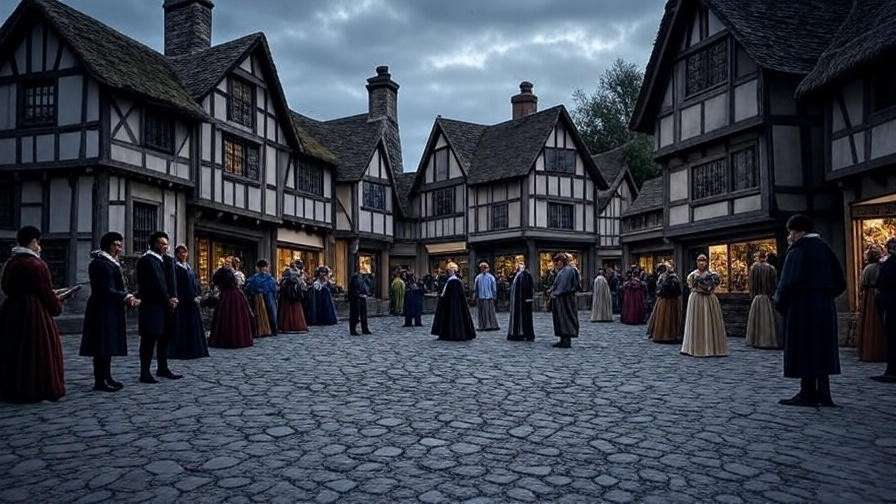
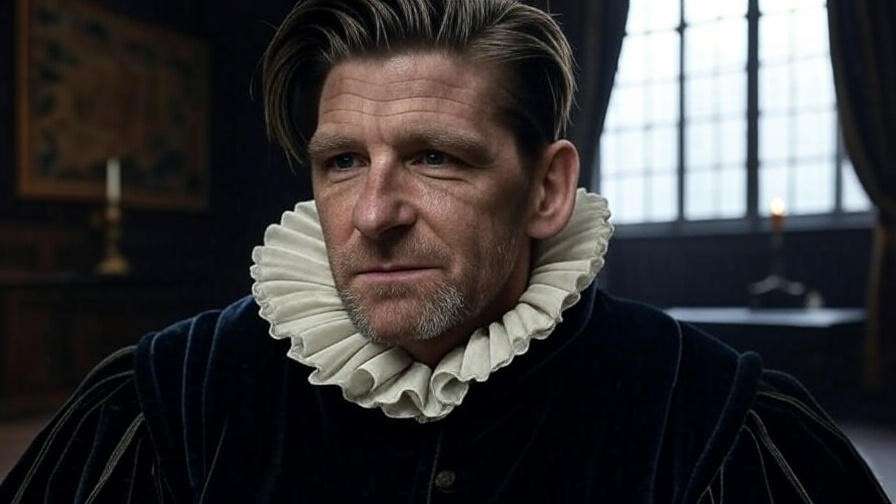
Claudius, the usurping king, embodies the theme most visibly. His opening speech is a masterpiece of calculated hypocrisy: he mourns his brother publicly while privately reveling in the fruits of regicide. He calls the marriage to Gertrude “our sometime sister, now our queen” and frames it as necessary statecraft rather than lustful opportunism. The entire court participates in this performance, offering empty condolences and accepting the new order without question.
Hamlet alone refuses to play along. His bitter response to Gertrude—“Seems, madam? Nay, it is. I know not ‘seems’” (1.2.76–86)—draws a sharp line between genuine grief and theatrical mourning. For Hamlet, the discrepancy between outward show and inner truth is unbearable. His black clothing, his refusal to be comforted, his barbed wit—all are attempts to signal that he sees through the court’s façade.
The theme reaches its most theatrical expression in the play-within-a-play, “The Murder of Gonzago.” Hamlet renames it “The Mousetrap” and instructs the players to insert a dozen or sixteen lines mirroring Claudius’s crime. When Claudius reacts with guilt and storms out, Hamlet declares triumphantly:
“The play’s the thing / Wherein I’ll catch the conscience of the king.” (2.2.616–617)
Here Shakespeare brilliantly uses metatheatre to expose hidden truth. The staged fiction becomes the only honest mirror in a world of lies.
Hamlet’s “Antic Disposition” – Feigned Madness or Real Breakdown?
One of the most debated questions in Hamlet scholarship is whether Hamlet’s madness is entirely pretended. He tells Horatio and Marcellus explicitly that he will “put an antic disposition on” (1.5.189), yet his behavior grows increasingly erratic and cruel. His treatment of Ophelia (“Get thee to a nunnery”) is vicious; his murder of Polonius is reckless. Many critics argue that the boundary between performance and genuine psychological collapse blurs, reflecting the corrosive effect of living in a world where truth is constantly concealed.
Modern Relevance Today, the appearance vs. reality theme feels eerily prescient. Social media encourages curated personas that rarely match inner experience. Political leaders stage photo opportunities while hiding inconvenient truths. Gaslighting and “alternative facts” erode shared reality. Reading Hamlet reminds us how exhausting—and dangerous—it is when no one can be trusted to mean what they say.
Action vs. Inaction – The Paralysis of Overthinking
If appearance versus reality is the atmosphere of Hamlet, then the theme of action versus inaction is its tragic engine. Hamlet knows what he must do—avenge his father—but he cannot bring himself to do it swiftly. The delay costs nearly every major character their life.
Why Hamlet Delays: The Tragic Cost of Hesitation
Shakespeare deliberately contrasts Hamlet with three other avenging sons: Fortinbras, Laertes, and young Hamlet himself in the abstract. Fortinbras wages war over a worthless patch of land yet acts decisively. Laertes, upon learning of his father’s death, raises a mob and storms the palace without hesitation. Hamlet, by comparison, is paralyzed.
Key Soliloquies Breakdown
The play’s most famous speech, “To be, or not to be” (3.1.56–90), is not primarily about suicide but about the paralyzing fear that action might bring worse consequences. Hamlet lists the “slings and arrows of outrageous fortune” and wonders whether it is nobler to endure or to fight back—only to conclude that “conscience does make cowards of us all.” Here “conscience” carries a double meaning: moral scruple and consciousness itself. Thinking too much prevents doing.
Another crucial soliloquy comes after Hamlet watches the players perform. Moved by the actor’s passionate grief for Hecuba, Hamlet berates himself:
“O, what a rogue and peasant slave am I! … … This is most brave, That I, the son of a dear father murdered, Prompted to my revenge by heaven and hell, Must, like a whore, unpack my heart with words And fall a-cursing like a very drab …” (2.2.550–605)
The self-loathing is palpable. Hamlet recognizes his own inaction as shameful yet remains unable to break the cycle.
Psychological and Philosophical Layers Elizabethan audiences would have understood Hamlet’s hesitation through the lens of Christian theology: revenge was a sin, and killing a king—even a usurper—was regicide. At the same time, Renaissance humanism celebrated decisive action. Hamlet is caught between these worldviews.
Modern readers often see clinical depression or anxiety disorder in Hamlet’s symptoms: indecisiveness, self-disgust, withdrawal, obsessive rumination. Existentialist philosophers (Kierkegaard, Camus, Sartre) later found in Hamlet a precursor to the absurd hero who recognizes meaninglessness yet must act anyway.
Solving the Reader’s Problem For students writing essays, the key is to avoid simplistic answers (“Hamlet is a coward”). Instead, argue that his inaction arises from moral intelligence, fear of damnation, and recognition that revenge solves nothing. The tragedy lies in the fact that decisive action (Laertes, Fortinbras) is often thoughtless, while thoughtful inaction leads to catastrophe.
Mortality, Decay, and the Mystery of Death
Perhaps no Hamlet theme strikes modern readers with greater immediacy than the relentless contemplation of death and the decay that follows it. Shakespeare does not treat mortality as an abstract philosophical problem; he makes it visceral, grotesque, and inescapable.
“Alas, Poor Yorick” – Confronting the Inevitability of Death
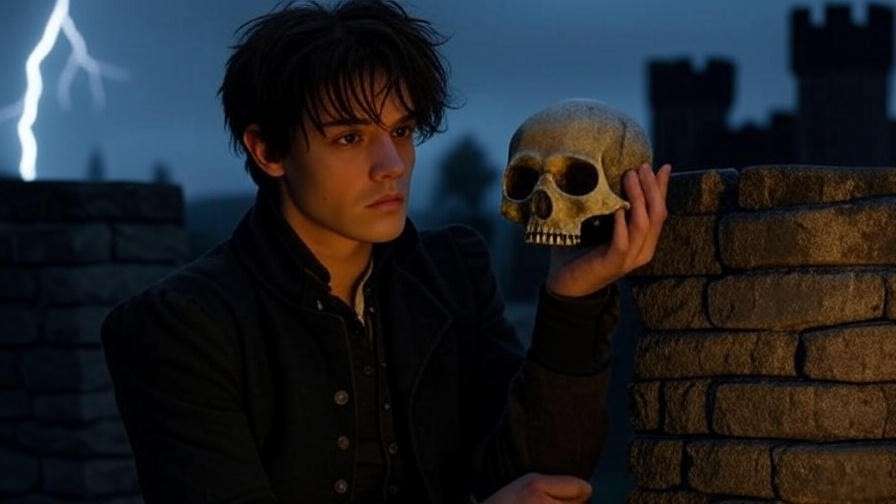
The graveyard scene (5.1) stands as one of the most iconic moments in all of drama. Hamlet, holding the skull of Yorick—the court jester who once carried him on his back—meditates on the leveling power of death:
“Alas, poor Yorick! I knew him, Horatio—a fellow of infinite jest, of most excellent fancy… Where be your gibes now? Your gambols? Your songs? Your flashes of merriment that were wont to set the table on a roar?” (5.1.177–185)
The shift from personal memory to universal truth is devastating. Yorick’s skull, once animated by laughter, is now indistinguishable from that of Alexander the Great or Caesar. Hamlet traces an imagined lineage: “Dost thou think Alexander looked o’ this fashion i’ th’ earth?… Alexander died, Alexander was buried, Alexander returneth to dust, the dust is earth…” (5.1.197–210). The reduction of greatness to “a little patch of earth” echoes the earlier motif of “something… rotten in the state of Denmark” (1.4.90), where moral and physical decay become intertwined.
Throughout the play, images of poison, infection, and putrefaction reinforce this theme. The Ghost describes his murder as poison poured into his ear—“a most instant tetter… bark’d about… with vile and loathsome crust” (1.5.71–79). Claudius’s crime literally rots the body politic. By the final act, the stage is littered with corpses, and the air itself seems thick with death.
Religious and Existential Dimensions
Hamlet’s fear of death is not merely physical; it is theological. In the “To be, or not to be” soliloquy, he dreads “the undiscovered country, from whose bourn / No traveller returns” (3.1.79–80). Suicide, though tempting as an escape from “a sea of troubles,” risks damnation—a mortal sin in the Christian framework of Elizabethan England. This tension between despair and religious prohibition contributes powerfully to his inaction.
Existentially, Hamlet anticipates later thinkers. The graveyard scene prefigures Heidegger’s “being-toward-death” and Camus’s absurd confrontation with meaninglessness. Death strips away illusion, forcing us to face what remains when titles, ambition, and even memory dissolve.
Contemporary Connections In an era marked by global pandemics, climate anxiety, and debates over assisted dying, Hamlet’s obsession with mortality feels urgent. The play asks: How do we live meaningfully when we know death is inevitable and perhaps meaningless? For many readers, especially young adults facing mental-health challenges, these questions offer language for experiences that are difficult to articulate.
Revenge, Justice, and Moral Corruption
Revenge is the engine of the plot, yet Shakespeare interrogates it so relentlessly that the theme of revenge becomes a study in moral self-destruction.
The Corrupting Cycle of Revenge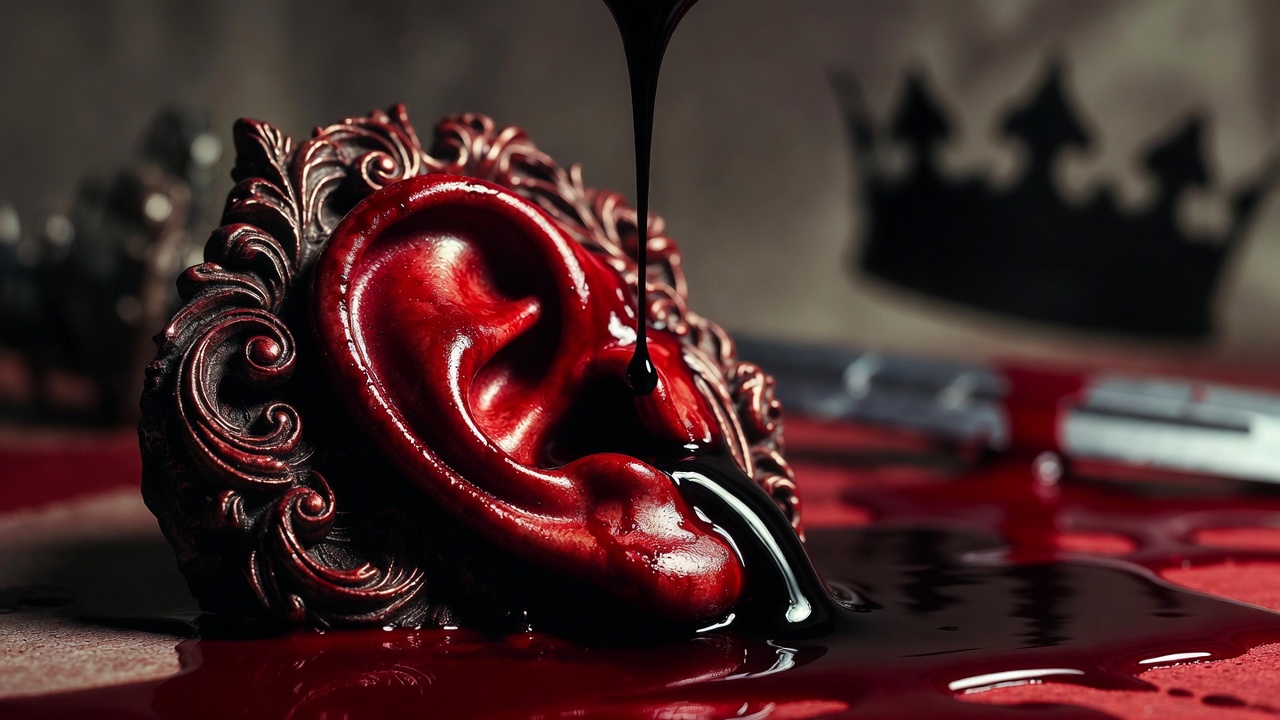
The Ghost’s command—“If thou didst ever thy dear father love… Revenge his foul and most unnatural murder” (1.5.23–25)—sets the tragedy in motion. Yet the act of revenge poisons Hamlet’s mind as surely as the literal poison poisoned King Hamlet’s body. By the play’s end, almost everyone connected to the original crime is dead: Polonius, Ophelia, Gertrude, Laertes, Claudius, Hamlet himself, and indirectly Rosencrantz and Guildenstern.
Poison as Metaphor
Poison operates on multiple levels. It is the literal murder weapon, the moral contagion that spreads through the court, and the psychological toxin that corrodes Hamlet’s humanity. Each act of vengeance begets another: Hamlet kills Polonius → Laertes seeks revenge → the final duel is rigged with poisoned sword and cup → Gertrude drinks the poison intended for Hamlet → Laertes is wounded by his own poisoned blade → Hamlet forces Claudius to drink.
Shakespeare thus transforms the revenge genre. In earlier plays such as The Spanish Tragedy, retribution brings cathartic satisfaction. In Hamlet, it brings only devastation and futility. The cycle illustrates a grim truth: violence justified as justice almost always escalates and corrupts everyone involved.
Ethical Dilemma Elizabethan audiences were familiar with the biblical prohibition “Vengeance is mine; I will repay, saith the Lord” (Romans 12:19), yet they also lived in a culture that valued honor and blood feuds. Hamlet is torn between these imperatives. Modern readers can see parallels in vigilante justice, cycles of retaliation in conflicts, and the moral hazards of “an eye for an eye” thinking.
Gender, Women, and Patriarchy in Hamlet
While not always foregrounded in traditional readings, the theme of gender roles and the treatment of women offers one of the play’s most poignant tragedies.
The Tragic Plight of Women – Gertrude and Ophelia
Gertrude and Ophelia are the only significant female characters, and both suffer from limited agency in a male-dominated world. Gertrude’s swift remarriage to Claudius prompts Hamlet’s misogynistic outburst: “Frailty, thy name is woman!” (1.2.146). Whether Gertrude knew of the murder remains ambiguous, but her silence and compliance reflect the limited options available to women of her status.
Ophelia’s fate is even more heartbreaking. Obedient to her father and brother, she rejects Hamlet on their command, then descends into madness after Polonius’s death. Her famous mad scenes—distributing flowers, singing bawdy songs, drowning—are among the most moving depictions of grief and mental collapse in literature. Critics argue that her suicide (or accidental death) is the direct result of patriarchal control: denied voice and choice, she breaks.
Feminist Readings Twentieth- and twenty-first-century scholars (Elaine Showalter, Jacqueline Rose, Carol Chillington Rutter) have highlighted how Ophelia’s madness and Gertrude’s complicity expose the suffocating effects of patriarchal structures. Hamlet’s verbal abuse of both women (“Get thee to a nunnery,” “You are keen, my lord, you are keen”) reflects not just personal anger but a broader cultural anxiety about female sexuality and autonomy.
Timeless Insight These portrayals remain relevant in discussions of gender inequality, mental-health stigma for women, coercive control in families, and the silencing of female voices in public and private spheres.
Expert Insights, Symbols, Practical Applications, FAQs
Expert Insights and Scholarly Perspectives Over centuries, Hamlet has invited diverse interpretations. Freud saw an Oedipal conflict in Hamlet’s fixation on Gertrude and hostility toward Claudius. Existentialists read the play as a meditation on absurdity and freedom. New Historicists place it in the context of Elizabethan succession anxieties and religious tensions after the Reformation. Recent psychological and trauma-informed readings emphasize Hamlet’s probable PTSD and complicated grief. Each lens adds depth without exhausting the play’s mystery—Shakespeare deliberately leaves questions unanswered.
Key Symbols and Motifs
- The skull: Memento mori, equality in death.
- Poison: Corruption of body and state.
- Ears: Deception enters through listening to false words.
- Theater/acting: Life as performance, truth hidden behind roles.
Practical Applications for Readers
- Essay writing tips: Always support thematic claims with specific quotations and act/scene/line references. Avoid sweeping generalizations; explore contradictions (e.g., Hamlet is both paralyzed and shockingly decisive when he acts).
- Discussion questions: Is Hamlet more a victim of circumstance or of his own mind? Does the play ultimately affirm or reject the possibility of moral certainty?
FAQs
Is Hamlet truly mad or feigning it? Most scholars now agree it is both: he begins with deliberate performance but the strain of grief, guilt, and isolation causes genuine psychological deterioration.
What is the main theme of Hamlet? There is no single “main” theme, but the interplay of uncertainty, mortality, and moral paralysis lies at the core. Revenge provides the plot; philosophical doubt provides the depth.
Why is “To be or not to be” so famous? It distills universal questions about suffering, courage, and the fear of death into language that is both poetic and accessible. Its rhythm and structure make it memorable across cultures.
How does Hamlet differ from other revenge tragedies? Unlike Titus Andronicus or The Revenger’s Tragedy, Hamlet internalizes the revenge motive, making the hero’s mind the central battlefield rather than external bloodshed.
Hamlet endures because it refuses easy answers. In an age of certainty—political slogans, self-help platitudes, algorithmic predictions—Shakespeare gives us a protagonist who sees too clearly, thinks too deeply, and suffers for it. The play does not solve the problems it raises; it forces us to live with them.
Whether you read it for academic purposes, personal reflection, or sheer aesthetic pleasure, Hamlet remains a mirror held up to our own doubts, fears, and fragile humanity. In its final tableau of death and the arrival of Fortinbras’s army, we are left not with resolution, but with a haunting question: What would we do, in the same circumstances, when certainty fails and action becomes both necessary and impossible?