Imagine standing on the battlements of Elsinore Castle at midnight, hearing the ghost of a murdered king demand revenge, or pondering the very meaning of existence in the most famous words ever written for the stage: “To be, or not to be.” Yet the beauty and profundity of these moments often remain locked behind Shakespeare’s intricate Elizabethan language—archaic words, dense metaphors, puns, and iambic pentameter that can feel impenetrable to modern readers. Hamlet with translation offers the key: side-by-side access to the original text paired with clear, faithful modern English paraphrases, allowing you to grasp the genius without losing the poetry.
Many readers, from high school students tackling assigned readings to lifelong literature enthusiasts, encounter the same frustration: the plot is gripping, the themes timeless, but the language barrier obscures the emotional depth and philosophical brilliance. This comprehensive guide solves that problem by providing selected key passages in original Shakespearean English alongside modern translations, enriched with expert analysis, historical context, and insights drawn from centuries of scholarship. As the curator of williamshakespeareinsights, with years dedicated to demystifying the Bard through accurate editions (like the First Folio and Second Quarto) and comparative study, I aim to make Hamlet accessible while preserving its ambiguities and poetic power—far surpassing basic paraphrase sites by adding literary depth, character psychology, and thematic exploration.
In this article, you’ll master the plot through act-by-act breakdowns, dive into iconic soliloquies, unpack major themes like revenge, madness, and mortality, and gain practical study tools. Whether you’re preparing for an exam, teaching a class, or simply wanting to experience Shakespeare’s greatest tragedy in full, this “Hamlet with translation” resource unlocks the masterpiece for deeper appreciation and understanding.
Why Hamlet Remains Shakespeare’s Most Studied and Challenging Masterpiece
Hamlet, likely composed between 1600 and 1601, stands as the pinnacle of Shakespeare’s tragic output. It belongs to the revenge tragedy genre, drawing from classical influences like Seneca and Thomas Kyd’s The Spanish Tragedy, yet elevates it into profound philosophical inquiry. The play exists in multiple versions: the “bad” First Quarto (1603), the more reliable Second Quarto (1604–05), and the First Folio (1623), with textual variations that scholars debate to this day.
The challenge stems from Shakespeare’s linguistic mastery—iambic pentameter rhythms, double entendres, wordplay, and philosophical density. Lines like “something is rotten in the state of Denmark” carry layers of political corruption, moral decay, and existential unease. Yet these same elements make it enduringly relevant: Hamlet grapples with grief, betrayal, mental health struggles, family dysfunction, and the ethics of revenge, mirroring contemporary issues from political intrigue to existential doubt in a post-modern world.
Critics have long celebrated its depth. Harold Bloom called Hamlet “the invention of the human,” crediting the prince with pioneering modern interiority and self-consciousness. A.C. Bradley, in Shakespearean Tragedy, analyzed Hamlet’s melancholy as a tragic flaw rooted in over-intellectualization, delaying action amid overwhelming emotion. These perspectives underscore why Hamlet transcends its era, demanding repeated study and interpretation.
How to Use This Hamlet with Translation Guide
This guide features carefully selected excerpts from pivotal scenes, presented with the original text followed by a clear modern English paraphrase that remains faithful to Shakespeare’s intent, tone, and imagery. Commentary follows each to highlight literary devices, character insights, and thematic connections.
For the best experience:
- Read the original aloud to feel the rhythm.
- Compare versions to appreciate retained ambiguities (e.g., puns on “sun” and “son”).
- Use this alongside full editions like Folger or Arden for complete context.
Note: These are paraphrases for clarity and fidelity, not literal word-for-word translations, as Shakespeare’s language thrives on nuance.
Act-by-Act Breakdown with Key Scenes in Original and Modern English
Act 1 – Setting the Stage: Ghost, Suspicion, and Grief
Act 1 establishes the supernatural catalyst and Hamlet’s profound grief.
Scene 2: Hamlet’s First Soliloquy (“O that this too too solid flesh…”)
Original: O, that this too too solid flesh would melt Thaw and resolve itself into a dew! Or that the Everlasting had not fix’d His canon ‘gainst self-slaughter! O God! God! How weary, stale, flat and unprofitable, Seem to me all the uses of this world! Fie on’t! ah fie! ’tis an unweeded garden, That grows to seed; things rank and gross in nature Possess it merely. That it should come to this! But two months dead: nay, not so much, not two: So excellent a king; that was, to this, Hyperion to a satyr; so loving to my mother That he might not beteem the winds of heaven Visit her face too roughly. Heaven and earth! Must I remember? why, she would hang on him, As if increase of appetite had grown By what it fed on: and yet, within a month— Let me not think on’t—Frailty, thy name is woman!— A little month, or ere those shoes were old With which she follow’d my poor father’s body, Like Niobe, all tears…
Modern Paraphrase: Oh, if only this too-solid body could melt away, thaw, and turn into dew! Or if God hadn’t forbidden suicide! Oh God, God! How tired, stale, flat, and useless everything in this world seems to me! Damn it! It’s like an overgrown garden gone to seed, where only weeds and gross things thrive. How could it come to this? My father dead just two months—not even that—and he was so noble compared to my uncle, like the sun god to a goat-man. He loved my mother so much he wouldn’t let the wind touch her face too harshly. Heaven and earth! Do I have to remember? She clung to him as if her hunger grew with every bite, yet within a month—don’t think about it—frailty, thy name is woman! Just a month after her shoes from the funeral were still new, she remarried my uncle, my father’s brother—no more like my father than I am like Hercules…
Analysis: This soliloquy reveals Hamlet’s suicidal despair and disgust at his mother’s hasty remarriage, introducing themes of corruption and appearance vs. reality. The “unweeded garden” metaphor symbolizes moral decay in Denmark. Hamlet’s reference to “self-slaughter” highlights Elizabethan religious prohibitions against suicide, adding psychological weight.
Scene 5: Ghost’s Revelation
Original (key lines): Ghost: Revenge his foul and most unnatural murder. Hamlet: Murder! Ghost: Murder most foul, as in the best it is; But this most foul, strange and unnatural. …The serpent that did sting thy father’s life Now wears his crown.
Modern Paraphrase: Ghost: Avenge his foul and unnatural murder. Hamlet: Murder! Ghost: The most horrible murder, though murder is always bad—but this one is especially foul, strange, and unnatural. …The snake that poisoned your father’s life now wears his crown.
Analysis: The ghost’s command sets the revenge plot in motion, rooted in Elizabethan beliefs about restless spirits. Hamlet’s shock (“O my prophetic soul!”) shows his suspicion of Claudius, blending supernatural horror with political intrigue.
Act 2 – The Antic Disposition and Rising Tension
Act 2 deepens the intrigue as Hamlet adopts his “antic disposition” (feigned madness) to conceal his intentions while testing the ghost’s claims.
Key Passage: “What a piece of work is a man” (Act 2, Scene 2)
Original: I have of late—but wherefore I know not—lost all my mirth, forgone all custom of exercises; and indeed it goes so heavily with my disposition that this goodly frame, the earth, seems to me a sterile promontory, this most excellent canopy the air, look you, this brave o’erhanging firmament, this majestical roof fretted with golden fire—why, it appears no other thing to me than a foul and pestilent congregation of vapours. What a piece of work is a man! How noble in reason, how infinite in faculty! in form and moving how express and admirable! in action how like an angel, in apprehension how like a god! the beauty of the world! the paragon of animals! And yet, to me, what is this quintessence of dust? man delights not me: no, nor woman neither…
Modern Paraphrase: Lately—but I don’t know why—I’ve lost all my joy, given up my usual habits of exercise. My mood is so heavy that this beautiful earth seems to me like a barren cliff, this magnificent sky like a foul, disease-ridden mass of vapors. What a masterpiece is a human being! How noble in reason, how limitless in ability! In form and movement how precise and wonderful! In action how like an angel, in understanding how like a god! The beauty of the world! The ideal of all creatures! And yet, to me, what is this essence of dust? Humans don’t delight me—no, nor women either…
Analysis: This famous speech reveals Hamlet’s profound disillusionment with humanity and existence itself. The Renaissance ideal of man as “the paragon of animals” is immediately undercut by existential despair, foreshadowing later nihilistic themes. The “quintessence of dust” line echoes biblical and classical ideas of human mortality, while Hamlet’s feigned madness allows him to speak truths that would otherwise be dangerous.
The Players and the Plan Later in Act 2, the arrival of the traveling actors prompts Hamlet to stage “The Murder of Gonzago” as a trap to confirm Claudius’s guilt. This “play within a play” is a brilliant meta-theatrical device, showcasing Shakespeare’s commentary on art’s power to reveal truth.
Insight: Hamlet’s instruction to the players (“Speak the speech… as I pronounced it to you”) reflects Renaissance acting theory and underscores his intellectual control—even in madness.
Act 3 – The Heart of the Play: “To Be or Not to Be” and the Mousetrap
Act 3 contains the philosophical and dramatic climax.
Scene 1: The “To be or not to be” Soliloquy (full excerpt for maximum value)
Original: To be, or not to be, that is the question: Whether ’tis nobler in the mind to suffer The slings and arrows of outrageous fortune, Or to take arms against a sea of troubles And by opposing end them. To die—to sleep, No more; and by a sleep to say we end The heart-ache and the thousand natural shocks That flesh is heir to: ’tis a consummation Devoutly to be wish’d. To die, to sleep; To sleep, perchance to dream—ay, there’s the rub: For in that sleep of death what dreams may come, When we have shuffled off this mortal coil, Must give us pause. There’s the respect That makes calamity of so long life. For who would bear the whips and scorns of time, Th’oppressor’s wrong, the proud man’s contumely, The pangs of dispriz’d love, the law’s delay, The insolence of office, and the spurns That patient merit of th’unworthy takes, When he himself might his quietus make With a bare bodkin? Who would fardels bear, To grunt and sweat under a weary life, But that the dread of something after death, The undiscover’d country, from whose bourn No traveller returns, puzzles the will, And makes us rather bear those ills we have Than fly to others that we know not of? Thus conscience does make cowards of us all, And thus the native hue of resolution Is sicklied o’er with the pale cast of thought, And enterprises of great pitch and moment With this regard their currents turn awry And lose the name of action.
Modern Paraphrase: To live, or to die—that is the question. Is it nobler to endure the slings and arrows of cruel fate in our minds, or to fight back against an ocean of troubles and end them by ending life? To die is to sleep—no more—and by sleeping we could end the heartache and the thousand natural shocks that flesh must endure. That would be a goal worth praying for. To die, to sleep; to sleep, perhaps to dream—there’s the problem. For in that sleep of death, what dreams might come when we’ve shaken off this mortal body must make us hesitate. That’s the consideration that makes long life a calamity. Who would endure the whips and scorns of time, the tyrant’s injustice, the arrogant man’s insults, the pain of unreturned love, the delays of the law, the arrogance of officials, and the contempt that patient merit receives from the unworthy—when he could simply make his quietus with a bare dagger? Who would carry such burdens, grunt and sweat through a weary life, except that the fear of something after death—the undiscovered country from which no traveler returns—confuses the will, and makes us prefer to bear the evils we know rather than fly to others we don’t understand? Thus conscience makes cowards of us all, and the natural color of determination is sicklied over with the pale cast of overthinking, so that great enterprises of high purpose lose their momentum and turn aside, losing the name of action.
Analysis: This soliloquy is perhaps the most famous passage in all of English literature, encapsulating Hamlet’s existential crisis. It debates suicide not merely as despair but as a philosophical choice weighed against fear of the unknown afterlife. Key devices include metaphor (“slings and arrows,” “sea of troubles,” “undiscover’d country”), antithesis (live vs. die, action vs. thought), and the famous “conscience does make cowards of us all,” which critiques excessive reflection as paralyzing. Freudian and existentialist readings see it as the core of Hamlet’s delay—fear of the unknown mirrors his hesitation to kill Claudius.
The Nunnery Scene and Play-Within-a-Play Hamlet’s cruel treatment of Ophelia (“Get thee to a nunnery”) blends genuine anguish with strategic madness. The Mousetrap play confirms Claudius’s guilt through his reaction, shifting the tragedy toward open confrontation.
Expert take: The scene showcases Hamlet’s psychological complexity—his words to Ophelia wound both her and himself, reflecting displaced anger at Gertrude’s betrayal.
Act 4 – Aftermath: Madness, Exile, and Conspiracy
Act 4 deals with the fallout from the play-within-a-play: Hamlet’s accidental killing of Polonius, his exile, Ophelia’s descent into genuine madness, and the growing conspiracy against him.
Key Passage: Ophelia’s Madness (Act 4, Scene 5 – selected lines)
Original: Ophelia: Where is the beauteous majesty of Denmark? … How should I your true love know From another one? By his cockle hat and staff, And his sandal shoon. … He is dead and gone, lady, He is dead and gone; At his head a grass-green turf, At his heels a stone.
Modern Paraphrase: Ophelia: Where is the beautiful king of Denmark? … How can I tell your true love From any other man? By his pilgrim’s hat decorated with shells, his staff, And his sandals. … He is dead and gone, lady, He is dead and gone; At his head a patch of green grass, At his heels a gravestone.
Analysis: Ophelia’s fragmented songs blend folk ballads with personal grief, symbolizing the collapse of innocence under patriarchal and political pressure. Her madness contrasts with Hamlet’s feigned version—hers is heartbreakingly authentic, driven by loss of father, lover, and social standing. The floral imagery she distributes (rosemary for remembrance, pansies for thoughts) later in the scene adds poignant layers of symbolic meaning.
Hamlet’s Reflective Soliloquy (“How all occasions do inform against me” – Act 4, Scene 4)
Original (excerpt): How all occasions do inform against me And spur my dull revenge! What is a man, If his chief good and market of his time Be but to sleep and feed? a beast, no more. Sure he that made us with such large discourse, Looking before and after, gave us not That capability and godlike reason To fust in us unus’d…
Modern Paraphrase: How every event accuses me and prods my sluggish revenge! What is a man if his main purpose in life is just to eat and sleep? Nothing but a beast. Surely the God who gave us such vast reasoning power, the ability to look to the past and future, didn’t grant us that godlike reason just so it would rot unused in us…
Analysis: Encountering Fortinbras’s army inspires this moment of self-reproach. Fortinbras serves as a foil—active where Hamlet is contemplative—highlighting the prince’s central tragic flaw: excessive thought paralyzing action. The speech reinforces the play’s meditation on human potential versus human inaction.
Act 5 – The Tragic Conclusion: Graveyard, Duel, and Catharsis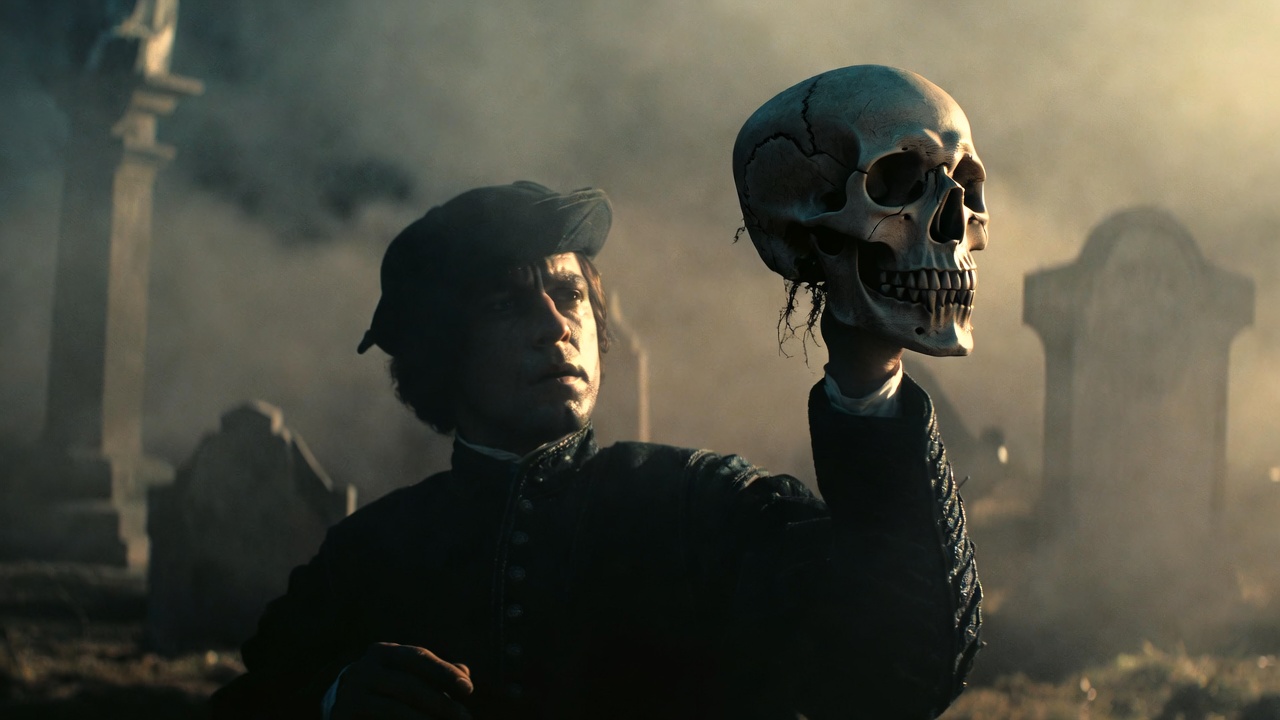
The final act delivers poetic justice, mortality, and resolution.
The Graveyard Scene (“Alas, poor Yorick!” – Act 5, Scene 1)
Original: Hamlet: Alas, poor Yorick! I knew him, Horatio: a fellow of infinite jest, of most excellent fancy: he hath borne me on his back a thousand times; and now, how abhorred in my imagination it is! my gorge rises at it. Here hung those lips that I have kissed I know not how oft. Where be your gibes now? your gambols? your songs? your flashes of merriment, that were wont to set the table on a roar? Not one now, to mock your own grinning? quite chap-fallen?
Modern Paraphrase: Hamlet: Alas, poor Yorick! I knew him, Horatio—a man of endless jokes, brilliant imagination. He carried me on his back a thousand times. And now, how disgusting it feels in my mind! It makes me sick. Those lips I kissed so many times—where are they now? Where are your witty remarks, your antics, your songs, your bursts of laughter that used to make the whole table roar? Not one left to mock your own skull’s grin? Completely fallen jaw?
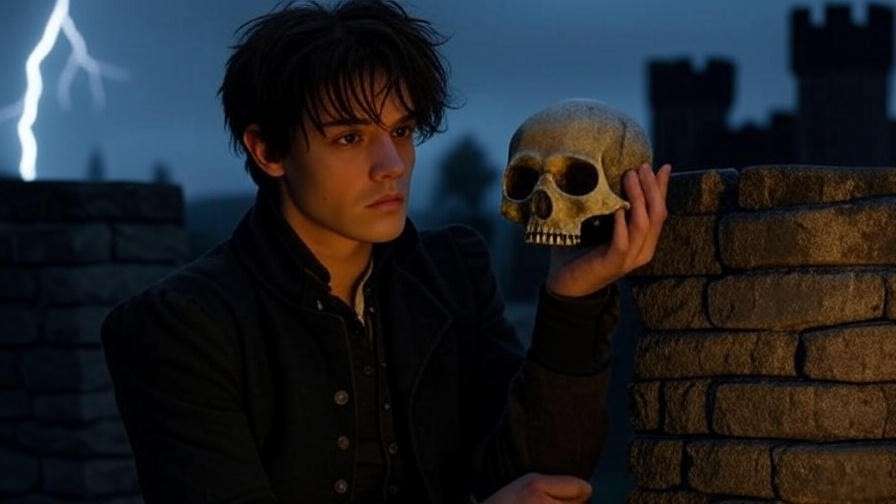
Analysis: Holding the jester’s skull, Hamlet confronts the leveling power of death—the great equalizer that reduces court fool and prince alike to dust. This memento mori moment shifts from abstract philosophy to visceral reality, preparing for the final catastrophe.
The Final Duel and Deaths (Act 5, Scene 2 – closing lines)
Original: Hamlet: The rest is silence. Horatio: Now cracks a noble heart. Good night, sweet prince: And flights of angels sing thee to thy rest!
Modern Paraphrase: Hamlet: The rest is silence. Horatio: Now a noble heart breaks. Good night, sweet prince: And may flights of angels sing you to your rest!
Analysis: Hamlet’s dying words encapsulate the play’s movement from endless questioning to ultimate quiet. Horatio’s farewell provides cathartic tenderness amid carnage. The arrival of Fortinbras restores order, yet the body count underscores the destructive cost of revenge.
Deep Dives into Hamlet’s Most Iconic Soliloquies and Quotes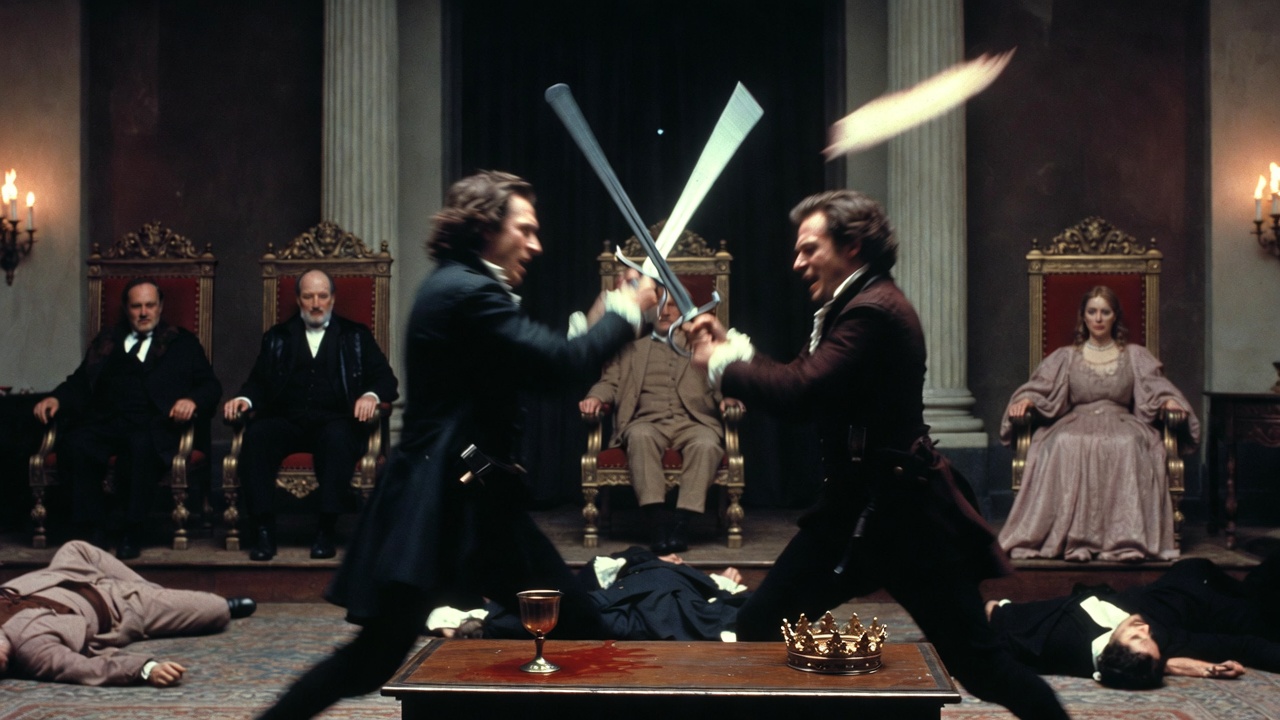
Here are selected famous lines with original, modern paraphrase, and brief insight:
- “Frailty, thy name is woman!” (Act 1, Scene 2) Modern: “Weakness, thy name is woman!” Insight: Reflects Hamlet’s disillusionment with Gertrude; often critiqued as misogynistic yet revealing his personal pain.
- “The lady doth protest too much, methinks.” (Act 3, Scene 2) Modern: “The lady protests too much, I think.” Insight: Gertrude’s unwitting self-indictment during the play; now proverbial for over-defensiveness.
- “Something is rotten in the state of Denmark.” (Act 1, Scene 4) Modern: “Something is rotten in the state of Denmark.” Insight: Marcellus’s line captures the pervasive moral corruption; widely quoted in political contexts.
- “What a rogue and peasant slave am I!” (Act 2, Scene 2) Modern: “What a worthless coward and peasant slave I am!” Insight: Hamlet berates himself for inaction after watching an actor perform passion he lacks.
Key Themes in Hamlet – Unlocked Through Translation
Shakespeare weaves several interlocking themes through Hamlet, each gaining clarity when viewed through modern paraphrase while retaining the original’s poetic weight.
Revenge and the Morality of Justice The revenge tragedy framework drives the plot, yet Hamlet constantly questions its ethics. The ghost’s command (“Revenge his foul and most unnatural murder”) sets a conventional path, but Hamlet delays, pondering whether personal vengeance aligns with divine justice or merely perpetuates bloodshed. Modern readers recognize parallels in debates over vigilante justice, capital punishment, and cycles of violence.
Appearance vs. Reality “Seems, madam? Nay, it is. I know not ‘seems.’” (Act 1, Scene 2) This line, spoken to Gertrude, establishes the play’s central dichotomy. Claudius’s court is a façade of order hiding corruption; Hamlet’s madness is performance hiding truth; even the play-within-a-play blurs art and reality. Translation sharpens the irony: what appears healthy (the new marriage) is rotten underneath.
Madness: Feigned, Real, or Ambiguous? Hamlet declares he will “put an antic disposition on,” yet his behavior grows increasingly erratic. Ophelia’s genuine breakdown contrasts sharply. Scholars debate whether Hamlet’s madness is entirely acted or if grief and pressure fracture his mind. The ambiguity—preserved in translation—mirrors real psychological complexity.
Mortality and the Afterlife The “undiscover’d country” metaphor in the “To be or not to be” soliloquy captures fear of what lies beyond death. The graveyard scene literalizes this: Yorick’s skull reduces all human achievement to dust. Hamlet’s reflections resonate with modern existentialism and discussions of mortality in an age of pandemics and prolonged lifespans.
Corruption and Decay “Something is rotten in the state of Denmark” (Marcellus, Act 1, Scene 4) serves as the play’s diagnostic. Poison, spying, incestuous sheets, and moral compromise permeate Elsinore. Translation makes the imagery visceral: a once-noble kingdom now diseased from the head (Claudius) downward.
Character Analysis: Understanding Motivations Beyond the Surface
Hamlet The intellectual prince is often called the first modern character due to his self-awareness and interior monologues. His delay is not cowardice but paralyzing overthinking—coupled with grief, disgust at his mother’s remarriage, and uncertainty about the ghost’s reliability. Freudian readings see an Oedipal conflict; others view him as a Renaissance humanist trapped in a corrupt world.
Claudius A skilled politician and murderer, Claudius combines charm, guilt, and ruthlessness. His prayer scene confession (“My words fly up, my thoughts remain below”) reveals genuine remorse yet unwillingness to relinquish power—making him a tragic villain rather than a cartoonish tyrant.
Ophelia Frequently reduced to a passive victim, Ophelia is a casualty of the men around her: Polonius’s control, Hamlet’s rejection, Claudius’s manipulation. Her madness and death highlight the collateral damage of patriarchal and political games.
Gertrude Debate persists: Is she complicit in the murder or merely naïve? Her quick remarriage shocks Hamlet, yet her final loyalty (drinking the poisoned cup to protect her son) suggests complexity and maternal love beneath surface weakness.
Supporting Characters as Foils
- Horatio: The rational friend who survives to tell the tale.
- Laertes: The impulsive avenger who contrasts Hamlet’s hesitation.
- Fortinbras: The decisive prince who achieves what Hamlet cannot.
These contrasts sharpen our understanding of Hamlet’s unique tragedy.
Study Tips and Resources for Mastering Hamlet
- Annotation Strategy Use a dual-text edition (Folger Shakespeare Library or Arden Third Series). Highlight archaic words, underline metaphors, and note stage directions in margins.
- Active Reading Techniques Read soliloquies aloud to capture rhythm. Compare your emotional response to the original vs. modern paraphrase.
- Essay and Exam Preparation Strong prompts:
- To what extent is Hamlet’s delay justified?
- How does Shakespeare use foils to develop the theme of revenge?
- Discuss the role of women in the play.
- Recommended Resources
- Full texts: Folger Digital Texts (free), Arden Shakespeare (scholarly notes).
- Online aids: myShakespeare.com (interactive annotations), Internet Shakespeare Editions.
- Films: Branagh (1996 – complete), Olivier (1948 – psychological), Zeffirelli (1990 – accessible).
- Books: A.C. Bradley’s Shakespearean Tragedy, Harold Bloom’s Shakespeare: The Invention of the Human.
Challenge yourself: Compare this guide’s paraphrases with another source (LitCharts, No Fear Shakespeare) and note differences in tone or emphasis.
Frequently Asked Questions (FAQs)
What is the best modern translation of Hamlet? No single “official” translation exists, as Shakespeare wrote in Early Modern English rather than a foreign language. Paraphrase guides like this one, No Fear Shakespeare, and LitCharts’ Shakescleare offer the clearest modern English while staying faithful. For poetic renderings, some prefer NoSweatShakespeare’s verse adaptations.
Is there a full Hamlet side-by-side original and modern English PDF? Several free and paid options exist (e.g., No Fear Shakespeare PDF editions, some university open-access resources). Always verify copyright status when downloading.
Why is Hamlet so hard to understand? Shakespeare’s language includes inverted syntax, obsolete words (“wherefore” = why), dense metaphors, puns, and philosophical complexity—all within poetic meter. Modern paraphrase removes these barriers without sacrificing meaning.
What does “To be or not to be” really mean? It is not merely about suicide but a profound weighing of existence versus non-existence, endurance versus escape, action versus inaction, and fear of the unknown afterlife. It captures the human condition’s central dilemma.
How does Hamlet end? Nearly every major character dies: Polonius, Ophelia, Rosencrantz and Guildenstern, Gertrude, Laertes, Claudius, and finally Hamlet. Fortinbras assumes control of Denmark, restoring political order after personal and moral chaos.
Hamlet with translation transforms an intimidating classic into an intimate, revelatory experience. By pairing Shakespeare’s original language with clear modern English—and enriching it with context, analysis, and insight—you can finally feel the full force of the prince’s anguish, wit, rage, and philosophical depth. The play asks timeless questions: How do we live with grief? When is revenge justified? What lies beyond death? These remain urgent whether read in 1601 or 2025.
Return to Elsinore armed with this guide. Re-read the soliloquies, revisit the graveyard, listen again to Horatio’s farewell. You’ll discover new layers each time. Shakespeare’s genius endures because it speaks to the human soul across centuries—and now, the language barrier no longer stands in your way.
Subscribe to williamshakespeareinsights for more in-depth guides to the Bard’s works. Share in the comments: Which soliloquy or theme resonates most with you, and why?