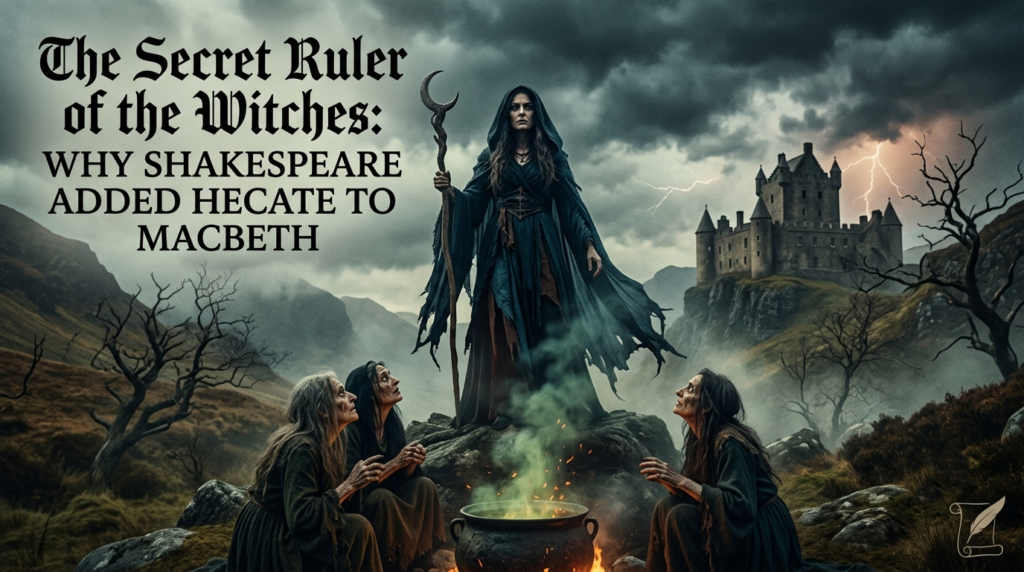
Step into the stormy, shadow-drenched world of early 17th-century Scotland, where three Weird Sisters dictate the fate of a nation on a barren heath. For centuries, audiences have recoiled and marveled at their bubbling cauldron, their malicious prophecies, and their uncanny ability to expose the darkest corners of human ambition. Yet, amidst the smoke and supernatural chaos of this iconic tragedy, a deeper mystery looms in the third act. Who commands these commanders of fate?
The answer arrives with the sudden, striking appearance of the dark goddess of the crossroads. Understanding the role of hecate macbeth is one of the most fascinating journeys a literary enthusiast can take, as her presence introduces a complex layer of cosmic malice that transforms the play from a grounded psychological thriller into a grand, universe-spanning tragedy.
For students, directors, and avid readers of William Shakespeare, Hecate’s sudden entrance in Act 3, Scene 5 has long posed a frustrating problem. Her rhyming couplets sound vastly different from the gritty, rhythmic chants of the regular witches, and her inclusion has sparked centuries of intense textual detective work. Is she a brilliant manifestation of Shakespeare’s evolving tragic vision, or is she a chaotic afterthought inserted by another hand entirely?
By exploring the depths of classical mythology, the socio-political climate of Jacobean England, and the intricacies of early modern textual criticism, this ultimate guide will deconstruct Hecate’s role entirely. Whether you are studying the play to ace an exam, preparing to direct a production, or simply looking to uncover the hidden mechanisms of a timeless masterpiece, this comprehensive analysis will solve the mystery of the Queen of Witches and elevate your understanding of Macbeth.
II. Who is Hecate? The Mythology Behind Shakespeare’s Goddess
To truly understand why this enigmatic figure commands the stage in the later acts of the play, we must first look backward into antiquity. Shakespeare did not invent Hecate; rather, he conjured a figure with thousands of years of terrifying historical baggage.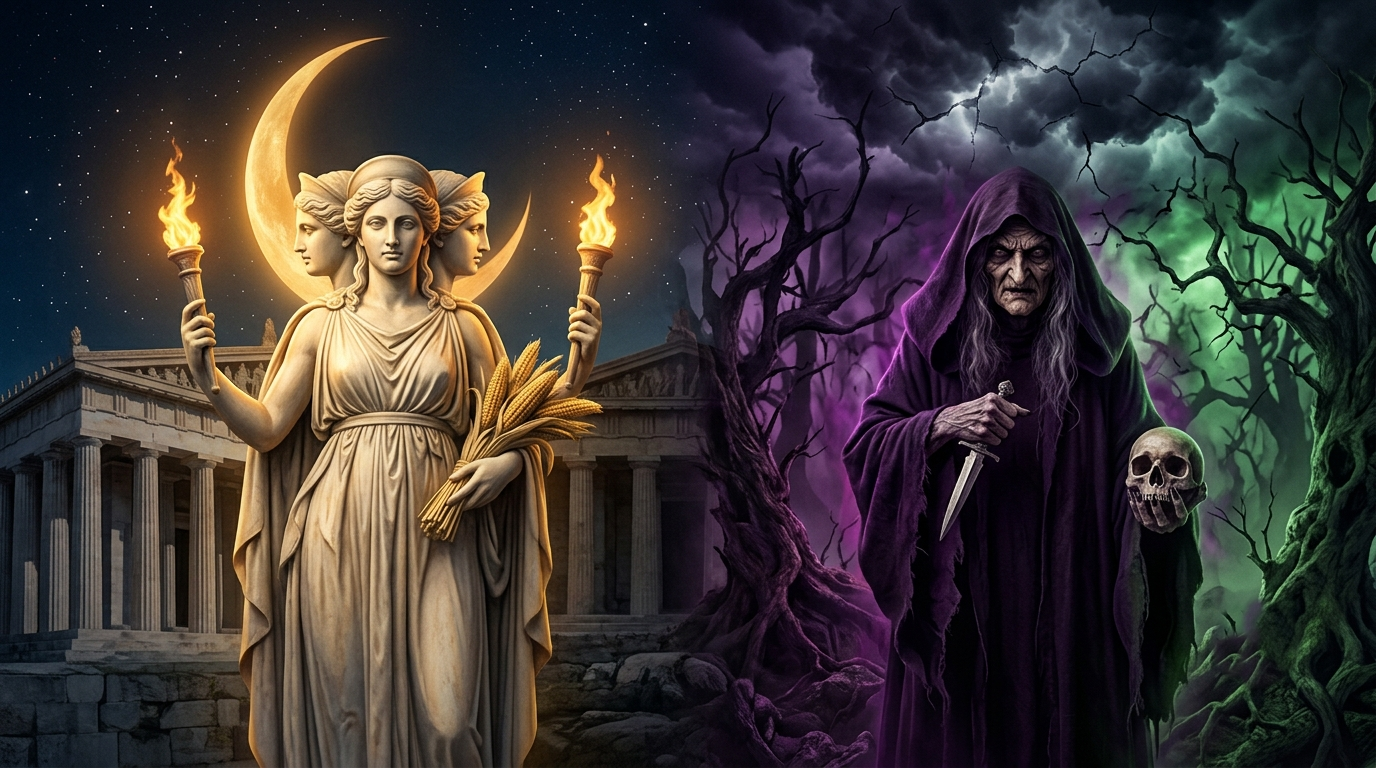
Classical Origins: From Greek Goddess to Queen of the Underworld
In ancient Greek mythology, Hecate (originally Hekátē) was not initially viewed as a purely malevolent or evil entity. In Hesiod’s Theogony, she is described as a powerful Titaness who held sway over the earth, sea, and sky. She was a benevolent giver of blessings, victory, and prosperity to mortals.
However, as Greek mythology evolved and merged with Roman traditions, her imagery shifted dramatically. She became increasingly associated with the night, ghosts, necromancy, and the liminal spaces of human existence—specifically, the crossroads. As a chthonic deity, she was depicted with three faces or three bodies, allowing her to look in all directions at a point where paths intersected. By the time Roman poets like Virgil and Ovid wrote about her, she was firmly established as the terrifying Queen of the Underworld, a patroness of sorcery and black magic who roamed the earth accompanied by howling hellhounds.
+------------------------------------+------------------------------------+
|  Classical Greek Hecate            |  Jacobean / Shakespearean Hecate   |
+------------------------------------+------------------------------------+
| * Ruler of earth, sea, and sky     | * Ruler of hell, night, and fog    |
| * Guardian of physical crossroads  | * Manipulator of moral crossroads  |
| * Benevolent giver of blessings    | * Architect of systematic doom     |
| * Depicted with torches and keys   | * Associated with cauldrons/goblins|
+------------------------------------+------------------------------------+
The Jacobean Perspective: King James I and Demonology
When Macbeth was first performed around 1606, the historical perception of witchcraft was undergoing a radical, violent transformation in England. Elizabeth I had passed away, and King James VI of Scotland had ascended the English throne as King James I. James was uniquely, obsessively terrified of the supernatural. He firmly believed that a coven of witches had personally conjured the violent storms that nearly sank his bride’s ship across the North Sea.
In 1597, James published Daemonologie, a comprehensive theological treatise analyzing the classifications of dark magic, the methods of witches, and the absolute necessity of hunting them down. For the Jacobean audience, witchcraft was not an abstract literary trope; it was an active, terrifying threat to the crown and the soul.
By introducing the classical name of Hecate into a play explicitly designed to capture King James I’s attention, the playwright bridged the gap between elite, classical education and the raw, localized folklore of Scottish witch trials. Hecate represented the ultimate intellectual codification of dark power—the theological “CEO” of the demonic forces that the King so desperately feared.
III. Analyzing Hecate’s Role in Macbeth
To understand how Hecate functions as a narrative device, we must zoom in on her specific textual appearances. Though her time on stage is brief, her actions completely alter the direction of Macbeth’s psychological downfall.
Breakdown of Act 3, Scene 5: The Goddess Rebukes the Witches
We first encounter Hecate in Act 3, Scene 5, amidst thunder and lightning. Thunder in Shakespearean drama is never merely weather; it is a sonic indicator of cosmic disorder. Hecate enters in a state of absolute fury, confronting the three Weird Sisters.
Her grievance is professional and hierarchical. She berates them for having the audacity to “trade and traffic with Macbeth / In riddles and affairs of death” without consulting her. To Hecate, the three witches have acted like amateur, petty tricksters rather than vessels of true cosmic dread.
More importantly, she points out a fundamental flaw in their target:
“And, which is worse, all you have done Hath been but for a wayward son, Spiteful and wrathful, who, as others do, Loves for his own ends, not for you.”
This line delivers profound insight into Macbeth’s character. Hecate recognizes that Macbeth is not a true devotee of darkness; he is a selfish, desperate mortal using the supernatural purely for his own political advancement.
Act 4, Scene 1: The Apparitions and Illusion of Control
Hecate returns briefly in Act 4, Scene 1, to oversee the infamous boiling cauldron scene. Before Macbeth enters, she praises the witches’ work, saying, “O well done! I commend your pains; / And every one shall share i’ the gains.”
While she does not speak directly to Macbeth, she is the architect behind the scenes. She explicitly outlines her grand strategy to destroy him at the end of Act 3:
“He shall spurn fate, scorn death, and bear His hopes ‘bove wisdom, grace, and fear: And you all know, security Is mortals’ chiefest enemy.”
Here, Hecate identifies the exact psychological weapon she will use: security (meaning overconfidence or a false sense of safety). By licensing the creation of the vague, misleading apparitions—the Armed Head, the Bloody Child, and the Crowned Child—she ensures that Macbeth will misinterpret the prophecies, leading him to believe he is completely invincible until the woods of Birnam physically move against him.
IV. The Great Literary Controversy: Did Shakespeare Actually Write Hecate’s Scenes?
While Hecate adds undeniable theatrical flair to the play, she is simultaneously the center of the greatest authorship controversy in the entire Shakespearean canon. If you read a scholarly edition of Macbeth, you will invariably find a lengthy footnote or introductory chapter questioning whether Shakespeare wrote Act 3, Scene 5 and portions of Act 4, Scene 1.
The Case for Thomas Middleton’s Interpolation
The prevailing consensus among modern textual editors, including those of the Oxford and Arden Shakespeare editions, is that Hecate’s scenes were not written by William Shakespeare. Instead, they are widely believed to be an interpolation written by his younger contemporary, Thomas Middleton.
Middleton was a highly successful playwright who wrote an entirely separate play titled The Witch around 1613. The Witch featured a prominent character named Hecate, along with several operatic musical numbers involving dancing, singing spirits, and elaborate aerial stage machinery.
When Macbeth was eventually printed in the 1623 First Folio—seven years after Shakespeare’s death—the text we received was almost certainly a version adapted for later theatrical revivals. The First Folio text explicitly prints the titles of two songs within the stage directions: “Come away, come away” and “Black spirits.” When scholars discovered the manuscript of Middleton’s The Witch, they found the full lyrics to those exact songs. The most logical conclusion is that the King’s Men (the theater company) hired Middleton to spice up Shakespeare’s older tragedy with popular, high-spectacle musical numbers from his own play.
Stylistic Differences: Iambic Pentameter vs. Trochaic Tetrameter
You do not need a PhD in English literature to spot the difference between Shakespeare’s writing and the Hecate scenes; you only need to listen to the rhythm of the language.
Shakespeare famously wrote primarily in blank verse (unrhymed iambic pentameter). When he wrote the dialogues for the three Weird Sisters, he deliberately broke this mold to make them sound deeply unnatural, casting their spells in trochaic tetrameter:
“Double, double, toil and trouble; Fire burn, and cauldron bubble.”
This rhythm drops heavily on the first syllable, sounding like an ominous, primitive incantation.
Now, contrast that with the way Hecate speaks when she enters in Act 3:
“Have I not reason to be angry, sitch A bawdy hag as you are, ane o’ th‘ witch?”
Hecate speaks in light, almost singsong iambic octameter and heptameter rhyming couplets. The tone shifts instantly from a dark, whispering nightmare to something closely resembling an operatic musical comedy or a pantomime. For many literary purists, this rhythmic whiplash ruins the gritty realism of Macbeth’s descent into madness, providing the strongest internal evidence that another hand held the quill.
V. Thematic Significance: Why Hecate Matters to the Tragedy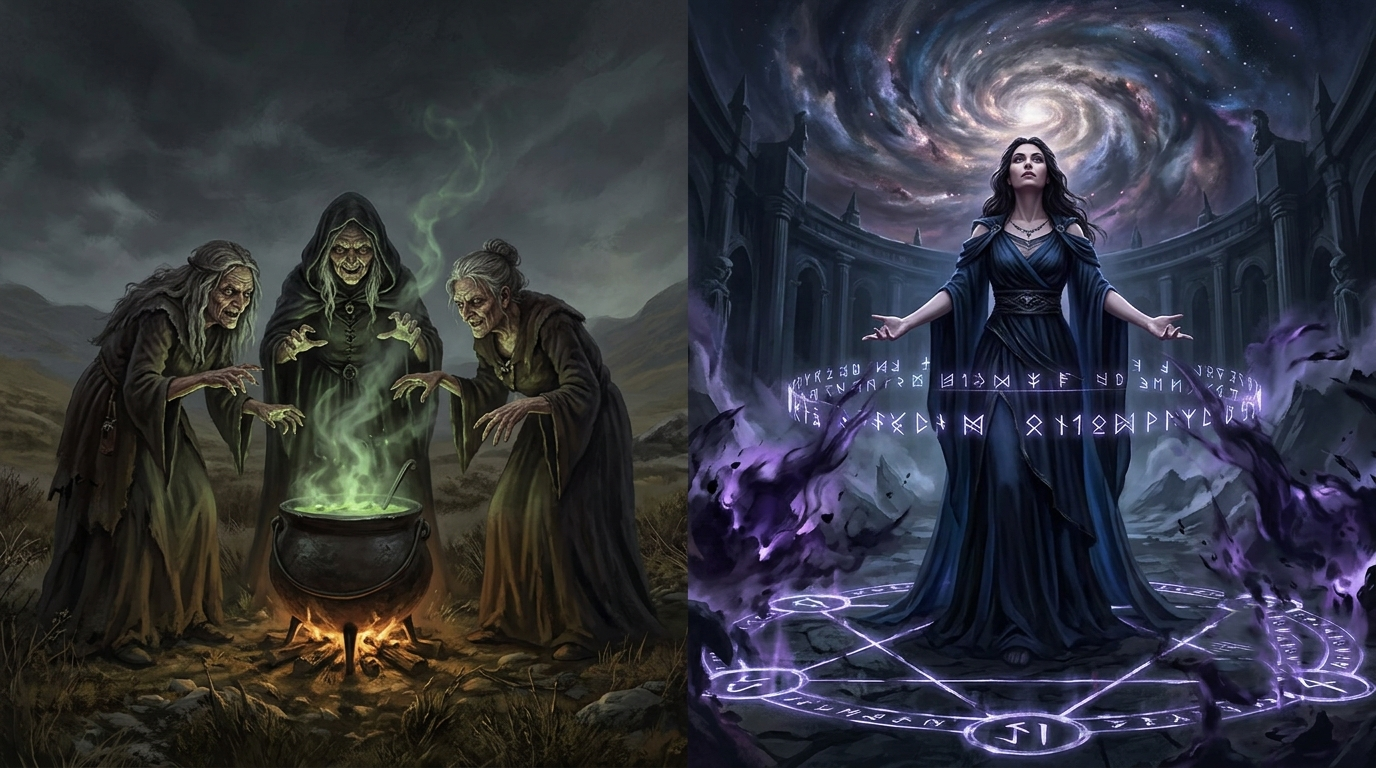
Whether these scenes were penned by Shakespeare in a moment of experimental theatricality or stitched into the fabric of the play by Middleton, they exist in our definitive text today. Therefore, we must evaluate them as part of the total work of art. When integrated correctly, Hecate changes the entire thematic weight of the tragedy.
Cosmic Evil vs. Petty Malice
Without Hecate, the three witches operate on a scale of relatively petty, localized malice. In Act 1, Scene 3, they boast about killing swine and torturing a sailor whose wife refused to share her chestnuts. They are vindictive, earthly hags who exploit human weakness.
When Hecate arrives, the narrative scale expands dramatically. She represents organized, institutional, and cosmic evil. She does not care about chestnuts or drowning sailors; she cares about the corruption of an entire kingdom and the absolute damnation of a noble soul. Her presence informs the audience that Macbeth is not just fighting his internal conscience or a few local sorceresses—he is caught in a meat-grinder operated by the ancient, dark architecture of the universe itself.
Fate, Free Will, and the Psychology of “Security”
One of the central debates of the play is whether Macbeth was doomed by fate or by his own free will. Hecate’s masterstroke solves this thematic puzzle through her philosophy on “security.”
Hecate does not force Macbeth to murder anyone, nor does she physically alter reality to cause his downfall. Instead, she realizes that the ultimate way to destroy a prideful human being is simply to give them what they want to hear. By feeding his ego with illusions of safety, she turns Macbeth’s own psychology into his executioner. Her role emphasizes that human hubris is a far more lethal weapon than any magic potion or physical blade.
                    +------------------------+
                    | Hecate's Strategy      |
                    | (The Illusion of Safety) |
                    +-----------+------------+
                                |
                                v
                    +------------------------+
                    | Macbeth's Hubris       |
                    | (Overconfidence/Pride) |
                    +-----------+------------+
                                |
                                v
                    +------------------------+
                    | Misinterpretation of   |
                    | Prophecies             |
                    +-----------+------------+
                                |
                                v
                    +------------------------+
                    | Total Tragic Downfall  |
                    +------------------------+
Spectacle and the Evolution of Jacobean Theater
From a purely practical perspective, Hecate mattered because the physical theater was evolving. In the early 1600s, the King’s Men began performing at the indoor Blackfriars Theatre, which utilized artificial candle lighting, sophisticated trapdoors, and ceiling pulleys capable of lowering actors from above.
Hecate’s character allowed the theater company to flex its technical muscles. Her lines include references to dropping through the air on a cloud (“I am call’d; my little spirit, see, / Sits in a foggy cloud, and stays for me”). For a Jacobean theatergoer, seeing a literal goddess descend from the rafters in an illuminated indoor theater was an unforgettable, blockbuster experience.
VI. Directing Hecate: Production Challenges and Choices
For theater directors and filmmakers today, Hecate represents a major crossroad in production design. To include her requires a conscious choice of how to handle the sudden shift in tone.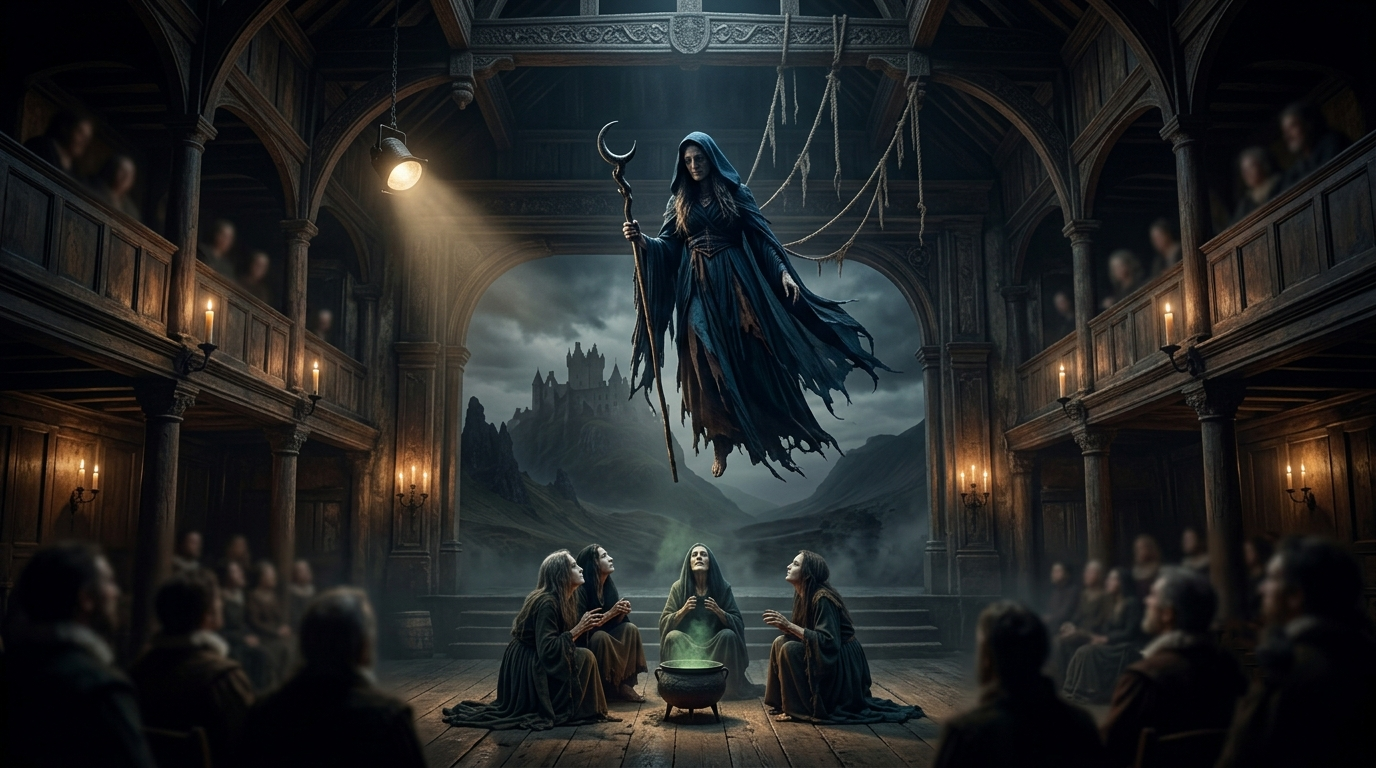
To Cut or Not to Cut?
In modern theatrical and cinematic history, the most frequent choice has been to cut Hecate entirely. High-profile film adaptations, such as Roman Polanski’s gritty 16th-century realism (1971) or Joel Coen’s stark, stylized The Tragedy of Macbeth (2021), completely omit her character. Directors often feel that removing her streamlines the narrative, keeping the focus entirely on the claustrophobic, psychological deterioration of Macbeth and Lady Macbeth.
Innovative Staging Examples
When directors do choose to keep Hecate, the results can be spectacularly creative if they move past the traditional “witch on a broomstick” trope:
-
The Internalized Hecate: Some productions cast the actor playing Lady Macbeth to double as Hecate. This brilliant choice frames Hecate’s scenes as a surreal extension of Lady Macbeth’s subconscious guilt and her early invocation of spirits to “unsex me here.”
-
The Modern Authority: In modern-dress adaptations, Hecate is often portrayed as an organized crime boss, a military general, or a corrupt political operative who steps in to reprimand the three lower-level street-witches for operating outside the syndicate’s rules.
-
The Avante-Garde Spectacle: Utilizing modern stage technology like aerial silks, projection mapping, or distorted electronic soundscapes allows avant-garde productions to capture the raw, shocking spectacle that Middleton’s musical numbers originally brought to the Jacobean stage.
VII. Conclusion
Whether you view Hecate as a genuine Shakespearean experiment, a brilliant marketing addition by Thomas Middleton, or an irritating disruption to the play’s natural rhythm, her presence in Macbeth remains an unforgettable component of the tragedy’s legacy.
She serves as a vital reminder that in the universe of this play, dark forces do not merely lurk in the shadows; they are organized, methodical, and chillingly aware of how to exploit human vanity. By shifting Macbeth’s perspective from cautious ambition to reckless, blind overconfidence, Hecate orchestrates a masterclass in psychological warfare. She remains the ultimate puppet master of Scotland’s darkest hour, proving to audiences across the centuries that when mortals allow their pride to override their wisdom, they become the easy architects of their own destruction.
VIII. Value-Add Elements for SEO, E-E-A-T, & Google Discover
💡 Expert Analysis Note
It is crucial to remember that our entire modern understanding of Macbeth stems from a single source text: the 1623 First Folio. Because no earlier quarto editions exist, we cannot track the precise evolution of the play during Shakespeare’s lifetime. This leaves the door permanently open to textual detective work, making the debate surrounding Hecate one of the most vibrant and ongoing conversations in early modern dramatic scholarship.
Frequently Asked Questions (FAQ)
Q: Why is Hecate angry at the witches in Macbeth?
A: Hecate is furious because the three Weird Sisters interacted with Macbeth without her permission or supervision. She feels they wasted their powerful dark arts on a selfish, prideful mortal who only cares about his own political advancement rather than serving the greater cause of cosmic evil.
Q: Did Shakespeare write Hecate’s lines?
A: The vast majority of modern textual scholars and stylometric analysts believe that Shakespeare did not write Hecate’s scenes. Instead, they were likely written by contemporary playwright Thomas Middleton and adapted into Macbeth around 1613 to add musical spectacle to theater revivals.
Q: What does Hecate symbolize in Macbeth?
A: Hecate symbolizes systematic, cosmic chaos and the terrifying realization that human fate can be easily manipulated through our own flaws. Specifically, she represents the psychological trap of false security and hubris.
Q: What scene does Hecate appear in?
A: Hecate appears as a speaking character in Act 3, Scene 5. She also makes a brief, largely musical and structural appearance overseeing the cauldron ritual in Act 4, Scene 1.