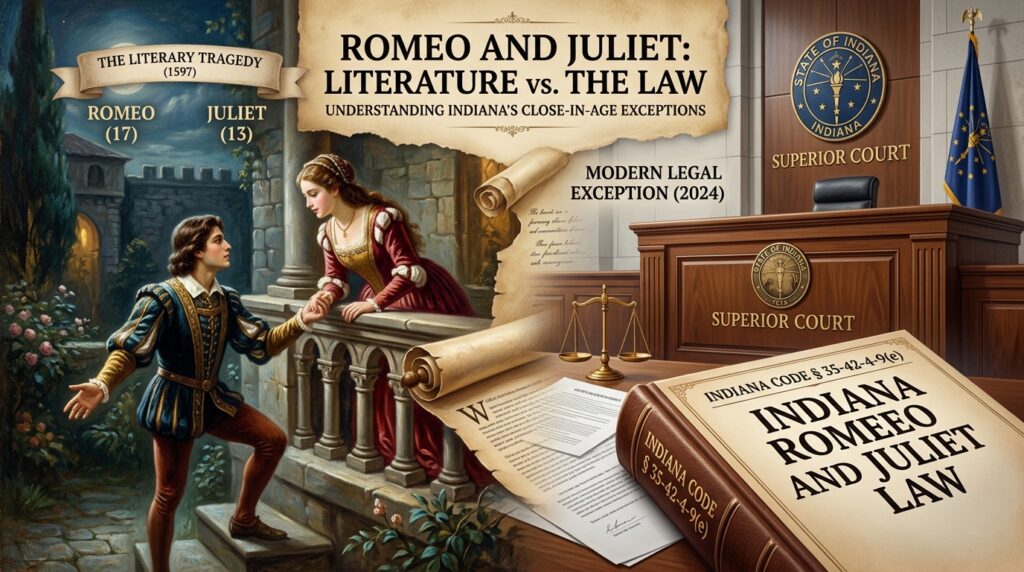
When William Shakespeare penned Romeo and Juliet in the late 16th century, he crafted an enduring masterwork on youth, passion, and fate. Centuries later, the names of literature’s most famous star-crossed lovers permeate far more than theatrical playbills and high school English curricula—they have been adopted directly into American jurisprudence. Across the United States, statutory provisions designed to protect teenagers from harsh criminal penalties for close-in-age consensual relationships are colloquially known as “Romeo and Juliet laws.”
In the Hoosier State, understanding how the indiana romeo and juliet law functions requires navigating a complex intersection of statutory rape legislation, criminal defense mechanisms, and historical culture. While the state’s legal statutes never explicitly mention the bard by name, Indiana Code § 35-42-4-9 provides a crucial affirmative defense for teenagers who engage in mutual romantic behavior within specific age parameters.
This comprehensive analysis deconstructs both the legal reality of Indiana’s statutory exceptions and the fascinating literary origins behind their naming. Whether you are analyzing Shakespearean drama, researching Indiana criminal law, or exploring how classical literature influences contemporary public policy, this guide provides the definitive breakdown.
II. The Real Ages of Shakespeare’s Romeo and Juliet: Fact vs. Fiction
To understand why modern law borrowed Shakespeare’s characters, one must first separate historical fact from theatrical drama. Popular culture often imagines Romeo and Juliet as late-stage teenagers or young adults entering early maturity. However, Shakespeare’s textual evidence paints a very different—and far more controversial—picture by modern standards.
       [ Shakespearean Text ]                       [ Modern Indiana Law ]
  Juliet: 13 Years Old (Act I, Sc. 2)        Younger Partner: Minimum 14 Years Old
  Romeo: Estimated 16 - 18 Years Old         Age Difference: Maximum 4 Years
               \                                            /
                \--> [ THE HISTORICAL LEGAL PARADOX ] <--/
                     Romeo would NOT qualify under modern
                     Indiana law due to Juliet's age.
Juliet Capulet’s True Age: Textual Proof
In Act I, Scene 2 of the tragedy, Lord Capulet explicitly discloses his daughter’s age during a conversation with Count Paris regarding marriage proposals:
“She hath not seen the change of fourteen years;
Let two more summers wither in their pride,
Eere we may thinke her ripe to be a bride.”
Lady Capulet and the Nurse reinforce this fact in Scene 3, calculating Juliet’s birthday down to the exact night: “Come Lammas-eve at night shall she be fourteen.” Therefore, throughout the entirety of the play’s five-day timeline, Juliet Capulet is 13 years old.
Romeo Montague’s Ambiguous Age
Unlike Juliet, Shakespeare never explicitly states Romeo Montague’s numerical age in the text. However, historical scholars, literary analysts, and theatrical performance traditions consistently place Romeo between 16 and 18 years old:
-
Social Context: Romeo moves freely throughout Verona, carries a sword, engages in street duels alongside Mercutio and Benvolio, and acts as an independent agent—privileges reserved for young men approaching adulthood in early modern Europe.
-
Literary Sources: Shakespeare based his play primarily on Arthur Brooke’s 1562 narrative poem The Tragicall Historye of Romeus and Juliet. In Brooke’s version, Romeus is described as a young man whose draft of youth is beginning to ripen into manhood, suggesting an age around 16 to 18.
Elizabethan Marriage & Historical Realities
Modern readers often assume that 13-year-old brides were standard practice during the Elizabethan era. Historical demographic research reveals otherwise:
-
Average Marriage Ages: In 16th-century England, the average age of marriage for commoners was actually between 24 and 26 years old for women and 26 to 28 for men, driven by economic requirements for household independence.
-
Noble Exceptions: While noble families occasionally arranged betrothals at younger ages for political or financial alliances, consummation and actual cohabitation were frequently delayed.
-
Dramatic Utility: Shakespeare deliberately emphasized Juliet’s extreme youth to heighten the emotional stakes, stress the tragic innocence of the lovers, and highlight the reckless impatience of Verona’s patriarchal society.
The Irony of the Legal Nomenclature
The term “Romeo and Juliet law” carries significant cultural resonance, but it creates a profound legal paradox. Under the indiana romeo and juliet law (and virtually all statutory equivalents across the United States), Romeo Montague would be prosecuted as a felon. Because Juliet is 13 years old, she falls below the absolute statutory age floor required for close-in-age affirmative defenses.
III. What Is Indiana’s “Romeo and Juliet Law”? (Legal Framework Breakdown)
In Indiana criminal law, statutory rape is covered under statutes addressing Sexual Misconduct with a Minor and Child Molestation. Understanding how the law operates requires examining the baseline legal definitions alongside the specific exceptions created by the Indiana General Assembly.
Indiana’s Baseline Age of Consent
Under Indiana law, the default legal age of consent is 16 years old.
-
Any individual who is 16 years of age or older can legally consent to sexual activity with another consenting adult.
-
Conversely, engaging in sexual acts with a person under 16 years of age generally constitutes a felony offense under Indiana Code § 35-42-4-9, regardless of whether the minor claimed to consent or initiated the conduct.
The Affirmative Defense: Indiana Code § 35-42-4-9(e)
Recognizing that severe felony prosecutions and mandatory sex offender registration were never intended for consensual teenage peer relationships, Indiana lawmakers enacted an affirmative defense. This clause—commonly called the indiana romeo and juliet law—is codified under IC § 35-42-4-9(e).
An “affirmative defense” means that the defendant admits the factual conduct occurred, but offers evidence showing that specific statutory conditions exempt them from criminal conviction under the offense charged.
+-------------------------------------------------------------------------------+
|                        INDIANA CODE § 35-42-4-9(e)                            |
|                     MANDATORY QUALIFICATION CHECKLIST                         |
+-------------------------------------------------------------------------------+
|  [✓] AGE FLOOR: Younger party must be AT LEAST 14 or 15 years old             |
|  [✓] AGE GAP: Older party cannot be MORE THAN 4 YEARS older                   |
|  [✓] RELATIONSHIP: Evidence of an ongoing dating or romantic relationship     |
|  [✓] NO POWER DYNAMICS: Defendant holds NO position of authority or trust     |
|  [✓] NO COERCION: Absolute absence of force, weapons, drugs, or physical harm |
|  [✓] RECORD: Defendant is not a prior registered sex offender                 |
+-------------------------------------------------------------------------------+
The Six Mandatory Criteria
To successfully assert the Romeo and Juliet defense in an Indiana court, all six of the following conditions must be met:
1. The Younger Minor’s Age Floor (14–15 Years Old)
The alleged victim must be at least 14 years of age at the time of the conduct. If the younger party is 13 years old or younger, Indiana Code enforces strict liability child molestation laws (ranging from Level 3 to Level 1 felonies), and no close-in-age defense is legally permitted under any circumstances.
2. The Four-Year Maximum Age Differential
The older participant must not be more than four (4) years older than the younger participant. The age calculation is made precisely using birth dates rather than school grade levels:
-
Example A: A 17-year-old high school senior dating a 15-year-old high school sophomore falls well within the 4-year window.
-
Example B: A 20-year-old college student dating a 14-year-old minor exceeds the 4-year limit and cannot use the defense.
3. Established Dating or Personal Relationship
The statutory exception is crafted specifically for genuine peer romance, not opportunistic encounters. The court evaluates whether the individuals shared an ongoing personal, social, or romantic relationship prior to or during the consensual acts.
4. Absence of Authority or Trust Dynamics
The defense is immediately voided if the older individual occupies a position of authority, supervision, or trust over the minor. Disqualifying roles include:
-
School teachers, tutors, and educational administrators
-
Athletic coaches and youth instructors
-
Employers or direct workplace supervisors
-
Relative caregivers, guardians, or household authority figures
5. Absolute Absence of Force, Threats, or Impairment
The sexual activity must be fully mutual and consensual. The defense fails instantly if there is evidence of:
-
Physical force, violence, or restraint
-
Verbal threats, coercion, or blackmail
-
Administration of alcohol, drugs, or controlled substances to alter capacity
6. No Prior Disqualifying Criminal Record
The defendant must not have prior convictions for sex-related offenses or be listed on the Indiana Sex and Violent Offender Registry.
IV. Comprehensive Comparison: Shakespeare’s Play vs. Indiana Law
To clearly highlight the divergence between classical fiction and modern statutory law, the following structured matrix compares key legal factors from Shakespeare’s Romeo and Juliet with the explicit parameters of Indiana Code § 35-42-4-9.
| Legal & Contextual Variable | Shakespeare’s Romeo & Juliet (1597) | Indiana Law: IC § 35-42-4-9(e) | Legal Analysis & Impact |
| Younger Partner’s Age | 13 Years Old (Act I, Scene 2) | Must be at least 14 Years Old | Fails Indiana Law: Juliet is below Indiana’s absolute statutory age floor of 14. |
| Older Partner’s Age | Estimated 16–18 Years Old | Max 4 years older than younger partner | Potentially Qualifies: If Romeo were 17 and Juliet 14, the gap would fit, but her actual age of 13 negates this. |
| Consent & Mutuality | Mutual romantic passion | Full, un-coerced mutual consent required | Matches: Both frameworks require genuine, mutual personal willingness. |
| Authority / Power Dynamic | Equal social status (Feuding Noble Families) | No position of authority, trust, or supervision | Matches: Romeo held no legal, custodial, or instructional authority over Juliet. |
| Criminal Legal Outcome | External banishment by Prince Escalus | Dismissal of criminal liability / Avoidance of registry | Divergence: Indiana law focuses on avoiding sex offender classification for qualifying teens. |
Judicial Application: Would Romeo Be Convicted in Modern Indiana?
If Romeo Montague were brought before an Indiana Circuit Court today based on the events described in Shakespeare’s text, his defense attorney could not invoke the indiana romeo and juliet law.
Because Juliet Capulet is 13 years old, Indiana prosecutors would charge Romeo under Indiana’s Child Molestation statutes. The close-in-age affirmative defense provided by IC § 35-42-4-9(e) is strictly unavailable when the younger individual is under 14 years old. Thus, despite giving its name to the law, the literary masterpiece describes a relationship that fails modern legal safety standards.
V. The Legal & Social Intent Behind Close-In-Age Exceptions
Why did state legislatures, including Indiana’s General Assembly, create these statutory exemptions? Understanding the legislative history requires examining the evolutionary shift in American criminal justice regarding adolescent behavior.
Historical Model (Pre-1990s)                  Modern Statutory Model (Post-2000s)
+---------------------------+                 +-----------------------------------+
| Strict Liability Standard |                 | Tiered / Close-in-Age Approach    |
| - Age cutoff was absolute |   ----------->  | - Distinguishes peers from predators|
| - Teens criminalized      |                 | - Preserves severe adult penalties|
| - Lifelong registry harm  |                 | - Provides affirmative defenses   |
+---------------------------+                 +-----------------------------------+
Decriminalizing Adolescent Peer Relationships
Historically, statutory rape laws were written with absolute strict liability. If a person above the age of consent engaged in intimacy with someone below it, a crime was committed—regardless of whether the parties were a 17-year-old high school senior and a 15-year-old sophomore who were genuinely dating.
In the late 1990s and early 2000s, criminal justice reformers highlighted the severe collateral consequences of this rigid model:
-
High school teenagers were facing felony criminal records for peer relationships.
-
Young adults were being placed on public sex offender registries alongside dangerous sexual predators, destroying their access to higher education, housing, and employment opportunities.
Distinguishing Peer Romance from Predatory Exploitation
The core purpose of the indiana romeo and juliet law is to draw a clear legal line between two fundamentally different scenarios:
-
Predatory Exploitation: An adult utilizing age, authority, maturity, or coercion to manipulate and abuse a minor.
-
Adolescent Peer Intimacy: Two teenage peers engaging in mutual, consensual dating behavior with minor age differentials.
By establishing a structured affirmative defense, Indiana law preserves heavy felony penalties for actual adult exploitation while offering a legal safeguard for qualifying adolescent couples.
Regional Legal Comparisons: Indiana vs. Neighboring States
Age-gap exemptions vary significantly across state lines. The table below illustrates how Indiana’s 4-year rule compares to surrounding Midwestern states:
-
Indiana: Requires younger party to be 14+; maximum age gap of 4 years (IC § 35-42-4-9).
-
Illinois: Allows defense if offender is less than 5 years older than the minor aged 13–16 (720 ILCS 5/11-1.50).
-
Ohio: Provides close-in-age exceptions for minors aged 13–15 if the older party is under 19 or within 4 years (ORC § 2907.04).
-
Kentucky: Enforces an age gap limit of 4 years for minors aged 14 or 15 (KRS § 510.040).
VI. Frequently Asked Questions (FAQ Section)
Q1: What is the age of consent in Indiana?
The legal age of consent in Indiana is 16 years old. Individuals who are 16 or older can legally consent to sexual activity with another consenting adult, provided no positions of authority, coercion, or trust dynamics are exploited.
Q2: Does Indiana have an explicit “Romeo and Juliet” law written into its code?
While the exact phrase “Romeo and Juliet” does not appear in the statutory text, Indiana Code § 35-42-4-9(e) serves as Indiana’s official “Romeo and Juliet” provision. It provides a legal affirmative defense against child molestation and sexual misconduct charges for qualifying close-in-age relationships.
Q3: What is the maximum age gap allowed under the Indiana Romeo and Juliet law?
The maximum allowable age difference is 4 years. The older individual cannot be more than four years older than the younger minor, and the younger minor must be at least 14 years old at the time of the sexual conduct.
Q4: Can a 19-year-old date a 15-year-old under Indiana law?
Yes, provided specific statutory conditions are met. A 19-year-old and a 15-year-old fall within the 4-year age gap window, and the 15-year-old meets the minimum age floor of 14. However, the relationship must be mutual and consensual, without force, coercion, or any authority dynamic (such as a coach, teacher, or supervisor role held by the 19-year-old).
Q5: Why are close-in-age statutory exceptions named after Shakespeare’s play?
Popular culture, legal scholars, and media outlets adopted the literary namesake because Shakespeare’s Romeo and Juliet remains the ultimate universal archetype of intense, youthful, peer-to-peer romantic relationships. The moniker simplifies complex statutory concepts into a recognizable cultural reference.
VII. Literary Legacy Meets Modern Jurisprudence
Four centuries after William Shakespeare introduced his tragic lovers to the London stage, the narrative framework of Romeo and Juliet continues to shape public consciousness and legislative policy. While the literal text of the 1597 play features a 13-year-old protagonist who would fail modern statutory exemptions, the symbolic essence of the story—youthful romance, peer alignment, and societal judgment—remains deeply embedded in the law.
Indiana Code § 35-42-4-9(e) represents a thoughtful statutory balance in modern jurisprudence. By establishing clear parameters—a 14-year age floor, a 4-year maximum differential, and strict exclusions for authority figures—Indiana law protects teenagers from life-altering sex offender classifications while maintaining robust legal safeguards against genuine adult exploitation.
Understanding both the legal mechanisms and the literary origins of the indiana romeo and juliet law highlights how classic literature provides the vocabulary for contemporary social solutions. As courts and legislatures refine statutory rape exceptions, Shakespeare’s star-crossed lovers continue to serve as a vital cultural touchstone for defining the boundaries of youth, consent, and justice.