For more than four centuries, William Shakespeare’s Hamlet has stood at the absolute pinnacle of English literature. Its lines have transcended the stage to become part of our everyday vocabulary, political discourse, and popular culture. However, finding clear context and accurate interpretations for these popular hamlet quotes can often be frustrating. Whether you are a literature student analyzing a text, an actor preparing a monologue, or a theater lover seeking deeper appreciation, Elizabethan syntax and complex poetic metaphors can obscure the profound truths Shakespeare intended to convey.
This scholar-reviewed guide breaks down the 15 most famous lines from the Prince of Denmark and his court. By providing accurate Act and Scene citations, line-by-line modern translations, and deep thematic analysis, this resource bridges the gap between 17th-century verse and contemporary understanding.
Quick Navigation Index
-
Section 3: Quotes on Human Nature, Fate, and Wisdom
-
Section 4: Quotes on Revenge, Madness, and Conflict
-
Section 5: Additional Iconic Lines Worth Knowing
-
Section 6: Quick Reference Summary Table
-
Section 7: How to Quote Hamlet Accurately in Academic Papers
-
Section 8: Frequently Asked Questions (FAQ)
1. Core Quotes on Existence, Mortality, and Action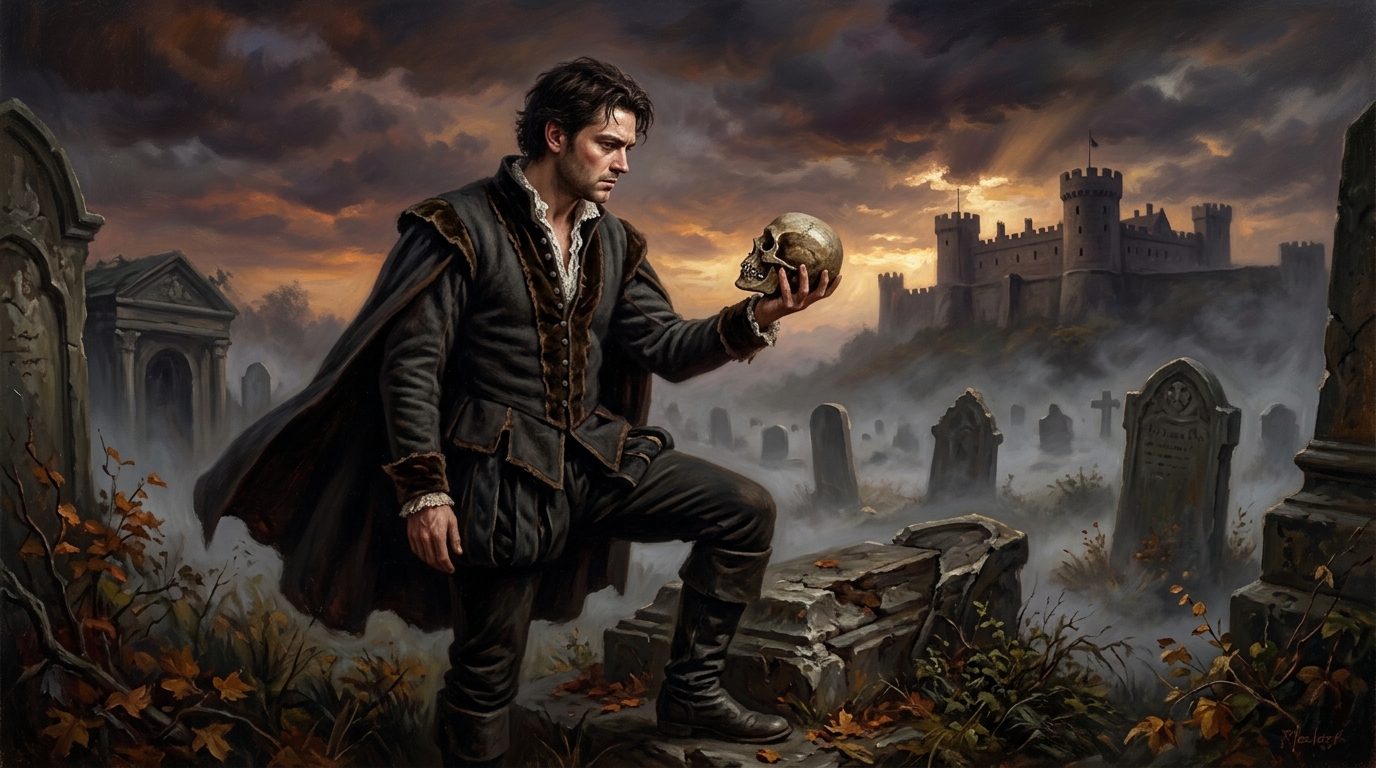
Quote 1: “To be, or not to be: that is the question.”
-
Act & Scene Reference: Act 3, Scene 1 (Lines 56–58)
-
Speaker & Context: Prince Hamlet delivers this solitary contemplation (soliloquy) in a hallway of Elsinore Castle, unaware that King Claudius and Polonius are eavesdropping behind a tapestry.
“To be, or not to be: that is the question:
Whether ’tis nobler in the mind to suffer
The slings and arrows of outrageous fortune,
Or to take arms against a sea of troubles,
And by opposing end them?”
Modern Translation
“The real question is: Is it better to go on living, or is it better to die? Is it nobler to endure the painful blows that life throws at us, or to fight back against a overwhelming ocean of troubles and end them by dying?”
Deep Analysis & Dramatic Significance
This passage represents perhaps the most famous soliloquy in world literature. Unlike Hamlet’s earlier outbursts, which are fueled by grief and fury, this speech is characterized by cool, philosophical detachment. Hamlet does not use personal pronouns like “I” or “my”; instead, he examines the human condition as a whole.
The core dilemma centers on action versus inaction. “To be” signifies living and suffering the unpredictable cruelties of existence (“slings and arrows”). “Not to be” represents suicide or choosing death. Shakespeare uses warfare imagery to illustrate the human struggle: we are attacked by fate, yet fighting back against a “sea” is inherently paradoxical—you cannot shoot arrows at an ocean and win. Ultimately, Hamlet concludes that humanity tolerates suffering because the fear of what comes after death—”the undiscovered country from whose bourn no traveler returns”—paralyzes our willpower, turning intellect into hesitation.
Quote 2: “Alas, poor Yorick! I knew him, Horatio…”
-
Act & Scene Reference: Act 5, Scene 1 (Lines 185–189)
-
Speaker & Context: Hamlet speaks to his loyal friend Horatio while standing in a churchyard graveyard, looking down at the freshly exhumed skull of his childhood king’s jester.
“Alas, poor Yorick! I knew him, Horatio: a fellow of infinite jest, of most excellent fancy: he hath borne me on his back a thousand times; and now, how abhorred in my imagination it is!”
Modern Translation
“How sad, poor Yorick! I used to know him, Horatio—he was a man of endless humor and wonderful imagination. He carried me on his back a thousand times when I was a child, and now, looking at his remains makes my stomach turn!”
Deep Analysis & Dramatic Significance
This scene marks a profound turning point in Hamlet’s psychological development. Throughout the play, death has been an abstract concept, a ghost’s command, or a moral dilemma. Holding Yorick’s skull forces Hamlet to confront death as a physical, inevitable reality.
Yorick was the court entertainer who provided warm, fond childhood memories for Hamlet, contrasting sharply with the grim, deceitful atmosphere of Elsinore under Claudius. By reflecting on how a man once vibrant with laughter is reduced to a hollow skull, Hamlet comes to understand mortality as the ultimate social equalizer. Moments later, he extends this meditation to Alexander the Great and Julius Caesar, noting that even world conquerors end up as clay used to plug beer barrels.
Note on Pop Culture Misquotes: One of the most widespread misquotations in literary history is “Alas, poor Yorick, I knew him well.” Shakespeare’s actual text reads: “Alas, poor Yorick! I knew him, Horatio.”
Quote 3: “O, that this too too solid flesh would melt…”
-
Act & Scene Reference: Act 1, Scene 2 (Lines 129–134)
-
Speaker & Context: Hamlet’s first major soliloquy, delivered shortly after King Claudius and Queen Gertrude urge him to stop grieving his father’s death and celebrate their rapid marriage.
“O, that this too too solid flesh would melt,
Thaw and resolve itself into a dew!
Or that the Everlasting had not fix’d
His canon ‘gainst self-slaughter! O God! God!
How weary, stale, flat and unprofitable,
Seem to me all the uses of this world!”
Modern Translation
“Oh, if only my solid physical body would melt away, thaw, and turn into water drops! Or if only God had not created a divine law forbidding suicide! Oh God, how exhausting, boring, meaningless, and useless everything in this world feels to me!”
Deep Analysis & Dramatic Significance
This opening soliloquy establishes Hamlet’s profound emotional state before he ever meets the Ghost or learns of his father’s murder. His distress is not merely sadness; it is a clinical depression (what Elizabethans called “melancholy”) caused by two compounding traumatic events: his father’s sudden death and his mother’s hasty, incestuous marriage to his uncle.
Shakespeare uses metaphors of decay to illustrate Hamlet’s worldview. He compares the world to an “unweeded garden that grows to seed,” dominated by gross and corrupt weeds. The phrase “too too solid flesh” (which some folios print as “sullied flesh”) highlights his feeling of being contaminated by his mother’s moral compromise. This line sets up the play’s fundamental tension: a young, idealistic prince forced to navigate a corrupt world that repulses him.
2. Quotes on Corruption, Deception, and Treachery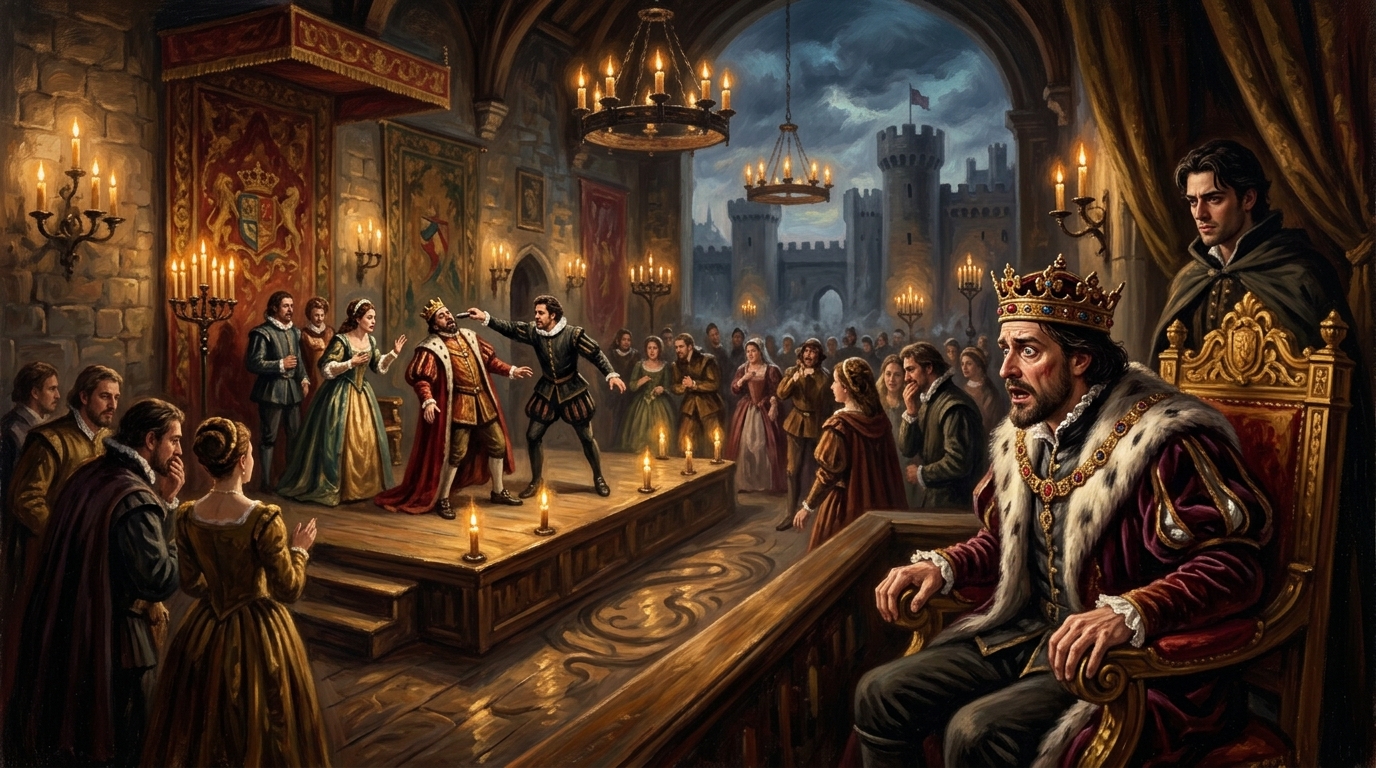
Quote 4: “Something is rotten in the state of Denmark.”
-
Act & Scene Reference: Act 1, Scene 4 (Line 90)
-
Speaker & Context: Marcellus, a Danish guard officer, speaking to Horatio as they watch Hamlet follow his father’s Ghost into the dark night.
“Something is rotten in the state of Denmark.”
Modern Translation
“There is a deep political and moral decay at the core of our nation.”
Deep Analysis & Dramatic Significance
Although brief, this line serves as a central thematic pillar for the entire play. In Renaissance philosophy, the “Great Chain of Being” dictated that a monarch’s moral state directly influenced the health of the nation. A good king brought prosperity, while an evil or illegitimate king brought supernatural disturbances and social ruin.
Marcellus delivers this line after seeing the armed Ghost of the late King Hamlet walking the castle battlements. The apparition is a physical symptom of an underlying political infection: King Claudius murdered his brother to usurp the throne. Marcellus’s observation establishes an atmosphere of paranoia, corruption, and impending doom that hangs over Denmark throughout all five acts.
Quote 5: “The play’s the thing / Wherein I’ll catch the conscience of the King.”
-
Act & Scene Reference: Act 2, Scene 2 (Lines 604–605)
-
Speaker & Context: Hamlet at the conclusion of his “O, what a rogue and peasant slave am I!” soliloquy, after hatching a plot with a visiting troupe of actors.
“About, my brain! I have heard
That guilty creatures sitting at a play
Have by the very cunning of the scene
Been struck so to the soul that presently
They have proclaim’d their malefactions…
The play’s the thing
Wherein I’ll catch the conscience of the King.”
Modern Translation
“Get to work, my brain! I’ve heard that guilty people watching a realistic performance on stage can be so shaken by the scene that they confess their crimes on the spot… A play is the perfect tool to trap the King and force his conscience to reveal his guilt.”
Deep Analysis & Dramatic Significance
This rhyming couplet marks the moment Hamlet transforms from a passive, grieving son into an active strategist. Up to this point, Hamlet has suffered from self-doubt, wondering if the Ghost he saw was actually his father’s spirit or a demon sent to trick him into damning his own soul.
To solve this ethical dilemma, Hamlet designs an empirical test. He writes a short scene depicting his father’s murder—pouring poison into a sleeping king’s ear—and asks the actors to perform it in front of Claudius (a play titled The Murder of Gonzago, which Hamlet sarcastically calls The Mousetrap). If Claudius flinches or panics, Hamlet will have moral certainty of his uncle’s guilt. This moment highlights the recurring theme of art reflecting reality and theater serving as a mirror for human morality.
Quote 6: “The lady doth protest too much, methinks.”
-
Act & Scene Reference: Act 3, Scene 2 (Line 230)
-
Speaker & Context: Queen Gertrude responding to Hamlet during the performance of The Mousetrap, when he asks her how she likes the play.
“The lady doth protest too much, methinks.”
Modern Translation
“I think the actress is over-promising and being too dramatic about her loyalty.”
Deep Analysis & Dramatic Significance
In the play-within-a-play, the Player Queen repeatedly vows that she will never remarry if her husband dies, insisting that a woman who takes a second husband commits emotional treason. Hamlet turns to his mother, Gertrude, to gauge her reaction to these dramatic vows. Gertrude’s calm, somewhat dismissive response reveals her psychological defenses.
The word “protest” in Elizabethan English meant “to declare solemnly” or “to vow formal promises,” rather than its modern meaning of objecting or complaining. Gertrude feels the Player Queen’s vows are exaggerated and unrealistically romantic. However, her comment also reveals her underlying discomfort: seeing a fictional queen pledge lifelong fidelity reminds Gertrude of her own swift remarriage to Claudius after her husband’s murder, making her response a defensive deflection.
3. Quotes on Human Nature, Fate, and Wisdom
Quote 7: “This above all: to thine own self be true…”
-
Act & Scene Reference: Act 1, Scene 3 (Lines 78–80)
-
Speaker & Context: Polonius, the Lord Chamberlain, giving parting advice to his son Laertes before Laertes sets sail for Paris.
“This above all: to thine own self be true,
And it must follow, as the night the day,
Thou canst not then be false to any man.”
Modern Translation
“Most importantly of all: be honest with yourself and adhere to your own principles. If you do that, it naturally follows—just as night follows day—that you will never be disloyal or dishonest to anyone else.”
Deep Analysis & Dramatic Significance
Out of context, this passage is frequently used as inspirational self-help advice for authenticity and personal integrity. However, within the dramatic context of Hamlet, the quote carries significant irony.
Polonius is the least authentic, most hypocritical character in the play. He is an overly verbose politician who relies on surveillance, manipulation, and deceit to advance his standing in court. He later sends spies to Paris to secretly monitor Laertes’ private behavior and uses his own daughter, Ophelia, as political bait to trap Hamlet. That such noble advice comes from a man who lives a life of calculated deception highlights Shakespeare’s mastery of dramatic irony: Polonius can articulate moral wisdom, but he is incapable of practicing it.
Quote 8: “There are more things in heaven and earth, Horatio, / Than are dreamt of in your philosophy.”
-
Act & Scene Reference: Act 1, Scene 5 (Lines 166–167)
-
Speaker & Context: Hamlet to his friend Horatio, immediately after the Ghost vanishes and Hamlet demands that his companions swear an oath of secrecy on his sword.
“There are more things in heaven and earth, Horatio,
Than are dreamt of in your philosophy.”
Modern Translation
“There are many mysteries in the universe, Horatio, that go far beyond what human logic and academic theories can explain.”
Deep Analysis & Dramatic Significance
Horatio represents the quintessential Renaissance scholar—rational, educated at the University of Wittenberg, and skeptical of supernatural claims. When the guards first report seeing a Ghost, Horatio dismisses it as mere fantasy. Even after witnessing the spirit himself, he tries to process it through logic and classical history.
Hamlet’s remark addresses the limits of human knowledge and rationalism. During the Renaissance, scientific rationalism was beginning to challenge medieval religious worldviews. Hamlet reminds his educated friend that human logic cannot account for every mystery in existence. This line sets the tone for a play in which rational planning often fails, and characters are forced to confront forces beyond their control.
Quote 9: “There is nothing either good or bad, but thinking makes it so.”
-
Act & Scene Reference: Act 2, Scene 2 (Lines 249–250)
-
Speaker & Context: Hamlet talking with his old schoolmates, Rosencrantz and Guildenstern, who have been hired by King Claudius to spy on him.
“Denmark’s a prison… Why, then, ’tis none to you; for there is nothing either good or bad, but thinking makes it so. To me it is a prison.”
Modern Translation
“Denmark feels like a prison to me… Well, then it isn’t one to you; because things aren’t inherently good or bad in themselves—our subjective thoughts make them that way. To my mind, Denmark is a prison.”
Deep Analysis & Dramatic Significance
This line showcases Hamlet’s intellect and his philosophical inclination toward Stoicism and subjective perspective. While Rosencrantz and Guildenstern view Denmark as a comfortable royal court filled with opportunities, Hamlet feels trapped in a corrupt environment controlled by his father’s murderer.
The phrase anticipates modern psychological insights regarding perception and reality. External circumstances hold no emotional power over an individual until the mind interprets them. For Hamlet, his heightened awareness, grief, and moral standards transform Elsinore into an intolerable prison cell. His brilliant intellect, which should be his greatest strength, becomes his personal prison because he cannot stop analyzing the dishonesty around him.
4. Quotes on Revenge, Madness, and Conflict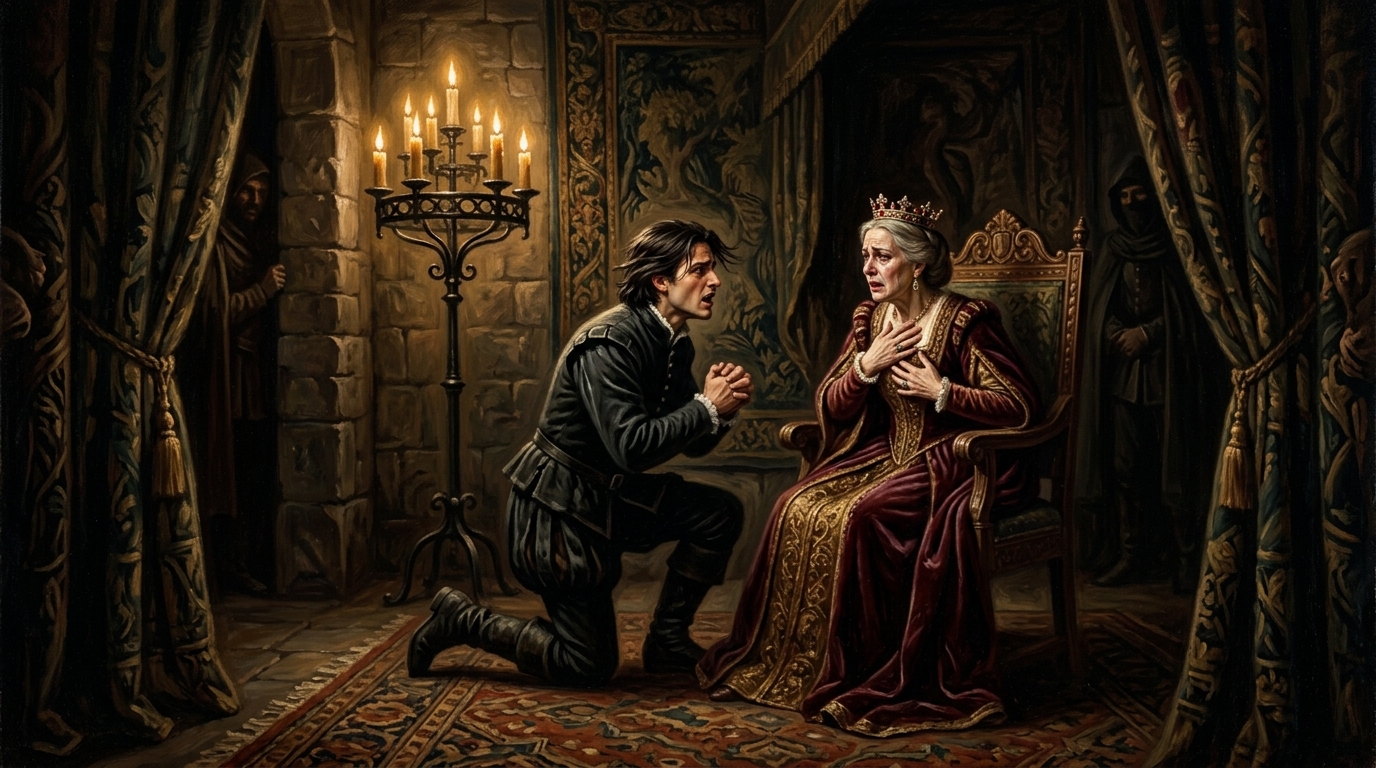
Quote 10: “Frailty, thy name is woman!”
-
Act & Scene Reference: Act 1, Scene 2 (Line 146)
-
Speaker & Context: Hamlet during his first soliloquy, expressing his deep outrage over his mother Gertrude’s swift remarriage to his uncle Claudius within a month of his father’s death.
“Must I remember? why, she would hang on him,
As if increase of appetite had grown
By what it fed on: and yet, within a month—
Let me not think on’t—Frailty, thy name is woman!”
Modern Translation
“Do I really have to remember it? She used to cling to my father as if her love for him grew stronger the more time they spent together. And yet, within a single month—I can’t bear to think about it—women are the very definition of weakness!”
Deep Analysis & Dramatic Significance
This outburst demonstrates how Hamlet takes his personal grief and generalizes it into an indictment of all women. He views Gertrude’s rapid transition from grieving widow to Claudius’s bride not just as a personal betrayal, but as proof of inherent female moral weakness (“frailty”).
This psychological scar damages Hamlet’s perception of love, romance, and trust throughout the rest of the play. His disappointment in his mother directly poisons his relationship with Ophelia, whom he later accuses of deceit, assuming that all women inevitably mirror Gertrude’s compromised integrity.
Quote 11: “Get thee to a nunnery.”
-
Act & Scene Reference: Act 3, Scene 1 (Line 121)
-
Speaker & Context: Hamlet furiously berating Ophelia after realizing that her attempt to return his love letters is a setup engineered by Claudius and Polonius.
“Get thee to a nunnery: why wouldst thou be a breeder of sinners? I am myself indifferent honest; but yet I could accuse me of such things that it were better my mother had not borne me…”
Modern Translation
“Go lock yourself away in a convent. Why would you want to give birth to more sinful human beings? I consider myself reasonably moral, yet I could accuse myself of such flaws that it would have been better if my mother had never born me…”
Deep Analysis & Dramatic Significance
This intense confrontation—often referred to as the “Nunnery Scene”—showcases the dual nature of Elizabethan language. In its literal sense, a “nunnery” is a religious convent where Ophelia could protect her virtue, withdraw from court corruption, and avoid giving birth to more corrupt human beings (“breeders of sinners”).
However, in Elizabethan slang, “nunnery” was also a common euphemism for a brothel. By using this double entendre, Hamlet expresses two conflicting emotions at once: a desire to save Ophelia from the court’s moral decay, and a bitter belief that she is already corrupted by acting as an accomplice to her father and Claudius. This cruel outburst shatters Ophelia’s fragile emotional state, contributing directly to her eventual descent into madness in Act 4.
Quote 12: “I must be cruel, only to be kind.”
-
Act & Scene Reference: Act 3, Scene 4 (Line 178)
-
Speaker & Context: Hamlet speaking to Queen Gertrude in her private chamber (the closet scene) after he accidentally stabs Polonius through the wall tapestry.
“I must be cruel, only to be kind:
Thus bad begins and worse remains behind.”
Modern Translation
“I have to act harshly right now in order to save you in the long run. The bad things are starting now, but even worse troubles are left ahead.”
Deep Analysis & Dramatic Significance
Delivered right after Hamlet accidentally kills Polonius—mistaking him for King Claudius—this line captures the paradox of Hamlet’s moral mission. He views himself not merely as an avenging son, but as a divine minister tasked with cleansing the Danish court of sin.
Hamlet believes that confronting his mother with her moral failures requires emotional cruelty. He must tear away her denial so she can seek spiritual redemption. The paradox—being cruel out of love and concern—illustrates the tragic reality of revenge drama: restoring justice often requires inflicting unavoidable harm on the people one seeks to protect.
5. Additional Iconic Lines Worth Knowing
Quote 13: “Neither a borrower nor a lender be.”
-
Act & Scene Reference: Act 1, Scene 3 (Line 75)
-
Speaker & Context: Polonius giving practical life advice to his son Laertes before Laertes departs for Paris.
-
Quick Meaning: Never borrow or lend money. Lending money often causes you to lose both your cash and your friend, while borrowing money makes you careless with personal finances.
Quote 14: “Though this be madness, yet there is method in ‘t.”
-
Act & Scene Reference: Act 2, Scene 2 (Lines 205–206)
-
Speaker & Context: Polonius in an aside, observing Hamlet’s nonsensical, erratic behavior while talking to him in the castle hall.
-
Quick Meaning: Even though Hamlet seems out of his mind, his crazy statements contain a hidden logic and calculated purpose.
Quote 15: “The rest is silence.”
-
Act & Scene Reference: Act 5, Scene 2 (Line 342)
-
Speaker & Context: Hamlet’s dying words to Horatio after being wounded by Laertes’s poisoned blade and killing Claudius.
-
Quick Meaning: Death has arrived to quiet my mind. All the turmoil, philosophical questioning, and pain are finally over, leaving only eternal silence.
6. Quick Reference Summary Table
7. How to Quote Hamlet Accurately in Academic Papers
When writing research essays, literary analyses, or citing Shakespeare for academic purposes, maintaining precise formatting standards demonstrates scholarly rigor and adheres to standard guidelines like MLA format.
MLA Citation Formatting Rules
-
Act, Scene, and Line Numbers: Use Arabic numerals separated by periods instead of Roman numerals. For example, Act 3, Scene 1, Lines 56–58 should be cited parenthetically as
(Hamlet 3.1.56–58). -
Short Quotes: Integrate quotes shorter than four lines directly into your text with quotation marks. Separate line breaks in the verse using a forward slash with spaces on both sides (
/).-
Example: Hamlet reflects on human knowledge when he notes, “There are more things in heaven and earth, Horatio, / Than are dreamt of in your philosophy” (1.5.166–167).
-
-
Block Quotes: For quotes spanning four lines or more, set the passage off as a block quote. Indent the entire block one-half inch from the left margin, maintain double spacing, and omit quotation marks.
-
Attribution Accuracy: Always verify the speaker. A common academic error is attributing Polonius’s lines (such as “To thine own self be true”) directly to Prince Hamlet.
8. Frequently Asked Questions (FAQ)
What is the most famous line in Hamlet?
The most famous line in Hamlet is “To be, or not to be: that is the question” from Act 3, Scene 1. It serves as the opening line of Hamlet’s soliloquy on existence, suffering, and the uncertainty of death.
Who says “To thine own self be true” in Hamlet?
The line is spoken by Polonius, King Claudius’s chief advisor, in Act 1, Scene 3. He gives this advice to his son, Laertes, right before Laertes leaves Denmark to study in France.
What are Hamlet’s final words before he dies?
Hamlet’s last spoken words are “The rest is silence” (Act 5, Scene 2, Line 342). These words signify the end of his tragic struggle and his transition into death.
Did Hamlet actually say “Alas, poor Yorick, I knew him well”?
No. The line is commonly misquoted in popular culture. Shakespeare’s original text reads: “Alas, poor Yorick! I knew him, Horatio” (Act 5, Scene 1, Line 185).
Why Hamlet Continues to Resonate
The enduring popularity of these quotes lies in Shakespeare’s ability to capture the complexities of human experience. Hamlet is not merely a tale of royal revenge; it is a meditation on doubt, moral responsibility, grief, and the search for truth in a deceptive world. By examining these famous lines within their original dramatic context, modern readers can appreciate why the Prince of Denmark’s words continue to resonate across cultures four centuries later.