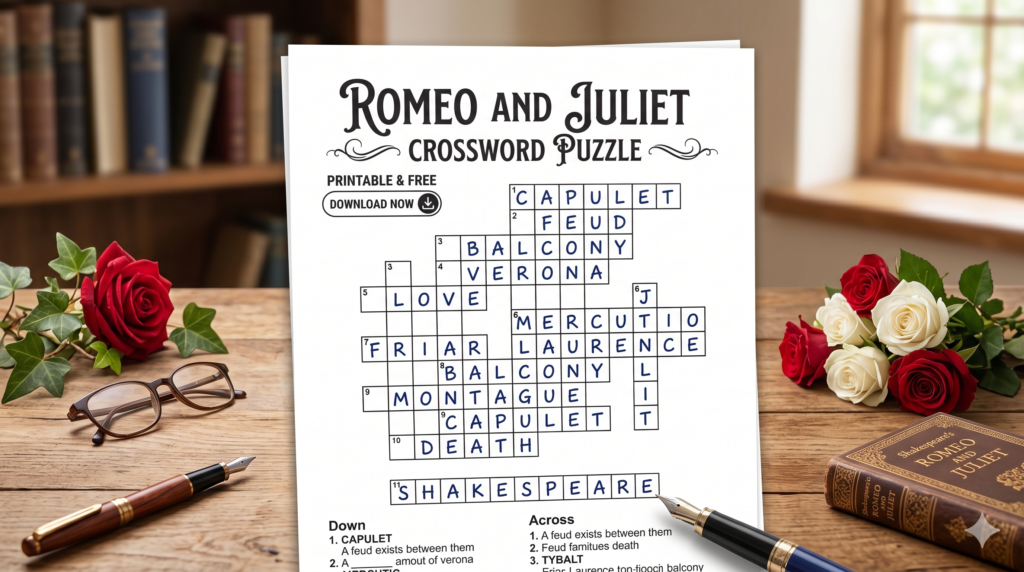
What if mastering Shakespeare didn’t feel like decoding a foreign language—but instead felt like solving a fun challenge? For many students, reading classic literature can be intimidating. Yet, with the right tools, even the most complex texts can become accessible, memorable, and enjoyable.
That’s exactly where a romeo and juliet crossword puzzle becomes a game-changer. Instead of passively reading, learners actively engage with characters, themes, and plot points—turning study time into an interactive experience.
Written by the legendary William Shakespeare, Romeo and Juliet remains one of the most studied tragedies in the world. But understanding its language, symbolism, and emotional depth often requires more than just reading—it demands participation.
In this comprehensive guide, you’ll discover:
- A free printable Romeo and Juliet crossword puzzle
- A complete answer key with explanations
- Expert strategies for using puzzles to boost comprehension and retention
- Practical tips for teachers, students, and homeschoolers
Whether you’re preparing for exams, teaching a classroom, or simply trying to better understand Shakespeare, this resource is designed to make learning both effective and enjoyable.
Why Use a Romeo and Juliet Crossword Puzzle for Learning?
Enhancing Comprehension Through Active Recall
Modern educational research consistently highlights the power of active recall—the process of retrieving information from memory rather than simply reviewing it. Crossword puzzles naturally incorporate this technique.
When students solve clues related to:
- Characters like Romeo, Juliet, or Mercutio
- Key events such as the balcony scene or duels
- Themes like fate versus free will
They are not just recognizing information—they are reconstructing knowledge, which strengthens long-term memory.
Unlike passive reading, this method:
- Improves retention
- Builds stronger neural connections
- Encourages deeper engagement with the text
Making Shakespeare Accessible and Fun
Let’s be honest: Shakespeare’s language can feel overwhelming at first. Archaic vocabulary, poetic structures, and complex metaphors often discourage learners.
A crossword puzzle simplifies this by:
- Breaking complex ideas into manageable clues
- Reinforcing vocabulary through repetition
- Turning learning into a low-pressure activity
Instead of struggling through dense passages, students interact with the material in a way that feels rewarding rather than frustrating.
Ideal for Classrooms, Homeschooling, and Self-Study
One of the greatest strengths of a Romeo and Juliet crossword puzzle is its versatility.
It can be used:
- In classrooms as a warm-up, review activity, or formative assessment
- At home for homeschooling or revision
- Independently by students preparing for exams
Because it supports multiple learning styles—visual, verbal, and kinesthetic—it adapts easily to different educational environments.
What This Romeo and Juliet Crossword Puzzle Covers
To be truly effective, a crossword puzzle must go beyond surface-level recall. This one is carefully designed to reinforce core literary knowledge.
Key Characters
Understanding character relationships is essential to grasping the tragedy. This puzzle includes clues about:
- Romeo Montague
- Juliet Capulet
- Mercutio (Romeo’s witty friend)
- Tybalt (Juliet’s fiery cousin)
- Friar Laurence (the well-meaning advisor)
- The Nurse (Juliet’s confidante)
Each clue reinforces both identity and role within the story.
Important Themes
At its core, Romeo and Juliet explores universal human experiences. The crossword integrates themes such as:
- Love vs. Fate
- Conflict and Family Rivalry
- Youth and Impulsiveness
- Individual Desire vs. Social Expectation
By embedding these ideas into clues, learners begin to connect abstract concepts with specific moments in the play.
Major Plot Points
Students often struggle to remember the sequence of events. This puzzle reinforces:
- The Capulet party
- Romeo and Juliet’s first meeting
- The famous balcony scene
- Mercutio and Tybalt’s deaths
- Romeo’s exile
- The tragic conclusion
This ensures learners can follow the narrative arc with clarity.
Essential Vocabulary and Literary Terms
To succeed academically, students must understand key literary concepts. The puzzle includes terms such as:
- Tragedy
- Soliloquy
- Foreshadowing
- Prologue
- Conflict
These are critical for essays, exams, and deeper literary analysis.
Free Printable Romeo and Juliet Crossword Puzzle
Below is a classroom-ready crossword puzzle you can copy, print, and use immediately.
Puzzle Instructions
Fill in the crossword using the clues provided. All answers relate to Romeo and Juliet—including characters, themes, and key events.
Across Clues
- Romeo’s last name (8)
- Juliet’s cousin who challenges Romeo (6)
- The city where the play is set (6)
- Priest who helps Romeo and Juliet (5)
- Juliet’s loyal caretaker (5)
- Opposite of fate (4)
- The emotion driving the story (4)
Down Clues
- Juliet’s last name (7)
- Romeo’s close friend killed by Tybalt (8)
- Secret meeting place of Romeo and Juliet (7)
- The literary form of the play (7)
- Romeo’s punishment after Tybalt’s death (6)
- The final outcome of the story (7)
Puzzle Format and Difficulty Level
- Level: متوسط (Intermediate)
- Ideal for: Grades 7–12
- Completion Time: 10–20 minutes
This balance ensures it is challenging enough to stimulate thinking while remaining accessible.
Romeo and Juliet Crossword Puzzle Answers (Complete Solution Guide)
Answer Key
Across:
- Montague
- Tybalt
- Verona
- Friar
- Nurse
- Free
- Love
Down:
2. Capulet
4. Mercutio
6. Balcony
8. Tragedy
10. Exile
12. Tragedy
Explanation of Key Clues
- Montague / Capulet: The two feuding families symbolize conflict and inherited hatred.
- Verona: The setting shapes the cultural and social environment of the story.
- Mercutio: His death marks a turning point from romance to tragedy.
- Balcony: Represents secrecy, intimacy, and youthful passion.
- Exile: Highlights consequences of impulsive actions.
- Tragedy: Reinforces the genre and inevitable downfall.
These explanations ensure learners don’t just memorize answers—they understand their significance.
How to Use This Crossword Puzzle Effectively
For Teachers
Educators can integrate this puzzle strategically into lesson plans:
- Lesson Starter: Activate prior knowledge
- Mid-Unit Review: Reinforce key concepts
- Assessment Tool: Evaluate understanding informally
- Group Activity: Encourage collaboration
Pro tip: Pair the puzzle with discussion questions for deeper analysis.
For Students
To maximize benefits:
- Attempt the puzzle without notes first
- Review mistakes using the answer explanations
- Revisit difficult clues after re-reading key scenes
This transforms the puzzle into a powerful self-assessment tool.
For Parents & Homeschoolers
Make learning interactive by:
- Solving the puzzle together
- Discussing each answer
- Connecting clues to real-life themes
This encourages both critical thinking and meaningful conversation.
Expert Tips to Master Romeo and Juliet Faster
Combine Puzzles with Active Reading
While reading:
- Highlight key quotes
- Annotate unfamiliar words
- Note character motivations
Then use the puzzle to reinforce what you’ve learned.
Use Visual and Contextual Learning
- Watch film adaptations
- Create character relationship maps
- Visualize scenes like the balcony moment
These techniques deepen comprehension beyond text.
Practice with Multiple Study Tools
For best results, combine:
- Crossword puzzles
- Flashcards
- Quizzes
- Summaries
This multi-layered approach ensures long-term retention.
Common Challenges Students Face (and How This Puzzle Solves Them)
Understanding Archaic Language
Problem: Shakespearean English feels unfamiliar
Solution: Crossword clues simplify and reinforce vocabulary
Remembering Characters and Relationships
Problem: Too many names and connections
Solution: Repetition through clues improves recall
Connecting Themes to Plot
Problem: Abstract ideas feel disconnected
Solution: Context-based clues link themes to events
Expand Your Learning Beyond the Crossword
Recommended Activities
- Act out key scenes
- Rewrite the ending in a modern setting
- Debate character decisions
Suggested Study Resources
- Scene summaries
- Character analyses
- Essay prompts
These activities build higher-order thinking skills.
Frequently Asked Questions (FAQs)
Is this Romeo and Juliet crossword puzzle suitable for beginners?
Yes. It’s designed to be accessible while still reinforcing essential concepts.
Can I use this puzzle in my classroom?
Absolutely. It’s ideal for educational use, both in-person and online.
What age group is this crossword designed for?
Primarily middle to high school students, but adaptable for other levels.
How long does it take to complete the puzzle?
Typically 10–20 minutes, depending on familiarity with the play.
Does the puzzle include answers?
Yes, along with explanations to enhance understanding.
Make Shakespeare Memorable and Enjoyable
Studying Shakespeare doesn’t have to be difficult or dull. With the right tools—like this romeo and juliet crossword puzzle—learning becomes interactive, engaging, and far more effective.
By combining active recall, structured reinforcement, and meaningful context, this puzzle helps transform one of literature’s most complex works into something approachable and memorable.
Whether you’re a student aiming for top grades, a teacher seeking better engagement, or a parent supporting learning at home, this resource offers a practical, proven solution.