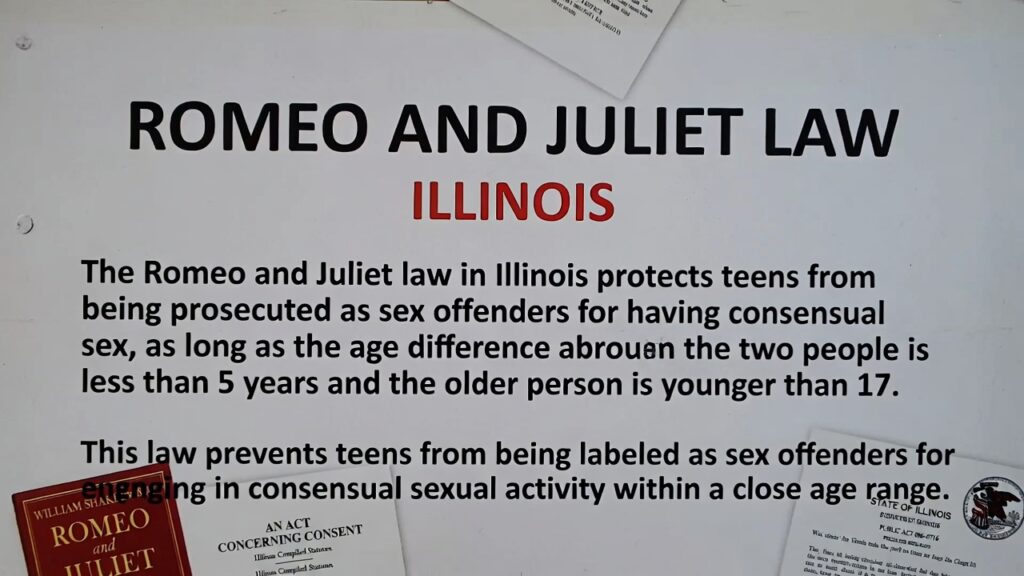
In William Shakespeare’s timeless tragedy Romeo and Juliet, two young lovers—barely teenagers—defy family feuds and societal norms in a passionate, impulsive romance that ends in heartbreak. Their story has inspired countless adaptations, discussions, and even modern legal terminology. The phrase “Romeo and Juliet law” refers to close-in-age exemptions (also called “Romeo and Juliet” provisions) in many U.S. states. These laws aim to prevent harsh criminal penalties for consensual sexual activity between minors or near-minors who are close in age, recognizing that not every teen relationship involves exploitation or predation.
But does Illinois have a Romeo and Juliet law in Illinois? The short answer is no—the state does not offer a full close-in-age exemption that decriminalizes such activity. Illinois maintains a strict age of consent at 17, and sexual conduct or penetration with anyone under that age remains illegal under state law, even in consensual, peer-like relationships. However, limited mitigations exist in certain scenarios, particularly for criminal sexual abuse charges when the age gap is small.
This comprehensive guide draws from primary sources like the Illinois Compiled Statutes (ILCS), particularly 720 ILCS 5/11-1.50 (Criminal Sexual Abuse) and related sections, along with legal analyses and official records from the Illinois General Assembly (ILGA.gov). As of 2026, no major changes have expanded exemptions, though proposals like Senate Bill 131 (introduced for the 2025-2026 session) seek to raise certain consent thresholds to 18 for enhanced penalties in specific crimes. Whether you’re a parent concerned about your teen’s relationships, a young adult navigating dating, an educator teaching consent, or simply curious about how Shakespeare’s iconic tale influences contemporary law, this article clarifies the rules, debunks myths, compares Illinois to other states, and offers practical steps to stay informed and safe.
Understanding these laws helps families avoid unintended legal pitfalls, promotes healthy discussions about consent, and distinguishes between normal adolescent exploration and genuine harm. Knowledge empowers better decisions in a world where misinformation spreads quickly.
What Is a “Romeo and Juliet” Law?
“Romeo and Juliet” laws—named after Shakespeare’s doomed young lovers—are informal terms for statutory close-in-age exemptions or defenses. They exist to avoid treating consensual relationships between teens close in age (typically gaps of 2–4 years) as equivalent to predatory statutory rape.
In states with robust versions, these provisions can:
- Provide a complete defense, making the act non-criminal.
- Downgrade charges from felony to misdemeanor.
- Prevent sex offender registration for qualifying cases.
The goal? To protect young people from lifelong consequences for age-appropriate romance while still punishing exploitation.
Common features include:
- Minimum age for the younger party (e.g., 13–16).
- Maximum age gap (e.g., 3–5 years).
- Requirements for no force, coercion, or authority imbalance.
Shakespeare’s play highlights the tragedy of forbidden young love, and modern laws borrow the name to humanize teen relationships. Without such exemptions, prosecutors could charge an 18-year-old senior for a consensual relationship with a 16-year-old junior—outcomes many view as disproportionate.
Illinois, however, takes a stricter approach, prioritizing broad protection for minors over broad exemptions.
The Age of Consent in Illinois: Key Rules
Illinois sets the general age of consent at 17 years old, as codified in 720 ILCS 5/11-1.70. This means individuals 17 and older can legally consent to sexual activity with others of similar or older age, provided no force, incapacity, or position of authority is involved.
Key statutes define prohibited acts:
- Criminal Sexual Abuse (720 ILCS 5/11-1.50): Covers sexual conduct (broadly defined to include touching for arousal) or penetration without force in specific age scenarios. This is the section most relevant to close-in-age cases.
- Subsection (b): A person under 17 commits the offense with a victim aged 9–16.
- Subsection (c): A person commits it with a victim aged 13–16 if the perpetrator is less than 5 years older.
- Aggravated Criminal Sexual Abuse (720 ILCS 5/11-1.60): Applies harsher penalties (often felonies) when the gap is 5+ years for victims 13–16, or involves victims under 13, force, or authority positions.
- Criminal Sexual Assault (720 ILCS 5/11-1.20): Involves penetration with force, incapacity, family relationships, or authority over minors under 18.
Important nuances:
- Position of trust/authority (e.g., teacher, coach, counselor): Raises effective consent age to 18.
- Federal overlap: The Mann Act and federal law (18 U.S.C. § 2423) prohibit crossing state lines for sexual activity with minors 12–16 if the gap is 4+ years, regardless of state law.
- Consent is irrelevant below 17: Even enthusiastic agreement doesn’t legalize the act; the law presumes minors can’t fully consent.
These rules protect against exploitation but create gray areas for teens.
Does Illinois Have a Romeo and Juliet Law or Close-in-Age Exemption? (Core Section)
No, Illinois does not have a true Romeo and Juliet law or broad close-in-age exemption that decriminalizes consensual sexual activity below age 17.
Unlike states like California (3-year gap), Texas (3 years over 14), or New York (tiered defenses), Illinois offers no complete defense or decriminalization. The conduct remains a crime, but limited mitigations apply:
- Under 720 ILCS 5/11-1.50(c): If the victim is 13–16 and the perpetrator is less than 5 years older, the offense is classified as Criminal Sexual Abuse—a Class A misdemeanor (up to 1 year jail, fines up to $2,500) rather than escalating to aggravated/felony levels.
- This isn’t an exemption—it’s a sentencing cap. The act is still illegal, prosecutable, and can lead to records or registration in some cases.
- For penetration in larger gaps or younger victims, charges escalate to felonies with prison time (3–30+ years) and mandatory sex offender registration.
- Both parties under 17: Theoretically chargeable (e.g., mutual acts), but prosecutors rarely pursue consensual peer cases absent complaints or aggravating factors.
Why no full exemption? Illinois prioritizes strict minor protection. A 2011 bill (HB 1139) to decriminalize 13–16 with <5-year gaps failed. No successful expansions since; recent focus (e.g., SB 131 in 2025–2026) aims to raise some thresholds to 18, not add exemptions.
Misconceptions debunked:
- No “4-year rule” or automatic defense—some outdated sources confuse misdemeanor classification with legality.
- Prosecutorial discretion often spares truly consensual close-age cases, but the law allows charges.
Expert insight: Courts and prosecutors weigh factors like relationship nature, complaint source, and harm. Discretion prevents overreach, but reliance on it isn’t guaranteed.
Penalties and Real-World Consequences
Penalties vary by charge and circumstances:
- Class A Misdemeanor (e.g., limited-gap Criminal Sexual Abuse): Up to 1 year county jail, fines ≤ $2,500, probation possible. No automatic registration, but possible under certain conditions.
- Class 2 Felony (e.g., aggravated cases with 5+ year gap): 3–7 years prison, fines up to $25,000, mandatory sex offender registration (lifelong or removable after years).
- Higher felonies: For force, younger victims, or authority—7–30+ years, permanent registration.
Collateral consequences:
- Employment barriers (teaching, childcare).
- College admissions, housing restrictions.
- Family court impacts (custody, visitation).
- Emotional stigma, mental health strain.
Hypothetical examples (based on statute, not specific cases):
- 16-year-old and 18-year-old dating consensually: Potential misdemeanor if prosecuted; often not charged.
- 15-year-old and 19-year-old: Felony risk (gap >5 years in some framings).
- Two 15-year-olds: Rare prosecution unless complaint or video evidence.
Comparison: Illinois vs. Other States
Illinois’ strict approach stands out when compared to many other U.S. states. While the state offers limited penalty mitigation for small age gaps, it lacks the affirmative defenses or full decriminalization found elsewhere. Here’s a clearer picture of how Illinois stacks up:
- States with strong Romeo and Juliet exemptions:
- California: 3-year age gap allowed for those 14–17 (Penal Code § 261.5). Consensual activity between, say, a 16-year-old and 19-year-old is typically not prosecutable as statutory rape.
- Texas: 3-year gap for ages 14–17 (Texas Penal Code § 22.011). Also includes a “promiscuity” defense in limited older cases (rarely used).
- New York: Tiered close-in-age defenses—4 years for 15–17, 2 years for 13–14 (Penal Law § 130.55).
- Florida: 4-year gap for 16–17; 16 is the age of consent, with exceptions down to 13 in some cases.
- States similar to Illinois (strict, limited or no exemptions):
- Wisconsin: Age of consent 18, no close-in-age exemption.
- Michigan: Age of consent 16, but no Romeo and Juliet law; close-in-age cases often handled via prosecutorial discretion rather than statutory protection.
- Virginia: Age of consent 18, very limited defenses.
Quick comparison table (based on 2026 statutes):
| State | Age of Consent | Close-in-Age Exemption? | Typical Gap Allowed | Notes |
|---|---|---|---|---|
| Illinois | 17 | No full exemption; misdemeanor cap for <5 years (13–16) | None (mitigation only) | Strict protection; discretion common |
| California | 18 | Yes | 3 years | Decriminalizes many teen relationships |
| Texas | 17 | Yes | 3 years | Popular “Romeo and Juliet” state |
| New York | 17 | Yes (tiered) | 2–4 years | Defenses vary by younger party’s age |
| Florida | 18 | Yes | 4 years (16–17) | Some protections down to 13 |
| Wisconsin | 18 | No | None | Similar strictness to Illinois |
These differences matter significantly. For families who travel, attend college out-of-state, or engage in long-distance online relationships, crossing state lines can trigger federal jurisdiction or harsher laws. An act legal in Texas could become a felony if the couple later moves to Illinois or if federal travel laws apply.
Practical Advice for Teens, Parents, and Educators
Navigating Illinois’ laws requires proactive education and open dialogue. Here are actionable steps tailored to different audiences:
For Parents and Guardians
- Start early conversations about consent, boundaries, and the law—frame it as protection, not punishment.
- Discuss digital risks: Illinois treats non-consensual sharing of intimate images (revenge porn) harshly under 720 ILCS 5/11-30 (Non-Consensual Dissemination of Private Sexual Images), a Class 4 felony.
- Monitor without invading privacy: Use family safety apps, review age-appropriate content together.
- Know warning signs of grooming or coercion and report concerns immediately to school counselors or law enforcement.
- If a situation arises involving your child, contact a qualified criminal defense attorney specializing in sex crimes before speaking to police.
For Teens and Young Adults
- Understand that “consent” under 17 doesn’t make the act legal in Illinois—enthusiasm doesn’t change the statute.
- Prioritize emotional and physical safety over pressure to escalate intimacy.
- If you’re in or considering a close-in-age relationship, keep communication respectful and private; avoid sharing explicit images (sexting can trigger child pornography laws even between minors).
- Use trusted adults as resources—school counselors, Planned Parenthood educators, or hotlines (e.g., Illinois Coalition Against Sexual Assault: 1-800-983-0371).
For Educators and Youth Program Leaders
- Incorporate age-appropriate consent education into health or sex-ed curricula, explicitly covering Illinois law.
- Be aware of mandatory reporting obligations if you suspect abuse or statutory violations.
- Foster environments where students feel safe asking questions without fear of immediate legal escalation.
Resources to bookmark:
- Illinois General Assembly (ILGA.gov) – search statutes directly.
- Illinois State Bar Association – lawyer referral service.
- RAINN (rainn.org) – national sexual assault hotline and resources.
Prevention through knowledge reduces risk far more effectively than reactive measures.
Recent Developments and Potential Changes
As of February 2026, Illinois has not enacted a broad Romeo and Juliet law. Legislative activity has focused more on strengthening protections than on creating exemptions:
- Senate Bill 131 (104th General Assembly, 2025–2026): Proposes raising the age threshold for certain aggravated sexual offenses to 18 in specific contexts. Still in committee; no passage yet.
- Past failed attempts: Bills in 2010–2012 to introduce 3–5 year gap exemptions never advanced out of committee, reflecting lawmakers’ caution.
- Broader trend: Illinois has strengthened laws around non-consensual intimate imagery, sextortion, and child exploitation (e.g., 2023–2024 amendments expanding grooming and dissemination offenses).
Monitor ILGA.gov for bill tracking. Any future change would likely require significant public support and careful balancing of teen autonomy versus protection.
Frequently Asked Questions (FAQs)
1. Can a 17-year-old legally date and be intimate with a 16-year-old in Illinois? Yes—once the older partner is 17, the age of consent is met. No Romeo and Juliet provision is needed here.
2. What if both partners are under 17 and very close in age (e.g., both 15 or 16)? The activity is still technically illegal, but prosecution is extremely rare in truly consensual, non-exploitative cases. Prosecutors often decline to file charges.
3. Does Illinois have a Romeo and Juliet law for sexting or sharing nude photos? No exemption exists. Minors sending or receiving explicit images can face child pornography charges (720 ILCS 5/11-20.1), even if both are minors and close in age. Federal law applies similarly.
4. What happens if an 18-year-old is in a relationship with a 16-year-old? Potential misdemeanor charge under Criminal Sexual Abuse if prosecuted. Many such cases are not charged, but the risk remains.
5. Can someone be charged if the younger person lied about their age? Generally no—Illinois is a strict liability state for age-of-consent crimes. Mistake of age is not a defense in most cases.
6. Are there penalties for first-time offenders in close-in-age cases? If charged as a misdemeanor, penalties may include probation, community service, counseling, and fines rather than jail. Felony cases carry far harsher outcomes.
7. How long does someone stay on the sex offender registry in Illinois? Varies: 10 years for some misdemeanors (if registration applies), lifetime for most felonies. Removal petitions are possible after set periods in limited cases.
8. Where can I get free or low-cost legal advice in Illinois? Legal Aid organizations (e.g., Legal Aid Chicago), Illinois Legal Aid Online (illinoislegalaid.org), or the Illinois State Bar Association referral service.
Illinois does not have a Romeo and Juliet law or broad close-in-age exemption. While limited mitigations exist—particularly misdemeanor classification for gaps under 5 years when the victim is 13–16—the state maintains a firm age of consent at 17 and treats sexual conduct below that age as criminal, regardless of mutual consent.
Shakespeare’s Romeo and Juliet warns of the devastating consequences when passion collides with rigid societal barriers. Modern Illinois law reflects a similar protective instinct: shielding young people from exploitation, even at the cost of occasional gray-area prosecutions. The absence of a full exemption underscores the state’s priority on safety over leniency.
Ultimately, the best protection comes from knowledge, communication, and respect for boundaries. Parents, teens, and educators who understand these rules can foster healthier relationships and avoid legal pitfalls. Stay informed through official sources like ILGA.gov, consult professionals when needed, and remember: informed choices today prevent tragedies tomorrow.