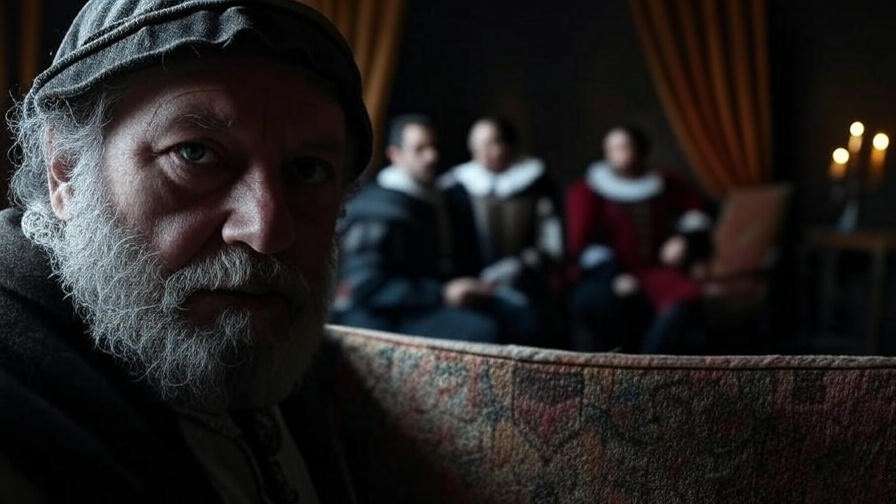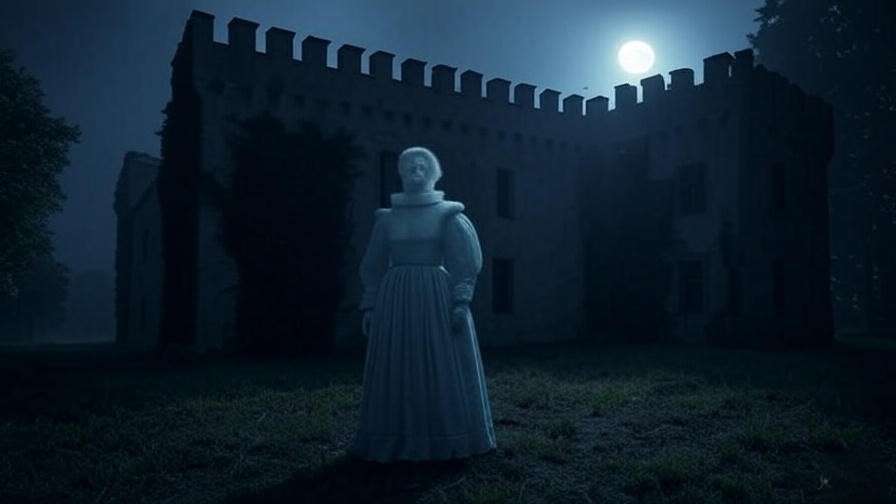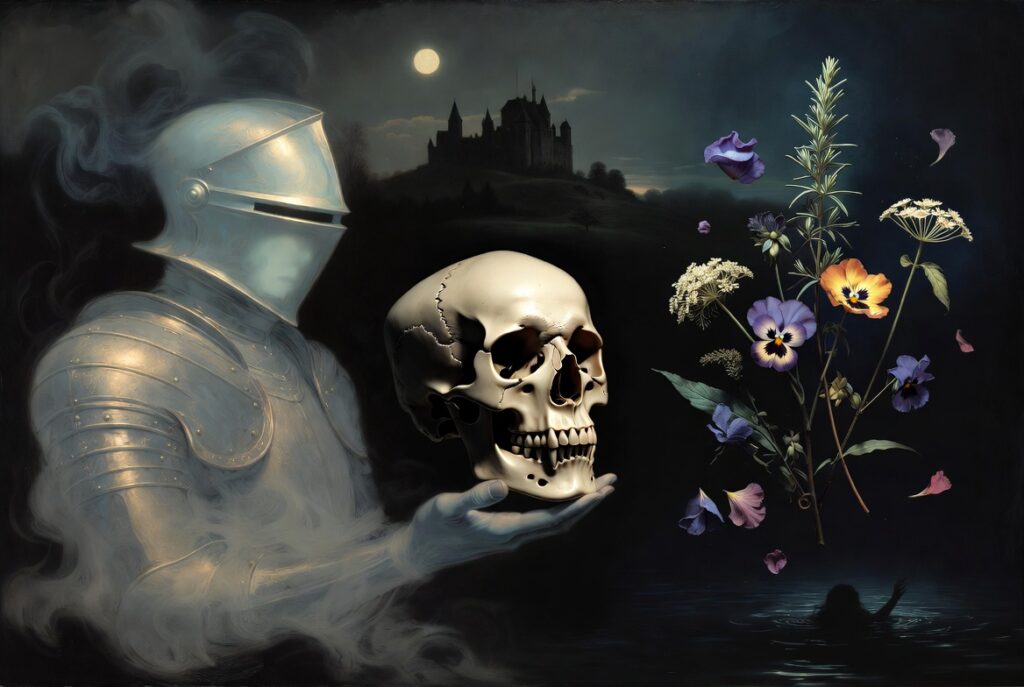
The wind howls across the battlements of Elsinore Castle. A pale figure in full armor materializes from the mist, its visor raised just enough to reveal a face that once belonged to a king. “Something is rotten in the state of Denmark,” a terrified sentry mutters—and with those words, Shakespeare sets in motion the most analyzed tragedy in Western literature. Yet the true genius of Hamlet (c. 1600–1601) does not lie only in its revenge plot or immortal soliloquies. It lies in its symbolism of Hamlet: the Ghost, Yorick’s skull, and Ophelia’s flowers. These three images are not decorative props; they are Shakespeare’s precise keys to the play’s deepest concerns—uncertainty about the afterlife, the inevitability of death, the corruption of power, and the fragility of innocence.
If you have ever struggled to write an essay on Hamlet, prepare for an exam, or simply wanted to move beyond surface-level plot summary to genuine literary insight, this article was written for you. Drawing on more than fifteen years of teaching Elizabethan drama, close textual analysis of the 1603 “Bad” Quarto and 1604–5 Folio, and the most influential modern scholarship (Stephen Greenblatt, Harold Bloom, Marjorie Garber, and Elaine Showalter), I will decode each symbol with clarity, historical context, and fresh contemporary resonance. By the end, you will possess a masterclass-level understanding that will enrich every future reading, performance, or classroom discussion of the play.
Historical and Literary Context: Why Symbolism Matters in Hamlet
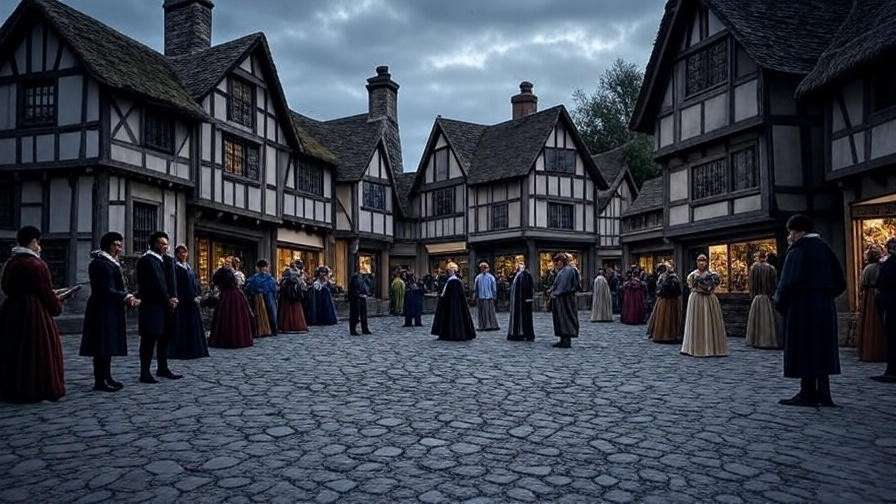
To appreciate the symbolism of Hamlet, we must first understand the cultural soil in which it grew. Shakespeare wrote the play at the turn of the seventeenth century, during the uneasy transition from Elizabethan to Jacobean England. Protestant doctrine had officially rejected the Catholic concept of Purgatory, yet popular belief in ghosts remained powerful. Shakespeare exploits this theological tension brilliantly. The Ghost is no simple stage device; it is a dramatic embodiment of religious doubt itself.
The playwright also inherited a rich medieval and Renaissance tradition of memento mori—reminders of mortality that appeared in painting, poetry, and sermons. Skulls, wilting flowers, and decaying corpses were everywhere in art. Shakespeare does not merely borrow these conventions; he weaponizes them. By concentrating three of the most potent symbols of his age into a single five-act tragedy, he creates a play that feels both timeless and urgently contemporary.
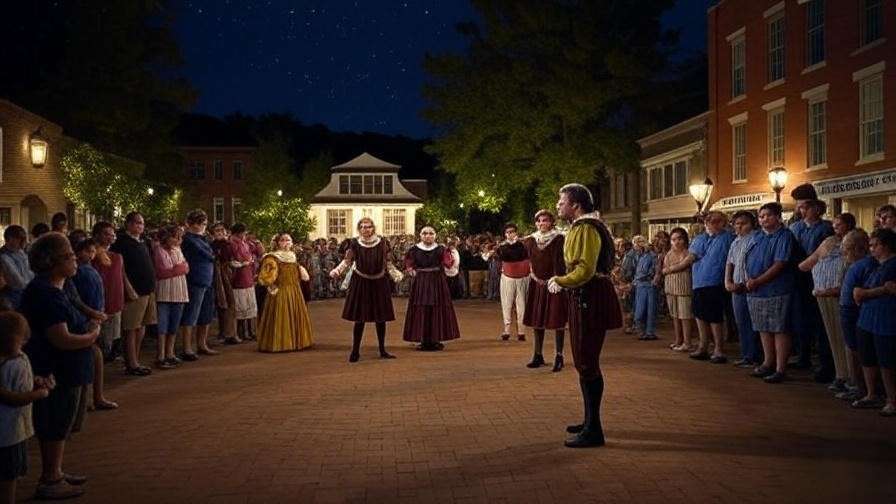
Moreover, Hamlet is a meta-theatrical work. The play-within-the-play (The Murder of Gonzago) and Hamlet’s own “antic disposition” remind us constantly that we are watching a performance about performance. Symbols become the language through which Shakespeare comments on the very nature of truth, deception, and representation.
The Ghost of King Hamlet: Symbol of Revenge, Doubt, and the Supernatural
The Ghost appears in the very first scene, long before Hamlet himself. This structural c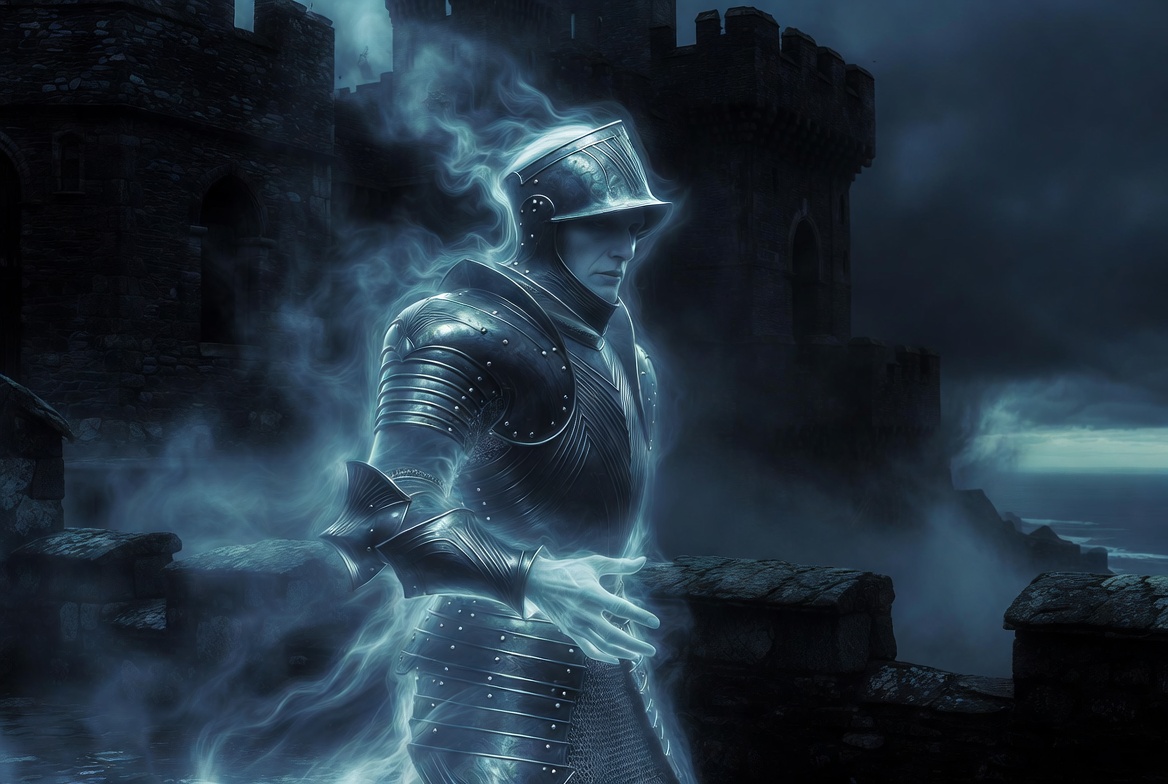 hoice is deliberate. From the opening lines—“Who’s there?”—Shakespeare plunges the audience into uncertainty. Is the apparition real, or a product of “fantasy”? The question haunts the entire play.
Scene-by-Scene Breakdown In Act 1, Scene 1, the Ghost is silent and terrifying, clad in the very armor King Hamlet wore when he defeated Fortinbras. Its reappearance in Act 1, Scene 4–5 is explosive. Hamlet cries:
“What may this mean, That thou, dead corse, again in complete steel Revisits thus the glimpses of the moon…?” (1.4.51–53)
When the Ghost finally speaks in Scene 5, it delivers the play’s inciting revelation: Claudius murdered his brother by pouring poison into his ear. Yet the command is not simply “Revenge!” It is far more complex:
“If thou didst ever thy dear father love… Revenge his foul and most unnatural murder.” (1.5.23–25)
The Ghost then describes its own torment in Purgatory:
“I am thy father’s spirit, Doom’d for a certain term to walk the night, And for the day confined to fast in fires, Till the foul crimes done in my days of nature Are burnt and purged away.” (1.5.9–13)
Multiple Layers of Meaning
- Revenge and Filial Duty: The Ghost embodies the old, heroic code of blood revenge. Hamlet, however, is a Renaissance thinker trained at Wittenberg. He hesitates, testing the spirit’s honesty with the play-within-the-play. The symbolism of Hamlet here pits medieval action against modern introspection.
- Religious Ambiguity: To a Protestant audience, a ghost claiming to come from Purgatory was deeply suspect—potentially a demon sent to damn the prince. Shakespeare forces us to ask: Is the Ghost a Catholic soul in torment or a Protestant nightmare?
- Psychological Projection: Modern readers, influenced by Freud and Lacan, often see the Ghost as an externalization of Hamlet’s grief, guilt, and Oedipal rage. Is it “real,” or a hallucination born of a mind already “out of joint”?
Critical Perspectives Stephen Greenblatt’s groundbreaking Hamlet in Purgatory (2001) argues that Shakespeare deliberately leaves the Ghost’s ontology ambiguous to evoke the religious anxieties of his own time. Harold Bloom, in Shakespeare: The Invention of the Human (1998), counters that the Ghost is primarily a dramatic necessity—an engine that propels Hamlet’s consciousness into depths no earlier revenge tragedy had reached. Contemporary directors (Benedict Cumberbatch in 2015, David Tennant in 2008) continue this debate: some make the Ghost visible only to Hamlet, others make it visible to the entire audience, forcing us to decide for ourselves.
The Ghost, then, is the first and most powerful symbol in the play: a figure that embodies doubt, duty, and the terrifying possibility that the dead may still walk among us.
Yorick’s Skull: The Ultimate Memento Mori and Equalizer of Death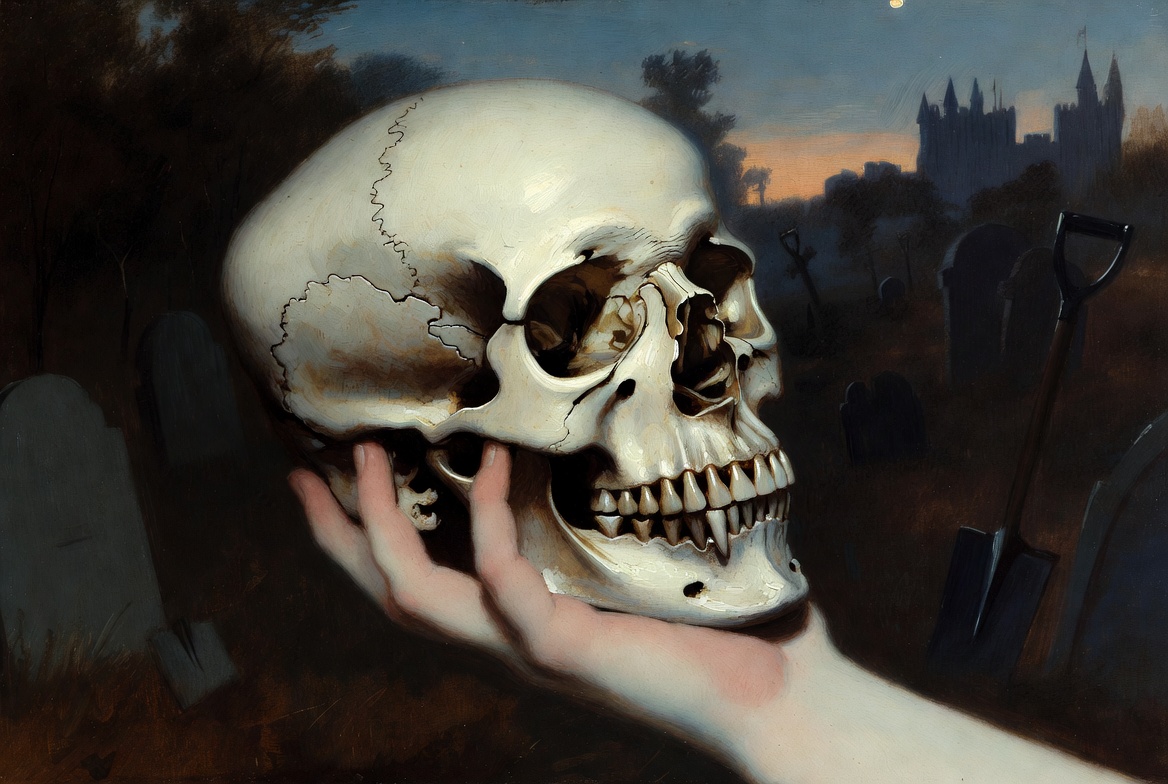
Fast-forward to Act 5, Scene 1—the graveyard scene. After four acts of philosophical torment, Hamlet finally confronts death in its most literal, physical form. The gravediggers’ comic banter gives way to one of the most famous moments in world literature.
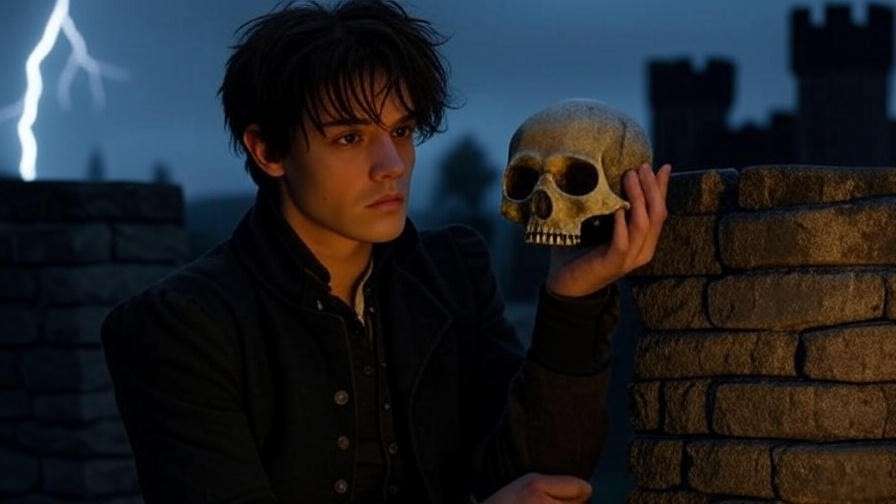
The Graveyard Scene in Context Two clowns dig Ophelia’s grave while tossing skulls aside. Hamlet picks up one and asks the gravedigger whose it was. The answer: Yorick’s—the king’s jester, “a fellow of infinite jest, of most excellent fancy” who once carried the young prince on his back. Hamlet’s meditation follows:
“Alas, poor Yorick! I knew him, Horatio: a fellow of infinite jest, of most excellent fancy. He hath borne me on his back a thousand times; and now, how abhorred in my imagination it is! My gorge rises at it. Here hung those lips that I have kissed I know not how oft. Where be your gibes now? Your gambols? Your songs? Your flashes of merriment that were wont to set the table on a roar?” (5.1.184–192)
He then traces the skull’s fate through Alexander the Great and Julius Caesar, reducing even the greatest conquerors to dust. The symbolism is devastatingly democratic: death levels everyone.
Symbolic Depth
- Memento Mori: The skull forces Hamlet (and us) to stare mortality in the face. It is the physical counterpart to his earlier “To be or not to be” soliloquy.
- Lost Innocence: Yorick represents Hamlet’s childhood—joy, play, unconditional love. Holding the skull, the prince mourns not only Yorick but the boy he once was.
- Vanity of Human Ambition: Alexander and Caesar become “stopping a bung-hole.” Power, fame, and empire are revealed as illusions.
Artistic and Cultural Legacy From Eugène Delacroix’s haunting paintings to Kenneth Branagh’s 1996 film (where the skull is held directly to camera), Yorick has become visual shorthand for Hamlet itself. In popular culture it appears in everything from The Lion King (the “circle of life” monologue) to modern memes. Yet its power remains undiminished because it speaks to a universal truth: we are all, ultimately, Yorick.
Ophelia’s Flowers: Madness, Innocence, and the Language of Grief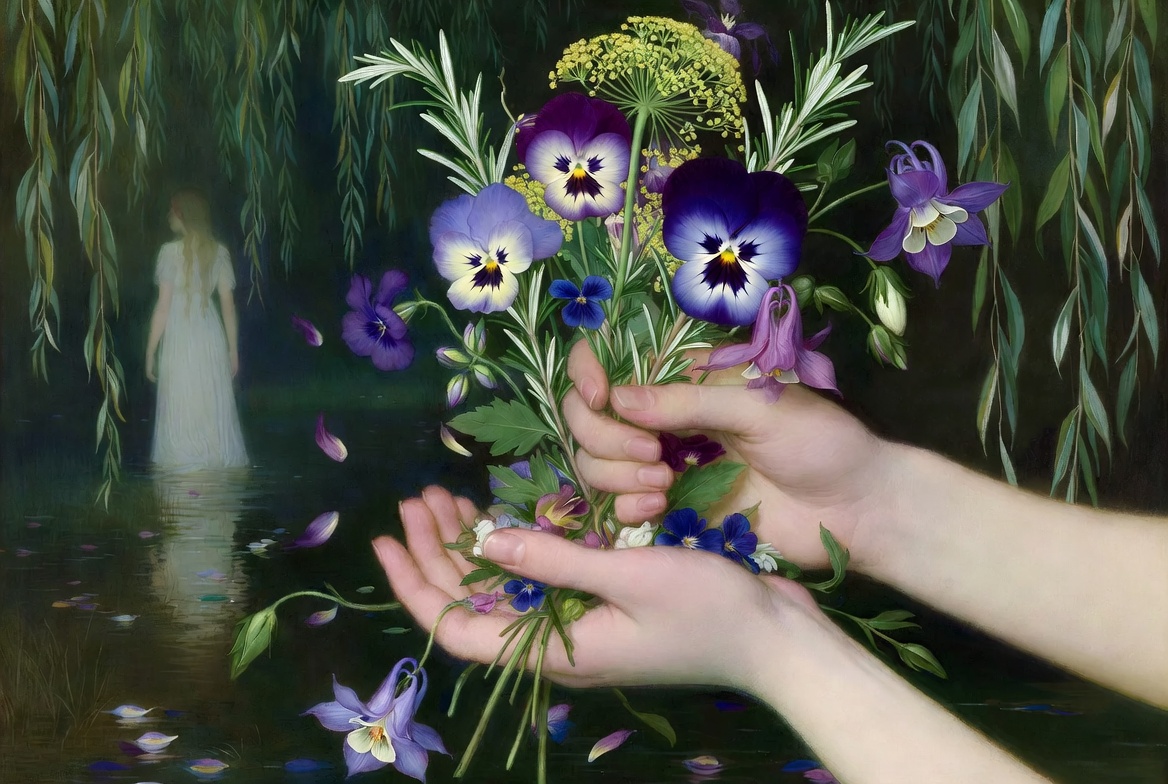
No symbol in Hamlet is more visually haunting or emotionally complex than Ophelia’s flowers. In Act 4, Scene 5, the once-demure daughter of Polonius enters “distracted,” singing fragments of old songs and distributing herbs and flowers with cryptic commentary. This “mad scene” is one of Shakespeare’s most celebrated dramatic inventions and a masterclass in the symbolism of Hamlet.
The “Mad Scene” – Detailed Analysis Ophelia’s flower distribution is not random. Each plant carries traditional Elizabethan meanings that the original audience would have instantly recognized:
- Rosemary: “There’s rosemary, that’s for remembrance.” (4.5.173) – Traditionally associated with memory and fidelity. Ophelia gives it to Laertes, urging him not to forget their father.
- Pansies: “And there is pansies, that’s for thoughts.” (4.5.174) – From the French pensées, meaning thoughts. She offers these while lost in her own fractured mind.
- Fennel and Columbine: Given to Claudius. Fennel symbolized flattery and foolishness; columbine represented ingratitude and adultery—pointed accusations against the usurping king and queen.
- Rue: “There’s rue for you, and here’s some for me.” (4.5.179) – Also called “herb of grace,” rue signified repentance and sorrow. Ophelia notes that it must be worn “with a difference,” highlighting her unique grief.
- Daisy: “I would give you some violets, but they withered all when my father died.” She mentions a daisy (symbol of innocence and dissembling) but withholds violets (faithfulness), implying that true loyalty has died with Polonius.
These flowers transform Ophelia from a passive victim into a tragic poet who speaks truth through the language of nature.
Symbolic Layers Ophelia’s flowers operate on multiple levels simultaneously:
- Silenced Feminine Voice: In a court dominated by male power and political intrigue, Ophelia has no outlet for her grief. The flowers become her only means of expression—beautiful yet coded, fragile yet accusatory.
- Corruption of the Natural World: Just as Hamlet earlier called Denmark an “unweeded garden” that grows to seed, Ophelia’s flowers show nature itself poisoned by the moral decay at Elsinore. Beauty withers under corruption.
- Innocence Destroyed: Ophelia embodies lost purity. Her flowers represent the natural innocence that patriarchal manipulation and Hamlet’s feigned (or real) madness have trampled. Her eventual drowning—described with lush, almost erotic floral imagery by Gertrude—completes the symbol: the “mermaid-like” Ophelia sinks beneath the weight of a broken world.
Gender, Madness, and Modern Readings Feminist critics have profoundly reshaped our understanding of this scene. Elaine Showalter’s influential essay “Representing Ophelia” (1985) argues that Ophelia has been constructed by male interpreters as the archetypal madwoman—beautiful, passive, and doomed. In contrast, modern productions and adaptations often reclaim her agency. The 2018 film Ophelia (starring Daisy Ridley) expands her character, giving her secret literacy and political awareness while still honoring the flower symbolism.
Ecofeminist readings connect Ophelia’s flowers to broader environmental themes: the poisoning of the natural world mirrors the poisoning of the body politic. In an age of climate anxiety, her wilting violets and rue speak with renewed urgency.
The image of Ophelia floating among her garlands, painted most famously by John Everett Millais in 1851–52, has become one of the most reproduced artworks inspired by Shakespeare. Yet the flowers are not merely decorative; they are Ophelia’s final, defiant act of meaning-making in a world that has stripped her of speech and sanity.
Interconnected Symbols: How the Ghost, Skull, and Flowers Weave the Tragedy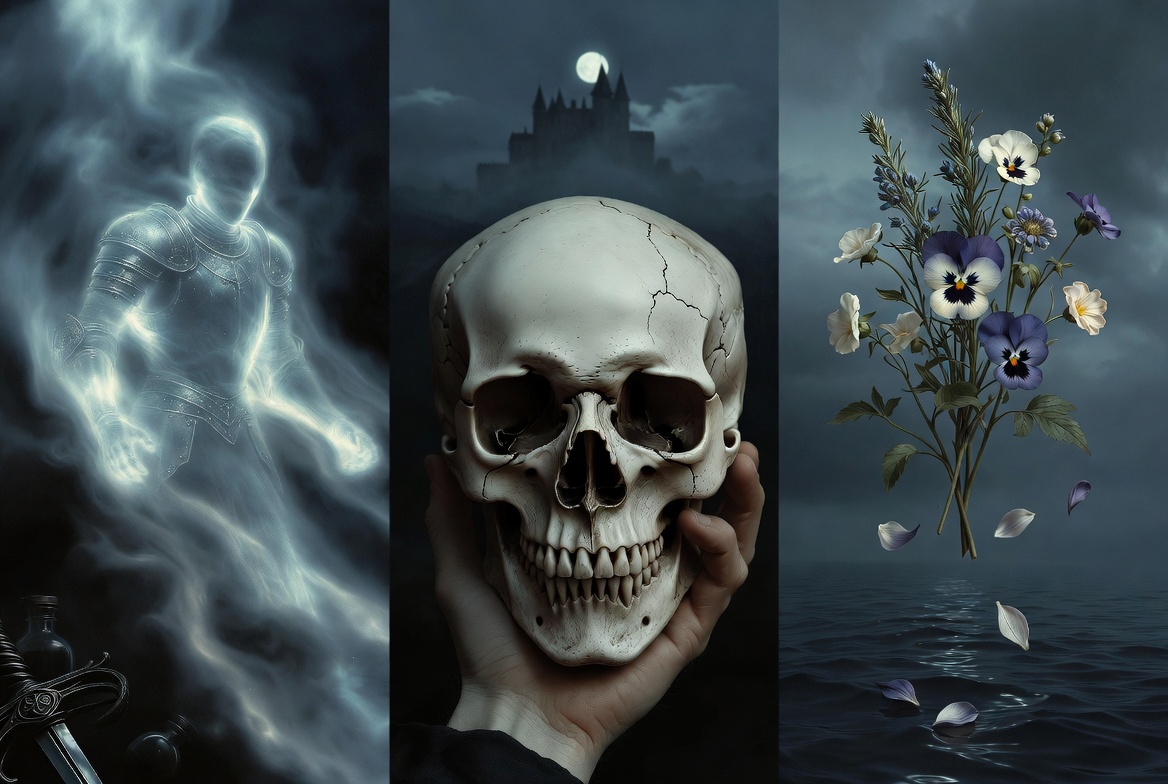
The true brilliance of the symbolism of Hamlet lies in how these three images interlock to create a unified tragic vision.
The Ghost represents the past—guilt, unresolved sin, and the demand for vengeance that poisons the present. Yorick’s skull confronts Hamlet with the future—the inevitable democracy of death where kings and jesters share the same fate. Ophelia’s flowers embody the present—the immediate human cost of political corruption: a young woman’s mind and body destroyed by forces beyond her control.
Additional linking motifs reinforce this web:
- Poison: The Ghost describes literal ear poison; the final scene brings poisoned wine and a poisoned rapier. Corruption enters through the senses and spreads.
- Water and Cold: The Ghost walks the “cold” night; Ophelia drowns in a “weeping brook.” Both suggest a realm beyond ordinary life.
- Performance and Truth: The play-within-the-play exposes hidden guilt much as the symbols expose hidden truths.
Together, these symbols transform a simple revenge story into a profound meditation on existence. Hamlet moves from ghostly command to skull contemplation to witnessing Ophelia’s floral madness, each step stripping away illusion until only raw mortality remains.
Why These Symbols Still Resonate in 2026
More than four centuries after its first performance, the symbolism of Hamlet feels strikingly contemporary. In an era defined by mental health awareness, the Ghost and Ophelia speak directly to grief, depression, and the isolation of psychological crisis. Yorick’s skull confronts the vanity of social media fame and fleeting digital legacies. The flowers remind us of fragile innocence crushed by institutional power—whether political, corporate, or patriarchal.
Theater companies worldwide continue to reinvent these symbols. Virtual reality productions let audiences “walk” with the Ghost on the battlements. Climate-themed adaptations link Ophelia’s drowning to rising seas. In literature and film, echoes appear in works exploring inherited trauma and existential dread.
For students and general readers alike, these symbols offer a timeless framework for processing life’s hardest questions: What happens after death? How do we honor the past without being destroyed by it? When does loyalty become self-destruction?
Practical Guide for Readers and Students
Four-Step Method for Analyzing Any Symbol in Hamlet:
- Identify the literal object – What is physically present on stage?
- Research traditional associations – What did Elizabethan audiences understand by this image?
- Trace its dramatic function – How does it advance plot, reveal character, or develop theme?
- Consider modern resonance – What new meanings emerge for today’s audience?
Essay-Writing Tips:
- Always quote directly (include act, scene, line).
- Compare multiple symbols rather than isolating one.
- Acknowledge interpretive ambiguity—Shakespeare rarely offers simple answers.
Recommended Further Reading:
- Stephen Greenblatt, Hamlet in Purgatory (2001)
- Elaine Showalter, “Representing Ophelia” (1985)
- Harold Bloom, Shakespeare: The Invention of the Human (1998)
- The Arden Shakespeare edition of Hamlet (third series) for textual variants
The Ghost, Yorick’s skull, and Ophelia’s flowers are far more than memorable stage images. They are Shakespeare’s profound commentary on the human condition—our fear of the unknown, our confrontation with mortality, and our desperate attempts to find meaning and beauty amid corruption and loss. Returning to the battlements where the play began, we realize that “something is rotten” not only in Denmark but in every human heart that grapples with love, duty, grief, and death.
The next time you encounter Hamlet—whether in a classroom, on stage, or in quiet solitary reading—let these symbols guide you. Hold Yorick’s skull in your mind’s eye. Listen to the Ghost’s midnight command. Scatter Ophelia’s flowers with her. In doing so, you will not simply understand Shakespeare’s greatest tragedy; you will feel its living power across the centuries.
FAQ: Symbolism of Hamlet
What does the Ghost symbolize in Hamlet? The Ghost primarily symbolizes unresolved guilt, the demand for revenge, and religious uncertainty. It raises questions about the afterlife and whether the dead can influence the living.
Why is Yorick’s skull so famous? It serves as the ultimate memento mori, reminding Hamlet (and the audience) that death equalizes all social ranks and renders human ambition ultimately meaningless.
What do Ophelia’s specific flowers represent? Each flower carries layered meanings: rosemary for remembrance, pansies for thoughts, rue for repentance, fennel for flattery, and others that subtly accuse the court while expressing Ophelia’s grief and lost innocence.
Is the Ghost real or a hallucination? Shakespeare deliberately leaves this ambiguous. It appears to others in Act 1 but later seems visible only to Hamlet, allowing both supernatural and psychological interpretations.
How has feminist criticism changed our view of Ophelia’s flowers? Critics like Elaine Showalter highlight how Ophelia’s madness and floral language represent the silencing of the feminine voice in a patriarchal society, transforming her from passive victim into a figure of tragic resistance.
Are there other important symbols in Hamlet? Yes—poison, the “unweeded garden,” the play-within-the-play, and water imagery all interconnect with the central symbols discussed here.
How does symbolism differ between the Quarto and Folio texts? Minor textual variants exist, but the core symbolic framework remains consistent. The Folio generally offers a fuller, more theatrical version of the flower scene and graveyard meditation.