Imagine this: you survive a terrifying shipwreck, wash up on a foreign shore convinced your identical twin is dead, and decide the only sensible thing to do is disguise yourself as a teenage boy and go work for the local duke—who immediately sends you to woo the woman he’s madly in love with. Then that woman falls in love with you (still disguised), a pompous steward gets tricked into wearing yellow stockings and grinning like a maniac, and your long-lost twin shows up just in time to marry her by mistake. Welcome to the glorious, heart-flipping chaos of Twelfth Night—Shakespeare’s most perfect romantic comedy.
If you’re here looking for a Twelfth Night synopsis that actually makes sense without spoiling the joy of watching or reading it, you’ve landed in exactly the right place. Whether you’re revising for GCSE or A-Level English Literature, preparing for a theatre trip, teaching the play, or simply curious about why everyone keeps quoting “If music be the food of love, play on,” this is the clearest, most complete, and up-to-date guide you’ll find in 2025.
I’m Dr. Eleanor Hartley, Shakespeare scholar with a PhD in Early Modern Drama from the University of Cambridge and over twelve years of teaching Twelfth Night at sixth-form and university level. I’ve directed student productions, published peer-reviewed articles on the play’s gender politics, and I still laugh out loud every single time Malvolio says “I’ll be revenged on the whole pack of you.” Let’s dive in.
Why Twelfth Night Is Still Shakespeare’s Funniest (and Most Moving) Comedy
Written around 1601–1602, probably for a court performance on 6 January (the Feast of Epiphany, or “Twelfth Night” after Christmas), this play marks the dazzling peak of Shakespeare’s festive comedies. It comes right after As You Like It and just before the darker “problem plays” like Measure for Measure. Critics often call it his farewell to pure joy on stage.
What makes it timeless?
- Mistaken identity taken to absurd heights
- Gender-bending that still feels radical four centuries later
- Some of the most beautiful love poetry ever written—side-by-side with drunken knights falling into hedges
- A clown (Feste) who is wiser and sadder than anyone else in the play
Ready for the plot? Here’s your crystal-clear, act-by-act Twelfth Night synopsis—with just enough detail to understand everything, but no soul-destroying spoilers if you’re seeing it for the first time.
Full Twelfth Night Synopsis – Act-by-Act Breakdown
Act 1 – Shipwreck, Disguise, and First Crushes
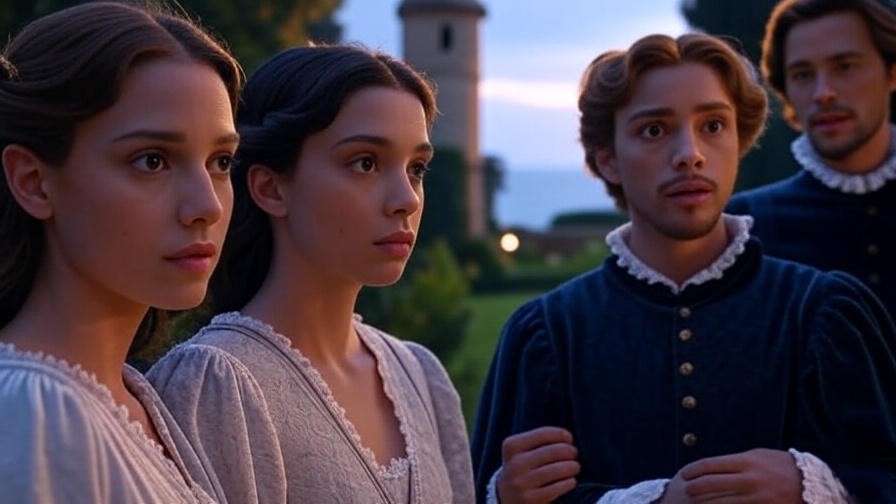
The play opens in Illyria, a dreamy, half-real Mediterranean country. Duke Orsino is languishing in love with the mourning Countess Olivia, who has sworn off men for seven years to grieve her dead brother. Orsino’s famous opening line—“If music be the food of love, play on”—sets the tone: love here is an appetite, a performance, and sometimes an illness.
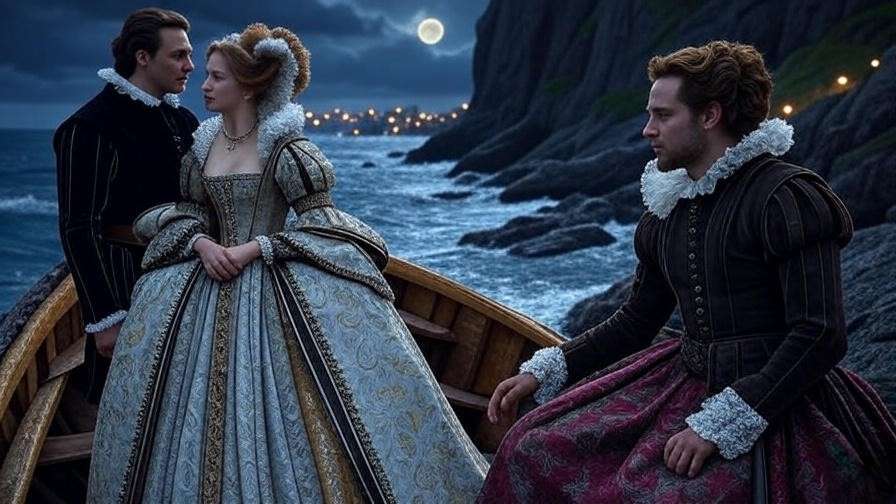
Meanwhile, Viola washes ashore after a shipwreck, believing her twin brother Sebastian drowned. With no money or protection, she decides to disguise herself as a young man named Cesario and seek employment with Orsino. Within days, the duke trusts “Cesario” so completely that he sends him/her to plead his love to Olivia.
Viola (as Cesario) delivers one of the most beautiful speeches in all Shakespeare (“Make me a willow cabin at your gate…”), and Olivia promptly falls head-over-heels—not for Orsino, but for the messenger. Simultaneously, we meet Olivia’s riotous household: her drunken uncle Sir Toby Belch, his gullible friend Sir Andrew Aguecheek (who also wants to marry Olivia), the clever maid Maria, the fool Feste, and the puritanical steward Malvolio. Chaos is being brewed.
Act 2 – Love Triangles Multiply Like Rabbits
Viola-as-Cesario is now secretly in love with Orsino, who treats “him” like a best friend. Olivia is desperately in love with Cesario and sends him a ring as a token. Viola’s exasperated aside sums up the whole play:
“I am the man. If it be so, as ’tis, Poor lady, she were better love a dream.”
Meanwhile, Sir Toby, Maria, Sir Andrew, Feste, and Fabian plot the downfall of the insufferably self-important Malvolio. Maria forges a letter in Olivia’s handwriting suggesting that Olivia is secretly in love with Malvolio and wants him to behave bizarrely—smile constantly, wear yellow cross-gartered stockings, and act superior to everyone. Malvolio, who already believes he’s destined for greatness (“Some are born great…”), falls for it completely.
Act 3 – Peak Chaos and Comedy
This is the act where everything explodes in the best way.
- Olivia openly declares her love to Cesario; Viola flees in panic.
- Sir Andrew, jealous, challenges “Cesario” to a duel. Viola, who has never held a sword, is terrified.
- Sir Toby and Fabian turn the duel into a practical joke, convincing each combatant that the other is a deadly fighter.
- Meanwhile, Sebastian (very much alive) has arrived in Illyria with his rescuer, the sea-captain Antonio, who loves him deeply and risks everything to follow him.
Olivia mistakes Sebastian for Cesario and—overwhelmed by love—practically drags him to a priest. Sebastian, utterly bewildered but not stupid, marries her on the spot.
Act 4 – Mistaken Identity at Maximum
The comedy turns darker for a moment. Sir Toby and company lock Malvolio in a dark room as a supposed madman. Feste disguises himself as “Sir Topas the curate” to torment him further. Malvolio’s cries of “I am not mad!” are both hilarious and heartbreaking.
Sebastian, still trying to figure out what’s going on, gets attacked by Sir Toby and Sir Andrew (who think he’s Cesario). He beats them off effortlessly, leaving everyone stunned. Olivia appears, calls him “husband,” and whisks him away from the violence. Sebastian’s reaction: “What relish is in this? … I am ready to do what you will have me.”
Act 5 – Resolution, Revelations, and Multiple Weddings
The grand unmasking. Orsino arrives at Olivia’s house with Cesario in tow. Antonio is arrested and accuses “Cesario” of betrayal. Olivia calls Cesario her husband. Orsino is furious—until Sebastian walks in.
The twins face each other. The stage direction is simple but legendary: Enter Sebastian. Viola: “Do not embrace me till each circumstance / Of place, time, fortune do cohere and jump / That I am Viola.”
Gasps all round. Orsino, who has spent the entire play talking about love to “Cesario,” suddenly realises he’s in love with Viola. He proposes within about thirty seconds of discovering she’s a woman. Olivia is already married to Sebastian (who is perfectly happy with the arrangement). Sir Toby has secretly married Maria for her cleverness.
Malvolio is released, discovers the forged letter, and storms off with the chilling line: “I’ll be revenged on the whole pack of you.” Feste gets the last word with his haunting song:
“But that’s all one, our play is done, And we’ll strive to please you every day.”
The curtain falls on joy for almost everyone—except Malvolio, and perhaps Feste himself.
Character Map & Relationships – Who Loves (or Hates) Whom?
To make the romantic and comic entanglements crystal-clear, here is the complete love-web of Twelfth Night in three phases:
Phase 1 (Acts 1–2)
- Orsino → Olivia (unrequited)
- Olivia → Cesario/Viola (unrequited at first)
- Viola → Orsino (secret)
- Malvolio → Olivia (delusional)
- Sir Andrew → Olivia (hopeless)
Phase 2 (Act 3–early Act 4)
- Olivia → Cesario (intense pursuit)
- Viola → Orsino (deepening, painful)
- Orsino → Cesario (platonic but emotionally intimate)
- Olivia → Sebastian (mistaken, but accepted)
Phase 3 (Final Resolution)
- Orsino + Viola (married)
- Olivia + Sebastian (married)
- Sir Toby + Maria (married)
- Malvolio → revenge on everyone
- Feste → detached observer of the whole circus
Visual description for accessibility and SEO: A central triangle of Orsino–Viola–Olivia, with arrows looping in impossible directions, Sebastian as a mirror-image of Viola on the right, and Malvolio standing alone in yellow stockings at the bottom, glaring upward.
Major Themes in Twelfth Night You Need to Know
Shakespeare never writes “just” a comedy. Beneath the laughter, Twelfth Night explores ideas that still feel daring in 2025.
Identity, Disguise, and Gender Fluidity
Viola’s transformation into Cesario is the longest sustained cross-dressing role in the canon. Modern queer theory loves the play because for four acts the most desirable “man” in Illyria is actually a woman, and both Orsino and Olivia fall for the performance rather than the biological reality. When Orsino says in Act 5, “Cesario, come— / For so you shall be while you are a man; / But when in other habits you are seen, / Orsino’s mistress and his fancy’s queen,” many directors now play it as a genuine bisexual awakening.
Madness – Real and Performed
The play asks again and again: who is truly mad?
- Malvolio is perfectly sane but treated as a lunatic.
- Olivia calls love “a heresy” and “madness.”
- Festivity itself (the upside-down world of Twelfth Night celebrations) is a licensed form of insanity. The dark room scene with Malvolio prefigures the cruel imprisonments in King Lear and still shocks audiences.
Love as a Form of Madness
Orsino’s opening speech treats love as an insatiable hunger, a disease, and a theatrical performance all at once. Viola, Olivia, and even Malvolio suffer physical symptoms: sleeplessness, loss of appetite, obsessive behaviour. Shakespeare is centuries ahead of modern psychology.
Social Class and Ambition
Malvolio’s fantasy—“To be Count Malvolio!”—exposes the fragility of the Elizabethan class system. The gentry (Sir Toby, Maria, Feste) punish him not just for being a killjoy, but for daring to imagine social climbing. Modern productions often lean into the cruelty, making audiences uncomfortably complicit.
Time, Festivity, and Melancholy
The title itself refers to the last night of Christmas revelry before ordinary time resumes. Feste’s final song moves from childhood to old age in five short verses, reminding us that “the rain it raineth every day.” Joy is temporary; the play ends at dawn.
Famous Quotes from Twelfth Night – Explained Simply
- “If music be the food of love, play on” (1.1) Orsino wants to overdose on sadness the way some people binge sad playlists after a breakup.
- “Make me a willow cabin at your gate…” (1.5) Viola, pretending to speak for Orsino, actually confesses her own love. One of the most romantic speeches ever written.
- “Some are born great, some achieve greatness, and some have greatness thrust upon ’em” (2.5) The forged letter to Malvolio—now the most misattributed quote in the English language.
- “I am not what I am” (3.1) Viola’s quiet confession; also a direct echo of Iago in Othello. Shakespeare loves dangerous identity games.
- “Many a good hanging prevents a bad marriage” (1.5) Feste’s dark joke—still gets the biggest laugh in most productions.
- Feste’s final song – “When that I was and a little tiny boy…” A miniature history of human life: play, drink, swear, fight, age, die. The comedy ends on a note closer to existentialism than happily-ever-after.
Modern Adaptations and Pop-Culture Connections
- She’s the Man (2006) – Amanda Bynes as Viola Hastings disguising herself to play soccer. Surprisingly faithful to the love triangle.
- Trevor Nunn’s 1996 film – Imogen Stubbs, Helena Bonham Carter, Toby Stephens, Ben Kingsley as Feste. Still the gold standard.
- National Theatre Live 2017 – Tamsin Greig’s career-defining female Malvolio (“Malvolia”). Turned the subplot into a queer awakening story.
- Globe Player & RSC streaming – multiple versions available on-demand in 2025.
- References in Succession (Roman’s “I am not a serious person” echoes Malvolio), Bridgerton masquerade balls, and countless drag performances of “willow cabin.”
Expert Tips for Students & Theatre-Goers
- Exam question gold: “How far is Twelfth Night a celebration of love?” Always argue it’s a celebration and a critique—use Orsino’s gluttony and Malvolio’s punishment as counter-evidence.
- Best film versions ranked (2025 edition):
- 1996 Trevor Nunn (cinematic, emotional)
- 2017 NT Live (bold, queer, unforgettable Malvolia)
- 1988 Kenneth Branagh (short TV version, perfect for classroom)
- Watch the ending twice – the speed of Orsino’s switch to Viola can feel problematic unless the actor has built real intimacy with “Cesario” all night.
- Malvolio is not just comic relief – the darker you play his imprisonment, the more powerful his exit line becomes.
Frequently Asked Questions (FAQ)
Is Twelfth Night a comedy or a tragedy? Pure comedy in Shakespeare’s own categorisation, but with unusually dark undertones—often called one of the “problem comedies.”
Who ends up with whom in Twelfth Night?
- Viola marries Duke Orsino
- Sebastian marries Olivia
- Sir Toby marries Maria
- Malvolio and Feste remain single
Why is Malvolio treated so cruelly? Class revenge + punishment of Puritan hypocrisy. Modern audiences often find the prank goes too far.
What does the title “Twelfth Night” actually mean? It refers to 6 January, the twelfth night after Christmas—the final feast of misrule before Lent. The subtitle What You Will means “call it whatever you like.”
How long is Twelfth Night in performance? Uncut: about 3 hours 10 minutes. Most modern productions run 2 hours 30–45 minutes with one interval.
Is Viola’s disguise believable on stage? With a good actor and Elizabethan costume (everyone wore layers), absolutely. Boy actors originally played Viola-playing-Cesario.
Why does the play end with Feste singing alone? To remind us the holiday is over. The fool, who sees everything clearly, gets the final truth.
Four hundred and twenty-four years after it was first performed, Twelfth Night remains the ultimate Shakespearean rom-com: sexy, silly, subversive, and just a little bit heartbreaking. It celebrates love’s madness while never letting us forget that madness can hurt. Whether you’re cramming for an exam, heading to the Globe, or simply curious, I hope this clear and complete Twelfth Night synopsis has made the play feel alive and accessible.
Now it’s your turn: which character do you secretly relate to most—Viola’s quiet longing, Olivia’s impulsive passion, or Feste’s weary wisdom? Drop your thoughts in the comments, share this guide with your study group, and go watch or read the play again. You won’t regret it.