Imagine receiving the devastating news that your spouse has died in a tragic accident. Grief crashes over you like a wave—yet within minutes, something unexpected stirs: a whisper of liberation, a glimpse of a life finally your own. In just a few hundred words, Kate Chopin’s “The Story of an Hour” captures this radical emotional pivot, turning a moment of supposed tragedy into a profound meditation on freedom, repression, and the hidden costs of marriage. Published in 1894, this short masterpiece remains one of the most powerful explorations of women’s inner lives in American literature.
If you’re searching for The Story of an Hour PDF, you’re likely a student preparing for class, a teacher building lessons, a literature enthusiast revisiting classics, or someone drawn to its timeless themes of autonomy and self-assertion. This comprehensive guide delivers exactly what you need: the full public-domain text of Kate Chopin’s story (formatted for easy reading, copying, or saving as your personal PDF reference), followed by expert-level analysis, unpacked symbols, key themes, historical context, and practical study tools. Far more than a simple download, this article equips you to truly understand Chopin’s genius—why the story shocked early readers, how it prefigures modern feminist thought, and why it still resonates in discussions of gender roles, mental health, and personal freedom today.
As literary scholars who explore timeless works from Shakespearean tragedies to American realism, we draw on established interpretations, scholarly sources, and close textual reading to provide trustworthy, nuanced insights. Let’s begin with the complete story.
Full Text of “The Story of an Hour” by Kate Chopin
Knowing that Mrs. Mallard was afflicted with a heart trouble, great care was taken to break to her as gently as possible the news of her husband’s death.
It was her sister Josephine who told her, in broken sentences; veiled hints that revealed in half concealing. Her husband’s friend Richards was there, too, near her. It was he who had been in the newspaper office when intelligence of the railroad disaster was received, with Brently Mallard’s name leading the list of “killed.” He had only taken the time to assure himself of its truth by a second telegram, and had hastened to forestall any less careful, less tender friend in bearing the sad message.
She did not hear the story as many women have heard the same, with a paralyzed inability to accept its significance. She wept at once, with sudden, wild abandonment, in her sister’s arms. When the storm of grief had spent itself she went away to her room alone. She would have no one follow her.
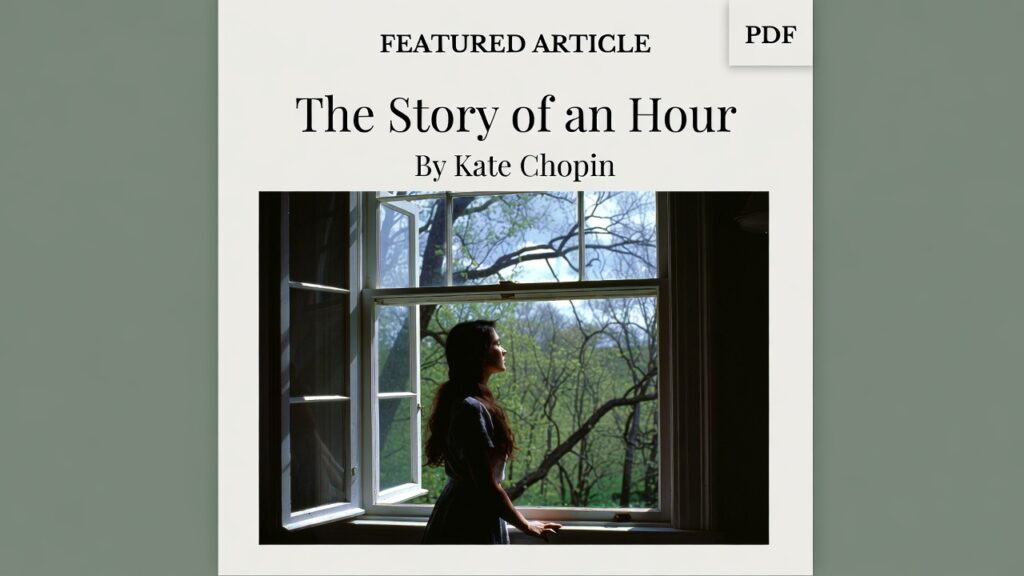
There stood, facing the open window, a comfortable, roomy armchair. Into this she sank, pressed down by a physical exhaustion that haunted her body and seemed to reach into her soul.
She could see in the open square before her house the tops of trees that were all aquiver with the new spring life. The delicious breath of rain was in the air. In the street below a peddler was crying his wares. The notes of a distant song which some one was singing reached her faintly, and countless sparrows were twittering in the eaves. There were patches of blue sky showing here and there through the clouds that had met and piled one above the other in the west facing her window.
She sat with her head thrown back upon the cushion of the chair, quite motionless, except when a sob came up into her throat and shook her, as a child who has cried itself to sleep continues to sob in its dreams.
She was young, with a fair, calm face, whose lines bespoke repression and even a certain strength. But now there was a dull stare in her eyes, whose gaze was fixed away off yonder on one of those patches of blue sky. It was not a glance of reflection, but rather indicated a suspension of intelligent thought.
There was something coming to her and she was waiting for it, fearfully. What was it? She did not know; it was too subtle and elusive to name. But she felt it, creeping out of the sky, reaching toward her through the sounds, the scents, the color that filled the air.
Now her bosom rose and fell tumultuously. She was beginning to recognize this thing that was approaching to possess her, and she was striving to beat it back with her will—as powerless as her two white slender hands would have been. When she abandoned herself a little whispered word escaped her slightly parted lips. She said it over and over under her breath: “free, free, free!” The vacant stare and the look of terror that had followed it went from her eyes. They stayed keen and bright. Her pulses beat fast, and the coursing blood warmed and relaxed every inch of her body.
She did not stop to ask if it were or were not a monstrous joy that held her. A clear and exalted perception enabled her to dismiss the suggestion as trivial.
She knew that she would weep again when she saw the kind, tender hands folded in death; the face that had never looked save with love upon her, fixed and gray and dead. But she saw beyond that bitter moment a long procession of years to come that would belong to her absolutely. And she opened and spread her arms out to them in welcome.
There would be no one to live for her during those coming years; she would live for herself. There would be no powerful will bending hers in that blind persistence with which men and women believe they have a right to impose a private will upon a fellow-creature. A kind intention or a cruel intention made the act seem no less a crime as she looked upon it in that brief moment of illumination.
And yet she had loved him—sometimes. Often she had not. What did it matter! What could love, the unsolved mystery, count for in face of this possession of self-assertion which she suddenly recognized as the strongest impulse of her being!
“Free! Body and soul free!” she kept whispering.
Josephine was kneeling before the closed door with her lips to the keyhole, imploring for admission. “Louise, open the door! I beg, open the door—you will make yourself ill. What are you doing, Louise? For heaven’s sake open the door.”
“Go away. I am not making myself ill.” No; she was drinking in a very elixir of life through that open window.
Her fancy was running riot along those days ahead of her. Spring days, and summer days, and all sorts of days that would be her own. She breathed a quick prayer that life might be long. It was only yesterday she had thought with a shudder that life might be long.
She arose at length and opened the door to her sister’s importunities. There was a feverish triumph in her eyes, and she carried herself unwittingly like a goddess of Victory. She clasped her sister’s waist, and together they descended the stairs. Richards stood waiting for them at the bottom.
Someone was opening the front door with a latchkey. It was Brently Mallard who entered, a little travel-stained, composedly carrying his grip-sack and umbrella. He had been far from the scene of the accident, and did not even know there had been one. He stood amazed at Josephine’s piercing cry; at Richards’ quick motion to screen him from the view of his wife.
But Richards was too late.
When the doctors came they said she had died of heart disease—of the joy that kills.
Quick Summary of “The Story of an Hour”
In this compact tale—under 1,300 words—Louise Mallard learns of her husband Brently’s death in a railroad accident. After initial wild grief, she retreats alone to her room. Gazing out an open window at signs of spring renewal, she experiences a profound realization: freedom. The years ahead will belong to her alone. She descends triumphantly, only for Brently to walk in alive (he was never on the train). The shock kills her. Doctors attribute her death to “the joy that kills”—a devastating ironic misdiagnosis.
In-Depth Character Analysis
Kate Chopin’s “The Story of an Hour” features a small cast, yet each character serves a precise purpose in illuminating the central conflict: the tension between individual selfhood and societal expectations, particularly within marriage. The story’s psychological depth emerges primarily through its protagonist, with supporting figures reinforcing the irony and thematic weight.
Louise Mallard – The Protagonist’s Transformation
Louise Mallard stands as one of American literature’s most compelling portraits of a woman’s inner awakening. Described as “young, with a fair, calm face, whose lines bespoke repression and even a certain strength,” she embodies the quiet endurance many 19th-century women were expected to display. Her “heart trouble” is introduced immediately—not merely as a medical condition, but as a metaphor for emotional constriction under patriarchal norms.
The story traces Louise’s rapid psychological evolution. Initial grief is genuine and intense (“sudden, wild abandonment”), reflecting societal conditioning. Yet, alone in her room, a shift occurs. As she gazes out the open window, she confronts an approaching realization she initially resists: freedom. The whispered mantra “free, free, free!” marks her epiphany—her “possession of self-assertion” overrides even love for her husband. Chopin masterfully conveys this through physical details: her pulses quicken, blood courses warmly, body relaxes. This is no mere relief; it’s a rebirth.
Critics often interpret Louise as a proto-feminist figure. Her brief taste of autonomy—”There would be no powerful will bending hers”—highlights how marriage, even a “kind” one, imposes a “blind persistence” that subordinates women’s wills. Her triumphant descent, carrying herself “like a goddess of Victory,” underscores this fleeting empowerment. Tragically, Brently’s return shatters it, leading to her death. The doctors’ verdict—”the joy that kills”—ironically misreads her demise as overwhelming happiness at her husband’s survival, when it stems from the abrupt loss of her newfound independence.
Supporting Characters: Josephine, Richards, and Brently Mallard
These figures frame Louise’s experience and amplify the story’s irony. Josephine, Louise’s sister, acts with protective tenderness, using “veiled hints” to deliver the news. Her concern (“Louise, open the door! … you will make yourself ill”) reflects genuine care but also patriarchal assumptions: women are fragile, needing shielding from harsh realities. Josephine’s pleas at the door contrast sharply with Louise’s inner vitality, highlighting how external perceptions fail to grasp women’s inner lives.
Richards, Brently’s friend, represents efficient male pragmatism. He verifies the telegram and hurries to deliver the message “tenderly,” yet his quick action to “screen” Brently from Louise at the end ironically delays the revelation that kills her.
Brently Mallard himself appears only at the conclusion—alive, “composedly carrying his grip-sack and umbrella.” Described earlier through Louise’s thoughts as having “kind, tender hands” that “never looked save with love upon her,” he is not a villain but a product of his era. Chopin emphasizes that even benevolent husbands exert oppressive “powerful will.” His oblivious return underscores the story’s tragic irony: Louise dies not from joy, but from the crushing return of subjugation.
Major Themes in “The Story of an Hour”
Chopin’s concise narrative packs profound commentary on identity, society, and human desire. The themes resonate because they expose universal tensions, particularly around autonomy and constraint.
Freedom and Independence vs. Repression
The core revelation—”Free! Body and soul free!”—captures Louise’s ecstatic discovery of self-ownership. For one hour, she envisions years “that would belong to her absolutely.” This theme critiques how societal structures—especially marriage in the late 19th century—repress women’s individuality. Spring imagery through the window (new life, rain, sparrows) symbolizes renewal and possibility, contrasting domestic confinement. Louise’s fear that “life might be long” flips to a “quick prayer that life might be long” once freedom arrives, illustrating how repression stifles vitality.
The Oppressiveness of Marriage and Gender Roles
Chopin subtly indicts marriage as an institution that, even when loving, limits women. Louise acknowledges loving Brently “sometimes. Often she had not,” yet prioritizes self-assertion over romantic mystery. The story predates organized feminism but anticipates it, portraying marriage as a “crime” when one will dominates another. In the 1890s context—when married women lacked legal rights to property, wages, or autonomy—this critique was radical. Josephine and Richards’ protective behavior reinforces gender norms: women as delicate, men as decisive protectors.
The Joy That Kills – Irony and Fate
The story’s famous closing line delivers devastating situational irony. Doctors attribute Louise’s death to “joy that kills,” assuming shock at Brently’s survival. Readers know the opposite: her “joy” was independence; its loss breaks her heart—literally and figuratively. Dramatic irony permeates: characters misread Louise’s emotions throughout. This underscores fate’s cruelty and society’s blindness to women’s inner truths.
Key Symbols and Literary Devices
Chopin’s economical style relies on rich symbolism and irony to convey depth without excess words.
The Open Window and Spring Imagery
The open window is the story’s dominant symbol: freedom, escape, new horizons. Louise gazes at “patches of blue sky,” trees “aquiver with the new spring life,” rain-scented air, singing sparrows. These evoke rebirth and limitless possibility, contrasting her enclosed domestic life. She “drinks in a very elixir of life” through it, suggesting spiritual nourishment denied in marriage.
Heart Trouble
Louise’s affliction is both literal and symbolic. Physically fragile, she metaphorically suffers from repressed emotions and lack of autonomy. Her “broken heart” at the end—caused by lost freedom—reverses the doctors’ diagnosis, turning physical weakness into commentary on emotional oppression.
Irony (Situational, Dramatic, Verbal)
Situational irony defines the plot: Brently’s “death” brings life to Louise; his return brings death. Dramatic irony arises as readers understand her joy while characters do not. Verbal irony appears in the final line, where “joy that kills” masks the true cause.
Point of View and Narrative Style
Chopin uses third-person limited omniscience, focusing on Louise’s thoughts while occasionally shifting to reveal others’ misinterpretations. This intimacy lets readers experience her awakening directly, heightening emotional impact. The restrained prose mirrors Louise’s initial repression, exploding into vivid imagery during her epiphany.
Historical and Biographical Context
Kate Chopin (1850–1904), born Katherine O’Flaherty in St. Louis to a French-Creole family, drew from personal experience. Widowed young with six children, she managed a Louisiana plantation, gaining insight into women’s constrained roles. Her marriage to Oscar Chopin was reportedly affectionate, yet she observed how societal norms limited women—even in “kind” unions.
Published in Vogue in 1894, “The Story of an Hour” appeared amid emerging women’s rights discussions post-Seneca Falls (1848), though full suffrage remained decades away. In Louisiana and much of America, married women were legally subordinate, unable to own property independently or control earnings. Chopin’s regionalist style and focus on women’s inner lives made her controversial; some editors rejected her work as “immoral” for challenging marriage ideals.
The story foreshadows her novel The Awakening (1899), which faced backlash for similar themes. Rediscovered in the 1960s–70s feminist wave, it is now hailed as a cornerstone of feminist literature.
Modern Relevance and Why It Still Matters
Over a century later, “The Story of an Hour” remains strikingly relevant. Louise’s brief liberation mirrors contemporary struggles with gender equality, emotional labor in relationships, and women’s autonomy. Many readers connect her “repression” to modern issues like the mental load in marriages, post-divorce self-rediscovery, or workplace barriers rooted in traditional roles.
The story anticipates discussions of consent, agency, and patriarchal structures. In an era of #MeToo and ongoing debates about reproductive rights and equal pay, Louise’s “possession of self-assertion” resonates as a call for women to prioritize their own wills. It also prompts reflection on mental health: repressed emotions can manifest physically, much like Louise’s heart condition.
Chopin’s work influenced generations of writers exploring female identity—from Virginia Woolf to contemporary authors like Chimamanda Ngozi Adichie. Its brevity makes it a powerful teaching tool for examining how literature exposes societal flaws.
Study Guide and Essay Tips
This section offers practical tools for students, teachers, and enthusiasts.
Common Essay Questions and Prompts
- What really killed Mrs. Mallard? Argue using evidence of irony, symbolism, and themes.
- Is marriage inherently oppressive in the story, or does Chopin nuance the portrayal?
- Analyze the role of irony in building the story’s impact.
- Discuss symbolism of the open window and heart trouble in conveying freedom vs. repression.
- How does “The Story of an Hour” function as proto-feminist literature?
Discussion Questions for Students/Teachers
- From Josephine’s perspective, how might the events appear differently?
- Does Louise’s love for Brently undermine or strengthen the theme of oppression?
- How does the single-hour structure intensify the narrative?
- Compare Louise’s awakening to modern experiences of personal freedom.
- Is the ending tragic or triumphant for Louise?
- How do spring images contrast with domestic setting?
- Why might Chopin have made Brently “kind” rather than abusive?
- In what ways does the story critique societal misreading of women’s emotions?
- How does heart trouble function metaphorically throughout?
- What does “the joy that kills” reveal about gender assumptions?
Key Quotes with Explanations
- “Free! Body and soul free!” – Louise’s pivotal realization; encapsulates self-assertion triumphing over repression.
- “There would be no powerful will bending hers in that blind persistence…” – Critiques marriage’s imposition of one will over another.
- “She had loved him—sometimes. Often she had not. What did it matter!” – Reveals love’s secondary place to independence.
- “She was drinking in a very elixir of life through that open window.” – Symbolizes renewal and vitality from freedom.
- “When the doctors came they said she had died of heart disease—of the joy that kills.” – Ultimate ironic misdiagnosis; highlights societal blindness.
- “Knowing that Mrs. Mallard was afflicted with a heart trouble…” – Foreshadows both literal and symbolic affliction.
- “Her fancy was running riot along those days ahead of her. Spring days, and summer days…” – Vivid envisioning of autonomous life.
Frequently Asked Questions (FAQs)
Where can I download “The Story of an Hour” PDF safely? The story is public domain. Reliable sources include Project Gutenberg, KateChopin.org, or educational sites like Owl Eyes. Avoid unverified downloads; copy the text above for personal use.
Is “The Story of an Hour” feminist literature? Yes, widely regarded as proto-feminist. It critiques patriarchal marriage norms and asserts women’s right to selfhood, predating formal feminist waves.
What does “the joy that kills” mean? Ironically, doctors assume Louise dies from ecstatic relief at Brently’s survival. In truth, she dies from the devastating loss of her brief freedom.
How does it compare to other Chopin stories? Similar to The Awakening, it explores repressed female desire and societal constraints. Unlike longer works, its brevity intensifies the emotional punch.
Why was the story controversial in 1894? It challenged idealized views of marriage, portraying a wife’s joy at her husband’s “death” as subversive in an era when women were expected to prioritize domestic duty.
“The Story of an Hour” endures because it captures a universal human longing—for autonomy, for a life unbent by another’s will—in mere pages. Louise Mallard’s hour of liberation, though tragically brief, exposes the quiet violence of repression and the explosive power of self-assertion. In our ongoing quest for gender equality and personal freedom, Chopin’s story remains a mirror and a challenge: What does true freedom feel like, and what are we willing to risk for it?