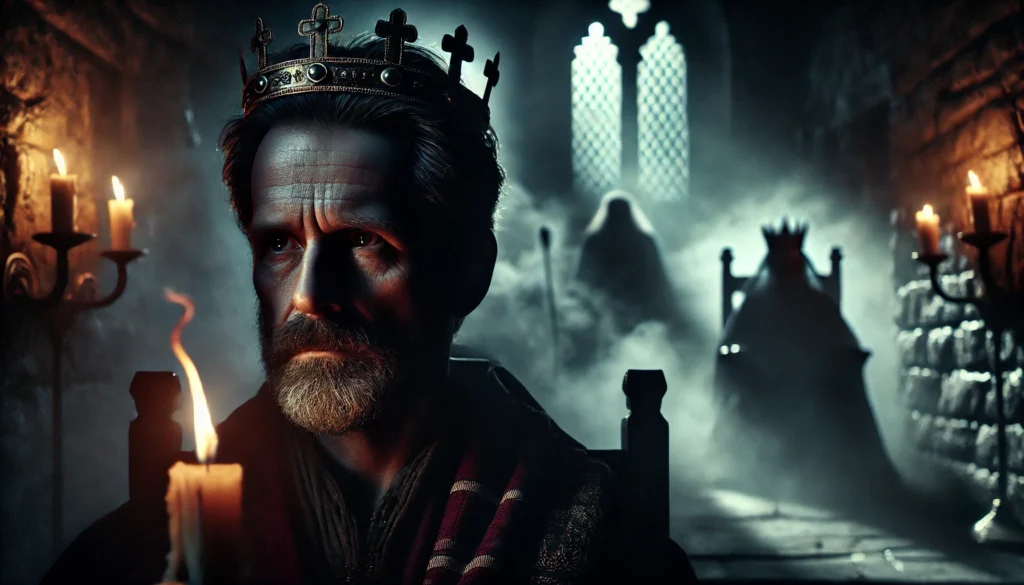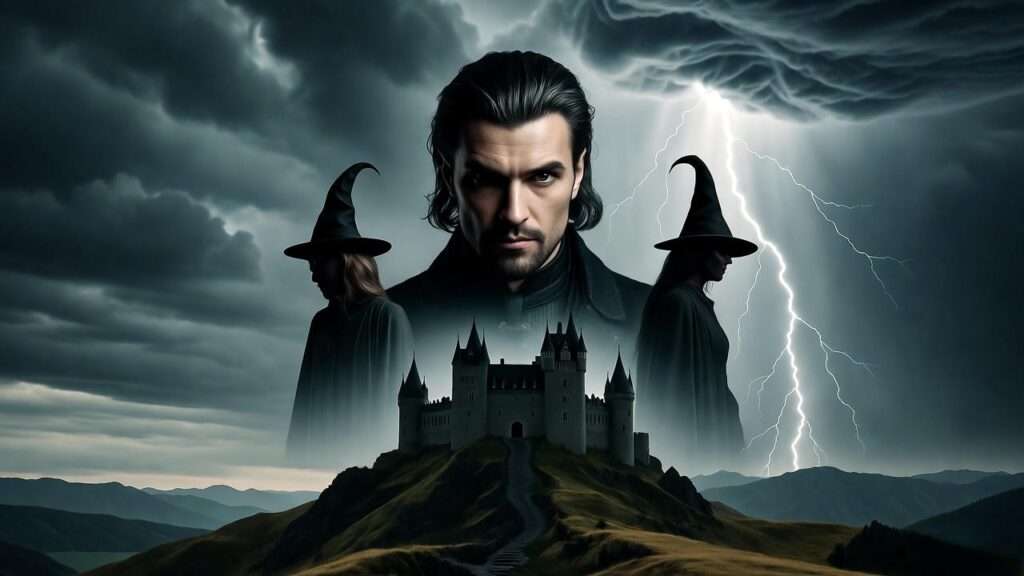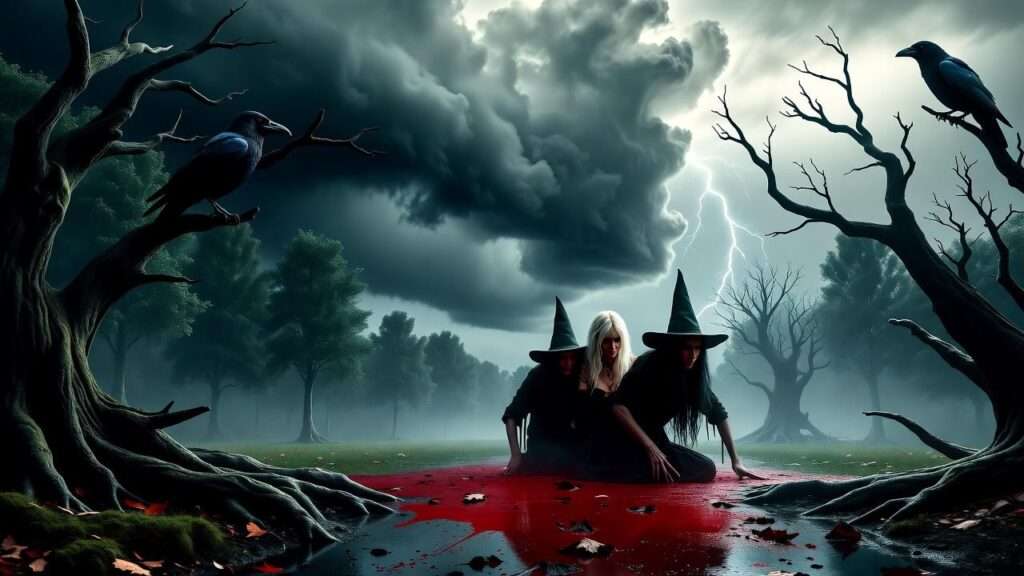
The shift in Macbeth’s character from Act 1 to Act 3 represents one of the most violent psychological collapses in Western literature. When we first meet Lord Macbeth, he is “noble,” “brave,” and lauded by his sovereign. However, seizing the throne through murder alters his fundamental relationship with reality.
In Act 3, power brings no satisfaction—only an acute awareness of vulnerability. Macbeth realizes that the same bloodshed that elevated him can easily be used by rivals to depose him. This realization triggers a relentless descent into tyranny. He no longer hesitates before committing violence, nor does he require the prompting of his wife. Instead, he proactively plots cold-blooded assassinations, demonstrating that his moral core has completely decayed.
The Climax of the Tragedy: Freytag’s Pyramid Explained
To understand why Act 3 feels so fast-paced and claustrophobic, it helps to examine its structure through Freytag’s Pyramid—the classic framework for five-act dramatic structure:
-
Act 1 (Exposition & Inciting Incident): Introduction of Macbeth, the Weird Sisters’ prophecies, and the initial plot against Duncan.
-
Act 2 (Rising Action): The murder of King Duncan, the discovery of the crime, and Macbeth’s ascension to the throne.
-
Act 3 (Climax / Turning Point): Macbeth’s peak authority, followed by his first major failure—the escape of Fleance—and his public mental collapse at the royal banquet.
-
Act 4 (Falling Action): The tyrant’s atrocities escalate, prompting a noble coalition to gather against him in England.
-
Act 5 (Catastrophe / Denouement): The siege of Dunsinane, the fulfillment of the paradoxical prophecies, and Macbeth’s death.
Act 3 acts as the narrative fulcrum. Prior to this point, Macbeth’s fortunes are rising. After Act 3, his control completely unravels, setting in motion an irreversible downward spiral toward his tragic demise.
What Students & Readers Need to Know About Act 3
-
The Catalysts: Macbeth turns on his closest brother-in-arms, Banquo, viewing him as a direct threat to his throne.
-
The Turning Point: While Banquo is successfully assassinated in Scene 3, his son Fleance escapes. This marks Macbeth’s first tactical failure, proving that fate cannot be controlled through violence.
-
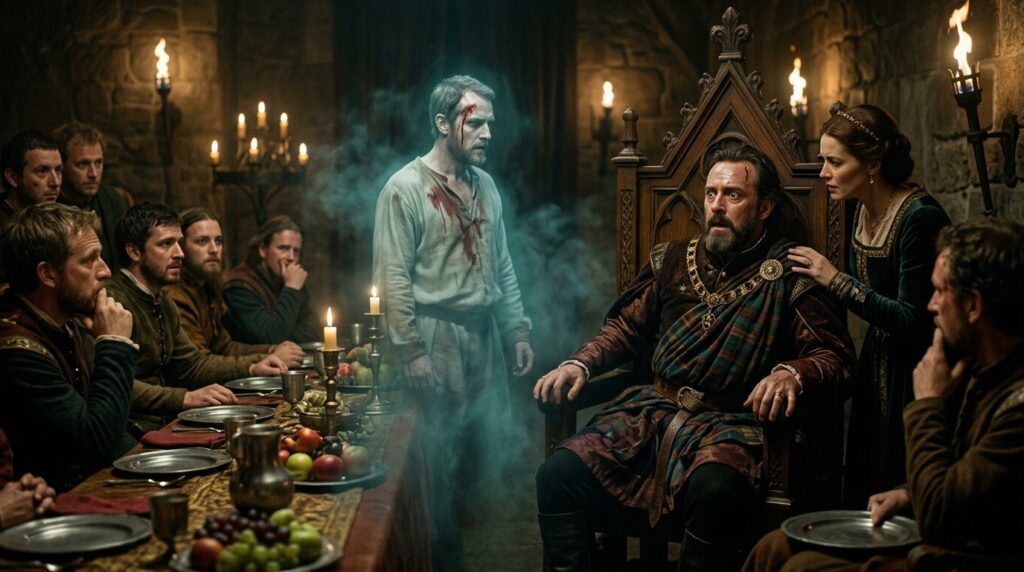
The Breakdown: During a state banquet in Scene 4, Macbeth hallucinates Banquo’s bloody ghost in front of his lords, publicly destroying his authority and legitimacy.
-
The Relationship Shift: The marital dynamic completely flips. Lady Macbeth loses her psychological hold over her husband as he isolates himself and acts alone.
2. Act 3 Scene-by-Scene Plot Summary
   [Act 3, Scene 1] ──► [Act 3, Scene 2] ──► [Act 3, Scene 3]
   Macbeth plots       Spouses drift        Banquo killed;
   Banquo's murder     apart in guilt       Fleance escapes
          │                                        │
          ▼                                        ▼
   [Act 3, Scene 6] ◄── [Act 3, Scene 5] ◄── [Act 3, Scene 4]
   Lennox suspects     Hecate prepares      Banquet ruined by
   Macbeth's tyranny   Macbeth's ruin       Banquo's Ghost
Act 3, Scene 1: Banquo’s Suspicion and Macbeth’s Fatal Plot
Setting: The Royal Palace at Forres.
The act opens with Banquo standing alone in the palace, reflecting on the rapid realization of the Weird Sisters’ predictions for Macbeth. In a brief but crucial soliloquy, Banquo voices his deepest suspicion:
“Thou hast it now: king, Cawdor, Glamis, all, / As the weird women promised, and I fear / Thou play’dst most foully for ’t.”
Despite his suspicions, Banquo remembers the rest of the prophecy: that his own offspring, not Macbeth’s, will form a lasting line of kings. Before he can ponder this further, King Macbeth and Queen Lady Macbeth enter in state, accompanied by their court.
Macbeth warmly invites Banquo as the guest of honor to a ceremonial feast that evening. Banquo accepts, noting that he must ride out on horseback for the afternoon with his young son, Fleance. Macbeth casually inquires about their route and timing, ensuring he knows their precise movements before sending them off.
Once the court departs, Macbeth delivers one of his most famous soliloquies, revealing the root of his unbearable anxiety:
“To be thus is nothing, / But to be safely thus. Our fears in Banquo / Stick deep, and in his royalty of nature / Reigns that which would be feared.”
Macbeth realizes that by killing Duncan, he has placed a “barren sceptre” in his own hands—he holds power, but has no heir to inherit it. He feels he has sold his soul to the devil (“put rancours in the vessel of my peace”) merely to prepare the throne for Banquo’s children.
To prevent this outcome, Macbeth summons two hired murderers. In a chilling demonstration of psychological manipulation—mirroring Lady Macbeth’s tactics from Act 1—Macbeth convinces these destitute men that Banquo is the sole cause of their poverty and suffering. He questions their manhood and promises them wealth and royal favor if they carry out the hit. The murderers agree, and Macbeth dispatches them to ambush Banquo and Fleance along the road.
Act 3, Scene 2: The Shift in Power and Lady Macbeth’s Isolation
Setting: Palace Chambers.
Away from the court, Lady Macbeth sits alone, expressing a rare moment of deep vulnerability and disillusionment. She utters lines that reveal the empty reality of her ambition:
“Nought’s had, all’s spent, / Where our desire is got without content: / ’Tis safer to be that which we destroy / Than by destruction dwell in doubtful joy.”
She recognizes that wearing the crown has brought no inner peace—only lingering dread. However, when Macbeth enters, she immediately puts on a brave face, advising her husband to stop dwelling on his dark thoughts: “Things without all remedy / Should be without regard: what’s done is done.”
Macbeth rejects her comfort, confessing that their terrible work is far from over. He describes his inner torment using vivid, nightmarish imagery: “O, full of scorpions is my mind, dear wife!” He admits that he envies Duncan, who rests peacefully in his grave, immune to treason, war, and poison (“Duncan is in his grave; / After life’s fitful fever he sleeps well”).
Crucially, when Lady Macbeth asks what he plans to do next, Macbeth deliberately excludes her from the murder plot:
“Be innocent of the knowledge, dearest chuck, / Till thou applaud the deed.”
This moment marks a pivotal shift in their marriage. In Acts 1 and 2, Lady Macbeth was the mastermind who spurred her hesitant husband to action. Now, Macbeth acts independently, driving the violence without her guidance, while Lady Macbeth is reduced to a helpless bystander.
Act 3, Scene 3: The Ambush—Banquo’s Death & Fleance’s Escape
Setting: A park near the palace grounds, dusk.
The two murderers wait in the gathering darkness near the palace gates. They are unexpectedly joined by a Third Murderer, sent by Macbeth due to his obsessive paranoia and distrust of everyone around him.
Banquo and Fleance approach on foot, having dismounted their horses as was customary when entering the royal palace grounds. As Banquo carries a torch, illuminating the path, the assassins spring from the shadows.
The attackers strike down Banquo, who calls out to his son in his dying breath:
“O, treachery! Fly, good Fleance, fly, fly, fly! / Thou mayst revenge. O slave!”
During the struggle, the torch is struck out, plunging the scene into darkness. Taking advantage of the shadow, Fleance escapes into the night. The murderers realize the job is only half done: Banquo lies dead with twenty gashes to his head, but the heir has vanished. They head back to the palace to report the partial failure to the King.
Act 3, Scene 4: The Banquet Scene and Banquo’s Ghost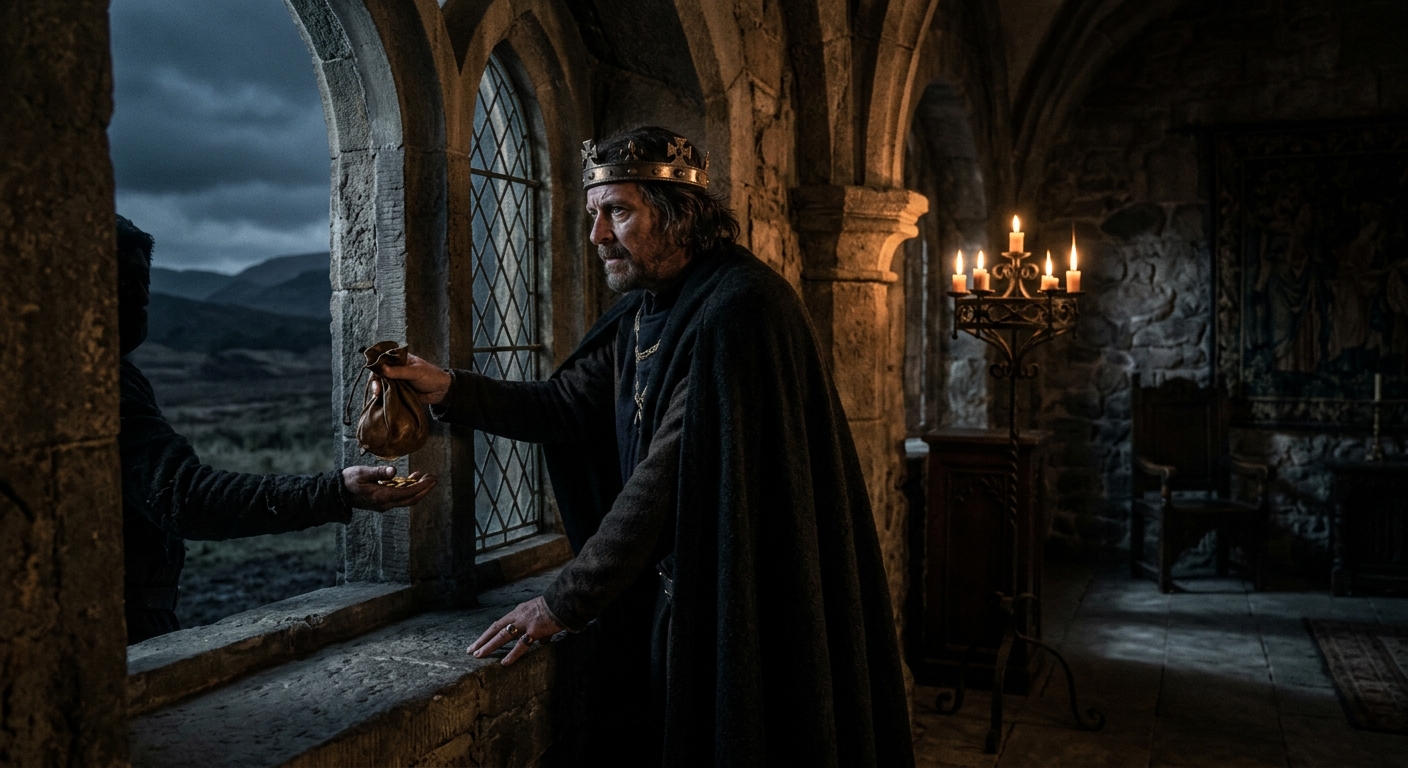
Setting: The Great Hall of the Palace Banquet.
Scene 4 is the psychological and dramatic centerpiece of Act 3. Macbeth and Lady Macbeth host a grand feast for the noble lords of Scotland. Macbeth acts as the hospitable host, circulating among his guests to display his authority and warmth.
At the door, the First Murderer appears with blood on his face. Macbeth steps aside to speak with him covertly. The murderer confirms that Banquo is dead in a ditch, but admits that Fleance has escaped. Macbeth is instantly overcome by panic and claustrophobia:
“Then comes my fit again: I had else been perfect, / Whole as the marble, founded as the rock… / But now I am cabined, cribbed, confined, bound in / To saucy doubts and fears.”
Returning to the banquet table, Macbeth prepares to toast his lords. He hypocritically laments the absence of his “honored friend,” Banquo. As he goes to take his seat at the center of the table, he finds a terrifying figure sitting in his chair: the Ghost of Banquo, visible only to Macbeth, dripping with blood from twenty wounds.
Macbeth recoils in terror, shouting at the empty chair:
“Thou canst not say I did it: never shake / Thy gory locks at me!”
The lords, unable to see the phantom, are bewildered and alarmed by their king’s violent outburst. Ross suggests that the King is unwell and attempts to dismiss the assembly, but Lady Macbeth intervenes to save the throne. She makes excuses for Macbeth, claiming he has suffered from brief “fits” since his youth.
She pulls Macbeth aside and sharply challenges his manhood: “Are you a man?” She dismisses the ghost as a mere trick of his fearful mind, comparable to the floating dagger he saw before killing Duncan.
The ghost vanishes temporarily, and Macbeth recovers his composure, apologizing to his guests. However, as he attempts to raise another toast to Banquo, the ghost re-enters and sits in his place once again. Macbeth breaks completely, screaming at the spectral image:
“Avaunt! and quit my sight! let the earth hide thee! / Thy bones are marrowless, thy blood is cold…”
With Macbeth’s sanity visibly shattered in front of the Scottish nobility, Lady Macbeth realizes damage control is impossible. She hastily abruptly dismisses the lords: “Stand not upon the order of your going, / But go at once.”
Once the guests leave, Macbeth notes with alarm that Macduff was noticeably absent from the feast. He reveals to Lady Macbeth that he maintains a system of spies in every noble household (“There’s not a one of them but in his house / I keep a servant fee’d”).
Recognizing that he has passed the point of moral redemption, Macbeth resolves to revisit the Weird Sisters the following morning to learn his destiny, declaring:
“I am in blood / Stepp’d in so far that, should I wade no more, / Returning were as tedious as go o’er.”
Act 3, Scene 5: Hecate’s Curse (The Witches’ Plan)
Setting: A stormy heath.
The three Weird Sisters meet Hecate, the classical goddess of witchcraft. Hecate is furious with the witches for meddling in Macbeth’s affairs without consulting her or including her in their dark rituals. She calls Macbeth a “wayward son” who uses magic for his own selfish gain rather than serving the true cause of evil.
Hecate instructs the witches to gather their cauldrons, spells, and charms at the pit of Acheron the next morning, where Macbeth will come to demand answers. She announces her plan to create powerful, misleading illusions designed to trick Macbeth into feeling invincible:
“He shall spurn fate, scorn death, and bear / His hopes ‘bove wisdom, grace, and fear: / And you all know, security / Is mortals’ chiefest enemy.”
Scholar’s Note: Many literary historians believe Scene 5 was added to Macbeth after Shakespeare’s original performance run, likely authored by contemporary playwright Thomas Middleton for his play The Witch. Nevertheless, it underscores the theme of overconfidence (hubris) leading to tragic ruin.
Act 3, Scene 6: The Rumblings of Rebellion
Setting: A palace elsewhere in Scotland.
The final scene of Act 3 acts as a political reality check, showing how Macbeth’s rule is perceived by the rest of the kingdom. Lennox speaks with an unnamed Lord about the suspicious deaths that have plagued Scotland.
Lennox uses heavy, dangerous sarcasm to mock Macbeth’s official propaganda. He points out how remarkably “convenient” it is that Duncan died while hosted by Macbeth, and how quickly Macbeth executed Duncan’s guards before they could talk. He also notes that Banquo “walked too late” and was killed, so Fleance must be guilty because he fled—just as Malcolm and Donalbain were accused when they fled after Duncan’s death.
Through this ironic tone, Lennox communicates what every noble in Scotland now privately knows: Macbeth is a murderous tyrant.
The Lord reveals crucial news regarding the gathering opposition:
-
Malcolm (Duncan’s rightful heir) is living in England, hosted graciously by King Edward the Confessor.
-
Macduff has fled to join Malcolm in England to request military aid—including troops led by the famous English commander, Siward, Earl of Northumberland.
-
Macbeth is aware of Macduff’s flight and is preparing for open warfare.
The scene ends with both nobles praying that a higher power will deliver Scotland from Macbeth’s tyrannical grip and restore peace, law, and legitimate order to their suffering country.
3. Key Themes & Symbolism in Act 3
Act 3 weaves together complex thematic threads that define the psychological landscape of Shakespearean tragedy.
| Theme / Symbol | Dramatic Function in Act 3 | Supporting Quote & Analysis |
| Paranoia & Tyranny | Tracks Macbeth’s shift from a legitimate monarch into a ruthless tyrant driven by fear of losing power. | “To be thus is nothing, / But to be safely thus.” (3.1) — Absolute power provides no peace if it is constantly threatened by rivals. |
| Guilt & Hallucinations | Serves as the physical manifestation of internal psychological decay and moral corruption. | “Thou canst not say I did it: never shake / Thy gory locks at me!” (3.4) — Macbeth’s guilt projects Banquo’s ghost, revealing his inner horror. |
| Fate vs. Human Agency | Illustrates the futility of attempting to thwart supernatural prophecies through human violence. | Banquo’s death alongside Fleance’s escape proves that violent intervention cannot stop the fulfillment of fate. |
| Light vs. Darkness | Symbolizes the loss of moral virtue, protection, and order across the kingdom of Scotland. | Banquo’s torch is struck out right before he dies (3.3), visually signifying the extinguishing of honor and light in the realm. |
Deep Dive: The Symbolism of Banquo’s Ghost
Is Banquo’s ghost a literal supernatural presence or a psychological illusion?
Shakespeare designs the scene so that it operates on both levels simultaneously:
-
The Psychological Interpretation: The ghost is a subjective hallucination produced by Macbeth’s guilt-ridden mind. This is supported by the fact that neither Lady Macbeth nor the noble lords can see the spirit. Like the floating dagger in Act 2, the ghost appears when Macbeth’s conscience is subjected to extreme strain.
-
The Supernatural Interpretation: In Jacobean theater, ghosts were often staged as real entities representing divine vengeance. The apparition disrupts the social order of the state banquet—a symbol of peace and royalty—demonstrating how Macbeth’s unnatural crime has corrupted the natural world.
4. Deep Character Development Analysis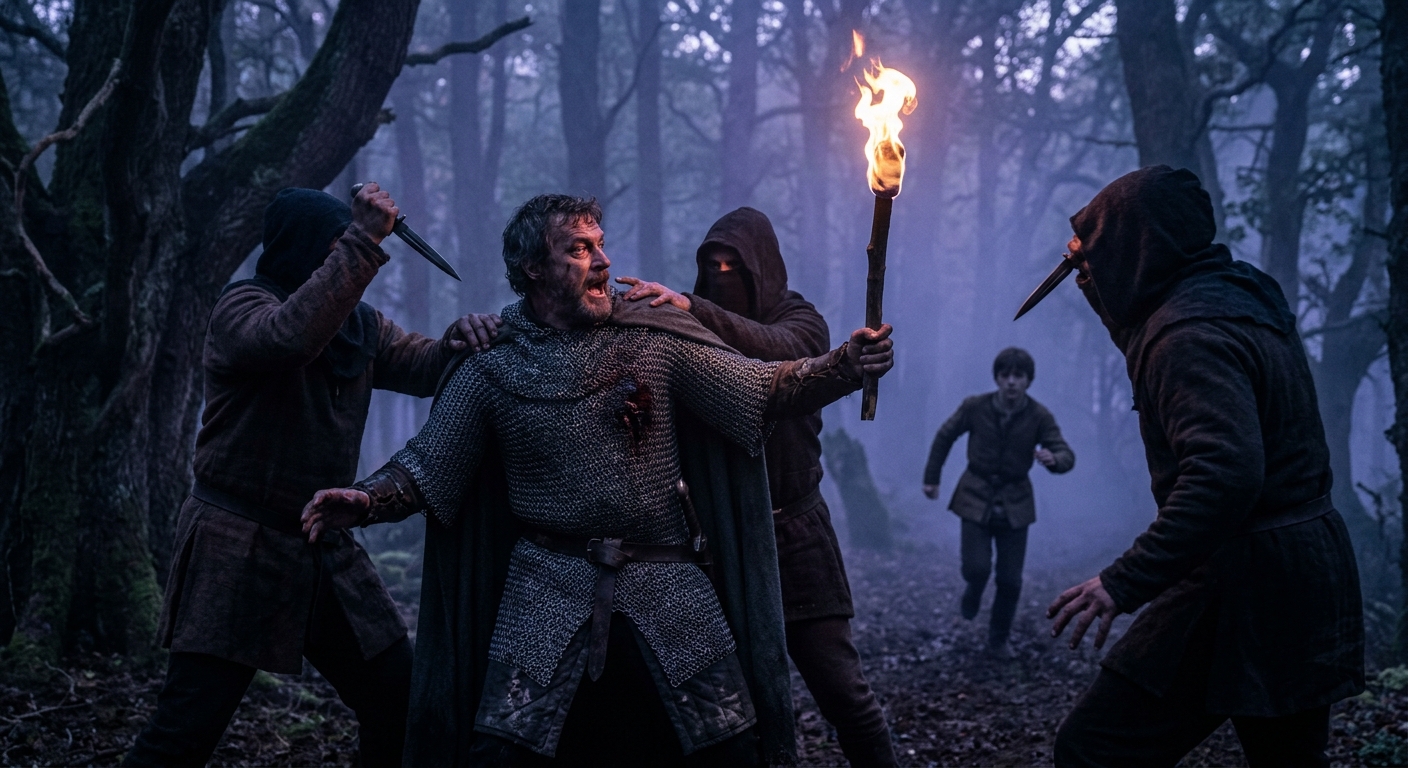
                    ┌────────────────────────┐
                    │    MACBETH'S DESCENT   │
                    └───────────┬────────────┘
                                │
          ┌─────────────────────┴─────────────────────┐
          ▼                                           ▼
┌──────────────────┐                        ┌──────────────────┐
│   Act 1 & Act 2  │                        │      Act 3       │
├──────────────────┤                        ├──────────────────┤
│ • Hesitant killer│                        │ • Proactive tyrant│
│ • Relies on wife │  ───────────────►      │ • Secretive plots│
│ • Guilt-stricken │                        │ • Total paranoia │
└──────────────────┘                        └──────────────────┘
Macbeth: The Descent into Tyranny
In Act 3, Macbeth crosses a psychological line from which he cannot return. In Act 2, he required extensive encouragement from his wife to kill Duncan, and he immediately felt intense remorse (“Will all great Neptune’s ocean wash this blood clean from my hand?”).
By Act 3, however, killing has become his primary strategic tool:
-
Loss of Moral Reflection: He plans Banquo’s assassination with cold, calculated precision, using hired hitmen to keep his own hands clean.
-
Isolating Himself: He no longer relies on Lady Macbeth for counsel or emotional support.
-
Acceptance of his Fate: By Scene 4, he acknowledges that he has stepped so far into a river of blood that returning to righteousness is impossible.
Lady Macbeth: The Loss of Control
Act 3 represents the beginning of Lady Macbeth’s tragic mental collapse, which culminates in her sleepwalking scene in Act 5.
-
The Illusion of Success: In Scene 2, her private soliloquy exposes her deep disappointment—achieving her dream of becoming Queen has brought anxiety rather than happiness.
-
Erosion of Influence: She loses her hold over Macbeth. She is excluded from his plans and reduced to covering for his wild behavior during the banquet scene.
-
Emotional Exhaustion: The effort required to manage Macbeth’s public breakdown in Scene 4 breaks her spirit, leaving her silent and exhausted by the end of the act.
Banquo: The Moral Foil
Banquo serves as Macbeth’s direct moral contrast throughout the play. Both men hear the Weird Sisters’ prophecies in Act 1, and both harbor ambitions for their respective lines.
However, where Macbeth turns to treason and murder to force the prophecy into reality, Banquo remains steadfast in his moral integrity. Even when he suspects Macbeth of regicide, he refuses to compromise his honor. Banquo’s tragedy is that his loyalty and virtue make him a direct threat to a paranoid tyrant. His murder demonstrates that under a tyrannical regime, nobility and innocence cannot survive.
5. Important Act 3 Quotes Analyzed for Essay Writing
Quote 1: Banquo on Macbeth’s Crime
“Thou hast it now: king, Cawdor, Glamis, all, / As the weird women promised, and I fear / Thou play’dst most foully for ’t.” (Act 3, Scene 1)
-
Context: Banquo’s opening soliloquy at the palace in Forres.
-
Literary Techniques: Asyndeton (rapid listing of titles), Alliteration (“foully for’t”).
-
Analysis: This quote establishes Banquo’s clear-eyed understanding of Macbeth’s moral decay. The phrase “play’dst most foully” echoes the witches’ key motif from Act 1 (“Fair is foul, and foul is fair”), reminding the audience that Macbeth has embraced the corrupt logic of the supernatural realm to gain the throne.
Quote 2: Macbeth on the Burden of Power
“To be thus is nothing, / But to be safely thus.” (Act 3, Scene 1)
-
Context: Macbeth speaks to himself after ordering Banquo to attend the evening feast.
-
Literary Techniques: Short syntax, Repetition of “thus”.
-
Analysis: This line summarizes the fundamental psychological torment of tyranny. Holding power (“to be thus”) has zero value if it is accompanied by constant fear of betrayal (“to be safely thus”). It demonstrates that Macbeth’s crime has destroyed his sense of security, driving him to commit further acts of violence in a futile attempt to feel safe.
Quote 3: Macbeth on his Mental Agony
“O, full of scorpions is my mind, dear wife!” (Act 3, Scene 2)
-
Context: Macbeth confesses his inner distress to Lady Macbeth before Banquo’s murder.
-
Literary Techniques: Zoomorphic Metaphor, Imagery.
-
Analysis: Shakespeare uses the metaphor of “scorpions” to convey intense, stinging mental agony and paranoia. The image suggests that Macbeth’s own thoughts have turned venomous, attacking his sanity from within. It highlights the profound psychological toll of his treason.
Quote 4: Macbeth Excluding Lady Macbeth
“Be innocent of the knowledge, dearest chuck, / Till thou applaud the deed.” (Act 3, Scene 2)
-
Context: Macbeth refuses to give Lady Macbeth the details of his plot against Banquo.
-
Literary Techniques: Diminutive term of endearment (“dearest chuck”), Irony.
-
Analysis: This quote highlights the total reversal of power in their marriage. Macbeth uses a patronizing term of endearment (“dearest chuck”) to dismiss the woman who previously directed his actions. By keeping her “innocent of the knowledge,” he isolates her, leaving her without a purpose or role in his reign.
Quote 5: Macbeth on the Cycle of Violence
“I am in blood / Stepp’d in so far that, should I wade no more, / Returning were as tedious as go o’er.” (Act 3, Scene 4)
-
Context: Macbeth speaks to Lady Macbeth after the disastrous banquet guests have departed.
-
Literary Techniques: Extended Visual Metaphor (River of Blood).
-
Analysis: Macbeth visualizes his moral transgression as a physical body of water made of blood. Having waded into the middle of this river, he reasons that walking back to righteousness requires as much effort as continuing forward into deeper bloodshed. This quote marks his total surrender to violence as a permanent way of life
6. Essay Writing & Exam Study Guide Insights
Common Exam Questions on Act 3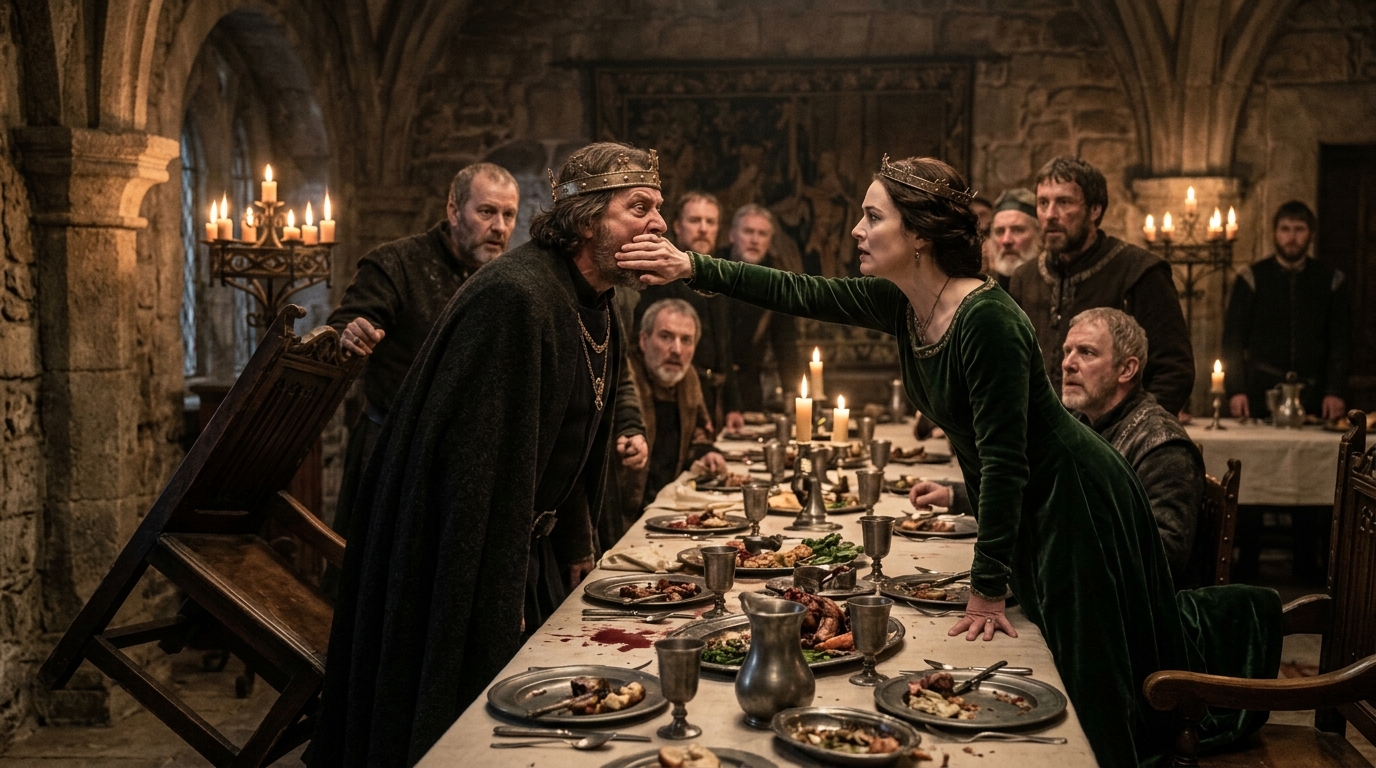
1. How does Shakespeare present the breakdown of Macbeth and Lady Macbeth’s relationship in Act 3?
-
Thesis Focus: Shakespeare portrays the breakdown as an inevitable consequence of shared guilt, where power shifts from a collaborative partnership to total isolation and emotional estrangement.
-
Key Evidence to Include:
-
Scene 2 Contrast: Contrast Lady Macbeth’s earlier dominance in Act 1, Scene 7 with her solitary admission in Act 3, Scene 2 (“Nought’s had, all’s spent”).
-
Language Shift: Analyze Macbeth’s dismissal (“Be innocent of the knowledge, dearest chuck”). Note how he adopts her manipulative, commanding language while excluding her from decisions.
-
Banquet Scene Dynamics: Examine how Lady Macbeth’s attempt to assert control in Scene 4 (“Are you a man?”) fails to restore order, leaving them physically together on stage but psychologically entirely disconnected.
-
2. To what extent is Banquo’s ghost a literal supernatural presence vs. a manifestation of Macbeth’s guilt?
-
Thesis Focus: While Jacobean audiences would recognize the ghost as a legitimate supernatural entity punishing regicide, Shakespeare uses the specter primarily as a psychological projection of Macbeth’s unraveling mind.
-
Key Evidence to Include:
-
Selective Visibility: Point out that only Macbeth sees the ghost; Lady Macbeth and the lords view an empty stool, mirroring the subjective vision of the dagger in Act 2, Scene 1.
-
The Physical Symptoms: Analyze the ghost’s gory details (“twenty trenched gashes on his head”), which directly match the First Murderer’s report in Scene 4, proving the hallucination is constructed from Macbeth’s immediate fears.
-
Dramatic Function: Argue that whether real or imagined, the ghost serves as a divine instrument of retribution, forcing Macbeth to expose his own treason to his court.
-
3. Analyze how Act 3 serves as the structural turning point of the play.
-
Thesis Focus: Utilizing Freytag’s Pyramid, Act 3 marks the structural pivot where Macbeth’s unchecked momentum hits its first irrevocable failure, shifting the narrative from rising fortune to inevitable downfall.
-
Key Evidence to Include:
-
The Turning Point Event: Identify Fleance’s escape in Scene 3 as the exact moment Macbeth’s control breaks—it is his first targeted assassination that fails.
-
Loss of Public Legitimacy: Detail how Scene 4 shatters Macbeth’s political standing, transforming him from a king in the eyes of his nobles into an unstable tyrant.
-
Political Realignment: Reference Scene 6, where Lennox and the Lord officially label Macbeth a “tyrant” and reveal that Macduff is mobilizing international forces in England to restore the legitimate crown.
-
Key Historical & Literary Context
The Gunpowder Plot (1605) and Political Warning
Written shortly after the failed Gunpowder Plot of November 1605—where Catholic conspirators attempted to blow up King James I and Parliament—Macbeth served as an explicit political warning against treason. Act 3 demonstrates the psychological ruin and inevitable failure that await anyone who attempts to usurp a rightful monarch. Shakespeare demonstrates that even if a regicide successfully secures the throne, peace, security, and legitimacy will remain permanently out of reach.
The Divine Right of Kings & The Great Chain of Being
The Jacobean worldview held that the monarch was appointed directly by God (the Divine Right of Kings) and sat at the top of the earthly hierarchy (the Great Chain of Being). When Macbeth murders Duncan and steals the crown, he violates the natural and divine order.
In Act 3, this cosmic disruption manifests in two distinct ways:
-
Psychological Torment: Macbeth cannot enjoy the benefits of royalty; his conscience is plagued by hallucinations and sleeplessness.
-
Social & Ecological Disorder: Scotland plunges into terror, crops wither, and the social ritual of the royal banquet devolves into chaos.
Equivocation and the Jesuit Trials
During the trials of the Gunpowder Plot conspirators, the concept of “equivocation”—using misleading language to lie without technically telling an untruth under oath—was widely discussed. In Act 3, Scene 5, Hecate explicitly declares her intent to use equivocation against Macbeth: “security / Is mortals’ chiefest enemy.” The witches provide illusions that seem to guarantee safety while secretly orchestrating his doom, reinforcing the Jacobean belief that deceptive speech is an instrument of evil.
7. Frequently Asked Questions (FAQs)
Why is Banquo’s death the turning point in Macbeth?
Banquo’s murder is the tragic climax because it represents Macbeth’s first crime committed purely out of paranoia rather than ambition. Duncan was killed to reach the throne; Banquo is killed to keep it. Furthermore, because Fleance escapes during the ambush, Macbeth fails to thwart the witches’ prophecy, demonstrating that violence cannot alter fate and signaling the beginning of his total loss of control.
Is Banquo’s ghost real or a hallucination?
Shakespeare deliberately leaves the ghost ambiguous to engage both literal and psychological interpretations. On a dramatic level, the ghost acts as a projection of Macbeth’s immense guilt and fractured sanity, visible only to him. On a thematic level, it functions as a supernatural manifestation of divine justice disrupting Macbeth’s illegitimate reign in front of his court.
Why does Macbeth keep his plot against Banquo secret from Lady Macbeth?
Macbeth conceals the assassination plot to assert his own authority and spare her from further moral burden (“Be innocent of the knowledge, dearest chuck”). This secrecy signals a complete reversal of their marital dynamic from Act 1, leaving Lady Macbeth isolated and stripped of her former influence over her husband’s actions.
What is the significance of Fleance escaping in Act 3, Scene 3?
Fleance’s escape is crucial because it keeps the Weird Sisters’ prophecy alive—that Banquo’s lineage, not Macbeth’s, will produce a line of kings. It represents Macbeth’s first major tactical failure, proving that despite committing regicide and murder, he cannot break the chain of destiny or secure a lasting dynasty.
Who is the Third Murderer in Act 3, Scene 3?
Shakespeare never explicitly identifies the Third Murderer, leading to significant literary debate. Common theories suggest he is a spy sent by Macbeth due to his paranoia, a servant of the palace, or even an embodiment of the Witches or Fate itself. His presence emphasizes Macbeth’s obsessive need to micromanage every crime.
8.The Legacy of Act 3 in Shakespearean Tragedy
Act 3 of Macbeth stands as a masterclass in psychological drama, political tension, and structural design. Within six tightly crafted scenes, Shakespeare shifts the play’s momentum from a dark tale of rising ambition into a harrowing portrait of tyrannical collapse.
By analyzing Banquo’s assassination, the chaos of the banquet scene, and the growing political rebellion in Scotland, we see that crime offers no true power—only an inescapable cycle of fear, violence, and isolation. For students, readers, and theatergoers alike, mastering Act 3 is the key to unlocking the central message of Macbeth: that power severed from morality will inevitably destroy the person who wields it.