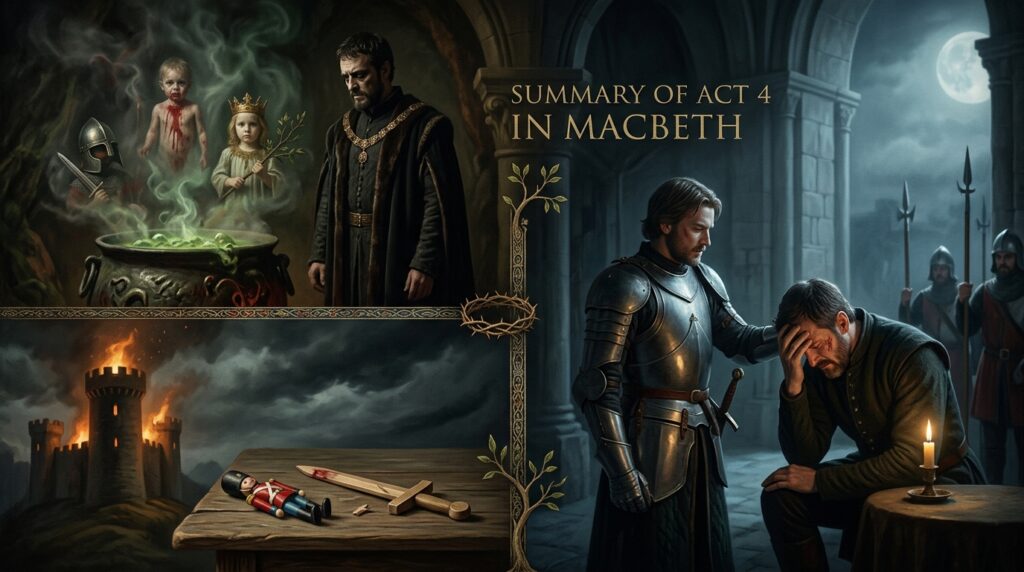
William Shakespeare’s Macbeth reaches its critical tipping point in its fourth movement. While the opening acts trace a decorated soldier’s descent into political assassination, an exhaustive summary of act 4 in macbeth reveals something far more chilling: the total institutionalization of tyranny. Here, the narrative shifts from hesitant, guilt-ridden murders to indiscriminate terror, setting the stage for tragic retribution.
Whether you are analyzing the play for an AP Literature exam, preparing a lesson plan, or looking to grasp the thematic mechanics of Shakespeare’s darkest tragedy, Act 4 serves as the indispensable bridge between Macbeth’s paranoid rise and his inevitable ruin.
1. Overview & Structural Layout
Act 4 consists of three distinct, carefully calibrated scenes. Each scene moves the dramatic focus across different geographical and psychological spaces:
 ┌─────────────────────────────────────────────────────────────┐
 │ 1. Introduction & Act 4 Overview                            │
 ├─────────────────────────────────────────────────────────────┤
 │ 2. Scene-by-Scene Breakdown                                │
 │    ├─ Scene 1: The Witches' Cave & The Three Apparitions    │
 │    ├─ Scene 2: The Slaughter at Macduff's Castle            │
 │    └─ Scene 3: Malcolm's Test & The Alliance in England     │
 ├─────────────────────────────────────────────────────────────┤
 │ 3. Deep Dive: The Apparitions Decoded                       │
 ├─────────────────────────────────────────────────────────────┤
 │ 4. Core Thematic Analysis                                   │
 ├─────────────────────────────────────────────────────────────┤
 │ 5. Character Transformations                                │
 ├─────────────────────────────────────────────────────────────┤
 │ 6. High-Yield Study Guide: Key Quotes & Modern Translation  │
 ├─────────────────────────────────────────────────────────────┤
 │ 7. Scholar's Classroom & Essay Prompts                      │
 ├─────────────────────────────────────────────────────────────┤
 │ 8. Frequently Asked Questions (FAQs)                        │
 └─────────────────────────────────────────────────────────────┘
At-a-Glance Dashboard
-
Primary Settings: A dark cavern near Forres (Scene 1); Macduff’s Castle at Fife (Scene 2); King Edward’s Palace in England (Scene 3).
-
Key Characters: The Weird Sisters, Hecate, Macbeth, Lady Macduff, Macduff’s Son, Malcolm, Macduff, Ross, Lennox.
-
Central Motifs: Equivocation, the murder of innocence, legitimate kingship vs. tyrannical rule, the nature of manhood.
2. Scene-by-Scene Breakdown
Scene 1: The Witches’ Cave & The Three Apparitions
The act opens in a cavern around a boiling cauldron. The Weird Sisters assemble to brew a grotesque concoction, using animal parts and human remains that symbolize Scotland’s moral decay under Macbeth’s rule. Their chanted refrain establishes the uncanny atmosphere: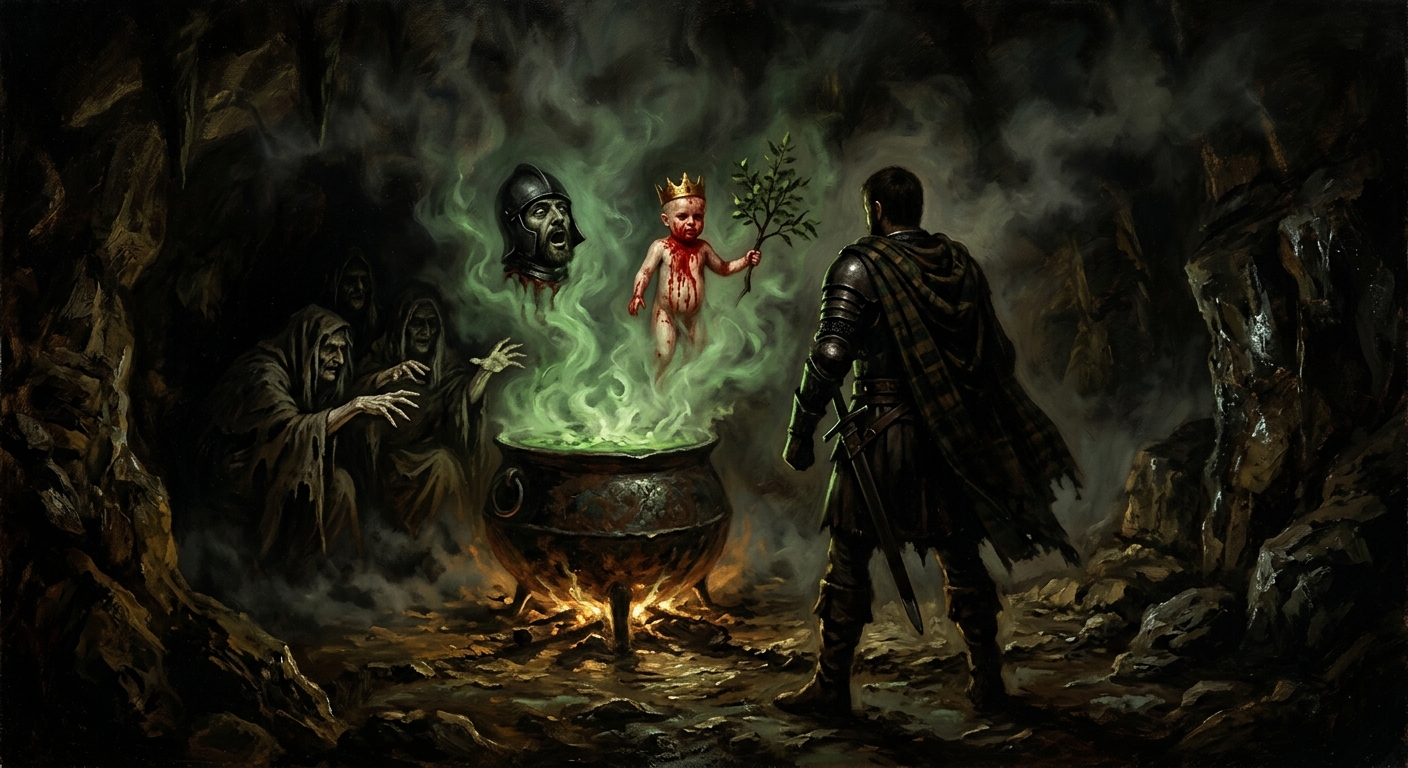
“Double, double toil and trouble; / Fire burn, and cauldron bubble.”
Hecate commends their work, and as Macbeth approaches, one witch famously declares, “By the pricking of my thumbs, / Something wicked this way comes”—a stark linguistic marker showing that Macbeth’s evil now matches or exceeds that of the supernatural realm.
Unlike his hesitant, terrified demeanor in Act 1, Macbeth enters demanding answers. He demands that the witches answer his questions regardless of the natural chaos or destruction it causes. The witches summon three spirits (apparitions) to answer him:
-
An Armed Head: Warns Macbeth to “Beware Macduff; / Beware the Thane of Fife.”
-
A Bloody Child: Declares that “none of woman born / Shall harm Macbeth.”
-
A Crowned Child with a Tree in Hand: Assures him he will never be vanquished until “Great Birnam Wood to high Dunsinane Hill / Shall come against him.”
These predictions fill Macbeth with supreme confidence. Believing that all men are born of women and that forests cannot walk, he concludes he is invincible. However, his lingering paranoia surrounding Banquo’s prophecy prompts one final demand: Will Banquo’s descendants ever reign?
The witches display a visual procession (a show of eight kings), followed by the ghost of Banquo holding a mirror. The vision confirms that Banquo’s royal lineage will stretch for generations—a direct nod to Shakespeare’s patron, King James I, who claimed descent from Banquo.
The witches vanish, leaving Macbeth alone. Lennox arrives with news that Macduff has fled to England. In a pivotal soliloquy, Macbeth abandons all hesitation and resolves to act instantly on impulse:
“From this moment / The very firstlings of my heart shall be / The firstlings of my hand.”
He immediately orders the murder of Macduff’s wife, children, and entire household.
Scene 2: The Slaughter at Macduff’s Castle (Fife)
Scene 2 shifts to Fife, providing an intimate look at the domestic realm Macbeth seeks to destroy. Lady Macduff feels abandoned and betrayed by her husband’s sudden flight to England, viewing it as cowardice or lack of love:
“His flight was madness. When our actions do not, / Our fears do make us traitors.”
Ross attempts to defend Macduff, urging her to trust his wisdom and calling the current era a time when “we are traitors / And do not know ourselves.” After Ross leaves, Lady Macduff engages in lighthearted banter with her young son regarding fidelity, honesty, and politics. The boy shows sharp intelligence, observing that the liars outnumber the honest men and could easily overthrow them.
A messenger bursts in, warning Lady Macduff of impending danger and urging her to flee with her children. She hesitates, reflecting on the inversion of morality in Macbeth’s Scotland:
“Whither should I fly? / I have done no harm. But I remember now / I am in this earthly world, where to do harm / Is often laudable, to do good sometime / Accounted dangerous folly.”
Macbeth’s assassins break in. When Macduff’s young son calls the attacker a tyrant, the murderer stabs the boy, who dies urging his mother to run. Lady Macduff runs off stage crying “Murder!”, pursued by the killers.
This scene is critical: it showcases Macbeth’s transition from targeted political assassinations (Duncan, Banquo) to senseless violence aimed at defenceless civilians.
Scene 3: Malcolm’s Test & The Alliance in England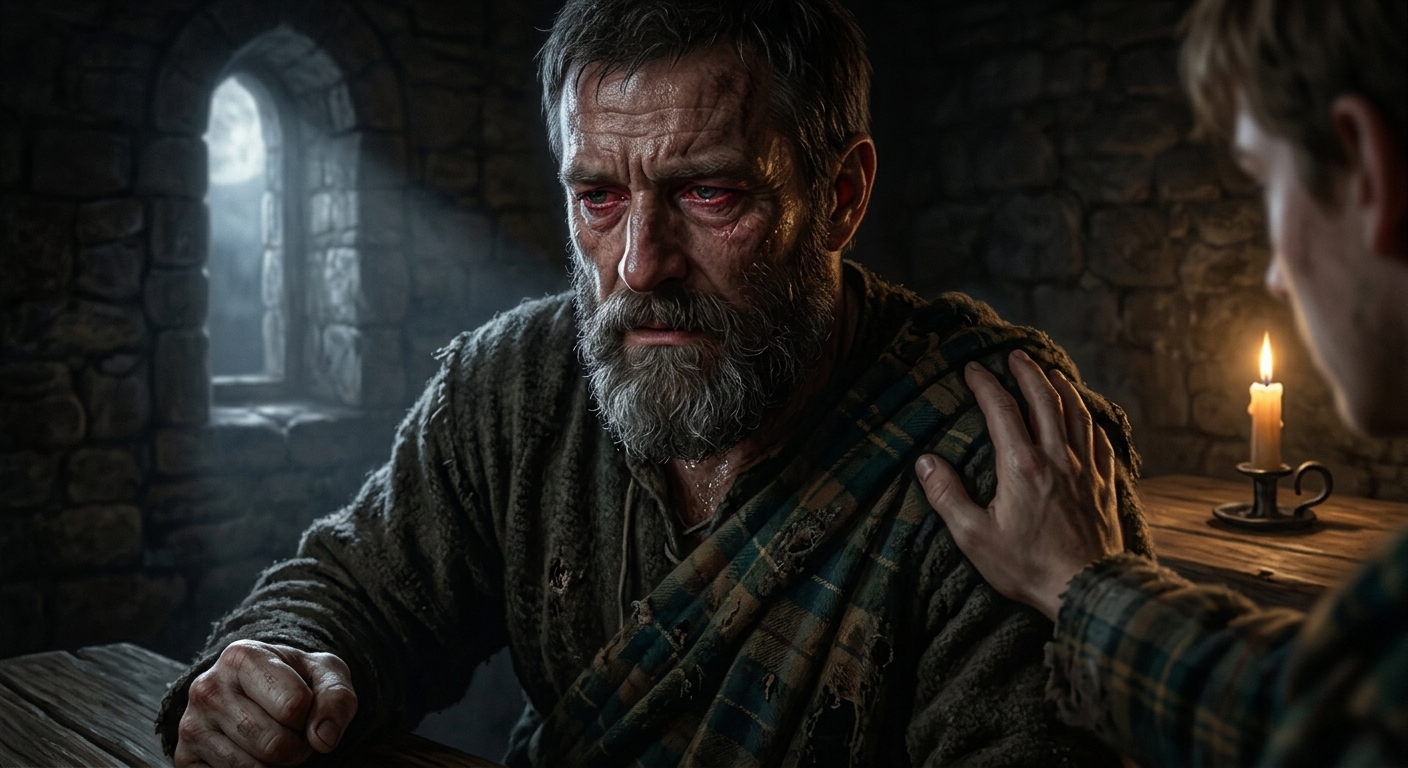
Scene 3 takes place outside the palace of King Edward the Confessor in England. Macduff attempts to convince Prince Malcolm to lead an invasion force to reclaim Scotland from Macbeth.
Malcolm, wary of treason and fearing Macduff might be an agent sent by Macbeth, subjects Macduff to a rigorous loyalty test. Malcolm claims he would be an even worse ruler than Macbeth, citing three vices:
-
Uncontrollable Lust: Claiming no woman in Scotland would be safe from his desires.
-
Insatiable Greed: Claiming he would confiscate the lands and wealth of all noblemen.
-
Complete Lack of Kingly Virtues: Claiming he lacks justice, verity, temperance, and stability, seeking only to throw the world into chaos.
Macduff initially tries to rationalize Malcolm’s self-proclaimed flaws. However, when Malcolm asserts he has no virtues at all, Macduff despairs for his country:
“O Scotland, Scotland! … Fit to govern? / No, not to live.”
Seeing Macduff’s genuine grief and devotion to the nation rather than personal gain, Malcolm reveals the deception. He retracts his confessions, confirming his purity, and reveals that an army of 10,000 English troops under Earl Siward is ready to march on Dunsinane.
A doctor enters, describing King Edward’s miraculous power to heal sufferers of “the Evil” (scrofula) through divine grace and prayer—a stark thematic contrast to Macbeth’s destructive, cursed influence over Scotland.
Ross arrives from Scotland with news. Initially reluctant to break Macduff’s heart, he eventually reveals that Macduff’s castle was attacked, and his wife, children, and servants were brutally slaughtered.
Macduff is struck with grief:
“He has no children. All my pretty ones? / Did you say all? O hell-kite! All? / What, all my pretty chickens and their dam / At one fell swoop?”
Malcolm encourages Macduff to turn his sorrow into rage (“Dispute it like a man”). Macduff responds with a nuanced view of emotional depth and manhood:
“I shall do so; / But I must also feel it as a man.”
Vowing vengeance, Macduff resolves to face Macbeth in battle, setting up the climax of Act 5.
3. Deep Dive: Decoding the Three Apparitions
The prophecies delivered in Act 4, Scene 1 rely on equivocation—statements that appear true on the surface but carry deceptive, hidden meanings.
| Apparition | Visual Form | Explicit Prophecy | Hidden / Literal Truth | Strategic Function |
| 1st Apparition | An Armed Head | “Beware Macduff; / Beware the Thane of Fife.” | Represents Macduff’s head cut off and presented by Macduff himself in Act 5. | Confirms Macbeth’s existing suspicion, prompting his attack on Fife. |
| 2nd Apparition | A Bloody Child | “None of woman born / Shall harm Macbeth.” | Macduff was born via Cesarean section (“untimely ripped”), not a natural birth. | Falsely reassures Macbeth, making him arrogant and reckless. |
| 3rd Apparition | A Crowned Child holding a Tree | Safe until Great Birnam Wood moves to Dunsinane Hill. | Malcolm’s soldiers use cut branches from Birnam Wood as camouflage while advancing. | Leads Macbeth to assume defeat is physically impossible. |
| Final Vision | Eight Kings & Banquo with a mirror | Banquo’s line will reign indefinitely. | Historical tribute to King James I, emphasizing the legitimate Stuart line. | Destroys Macbeth’s hope of establishing a lasting dynasty. |
4. Core Thematic Analysis
Equivocation and the Illusion of Security
Act 4 explores how false security can destroy a person. The Weird Sisters do not force Macbeth to act; instead, they tell him partial truths that play into his ambition and paranoia. By telling him that “none of woman born” can harm him, they lead him to discount Macduff as a real threat.
Macbeth mistakes ambiguity for invincibility, illustrating how tyranny often relies on self-deception.
Tyranny vs. Legitimate Kingship
Shakespeare presents two contrasting models of rule in Act 4:
-
The Tyrant (Macbeth): Governs through paranoia, fear, and violence. He treats Scotland like a victim, bleeding under his rule. His actions bring division, corruption, and the slaughter of innocents.
-
The True King (Edward/Malcolm): Governs with divine favor, humility, and concern for the common good. King Edward uses his touch to heal the sick, while Malcolm tests prospective allies to protect his nation from corruption.
MACBETH (TYRANNY)                     KING EDWARD / MALCOLM (KINGSHIP)
┌───────────────────────────────┐     ┌───────────────────────────────┐
│ • Governs through fear        │     │ • Governs with divine grace   │
│ • Destroys families & land    │ VS. │ • Heals the sick & unifies    │
│ • Driven by selfish interest  │     │ • Prioritizes national good   │
└───────────────────────────────┘     └───────────────────────────────┘
Redefining Masculinity and Grief
Throughout the play, characters often equate manhood with violence and emotional suppression. Lady Macbeth previously attacked Macbeth’s manhood to force him to kill Duncan.
In Act 4, Scene 3, Shakespeare presents a more balanced view of manhood through Macduff. When told to “dispute it like a man” after learning his family has been killed, Macduff replies:
“I shall do so; / But I must also feel it as a man.”
Here, true manhood requires feeling grief and compassion before taking action.
5. Character Transformations in Act 4
MACBETH           Hesitant Murderer  ────────► Cold-Blooded Tyrant
MACDUFF          Passive Nobleman   ────────► Vengeful Liberator
MALCOLM          Cautious Exile     ────────► Strategic Leader
-
Macbeth: Moves from hesitation to swift, unprovoked violence. He no longer acts out of political necessity, but out of pure spite and paranoia.
-
Macduff: Transforms from a noble observer into a driven fighter. The murder of his family turns his political opposition into a personal mission to kill the tyrant.
-
Malcolm: Matures into a thoughtful leader. His test of Macduff shows he possesses the political awareness his father, King Duncan, lacked.
6. High-Yield Study Guide: Key Quotes & Modern Translation
Quote 1: Act 4, Scene 1
Original: “By the pricking of my thumbs, / Something wicked this way comes.”
Modern Meaning: My instincts tell me that an evil person is coming this way.
Significance: The witches recognize that Macbeth’s moral decay now matches their own supernatural wickedness.
Quote 2: Act 4, Scene 1
Original: “From this moment / The very firstlings of my heart shall be / The firstlings of my hand.”
Modern Meaning: From now on, as soon as I decide to do something, I will act immediately without waiting or thinking.
Significance: Marks Macbeth’s complete abandonment of reason, conscience, and moral deliberation.
Quote 3: Act 4, Scene 3
Original: “Angels are bright still, though the brightest fell. / Though all things foul would wear the brows of grace, / Yet grace must still look so.”
Modern Meaning: Angels remain bright even though Lucifer fell. Even if evil tries to look good, good must still keep its appearance.
Significance: Highlights the difficulty of distinguishing between loyalty and betrayal during a tyrant’s reign.
Quote 4: Act 4, Scene 3
Original: “He has no children. All my pretty ones? / Did you say all?”
Modern Meaning: Macbeth has no children I can kill in revenge. Did he really murder every single one of my sweet children?
Significance: Captures Macduff’s profound grief and highlights the cruelty of Macbeth’s attack on Fife.
7. Scholar’s Classroom & Essay Prompts
High-Yield Essay Prompts
-
The Function of Equivocation: How do the apparitions in Act 4, Scene 1 use double meanings to lead Macbeth to his downfall?
-
Models of Authority: Contrast the representation of royal authority in Act 4 through Macbeth, Malcolm, and King Edward the Confessor.
-
Innocence and Tyranny: Analyze how the murder of Macduff’s family in Scene 2 marks a key turning point in Macbeth’s reign.
Classroom Discussion Guide
-
Discussion Topic: Why does Shakespeare include the domestic scene between Lady Macduff and her son right before their murder?
-
Key Insight: The scene humanizes the victims, making the violence feel personal rather than abstract. It shows the real human cost of Macbeth’s tyranny.
8. Frequently Asked Questions (FAQs)
Why does Macbeth return to the witches in Act 4?
Paranoid after seeing Banquo’s ghost and learning Macduff has fled, Macbeth seeks out the witches to regain a sense of control over his future.
Why does Macbeth order the slaughter of Macduff’s family?
Unlike Duncan or Banquo, Macduff’s wife and children pose no direct threat to Macbeth’s throne. Macbeth orders the attack out of anger over Macduff’s escape to England, hoping to strike fear into his enemies and assert his authority.
Why does Malcolm lie about his character to Macduff in Scene 3?
Malcolm worries Macduff might be an agent sent by Macbeth to trick him into returning to Scotland. By claiming to be wicked, Malcolm tests Macduff’s true loyalty to Scotland.
How do the apparitions come true in Act 5?
-
“Beware Macduff”: Macduff kills Macbeth in battle.
-
“None of woman born”: Macduff was delivered via Cesarean section.
-
“Birnam Wood”: Malcolm’s soldiers cut down tree branches from Birnam Wood for camouflage as they march to Dunsinane.