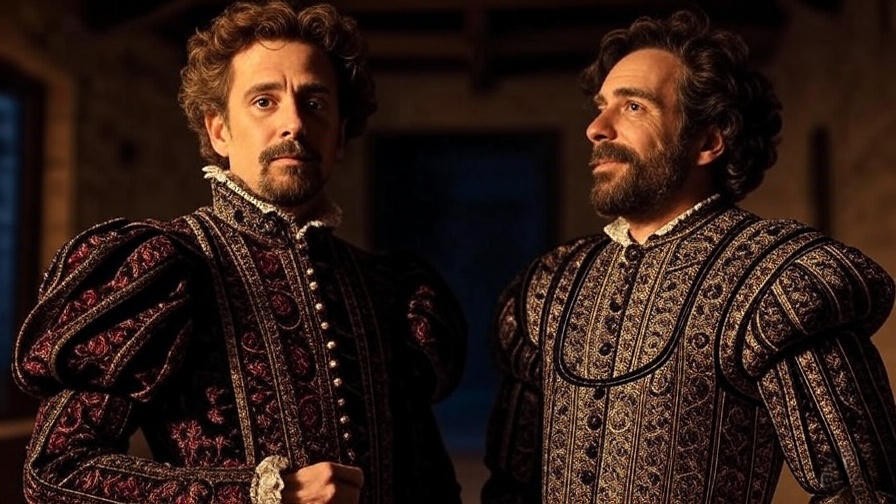
When we think of William Shakespeare’s immortal tragedy Romeo and Juliet, our minds instantly conjure up star-crossed lovers on a moonlit balcony, the fiery temper of Tybalt, the poetic melancholy of Romeo, or the tragic finality of the tomb. Yet, the entire machinery of this devastating catastrophe is not set in motion by a nobleman or a principal rival; it is ignited on the sun-baked streets of Verona by a minor, working-class character. If you have ever wondered abram from romeo and juliet and what role he plays in the grand scheme of the narrative, you are looking at the crucial spark that turns an ancient grudge into a fatal public riot.
The Spark: How Abram and Sampson’s Street Brawl Sets the Tone
The play famously opens not with a grand soliloquy about love, but with crude banter, low humor, and a ticking time bomb of systemic violence. In Act 1, Scene 1, two Capulet servants—Sampson and Gregory—loiter on a Veronese street, spoiling for a fight. They look for an excuse to provoke the opposing household, the Montagues. Enter Abram (sometimes spelled Abraham in various early modern texts), a servingman belonging to the house of Montague, accompanied by his fellow servant Balthasar.
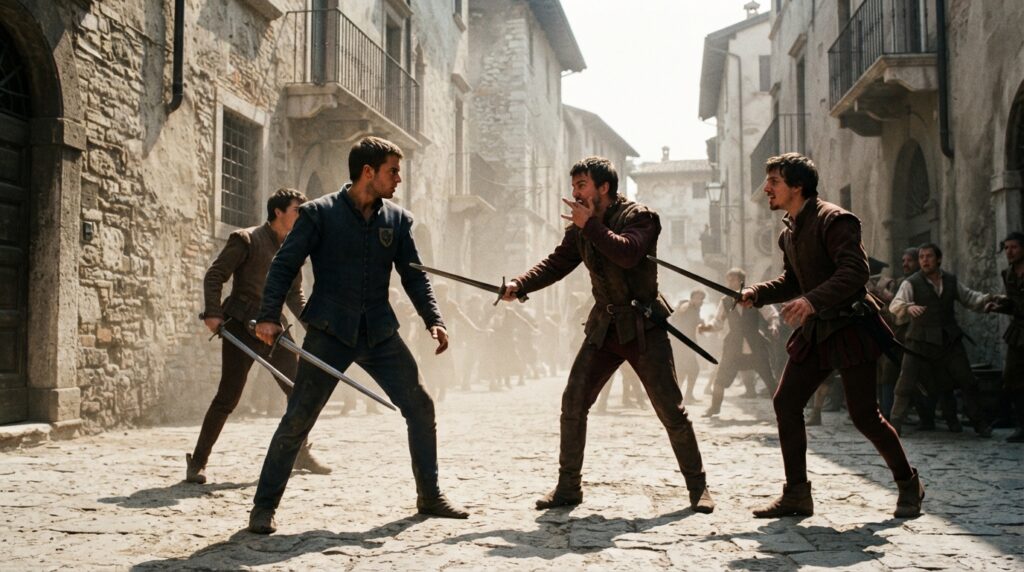
What follows is a masterclass in escalating tension. Sampson bites his thumb at them—a gesture roughly equivalent to flashing an offensive middle finger today. A war of words ensues over whether the insult was directed at Abram and his companion or merely at them generally. Within seconds, verbal sparring gives way to drawn swords, drawing in Benvolio, Tybalt, and eventually the brawling citizens and weary Prince Escalus. Without abram from romeo and juliet stepping onto the pavement to answer Sampson’s juvenile taunt, the dramatic momentum of the play’s inciting incident would collapse.
Textual Context: Why Open with Servants?
Shakespeare’s choice to open a high-stakes aristocratic tragedy with the domestic help is a brilliant structural maneuver. Elizabethan audiences understood that the health of a commonwealth or a noble house trickles down from the top, but it is felt most sharply at the bottom. By starting with Abram and Sampson, Shakespeare immediately establishes that the Capulet-Montague feud is not an isolated lovers’ quarrel or a private aristocratic dispute; it is a systemic infection that has corrupted every stratum of Verona’s society. The hatred is so pervasive that even the men who empty slops and carry water for the lords are ready to draw blood over it.
Article Thesis
This comprehensive exploration will examine who Abram is, dissect his single appearance in Act 1, Scene 1, analyze the socio-political realities of Elizabethan and Veronese servitude, and demonstrate how minor characters like Abram function as vital narrative foils, expanding Shakespeare’s exploration of systemic violence, class honor, and tragic inevitability.
Who is Abram in Romeo and Juliet? (Character Profile & Basics)
To truly understand Abram, we must look closely at the sparse textual evidence Shakespeare provides, augmented by historical context regarding Renaissance theater and household structures.
Master and Allegiance
-
Household: House of Montague
-
Social Status: Servingman / Working-class retainer
-
Companions: Frequently appears alongside Balthasar (Romeo’s trusted personal servant who later brings him the false news of Juliet’s death).
-
Primary Motivation: Defense of household honor and personal dignity against aggressive Capulet provocation.
First and Only Appearance
Abram makes his sole physical appearance on stage in Act 1, Scene 1, lines 35 through 65. Unlike characters who weave in and out of the five acts, Abram exits the stage almost as quickly as he enters, swallowed up by the chaotic tide of the full-scale riot that his argument helps precipitate. Despite his brief screen time (or stage time), his dialogue establishes him as a man acutely aware of social slights, reluctant to start unnecessary brawls unprovoked, yet entirely unwilling to back down when directly challenged.
The Etymology and Name
The name Abram (or Abraham) carries heavy biblical resonance. In Elizabethan England, biblical names were extraordinarily common across all social classes. Choosing a traditional, respectable Hebrew name for a Montague servant anchors him in a recognizable domestic reality. In modern stage productions and cinematic adaptations—ranging from Franco Zeffirelli’s lavish 1968 film to Baz Luhrmann’s hyper-stylized 1996 William Shakespeare’s Romeo + Juliet—Abram is typically cast as a rugged, loyal foot soldier of the household, dressed in livery or working-class garb that instantly distinguishes him from the silk-clad patricians like Tybalt or Mercutio.
Scene Breakdown: Analyzing Abram’s Role in Act 1, Scene 1
A granular look at the opening scene reveals the delicate psychological choreography Shakespeare employs before plunging Verona into chaos.
[Sampson & Gregory plot provocation]
       │
       ▼
[Abram & Balthasar enter]
       │
       ▼
[The Thumb-Biting Gesture]
       │
       ▼
[Verbal Sparring: "Do you bite your thumb at us, sir?"]
       │
       ▼
[Escalation to Drawn Swords]
       │
       ▼
[Intervention of Benvolio & Tybalt]
The Provocation: Dark Comedy and Crude Bravado
Sampson and Gregory establish a darkly comedic, almost farcical tone at the start. They talk tough about “thrusting” Montague men to the wall and violating Montague women, displaying the toxic hyper-masculinity bred by the generational feud. When Abram and Balthasar appear, Sampson actively looks for trouble, instructing Gregory to look out so he can legalistically skirt the boundaries of the law: “I will back them… but I will back down? No; let them take the law of us; let them begin.”
The Exchange: Dignified Restraint vs. Aggressive Posturing
When Sampson bites his thumb—an insulting gesture designed to invite a reaction—Abram does not immediately swing his sword. Instead, he engages in a cautious, controlled verbal parry:
ABRAM: Do you bite your thumb at us, sir? SAMPSON: I do bite my thumb, sir. ABRAM: Do you bite your thumb at us, sir? SAMPSON: [Aside to Gregory] Is the law of our side, if I say ay? GREGORY: No. SAMPSON: No, sir, I do not bite my thumb at you, sir, but I bite my thumb, sir.
This exchange is brilliant because it highlights Abram’s restraint and adherence to legal boundaries. He wants to know if Sampson is directing the insult at them explicitly, trying to avoid a catastrophic brawl if possible. However, the linguistic dance cannot hold. Sampson’s prevarication (“I bite my thumb, sir, but not at you”) is transparently mocking.
Abram’s final verbal push before steel meets steel is direct and uncompromising: “Do you quarrel, sir?” When Sampson replies, “Quarrel, sir? no, sir,” Abram challenges him to do better: “If you do, sir, I am for you.” At this exact moment, Sampson spots Tybalt approaching and feels emboldened enough to drop the pretense and draw his weapon, shouting, “Draw, if you be men.” Abram draws in response, and the street erupts.
The Socio-Political Context: Servants in Elizabethan Verona
To modern readers, a street fight between low-level servants breaking out into a full-scale riot might feel exaggerated. To Shakespeare’s contemporary Elizabethan audience, it mirrored very real anxieties about urban violence, honor culture, and the behavior of masterless men or household retainers in London.
Class Dynamics and Retainer Culture
In Renaissance Europe, a nobleman’s household was not merely a family home; it was a mini-government, a military unit, and an economic enterprise combined. Servants and retainers wore their master’s colors and bore their master’s reputation.
-
Proxy Honor: If a Capulet servant insulted a Montague servant, it was treated as a direct assault on the honor of Lord Montague himself.
-
Economic Survival: Servants derived their livelihood, social protection, and identity from their employers. Defending the house was an absolute occupational imperative.
The Code of Honor in Elizabethan England
Honor was currency in the 16th and 17th centuries. The English concept of dueling and public reputation meant that a gentleman—and by extension, his fiercely loyal servants—could not ignore a public insult without suffering severe social degradation. When Abram challenges Sampson, he is acting as an organic extension of Montague pride. He cannot walk away without proving that his household is unafraid of Capulet intimidation.
Legal and Civic Perils: Prince Escalus’s Edict
The gravity of Abram and Sampson’s actions is underscored immediately after the brawl when Prince Escalus arrives to break up the melee. The Prince delivers a scathing rebuke, noting that the feud has disturbed the streets of Verona three times already, sparked by minor, trivial words:
“Three civil brawls, bred of an airy word,
By thee, old Capulet, and Montague,
Have thrice disturbed the quiet of our streets…”
The fact that an “airy word” exchanged between working-class servants like Abram and Sampson can trigger an armed insurrection demonstrates the fragile state of civil order in Verona. The Prince institutes a death penalty for any future breach of the peace, elevating the stakes of the opening skirmish into a matter of life and death for the entire city.
Abram as a Narrative Foil
Shakespeare frequently utilizes minor characters to mirror, contrast, or amplify major themes. Abram serves several critical functions as a narrative foil in the opening sequence.
Contrast with Tybalt
Abram’s interaction with Sampson directly contrasts with the entrance of Tybalt moments later.
-
Abram enters with a peer (Balthasar), conducts himself with measured vigilance, and fights out of defensive necessity and immediate provocation.
-
Tybalt, upon arriving, sees Benvolio (a Montague trying to keep the peace) and immediately flies into a murderous rage, declaring: “What, art thou drawn among these heartless hinds? / Turn thee, Benvolio, look upon thy death.”
While Abram represents the working-class foot soldier caught up in an inherited machine of hate, Tybalt represents the aristocratic fanatic who actively worships that hatred, treating bloodshed as an aesthetic sport.
Fleshing Out the Feud: Macro vs. Micro
By beginning the play at the bottom of the social ladder, Shakespeare ensures the audience understands that the Capulet-Montague hatred is totalizing. It is not just Romeo and Juliet who suffer; it is the cooks, the pot-painters, the musicians, and the servingmen like Abram whose daily lives are governed, endangered, and ultimately ruined by the toxic politics of their betters.
Cultural and Modern Interpretations of Abram
Over the centuries, directors, actors, and literary critics have treated Abram’s brief appearance in various ways to shape the overall tone of their productions.
Stage and Film Adaptations
-
Franco Zeffirelli (1968): In this classic cinematic adaptation, the opening brawl is choreographed with immense historical texture, mud, heat, and raw energy. Abram and Sampson’s exchange feels gritty and immediate, establishing the oppressive summer heat of Verona that mirrors the boiling tempers of its inhabitants.
-
Baz Luhrmann (1996): In William Shakespeare’s Romeo + Juliet, the period setting is swapped for a modern, gun-toting Miami-style “Verona Beach.” Here, the equivalents of Abram and Sampson square off at a gas station. The thumb-biting is transformed into modern crude gestures and biting cigar ends, proving that Shakespeare’s depiction of petty, machismo-driven street violence transcends centuries and dress codes.
Literary Criticism Perspectives
Scholars often point to Abram to illustrate Shakespeare’s supreme economy of writing. Every single line in a Shakespearean exposition must accomplish multiple tasks: establish setting, introduce character motivation, foreshadow plot conflict, and build thematic depth. In under thirty lines of dialogue, Abram helps accomplish all four.
Frequently Asked Questions (FAQs)
What lines does Abram speak in Romeo and Juliet?
Abram speaks only a few short, direct lines in Act 1, Scene 1, primarily centered around confronting Sampson about his provocative behavior:
-
“Do you bite your thumb at us, sir?”
-
“Do you bite your thumb at us, sir?”
-
“Do you quarrel, sir?”
-
“If you do, sir, I am for you.”
Is Abram on the side of the Capulets or Montagues?
Abram is a servingman in the household of Montague. His primary rival in the scene is Sampson, who serves the house of Capulet.
Why does the fight start between servants instead of Romeo and Juliet?
Shakespeare begins with the servants to demonstrate that the family feud is systemic, deeply entrenched, and toxic to all levels of Veronese society. It establishes that the hatred did not originate with the young lovers, but is an environmental poison that infects everyone from the lowest domestic help to the ruling Prince.
How many scenes does Abram appear in?
Abram appears in only one scene throughout the entire play: Act 1, Scene 1. He does not appear or get mentioned by name again after the initial street brawl is broken up by the Prince and citizens.
The Legacy of Shakespeare’s Minor Players
When we step back to evaluate the grand architecture of Romeo and Juliet, it becomes clear that William Shakespeare waste no words and populates his world with no truly disposable characters. Abram from Romeo and Juliet may walk across the stage for only a few fleeting moments, but his willingness to stand his ground against Sampson’s juvenile insults is the friction that strikes the match.
Through Abram, Shakespeare reminds us that grand historical tragedies—whether in Elizabethan drama or real-world history—are frequently fueled by ordinary people caught up in institutional hatreds they did not create, yet eagerly perpetuate. Understanding Abram deepens our appreciation for Shakespeare’s peerless world-building, proving that even the lowliest servingman on the streets of Verona carries the weight of a world on the brink of collapse.