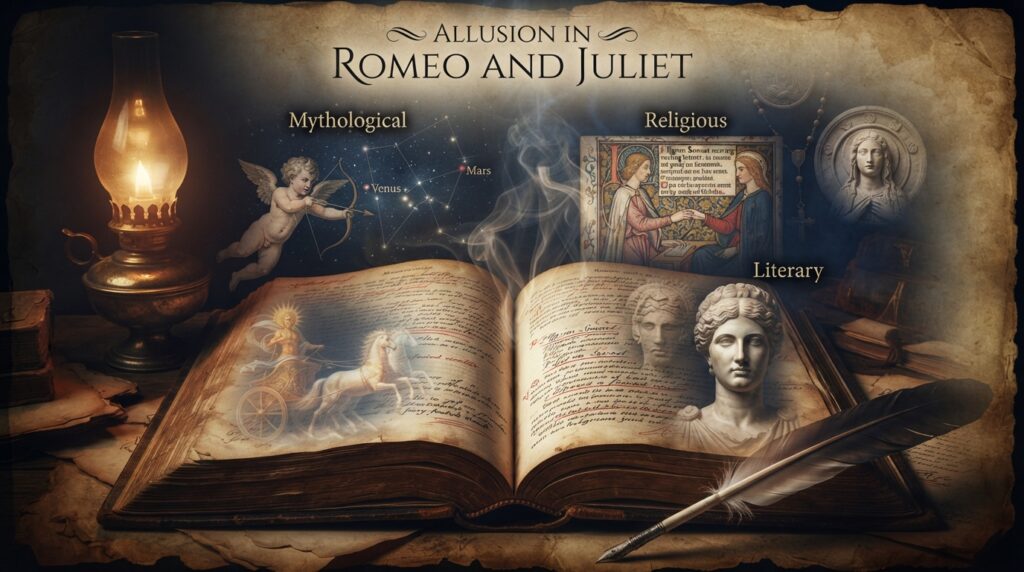
When Romeo begs Juliet to let him stay a little longer, he isn’t just whispering sweet nothings; he is invoking Phoebus, the god of the sun, racing his fiery-footed steeds across the sky. For modern readers and students encountering Romeo and Juliet for the first time, lines like these can easily feel like archaic window dressing—dense, dusty references meant only for academic tests. Yet, mastering the allusion in romeo and juliet completely unlocks the play’s psychological depth. Shakespeare did not use classical mythology, religious iconography, and Elizabethan folklore merely to show off his grammar school education. He used these hidden cultural codes as shorthand to elevate a local teenage feud into an epic, universal clash of fate, faith, and human passion.
Decoding What an Allusion Does in Shakespearean Drama
To truly appreciate Shakespeare’s craft, we must look beyond the plot of rival houses and masked balls. An allusion is a brief, intentional reference to a well-known person, place, event, work of art, or biblical passage. In Elizabethan England, grammar school curricula heavily emphasized Ovid’s Metamorphoses, Virgil’s Aeneid, and classical mythology. Consequently, Shakespeare’s original theatergoers—from groundlings to nobility—possessed a cultural literacy that allowed them to catch these references instantly.
When a character invokes a god or a biblical archetype, the reference functions like an emotional amplifier. It adds instant context, shaping audience expectations and revealing character psychology long before a monologue concludes. In Romeo and Juliet, allusions track the evolution of the characters’ emotional maturity. Early in the play, Romeo relies on tired, artificial Petrarchan clichés, hiding behind the tropes of unrequited love and classical figures like Cupid and Diana. As the play darkens, the allusions shift from playful mythological posturing to desperate, high-stakes religious and cosmic imagery.
Classical Mythology: Gods, Goddesses, and the Weight of Fate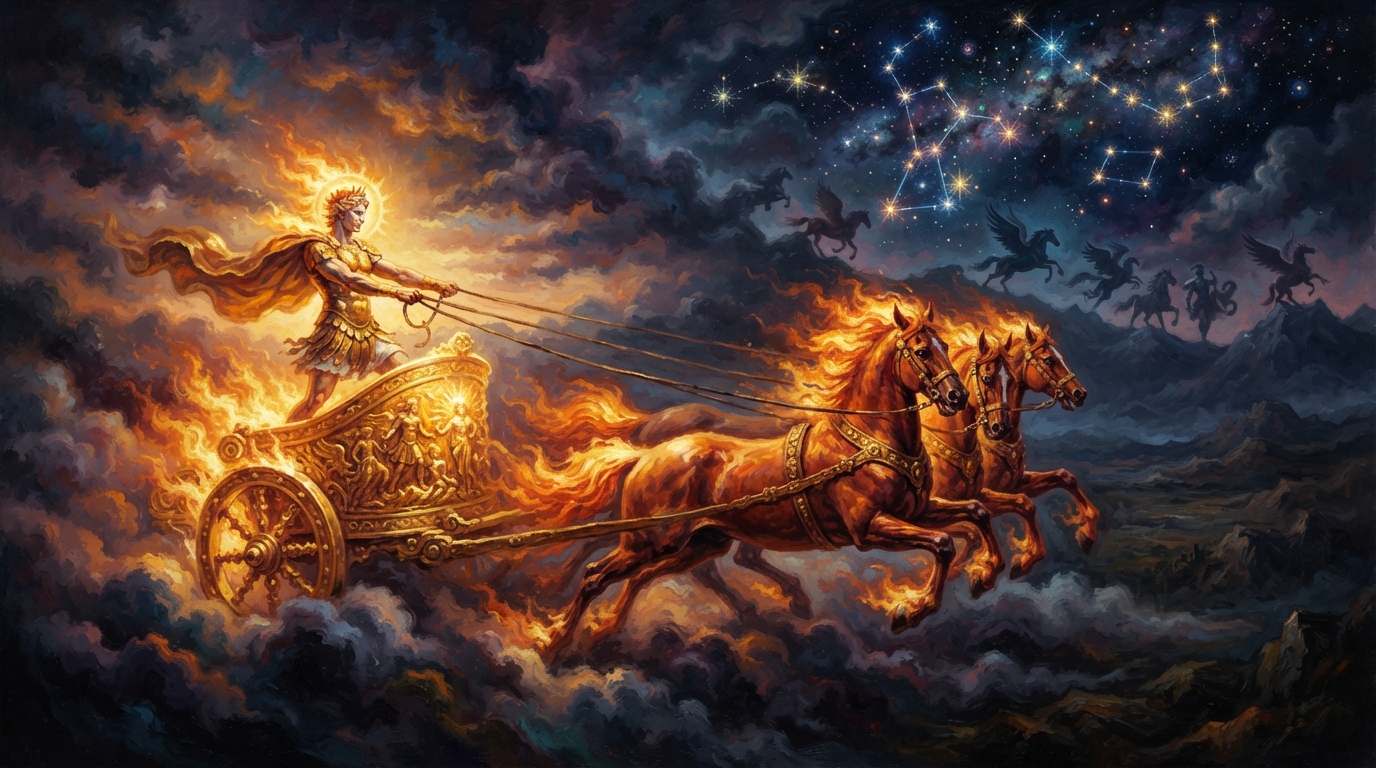
Verona may be a fictionalized Italian city-state, but its inhabitants live under the heavy shadow of the Olympian pantheon. Shakespeare populates the text with deities to externalize internal conflicts.
Cupid and Petrarchan Clichés
At the opening of the play, Romeo is lovesick over Rosaline, but his suffering is deeply performative. He speaks in heavy paradoxes and leans hard on the tropes of courtly love, invoking Cupid, the blind god of desire, and Diana, the virgin goddess of the chase. Romeo complains that Rosaline “hath Dian’s wit / And, in strong proof of chastity well armed, / From love’s weak childish bow she lives unharm’d.” Here, the allusion exposes Romeo’s superficial understanding of romance; he is playing the role of the tragic poet because he thinks it is expected of him.
Aurora and the Nocturnal Melancholy
Montague describes his son’s nocturnal habits using the goddess of the dawn:
“Away from light steals home my heavy son, / And private in his chamber pens himself, / Shuts up his windows, locks fair daylight out / And makes himself an artificial night. / Black and portentous must this humour prove, / Unless good counsel may the cause remove.”
By contrasting Romeo’s self-imposed darkness with Aurora’s bright morning, Shakespeare highlights Romeo’s isolation from the actual world. He is living in a self-generated myth, detached from reality until Juliet shatters that illusion.
Phoebus and Phaeton: The Rush Toward Disaster
One of the most brilliant uses of classical mythology occurs in Act 3, Scene 2. Juliet waits impatiently for nightfall so Romeo can visit her room. She cries:
“Gallop apace, you fiery-footed steeds, / Towards Phoebus’ lodging: such a wagoner / As Phaeton would whip you to the west, / And bring in cloudy night immediately.”
This dual reference is rich with dramatic irony. Phoebus is the sun god driving his chariot across the sky, while Phaeton is his reckless son who tried to drive the chariot of the sun, lost control, and nearly set the earth on fire. By invoking Phaeton, Juliet unwittingly foreshadows the catastrophic speed of their romance. They are driving too fast, ignoring the boundaries of the road, and hurtling toward an inevitable crash.
Religious and Biblical Allusions: Sin, Salvation, and Sacrifice
While classical gods govern the romance, Christian iconography frames the moral and spiritual weight of the tragedy. Shakespeare deliberately elevates the lovers’ passion into a quasi-religion, effectively setting them apart from a corrupt, feuding Verona.
The Pilgrim Sonnet at the Capulet Ball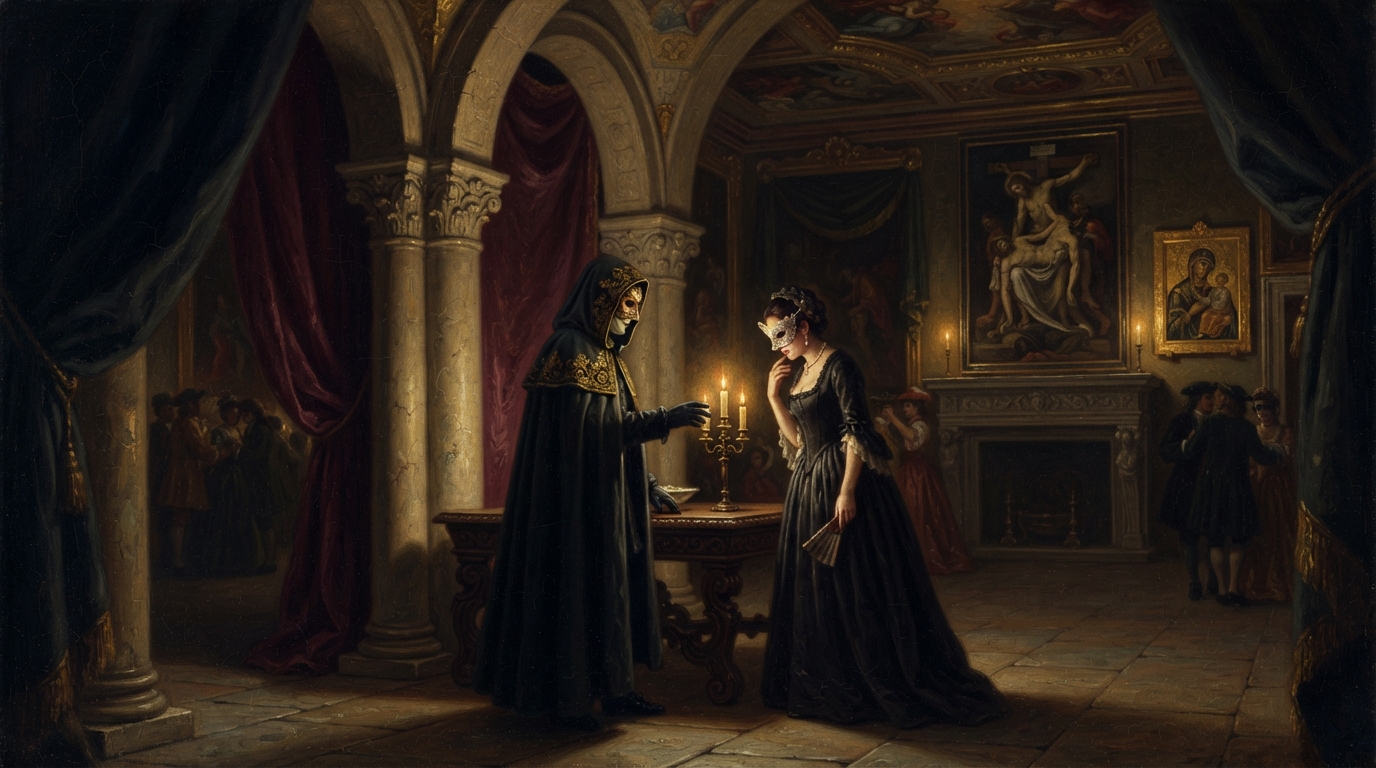
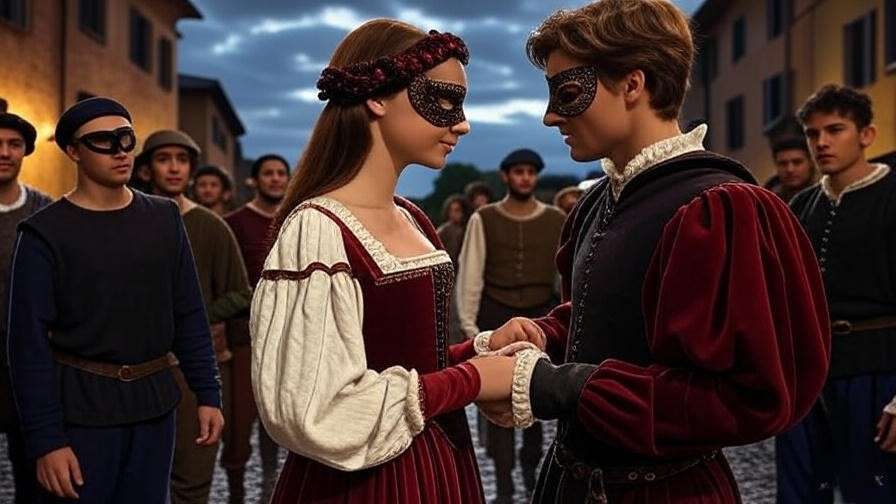
When Romeo and Juliet first lock eyes, their very first shared dialogue forms a complete, perfect Shakespearean sonnet structured entirely around religious devotion. Romeo approaches Juliet and touches her hand, saying:
“If I profane with my unworthiest hand / This holy shrine, the gentle fine is this: / My lips, two blushing pilgrims, ready stand / To smooth that rough touch with a tender kiss.”
Juliet plays along, matching his sacred register:
“Good pilgrim, you do wrong your hand too much, / Which mannerly devotion shows in this; / For saints have hands that pilgrims’ hands do touch, / And palm to palm is holy palmers’ kiss.”
In Elizabethan England, comparing a mortal woman to a holy shrine and framing a kiss as a pilgrimage bordered on blasphemy. Yet, this extended religious metaphor reframes their love. To them, their passion is not a sin born of the family feud; it is a sacred act of worship that transcends the petty hatred of their parents. They create their own liturgy in a church of two.
Eden, Temptation, and the Fall
Underneath the surface of Verona’s street brawls lie subtle undertones of the original fall from grace. The ancient grudge between the Capulets and Montagues acts as an inherited original sin. The young lovers try to forge an Edenic paradise within the orchard walls, away from the poison of the civic feud. However, just as in Genesis, temptation, forbidden fruit (symbolized by the secrecy of their marriage), and outside interference corrupt the sanctuary, leading to expulsion and ultimate ruin.
Historical and Literary Foils: Dido, Cleopatra, and Petrarch
Shakespeare also anchors his characters by referencing legendary historical and literary figures, often using them as cautionary mirrors or ironic foils.
Mercutio’s Reality Checks
Mercutio acts as the ultimate antidote to Romeo’s elevated mythological posturing. When Romeo laments his love for Rosaline, Mercutio mocks the traditional poetic canon:
“Now is he for the numbers that Petrarch flowed in: Laura to his lady… Dido a dowdy; Cleopatra a gypsy; Helen and Hero hildings and harlots; Thisbe a grey eye or so, but not to the purpose.”
By rattling off the names of classical heroines—Dido of Carthage, Cleopatra of Egypt, Helen of Troy, and Hero of myth—Mercutio reduces epic tragedies of love and war to punchlines. He warns Romeo that romantic obsession is a trap. Ironically, Mercutio’s cynical dismissal of classical romantic tragedy contrasts sharply with the fact that Romeo and Juliet’s deaths will soon rival those very ancient stories in scale and sorrow.
Scene-by-Scene Mapping of Key Allusions
To trace how these references evolve across the five acts, consider the following structural shift:
| Act / Scene | Primary Allusion Type | Key Figures Mentioned | Dramatic Function & Psychological Shift |
| Act 1, Scene 1 | Classical Mythology | Cupid, Diana, Aurora | Establishes Romeo’s immature, performative melancholy and unrequited courtly love tropes. |
| Act 1, Scene 5 | Religious / Sacred | Saints, Pilgrims, Palmers | Elevates the initial meeting of the lovers into a sacred, spiritual sanctuary away from Verona’s hatred. |
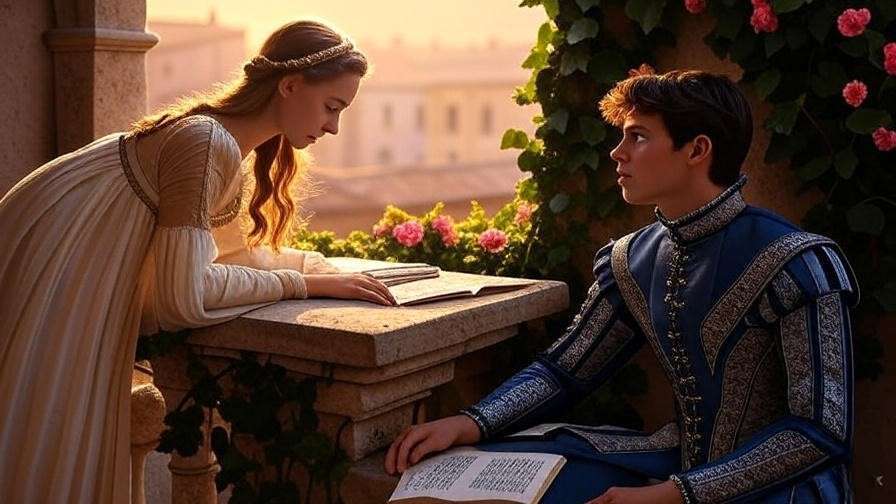
| Act 2, Scene 2 | Classical / Celestial | Romeo as the sun, Moon (Diana) | The Balcony Scene strips away artificial poetry; Romeo compares Juliet to the sun, eclipsing the envious moon. |
| Act 3, Scene 2 | Classical Mythology | Phoebus, Phaeton | Juliet’s soliloquy exposes her frantic desire for night, foreshadowing reckless speed and disaster. |
| Act 5, Scene 3 | Monumental / Mythical | Roman / Veronese Statues | Capulet and Montague pledge to build golden statues, immortalizing the lovers in civic myth. |
Expert Teaching Insights: How to Spot and Analyze Allusions
Analyzing allusions effectively in essays or literary studies requires looking past the name drop to ask why that specific reference was chosen.
-
Examine the Speaker: Consider who is delivering the allusion. When Mercutio drops classical names, it reflects his cynicism and intellectual wit. When Juliet invokes Phaeton, it demonstrates her passionate urgency and loss of control. When the Friar speaks in botanical and herbal metaphors rooted in folk tradition, it underscores his pragmatism.
-
Identify Subversion: Shakespeare frequently sets up a classical comparison only to subvert it. Romeo starts by treating love like a mythological game, but by the time he drinks the poison in Act 5, the stakes are painfully, irrevocably real.
-
Avoid Plot Summary: When writing about allusions, never spend more than one sentence explaining who Cupid or Phaeton was. Immediately pivot back to how the reference changes our understanding of the character’s internal state or advances the play’s thematic arguments.
Frequently Asked Questions
-
Why does Shakespeare use so many mythological references in Romeo and Juliet?
Renaissance education was rooted in classical humanism. Playwrights used mythology as a universal language that educated audiences instantly understood, allowing them to convey complex emotional states and historical weight quickly.
-
What is the difference between an allusion and a metaphor in this play?
A metaphor directly equates two unrelated things (e.g., “Juliet is the sun”), whereas an allusion references an outside entity, story, or person from history, mythology, or religion (e.g., referencing Phoebus or a pilgrim) to enrich the primary text.
-
How do Romeo’s classical allusions change after he meets Juliet?
Early on, Romeo uses clichés about Cupid and Rosaline to sound like a tragic poet. After meeting Juliet, his language shifts from artificial Petrarchan posturing to genuine, visceral imagery of light, stars, and sacred devotion.
-
Which classical figure is referenced most frequently by the characters?
Cupid and various iterations of love goddesses (like Venus and Diana) appear most frequently in the early acts to frame the dynamics of desire and chastity within Verona.
The hidden layers woven into Romeo and Juliet transform what could easily be a standard teenage melodrama into a timeless examination of human destiny. By embedding classical myths, biblical echoes, and historical figures into everyday dialogue, Shakespeare gave his characters a language that reaches far beyond the walls of Verona. The next time you open the script, look past the surface plot. Pay attention to the gods they invoke, the saints they pray to, and the ancient stories they echo—that is where the true heart of the tragedy beats.