
Picture this: it’s late in the evening, you have an English literature essay due tomorrow, and you are staring blankly at a page of Elizabethan text that might as well be written in a foreign language. If you have ever felt completely lost trying to navigate the complex metaphors and archaic vocabulary of the world’s most famous tragedy, you are certainly not alone. Shakespeare’s brilliant but demanding poetry creates a massive barrier for modern readers.
Fortunately, there is a perfect solution for this academic hurdle. The romeo and juliet book no fear edition acts as the ultimate bridge between 16th-century dialogue and 21st-century comprehension. Far from being a simple summary, this invaluable study tool is designed to decode the original text without sacrificing its literary integrity.
In this comprehensive guide, we will break down exactly how this essential edition works, explore why classic literature can be so challenging to process, and provide expert strategies on how to use this book to write better essays, ace your exams, and actually enjoy the tragedy of star-crossed lovers.
What is the “Romeo and Juliet Book No Fear” Edition?
Published under the well-known SparkNotes umbrella, the No Fear Shakespeare series revolutionized how modern students approach classic drama. Rather than forcing readers to rely entirely on dense academic footnotes or separate study guides, this edition integrates comprehension directly into the reading experience.
The Side-by-Side Translation Format
The defining feature of this edition is its ingenious structural layout. When you open the book, the pages are split into a dual-facing format. On the left-hand page, you will find William Shakespeare’s original, unabridged text—exactly as it appears in standard academic editions like Folger or Arden. Directly across from it, on the right-hand page, is a line-by-line modern English translation.
This side-by-side format allows your eyes to easily dart across the binding the exact moment you encounter a confusing word or convoluted sentence. There is no need to flip back and forth to a glossary at the back of the book or pull out your phone to search for definitions. The translation is immediate, seamless, and incredibly easy to follow.
Who is This Edition Actually For?
While often categorized purely as a high school study guide, this text serves a much broader audience:
-
Students (Middle School to College): It provides the clarity needed to participate in class discussions and the exact textual evidence required for analytical essays.
-
ESL Learners: For non-native English speakers, tackling 400-year-old poetic verse is a daunting task. The plain-English side provides necessary context.
-
Actors and Directors: Theatre professionals frequently use parallel texts during table reads to ensure they fully understand the motivations and literal meanings behind their lines before layering on the Shakespearean performance.
-
Casual Readers: Anyone who wants to enjoy a classic piece of Western literature without the friction of constantly translating antiquated vocabulary.
Why Shakespeare is So Hard to Read (And How This Book Fixes It)
Before you can appreciate how helpful this edition is, it helps to understand exactly why reading the original play feels like such an uphill battle. The difficulty isn’t a reflection of your reading comprehension; it is a byproduct of linguistic evolution.
Lost in Translation: Elizabethan Slang and Puns
Shakespeare was a master of wordplay, but jokes have an expiration date. What was a hilarious, crowd-pleasing pun in 1597 often flies completely over the head of a modern reader.
Take the famous opening scene of the play, where the Capulet and Montague servants are bickering. The phrase “I will bite my thumb at them” carries very little weight today. However, a quick glance at the right side of the No Fear edition instantly translates this gesture as a severe, highly offensive insult—the Elizabethan equivalent of flipping the bird.
Similarly, characters like Mercutio and the Nurse speak almost entirely in double entendres, bawdy humor, and hyper-specific cultural references. The modern translation strips away the obscurity, allowing you to understand the humor, the tension, and the character dynamics that are otherwise buried beneath archaic slang.
Untangling the Syntax
Vocabulary is only half the battle; the other half is sentence structure. To maintain his famous rhythmic meter (iambic pentameter), Shakespeare frequently inverted traditional sentence structures. Instead of the standard Subject-Verb-Object format modern English speakers use (“I caught the ball”), Shakespeare might write Object-Subject-Verb (“The ball I caught”) or even Verb-Object-Subject (“Caught the ball I”).
When a sentence is stretched across three lines of poetic verse and inverted, it becomes incredibly difficult to track who is doing what to whom. The right-hand page of the book straightens out this tangled syntax. It restructures the sentences into a familiar, linear flow, allowing you to grasp the core action immediately before re-reading the poetic original on the left.
Key Features That Make the No Fear Edition a Lifesaver
Beyond just the modern translation, this specific edition is packed with structural elements designed to optimize the studying and reading experience.
Unabridged Original Text
A common misconception among students—and a frequent worry among English teachers—is that this book is a “dumbed-down” summary that skips over chunks of the play. This is entirely false. The left-hand page features the complete, unabridged original play. Every soliloquy, every minor character interaction, and every stage direction is preserved. Because the original text is fully intact, students can confidently use this edition to pull direct quotes for term papers and academic citations.
Character Breakdowns and Scene Summaries
Keeping track of Verona’s feuding families can be confusing for first-time readers. Is Benvolio a Montague or a Capulet? Who exactly is Count Paris? The book features a heavily annotated Dramatis Personae (character list) at the front, explaining not just who the characters are, but their allegiances and relationships to one another. Furthermore, before every single scene begins, there is a brief, italicized paragraph that sets the stage, telling you exactly where the characters are and what is about to happen, ensuring you never start a scene lost.
The Deluxe Student Edition Upgrades
For those looking to take their academic prep to the next level, the publisher offers a “Deluxe” version of the No Fear edition. This upgraded version includes several highly valuable additions at the back of the book, including:
-
A comprehensive list of the play’s most important quotes, organized by theme and character.
-
Breakdowns of major motifs (like light vs. dark, and the role of fate).
-
Sample A+ student essays to demonstrate how to structure an analytical paper.
-
Historical context about life, marriage, and law in Renaissance-era society.
Expert Tips for Studying with the No Fear Edition
While this parallel text is an incredibly powerful tool, using it incorrectly can actually hinder your academic growth. To truly elevate your understanding of classic drama and impress your English literature teacher, you need to be strategic. Here is how subject matter experts recommend utilizing the text.
Don’t Just Read the Right Side (The Modern Trap)
The most common mistake students make is abandoning the left page entirely. It is deeply tempting to breeze through the modern English translation, get the basic plot points, and close the book. However, doing this deprives you of the actual literary genius of the play.
Expert Insight: Use the modern translation as a scaffolding, not a replacement. The most effective study method is to read the plain-English translation on the right side first to grasp the literal meaning of a passage. Once you understand the context—who is speaking, what they want, and what they are actually saying—immediately read the original Shakespearean verse on the left. You will be amazed at how quickly the complex metaphors and poetic devices suddenly make perfect sense when you already know the underlying meaning.
Read Aloud to Catch the Rhythm
Shakespeare’s plays were never meant to be read silently at a desk; they were written to be performed on a loud, bustling stage in front of thousands of people. The dialogue is structured in iambic pentameter (a rhythmic pattern that sounds like a heartbeat: ba-DUM, ba-DUM, ba-DUM).
Reading the original text aloud helps you internalize this rhythm, making the emotional stakes of the scene much clearer. If you stumble on a particularly difficult line of verse, glance at the modern translation to regain your footing, and then continue reading the original aloud.
Pair with a Visual Performance
Even with a modern translation in front of you, a play is a visual medium. To cement your comprehension, pair your reading with a high-quality film adaptation. Franco Zeffirelli’s classic 1968 film or Baz Luhrmann’s stylized 1996 Romeo + Juliet are excellent companions. Watch a scene play out on screen, then go back and read that same scene in your book. Seeing the actors physically express the text while you read the side-by-side translation bridges the gap between written word and theatrical performance.
Act-by-Act Guide: Finding Key Moments in the No Fear Edition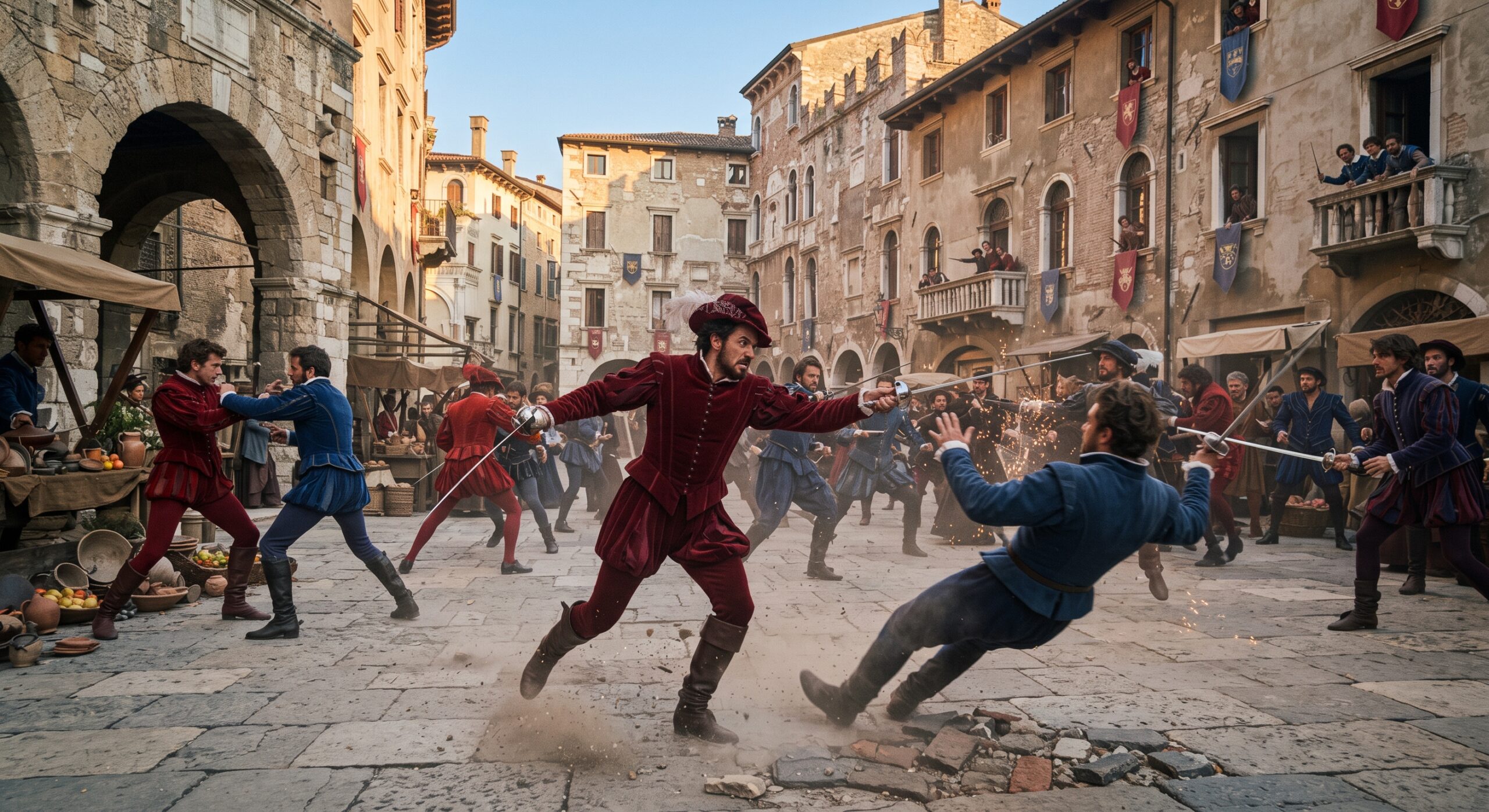
Understanding the overarching structure of the tragedy is vital for writing strong essays. Here is a brief look at how the modern translation clarifies the most crucial turning points in the play.
Acts 1 & 2: Setting the Scene and The Balcony
The first two acts establish the bitter feud and the rapid, intoxicating romance.
-
The Capulet Ball (Act 1, Scene 5): When Romeo and Juliet first meet, their dialogue forms a perfect, shared sonnet filled with religious imagery (pilgrims, saints, and shrines). The modern translation brilliantly unpacks these metaphors, showing how their banter is essentially an extended, highly intellectual flirtation.
-
The Balcony Scene (Act 2, Scene 2): When Juliet famously asks, “Wherefore art thou Romeo?”, modern readers often mistakenly think she is asking where he is. The right-hand page instantly clarifies that “wherefore” means “why.” She is agonizing over why the boy she loves has to be a Montague, a sworn enemy of her family.
Act 3: The Climax and the Turning Point
Act 3 is the pivot point where the play shifts from a romantic comedy into a devastating tragedy.
-
The Street Fight (Act 3, Scene 1): The tension leading up to the deaths of Mercutio and Tybalt is thick with aggressive wordplay and challenges to manhood. The plain-English side ensures you do not miss the escalating insults that inevitably lead to fatal swordplay.
-
Juliet’s Internal Conflict (Act 3, Scene 2): Upon learning that her new husband has murdered her cousin, Juliet delivers a breathtaking monologue filled with oxymorons (“Beautiful tyrant! Fiend angelical!”). The modern text helps you track her rapid emotional pendulum as she swings between grief for Tybalt and fierce loyalty to Romeo.
Acts 4 & 5: The Tragic Conclusion
The final acts are heavily plot-driven, relying on miscommunications, desperate plans, and fatal timing.
-
The Potion Plan (Act 4, Scene 1): Friar Lawrence’s scheme to fake Juliet’s death is logistically complicated. He outlines exactly how long the potion will last, what the physical symptoms will be, and how Romeo will be notified. The No Fear edition breaks down these instructions plainly, ensuring you understand the exact mechanics of the doomed plan.
-
The Tomb (Act 5, Scene 3): The tragic climax relies heavily on dramatic irony (the audience knows Juliet is alive, but Romeo does not). The side-by-side translation strips away the archaic language of the tomb scene, leaving only the raw, visceral grief of the lovers’ final moments, making the emotional impact infinitely stronger for a modern reader.
Comparing No Fear Shakespeare to Other Study Guides
With so many resources available, you might wonder how this specific book stacks up against other popular study aids.
SparkNotes No Fear vs. Traditional CliffNotes
Standard study guides (like CliffNotes or traditional online SparkNotes) provide excellent chapter summaries, character analysis, and thematic breakdowns. However, they are substitutes for reading the text. If your teacher asks for textual evidence or a close-reading analysis of a specific soliloquy, a summary guide will not help you. The parallel text edition forces you to engage with the actual play, ensuring you develop real literary analysis skills.
Digital vs. Physical Copies
While the modern translations are available digitally on the SparkNotes website, investing in the physical book is highly recommended for serious students. A physical copy allows you to annotate the text, highlight key quotes on the left page, and jot down connections to the modern translation in the margins. This active engagement is the foundation of high-level literary analysis.
Frequently Asked Questions (FAQs)
Is reading the modern translation considered cheating? Absolutely not. Using a comprehension tool is a strategic way to learn. Teachers and professors want you to understand the themes, character arcs, and historical context of the play. They do not want you to spend three hours blindly staring at a dictionary trying to translate Elizabethan idioms. It is a stepping stone to mastery, not a shortcut to skip the work.
Does the No Fear edition leave out any of the original play? No. A common myth is that this edition is abridged. The left-hand side of the book contains the complete, unabridged original text of the play, identical to what you would find in any standard academic edition.
Can I cite the modern translation in my English essay? Generally, no. When writing an academic paper, your teacher expects you to analyze Shakespeare’s actual words, not a modern editor’s translation of them. You should use the right side of the book to understand the meaning, but always quote and cite the original Elizabethan text from the left side of the page.
Conquering Verona
Navigating the complexities of Elizabethan literature does not have to be an isolating or frustrating experience. The romeo and juliet book no fear edition transforms what could be a dreaded academic chore into an accessible, engaging, and deeply moving experience. By providing a clear, immediate translation directly alongside the original text, it empowers you to fully grasp the intricate plot mechanics, appreciate the sharp humor, and feel the devastating emotional weight of the world’s most famous tragedy.
Whether you are preparing for a difficult final exam, writing a comprehensive term paper, or simply wanting to experience the brilliance of the Bard without the linguistic headache, this parallel text is an absolute necessity. Do not let 400-year-old vocabulary stand between you and a masterpiece. Use the modern translation to unlock the door, and let Shakespeare’s original poetry take it from there.