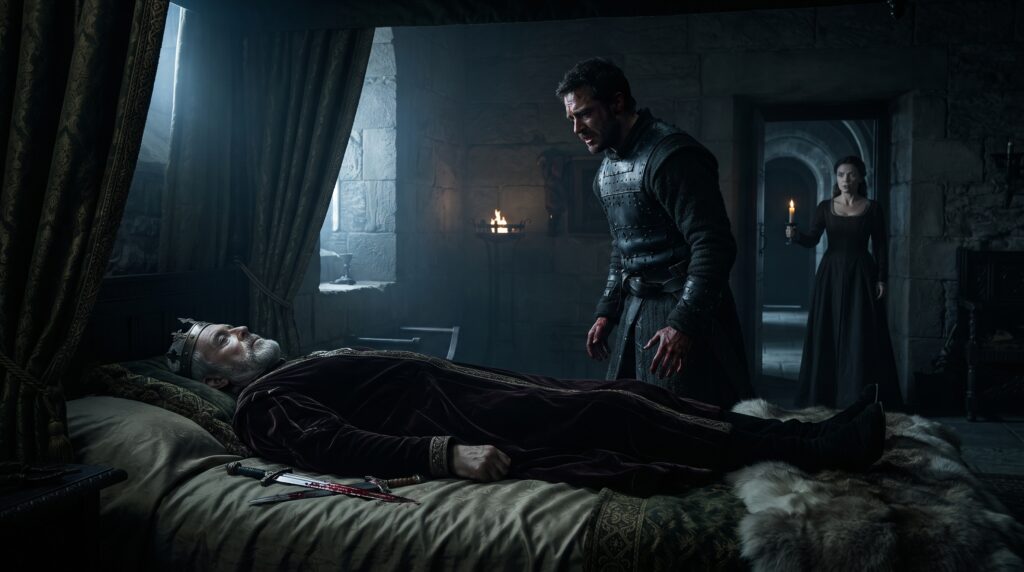
The midnight shadows of Inverness close in, heavy with the metallic tang of blood and the chilling certainty of treason. Macbeth creeps toward the royal bedchamber, his mind unhinged by prophecy and prodded by ruthless ambition, carrying daggers that will alter the destiny of Scotland forever. At the heart of this theatrical tragedy lies a devastating act of regicide, prompting countless students, literary historians, and theatergoers to ask: who was the slain king in macbeth? This comprehensive guide explores the tragic literary figure of King Duncan, examines the turbulent 11th-century historical reality behind Shakespeare’s Jacobean masterpiece, and dissects why this iconic murder continues to captivate audiences more than four centuries later.
I. Introduction: The Murder That Shook Scotland and Stage
The Dramatic Hook
Few moments in world literature match the sheer psychological terror of Act 2, Scene 2 of William Shakespeare’s Macbeth. The stage directions whisper of an ominous quiet broken only by the shriek of an owl and the screams of crickets. Macbeth emerges from the chamber of his royal host, trembling, his hands stained with “blood of Neptune’s ocean.” The king is dead. The divine order is shattered. Within seconds, a kingdom plunges into a spiral of tyranny, paranoia, and supernatural retribution that will end only with severed heads on pikes and rightful restoration.
The Core Question
At the center of this cataclysmic plot is the slain king in macbeth, a character whose brief appearance on stage triggers the entire dramatic engine of the play. Yet, the boundary between Shakespearean drama and actual Scottish history is frequently blurred. Who was King Duncan in the play? How does his characterization serve Shakespeare’s political and moral agenda? And how drastically does the dramatic fiction differ from the historical chronicle of Macbeth, King of Scotland?
Article Roadmap & Value Proposition
This skyscraper-level guide offers a definitive, exhaustive breakdown of the slain king. We will analyze Duncan’s literary characterization, dissect the anatomy of the regicide, pull back the curtain on Raphael Holinshed’s historical chronicles, compare the fictional murder with the real 1040 battle of Bothnagowan, explore the Elizabethan and Jacobean worldview of divine right, and provide critical insights for academic essays—complete with frequently asked questions.
II. The Literary Portrait: King Duncan in Shakespeare’s Macbeth
Character Who Was King Duncan in the Play?
In Shakespeare’s dramatic universe, King Duncan is introduced not as a tyrant, but as the embodiment of grace, justice, and patriarchal benevolence. Unlike historical accounts that paint a very different picture, Shakespeare deliberately elevates Duncan to highlight the heinous nature of Macbeth’s betrayal.
-
The Benevolent Patriarch: Duncan is portrayed as an aging, deeply appreciative sovereign who showers his thanes with honors. When he arrives at Macbeth’s castle at Inverness, he expresses gentle warmth, calling Lady Macbeth a “fair and noble hostess.”
-
The Voice of Virtue: Duncan’s character is defined by his absolute trust and his inability to read “mind’s construction in the face.” Macbeth himself acknowledges Duncan’s pristine leadership, noting that the king has “been so clear in his great office, that his virtues will plead like angels, trumpet-tongued, against the deep damnation of his taking-off.”
The Symbolic Significance
Duncan is far more than a frail old man; he represents the cosmic and political order of the universe. In Jacobean political theory, the king is God’s lieutenant on Earth. Therefore, the murder of Duncan is not merely a political assassination—it is a cosmic catastrophe.
When Duncan is slain, nature itself rebels. Horses break their stalls and eat each other, darkness blankets the daytime sky, and a falcon is slain by a mousing owl. Shakespeare uses these symbolic disruptions to emphasize that killing the legitimate monarch dismantles the fabric of reality.
The Anatomy of the Murder
Macbeth’s Internal Conflict
Macbeth’s journey toward regicide is mapped out through some of the most famous soliloquies in English drama. In Act 1, Scene 7, Macbeth wrestles not with moral righteousness, but with the terrifying consequences of crossing the moral Rubicon:
“If it were done when ’tis done, then ’twas well / It were done quickly…”
He recognizes a “double trust”: he is Duncan’s kinsman and his subject (should protect him against all murderers) and his host (should against the murderer shut the door, not bear the knife himself). His only motivation is “vaulting ambition, which o’erleaps itself / And falls on th’ other.”
Lady Macbeth’s Machiavellian Push
Without Lady Macbeth, the murder may have remained an unfulfilled ambition. Subverting conventional Jacobean gender roles, she calls upon dark spirits to “unsex” her, replacing motherly milk with “gall.” She bullies Macbeth’s masculinity, questioning his courage and orchestrating the logistical details: drugging the chamberlains so they can be framed for the bloody deed.
Immediate Aftermath and Chaos
The Discovery by Macduff
The dramatic tension peaks in Act 2, Scene 3, with the arrival of Macduff and Lennox. Macduff enters the royal chamber to wake the king and stumbles upon the horror, bursting forth with the iconic cry:
“O horror, horror, horror! Tongue nor heart / Cannot conceive nor name thee!”
Macduff labels the murder “The great doom’s image,” transforming the bedchamber into a micro-apocalypse.
Flight of the Princes
In the ensuing chaos, Duncan’s sons, Malcolm and Donalbain, realize their lives are in immediate danger. Their decision to flee—Malcolm to England, Donalbain to Ireland—ironically casts immediate suspicion upon them, allowing Macbeth to seize the vacant crown unopposed. Yet, this hasty flight plants the seeds of Macbeth’s ultimate undoing, as Malcolm returns later with an English army to reclaim his birthright.
III. Historical Reality vs. Stage Fiction: The True Slain King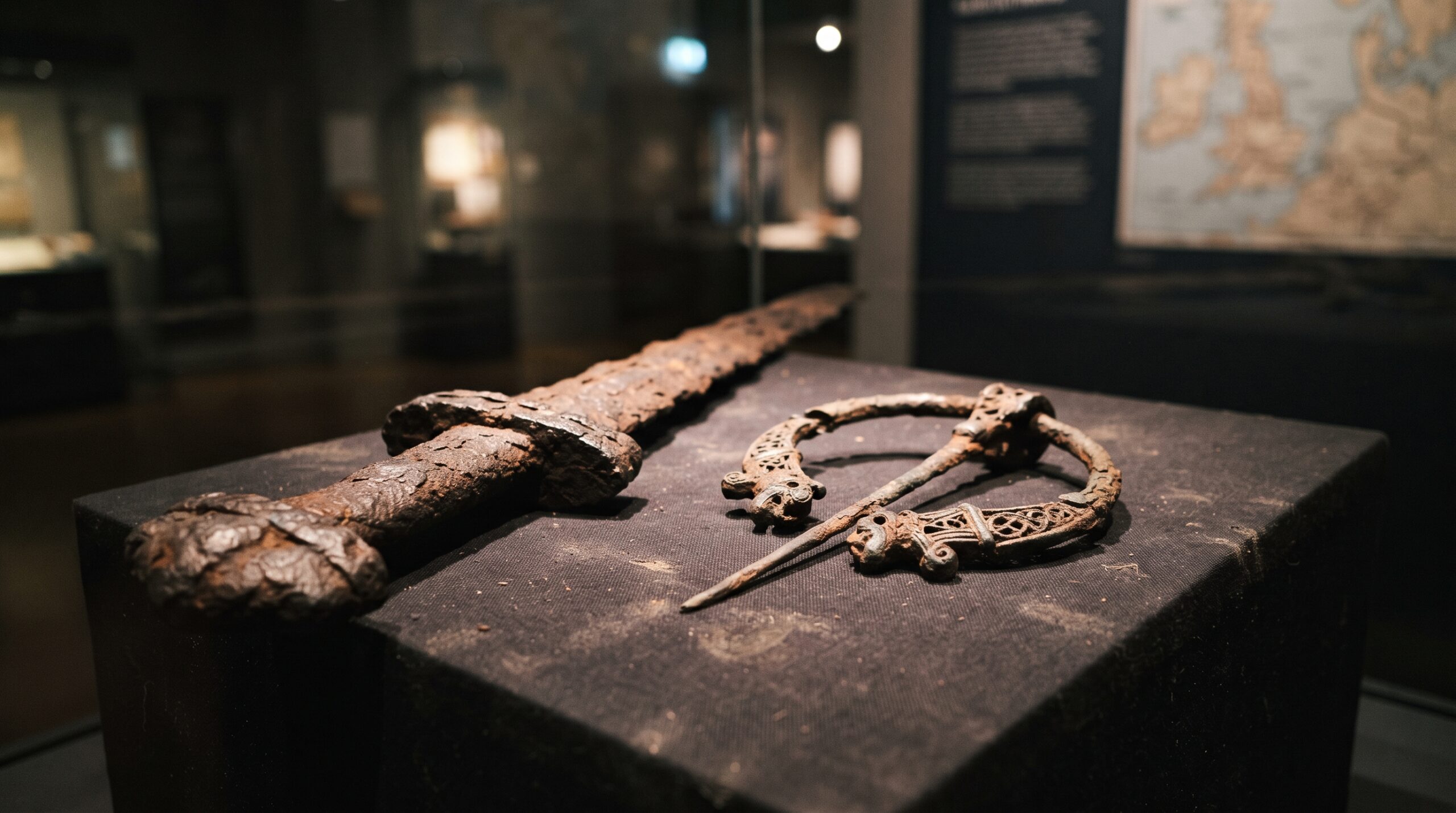
Lifting the Shroud of Holinshed’s Chronicles
Shakespeare’s Primary Source
To understand the historical context behind the slain king in macbeth, we must examine Shakespeare’s primary source material: Raphael Holinshed’s Chronicles of England, Scotland, and Ireland (1587 edition). Shakespeare adapted Holinshed’s accounts of Scottish history, but he took massive creative liberties to serve dramatic pacing and political messaging.
Political Motives of the Jacobean Era
Writing in 1606 under the patronage of King James I, Shakespeare had to navigate a sensitive political landscape:
-
The Gunpowder Plot (1605): Just a year prior, Catholic conspirators attempted to blow up Parliament and assassinate King James. A play exploring the horrific consequences of regicide resonated deeply with the anxieties of the Jacobean court.
-
Ancestral Flattery: King James claimed descent from Banquo. In Holinshed’s chronicle, however, Banquo was an accomplice to Macbeth in the murder of Duncan. Shakespeare completely whitewashed Banquo’s character, turning him into a noble, ghostly prophet incapable of treason, thereby flattering the reigning monarch.
The Historical King Duncan I of Scotland
A Young, Ineffective Ruler
In stark contrast to Shakespeare’s elderly, saintly sage, the real King Duncan I (Duncan mac Crínáin) was a young man when he ascended the throne in 1034, and he was far from a universally beloved leader. Historical records suggest Duncan was an weak, ineffective military commander whose reign was plagued by disastrous campaigns against neighboring territories, including defeats in Northumbria and internal conflicts with his own noblemen.
The Battle of Bothnagowan (1040)
The historical death of the slain king bore little resemblance to a quiet, midnight assassination in a castle guest room.
-
The Setting: Duncan was not murdered while sleeping under Macbeth’s roof at Inverness.
-
The Event: In 1040, Duncan led an army into Moray—Macbeth’s stronghold—to attack his cousin and rival. Macbeth met Duncan on the battlefield at Pitgaveny (near Elgin) or Bothnagowan, where Duncan was mortally wounded in battle or killed during a skirmish.
The Historical Macbeth (Mac Bethad mac Findlaích)
Reclaiming the Villain
Shakespeare portrays Macbeth as a tyrannical usurper who plunges Scotland into a dark age of terror. Historically, Macbeth was far from the bloodthirsty monster of the stage.
-
A Successful Reign: Macbeth ruled Scotland for 14 relatively peaceful and prosperous years (1040–1057).
-
Pilgrimage and Law: Records show he was a capable king who enforced law and order, supported the church, and even made a pilgrimage to Rome in 1550, where he distributed silver to the poor.
-
The True Fall: Macbeth was eventually defeated by Duncan’s son, Malcolm III (Malcolm Canmore), supported by English forces, at the Battle of Dunsinane (1054) and Lumphanan (1057), where Macbeth was killed.
IV. Thematic Depth: Why the Murder of the King Resonates Today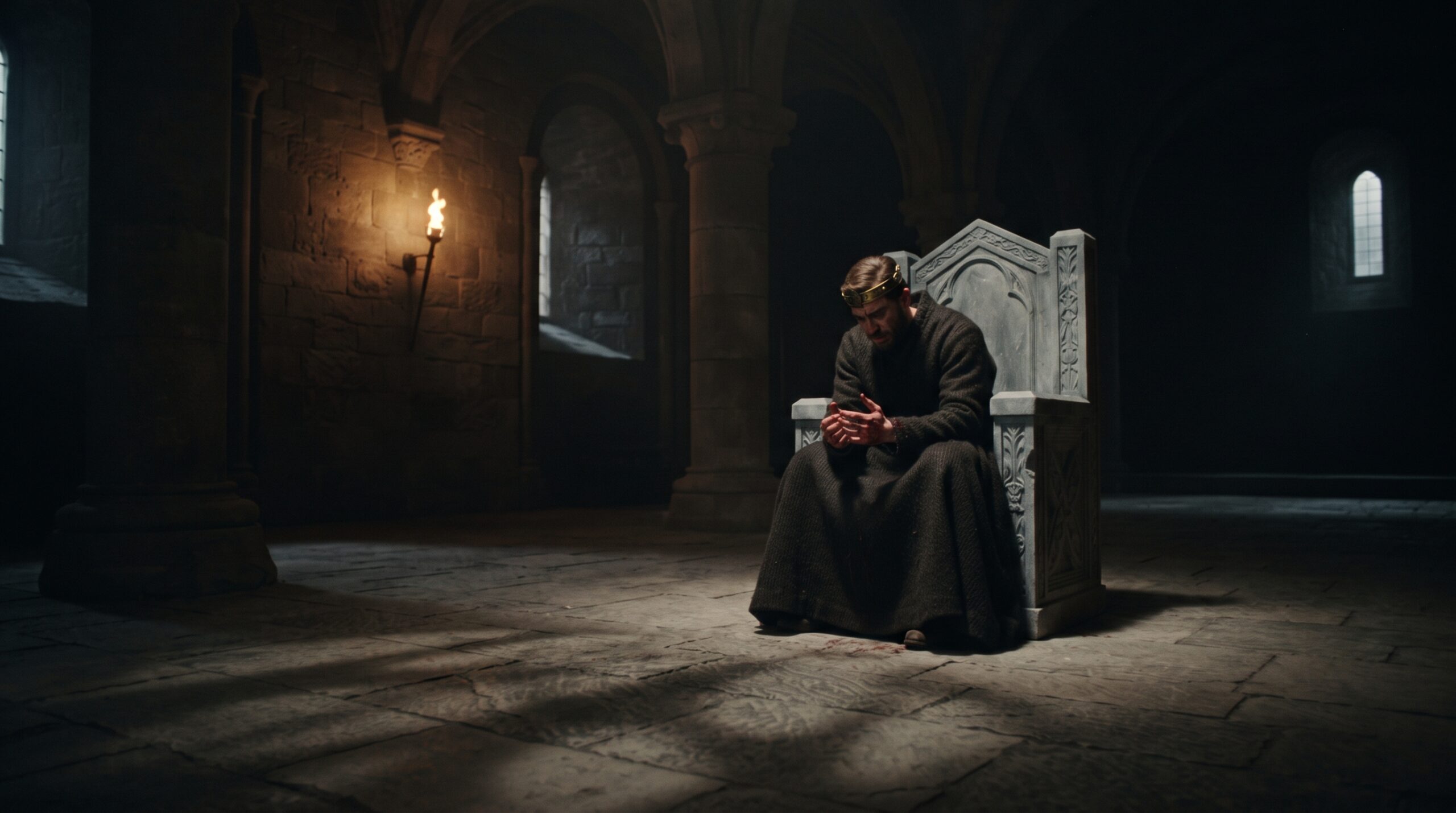
The Ultimate Taboo: Regicide and Divine Right
The Great Chain of Being
To the Elizabethan and Jacobean mind, society was structured by a strict hierarchy known as the Great Chain of Being, stretching from God down through angels, monarchs, humanity, animals, and plants. The king occupied the pinnacle of earthly authority, ordained directly by God.
Because of this worldview, regicide was viewed as the ultimate sin—a crime that inverted natural law. When Macbeth slays Duncan, he disrupts the cosmic balance. This explains why the supernatural elements (witches, floating daggers, ghost of Banquo) find fertile ground in Macbeth’s mind: he has broken the fundamental covenant of the universe.
Psychological Fallout of Murder
Guilt and Paranoia
The murder of Duncan serves as a psychological masterclass in the consequences of guilt. While Lady Macbeth initially believes “a little water clears us of this deed,” both characters experience catastrophic mental unraveling:
-
Macbeth’s Isolation: Having murdered sleep and his king, Macbeth descends into total paranoia. He realizes that wearing an insecure crown means “To be thus is nothing, but to be safely thus.” He transitions from a hesitant, honorable soldier into a tyrant who slaughters Macduff’s entire family out of blind panic.
-
Lady Macbeth’s Descent: The guilt eventually manifests as severe somnambulism (sleepwalking). Her famous cry—“Out, damned spot! out, I say!”—demonstrates that physical water cannot wash away the stain of moral corruption, culminating in her tragic suicide.
V. Expert Insights & Literary Analysis Tips
How to Write About Macbeth’s Regicide for Academic Essays
If you are analyzing the slain king in macbeth for an academic paper, high school examination, or university literature module, keep these structural tips in mind:
-
Avoid Simple Moral Binaries: Do not just write that “Macbeth is evil.” Argue how external pressures (the witches’ prophecies) combined with internal flaws (ambition) and spousal manipulation to corrupt a noble warrior.
-
Analyze Dramatic Irony: Contrast Duncan’s profound gratitude and trust when entering Inverness with the horrific reality awaiting him inside. Shakespeare uses dramatic irony to heighten the audience’s sense of dread.
-
Key Quotations to Memorize and Integrate:
-
On Duncan’s character: “His virtues / Will plead like angels, trumpet-tongued, against / The deep damnation of his taking-off” (Act 1, Scene 7).
-
On the aftermath: “Most sacrilegious murder hath broke ope / The Lord’s anointed temple, and stole thence / The life o’ the building!” (Act 2, Scene 3).
-
VI. Frequently Asked Questions (FAQs)
What was the name of the slain king in Macbeth?
The slain king in Shakespeare’s Macbeth is King Duncan. He is the sovereign of Scotland who hosts Macbeth at Inverness and is subsequently murdered in his sleep.
Did Macbeth actually murder Duncan in his sleep in real life?
No. In actual 11th-century Scottish history, King Duncan I was a young, struggling ruler who was killed by his cousin Macbeth in 1040 during a military conflict or battle (likely at Pitgaveny or Bothnagowan), rather than being assassinated in a peaceful bedchamber.
Why did Macbeth kill Duncan?
Macbeth’s primary motivation was unchecked ambition, catalyzed by the prophecy of the three witches who hailed him as Thane of Cawdor and future King. This ambition was aggressively fueled and manipulated by his wife, Lady Macbeth, who challenged his manhood and planned the logistics of the murder.
Who takes the throne after Duncan is slain?
Immediately following Duncan’s murder and the suspicious flight of his sons (Malcolm and Donalbain), Macbeth seizes the Scottish crown. However, after a tyrannical reign, Macbeth is overthrown and slain by Duncan’s eldest son, Malcolm III, who restores the rightful bloodline to the throne.
VII.Next Steps
The mystery surrounding the slain king in macbeth bridges the gap between timeless theatrical art and murky medieval history. While Shakespeare crafted King Duncan as a pristine symbol of divine order and virtuous majesty to captivate a Jacobean audience and appease King James I, the historical reality reveals a gritty power struggle between rival claimants to an unstable Scottish throne.
Whether studied for its brilliant psychological exploration of guilt, its unmatched dramatic structure, or its political commentary on regicide, Macbeth remains an eternal pillar of world literature.
Explore more of our literature guides on Shakespearean tragedy, character breakdowns, and historical backstories to deepen your appreciation of Renaissance drama.