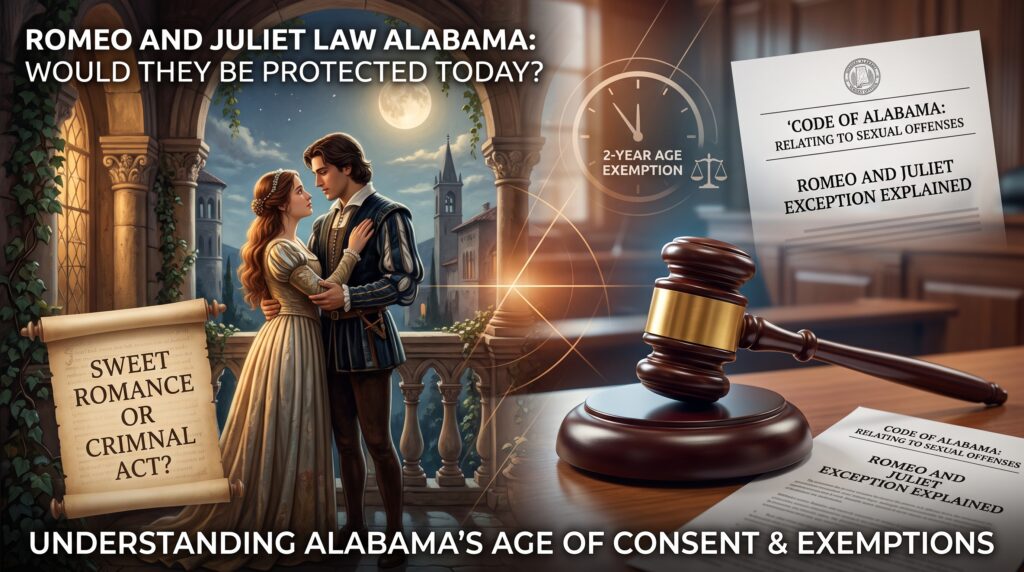
If William Shakespeare’s famous star-crossed lovers lived in modern-day Birmingham or Mobile, would their timeless romance be celebrated as a beautiful tragedy—or prosecuted as a felony crime?
When people search for information on the Romeo and Juliet law Alabama, they are usually looking for immediate clarity on the state’s statutory rape exemptions and how close-in-age exceptions work for teenagers. It is a highly specific legal query born from the need to understand the boundary between normal adolescent development and serious criminal liability. But the phrase itself begs a fascinating, cross-disciplinary question: if we apply Alabama’s modern criminal statutes directly to the classic play, would the actual Romeo and Juliet be protected by the very law named after them?
In this comprehensive guide, we will break down exactly how Alabama’s age of consent and close-in-age exemptions work, explore the historical ages of Shakespeare’s most famous characters, and reveal the ironic legal verdict of their romance.
Disclaimer: This article blends literary analysis with an overview of legal statutes for educational and entertainment purposes. The information provided does not constitute formal legal advice. If you or someone you know is facing legal issues regarding statutory laws in Alabama, please consult a licensed criminal defense attorney immediately.
What You Will Learn in This Article:
-
The strict parameters of the “Romeo and Juliet Law” in Alabama.
-
The specific math behind Alabama’s close-in-age exemption (the 2-year rule).
-
A literary investigation into the true ages of Shakespeare’s Romeo and Juliet.
-
Why the actual Romeo would likely face felony charges today.
-
Crucial exceptions where this legal defense is entirely void.
II. What is the “Romeo and Juliet Law” in Alabama?
To understand the so-called “Romeo and Juliet law,” we must first look at the baseline rules regarding the age of consent. In the realm of criminal law, these statutes are designed to protect minors from exploitation by adults, recognizing that children and young teenagers lack the cognitive maturity to legally consent to sexual activity.
The General Age of Consent in Alabama
In the state of Alabama, the legal age of consent is 16 years old.
If a person is 16 or older, they have the legal capacity to consent to sexual activity, provided that the other party is also of legal age or the interaction does not violate other specific statutes (such as authority figure prohibitions, which we will discuss later).
Statutory rape laws operate on the principle of strict liability. This means that in the eyes of the court, a minor under the age of 16 simply cannot consent. Furthermore, a defendant cannot use the excuse that the minor “looked older,” “lied about their age,” or that the interaction was entirely consensual. In strict liability cases, mistaken age is not a valid legal defense.
How Alabama’s Romeo and Juliet Exception Works
If the law strictly punished every instance of underage sexual contact, thousands of teenagers exploring normal, consensual adolescent relationships with their peers would be branded as registered sex offenders and felons. To prevent the justice system from ruining the lives of teenagers who are close in age, states introduced close-in-age exemptions—colloquially known in the cultural lexicon as “Romeo and Juliet laws.”
Under Alabama law (specifically referencing Title 13A of the Code of Alabama), the state provides a narrow carve-out for these situations.
The Math (The 2-Year Rule): For the Romeo and Juliet exception to apply in Alabama, specific conditions regarding the ages of both parties must be met perfectly:
-
The younger party must be between the ages of 12 and 15. (If the younger party is under 12, the crime is elevated to first-degree statutory rape, and no close-in-age exception applies under any circumstance).
-
The older party cannot be more than two years older than the younger party.
-
The sexual contact must be strictly consensual.
If the age gap is precisely two years or less, the older teenager is generally protected from a statutory rape conviction. For example, if a 15-year-old and a 17-year-old engage in a consensual relationship, the 17-year-old is protected by the two-year rule.
Quick Reference Comparison:
-
Minor is 15: Partner can be up to 17. (Protected)
-
Minor is 14: Partner can be up to 16. (Protected)
-
Minor is 13: Partner can be up to 15. (Protected)
-
Minor is 15, Partner is 18: Age gap is 3 years. (Not Protected – Prosecution is possible).
III. The Literary Investigation: Would Shakespeare’s Lovers Be Protected?
Now that we have established the strict mathematical parameters of the Romeo and Juliet law in Alabama, let’s apply these modern legal standards to the characters who inspired the moniker.
To determine if Romeo and Juliet would survive the scrutiny of an Alabama courtroom, we have to determine their exact ages at the time of the play’s events in Verona.
How Old Was Juliet Capulet?
Unlike many of Shakespeare’s characters whose ages are left to the imagination, Juliet’s age is explicitly and repeatedly stated in the text of the play. In Act 1, Scene 3, Juliet’s father, Lord Capulet, discusses her potential marriage to Count Paris. He clearly states:
“She hath not seen the change of fourteen years.”
Later in the same scene, Juliet’s fiercely loyal Nurse confirms the exact timeline, counting down the days to Lammas-tide (August 1st), which is Juliet’s birthday. The text leaves absolutely zero room for literary debate: Juliet is 13 years old.
How Old Was Romeo Montague?
Romeo’s age, on the other hand, is one of the enduring mysteries of Shakespearean scholarship. Shakespeare never explicitly provides Romeo’s age in the text. However, by examining the historical context of Elizabethan England, the source material Shakespeare adapted, and Romeo’s behavior in the play, literary historians have reached a strong consensus.
Romeo is clearly older than Juliet. He operates with a high degree of independence, roams the streets of Verona freely at all hours, carries a rapier, and is deeply involved in the deadly, violent street brawls of his family’s feud. He is treated by society as a young man, not a child. Most Shakespearean scholars and dramaturgs place Romeo’s age somewhere between 16 and 21 years old.
The Verdict: Would Romeo Face Felony Charges in Alabama?
Let’s run the math using the Alabama close-in-age exemption:
-
Juliet’s Age: 13
-
Romeo’s Age: Minimum of 16 (likely older)
-
The Age Gap: At least 3 years.
Because Romeo is at least three years older than the 13-year-old Juliet, he entirely blows past the two-year limit allowed by Alabama’s close-in-age exception.
The Ironic Reveal: Under the “Romeo and Juliet Law in Alabama,” the actual Romeo would not be protected at all. The very law named after their legendary romance would fail to save him. In modern Alabama, Romeo Montague would likely be charged with second-degree statutory rape, which is a Class B felony. A conviction of this magnitude carries a severe penalty, potentially resulting in 2 to 20 years in a state penitentiary, alongside mandatory registration on the sex offender registry.
Their story would indeed end in tragedy, but perhaps one involving a lengthy prison sentence rather than a crypt in Verona.
IV. Key Exceptions Where the Law Will Not Protect You
While the Romeo and Juliet law in Alabama provides a crucial safety net for teenagers close in age, it is absolutely not a blanket protection. The state has implemented strict legal boundaries to ensure this exemption is not abused by predators attempting to exploit loopholes.
Understanding these exceptions is vital for anyone researching statutory rape laws in Alabama, as crossing these lines immediately nullifies the close-in-age exemption, regardless of the age gap.
Positions of Authority and Trust (The Teacher/Student Rule)
One of the most significant caveats to Alabama’s age of consent laws involves positions of authority. The law recognizes that true consent cannot be given when there is a significant power imbalance.
Under Alabama Act 2010-497 and related statutes, if the older individual holds a position of authority, trust, or supervision over the younger individual, the legal age of consent effectively rises. For instance, if the older party is a school employee (such as a teacher, coach, administrator, or school resource officer), it is illegal for them to engage in a sexual relationship with a student who is under the age of 19.
In these scenarios, the two-year math of the Romeo and Juliet exception is completely voided. Even if a 17-year-old student teacher’s aide were involved with a 15-year-old student, the dynamics of authority could complicate or completely dismantle their legal defense.
The Element of Absolute Consent
The most foundational requirement of any close-in-age exemption is that the sexual contact must be unequivocally consensual. The Romeo and Juliet law is specifically designed to protect mutual teenage exploration.
If there is any element of coercion, manipulation, physical force, or threats involved, the exemption is thrown out immediately. Furthermore, if the younger party is intoxicated, under the influence of drugs, or mentally incapacitated to the point where they cannot legally provide consent, the older party cannot hide behind the close-in-age exemption. Standard sexual assault and rape laws will apply, carrying the full, severe weight of the Alabama criminal justice system.
V. Why Do States Have “Romeo and Juliet” Laws? (The Broader Context)
To fully grasp the importance of the Romeo and Juliet law in Alabama, it helps to zoom out and look at the broader legal landscape of the United States. Why did lawmakers feel compelled to write these specific exemptions into the penal code?
The Social and Legal Purpose
For decades, statutory laws were rigid, black-and-white statutes. If you were under the legal age, you were a victim; if you were over the legal age, you were a predator. However, as society modernized, the legal system realized that these strict liability laws were creating unintended, catastrophic consequences.
High school students who were in normal, consensual relationships—often just a grade level apart—were being caught in the crosshairs of aggressive prosecutions. A 17-year-old high school senior dating a 15-year-old sophomore is a completely normal social dynamic in most American high schools. Yet, under strict statutory frameworks, the 17-year-old could be prosecuted as a felon, stripped of their voting rights, denied access to college financial aid, and forced to register as a sex offender for the rest of their life.
The close-in-age exemption was developed to bridge the gap between two competing legal necessities:
-
Protecting vulnerable children from predatory adults who seek to exploit them.
-
Decriminalizing normal adolescent development and protecting teenagers from having their futures destroyed by overly broad legal technicalities.
Why Call it a “Romeo and Juliet” Law?
In legal texts and state codes, you will rarely see the phrase “Romeo and Juliet” explicitly written into the statute. The official terminology usually revolves around “close-in-age exemptions” or “affirmative defenses to statutory offenses.”
However, the legal community, the media, and the general public needed a shorthand to explain this complex legal carve-out. Shakespeare’s play—featuring two young, rebellious teenagers risking everything for a passionate, forbidden love—became the ultimate cultural touchstone. Even though, as we proved in our earlier literary investigation, the actual characters wouldn’t legally qualify for the exemption, the romanticized ideal of their youthful relationship made the moniker stick. Today, it is the universally recognized term used by defense attorneys, judges, and lawmakers nationwide.
VI. What to Do If Facing Statutory Charges in Alabama
Because the stakes involving statutory laws are incredibly high, relying on a misunderstanding of the Romeo and Juliet law in Alabama can lead to devastating consequences. If an individual finds themselves under investigation or facing charges, legal experts universally recommend the following critical steps.
1. Exercise the Right to Remain Silent
The Fifth Amendment exists for a reason. Often, individuals—especially teenagers or their parents—believe they can “talk their way out of it” by explaining that the relationship was consensual or that they are close in age. However, in statutory cases, admitting to the act itself provides law enforcement with the exact evidence they need for a conviction. Even stating, “We love each other and she said she was 16,” is a confession to strict liability statutory rape if the minor is actually younger. Suspects should clearly state they wish to remain silent and request an attorney.
2. Hire a Specialized Criminal Defense Attorney
Navigating sexual offense charges requires highly specialized legal expertise. A general practice lawyer may not be intimately familiar with the nuances of Alabama’s Title 13A exemptions. A dedicated criminal defense attorney who specializes in statutory offenses will know exactly how to examine the evidence, verify birth dates, and build a robust defense.
3. Understand the “Affirmative Defense” Mechanism
The Romeo and Juliet law in Alabama is not a magic shield that stops an arrest from happening. Often, it operates as an affirmative defense. This means that if a prosecutor decides to press charges, the burden of proof may shift to the defense attorney to actively prove to a judge or jury that the defendant meets the exact criteria of the close-in-age exemption (e.g., proving the age gap is 24 months or less and proving the interaction was completely consensual). This requires gathering evidence, which in modern cases often involves digital forensics, text messages, and social media records to establish the nature of the relationship.
VII. Frequently Asked Questions (FAQs)
To ensure you have all the facts, here are the most common questions people ask regarding Alabama’s age of consent and Shakespeare’s famous characters.
Q: What is the exact age of consent in Alabama? A: The legal age of consent in Alabama is 16 years old. Anyone 16 or older can legally consent to sexual activity, provided there are no other extenuating illegal circumstances (such as the involvement of an authority figure).
Q: Does the Romeo and Juliet law in Alabama apply to 18-year-olds? A: In most scenarios involving a minor, no. Because the younger party must be between 12 and 15, and the age gap cannot exceed two years, an 18-year-old cannot legally have relations with anyone under the age of 16. If the minor is 15, a two-year gap means the older partner can be a maximum of 17. An 18-year-old would exceed this limit and could face felony charges.
Q: Do Romeo and Juliet laws exist in every state? A: The vast majority of U.S. states have some variation of a close-in-age exemption, but the rules vary wildly. Some states allow a three-year or four-year age gap, while others, like Alabama, restrict it to just two years. Additionally, the baseline age of consent varies by state (ranging from 16 to 18 across the country).
Q: Did Shakespeare know he was writing about a legally problematic age gap? A: Not at all. In Elizabethan England (the late 1500s), the legal age of consent for marriage for a female was actually 12 years old, provided she had parental consent. While historical records show that most English women of that era actually married in their early twenties, Juliet’s age of 13 would not have been viewed as a criminal legal issue by Shakespeare’s original audience, but rather as an aristocratic family rushing a strategic marriage.
VIII.The Intersection of Literature and Law
The Romeo and Juliet law Alabama provides a fascinating intersection between classic literature and modern criminal justice. On one hand, the law represents a compassionate, pragmatic approach by the legal system to protect teenagers from having their lives ruined by normal adolescent relationships. By allowing a strict two-year close-in-age exemption, Alabama acknowledges the difference between malicious predation and mutual teenage romance.
On the other hand, the literary irony is impossible to ignore. By enforcing a strict two-year age gap, modern Alabama law would look at the 13-year-old Juliet and the 16-to-21-year-old Romeo and deem their legendary romance a severe felony. Shakespeare’s ultimate symbol of young love would not survive the scrutiny of a modern courtroom.
Whether you are a student of classic literature marveling at the historical differences in societal norms, or a citizen seeking to understand the rigid boundaries of Alabama’s statutory laws, the lesson remains clear: words, ages, and legal definitions matter profoundly.