The dead of night. A heavy, unnatural silence. A mind unraveling before our very eyes in the flickering torchlight. When charting the psychological collapse of Shakespeare’s most notorious tragic hero, the turning point is undeniable. In act two of Macbeth, ambitious thought violently transforms into treasonous action, marking the absolute point of no return for the Thane of Cawdor.
This act serves as the narrative and psychological fulcrum of the entire play. It bridges the sinister prophecies and brewing ambitions of Act One with the paranoid tyranny that dominates the rest of the tragedy. For students analyzing the text, actors preparing for a role, or literary enthusiasts diving deep into Jacobean drama, understanding the intricacies of this act is paramount. The murder of King Duncan does not just shift the political landscape of Scotland; it shatters the natural order of the universe and permanently fractures the minds of its perpetrators.
This comprehensive guide breaks down the pivotal events of the act, offering a detailed scene-by-scene analysis, exploration of core thematic motifs, and critical insights into the characters’ fatal motivations.
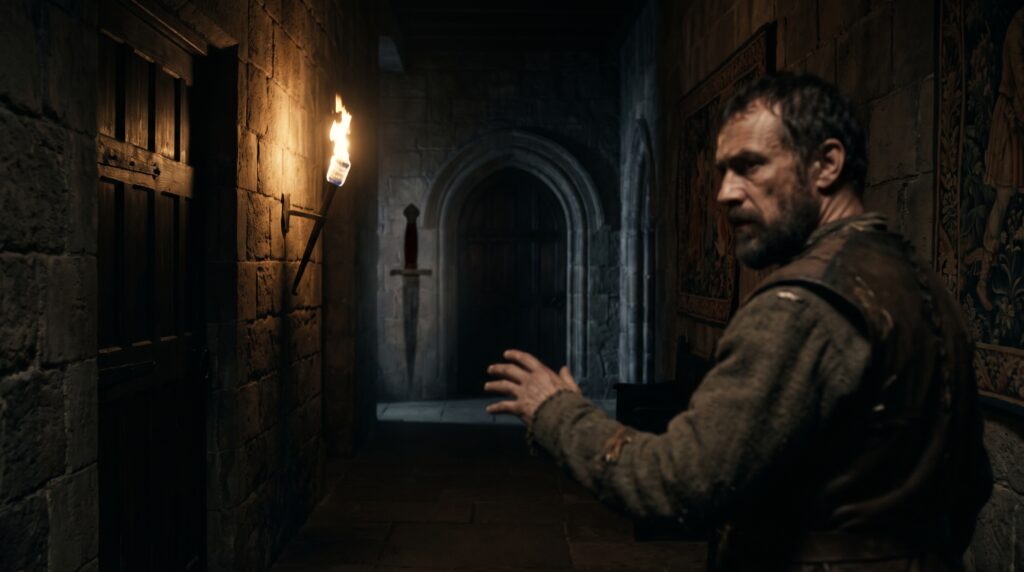
[Visual Asset Recommendation: 16:9 photorealistic, text-free, cinematic image of a dark, stone-walled Scottish castle hallway illuminated by a single flickering torch, casting long, distorted shadows.]
II. Act 2, Scene 1: The Floating Dagger & The Descent into Darkness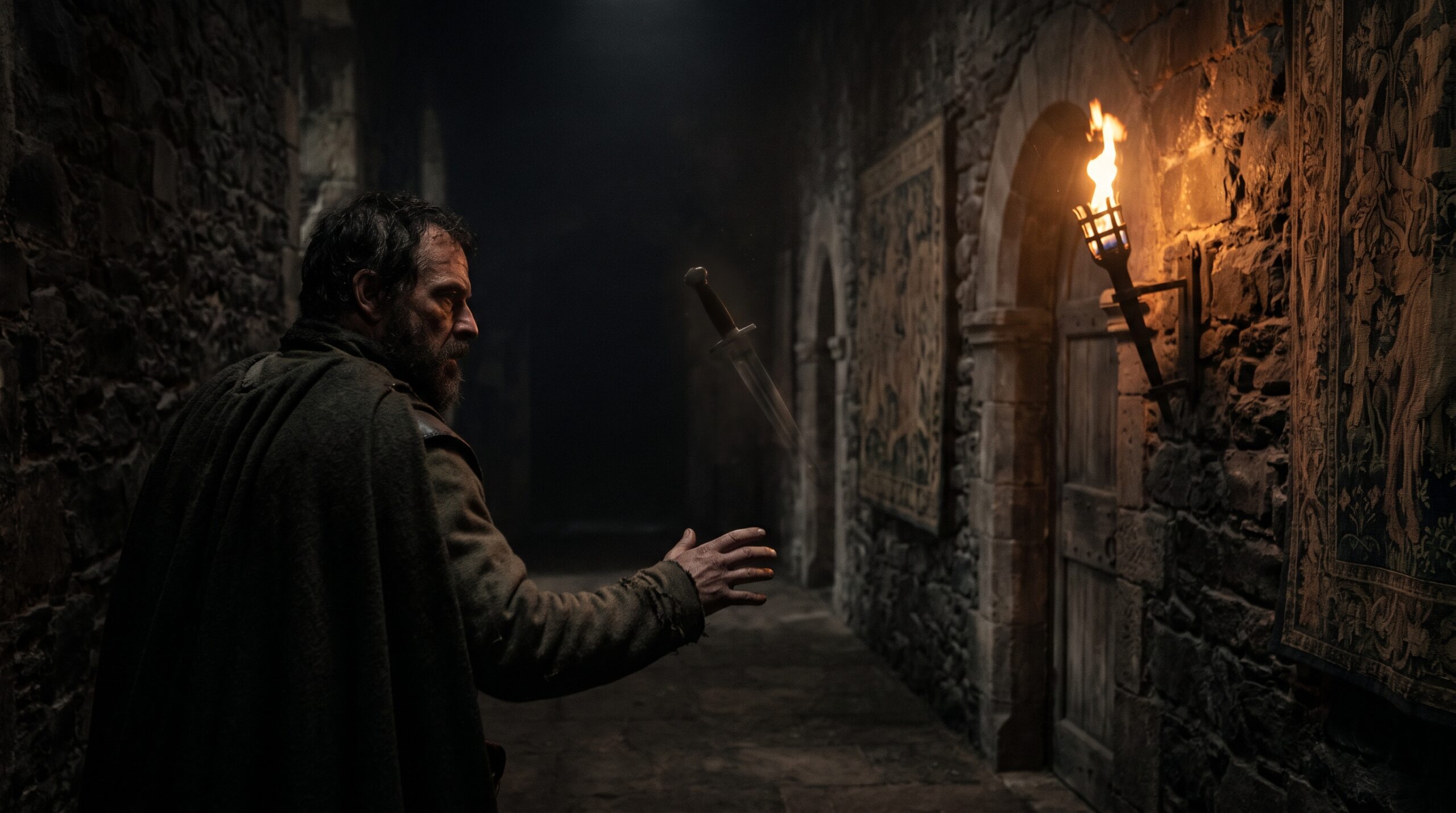
The act opens in the dark, oppressive courtyard of Macbeth’s castle at Inverness. The atmosphere is immediately established as heavy and foreboding. Banquo and his son, Fleance, are awake past midnight. Banquo notes that “There’s husbandry in heaven; / Their candles are all out,” signaling a starless, pitch-black night that mirrors the dark deeds about to unfold.
Macbeth enters, and after a brief, tense exchange where he deceitfully claims he hasn’t thought about the Weird Sisters’ prophecies, he is left alone. What follows is one of the most famous and heavily analyzed soliloquies in English literature.
The “Is this a dagger which I see before me?” Soliloquy
Macbeth’s vision of the floating dagger is a masterclass in psychological terror and dramatic tension. The soliloquy traces his real-time transition from terrifying hesitation to fatalistic resolve.
-
The Hallucination: “Is this a dagger which I see before me, / The handle toward my hand? Come, let me clutch thee.” Macbeth attempts to grasp the weapon, but his hands pass through empty air. He realizes it is a “dagger of the mind, a false creation, / Proceeding from the heat-oppressed brain.”
-
The Manifestation of Guilt: As the soliloquy progresses, the imaginary dagger becomes coated in “gouts of blood.” This visceral imagery highlights that Macbeth is already suffering the psychological consequences of the murder before he has even committed it.
-
Expert Insight: The true brilliance of this scene lies in its ambiguity. Is the dagger a supernatural manifestation conjured by the witches to lead him to Duncan’s chamber? Or is it the first symptom of Macbeth’s fracturing psyche, a physical projection of his own intense guilt and ambition? Shakespeare leaves this intentionally unresolved, placing the focus squarely on Macbeth’s internal war. Ultimately, the ringing of Lady Macbeth’s bell interrupts his trance, serving as the literal and metaphorical death knell for King Duncan.
Banquo’s Restlessness: The Ultimate Foil
Before the dagger appears, Shakespeare carefully positions Banquo as Macbeth’s moral foil. Banquo admits to being plagued by “cursed thoughts” in his sleep—likely ambitions regarding the witches’ prophecy that his descendants will be kings. However, unlike Macbeth, who actively courts the darkness and yields to his murderous impulses, Banquo prays to “merciful powers” to restrain these thoughts. Banquo represents the path of restraint and loyalty, starkly contrasting Macbeth’s surrender to treason.
III. Act 2, Scene 2: The Murder of King Duncan (The Bloodied Hands)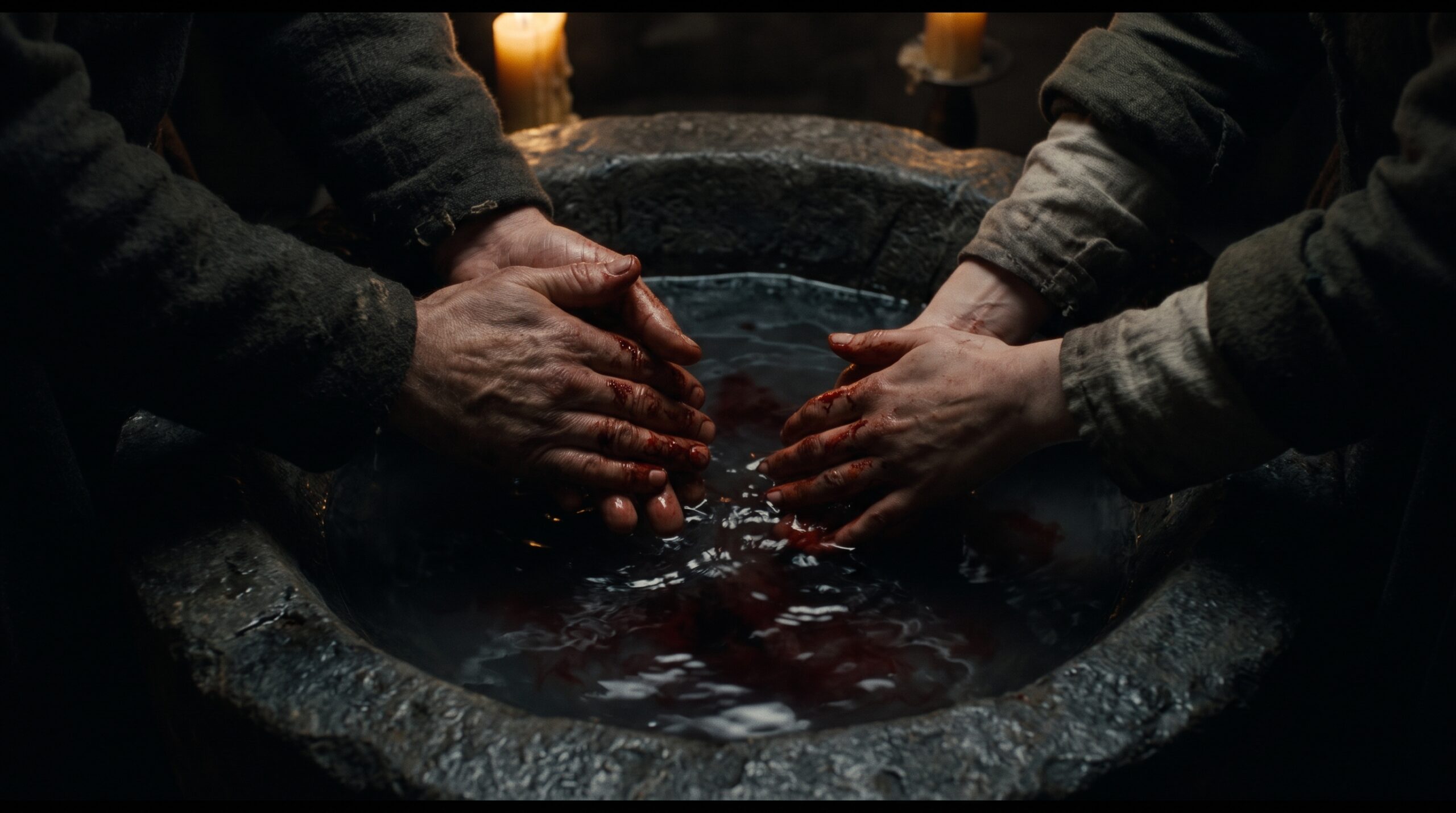
If Scene 1 is the psychological buildup, Scene 2 is the horrifying aftermath. Shakespeare makes the brilliant dramatic choice to keep the actual regicide off-stage. Instead of a spectacle of violence, the audience is forced to focus entirely on the emotional and psychological devastation of the murderers.
Lady Macbeth waits in the shadows, emboldened by alcohol, yet she reveals a momentary flash of vulnerability: she claims she would have killed Duncan herself had he not resembled her sleeping father. This fleeting humanization makes her subsequent coldness even more jarring.
Macbeth enters, his hands covered in Duncan’s blood, completely unraveled.
Macbeth’s Guilt vs. Lady Macbeth’s Pragmatism
The dialogue in this scene is fragmented, rapid, and breathless, reflecting the panic of the moment.
-
Macbeth’s Collapse: Macbeth is immediately consumed by auditory hallucinations and a profound sense of spiritual damnation. He is obsessed with his inability to say “Amen” when the chamberlains said “God bless us,” realizing he has severed his connection to God. He then hears a voice cry, “Sleep no more! / Macbeth does murder sleep.”
-
Lady Macbeth’s Control: In stark contrast, Lady Macbeth is terrifyingly pragmatic. She chides him for his “brain-sickly” thoughts and takes command. When Macbeth is too paralyzed by horror to return the bloody daggers to the sleeping guards, she takes them herself, dismissing the dead as mere pictures. “A little water clears us of this deed,” she confidently declares—a line heavy with tragic irony, as the audience will later see her desperately trying to wash invisible blood from her hands in Act Five.
Key Thematic Motifs in Scene 2
-
Blood: Blood shifts from a symbol of martial honor (as seen in Act One) to a permanent, indelible stain of guilt. Macbeth looks at his hands and asks, “Will all great Neptune’s ocean wash this blood / Clean from my hand?” He concludes that his bloody hands would instead turn the entire green ocean red, illustrating the magnitude and permanence of his crime.
-
Sleep: Sleep, previously described as “the innocent sleep” and the “balm of hurt minds,” is destroyed. By murdering a sleeping king, Macbeth has murdered his own ability to rest.
-
Water: Water is presented as a physical cleanser by Lady Macbeth, but Shakespeare makes it clear that no physical element can wash away a moral and spiritual stain.
IV. Act 2, Scene 3: The Porter and the Discovery of Chaos
The intense, claustrophobic horror of the murder scene is immediately shattered by a persistent, heavy knocking at the castle gate. This auditory intrusion of the outside world breaking into Macbeth’s isolated nightmare introduces one of the most debated scenes in Shakespearean tragedy: the Porter’s comic interlude.
The Porter as Comic Relief and Thematic Anchor
As the hungover Porter stumbles to answer the gate, he jokingly pretends to be the gatekeeper of Hell, welcoming in various sinners—an equivocator, a greedy farmer, and an English tailor. While traditionally viewed as necessary comic relief to give the audience (and the actors) a moment to breathe, the Porter’s monologue is deeply symbolic.
-
Literary Analysis: The Porter is not just a drunken servant; he functions as a thematic anchor. By imagining himself guarding the gates of Hell, he metaphorically identifies Inverness as an infernal realm. Macbeth’s castle has literally become a place of damnation where treason and murder reside. The mention of the “equivocator” (someone who lies by using ambiguous language) directly points to the Weird Sisters’ deceptive prophecies and Macbeth’s own duplicity.
The Disruption of the Natural Order
When Macduff and Lennox finally enter, the focus shifts to the macrocosmic fallout of the murder. Lennox describes the previous night as profoundly unruly, noting that chimneys were blown down, strange screams of death echoed in the air, the earth shook, and the obscure bird (the owl) clamored all night.
In Jacobean ideology, the universe was structured by the Great Chain of Being. The monarch was God’s appointed deputy on Earth. By killing King Duncan, Macbeth has not just committed a political crime; he has fractured the cosmic order. The turbulent weather and unnatural occurrences reflect nature violently rebelling against the sacrilege of regicide.
The Flight of the Heirs
It is Macduff who discovers the horrific scene, crying out that “Confusion now hath made his masterpiece.” In the ensuing chaos, Macbeth overplays his part, claiming he killed the chamberlains out of sudden, uncontrollable rage and loyalty to the king.
Duncan’s sons, Malcolm and Donalbain, immediately sense the danger. Realizing that the murderer is likely among them and feigning grief, they decide to flee—Malcolm to England and Donalbain to Ireland. They astutely observe that there are hidden threats behind the friendly faces around them, recognizing that their blood relation to the king makes them the next targets. Their flight, however, inadvertently casts suspicion upon them, creating the perfect political vacuum for Macbeth to claim the throne.
V. Act 2, Scene 4: The Aftermath and the Unnatural World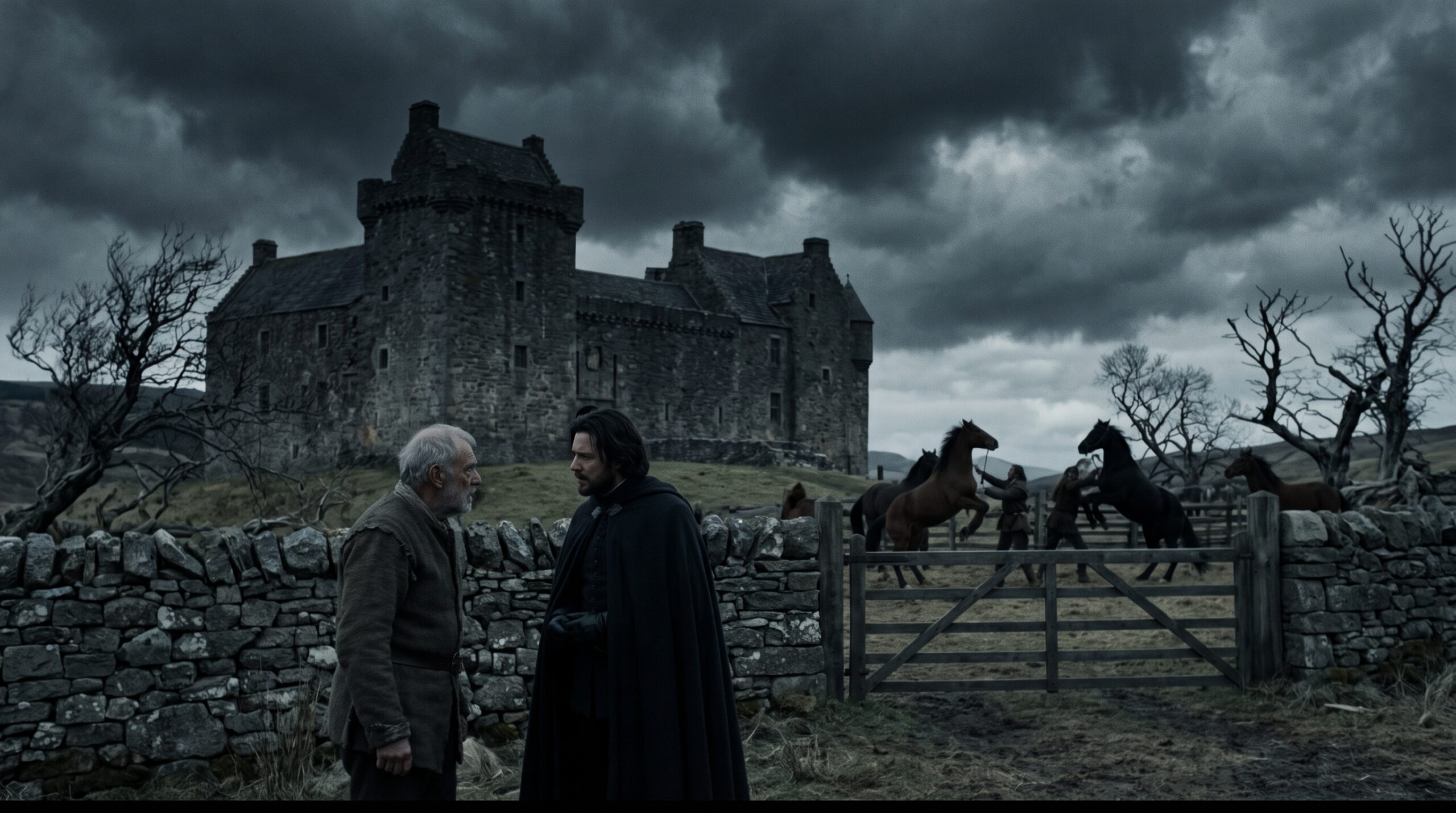
The final scene of the act functions as a chilling epilogue to the night’s atrocities. The action moves outside the castle, where Ross (a Scottish noble) converses with an Old Man about the terrifying state of the world.
Symbolism in the Unnatural Events
The dialogue details a series of grotesque, unnatural phenomena that mirror the subversion of the social and political hierarchy:
-
The Eclipse: By the clock, it is daytime, yet “dark night strangles the traveling lamp” (the sun). The darkness of Macbeth’s deed has literally blotted out the light of the sun.
-
The Falcon and the Owl: A magnificent falcon, soaring at its highest pitch, was hunted and killed by a “mousing owl.” This is a direct parallel to the natural hierarchy being upended: the lesser bird (Macbeth) destroying the apex predator (King Duncan).
-
Duncan’s Horses: The king’s beautiful, swift horses reportedly broke out of their stalls, turned wild, and ate each other. This horrific image symbolizes the Scottish nobility turning against one another in a cannibalistic frenzy of ambition and betrayal.
Macduff’s Early Defiance
The scene concludes with Macduff arriving to deliver the news that Macbeth has been named king and has gone to Scone to be crowned. Crucially, Macduff announces he will not attend the coronation, choosing instead to return to his own castle in Fife. This quiet act of defiance establishes Macduff’s suspicion of the new regime and sets him up as the central antagonist who will eventually bring about Macbeth’s downfall.
VI. Core Themes Explored in Act Two of Macbeth
To fully grasp the depth of this section of the play, readers and students must examine the recurring thematic currents driving the narrative forward.
-
The Psychology of Guilt: Shakespeare explores guilt not just as an emotion, but as a physical and mental affliction. Macbeth’s hallucinations—both visual (the dagger) and auditory (the voices crying about sleep)—demonstrate a mind buckling under the weight of moral transgression. Guilt is instantaneous and paralyzing.
-
Appearance vs. Reality: The dichotomy between what is seen and what is true dominates the act. The hosts of the castle are actually the murderers; the grieving noblemen are plotting survival; the seemingly loyal thane is a traitor. Lady Macbeth’s earlier instruction to look like the innocent flower but be the serpent underneath is flawlessly executed by the couple during the discovery of the body.
-
Masculinity and Cruelty: The play continuously questions the nature of manhood. Lady Macbeth weaponizes the concept of masculinity to manipulate her husband, equating physical cruelty and ruthless ambition with true manliness, while dismissing hesitation or moral conflict as cowardice.
VII. Essential Quotes to Memorize from Act 2 (With Analysis)
For analytical essays or exam preparation, mastering a few pivotal lines from this act provides strong textual evidence for thematic arguments.
1. On Psychological Deterioration:
-
“Is this a dagger which I see before me, / The handle toward my hand?” (Macbeth, Scene 1)
-
Analysis: This rhetorical question highlights Macbeth’s fractured reality. The physical manifestation of his ambition and guilt signals the beginning of his descent into madness.
2. On the Destruction of Peace:
-
“Methought I heard a voice cry ‘Sleep no more! / Macbeth does murder sleep'” (Macbeth, Scene 2)
-
Analysis: Shakespeare uses personification to transform sleep from a biological necessity into a fragile, innocent entity that Macbeth has slaughtered, indicating he will never know peace again.
3. On the Permanence of Guilt:
-
“Will all great Neptune’s ocean wash this blood / Clean from my hand?” (Macbeth, Scene 2)
-
Analysis: Through this powerful hyperbole, Macbeth acknowledges that his crime is so monumental it would corrupt the entire ocean before the ocean could cleanse him.
4. On Deception and Survival:
-
“Where we are, / There’s daggers in men’s smiles.” (Donalbain, Scene 3)
-
Analysis: A potent metaphor capturing the paranoia that infects Scotland post-regicide. Donalbain recognizes that outward displays of grief or loyalty are merely masks for lethal intentions.
VIII. Jacobean Historical Context: Treason and the Divine Right of Kings
To appreciate the sheer horror Act Two would have instilled in a 17th-century audience, one must view it through the lens of Jacobean history. Shakespeare wrote the play shortly after King James I took the throne.
King James was a staunch believer in the Divine Right of Kings—the doctrine that monarchs derive their authority directly from God, not from their subjects. Therefore, an earthly king was God’s sacred representative. To murder a king was not just treason against the state; it was a blasphemous strike against God Himself.
Furthermore, the play was written in the immediate aftermath of the Gunpowder Plot of 1605, an unsuccessful assassination attempt against King James I by a group of provincial English Catholics. The themes of regicide, equivocation, and the resulting chaos would have resonated deeply with a public still traumatized by the near-destruction of their government. Duncan’s assassination on stage reflects the very real anxieties of Shakespeare’s contemporary audience.
IX. Frequently Asked Questions (FAQs)
Why doesn’t Shakespeare show the murder of King Duncan on stage? By keeping the murder off-stage, Shakespeare forces the audience to focus on the psychological impact of the crime rather than the physical gore. It heightens the suspense and allows the spotlight to remain firmly on the mental deterioration of Macbeth and Lady Macbeth.
What does the floating dagger symbolize? The dagger is a multifaceted symbol. It represents Macbeth’s bloody ambition, his intense internal conflict, and the crippling guilt he feels before even committing the act. It is the visual threshold between his loyal past and his treacherous future.
Why do Malcolm and Donalbain flee after their father is murdered? The brothers astutely realize that whoever murdered their father will likely target them next to secure the throne. While their flight makes them look guilty to the other thanes, it is a necessary tactical retreat for survival.
Who discovers King Duncan’s body? Macduff, the Thane of Fife, discovers the king’s murdered body when he arrives at Inverness to wake Duncan, setting Macduff up as the primary agent of justice in the play.
The bloody events of Act Two secure Macbeth the Scottish crown, but the cost is his humanity. As the royal retinue departs Inverness and the unnatural darkness settles over the kingdom, the physical assassination is complete. Yet, the psychological torment has only just begun. The paranoia required to maintain a stolen throne will soon prove far more destructive than the ambition required to take it.