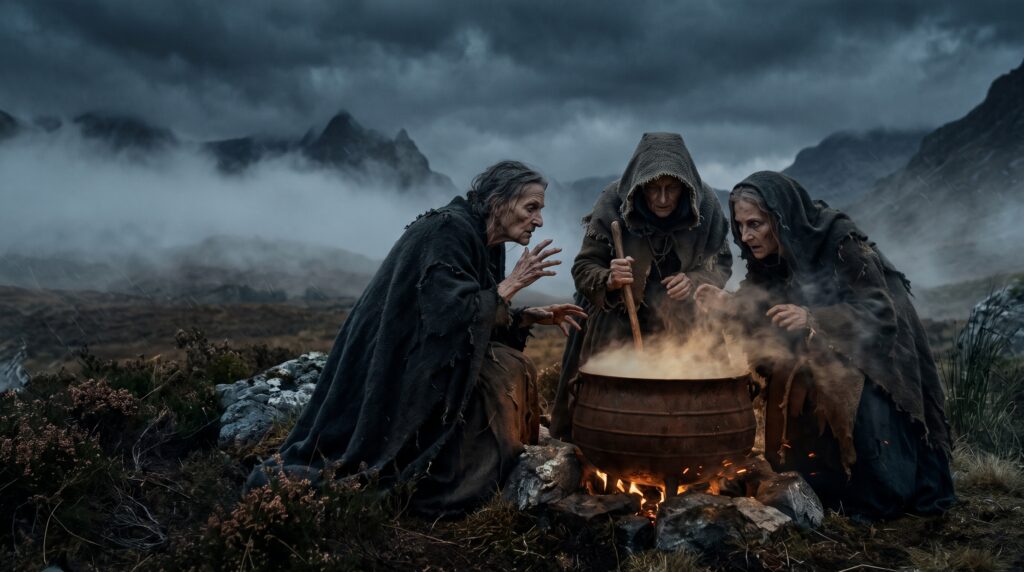
Thunder cracks. Lightning illuminates a barren Scottish heath. Before a single human character steps onto the stage, William Shakespeare plunges his audience into a terrifying world of dark magic and supernatural chaos. If you are studying the play, preparing for a performance, or writing an analytical essay, mastering the macbeth witches quotes is absolutely essential. These eerie incantations and prophecies are not just spooky window dressing—they are the psychological catalyst for the entire tragedy, masterclasses in the art of equivocation, and the ultimate test of human free will.
While the Weird Sisters are some of the most iconic figures in English literature, their 17th-century Elizabethan language and riddles can be notoriously difficult to decode. This comprehensive guide goes far beyond merely listing the text. We will unpack the psychological weight, historical context, and hidden thematic meanings behind every chilling chant, providing you with expert-level insights to elevate your understanding of Shakespeare’s darkest masterpiece.
Who Are the Witches in Macbeth?
Before dissecting what the witches say, it is crucial to understand what they are. Misunderstanding their nature leads to a fundamental misreading of the play’s central themes of fate and agency.
The Weird Sisters vs. Traditional Witches
Throughout the play, the trio is rarely referred to simply as “witches.” Shakespeare and the characters more commonly call them the “Weird Sisters.” This is a vital distinction. The term stems from the Old English word wyrd, which translates to fate or destiny.
Unlike the stereotypical folklore witches who merely cast petty hexes on local farmers, the Weird Sisters operate on a cosmic scale. They are aligned with the classical Fates of Greek and Norse mythology (the Norns). They exist outside the natural order of society, appearing and vanishing at will, and possessing an eerie omniscience regarding the future of Scotland. Their quotes are not just spells; they are the threads of destiny being woven and cut.
Historical Context: Shakespeare and King James I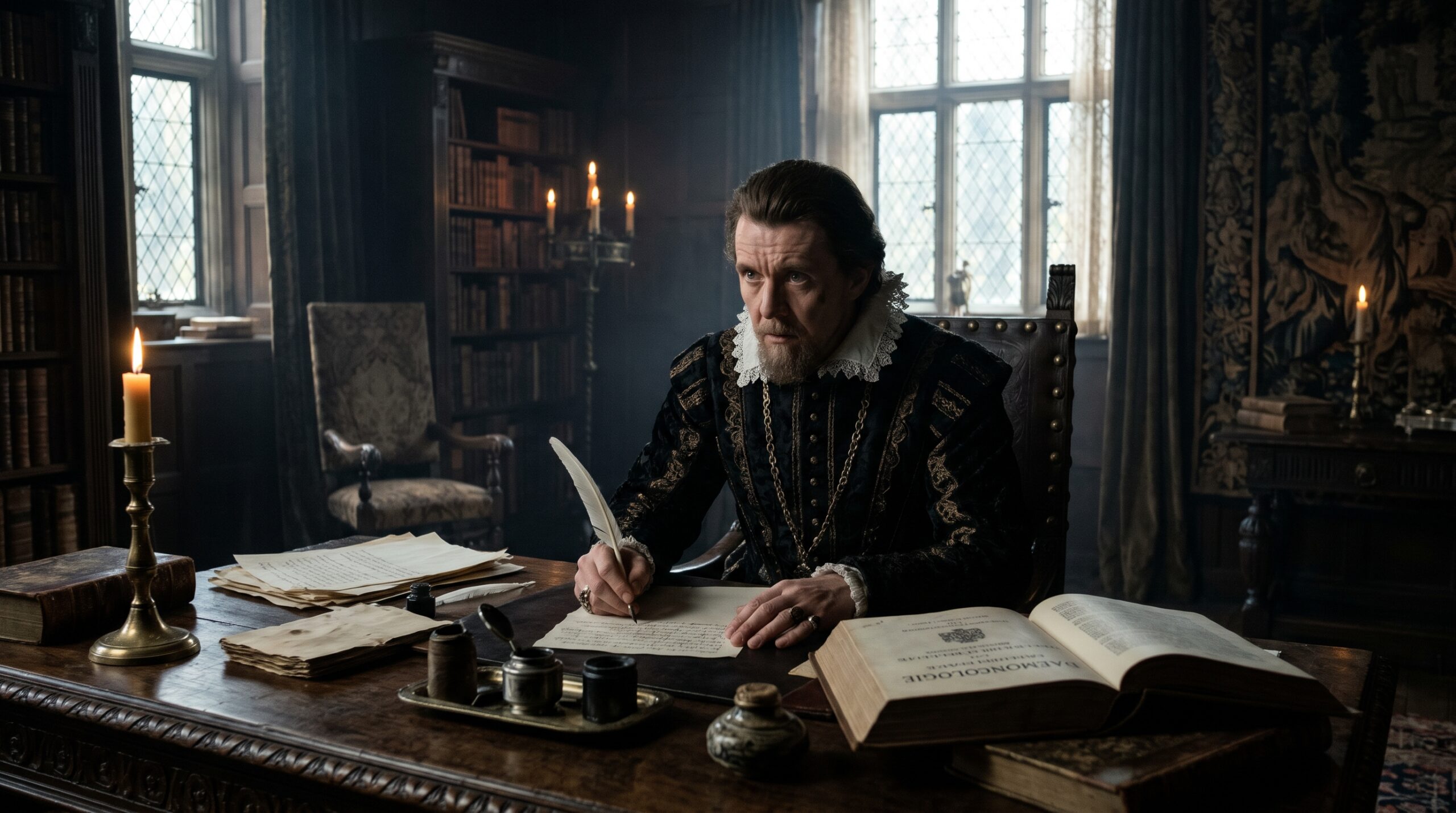
Expert Insight: Shakespeare did not write Macbeth in a vacuum. The play was penned in 1606, shortly after King James I (who was also King James VI of Scotland) ascended to the English throne.
King James I was famously paranoid about the occult. He even authored a treatise on witchcraft titled Daemonologie and presided over the infamous North Berwick witch trials. Shakespeare specifically tailored the witches to exploit the King’s very real, very visceral fears. To a modern audience, a bubbling cauldron might seem like a Halloween trope. To a 17th-century audience—and the King sitting in the royal box—the witches’ dialogue represented a genuine, existential threat of treason and demonic subversion.
Act 1: Sowing the Seeds of Ambition
The early scenes of Macbeth establish the rules of this supernatural world. The witches do not force Macbeth to commit treason; instead, they plant insidious seeds of ambition, allowing his own dark desires to do the heavy lifting.
“Fair is foul, and foul is fair: / Hover through the fog and filthy air.” (Act 1, Scene 1)
-
The Context: The closing lines of the play’s opening scene. The witches establish their intent to meet Macbeth after the battle concludes.
-
What It Really Means: This is the ultimate paradox of the play and the thematic anchor for everything that follows. The witches are declaring an inversion of the natural moral order: what is good (fair) is evil (foul), and what is evil is good. This chiasmus warns the audience that appearances will be deeply deceiving. Macbeth will look like an “innocent flower” but be the “serpent under’t.”
-
Literary Impact: The “fog and filthy air” represents the moral ambiguity and confusion that will soon envelop Scotland. The witches thrive in this obscurity, blurring the lines between right and wrong.
“All hail, Macbeth, that shalt be king hereafter!” (Act 1, Scene 3)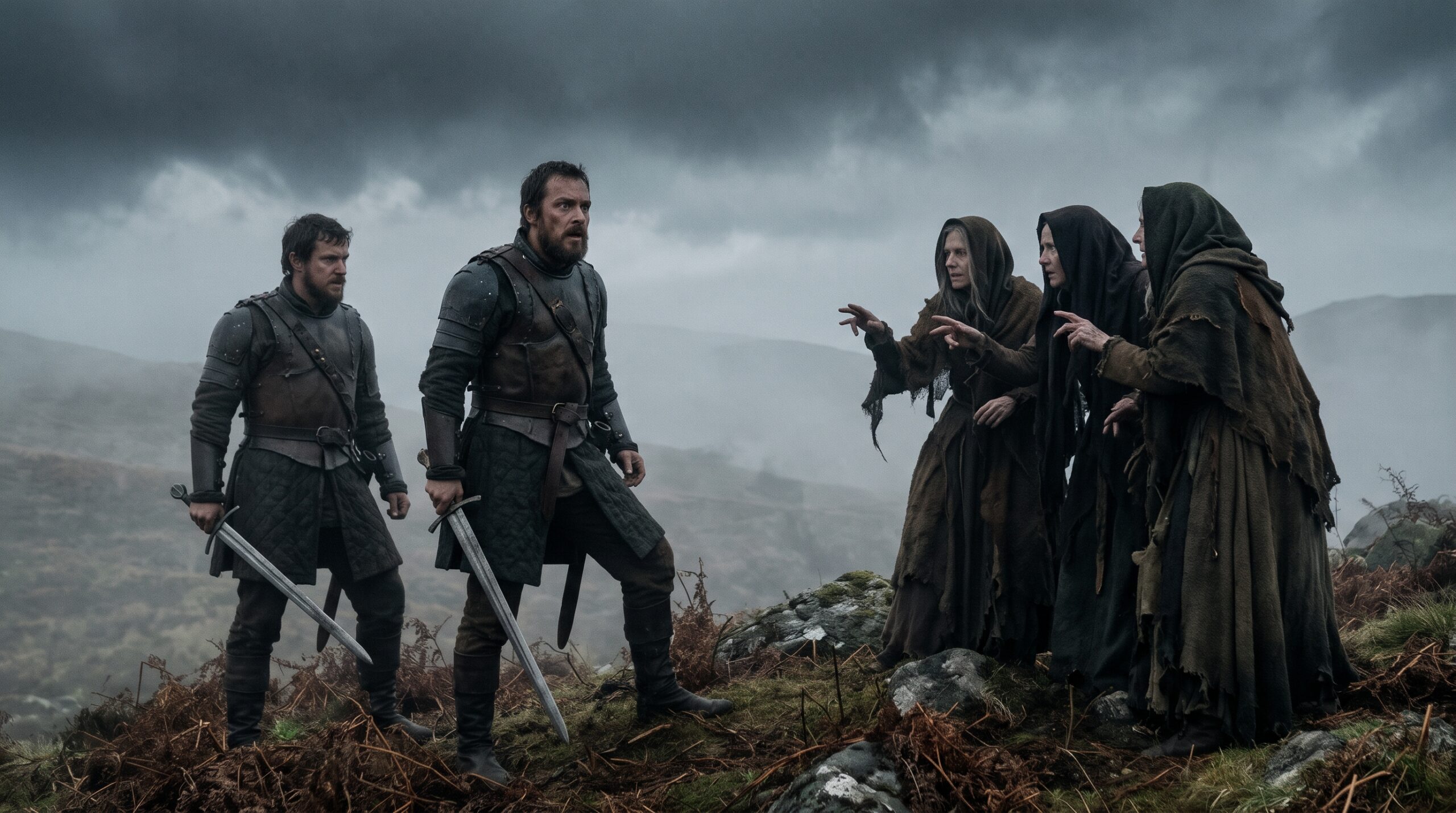
-
The Context: The Weird Sisters confront Macbeth and Banquo on the heath, delivering their primary prophecy. They greet Macbeth with three titles: Thane of Glamis (his current title), Thane of Cawdor (a title he does not yet know he has won), and King.
-
What It Really Means: This quote is the spark that ignites Macbeth’s dormant ambition. Notice the phrasing: it is an assertion (“shalt be”), not an instruction. The witches never tell Macbeth to assassinate King Duncan. By presenting the crown as a predetermined destiny, they exploit Macbeth’s secret desires. This raises the central thematic question of the play: if fate decreed he would be king, did he need to murder to achieve it, or would it have happened naturally?
“Lesser than Macbeth, and greater. / Not so happy, yet much happier.” (Act 1, Scene 3)
-
The Context: After delivering Macbeth’s prophecy, the witches turn to his loyal friend, Banquo, who demands to know his own future.
-
What It Really Means: The witches speak to Banquo entirely in paradoxes. They prophesy that Banquo will never wear the crown himself, making him “lesser” in earthly status and title than Macbeth. However, he will be “greater” in morality, character, and legacy, as he will not surrender his soul to darkness to seize power. Furthermore, they prophesy that Banquo will father a line of kings—a direct nod to King James I, who claimed descent from the historical Banquo.
Act 4: The Cauldron and the Apparitions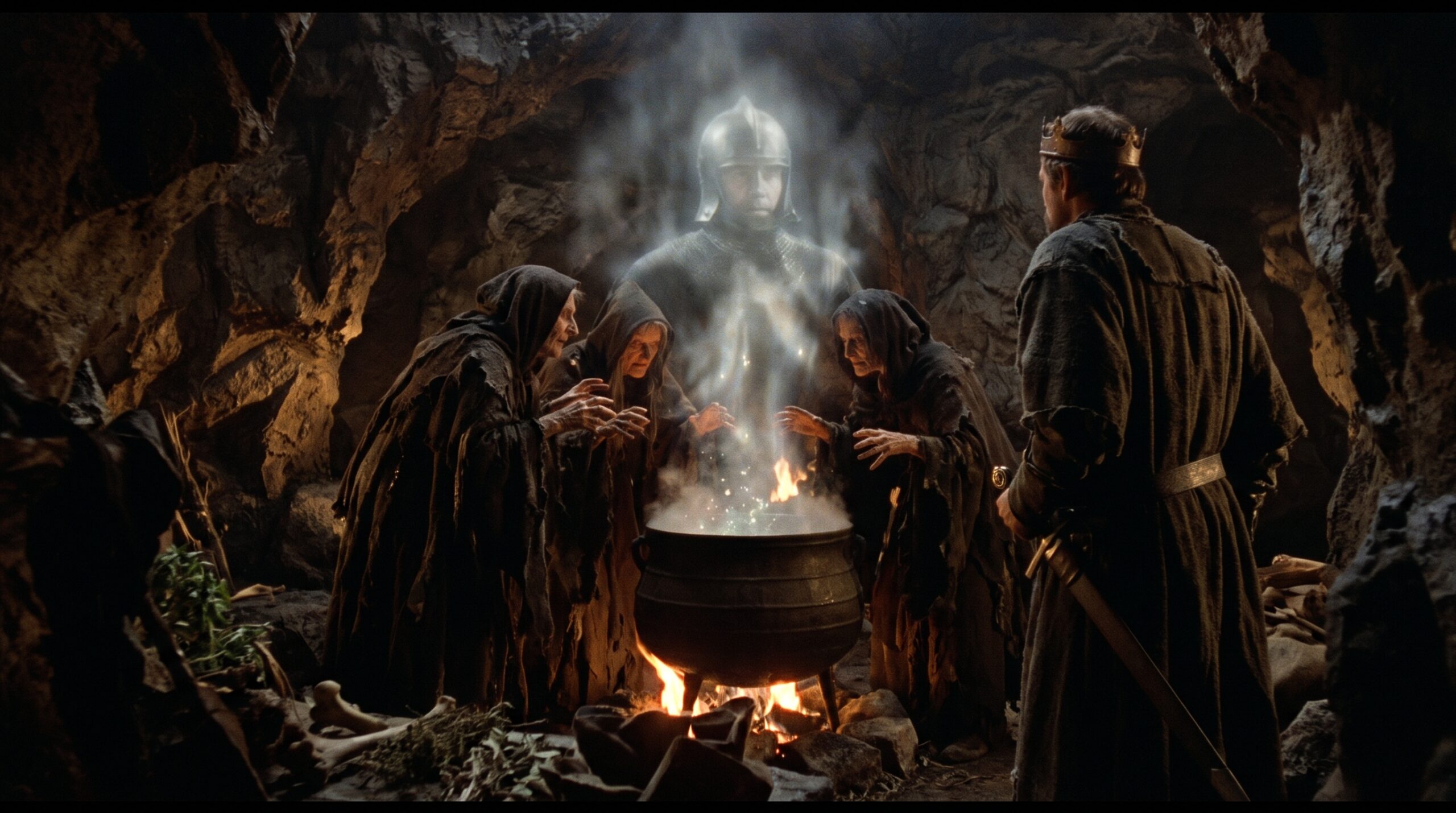
By the time the audience reaches the fourth act, Macbeth’s psychological deterioration is nearly complete. He is no longer a hesitant soldier; he is a tyrannical king drowning in paranoia. Desperate for certainty, he actively seeks out the Weird Sisters. This scene marks the climax of the witches’ dark magic, focusing heavily on sensory imagery, grotesque ingredients, and their ultimate weapon: equivocation.
“Double, double toil and trouble; / Fire burn, and cauldron bubble.” (Act 4, Scene 1)
-
The Context: The opening of the iconic cauldron scene. The witches are brewing a vile potion using the dismembered parts of nocturnal animals and human outcasts.
-
What It Really Means: Beyond being the most famous spell in literature, the word “double” is the master key to understanding the witches’ methodology. It represents the “doublespeak” (equivocation) they use to manipulate Macbeth, offering promises with double meanings. Furthermore, it foreshadows the doubling of Macbeth’s own “trouble”—his crimes are compounding, and his mental torment is multiplying.
-
Literary Impact: While most of Shakespeare’s noble characters speak in iambic pentameter (da-DUM da-DUM da-DUM da-DUM da-DUM), the witches speak in trochaic tetrameter (DUM-da DUM-da DUM-da DUM-da). This heavy, falling rhythm sounds unnatural, repetitive, and menacing, aurally separating the witches from humanity and mimicking the rhythmic chanting of a demonic incantation.
“By the pricking of my thumbs, / Something wicked this way comes.” (Act 4, Scene 1)
-
The Context: Spoken by the Second Witch just as Macbeth approaches their cave to demand more answers.
-
What It Really Means: This quote represents one of the most chilling role reversals in theatrical history. The Weird Sisters, who are literally brewing a potion with the “finger of birth-strangled babe,” recognize the approaching Macbeth not as a human king, but as a fellow monster. Macbeth has become so corrupted, bloodthirsty, and devoid of humanity that supernatural entities of pure malice refer to him as “something wicked.”
The Three Apparitions (Decoding the False Promises)
When Macbeth demands to know his future, the witches conjure three spirits to deliver a series of half-truths designed to breed hubris and false security.
-
The Armed Head (“Beware Macduff”): A literal warning that Macduff is the true threat.
-
The Bloody Child (“For none of woman born / Shall harm Macbeth”): This gives Macbeth a god-like sense of invincibility. He takes it literally, assuming all human men are born of women. He fails to realize the witches are equivocating; Macduff was “from his mother’s womb untimely ripped” (a Caesarean section).
-
The Crowned Child with a Tree (“Macbeth shall never vanquished be until / Great Birnam Wood to high Dunsinane Hill / Shall come against him”): Macbeth laughs at this, believing forests cannot walk. He ignores the possibility of human ingenuity—Malcolm’s army using tree branches as camouflage to mask their numbers.
Study Tip: The witches never actually lie to Macbeth in Act 4. They tell him the literal truth, knowing his arrogance will cause him to misinterpret the prophecies. This use of malicious ambiguity is the pinnacle of Shakespearean equivocation.
Key Themes Explored Through the Macbeth Witches Quotes
Analyzing these quotes reveals the structural spine of the play. The witches provide the atmosphere, but they also embody Macbeth’s deepest literary themes.
Fate vs. Free Will
Do the witches control Macbeth, or merely predict his actions? The text strongly suggests the latter. The witches operate as catalysts. They put the crown in Macbeth’s mind, but they never put the dagger in his hand. Their quotes challenge the audience to consider the nature of agency. Macbeth’s tragic flaw (hamartia) is not that he was cursed by witches, but that his own unchecked ambition led him to violently force a prophecy that might have otherwise unfolded naturally.
The Subversion of Nature
In the Elizabethan worldview, the Great Chain of Being dictated that everything in the universe had a strict hierarchical order. The witches represent the total disruption of this order. Their dialogue constantly references unnatural events, storms, disrupted animal hierarchies (owls killing falcons), and dismembered body parts. This linguistic subversion of nature perfectly mirrors the political and moral chaos Macbeth brings to Scotland by assassinating God’s appointed king.
Equivocation and Deception
The Jesuit concept of equivocation—the use of ambiguous language to conceal the truth without technically lying—was a highly controversial topic in 1606 following the Gunpowder Plot. Shakespeare weaponizes this concept through the Weird Sisters. They are agents of chaos who enjoy watching humans destroy themselves through misinterpretation. They give Macbeth exactly what he asks for, but never what he actually wants.
Why the Weird Sisters Still Terrify Modern Audiences
While a 21st-century audience might not fear witchcraft in the same way King James I did, the psychological manipulation embedded in the macbeth witches quotes remains profoundly disturbing. Today, we recognize their tactics as a form of gaslighting and the exploitation of confirmation bias. The witches tell Macbeth what his ego wants to hear, blinding him to reality.
Modern film adaptations continue to mine these quotes for terror. In Justin Kurzel’s 2015 Macbeth (starring Michael Fassbender), the witches are grounded, war-torn refugees, making their prophecies feel hauntingly psychological. In Joel Coen’s 2021 The Tragedy of Macbeth, actress Kathryn Hunter plays all three witches, contorting her body and vocal cords to deliver the famous quotes with bird-like, unnatural precision, proving the timeless versatility of Shakespeare’s text.
Frequently Asked Questions (FAQs)
Why do the witches speak in riddles? The witches use paradoxes and riddles to confuse human morality and mask their true intent. By speaking ambiguously, they force the listener (Macbeth) to project his own desires onto their words, making him the architect of his own downfall.
What is the significance of the number three in the witches’ quotes? The number three is deeply symbolic. There are three witches, three initial prophecies, and three apparitions. In a Christian context, this represents an unholy trinity—a demonic mockery of the Father, Son, and Holy Spirit. In folklore, things that happen in threes carry immense magical weight.
Did Shakespeare invent the witches in Macbeth? No. Shakespeare drew heavy inspiration from Holinshed’s Chronicles, a historical text that detailed the real-life Scottish King Macbeth’s encounter with three “weird sisters.” However, Shakespeare significantly darkened their characterization, transforming them from fate-telling nymphs into malevolent hags to align with the demonic anxieties of his patron, King James I.
The prophecies spoken on that desolate Scottish heath remain some of the most enduring symbols of supernatural temptation in the English language. They remind us that the most dangerous demons are rarely the ones brewing potions in a cave; they are the ones we harbor within our own minds, just waiting for the right whisper to awaken them.