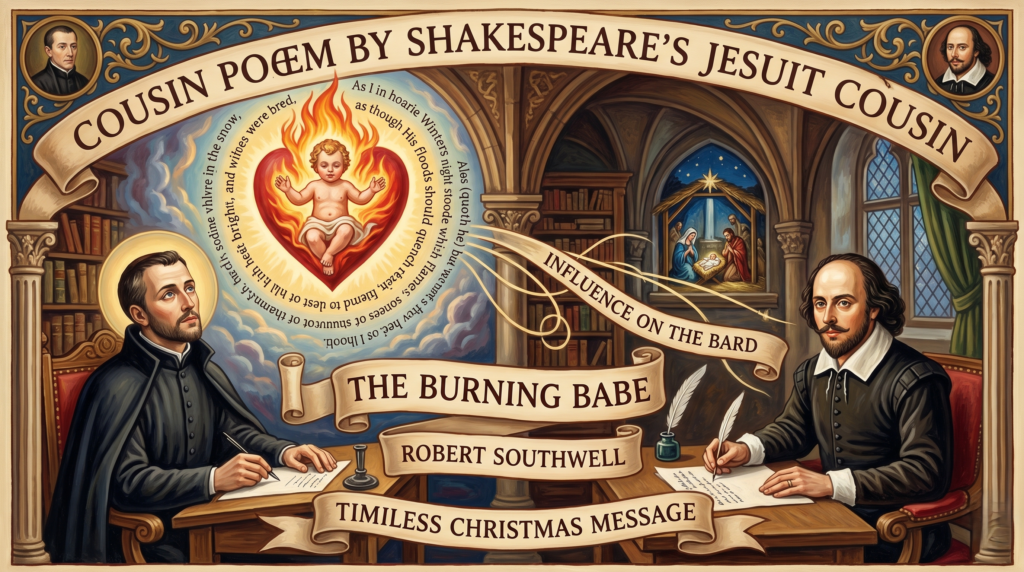
As I in hoary winter’s night stood shivering in the snow… These haunting opening lines have stirred hearts for over four centuries. Yet few readers realize they come from a “cousin poem” — written by William Shakespeare’s own distant cousin, the Jesuit priest and poet Robert Southwell.
In the depths of Elizabethan winter, a vision appears: a burning Babe whose flames of divine love consume yet purify. This is The Burning Babe, one of the most powerful Christmas poems in the English language. Its author, St. Robert Southwell, was not only a gifted metaphysical poet but a blood relative of England’s greatest playwright. Their shared family ties, literary influences, and the dramatic religious tensions of their age create a fascinating story that deepens our understanding of both men and the era that shaped them.
This article explores the remarkable life of Robert Southwell, his intimate family connection to Shakespeare, the full text and profound analysis of his famous Christmas poem, and the lasting impact of his work on the Bard. Whether you’re a Shakespeare enthusiast searching for hidden family stories, a lover of devotional poetry, or someone seeking meaningful Christmas reflections, you’ll discover fresh insights here. Far more than a historical footnote, Southwell’s “cousin poem” offers timeless wisdom on love, sacrifice, and redemption.
Who Was Robert Southwell? The Jesuit Poet and Martyr
Robert Southwell was born around 1561 in Horsham St. Faith, Norfolk, England, into a noble recusant Catholic family during one of the most dangerous periods for Catholics in English history.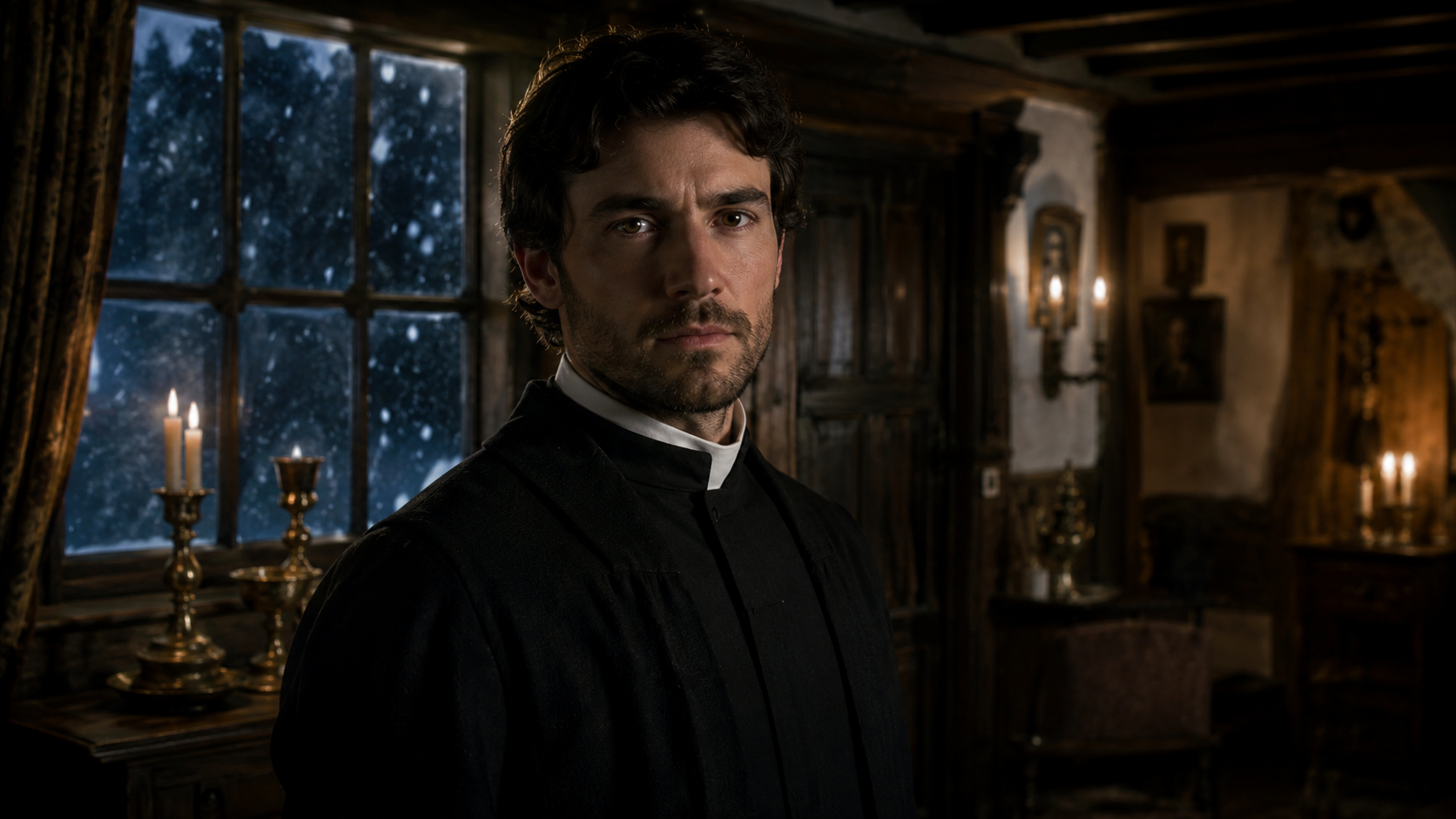
Early Life and Noble Roots
The Southwells were a distinguished family with strong Catholic roots. Young Robert showed early piety and intellectual promise. At age 15, he left England for the continent to pursue his education, studying at the Jesuit college in Douai and later in Rome. In 1578, he joined the Society of Jesus (the Jesuits), a bold choice given the order’s reputation as fierce defenders of the Catholic faith during the Counter-Reformation. He was ordained a priest in 1584 and became prefect of studies at the English College in Rome.
Secret Mission in Elizabethan England
In 1586, Southwell returned to England as part of the Jesuit English Mission — a dangerous underground operation to minister to persecuted Catholics. Disguised and constantly on the move, he served as chaplain to prominent Catholic families, including the Howards. He acted as a spiritual advisor and wrote consoling letters and devotional works that circulated in manuscript form among the faithful. His life was one of constant peril under the harsh anti-Catholic laws of Queen Elizabeth I.
Arrest, Torture, and Martyrdom (1595)
Betrayed in 1592 while celebrating Mass, Southwell was arrested and imprisoned in the Tower of London. He endured brutal torture — including the rack — but refused to reveal the names of fellow priests or compromise his faith. After three years in harsh conditions, he was tried for treason and executed at Tyburn on February 21, 1595. He was hanged, drawn, and quartered, the standard punishment for Catholic priests. His final words affirmed his loyalty to God and country. In 1970, Pope Paul VI canonized him as one of the Forty Martyrs of England and Wales.
Southwell’s combination of deep faith, poetic talent, and courageous witness made him a legendary figure in English Catholic history.
The Shakespeare Connection – Cousins in Turbulent Times
The family link between Robert Southwell and William Shakespeare adds a compelling personal dimension to literary history.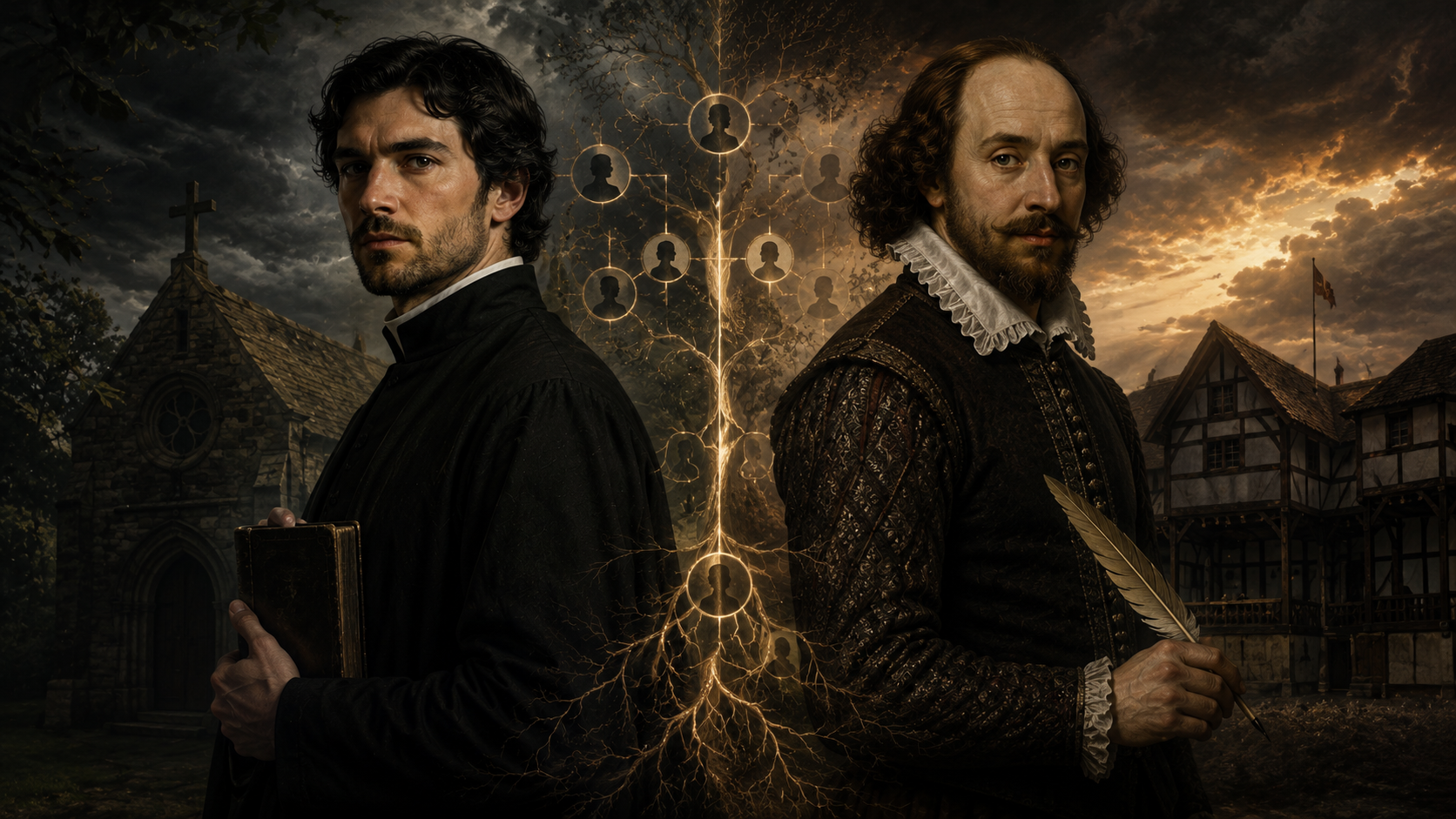
Tracing the Family Link
Scholarly research, notably by John Klause in Shakespeare, the Earl, and the Jesuit, along with historians like Christopher Devlin and Michael Wood, establishes that Southwell and Shakespeare were distant cousins through complex intermarriages involving families like the Copleys, Belknaps, and Vaux. They were also both distantly related to Henry Wriothesley, the 3rd Earl of Southampton — Shakespeare’s famous patron and dedicatee of Venus and Adonis and The Rape of Lucrece.
Some editions of Southwell’s poems include a preface addressed “To my worthy good cosen Maister W.S.,” which many scholars believe refers to William Shakespeare.
Shared World, Hidden Influences
Living in the same turbulent era, both men navigated religious tensions. Southwell operated in secret Catholic circles, while Shakespeare’s plays often contain subtle Catholic sympathies debated by scholars. Their mutual connection to Southampton likely brought them into the same orbit. Southwell may have served as confessor to the young Earl.
Why This “Cousin Poem” Matters Today
This connection humanizes Shakespeare. It shows how personal and family networks influenced the greatest writer in the English language, offering readers a richer, more nuanced view of Elizabethan literature and culture.
The Burning Babe – Full Text and Line-by-Line Analysis
One of the most compelling reasons Southwell’s work endures is his masterpiece, The Burning Babe. This short lyric poem masterfully blends vivid imagery, theological depth, and emotional intensity, making it a standout piece of Elizabethan devotional poetry.
Full Text of The Burning Babe by Robert Southwell
As I in hoary winter’s night stood shivering in the snow, Surpris’d I was with sudden heat which made my heart to glow; And lifting up a fearful eye to view what fire was near, A pretty Babe all burning bright did in the air appear; Who, scorched with excessive heat, such floods of tears did shed As though his floods should quench his flames which with his tears were fed.
“Alas!” quoth he, “but newly born, in fiery heats I fry, Yet none approach to warm their hearts or feel my fire but I! My faultless breast the furnace is, the fuel wounding thorns, Love is the fire, and sighs the smoke, the ashes shame and scorns; The fuel Justice layeth on, and Mercy blows the coals, The metal in this furnace wrought are men’s defilèd souls.
For which, as now on fire I am to work them to their good, So will I melt into a bath to wash them in my blood.”
With this he vanish’d out of sight and swiftly shrunk away, And straight I callèd unto mind that it was Christmas day.
This 16-line poem, written in common meter with a ballad-like rhythm, transforms a traditional nativity scene into a profound meditation on Christ’s redemptive suffering.
Stanza-by-Stanza Breakdown
The opening stanza sets a dramatic winter scene — cold, dark, and isolating. The speaker’s sudden “heat” introduces the supernatural vision of the Burning Babe. This contrast between external cold and internal spiritual fire is a hallmark of Southwell’s style, drawn from Ignatian meditative practices.
In the second stanza, the Babe speaks directly, revealing His identity as the infant Christ. The paradoxes are striking: newly born yet “in fiery heats I fry,” innocent yet bearing the weight of humanity’s sins. The imagery of fire and tears creates a dynamic tension that mirrors the theological mystery of the Incarnation.
The third stanza delves deeper into allegory. Christ’s breast is a furnace; His love is the fire; humanity’s sins are the metal being purified. Justice and Mercy work together in this divine alchemy — a sophisticated presentation of core Christian doctrine accessible through powerful metaphor.
The closing lines deliver the emotional punch: Christ will “melt into a bath to wash them in my blood,” foreshadowing the Crucifixion. The revelation that this vision occurs on Christmas Day ties the Nativity directly to the Passion, reminding readers that the joy of Christ’s birth is inseparable from His sacrificial death.
Literary Techniques and Innovation
Southwell employs metaphysical conceits years before John Donne popularized the style. His use of paradox, vivid sensory imagery, and emotional directness reflects his Jesuit training and Counter-Reformation influences from Italy. The poem’s musical quality made it suitable for both private devotion and potential singing.
The Burning Babe stands out among Christmas poems for its willingness to confront suffering amid celebration, offering readers a more contemplative and mature approach to the holiday.
How Robert Southwell’s Poetry Shaped Shakespeare
The influence of Southwell on Shakespeare represents one of the most fascinating — and debated — aspects of Elizabethan literature. As cousins connected through family and patronage networks, their literary cross-pollination adds depth to our understanding of the Bard.
Documented Textual Echoes
Scholars have identified numerous parallels:
- In Romeo and Juliet, themes of passionate love and sacrifice echo Southwell’s treatment of divine love.
- The famous graveyard scene in Hamlet shows strong influence from Southwell’s “Upon the Image of Death.”
- Passages in King Lear, particularly Lear’s redemptive speeches, resonate with Southwell’s poems on mercy and contrition.
- The Merchant of Venice contains echoes of Southwell’s “Lewd Love is Loss,” particularly in the casket scenes exploring true versus false love.
- Shakespeare’s narrative poems Venus and Adonis and The Rape of Lucrece respond to Southwell’s call for more morally elevated verse while engaging with his stylistic innovations.
Thematic Influences
Beyond direct quotes, Southwell’s exploration of conscience, redemption, mortality, and the tension between earthly and divine love permeates Shakespeare’s canon. Southwell’s emphasis on interior spiritual struggle likely contributed to Shakespeare’s complex character psychology.
Expert Perspectives
Literary historian John Klause, in his authoritative work Shakespeare, the Earl, and the Jesuit, provides extensive evidence of these connections. Other scholars like Christopher Devlin and Joseph Pearce reinforce the view that Southwell’s poetry offered Shakespeare both stylistic models and thematic inspiration during a formative period.
This “cousin poem” connection thus serves as a bridge between sacred and secular Elizabethan literature.
Other Notable Poems by Robert Southwell
While The Burning Babe remains his most famous Christmas poem, Southwell’s broader oeuvre is rich and varied:
- Saint Peter’s Complaint: A long meditative poem on betrayal, remorse, and repentance that influenced Shakespeare’s The Rape of Lucrece.
- The Author to His Loving Cousin: The prefatory letter addressed to “W.S.,” offering insight into Southwell’s intentions and possible personal connection to Shakespeare.
- New Heaven, New War and New Prince, New Pomp: Additional Christmas-themed verses that blend simplicity with profound theology.
- Shorter lyrics like “Times Go by Turns” and “Upon the Image of Death” showcase his gnomic wisdom and memento mori tradition.
Southwell helped popularize short, lyrical religious poetry in English, paving the way for later metaphysical poets.
Historical and Religious Context – Catholicism in Shakespeare’s England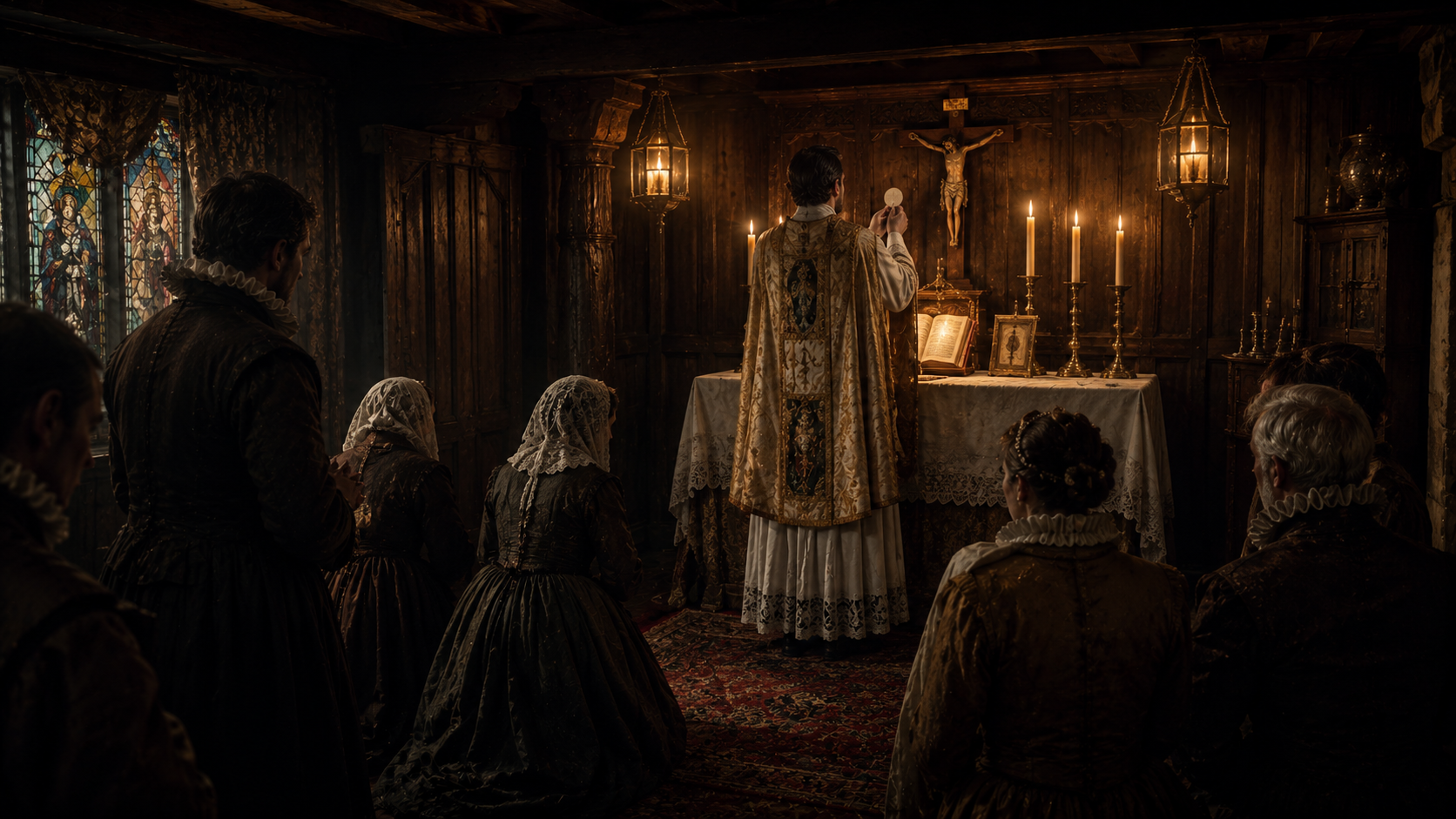
To fully appreciate this cousin poem, one must understand the perilous world of Elizabethan recusancy. After the English Reformation, Catholics faced fines, imprisonment, and execution for practicing their faith. Jesuits like Southwell were seen as particular threats due to their loyalty to the Pope.
Southwell’s secret ministry and eventual martyrdom exemplify the courage of underground Catholic communities. His writings provided spiritual sustenance and literary resistance. The ongoing scholarly debate about Shakespeare’s own possible Catholic sympathies gains weight through these family and patronage links.
Why Southwell’s Christmas Verse Still Resonates in the 21st Century
In our fast-paced, often secular age, The Burning Babe offers a powerful antidote to superficial holiday celebrations. Its themes of purifying love, sacrifice, and hope amid suffering speak directly to modern struggles with meaning, loss, and redemption.
Many readers, students, and faith communities return to Southwell’s work for Christmas reflections that balance joy with contemplative depth.
Practical Takeaways – How to Engage with This Cousin Poem Today
For Readers and Students
- Read The Burning Babe aloud to appreciate its rhythm.
- Journal: How does the image of the Burning Babe change your view of Christmas?
- Compare it with modern Christmas poems for fresh perspectives.
For Educators and Writers
- Use the Shakespeare-Southwell connection to teach intertextuality in Elizabethan literature.
- Incorporate Southwell into discussions of religious diversity in Shakespeare’s England.
Frequently Asked Questions (FAQ)
Is Robert Southwell really Shakespeare’s cousin? Yes, scholarly consensus supports they were distant cousins through extended family networks, further linked via the Earl of Southampton.
What is the most famous poem by Southwell? The Burning Babe is his best-known work, especially popular during the Christmas season.
Did Shakespeare know Southwell personally? It is likely, given their shared connections, though direct evidence remains circumstantial.
Where can I read more of Southwell’s work? Excellent editions are available from the Poetry Foundation and various academic publishers.
Why is The Burning Babe considered a great Christmas poem? It masterfully connects Christ’s birth with His redemptive suffering, offering profound theological insight through beautiful verse.
The “cousin poem” by Shakespeare’s Jesuit cousin, Robert Southwell, stands as a testament to the enduring power of faith, family, and literary artistry. The Burning Babe not only enriches our understanding of Shakespeare’s world but invites every reader into a deeper encounter with the Christmas mystery — one of purifying love that transforms suffering into salvation.
As we revisit Shakespeare’s plays this season, let us also remember his courageous cousin whose words may have helped shape the greatest voice in English literature. In a world still marked by division and uncertainty, Southwell’s vision of divine fire offers hope: a Babe who burns not to destroy, but to redeem.