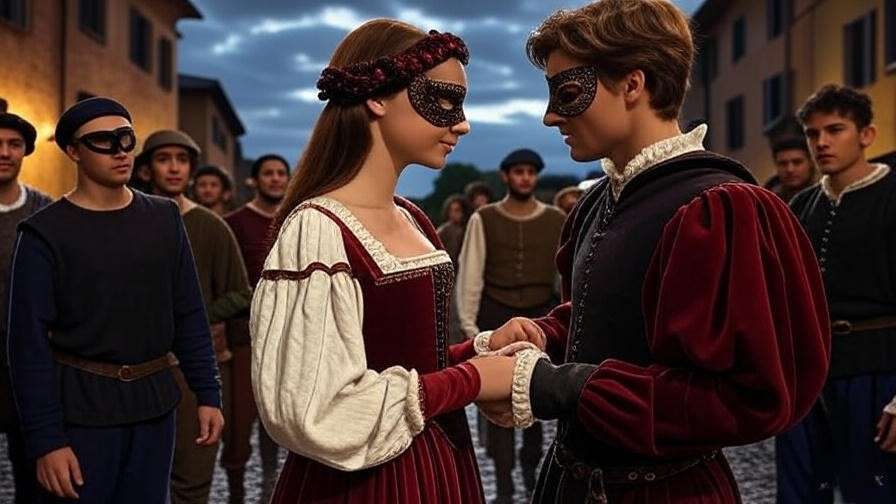
In the sweltering streets of Verona, swords clash as servants from two noble houses trade insults that quickly escalate into bloodshed. “A plague o’ both your houses!” cries the dying Mercutio, summing up the senseless cycle of violence that defines Shakespeare’s Romeo and Juliet. This ancient grudge between the Montagues and Capulets destroys everything it touches—including the lives of two young lovers whose only crime is falling in love across enemy lines.
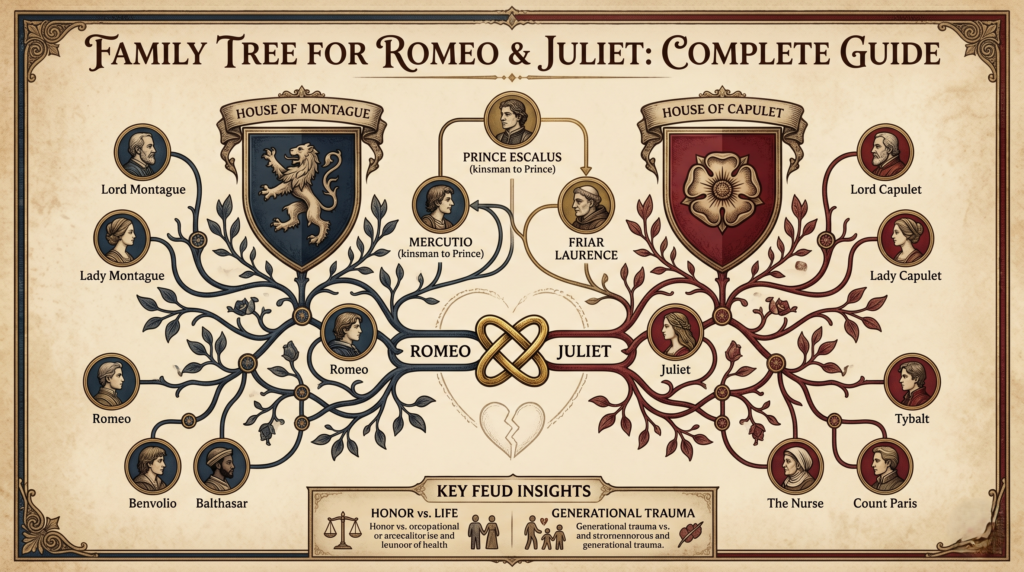
If you’ve ever searched for a family tree for Romeo and Juliet, you’re not alone. Students, theater lovers, and literature enthusiasts frequently seek a clear, comprehensive map of these intertwined families to understand the play’s complex relationships, motivations, and tragic momentum. This guide delivers exactly that: a detailed visual and narrative breakdown of the Montague and Capulet family trees, deep character analysis, historical context, thematic insights, and practical study aids. Whether you’re preparing for an exam, directing a production, or simply appreciating Shakespeare’s masterpiece, this resource illuminates how family loyalty, generational conflict, and blind hatred drive one of literature’s greatest tragedies.
Understanding the Historical and Literary Context of the Feud
Shakespeare’s Romeo and Juliet, first performed around 1595–1597, transforms a familiar story into a timeless exploration of love versus hate. The play is set in Verona, a city whose Renaissance Italian atmosphere Shakespeare evokes with vivid detail, though he never visited Italy. The “ancient grudge” between the Montagues and Capulets forms the essential backdrop, yet Shakespeare deliberately leaves its precise origin mysterious—emphasizing that the cause no longer matters; only its destructive power does.
The Setting – Verona in the Renaissance Imagination
Verona in the play represents a society fractured by partisan violence. Noble families like the Montagues and Capulets wield significant private power, often challenging the Prince’s authority. This mirrors real Italian city-states of the period, where feuds between powerful houses (such as the Guelphs and Ghibellines) frequently destabilized public order. Shakespeare draws on this cultural memory to heighten dramatic tension.
Origins of the “Ancient Grudge” – Why Shakespeare Left It Unexplained
By withholding the feud’s root cause, Shakespeare shifts focus from justification to consequence. The opening Chorus describes it as an “ancient grudge” that “breaks to new mutiny,” signaling a cycle of revenge that has persisted for generations. This narrative choice invites audiences to question the futility of inherited hatred—a theme that resonates powerfully today.
Real Historical Inspirations and Literary Sources
Shakespeare primarily adapted the story from Arthur Brooke’s 1562 poem The Tragical History of Romeus and Juliet, itself based on earlier Italian novellas by Matteo Bandello and Luigi da Porto. In these sources, family feuds were common plot devices. Historians note parallels with real Veronese or Italian rivalries, though Shakespeare universalizes the conflict. Elizabethan England itself had its share of noble disputes and street violence, making the play’s themes immediately relevant to original audiences.
Social Class and Power in Elizabethan England vs. the Play’s Italy
The Montagues and Capulets are wealthy, influential houses. Their servants bear the brunt of the violence, while lords and ladies navigate arranged marriages and political alliances. This class dynamic underscores Shakespeare’s critique of how elite feuds ripple through society, affecting everyone from princes to peasants.
The Montague Family Tree – Visual Breakdown and Key Members
The Montague household is smaller and appears more unified than their rivals, though still bound by the same destructive code of honor. Here is a clear textual representation of the Montague family tree:
Lord Montague ├── Lady Montague (wife) │ └── Romeo Montague (only son) │ Cousins/Allies: └── Benvolio Montague (nephew/cousin) └── Servants: Abram, Balthasar
Lord Montague and Lady Montague – Patriarch and Matriarch
Lord Montague is a concerned but somewhat distant father. In the opening scene, he worries about Romeo’s melancholy and seeks Benvolio’s help to understand his son. Lady Montague is gentler; she expresses relief when Romeo avoids the fight and later dies of grief over her son’s banishment and death. Their parenting style contrasts with the Capulets’—more permissive, yet still steeped in family pride.
Romeo Montague – The Romantic Protagonist
Romeo, the only son and heir, embodies passionate idealism. At the play’s start, he pines for Rosaline (a Capulet relative, though unseen). His impulsive nature leads him to crash the Capulet feast, fall instantly for Juliet, marry in secret, kill Tybalt in revenge for Mercutio, and ultimately take his life believing Juliet dead. Romeo’s arc illustrates the collision between youthful love and inherited enmity. His relationships with Mercutio (witty foil) and Benvolio (voice of reason) highlight different facets of loyalty. Friar Laurence serves as his spiritual father figure, enabling the secret marriage with good intentions but disastrous results.
Benvolio Montague – The Peacemaker Cousin
Benvolio, whose name literally means “good will,” consistently tries to defuse violence. He advises Romeo, reports events truthfully to the Prince, and survives to help narrate the tragedy. His calm demeanor provides crucial contrast to Tybalt’s aggression and Romeo’s passion.
Supporting Montague Allies and Servants
- Abram and Balthasar: Loyal servants who participate in the opening brawl and later deliver critical messages (Balthasar informs Romeo of Juliet’s “death”).
- Mercutio: Though not blood-related, as the Prince’s kinsman and Romeo’s closest friend, he is deeply entangled. His death marks a turning point, forcing Romeo to choose family loyalty over peace.
The Capulet Family Tree – Structure, Dynamics, and Influences
The Capulet side is larger, louder, and more socially dominant in the play. Their household pulses with activity—banquets, preparations for Juliet’s wedding, and underlying tension.
Lord Capulet ├── Lady Capulet (wife) │ └── Juliet Capulet (only daughter, nearly 14) │ Extended family: ├── Tybalt Capulet (Juliet’s cousin) ├── Capulet’s Cousin (older relative at the feast) └── Nurse (wet-nurse and surrogate mother to Juliet) └── Servants: Sampson, Gregory, Peter, etc.
Lord Capulet – The Authoritative Yet Volatile Father
Initially portrayed as a reasonable host (“My child is yet a stranger in the world”), Capulet later becomes tyrannical when Juliet refuses Paris. His mood swings—from indulgent father to rage-filled patriarch—reveal the pressures of maintaining family honor and securing advantageous marriages. His grief at the end is profound, leading to reconciliation.
Lady Capulet – Ambitious Mother and Distant Parent
Married young herself (“I was your mother much upon these years”), Lady Capulet pushes Juliet toward Paris and relies heavily on Tybalt as a surrogate enforcer. Her emotional distance from Juliet contrasts sharply with the Nurse’s warmth, highlighting different models of motherhood in the play.
Juliet Capulet – The Innocent Heroine
Juliet matures dramatically over the play’s short timeframe. From obedient daughter (“I’ll look to like, if looking liking move”) to someone who defies her family, fakes her death, and chooses suicide rather than life without Romeo. At not quite fourteen, her youth makes her courage and agency all the more remarkable. Her relationship with the Nurse provides comic relief and emotional support.
Tybalt Capulet – The Fiery Hothead Cousin
Tybalt, Juliet’s hot-tempered cousin, embodies the feud’s aggressive spirit. His challenge to Romeo at the feast and fatal duel with Mercutio/Romeo accelerate the tragedy. Tybalt’s unwavering loyalty to Capulet honor makes him a formidable antagonist.
The Nurse – Surrogate Mother and Key Confidante
Though not blood family, the Nurse is indispensable. Having lost her own daughter, she nursed Juliet and remains her closest confidante. Her earthy humor and pragmatic advice contrast with the lovers’ idealism, yet her role in facilitating the marriage proves pivotal—and ultimately tragic.
Other Capulet Relatives and Servants
Servants like Sampson and Gregory initiate the opening fight with crude bravado, showing how the feud permeates all levels of the household.
Intersecting Characters and the Broader Verona Society
The Montague and Capulet families do not exist in isolation. Several key figures outside the direct bloodlines influence the feud and the lovers’ fate, illustrating how private grudges poison an entire community.
Prince Escalus and the Civic Authority
Prince Escalus represents law and order in Verona. Exasperated by the repeated disturbances, he threatens death to any who disturb the peace again. His kinsmen—Mercutio and Paris—tie the ruling family into the story, showing how elite networks overlap with the feuding houses. At the play’s end, the Prince delivers the final judgment: “For never was a story of more woe / Than this of Juliet and her Romeo.”
Count Paris – The “Suitable” Suitor
Paris, a young noble and the Prince’s kinsman, is Capulet’s chosen match for Juliet. Courteous and socially appropriate, he contrasts with Romeo’s passionate intensity. His genuine grief at Juliet’s tomb adds pathos and underscores the collateral damage of the feud.
Friar Laurence – Spiritual Advisor and Secret Facilitator
The Franciscan friar serves as confidant to both Romeo and Juliet. He marries them secretly hoping “to turn your households’ rancour to pure love,” but his well-intentioned plan involving the sleeping potion unravels due to miscommunication and bad luck. Friar Laurence embodies the theme of flawed human attempts to control fate.
How Outsiders Highlight the Feud’s Impact on the Community
From the servants brawling in the streets to the citizens calling for peace, Shakespeare shows the feud’s broad social cost. The play critiques a society where personal honor trumps public welfare, a message that feels strikingly contemporary.
Side-by-Side Comparison of Montague and Capulet Families
One of Shakespeare’s masterful techniques is the near-mirroring of the two households, emphasizing the arbitrary nature of their hatred.
| Aspect | Montagues | Capulets | Shakespeare’s Insight |
|---|---|---|---|
| Leadership Style | More permissive, concerned father | Authoritative, volatile patriarch | Both struggle with control over youth |
| Parenting Approach | Distant but affectionate | Pressuring yet initially indulgent | Generational gap fuels tragedy |
| Key Hothead | (Romeo’s passion redirected) | Tybalt | Violence takes different forms |
| Female Figures | Lady Montague (gentle) | Lady Capulet (ambitious), Nurse (earthy) | Contrasting models of womanhood |
| Social Presentation | Fewer scenes, more introspective | Lavish feasts, public displays | Public vs. private honor |
| End Result | Lose only son; Lady dies of grief | Lose daughter and nephew; public reconciliation | Mutual destruction |
This symmetry drives home the play’s central irony: the families are more alike than they admit. Their names—Montague and Capulet—carry no inherent moral distinction, reinforcing the futility of the “ancient grudge.”
The Feud’s Role in Driving the Tragedy – Key Events and Turning Points
The Montague-Capulet feud is not mere background; it is the engine of the plot.
Timeline of Feud-Related Conflicts
- Act 1, Scene 1: Opening brawl between servants escalates when Tybalt and Benvolio enter. Prince intervenes.
- Act 1, Scene 5: Tybalt recognizes Romeo at the Capulet feast and wants to fight; Capulet restrains him.
- Act 3, Scene 1: Fateful street fight. Mercutio slain by Tybalt; Romeo kills Tybalt and is banished.
- Act 3, Scene 5: Capulet explodes at Juliet’s refusal to marry Paris, threatening to disown her.
- Act 5: Miscommunication leads to the lovers’ suicides. The families discover the bodies and finally reconcile.
Themes of Loyalty, Honor, and Revenge
Shakespeare explores how rigid family loyalty distorts individual morality. Romeo’s killing of Tybalt is framed as honorable revenge for Mercutio, yet it seals his doom.
Generational Conflict – Parents vs. Children
Both sets of parents arrange marriages and demand obedience, while the young lovers seek autonomy. The children’s secret defiance highlights the destructive consequences of suppressed agency.
Fate, Free Will, and Miscommunication
The “star-crossed lovers” motif suggests destiny, but human errors—undelivered letters, hasty decisions, impulsive violence—prove equally decisive. The feud creates an environment where trust is impossible, making tragedy inevitable.
Visual Family Tree Resources and Study Aids
To truly grasp the family tree for Romeo and Juliet, visual aids are invaluable. Consider creating or referencing:
- Color-coded diagrams distinguishing blood relatives, in-laws, servants, and allies.
- Relationship maps showing romantic, friendly, and adversarial connections.
- Timelines linking family events to plot progression.
Tips for Students and Teachers
- Draw your own tree while reading: Start with the heads of houses and branch outward.
- Use digital tools (Lucidchart, Canva) or printables for classroom analysis.
- Analyze key quotes: “O Romeo, Romeo! Wherefore art thou Romeo?” reveals Juliet’s awareness of the name/family barrier.
- Compare with other Shakespeare works, such as the dysfunctional families in King Lear or Hamlet, to deepen understanding of Shakespearean family dynamics.
Recommended viewing: Franco Zeffirelli’s 1968 film or Baz Luhrmann’s 1996 adaptation, both excellent at visualizing household tensions.
Modern Relevance and Lessons from the Montague-Capulet Feud
Centuries later, the Montague-Capulet conflict remains painfully relevant. In an era of political polarization, online tribalism, and generational family rifts, Shakespeare’s warning resonates.
Applications to Today’s Conflicts
- Tribalism and Echo Chambers: Like the Veronese citizens, modern society often inherits divisions without questioning their origins.
- Youth vs. Tradition: Romeo and Juliet’s story mirrors young people navigating cultural, religious, or political family expectations.
- Cycle of Revenge: From street gangs to international disputes, the play shows how retaliation escalates suffering.
Adaptations in Popular Culture
The story has inspired West Side Story, Romeo + Juliet (1996), musicals, ballets, and countless retellings. Pop culture references abound—from Taylor Swift lyrics to episode plots in TV series—proving its enduring appeal.
Why the Story Endures
Shakespeare reveals that love can briefly transcend hate, but without empathy and communication, hatred consumes all. The final reconciliation comes too late, at the cost of the younger generation—a sobering lesson on the price of division.
Expert Insights and Common Misconceptions
As a scholar of Shakespearean literature, I often encounter misunderstandings:
- Misconception: The feud has a clear cause. Reality: Shakespeare intentionally leaves it vague to focus on consequences.
- Misconception: Juliet is extremely young and passive. Reality: At nearly 14, she displays remarkable maturity and agency.
- Misconception: Romeo is the primary tragic hero. Reality: Both lovers share equal weight; the tragedy belongs to the families.
Scholarly consensus (from critics like Stephen Greenblatt and Marjorie Garber) emphasizes family as the core dramatic mechanism. Directors frequently highlight the parents’ culpability in staging to underscore societal critique.
The family tree for Romeo and Juliet reveals far more than names and relationships—it maps the anatomy of hatred and the fragile hope of love. Through the Montagues and Capulets, Shakespeare holds a mirror to humanity’s oldest failing: our willingness to destroy ourselves and those we claim to protect in the name of loyalty and honor.
The lovers’ deaths finally compel the families to end their “ancient grudge.” In that moment of devastating clarity, we see the possibility of reconciliation, however belated. As readers and audiences, we are left with a call to examine our own inherited divisions—whether familial, cultural, or societal—before they claim their own innocent victims.
Shakespeare’s genius lies not only in crafting unforgettable characters but in crafting a story that continues to teach empathy across centuries. I encourage you to revisit the play, attend a live performance, or discuss these themes with others. In understanding the Montague and Capulet family trees, we better understand ourselves.
FAQs
What is the exact family relationship between Romeo and Benvolio? Benvolio is Romeo’s cousin (or nephew in some interpretations), specifically Lord Montague’s nephew.
How old are Romeo and Juliet? Juliet is not yet 14; Romeo’s age is unspecified but implied to be slightly older, likely late teens.
Who started the feud between Montagues and Capulets? Shakespeare never reveals the origin, emphasizing its irrational persistence.
What happens to the families at the end of the play? Both lose their only heirs. They reconcile, agreeing to end the feud and erect golden statues in memory of the lovers.
Is the Nurse part of the Capulet family? She is not blood-related but serves as Juliet’s lifelong wet-nurse and surrogate mother, making her an integral part of the household.
How does the play differ from its source materials? Shakespeare compresses the timeline, deepens character psychology, and adds poetic brilliance while retaining the core tragic arc.