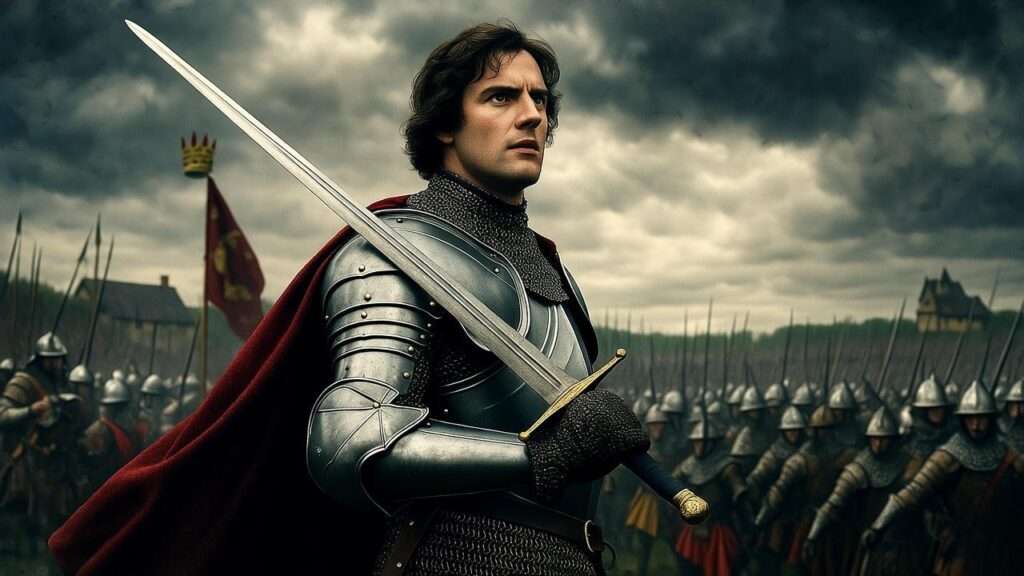
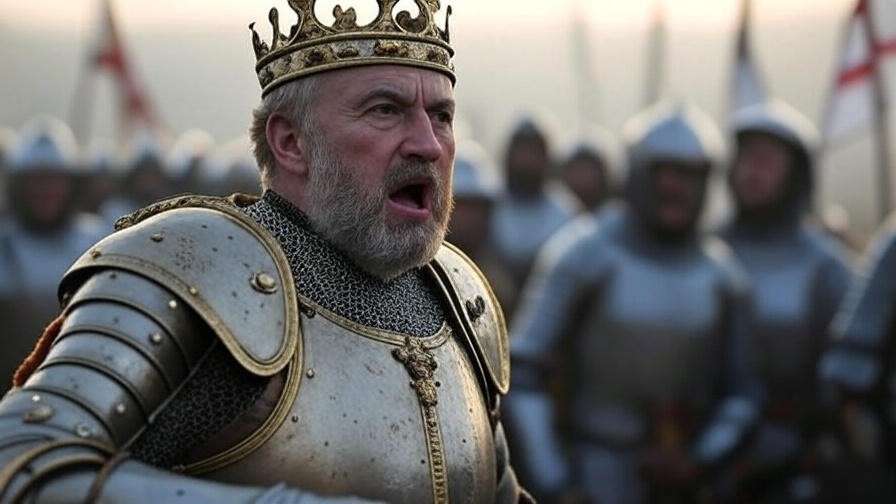
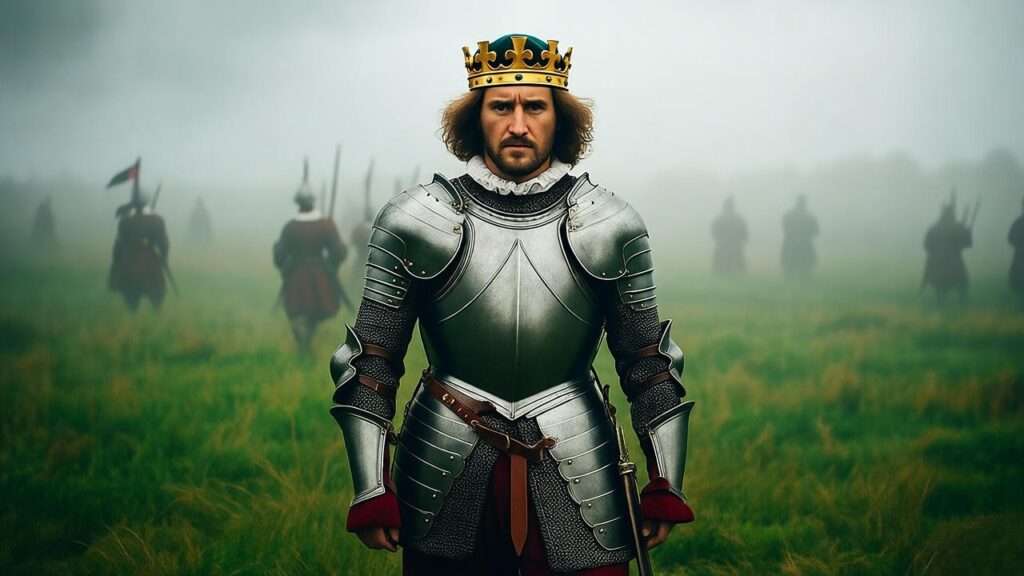
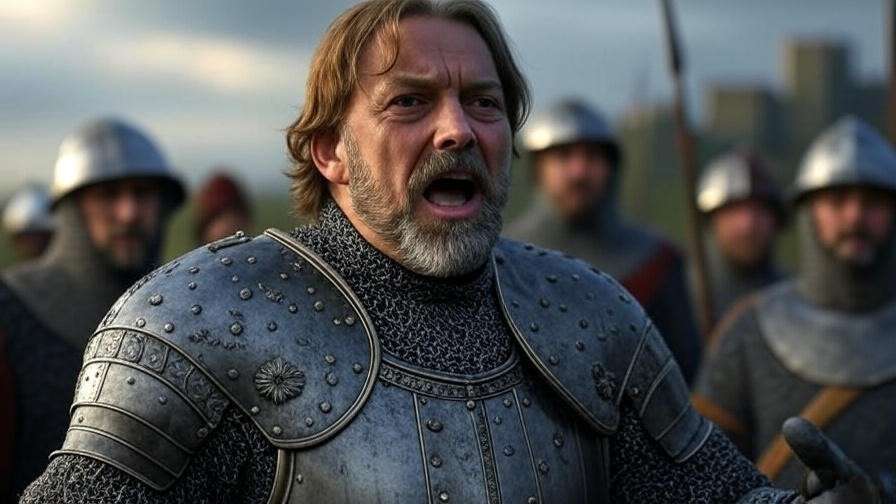
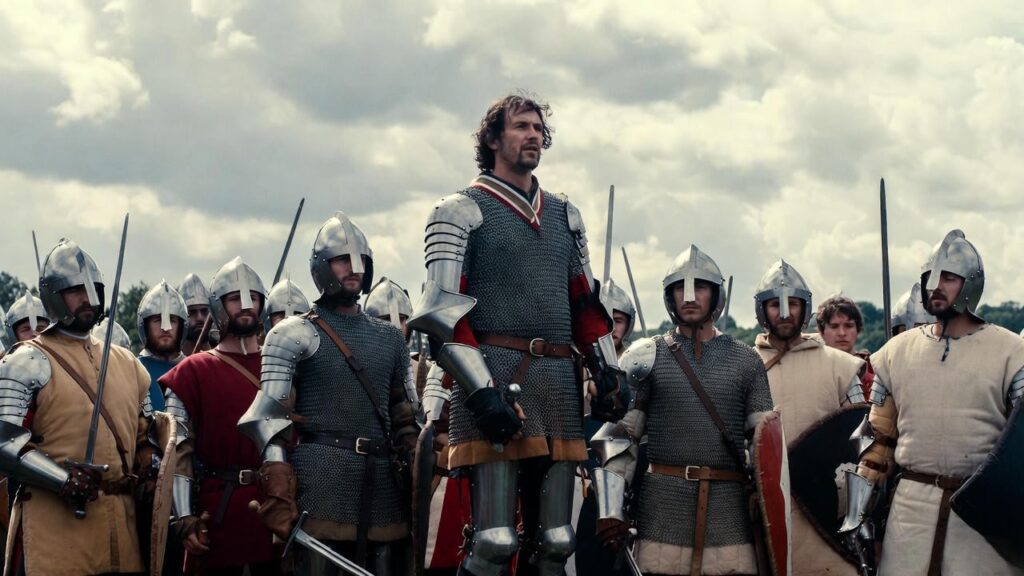
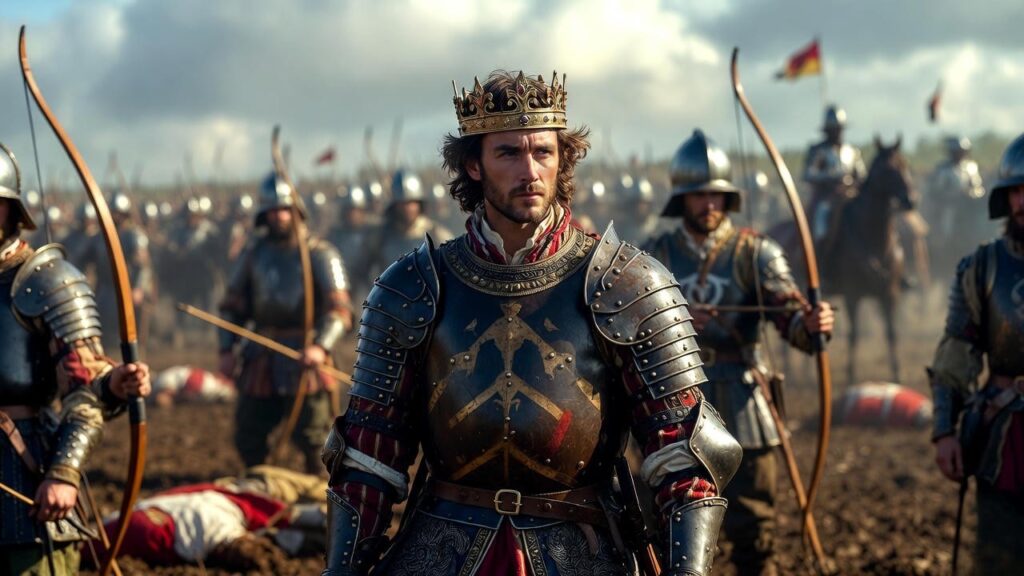
“Once more unto the breach, dear friends, once more; Or close the wall up with our English dead!”
These thunderous words, delivered by a young king facing impossible odds, have echoed through centuries — inspiring soldiers, leaders, actors, and students alike. They belong to Henry V, one of William Shakespeare’s most stirring and complex history plays, and the triumphant final chapter of the so-called Henriad.
If you’ve come here searching for a Henry V play synopsis, you’re likely looking for more than a bare plot summary. You want to understand how a wayward prince becomes one of England’s most legendary warrior-kings, why the Battle of Agincourt remains one of history’s greatest underdog victories, and how Shakespeare weaves together breathtaking rhetoric, brutal realism, patriotic fervor, and quiet moral questioning into a single, unforgettable drama.
In this comprehensive guide, we provide:
- A detailed, act-by-act synopsis that leaves nothing out
- Essential historical and literary context
- In-depth exploration of major themes (leadership, war, kingship, national identity)
- Analysis of the play’s most famous speeches and their modern significance
- Character breakdowns
- Discussion of adaptations and contemporary relevance
Whether you’re a student preparing for an exam, a teacher designing lessons, an actor studying the role, or simply a lover of great literature wanting to finally “get” Henry V, this article aims to be the most thorough, insightful resource available.
Historical and Literary Context
Henry V was most likely written in 1599, during the final years of Queen Elizabeth I’s reign — a time of intense national pride but also growing anxiety about succession and foreign threats.
The play dramatizes events from 1415, the height of the Hundred Years’ War between England and France. The real Henry V (1386–1422), son of Henry IV, had a reputation as both a brilliant military commander and a ruthless politician. Shakespeare drew primarily from Raphael Holinshed’s Chronicles of England, Scotland, and Ireland (1577/1587), while also borrowing details from earlier anonymous plays, including The Famous Victories of Henry the Fifth.
Unlike most history plays, Henry V employs a unique structural device: the Chorus. This single speaking figure appears at the beginning of each act (and the epilogue), apologizing for the limitations of the Elizabethan stage while simultaneously urging the audience’s imagination to fill the gaps:
“Can this cockpit hold The vasty fields of France? Or may we cram Within this wooden O the very casques That did affright the air at Agincourt?”
The Chorus serves several purposes: it bridges time and location, heightens epic scale, and subtly reminds us that what we are watching is a theatrical reconstruction — not literal history.
Shakespeare also inherits the dramatic arc begun in Henry IV, Part 1 and Part 2: the transformation of wild Prince Hal into responsible King Henry V. Many audience members in 1599 would already have known the story of the prodigal prince who once caroused with Falstaff in Eastcheap taverns. Henry V therefore functions as both a standalone play and the climactic resolution of a larger tetralogy.
Crucially, the play is not simple propaganda. While it contains some of the most rousing patriotic language in the English language, it also quietly shows the human cost of war: hanging of thieves, execution of prisoners, exhaustion of common soldiers, and the king’s private doubts about the justice of his cause.
This tension — between glory and brutality — is one reason Henry V continues to provoke debate more than 400 years later.
Act-by-Act Detailed Synopsis
Act 1: The Seeds of War
The Chorus opens the play with an invocation to the Muse of fire, asking the audience to imagine the grandeur of two mighty monarchies preparing for war.
In London, two powerful churchmen — the Archbishop of Canterbury and the Bishop of Ely — discuss the king’s claim to the French throne. They cleverly support Henry’s right through a complicated rebuttal of the Salic Law (the French argument that females cannot inherit the crown, thus invalidating Henry’s claim through his great-great-grandmother Isabella).
Their real motive? To divert the king from passing a bill that would strip the Church of much of its wealth.
Henry, now a mature and commanding monarch, summons the French ambassadors. The Dauphin (heir to the French throne) has sent a mocking gift: a chest of tennis balls — implying that Henry is still the frivolous youth he once was.
The insult backfires spectacularly. Henry responds with one of the play’s most chilling speeches:
“When we have match’d our rackets to these balls, We will in France, by God’s grace, play a set Shall strike his father’s crown into the hazard.”
Before departing for France, Henry discovers a treasonous plot by three English nobles — Cambridge, Scroop, and Grey — who have accepted French bribes. He exposes them in a masterclass of controlled fury and lets justice take its course.
Meanwhile, in the comic subplot, Pistol, Nym, Bardolph, and the Boy prepare to follow the army to France. The Hostess reports that their old companion Sir John Falstaff is dying of a broken heart — a poignant reminder of the world Prince Hal left behind.
Act 2: Departure and Early Tensions
The Chorus returns, vividly describing the excitement across England as ships prepare to sail for France and the French court mocks the young king’s ambitions. “All the youth of England are on fire,” the Chorus declares, painting a picture of national fervor.
In London, the low-life comic characters from Prince Hal’s past — Pistol, Nym, Bardolph, and the Boy — bicker and prepare to join the expedition, driven more by opportunism than patriotism. The Hostess (Mistress Quickly) delivers one of Shakespeare’s most poignant offstage deaths: Sir John Falstaff, the larger-than-life companion who shaped Hal’s youth, has died of grief and heartbreak after being rejected by the new king. “The king has run bad humours on the knight,” she says, underscoring the personal cost of Henry’s transformation into a responsible monarch.
Back at the royal level, Henry addresses his court with calm authority. He pardons a man who insulted him while drunk — a small act that demonstrates mercy — then turns to the three traitors (Cambridge, Scroop, and Grey). In a masterful display of psychological control, Henry lets them condemn themselves by first praising their loyalty, then revealing the evidence of their treason. Their executions are swift and public, reinforcing Henry’s image as a just but unyielding ruler.
The act shifts to France, where the French king and his court underestimate Henry, viewing him as the same “mad-cap” prince of old. The Dauphin continues his arrogance, while the French prepare for war with overconfidence.
A charming comic interlude lightens the tension: Princess Katherine of France receives an English lesson from her gentlewoman Alice. The scene is played for laughs as Katherine mangles English words (“de foot” and “de coun” become comically suggestive), but it also foreshadows the play’s romantic resolution — the union of England and France through marriage.
Henry’s army lands in France, and the siege of Harfleur begins. The act ends with the famous “Once more unto the breach” speech (technically the start of Act 3, but often discussed here for flow), where Henry rallies his exhausted troops:
“Once more unto the breach, dear friends, once more; Or close the wall up with our English dead! In peace there’s nothing so becomes a man As modest stillness and humility: But when the blast of war blows in our ears, Then imitate the action of the tiger…”
This rousing call transforms fear into ferocity, urging soldiers to “stiffen the sinews” and fight like predators. It’s a masterclass in motivational rhetoric, blending patriotism, shame, and raw energy.
Act 3: The Turning Point
The siege of Harfleur continues. After Henry’s threats of merciless destruction if the town does not surrender — including rape, pillage, and slaughter — the governor capitulates. Henry shows mercy, ordering his troops to treat the citizens well.
Shakespeare introduces the play’s diverse captains, symbolizing British unity: the Welsh Fluellen (pedantic and honorable), the English Gower, the Irish Macmorris (hot-tempered), and the Scottish Jamy. Their quarrels and eventual camaraderie highlight how shared purpose overcomes regional differences.
In a darker moment, Bardolph is caught stealing from a church and hanged on Henry’s orders. The king refuses to intervene, declaring: “We would have all such offenders so cut off.” This act of strict discipline shows Henry’s commitment to justice, even when it means sacrificing old friends.
The English army marches inland, weary and outnumbered. On the night before the Battle of Agincourt, Henry disguises himself as a common soldier and moves among his men. He debates with soldiers Williams and Bates about the morality of the war — if the king’s cause is unjust, the soldiers’ souls bear the burden, not the king. Henry defends his position but privately wrestles with doubt.
In a moving soliloquy, Henry reflects on the burdens of kingship: “Upon the king! Let us our lives, our souls, our debts, our careful wives, our children, and our sins lay on the king!” He envies the simple life of a peasant who sleeps soundly, free from responsibility. This scene humanizes Henry, revealing the isolation and guilt beneath his heroic exterior.
Act 4: Triumph at Agincourt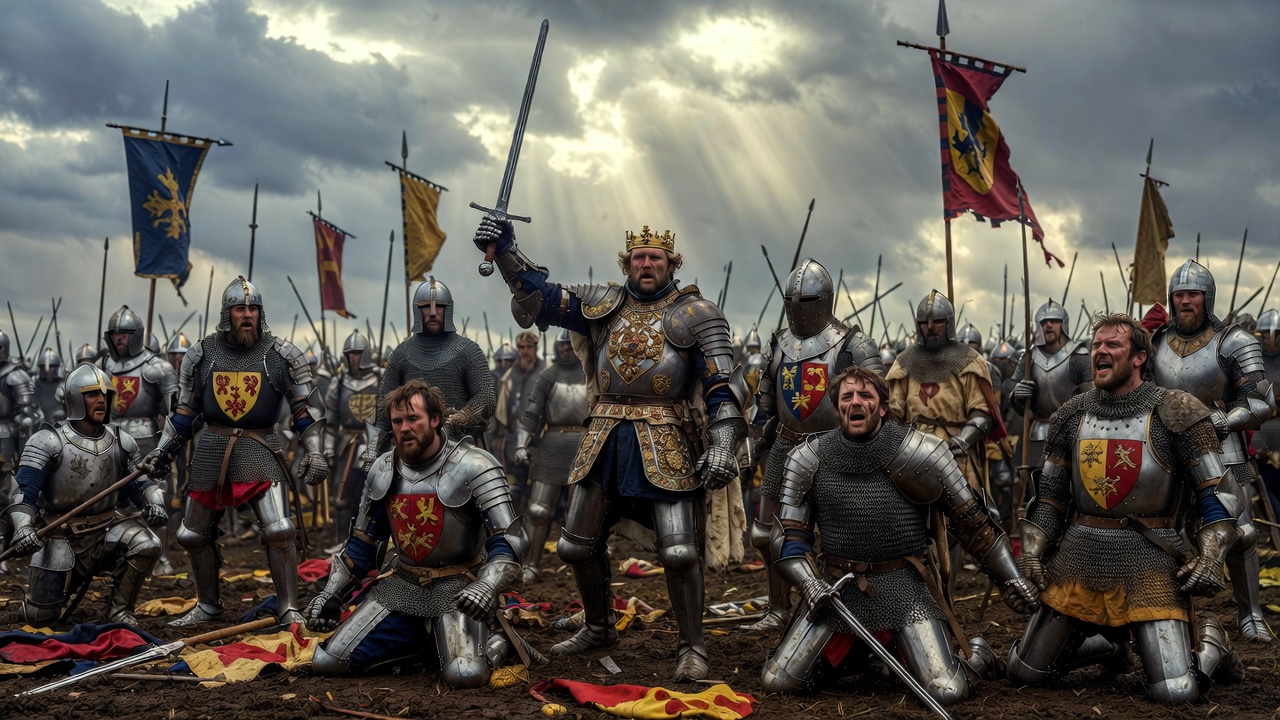
Dawn breaks on St. Crispin’s Day. The English are vastly outnumbered (estimates suggest 5:1 or worse). Westmoreland wishes for more men; Henry famously replies that fewer men mean greater glory.
He delivers the play’s most celebrated speech — the St. Crispin’s Day oration:
“This day is called the feast of Crispian: He that outlives this day, and comes safe home, Will stand a tip-toe when this day is named… We few, we happy few, we band of brothers; For he to-day that sheds his blood with me Shall be my brother; be he ne’er so vile, This day shall gentle his condition…”
This speech transforms a desperate situation into one of immortal brotherhood and glory. It promises that survivors will recount the tale for generations, while those absent will regret it forever. The rhetoric is so powerful that it has inspired leaders from Winston Churchill to modern motivational speakers.
The battle itself occurs offstage (as per the Chorus’s apology for the stage’s limits). Messengers report a miraculous English victory: the French suffer catastrophic losses, while English casualties are astonishingly low (Shakespeare inflates the disparity for dramatic effect). Henry orders the execution of French prisoners — a controversial historical decision justified here by the need to prevent a counterattack.
Fluellen provides comic relief, proudly recounting the victory in his Welsh accent and forcing Pistol to eat a leek (a symbol of Welsh pride).
Act 5: Peace and Legacy
The Chorus describes Henry’s triumphant return to England before shifting to the French court. Burgundy pleads for peace, lamenting the devastation of war on the land and people.
Henry negotiates terms, demanding territories and the hand of Princess Katherine. The wooing scene is charmingly awkward: Henry speaks in halting French, Katherine in broken English. Despite the language barrier, genuine affection emerges. “You and I cannot be confined within the weak list of a country’s fashion,” Henry says, winning her over.
The treaty is signed, uniting the kingdoms through marriage. The Chorus delivers the epilogue, reminding the audience of the tragic aftermath: Henry dies young, his infant son loses France, and civil wars erupt (events dramatized in the Henry VI plays). This bittersweet close underscores the fragility of even the greatest triumphs.
Key Themes and Analysis
Shakespeare’s Henry V is far more than a patriotic celebration of English victory. It is a richly layered exploration of power, morality, leadership, and the human cost of war. Below are the play’s central themes, examined with the nuance that makes the work endure.
1. Leadership and the Burden of Kingship Henry’s journey from the tavern-roaming Prince Hal to the inspiring yet burdened King Henry V is the emotional spine of the entire Henriad. By the time we meet him in this play, he has deliberately shed his youthful wildness. Yet Shakespeare never lets us forget the cost: the rejection of Falstaff, the sleepless nights before Agincourt, the private soliloquy in which he envies the simplest peasant.
Henry understands that true leadership requires sacrifice — of personal comfort, of old friendships, and even of moral certainty. His most revealing moment comes when he prays alone: “My crown and my kingdom are great, yet I would give them all for a quiet night’s sleep.” This private vulnerability contrasts powerfully with his public persona as the heroic orator.
2. The Glory and Brutality of War The play presents both sides of military conflict without fully resolving the tension. On one hand, we have the soaring rhetoric of the St. Crispin’s Day speech and the miraculous victory at Agincourt — moments that still bring audiences to their feet. On the other, we witness:
- The hanging of Bardolph for petty theft
- Henry’s chilling threat to rape and slaughter the citizens of Harfleur
- The cold execution of French prisoners
- The exhaustion, fear, and moral questioning of ordinary soldiers
Critics have long debated whether Henry V is a pro-war or anti-war play. The honest answer is: it is both. Shakespeare gives us the exhilaration of victory and the grim reality of its price — a deliberate ambiguity that invites reflection rather than propaganda.
3. National Identity and Unity The diverse captains — Fluellen (Welsh), Jamy (Scottish), Macmorris (Irish), and Gower (English) — represent the newly unified kingdom under a strong monarch. Their squabbles are comic, but their cooperation on the battlefield is serious. Shakespeare reflects the Elizabethan project of forging a British identity out of separate nations, even while gently satirizing regional stereotypes.
4. Honor, Brotherhood, and the Morality of Conquest The St. Crispin’s Day speech transforms a desperate military situation into a promise of eternal brotherhood: “We few, we happy few, we band of brothers.” Yet this ideal is shadowed by the earlier debate between Henry (disguised) and Williams, who questions whether the king’s cause is just and who will bear the moral responsibility for the dead.
This moral questioning elevates Henry V above simple jingoism. Shakespeare asks difficult questions: Can a war be both glorious and unjust? Can a leader be both heroic and ruthless?
Famous Quotes and Their Significance
Shakespeare’s language in Henry V is among his most memorable. Here are several lines that have shaped literature, leadership, and popular culture:
- “Once more unto the breach, dear friends, once more…” (Act 3, Scene 1) The ultimate rallying cry — used in military training, sports, business, and countless motivational speeches.
- “We few, we happy few, we band of brothers” (Act 4, Scene 3) Perhaps the most quoted passage in the play. It has been invoked to inspire teams, armies, and even political movements.
- “The game’s afoot!” (Act 3, Scene 1) A thrilling call to action, later echoed by Sherlock Holmes (“The game is afoot!”).
- “Upon the king! Let us our lives, our souls… lay on the king!” (Act 4, Scene 1) Henry’s private meditation on the loneliness and guilt of absolute power.
- “Men of few words are the best men” (Fluellen, Act 3, Scene 2) A comic gem that contrasts beautifully with Henry’s own eloquence.
These lines are not mere decoration — they crystallize the play’s central tensions and continue to resonate in 2026.
Characters Overview
- King Henry V — Charismatic, calculating, devout, ruthless when necessary. One of Shakespeare’s most complex protagonists.
- The Chorus — Narrator, apologist for the stage, and subtle commentator on the limits of representation.
- Fluellen — Pedantic, loyal, brave Welsh captain; provides both comedy and humanity.
- Pistol, Nym, Bardolph — Comic lowlifes who follow the army for profit, reminding us of the underside of war.
- Princess Katherine — Innocent, charming, and eventually won over by Henry’s awkward sincerity.
- The Dauphin — Arrogant and foolish; embodies French overconfidence.
Modern Relevance and Adaptations
In an era still marked by geopolitical conflict, leadership crises, and debates over national identity, Henry V feels strikingly contemporary.
- Leadership lessons — Henry’s ability to inspire exhausted troops, maintain discipline, and balance mercy with justice continues to be studied in military academies and business schools.
- War’s human cost — The play’s refusal to glorify violence without showing its price resonates deeply in discussions of modern warfare.
- Nationalism vs. humanity — The tension between patriotic unity and moral questioning speaks to ongoing debates about patriotism and international responsibility.
Notable screen adaptations include:
- Laurence Olivier’s 1944 wartime version (rousing and patriotic)
- Kenneth Branagh’s 1989 film (grittier, emotionally richer)
- The 2012 BBC Hollow Crown production with Tom Hiddleston (intimate and psychologically complex)
Each generation rediscovers Henry V in its own image.
Frequently Asked Questions (FAQs)
What is the main plot of Henry V in simple terms? Young King Henry V claims the French throne, invades France, wins a stunning victory at Agincourt against overwhelming odds, and secures peace through marriage to Princess Katherine.
Is Henry V a pro-war or anti-war play? It is both. Shakespeare gives us inspiring battle speeches and a miraculous victory, but also shows looting, executions, exhaustion, and moral doubt.
Why does Henry disguise himself before Agincourt? To hear his soldiers’ honest opinions about the war and the king’s responsibility for their fate — a moment that reveals his own inner conflict.
What happened to Falstaff? He dies of a broken heart after Henry publicly rejects him, a poignant end to the tavern world of the earlier plays.
How does Henry V connect to other Shakespeare history plays? It concludes the second tetralogy (Richard II → Henry IV Part 1 → Henry IV Part 2 → Henry V), showing the full arc of Prince Hal’s transformation.
Henry V is Shakespeare at his most thrilling and most troubling. It gives us one of the greatest underdog victories in literature, some of the most stirring language ever written, and — quietly — some of the most searching questions about power, war, and responsibility.
Whether you are studying for an exam, preparing to see or perform the play, or simply wanting to understand why this 400-year-old drama still moves audiences, the story of Henry’s great campaign remains as powerful today as it was in 1599.