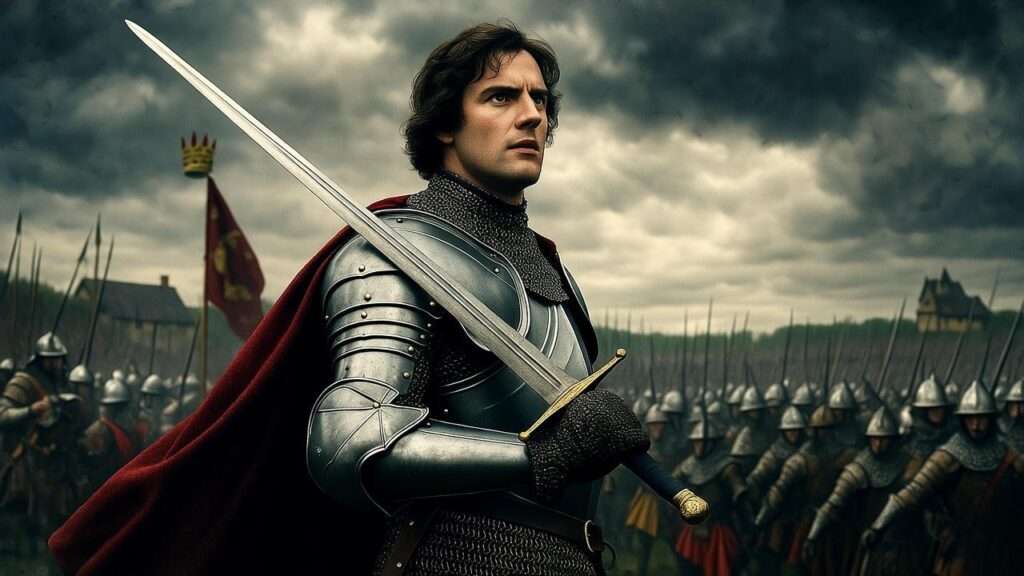
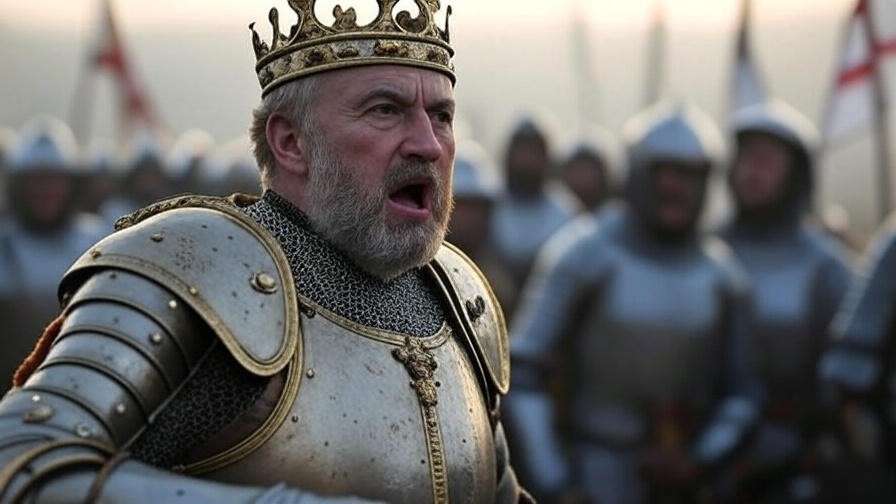
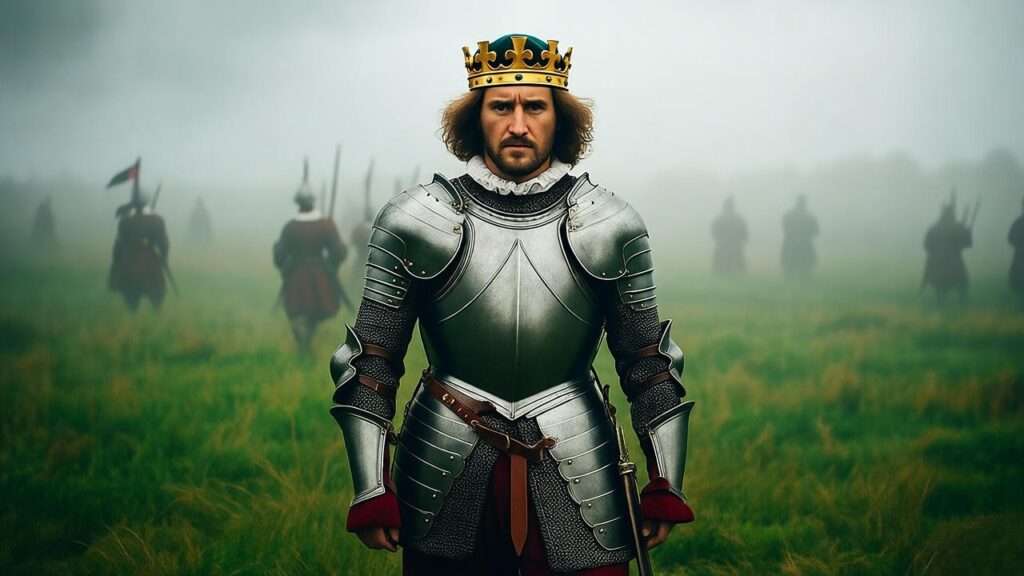
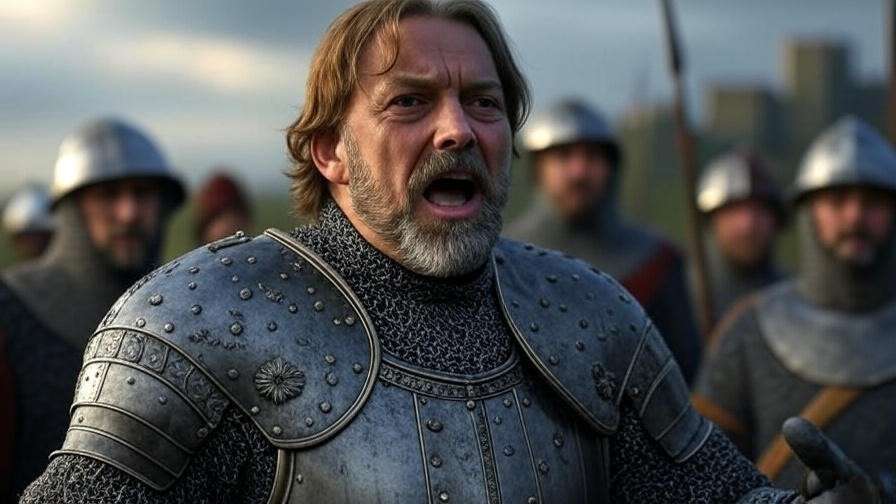
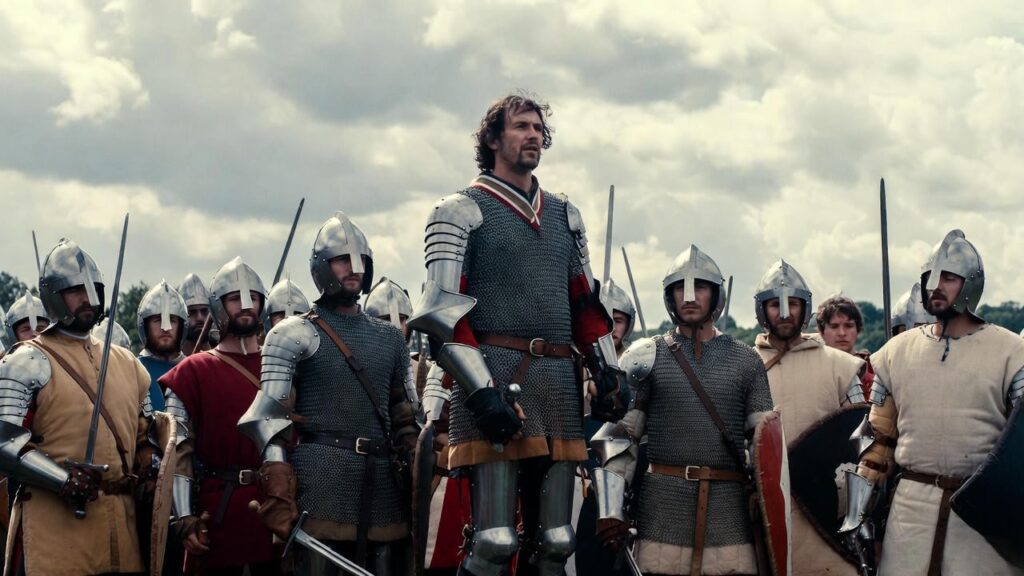
Imagine a cold, wet October morning in 1415. Thousands of English soldiers—exhausted, dysentery-ridden, outnumbered, and staring at the heavily fortified walls of Harfleur—have reached the point of physical and psychological collapse. Their young, inexperienced king climbs onto a makeshift platform of earth and timber. He opens his mouth and speaks words that will transform hesitation into ferocity, fear into collective pride.
Among those words are five that cut through the rain and the despair like a drawn sword:
“On, on, you noblest English.”
This short, urgent phrase—embedded inside the famous “Once more unto the breach” speech from Shakespeare’s Henry V—remains one of the most concentrated bursts of motivational rhetoric in the English language. In fewer than ten syllables Shakespeare achieves an extraordinary psychological feat: he flatters, challenges, unites, and elevates ordinary men into legendary status in a single breath.
In this in-depth guide we will explore:
- the precise dramatic moment and full text of the speech
- a clear modern-English line-by-line explanation
- the rhetorical brilliance hidden inside those five words
- the historical reality behind the scene
- how actors and directors have interpreted the moment across four centuries
- and—most importantly—why “you noblest English” continues to move leaders, coaches, teachers, writers, and individuals facing their own versions of Harfleur today.
Whether you are studying the play for school or university, preparing to teach it, directing or acting in a production, writing leadership content, or simply searching for the meaning behind a line that keeps appearing in motivational posters and sports speeches, you will find the clearest, most comprehensive explanation here.
Where Does “You Noblest English” Actually Appear? The Full Context
The line appears in Act 3, Scene 1 of Henry V (written circa 1599).
The English army has landed in northern France with the intention of claiming the French throne. After a long, difficult voyage they have besieged the port town of Harfleur—the gateway to Normandy. The siege has dragged on far longer than anyone expected. The town’s defenders are stubborn, English cannon are running low on powder, autumn rains have turned the ground into a quagmire, and disease is killing more men than French arrows.
The walls have been breached, but the assault has stalled. Soldiers are hanging back, reluctant to throw themselves into the killing zone again. It is at this exact moment—when momentum is slipping away—that King Henry leaps forward and delivers one of the most famous rallying speeches in dramatic literature.
Important clarification: This is not the St. Crispin’s Day speech (“We few, we happy few, we band of brothers”). That later speech (Act 4, Scene 3) takes place before Agincourt and is delivered to a much smaller, more desperate force. The Harfleur speech is earlier, louder, more physically immediate, and—crucially—directed at a much larger, socially mixed army that still contains hope of victory.
This is Henry’s first great battlefield oration as king. Everything he says here begins to define his leadership style for the audience.
The Complete “Once More Unto the Breach” Speech – Original Text
Here is the full speech (Act 3, Scene 1, lines 1–34) in the original Shakespearean wording (lightly modernized punctuation for readability):
Once more unto the breach, dear friends, once more; Or close the wall up with our English dead! In peace there’s nothing so becomes a man As modest stillness and humility; But when the blast of war blows in our ears, Then imitate the action of the tiger: Stiffen the sinews, conjure up the blood, Disguise fair nature with hard-favoured rage; Then lend the eye a terrible aspect; Let it pry through the portage of the head Like the brass cannon; let the brow o’erwhelm it As fearfully as doth a galled rock O’erhang and jutty his confounded base, Swilled with the wild and wasteful ocean. Now set the teeth and stretch the nostril wide, Hold hard the breath, and bend up every spirit To his full height. On, on, you noblest English, Whose blood is fet from fathers of war-proof, Fathers that like so many Alexanders Have in these parts from morn till even fought, And sheathed their swords for lack of argument. Dishonour not your mothers; now attest That those whom you called fathers did beget you. Be copy now to men of grosser blood And teach them how to war. And you, good yeoman, Whose limbs were made in England, show us here The mettle of your pasture; let us swear That you are worth your breeding—which I doubt not, For there is none of you so mean and base That hath not noble lustre in your eyes. I see you stand like greyhounds in the slips, Straining upon the start. The game’s afoot! Follow your spirit; and upon this charge Cry, “God for Harry, England and Saint George!”
Modern English Translation & Line-by-Line Breakdown
To truly appreciate the genius of “On, on, you noblest English,” we need to see how it functions within the entire speech. Below is a clear, modern paraphrase of the full passage followed by a detailed breakdown of its major sections.
Modern paraphrase of the complete speech:
Come on, one more time into the gap in the wall, my friends—one more push, or we’ll fill that breach with the bodies of Englishmen! In peacetime, nothing suits a man better than calm modesty and humility. But when the trumpet of war sounds in our ears, then act like a tiger: tense your muscles, summon up your blood, hide your usual gentle nature behind fierce anger. Make your eyes look terrifying; let them glare through your face like cannons through gun ports. Let your forehead overhang like a cliff battered by the wild sea. Now grit your teeth, flare your nostrils, hold your breath tight, and raise every ounce of your spirit to its maximum. On, on, you noblest English, you whose blood comes from fathers proven in war—fathers who, like so many Alexanders, fought here from dawn to dusk in these lands and only sheathed their swords because they ran out of enemies to fight. Do not shame the women who gave birth to you. Prove right now that the men you call your fathers really did father you. Become an example to men of lower birth; teach them what real warfare looks like. And you, good yeomen—men whose bodies were made in England—show us here the quality of the land that raised you. Let us swear that you are worthy of your breeding—and I have no doubt you are. There is not one of you so low-born that your eyes do not shine with noble fire. I see you standing there like greyhounds straining at the leash, ready to run. The hunt has begun! Follow your fighting spirit, and as you charge, shout: “God for Harry, England, and Saint George!”
Opening call to action (lines 1–2)
“Once more unto the breach, dear friends, once more; Or close the wall up with our English dead!”
This is one of the most famous openings in Shakespeare. The word “breach” refers literally to the gap blown in Harfleur’s walls by English artillery. Henry presents a brutal binary choice: advance again or die trying and let the gap be sealed with corpses. The phrase “dear friends” is intimate and democratic—Henry is deliberately closing the distance between king and common soldier.
From animal ferocity to human discipline (lines 3–14)
The famous “imitate the action of the tiger” passage is a masterclass in embodied rhetoric. Shakespeare has Henry instruct his men to physically transform themselves:
- Stiffen muscles
- Summon blood
- Put on rage like a mask
- Make eyes terrifying
- Let the brow overhang like a storm-lashed cliff
This is not abstract encouragement; it is a step-by-step acting lesson for fear and courage. Actors playing Henry often use this section to visibly change their own posture and breathing on stage.
The hinge moment – “On, on, you noblest English” (line 17)
This is the emotional and structural pivot of the entire speech.
Why these five words are so effective:
- Urgent repetition — “On, on” is a double imperative, almost a drumbeat.
- Direct address — “you” speaks to every single listener.
- Superlative flattery — “noblest” is the highest possible compliment. Henry is not saying “you are noble”; he is saying you are the most noble Englishmen who have ever lived.
- Elevation through contrast — Coming right after the animal imagery, the shift to “noblest” pulls the men upward from beasts to aristocratic heroes in one heartbeat.
- Rhythmic power — The line lands on a strong iambic beat and sits almost exactly at the midpoint of the speech, giving it structural weight.
In performance, this is frequently the moment when actors playing Henry make eye contact across the entire army (or audience), sweeping their gaze deliberately.
Ancestry and heroic lineage (lines 18–22)
“Whose blood is fet from fathers of war-proof, Fathers that like so many Alexanders Have in these parts from morn till even fought, And sheathed their swords for lack of argument.”
“Fet” = fetched / derived. Henry invokes a mythic genealogy: every Englishman present is descended from invincible warriors who conquered these same French lands and only stopped fighting because they ran out of opponents. The comparison to “so many Alexanders” is breathtakingly bold—each English soldier’s father is being equated with the greatest conqueror of antiquity.
Shame, mothers, and masculine honor (lines 23–25)
“Dishonour not your mothers; now attest That those whom you called fathers did beget you.”
This is ruthless psychological brilliance. Henry suddenly brings mothers into the equation. If the men fail now, they dishonor not just themselves and their fathers, but the women who bore them. The line implies that cowardice would prove they were not truly their fathers’ sons—perhaps even suggesting illegitimacy. It is a devastating double bind.
The yeomen section – class unity (lines 26–33)
“And you, good yeoman, Whose limbs were made in England, show us here The mettle of your pasture…”
After speaking to the nobility, Henry deliberately turns to the yeomen (free farmers, the sturdy English middle/lower class). He includes them fully in the same noble lineage. “Mettle of your pasture” is a brilliant agricultural metaphor: just as the quality of land produces strong livestock, so English soil produces strong men.
This moment of class unity is radical for an Elizabethan play. Shakespeare’s audience would have recognized how unusual it was for a king to address yeomen as equals in nobility.
Final image – greyhounds ready to run (lines 34–end)
“I see you stand like greyhounds in the slips, Straining upon the start. The game’s afoot!”
Why “You Noblest English” Works So Powerfully – Literary & Rhetorical Analysis
Shakespeare could have written a simple cheer or a blunt command. Instead, he crafted five words that perform multiple psychological operations at once. Let’s break down the rhetorical engineering behind “On, on, you noblest English”.
1. Anaphora and rhythmic momentum (“On, on”)
The double “On” is not accidental. It is a sonic imitation of marching feet or a heartbeat accelerating. In classical rhetoric this figure is called epizeuxis (immediate repetition for emphasis). Elizabethan actors would have delivered it with rising volume and speed, turning two small words into a physical shove forward.
2. Direct, personal address (“you”)
Henry does not speak about his army; he speaks to them. The second-person pronoun creates instant intimacy and accountability. Every soldier feels the king is looking directly at him. Modern public speakers, TED Talk presenters, and even sports coaches still rely on this technique: “You are the ones who can make this happen.”
3. The superlative compliment (“noblest”)
This is the single most important word in the line.
- “Noble” would have been flattering enough.
- “Noblest” is the absolute superlative form — there is no higher rank possible.
- By using it, Henry instantly redefines the identity of every man present. They are not merely soldiers; they are the pinnacle of English virtue.
Psychologically, this is classic positive labeling — give someone an elevated identity and they will often work hard to live up to it. (Modern research in social psychology calls this the “Pygmalion effect” or “labeling theory.”)
4. Strategic elevation after degradation
The first half of the speech reduces men to animals (“imitate the action of the tiger,” “bend up every spirit”). Then, right at the turning point, Henry lifts them to the highest human category: nobility. This descent-ascent pattern creates emotional contrast and makes the rise feel more dramatic.
5. Inclusive national and class rhetoric
The phrase “you noblest English” is deliberately national rather than aristocratic. It enfolds nobles, gentlemen, and yeomen into a single elevated category defined by Englishness rather than birth. In 1599, when the play was first performed, this kind of cross-class unity carried strong patriotic resonance — especially after the 1588 Armada victory, when national identity briefly trumped internal class divisions.
6. Contrast with the French enemy (implicit throughout)
While never stated directly in this speech, the entire play contrasts English martial simplicity and unity with French aristocratic vanity and division. By calling his men “noblest English,” Henry implicitly claims moral and martial superiority over the French nobility. Elizabethan audiences would have felt this subtext very strongly.
7. Shame + pride + future legacy triad
The lines immediately following the key phrase activate three powerful motivators:
- Shame — “Dishonour not your mothers”
- Pride — lineage of heroic fathers
- Future legacy — “Be copy now to men of grosser blood”
Shakespeare combines negative motivation (avoid shame) with positive motivation (claim your birthright and set an example). This combination is far more effective than either alone.
Historical Background – Harfleur, Agincourt, and Shakespeare’s Sources
The speech is dramatically powerful, but it is worth remembering that it is built on real historical events—filtered, compressed, and dramatized through Shakespeare’s imagination and his sources.
The real Siege of Harfleur (August–September 1415)
Henry V’s 1415 campaign was not the swift, heroic march that later legend (and Shakespeare) made it appear.
- The English army landed near the mouth of the Seine in mid-August.
- Harfleur, a strongly fortified port, was the first major objective.
- The siege lasted over five weeks—far longer than Henry had planned.
- English casualties from dysentery, typhoid, and combat were catastrophic: contemporary estimates suggest that between 30% and 50% of the army was lost before Harfleur even surrendered.
- The town finally yielded on 22 September 1415, but the army was in no condition to press on immediately toward Calais.
The real Henry V did address his troops several times during the campaign. Chroniclers (especially Enguerrand de Monstrelet and the anonymous author of the Gesta Henrici Quinti) record that he gave motivational speeches, though none survive in anything like the detail or poetry Shakespeare provides. The closest historical parallel is a reported speech before the assault on the walls in which Henry urged his men to fight bravely for honor and God. Shakespeare takes this kernel and expands it into a masterpiece of oratory.
From Harfleur to Agincourt
After Harfleur, Henry chose to march overland to Calais rather than risk returning by sea (where French ships could intercept him). The march became legendary for its hardships:
- Constant rain
- Destroyed bridges
- Scorched-earth tactics by the French
- Starvation and continued disease
- A final desperate battle at Agincourt on 25 October 1415, where a vastly outnumbered English force won an astonishing victory.
Shakespeare compresses this entire sequence into a tight dramatic arc. The Harfleur speech (Act 3) and the St. Crispin’s Day speech (Act 4) are presented as two contrasting high points of inspiration—one aggressive and physical, the other reflective and almost spiritual.
Shakespeare’s main source: Raphael Holinshed’s Chronicles (1587 edition)
Shakespeare drew heavily from the second edition of Holinshed’s Chronicles of England, Scotland, and Ireland. Holinshed gives a prose summary of Henry’s speeches at Harfleur, including phrases that Shakespeare clearly echoes:
- Urging the men to “imitate the actions of lions” (compare Shakespeare’s tiger)
- Reminding them of their noble blood and ancestry
- Calling on them not to dishonor their lineage
Shakespeare takes these rather plain historical notes and transforms them into soaring blank verse, adding psychological depth, vivid imagery, and the famous inclusive appeal to yeomen that has no direct parallel in Holinshed.
Elizabethan context: why this play mattered in 1599
When Henry V was first performed (likely at the Globe in 1599), England had only recently survived the Spanish Armada (1588). Plays about warrior-kings and national unity carried extra resonance. Shakespeare’s portrait of Henry as a charismatic, unifying leader who can inspire men across social classes spoke directly to contemporary anxieties and pride.
From Stage to Screen – Memorable Performances of the Speech
The “Once more unto the breach” speech has been one of the most frequently performed and filmed passages in Shakespeare’s canon. Different actors and directors have chosen to emphasize very different aspects of the text—ranging from raw physicality to quiet authority—and the delivery of “On, on, you noblest English” often becomes the emotional high point that reveals their interpretation.
Laurence Olivier (1944 film)
Olivier’s wartime Henry V remains the most iconic cinematic version for many older generations. Filmed during World War II, the production carries an unmistakable patriotic charge.
- The speech is delivered in bright Technicolor sunlight on a stylized, almost theatrical set.
- Olivier plays Henry as the idealized warrior-king—confident, clear-voiced, and larger than life.
- When he reaches “you noblest English”, he sweeps his arm outward in a broad, embracing gesture, including the entire army (and by extension, the British audience watching in 1944).
- The line is spoken with ringing pride rather than desperation; it feels like a celebration of English identity at a moment when national morale needed bolstering.
This version treats the phrase as pure uplift—almost a recruiting poster in verse.
Kenneth Branagh (1989 film)
Branagh’s film deliberately sets out to be the anti-Olivier: grittier, muddier, more psychologically realistic.
- The scene is shot in pouring rain; the soldiers are visibly exhausted and filthy.
- Branagh’s Henry is younger, more visibly strained, more human. His voice cracks with urgency and barely contained emotion.
- On “On, on, you noblest English”, Branagh lowers his voice slightly and leans forward, speaking almost conversationally to the men nearest him. The camera moves in tight on faces—rain streaming down helmets—making the moment intimate rather than grandiose.
- The effect is electrifying: the soldiers visibly straighten, shoulders squaring as if the words themselves are pulling them upright.
Branagh’s reading emphasizes the personal, almost pleading quality of the line—Henry is not just commanding; he is begging his men to find the strength he knows they possess.
Tom Hiddleston – The Hollow Crown (2012)
The BBC’s The Hollow Crown series gave a more introspective, almost vulnerable Henry.
- Hiddleston plays the king as a man still learning to wield power. His voice is quieter, more controlled, but carries an undercurrent of intense conviction.
- The “you noblest English” moment is delivered with deliberate slowness. Hiddleston pauses after “On, on,” letting the silence hang, then speaks “you noblest English” almost tenderly—as though he is reminding each man of his own worth.
- The camera lingers on individual faces in the rain, showing doubt turning to determination.
- This version foregrounds the psychological insight of the line: Henry is not merely motivating through flattery—he is re-awakening a dormant sense of self-respect.
Stage traditions (RSC, Globe, and beyond)
On stage, directors often experiment with scale and staging:
- At Shakespeare’s Globe, actors frequently leave the stage and move among groundlings during the speech, delivering “you noblest English” directly to audience members, blurring the line between Elizabethan spectators and the fictional army.
- Modern RSC productions have sometimes cast very diverse companies, making the phrase feel freshly inclusive and contemporary.
- Some directors slow the tempo drastically on the key line, letting it resonate in silence before the final charge; others turn it into a shout that triggers an immediate roar from the cast.
Each interpretation reveals a different facet of the same five words: patriotic anthem, desperate plea, intimate reminder of dignity, or electrifying call to collective action.
Why “You Noblest English” Still Resonates Today – Modern Leadership & Inspiration
More than four centuries after Shakespeare wrote them, the five words “On, on, you noblest English” continue to echo far beyond literature classrooms and theater stages. They appear in locker-room pep talks, corporate keynote speeches, military training manuals, leadership workshops, sports halftime addresses, and even personal journaling when someone needs to summon courage for a difficult moment.
Why does this particular line—out of thousands of stirring Shakespearean passages—retain such enduring motivational power?
1. It performs instant identity transformation
The phrase does not merely encourage people to act bravely; it redefines who they are. By declaring his listeners to be “the noblest English,” Henry gives them an identity they must now live up to. Modern psychology calls this identity-based motivation (a concept popularized by researchers such as Oyserman and Destin): when people are assigned a valued identity, their behavior tends to align with it.
Coaches, CEOs, teachers, and drill sergeants instinctively use versions of the same technique:
- “You are the best team this school has ever had—now go prove it.”
- “You are the future leaders of this industry—act like it today.”
- “You are warriors—never forget that.”
Each is a direct descendant of Shakespeare’s rhetorical move.
2. It unites hierarchy through shared nobility
Henry deliberately includes both nobles and yeomen in the same exalted category. In 1599 that was politically and socially bold; in the 21st century it remains emotionally potent. Modern teams and organizations are often fractured by rank, department, pay grade, or background. A leader who can convincingly say “all of you are the best version of what we stand for” can briefly dissolve those divisions and create a shared sense of purpose.
This is why the line is quoted so frequently in:
- Sports (especially underdog teams)
- Startups facing make-or-break moments
- Non-profit and activist groups rallying volunteers
- Military units preparing for high-risk operations
3. It balances ferocity with dignity
The speech begins with raw, almost bestial imagery (“imitate the action of the tiger”), then pivots to noble lineage and self-respect. That emotional arc—from primal energy to elevated purpose—mirrors what effective modern motivational speakers try to achieve. Pure aggression burns out quickly; pure idealism can feel detached from reality. Shakespeare’s genius is to fuse both.
You see echoes of this balance in:
- Films such as Braveheart (“They may take our lives, but they’ll never take our freedom!”)
- Gladiator (“What we do in life echoes in eternity”)
- Independence Day (the president’s pre-battle speech)
- Numerous championship-winning sports speeches that alternate between “fight like hell” and “remember who you are”
4. It works equally well in small and large settings
Because the line is direct and personal (“you”), it scales. A single leader can speak it quietly to one exhausted colleague in a 1:1 conversation or shout it to thousands. That flexibility explains why fragments of the speech appear everywhere from:
- TED-style leadership talks
- YouTube motivational montages
- High-school drama club warm-ups
- Personal affirmations people write on Post-it notes before job interviews or medical procedures
5. A necessary caution: the shadow side of inspirational rhetoric
Shakespeare was too sophisticated to present Henry as a flawless hero. Later in the play we see the king calculating, manipulative, and willing to use threats and deception. The Harfleur speech itself contains an undercurrent of coercion (“close the wall up with our English dead” is not a gentle invitation).
This reminds us that the same language that inspires can also manipulate. Modern leaders and influencers sometimes borrow Shakespearean grandeur to dress up questionable goals. Responsible readers and listeners therefore ask:
- Is the speaker genuinely elevating people, or using flattery to extract effort?
- Does the “noble” identity come with real respect and support, or is it a one-time motivational tactic?
Shakespeare gives us both the tool and the warning—making his text richer than simple self-help rhetoric.
Real-world examples (2020s context)
- Sports: Multiple football (soccer) and rugby coaches have quoted or paraphrased the line before crucial matches, especially during injury-weakened or rain-soaked campaigns.
- Business: Tech founders facing layoffs or pivots have circulated versions of the speech internally to remind teams of their shared mission and capability.
- Education: Teachers working with disadvantaged or disengaged students sometimes adapt the yeoman section (“show us here the mettle of your pasture”) to affirm that background does not determine worth.
- Personal resilience: In mental-health and recovery communities, people report using the line privately as a reminder that they carry a legacy of strength even when they feel broken.
Frequently Asked Questions
Is “you noblest English” from the St. Crispin’s Day speech? No. The line “On, on, you noblest English” appears in the “Once more unto the breach” speech (Act 3, Scene 1), delivered before the siege of Harfleur. The much more famous “We few, we happy few, we band of brothers” speech occurs later, on the morning of Agincourt (Act 4, Scene 3). The two speeches are often confused because both are powerful battlefield orations, but they serve different dramatic purposes: Harfleur is aggressive and physical; Agincourt is reflective and almost elegiac.
What does “fet from fathers of war-proof” mean exactly? “Fet” is an old past participle of “fetch” meaning “derived” or “descended from.” The full phrase “Whose blood is fet from fathers of war-proof” means “whose blood comes from fathers who were proven in war” — in other words, your ancestors were battle-tested veterans. Shakespeare uses the archaic word to give the line a slightly elevated, ancestral tone.
Why is this speech less quoted than “Once more unto the breach” as a whole or the St. Crispin’s Day speech? The opening line (“Once more unto the breach, dear friends, once more”) is so instantly recognizable that it often stands in for the entire speech. The St. Crispin’s Day speech is longer, more lyrical, and ends with the immortal “band of brothers” phrase — giving it greater emotional staying power in popular culture. The Harfleur speech is more raw and direct, which makes it slightly less quotable in isolation but extremely effective in performance.
Did the real Henry V give a speech anything like this at Harfleur? Almost certainly not in this poetic form. Contemporary chronicles (such as the Gesta Henrici Quinti and Monstrelet) mention that Henry addressed his troops several times during the siege and the later march, urging courage and reminding them of honor and divine favor. However, no verbatim record survives that resembles Shakespeare’s language. Shakespeare drew inspiration from Holinshed’s Chronicles, which give only brief prose summaries of Henry’s encouragements. The soaring rhetoric, vivid imagery, and psychological depth are Shakespeare’s invention.
Which film or TV version has the best delivery of “you noblest English”? This is subjective, but two performances stand out:
- Kenneth Branagh (1989) — widely regarded as the most emotionally gripping and realistic. The quiet intensity he brings to the line in the rain makes it feel like a personal plea that suddenly ignites the army.
- Tom Hiddleston (The Hollow Crown, 2012) — offers the most introspective and tender reading, turning the phrase into a moment of almost quiet revelation. Olivier’s 1944 version is the most rousing and patriotic, but feels dated to many modern viewers.
How can I use this speech (or this specific line) in public speaking, teaching, or coaching?
- Opening a difficult meeting or project: Quote the opening line quietly, then paraphrase the core idea: “We’ve hit the wall before — but we’ve also come through before. Let’s remember who we are and take one more push.”
- Motivating a team facing burnout: Focus on “you noblest English” as a re-framing tool — remind people of their proven track record and collective strength rather than just demanding more effort.
- Classroom or drama teaching: Have students experiment with different deliveries of the five-word phrase (whispered, shouted, slow, fast, intimate, public) to discover how tone changes meaning.
- Personal use: Write “On, on, you noblest [your name/family/team]” on a note before a challenging day — a small, private ritual of self-reminder.
Five ordinary words — “On, on, you noblest English” — sit at the exact center of one of Shakespeare’s most famous speeches, yet they carry an extraordinary weight.
In a single breath Shakespeare achieves what countless leaders, coaches, writers, and parents have tried to do ever since: he takes exhausted, frightened people and, for a moment, persuades them they are capable of greatness. He does it not by promising safety or ease, but by reminding them who they already are — or who they can choose to become.
The line works because it is both a command and a compliment, both a challenge and a gift. It demands action while simultaneously bestowing dignity. It speaks to the part of us that wants to be seen, not as ordinary or replaceable, but as noble — worthy of the lineage we carry, the land we stand on, the people who came before us.
Shakespeare never lets us forget the cost of war, or the moral complexity of the man who speaks these words. Yet he also shows us the undeniable power of language to lift people beyond their immediate fear and fatigue. In an age when many feel small, divided, or overwhelmed, that power has not diminished.