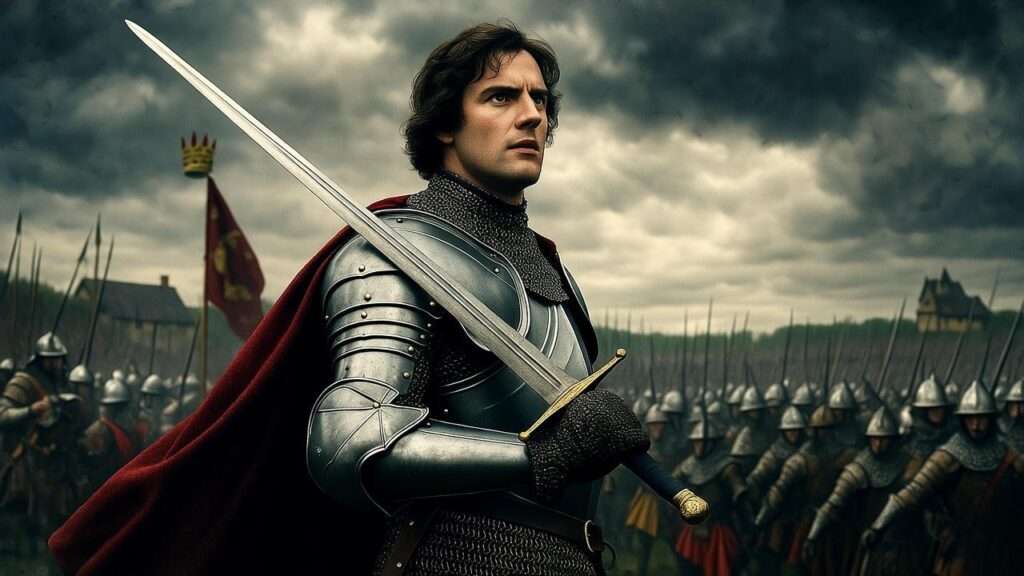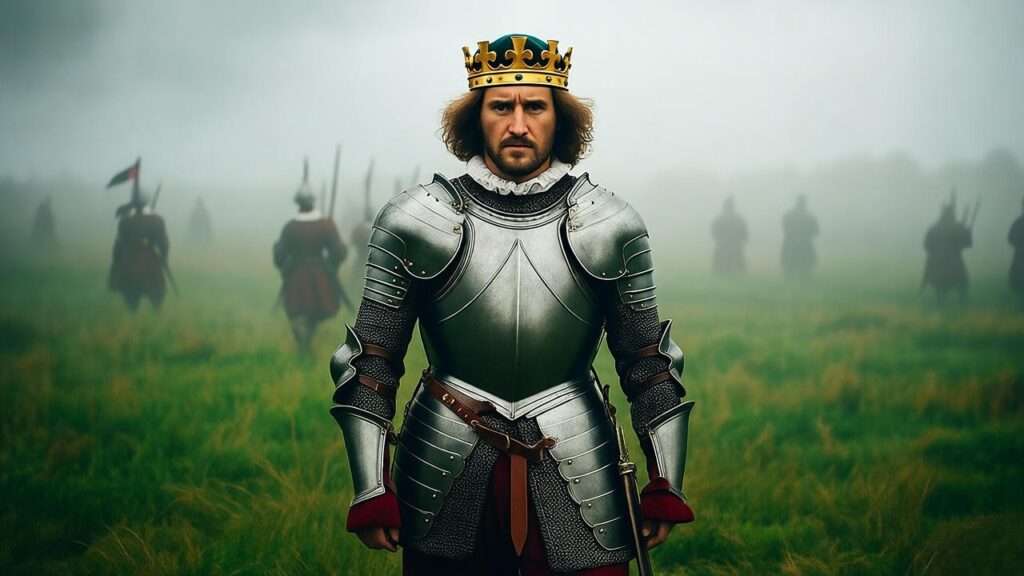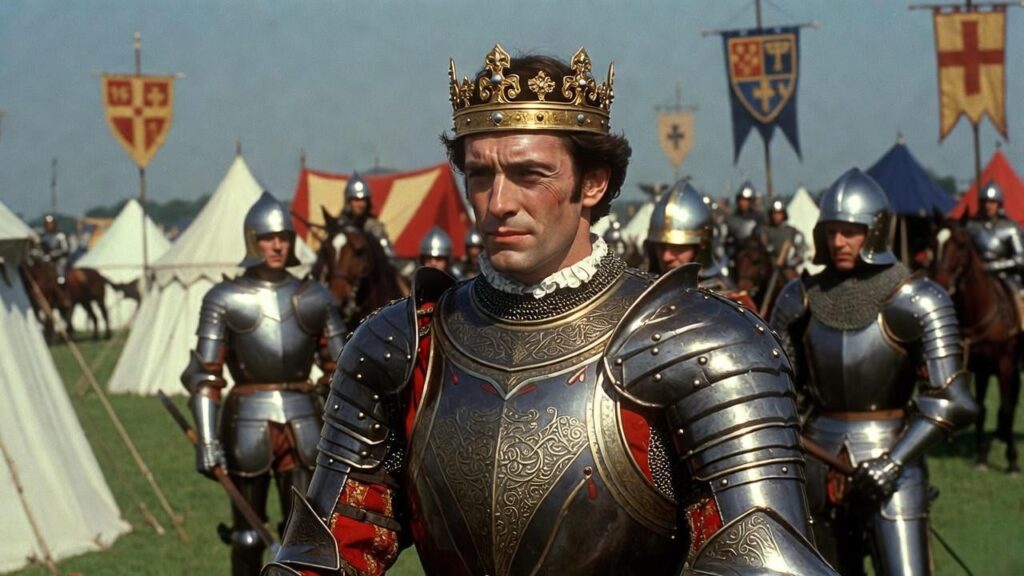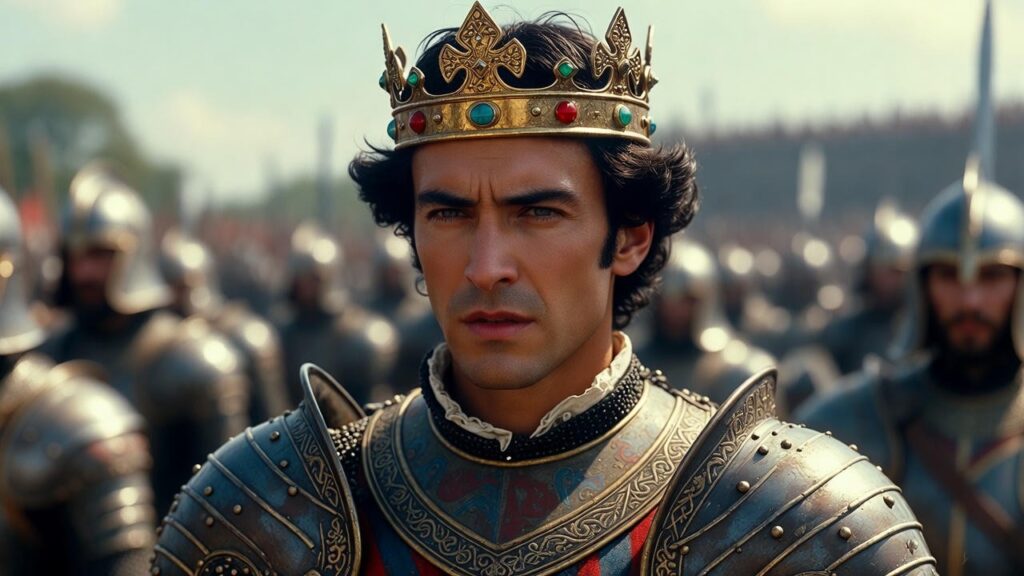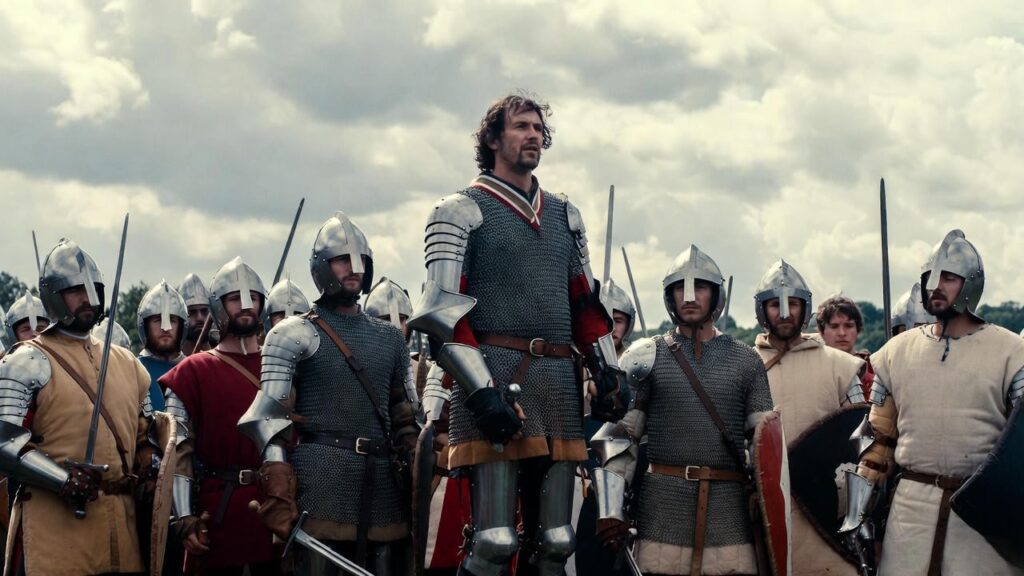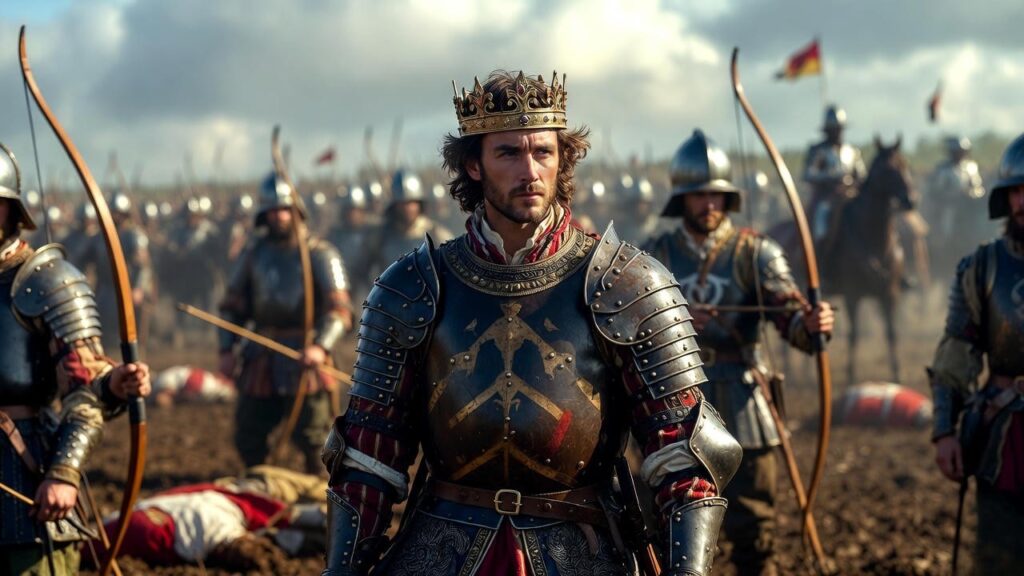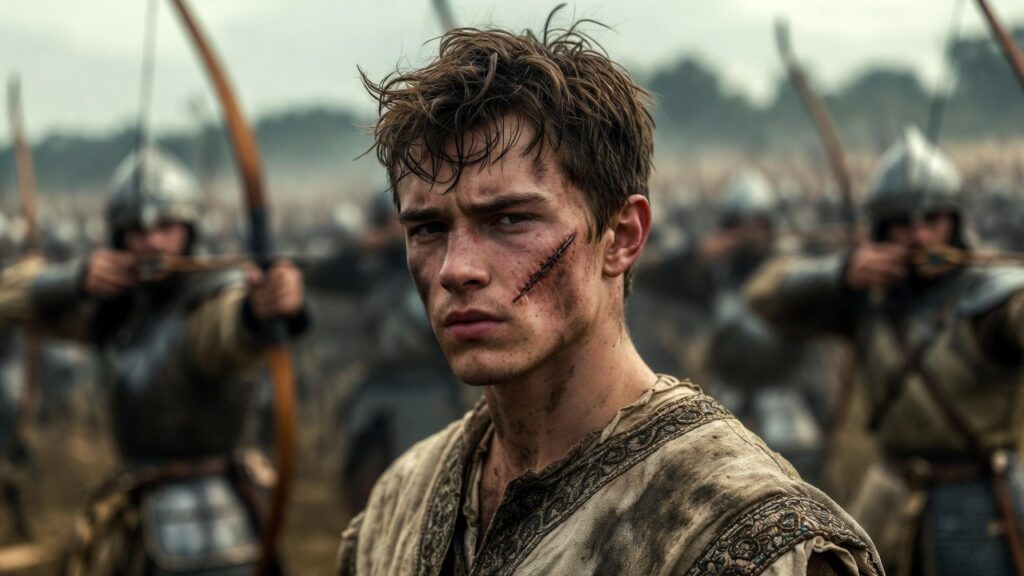
Imagine a 16-year-old prince, charging into the chaos of battle, only to have an arrow plunge deep into his face—burying six inches into his skull, narrowly missing his brain. He refuses to leave the field, fighting on despite the agony, earning a permanent facial scar as a “mark of manhood.” This isn’t fiction; it’s the true story of Prince Hal, the future King Henry V of England, wounded at the Battle of Shrewsbury in 1403. Yet when William Shakespeare immortalized this warrior-king in his renowned Henriad plays—Henry IV, Part 1, Henry IV, Part 2, and especially Henry V—the dramatic, life-altering scar is conspicuously absent. Why did the Bard downplay or omit this vivid historical detail in his portrayal of the “mirror of all Christian kings”? And what does its “disappearance” reveal about Shakespeare’s artistry, Renaissance ideals of heroism, and the enduring legend of Henry V?
In this in-depth exploration, we’ll uncover the grisly reality of the wound, the ingenious medieval surgery that saved the prince, the reasons Shakespeare chose to idealize his hero, and how modern adaptations sometimes subtly nod to the scar. Whether you’re a Shakespeare enthusiast puzzled by the historical discrepancies, a history buff fascinated by medieval battlefield medicine, or simply curious about the real man behind the myth, this article delivers the comprehensive answers you’ve been seeking—drawing on primary sources like surgeon John Bradmore’s Philomena manuscript, contemporary chronicles, and modern scholarship.
The Historical Reality – Prince Hal’s Near-Fatal Wound at Shrewsbury
The Battle of Shrewsbury on July 21, 1403, was a brutal civil conflict that tested the fragile rule of King Henry IV, who had seized the throne from Richard II in 1399. Rebel forces led by Henry “Hotspur” Percy challenged the king’s authority, and English longbowmen—famously on both sides—turned the field into a storm of arrows.
Prince Henry (Hal), just 16, commanded the royal rear division with remarkable courage. Amid the chaos, an arrow struck him in the face, entering beside his nose (likely the right side, based on interpretations of Bradmore’s account where “left side” refers to the surgeon’s perspective facing the patient). The bodkin-point arrowhead embedded approximately six inches deep into his skull, narrowly avoiding the brain stem and major arteries. Initial attempts to remove it failed—the shaft broke off, leaving the barbed head lodged in bone.
Remarkably, the young prince refused to retreat. Chronicles describe him continuing to fight, embodying the medieval ideal of princely valor. Transported to Kenilworth Castle after the Lancastrian victory, his life hung in the balance from infection and trauma.
The Battle of Shrewsbury (1403): Context and Chaos
This wasn’t just another skirmish; it was the decisive clash that secured Henry IV’s hold on the throne. Hotspur’s rebellion stemmed from grievances over unpaid debts and perceived favoritism. The battle saw unprecedented English archers firing at each other, causing massive casualties. Prince Hal’s leadership here foreshadowed his later triumphs at Agincourt.
The Arrow Strike – A Wound That Should Have Killed Him
The wound was catastrophic: deep, angled, and prone to fatal infection in an era before antibiotics. Yet Hal’s resilience—refusing to abandon his men—turned personal peril into a symbol of emerging manhood. Contemporary accounts, though often understated (one chronicler called it merely “hurt in the face”), highlight the severity.
John Bradmore’s Groundbreaking Surgery
Enter John Bradmore, a London surgeon, metalworker, and royal physician. Called when other experts failed, Bradmore documented his treatment in his Latin treatise Philomena (c. 1403–1412), a pioneering surgical text.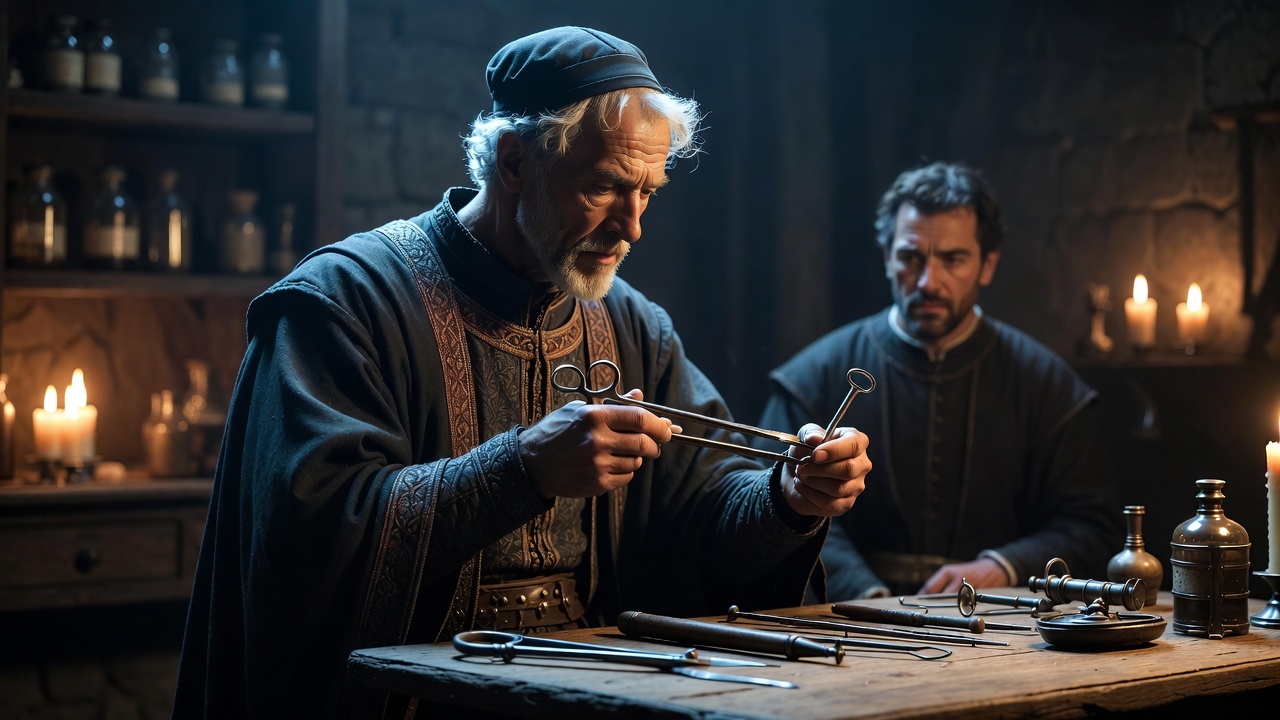
Bradmore’s method was revolutionary:
- He first probed the wound with elder pith wrapped in linen soaked in rose honey (a natural antiseptic).
- Over days, he gradually dilated (widened) the tract to prevent closure and allow access.
- He designed custom tongs—hollow, arrow-width, with a central screw mechanism—to grip and extract the arrowhead slowly, “wiggling it to and fro, little by little (with the aid of God).”
- The wound was flushed daily with white wine (antiseptic) and cleansed with ointments for about 20 days until it healed.
Bradmore’s success saved the prince and earned him a royal pension. The only remnant: a permanent facial scar, a testament to Hal’s survival and grit.
Shakespeare’s Portrayal – Why the Scar “Disappears“
When we turn from the gritty historical record to William Shakespeare‘s dramatic treatment of Prince Hal / King Henry V, one of the most striking absences is the facial scar itself. Shakespeare, who drew heavily on Raphael Holinshed’s Chronicles of England, Scotland, and Ireland (1587), knew the wound existed. Holinshed explicitly mentions that the young prince was “hurt in the face with an arrow” at Shrewsbury. Yet the playwright chooses to minimize, generalize, or entirely omit any detailed reference to a disfiguring mark on the future king’s face.
This is no accident. Shakespeare’s handling of the wound reflects deliberate artistic choices that serve both dramatic structure and Renaissance ideals of kingship.
The Wound in Henry IV, Part 1 – A Mere “Scratch”
In Henry IV, Part 1, Act 5, Scene 4, after the battle of Shrewsbury, Prince Hal speaks with his father, King Henry IV. The king notices blood on his son’s face and asks:
“How fares my lord the Prince?”
Hal replies casually:
“I do beseech your Majesty, may salve The long-grown wounds of my intemperance With my reformed life…”
Later, when Falstaff boasts of his own (fictitious) wounds, Hal dryly remarks that he himself was “hurt” but dismisses it as trivial. The text never describes the wound’s location, severity, or lasting mark. Shakespeare reduces a potentially career-ending injury to a passing reference—almost a badge of youthful bravado rather than a permanent alteration.
This narrative choice serves several purposes:
- It reinforces Hal’s transformation arc from wayward prince to responsible heir.
- It avoids any suggestion of physical imperfection in the character who will become the idealized hero of the next play.
Absence in Henry V – Idealized Heroism
By the time we reach Henry V (1599), the scar has vanished completely from the text. The play contains no mention of a facial disfigurement. Even in the famous wooing scene with Princess Katherine (Act 5, Scene 2), Henry apologizes for his “warlike” appearance and rough manners, saying:
“I know not how to court in fashionable terms… But, before God, Kate, I cannot look greenly, nor gasp out my eloquence…”
Some scholars interpret this as a possible oblique nod to a battle-hardened, perhaps scarred face. However, the overwhelming impression is of a handsome, charismatic, rhetorically masterful king—precisely the opposite of a man bearing a prominent, lifelong facial scar.
The most famous reference to wounds in the entire play occurs during the St. Crispin’s Day speech (Act 4, Scene 3):
“He that sheds blood with me Shall be my brother; be he ne’er so vile, This day shall gentle his condition; And gentlemen in England now abed Shall think themselves accursed they were not here, And hold their manhoods cheap whiles any speaks That fought with us upon Saint Crispin’s day.”
Here, wounds are collective, honorable, and ennobling—but never individualized or disfiguring. Shakespeare transforms the idea of injury into a source of brotherhood and glory, not a visible reminder of vulnerability.
Artistic and Dramatic Reasons for Omission
Why did Shakespeare make this choice? Several interlocking explanations emerge from literary scholarship and historical context:
- Renaissance ideals of heroic beauty In the Elizabethan imagination, the ideal king was physically impressive. Facial disfigurement, especially on the most visible part of the body, could evoke associations with villainy (think of Richard III’s hunchback and withered arm, deliberately exaggerated by Shakespeare to mark moral deformity). A scarred Henry V would risk undercutting the play’s project of presenting him as the perfect Christian prince and national hero.
- Thematic focus on internal transformation The Henriad tetralogy is ultimately about spiritual and moral growth. The scar is external, physical, and permanent. By downplaying it, Shakespeare keeps the emphasis on Hal’s inner journey—from tavern roisterer to pious, unifying king.
- Dramatic economy and stage practicality In an open-air theater with limited makeup and lighting, portraying a convincing lifelong facial scar would have been difficult. More importantly, it would distract from the language and rhetoric that are the true glory of the play.
- Political and national myth-making Written during the late years of Elizabeth I’s reign, Henry V served as patriotic propaganda. The unblemished, eloquent warrior-king suited the needs of a nation anxious about succession and invasion threats far better than a realistically scarred medieval monarch.
Visual Evidence – Portraits, Effigies, and Modern Depictions
One of the most compelling pieces of evidence supporting the existence—and subsequent cultural erasure—of Henry V‘s facial scar lies in the visual record. Medieval and early modern portraiture, tomb effigies, and later artistic interpretations reveal a fascinating pattern: the king’s face is almost always presented in strict profile, and usually from the left side.
Contemporary Portraits and the “Hidden” Side
Very few authentic contemporary portraits of Henry V survive, but those that do are telling. The most authoritative image is the profile portrait in the Royal Collection (c. 1500–1520, based on an earlier original), which shows the king in strict left profile. Art historians have long noted that this consistent choice of angle may have been deliberate: if the arrow entered beside the right side of the nose (as many interpretations of Bradmore’s description suggest), the right side of the face would bear the most visible scarring. By depicting Henry exclusively from the left, artists could present an unblemished royal visage while technically remaining accurate.
The famous “Agincourt portrait” (National Portrait Gallery, London) follows the same pattern. Even when full-face images appear in later centuries, they tend to be idealized reconstructions rather than faithful reproductions of any surviving likeness.
The Tomb Effigy at Westminster Abbey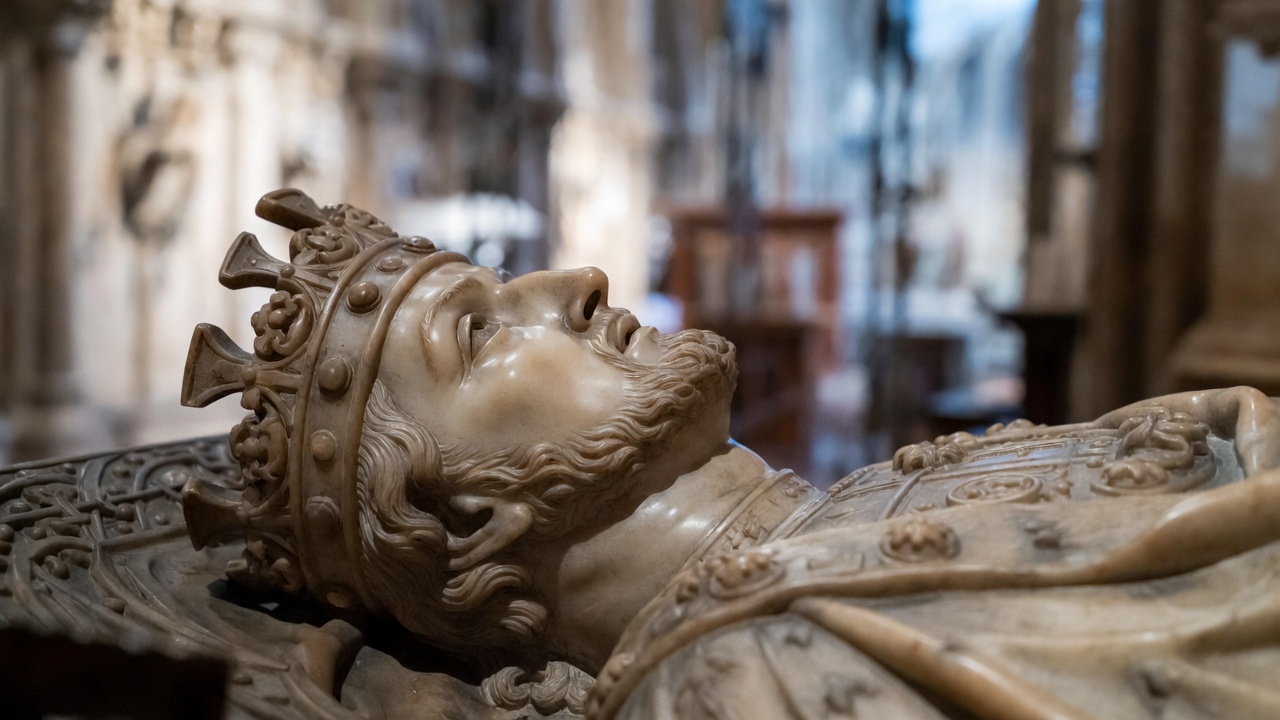
Henry V’s tomb in the chantry chapel at Westminster Abbey provides another layer of evidence. The original wooden effigy (c. 1422–1430) was heavily damaged over the centuries, but surviving fragments and 19th-century restorations show a face that was likely intended to be smooth and regal. Interestingly, the hands of the current effigy were recast in the 1970s using Laurence Olivier’s hands as a model—another example of how Shakespeare’s theatrical image has retroactively shaped historical representation.
The absence of any visible scar on the effigy has been explained in two main ways:
- Medieval tomb sculpture routinely idealized monarchs, emphasizing divine right and kingly perfection over physical realism.
- The original face may have been painted or gilded in such a way that subtle scarring was not emphasized.
Adaptations – From Olivier to Chalamet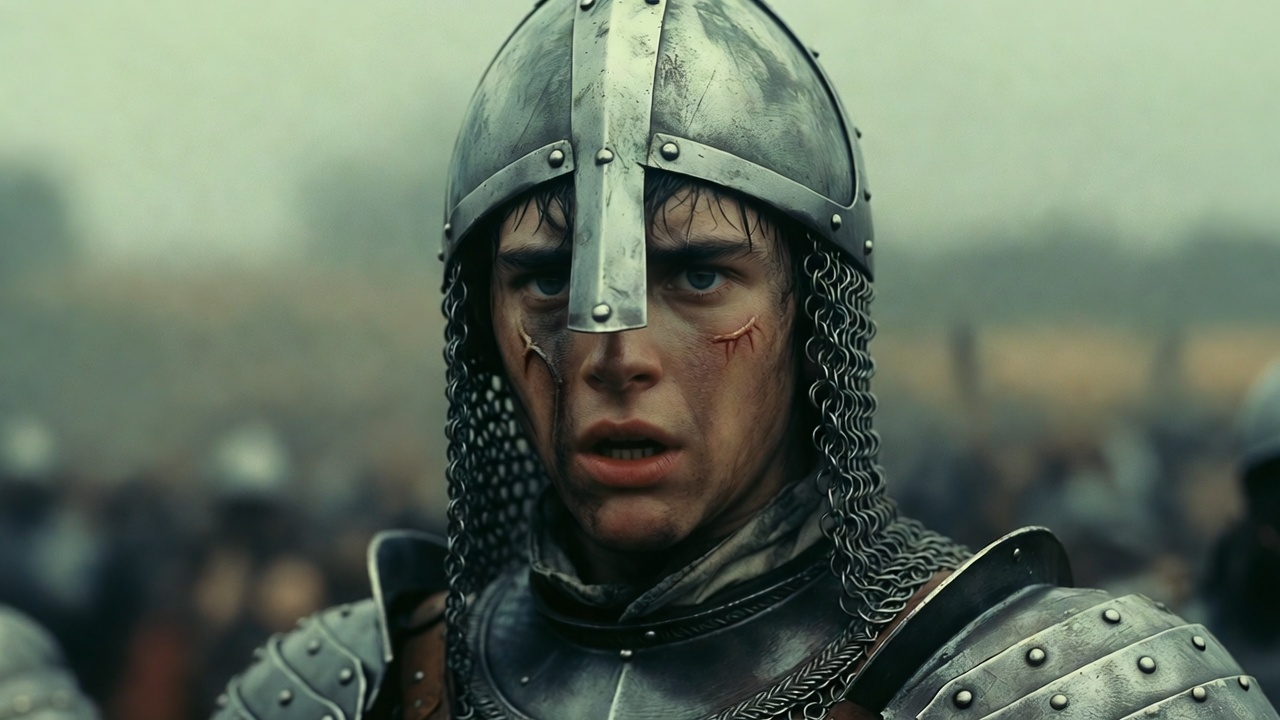
Theatrical and cinematic adaptations have overwhelmingly followed Shakespeare’s lead in presenting an unscarred Henry.
- Laurence Olivier (1944): The Technicolor film is unabashed propaganda. Olivier’s Henry is youthful, handsome, and completely unmarked—his face glowing with heroic perfection.
- Kenneth Branagh (1989): Branagh’s grittier, more realistic take still avoids any facial disfigurement. The focus remains on psychological intensity rather than physical imperfection.
- Netflix’s The King (2019): Directed by David Michôd and starring Timothée Chalamet, this adaptation makes the most explicit visual reference to the historical wound. Chalamet’s Henry bears a subtle, wishbone-shaped scar across his right cheek—a clear nod to the Shrewsbury injury. This choice marks a rare moment when modern filmmakers chose historical fidelity over Shakespearean idealization, and it significantly alters the viewer’s perception of the young king’s vulnerability.
These visual choices illustrate how powerfully Shakespeare’s text has shaped four centuries of cultural imagination. The “disappearing scar” has become almost as iconic as the wound itself.
(Suggested images for this section – if your blog platform supports them:)
- Left-profile portrait of Henry V (Royal Collection Trust)
- Westminster Abbey tomb effigy close-up
- Still from The King (2019) showing Chalamet’s facial scar
- Side-by-side comparison of Olivier, Branagh, and Chalamet as Henry
What the Scar Teaches Us About Henry V and Shakespeare
The Henry V scar is more than a historical footnote; it serves as a powerful lens through which to understand both the real medieval king and Shakespeare’s dramatic genius.
The Real King’s Humanity and Legacy
For the historical Henry V, the wound was transformative. Surviving such an injury at sixteen likely deepened his already intense piety (he became known for daily devotions and patronage of religious houses). It may also have sharpened his resolve and tactical brilliance—qualities that reached their zenith at Agincourt in 1415. The scar was a constant, physical reminder of mortality in an age when kings were expected to embody divine invincibility.
Shakespeare’s Genius in Shaping History
Shakespeare understood that history on stage must serve drama, not documentary accuracy. By erasing or minimizing the scar, he created a Henry who could function as a unifying national symbol during a time of uncertainty. The result is a character who inspires awe rather than pity—a king whose “wounds” are metaphorical and shared, not literal and solitary.
This artistic decision also reflects a broader Renaissance tendency to sanitize the medieval past, transforming flawed, scarred human beings into polished icons of virtue.
The Enduring Mystery of the Henry V Scar
The Henry V scar represents one of the most intriguing silences in Shakespearean drama. A wound that should have killed a prince, a surgical miracle that saved him, and a permanent mark of courage—all vanished from the greatest dramatic portrait of a warrior-king ever written.
Yet its absence is as meaningful as its presence might have been. It reminds us that Shakespeare’s Henry V is not a biography but a myth—a deliberate construction of heroism designed to inspire, unite, and endure.
The next time you read or watch Henry V, notice the absence. Imagine the shadow of that arrow scar across the king’s cheek. It humanizes the legend without diminishing its power. And it proves once again that sometimes the most powerful stories are told not through what is shown, but through what is carefully, artfully, left out.
FAQs
Did Henry V really have a facial scar? Yes. Primary sources, including surgeon John Bradmore’s own account in Philomena, confirm that Prince Hal was struck by an arrow beside the nose at Shrewsbury in 1403, leaving a permanent scar after a remarkable surgical extraction.
How did surgeons treat the wound in 1403? Bradmore used honey-soaked probes to dilate the wound, custom-designed tongs to extract the arrowhead, and daily irrigations with white wine. The treatment lasted approximately 20 days and is considered one of the greatest successes of medieval maxillofacial surgery.
Why don’t most Henry V adaptations show the scar? Most productions follow Shakespeare’s idealized portrayal, which prioritizes heroic perfection over historical realism. The 2019 film The King is a notable exception, giving Timothée Chalamet’s Henry a visible cheek scar.
Is Shakespeare’s Henry V historically accurate? Partially. Shakespeare drew on Holinshed and other chronicles, but he freely adapted, invented, and idealized events and character traits to suit dramatic and patriotic purposes. The omission of the facial scar is one of the clearest examples of artistic license.