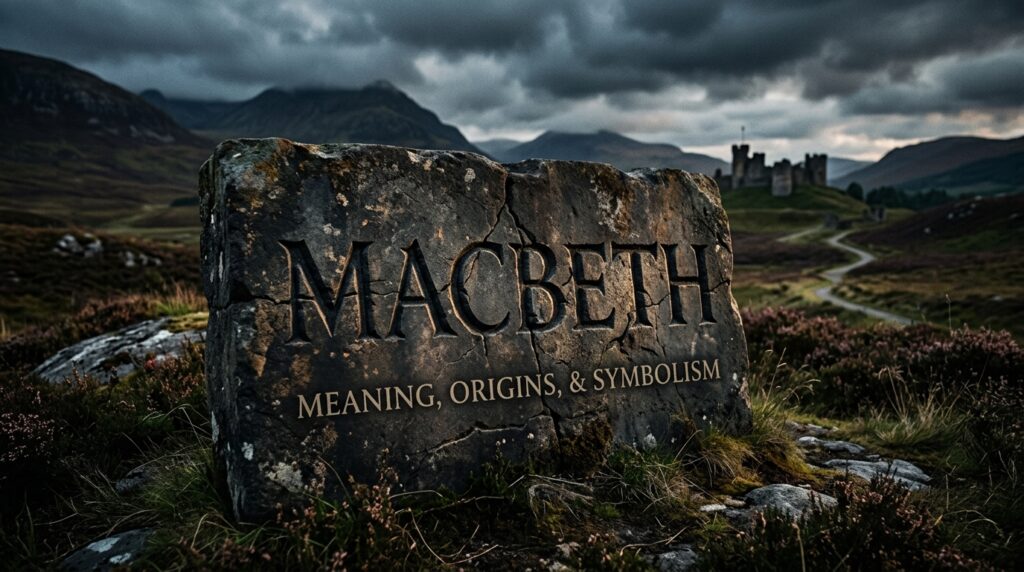
Three simple words can carry centuries of royal intrigue, psychological horror, and theatrical superstition. Yet, when analyzing Shakespeare’s shortest tragedy, readers and theatergoers consistently return to a foundational question: why does the Macbeth title hold such an undeniable, almost hypnotic grip over Western literature? On the surface, naming a play after its central figure seems like a straightforward choices—a standard literary convention of the Jacobean era. Beneath that minimalist surface, however, lies a complex tapestry of Gaelic etymology, high-stakes political maneuvering, demonic obsession, and structural irony.
Understanding the full depth of the Macbeth title isn’t just an academic exercise for scholars and students. It is the key that unlocks the entire play’s thematic architecture. By examining the name’s history, its royal motivations, its psychological weight, and the terrifying curse that followed it into the modern theater, we reveal how a single name transforms from a royal designation into a symbol of absolute moral decay.
Quick Summary & Key Takeaways
-
Etymological Irony: The Gaelic root Mac Bethad translates to “Son of Life,” creating a sharp, tragic contrast with a character who brings death to Scotland.
-
Political Maneuvering: Written shortly after the 1603 Union of the Crowns and the 1605 Gunpowder Plot, the title was explicitly crafted to flatter King James I (formerly James VI of Scotland).
-
The “Borrowed Robes” Motif: Macbeth’s identity is continually defined, warped, and destroyed by the progression of titles he acquires: Thane of Glamis, Thane of Cawdor, and King.
-
Theatrical Superstition: Centuries of stage mishaps transformed the title into a taboo phrase within the theater, giving rise to the famous euphemism “The Scottish Play.”
1. The Etymology & Historical Context of the Macbeth Title
To understand what Shakespeare was attempting to achieve, one must first dismantle the name itself. The modern name “Macbeth” is an anglicization of the medieval Gaelic name Mac Bethad mac Findlaích, who ruled as King of the Scots from 1040 until his death in 1057.
Gaelic Root: Mac Bethad
├── "Mac" = Son
└── "Bethad" = Life
    └── Literal Meaning: "Son of Life" (Or "Man of Faith")
Who Was the Real Mac Bethad mac Findlaích?
Unlike the paranoid, childless tyrant depicted in Shakespeare’s tragedy, the historical Mac Bethad was widely considered an efficient, equitable, and successful monarch. Medieval chronicles, such as the Berchan’s Prophecy, describe him as a “generous king” whose 17-year reign was marked by relative stability, agricultural prosperity, and lawfulness. He was even secure enough in his crown to make a lengthy pilgrimage to Rome in 1050, distributing alms generously to the poor.
Shakespeare did not draw his material directly from Scottish state archives, however. He relied almost entirely on Raphael Holinshed’s 1587 Chronicles of England, Scotland, and Ireland. Holinshed himself had relied on earlier, biased Scottish accounts designed to legitimize the ruling dynasty that eventually replaced Macbeth’s line. Consequently, the historical “Son of Life” was rewritten into a cautionary archetype of treacherous ambition.
Why Shakespeare Left the Title Unadorned
In the First Folio of 1623, the play is officially listed as The Tragedie of Macbeth. Compared to the sprawling, descriptive titles common to Renaissance theater—such as The Most Excellent and Lamentable Tragedy of Romeo and Juliet or The Famous History of the Life of King Henry the Eight—the decision to keep the title focused singularly on one name is structurally significant.
+-------------------------------------------------------+--------------------------------------------------------+
| Descriptive Jacobean Title                            | The Direct "Macbeth" Title                             |
+-------------------------------------------------------+--------------------------------------------------------+
| Signals broad social context and romantic subplots    | Isolates the protagonist in absolute psychological space|
| Frames story around external historical events        | Forces audience to focus entirely on internal decay    |
| Softens the narrative focus through multi-character billing| Creates a singular pressure-cooker of tragic fate       |
+-------------------------------------------------------+--------------------------------------------------------+
By stripping away subtitles, geographical qualifiers, or romantic framing, Shakespeare isolates his protagonist. The title acts as a singular focus, forcing the audience into the narrowing, claustrophobic mind of a man devouring his own soul.
2. Royal Patronage: How King James I Shaped the Title
No analysis of the play’s name is complete without placing it in the political pressure-cooker of 1606 London. Queen Elizabeth I had died in 1603 without an heir, ending the Tudor dynasty. The English crown passed to her cousin, King James VI of Scotland, who assumed the English throne as King James I. Shakespeare’s acting troupe, formerly known as The Lord Chamberlain’s Men, was swiftly granted royal patronage, becoming The King’s Men.
Shakespeare was not merely writing art; he was writing for his ultimate patron. The Macbeth title was a masterclass in Jacobean political PR.
1603: James VI of Scotland becomes James I of England (Union of Crowns)
  │
  ├── 1603: Shakespeare's troupe rebranded as "The King's Men"
  │
  ├── 1605: The Gunpowder Plot (Failed Catholic assassination attempt on James I)
  │
  └── 1606: Shakespeare writes "Macbeth" (Scottish theme + Witchcraft + Regicide defeated)
The Scottish Connection to the English Throne
By setting his new tragedy in Scotland, Shakespeare directly honored James’s heritage. But the connection ran deeper than geography:
-
The Banquo Lineage: James I claimed direct descent from Banquo, Thane of Lochaber. In Holinshed’s original history, Banquo was actually Macbeth’s accomplice in the murder of King Duncan. Shakespeare fundamentally altered history, transforming Banquo into an innocent, noble martyr whose descendants would rule forever—a direct nod to the Stuart line.
-
The Mirror Scene: In Act 4, Scene 1, the Witches show Macbeth a vision of eight kings, the last holding a glass (mirror) showing even more kings stretching into infinity. In 1606, King James I was sitting in the audience; the mirror was literally angled to reflect his face, positioning James as the ultimate fulfillment of divine prophecy.
Demonology and the Supernatural Weight of the Name
King James was obsessed with the occult. In 1597, he had authored Daemonologie, a philosophical treatise defending the reality of witchcraft and outlining how witches should be prosecuted. He had personally presided over the North Berwick Witch Trials in 1590, convinced that a coven had conjured a tempest to sink his bride’s ship.
When Londoners saw a play whose title summoned Scottish lore, regicide, and dark forces, they were stepping into a narrative tailormade for their new monarch’s deepest anxieties. Coming directly on the heels of the 1605 Gunpowder Plot—a horrific attempt by Guy Fawkes and conspirators to blow up Parliament and assassinate the King—a play centered on the doom of a regicidal usurper served as a stark political warning: treason against the Crown leads directly to damnation.
3. Literary & Thematic Symbolism Within the Title
Within the text of the play, the concept of a “title” is not merely a label—it is a central motif that charts the moral and psychological degradation of the protagonist. Titles in Macbeth are treated like physical garments: worn, stolen, unearned, and ultimately suffocating.
Ambition, Titles, and Identity Theft
The narrative engine of the play is fueled by a sequence of three titles conferred upon Macbeth, each marking a step deeper into his self-constructed hell:
[ Thane of Glamis ] ──(Prophecy Fulfilled)──> [ Thane of Cawdor ] ──(Regicide)──> [ King of Scotland ]
     (Inherited)                                   (Bestowed)                            (Usurped)
-
Thane of Glamis: Macbeth’s inherited, rightful title. It represents his original state of noble service, bravery, and social integration.
-
Thane of Cawdor: A conferred title given by King Duncan after the previous Thane committed treason. The title carries an implicit structural curse: to become Cawdor is to step into the shoes of a traitor. Macbeth immediately reflects on this: “The Thane of Cawdor lives: why do you dress me / In borrow’d robes?” (Act 1, Scene 3).
-
King of Scotland: The ultimate usurped title. Rather than bringing honor, the title of King strips Macbeth of his sleep, his sanity, his wife, and his humanity.
This “borrowed robes” imagery reaches its climax in Act 5, Scene 2, when Angus observes:
“Now does he feel his title / Hang loose about him, like a giant’s robe / Upon a dwarfish thief.”
+----------------------------------+-----------------------------------------------------------------+
| Stage of the Trajectory          | Psychological & Moral State                                      |
+----------------------------------+-----------------------------------------------------------------+
| Thane of Glamis                  | Honorable warrior; anchored in community and clear conscience.   |
| Thane of Cawdor                  | Divided mind; tempted by ambition, trying on "borrowed robes."  |
| King of Scotland                 | Isolated tyrant; drowning in blood, the title completely ill-fitting.|
+----------------------------------+-----------------------------------------------------------------+
Irony in the Name “Son of Life”
The contrast between the literal Gaelic translation of Mac Bethad (“Son of Life”) and the protagonist’s actions is one of the most powerful structural ironies in Western drama.
Macbeth does not produce or nurture life; he systematically destroys it. He murders Duncan (a king who was a father figure), orders the execution of Banquo (and attempts to kill his son Fleance), and slaughters Lady Macduff and her entire household of innocent children. By the end of the play, the “Son of Life” has transformed Scotland into a land of death, where “sighs and groans and shrieks that rend the air / Are made, not mark’d” (Act 4, Scene 3).
4. The Curse of the Title: “The Scottish Play” Superstition
In the world of professional theater, merely pronouncing the word “Macbeth” inside a venue—unless rehearsing or performing the actual play—is considered a major jinx. Actors, directors, and crew members will go to extraordinary lengths to avoid saying the Macbeth title, referring to it instead through euphemisms like “The Scottish Play,” “The Bard’s Play,” or “That Play.”
In-Theater Mention of "Macbeth" ──> Invokes the Stage Curse ──> Requires Cleansing Ritual
                                                                    │
                                                                    ├── 1. Exit the theater
                                                                    ├── 2. Spin around 3 times
                                                                    ├── 3. Spit over left shoulder
                                                                    └── 4. Curse/Quote Shakespeare
Why Actors Refuse to Speak the Title
The origin of the curse is a mix of theatrical folklore, historical accidents, and genuine production hazards:
-
The Incantation Myth: Legend holds that Shakespeare used actual black magic incantations when writing the Witches’ spells (“Double, double toil and trouble…”). According to theater lore, a genuine coven of witches cursed the production for exposing their ritual secrets to the public.
-
The First Performance Mishap (1606): According to legend, the young boy actor playing Lady Macbeth, Hal Berridge, suddenly fell ill with a fever and died backstage right before the premiere, forcing Shakespeare himself to step into the role.
-
Real Structural Hazards: The play contains more broadsword fights, low-light stage settings, combat choreography, and theatrical pyrotechnics (such as early gunpowder cauldrons) than almost any other Jacobean drama. Statistically, more actors were injured during runs of this play simply because of its demanding staging.
-
Financial Ruin: Because Macbeth was historically a guaranteed box-office hit, struggling theater companies would stage it as a last-ditch effort to stave off bankruptcy. Consequently, the play became associated with bankrupt companies closing down shortly after the run.
Famous Historical Disasters Associated with the Play
+----------------------------------+-----------------------------------------------------------------+
| Event / Year                     | Details of the Incident                                         |
+----------------------------------+-----------------------------------------------------------------+
| The Astor Place Riot (1849)      | A rivalry between American actor Edwin Forrest and British actor|
|                                  | William Charles Macready playing Macbeth turned into a riot in  |
|                                  | New York City, leaving over 20 people dead and 100 injured.     |
+----------------------------------+-----------------------------------------------------------------+
| The Amsterdam Staging (1672)     | An actor playing Macbeth replaced the prop dagger with a real    |
|                                  | knife, accidentally murdering the actor playing Duncan onstage.  |
+----------------------------------+-----------------------------------------------------------------+
| Charlton Heston Incident (1953)  | While playing Macbeth in Bermuda, Heston suffered severe burns  |
|                                  | when his tights were mysteriously soaked in kerosene instead of |
|                                  | non-flammable mineral oil during a horse-mounted scene.         |
+----------------------------------+-----------------------------------------------------------------+
How to Reverse the Curse: The Traditional Theater Rituals
If an actor accidentally utters the forbidden word inside a theater, tradition demands an immediate, precise counter-ritual to cleanse the space:
-
Exit the building immediately and step entirely outside the theater doors.
-
Spin around in place three times (clockwise) to disrupt the bad fortune.
-
Spit over your left shoulder (to blind the devil or bad luck).
-
Utter a profanity or recite a line from a lighter Shakespeare play (popular choices include “Fair thoughts and happy hours attend on you” from The Merchant of Venice or lines from A Midsummer Night’s Dream).
-
Knock on the door and humbly ask for permission to re-enter the theater.
5. Comparative Analysis: Macbeth vs. Other Shakespearean Titles
Shakespeare’s titling strategy across his major tragedies reveals a clear, intentional pattern. By comparing Macbeth to his other masterpieces, we see how the choice of a single name establishes unique structural expectations.
Shakespearean Tragic Title Architectures
│
├── Single-Name Titles (Internal Psychological Collapse)
│   ├── Macbeth
│   ├── Hamlet
│   └── Othello
│
├── Dual-Name Titles (Relational/Fate-Bound Collapses)
│   ├── Romeo and Juliet
│   └── Antony and Cleopatra
│
└── Title-plus-Status (Political & Systemic Collapses)
    ├── King Lear
    └── Richard III
Single-Name Tragedies (Macbeth, Hamlet, Othello)
When Shakespeare titles a play with a single proper noun, the narrative is almost entirely internal. The play becomes a deep-dive into that individual’s specific psychological flaw:
-
Hamlet: Explores the paralysis of over-analysis and moral hesitation.
-
Othello: Explores the vulnerability of jealousy and misplaced trust.
-
Macbeth: Explores the ruinous velocity of unchecked ambition.
In these plays, the central character isn’t just the protagonist; they are the environment. The entire world of the play distorts around their specific mental state.
Dual-Name Tragedies (Romeo and Juliet, Antony and Cleopatra)
By contrast, titles featuring two names signal that tragedy emerges from the space between two people or two opposing worlds. Romeo and Juliet are bound by fate and family conflict; Antony and Cleopatra are torn between personal passion and geopolitical empire.
Macbeth could easily have been titled Macbeth and Lady Macbeth, given how crucial their shared dynamic is in the first two acts. But by leaving her out of the title, Shakespeare signals that Lady Macbeth’s authority will eventually evaporate, leaving Macbeth completely isolated in his madness.
6. Teaching & Analyzing the Macbeth Title (Student & Educator Resource)
For literature teachers, high school students, and university scholars, studying the title provides an excellent entry point for essay prompts, classroom debates, and analytical research papers.
Key Essay Prompts for Students
+-------------------------------------------------------+--------------------------------------------------------+
| Essay Prompt Theme                                    | Core Focus & Thesis Direction                          |
+-------------------------------------------------------+--------------------------------------------------------+
| 1. The Trajectory of Titles                           | Analyze how Macbeth’s identity transforms as he moves  |
|                                                       | from Glamis to Cawdor to King. Focus on "borrowed robes."|
+-------------------------------------------------------+--------------------------------------------------------+
| 2. Etymological Irony                                 | Contrast the Gaelic meaning of Mac Bethad ("Son of     |
|                                                       | Life") with the theme of sterile, childless tyranny.   |
+-------------------------------------------------------+--------------------------------------------------------+
| 3. Jacobean Political Context                         | Evaluate how Shakespeare tailored the title and theme  |
|                                                       | specifically for King James I following the 1605 plot. |
+-------------------------------------------------------+--------------------------------------------------------+
Discussion Questions for Book Clubs & Classrooms
-
Why do you think Lady Macbeth’s name is omitted from the play’s official title, even though she is the driving force behind the initial murder?
-
How does the superstition surrounding the title “The Scottish Play” alter how modern actors approach performing it today?
-
If Shakespeare were writing this play for a modern audience rather than King James I, how might the title or historical framing change?
Frequently Asked Questions (FAQ)
Why is it called “The Scottish Play” instead of Macbeth?
Actors and theater professionals call it “The Scottish Play” out of a long-standing superstition that speaking the name Macbeth inside a theater brings bad luck, accidents, or financial ruin to the production.
What does the title Macbeth mean in Gaelic?
The name derives from the Gaelic Mac Bethad, which literally translates to “Son of Life” or “Man of Faith.”
Is Macbeth based on a real historical person?
Yes. Mac Bethad mac Findlaích was the King of Scots from 1040 to 1057. However, the real historical figure was generally considered a stable and successful ruler, unlike the murderous tyrant portrayed in Shakespeare’s tragedy.
What are Macbeth’s three titles in the play?
Macbeth holds three distinct titles throughout the course of the tragedy: Thane of Glamis (his inherited title), Thane of Cawdor (bestowed by King Duncan), and King of Scotland (usurped through regicide).
The Macbeth title is far more than an arbitrary label attached to a 17th-century script. It is a dense, brilliantly calculated nexus where history, etymology, monarchical politics, and dramatic design intersect. From the subtle irony of its Gaelic roots to the haunting legacy of its theater curse, the title mirrors the tragedy of its protagonist: a name that began in honor, became heavy with usurped power, and ultimately transformed into a word whispered with fear.
Whether you are a student writing an essay, an actor honoring centuries-old stage traditions, or a lover of literature, recognizing the power behind this single name deepens your connection to Shakespeare’s most terrifying exploration of human ambition.