Have you ever cracked open Romeo and Juliet, buzzing with excitement for the world’s most famous love story, only to stumble over phrases like “wherefore art thou” or “parting is such sweet sorrow,” feeling completely lost in Shakespeare’s 400-year-old language? If so, you’re far from alone—millions of students, teachers, and literature lovers face this exact barrier every year, turning what should be an exhilarating read into a frustrating chore.
That’s where No Fear Shakespeare Romeo and Juliet comes in. This invaluable resource from SparkNotes provides the complete original text of William Shakespeare’s timeless tragedy side-by-side with a clear, line-by-line modern English translation. It demystifies the Elizabethan language without stripping away the poetry, puns, or emotional depth, allowing you to fully appreciate the play’s beauty while understanding every word.
In this comprehensive guide, we’ll explore the No Fear Shakespeare edition in depth. As a long-time Shakespeare scholar and educator with over two decades of teaching the Bard’s works to high school and college students, I’ve seen firsthand how this tool transforms reluctant readers into passionate fans. We’ll break down the play act by act with selected key passages in original and modern formats, dive into major themes, analyze characters, and offer practical study tips. Whether you’re preparing for an exam, teaching a class, or simply rediscovering the play, this resource will help you bridge the language gap and connect deeply with one of literature’s greatest masterpieces.
What Is No Fear Shakespeare? And Why It’s Essential for Romeo and Juliet
Understanding the No Fear Shakespeare Series
The No Fear Shakespeare series, published by SparkNotes, is designed to make Shakespeare’s plays accessible to modern audiences. Launched in the early 2000s, it addresses a common complaint: Shakespeare’s language, rich in Elizabethan English, idioms, metaphors, and wordplay, can be intimidating for contemporary readers.
The format is straightforward yet brilliant: the original Shakespearean text appears on the left page (or left column online), with a precise modern English paraphrase directly opposite on the right. This side-by-side presentation allows readers to follow the exact lines while instantly grasping the meaning. It’s not a loose summary—it’s a faithful translation that retains the structure, rhythm, and intent of the original.
No Fear Shakespeare covers all of Shakespeare’s major plays, but it’s particularly vital for tragedies like Romeo and Juliet, where emotional intensity and rapid plot developments demand clear comprehension.
Why Romeo and Juliet Benefits Most from No Fear
Romeo and Juliet, written around 1595, is packed with challenges for modern readers:
- Archaic vocabulary: Words like “wherefore” (meaning “why”), “thou/thee/thy” (you/your), and “hath” (has).
- Complex sentence structures: Inverted syntax and lengthy metaphors.
- Puns and wordplay: Especially in Mercutio’s witty speeches, where double meanings drive humor and character.
- Poetic devices: Sonnets, iambic pentameter, and rhyming couplets that lose impact if misunderstood.
While other translations exist (such as those from Folger Shakespeare Library or LitCharts’ Shakescleare), No Fear stands out for its literal accuracy and student-friendly clarity. In my experience teaching hundreds of students, No Fear consistently helps them transition from confusion to confidence, enabling deeper analysis rather than surface-level reading.
For advanced readers, it serves as a quick reference to confirm interpretations without consulting dense annotations.
Full Side-by-Side Translation: Act-by-Act Breakdown
Here, we’ll provide detailed summaries for each act, highlighting pivotal scenes with selected iconic passages in original text alongside modern translations (drawn faithfully from the No Fear Shakespeare style and reliable sources). These excerpts focus on the most famous and thematically rich moments to illustrate the value of the side-by-side format.
Prologue and Act 1: The Feud Ignites and Love at First Sight
The play opens with a Chorus delivering the Prologue, setting the tragic tone in sonnet form.
Prologue (Chorus)
| Original Text | Modern English Translation |
|---|---|
| Two households, both alike in dignity, In fair Verona, where we lay our scene, From ancient grudge break to new mutiny, Where civil blood makes civil hands unclean. From forth the fatal loins of these two foes A pair of star-cross’d lovers take their life; Whose misadventured piteous overthrows Do with their death bury their parents’ strife. | Two households of similar status and dignity, In beautiful Verona, where our story takes place, From an old grudge erupt into new violence, Where citizens’ blood stains citizens’ hands. From the fatal children of these two enemies A pair of star-crossed lovers take their lives; Whose unfortunate pitiful downfalls End their parents’ feud through their deaths. |
This sets up the themes of fate (“star-cross’d”) and family feud.
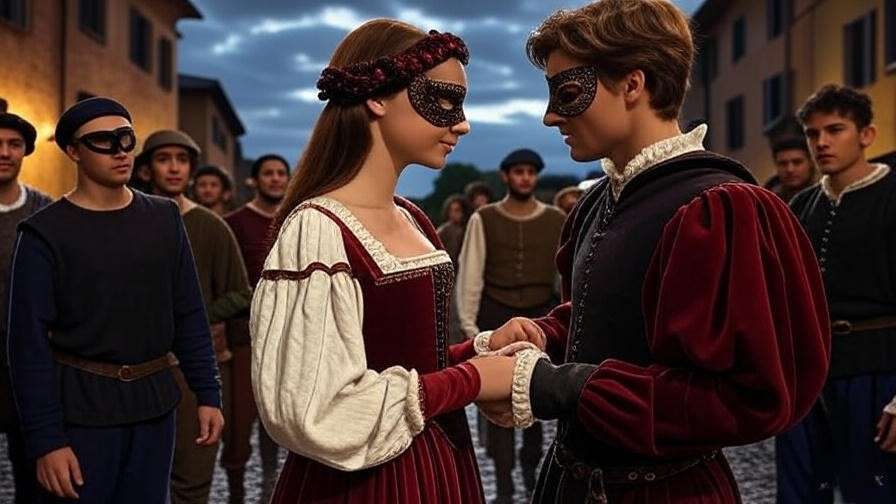
Act 1 Summary: The play begins with a street brawl between servants of the Montagues and Capulets, escalating until Prince Escalus intervenes, threatening death for further violence. We meet Romeo, pining over unrequited love for Rosaline. Benvolio urges him to move on, while Lord Capulet discusses marrying his daughter Juliet to Paris. At the Capulet masquerade ball, Romeo crashes the party, sees Juliet, and falls instantly in love. Their first conversation forms a shared sonnet, ending in a kiss. Tybalt recognizes Romeo but is restrained.
Key Scene: Act 1, Scene 5 – First Meeting
Romeo spots Juliet:
| Original Text | Modern English Translation |
|---|---|
| O, she doth teach the torches to burn bright! It seems she hangs upon the cheek of night Like a rich jewel in an Ethiope’s ear… | Oh, she shows the torches how to burn bright! She stands out against the darkness Like a jeweled earring hanging against dark skin… |
They share their first kiss after poetic banter, highlighting instant passion.
Act 2: The Rush of Young Love
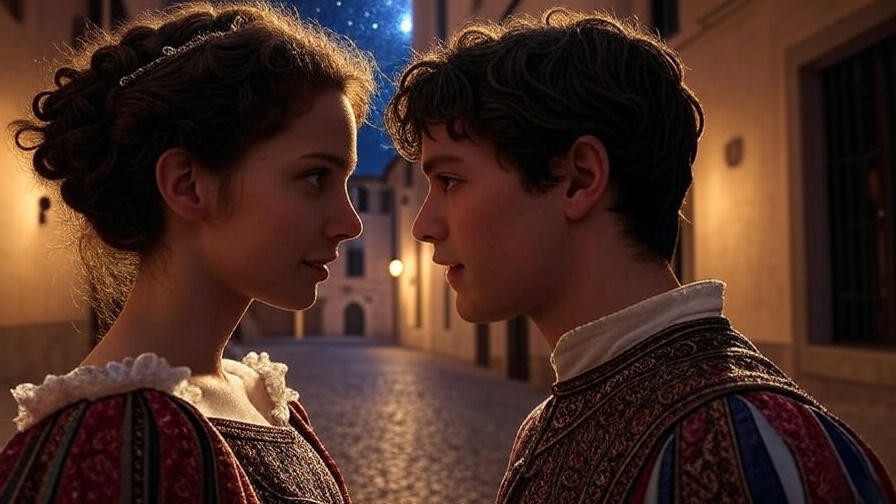
Act 2 Summary: Romeo scales the Capulet orchard wall to declare his love. The famous balcony scene unfolds as Juliet appears above, unaware of him at first. They profess love, plan secret marriage. Friar Laurence agrees to wed them, hoping to end the feud. Mercutio and Benvolio tease Romeo about Rosaline.
Key Scene: Act 2, Scene 2 – The Balcony Scene
This is arguably Shakespeare’s most iconic romantic exchange.
Romeo:
| Original Text | Modern English Translation |
|---|---|
| But soft! What light through yonder window breaks? It is the east, and Juliet is the sun. Arise, fair sun, and kill the envious moon… | Wait! What light is breaking through that window? It is the east, and Juliet is the sun. Rise, beautiful sun, and make the jealous moon fade away… |
Juliet:
| Original Text | Modern English Translation |
|---|---|
| O Romeo, Romeo! Wherefore art thou Romeo? Deny thy father and refuse thy name… What’s in a name? That which we call a rose By any other name would smell as sweet. | Oh Romeo, Romeo! Why do you have to be Romeo? Reject your father and refuse your name… What’s in a name? A rose called by any other name would smell just as sweet. |
They vow love and part with “parting is such sweet sorrow.”
Mercutio’s Queen Mab Speech (Act 1, Scene 4 – often associated with Act 2 buildup): Mercutio mocks Romeo’s dreams with this vivid monologue about the fairy queen who brings dreams, showcasing Shakespeare’s imaginative wordplay.
Act 3: Tragedy Strikes
Act 3 Summary: The turning point. Tybalt challenges Romeo, who refuses to fight (now secretly related). Mercutio fights instead and is killed. Romeo, enraged, slays Tybalt and is banished. Juliet learns of the events, grieves, but remains loyal to Romeo. The Capulets arrange her marriage to Paris.
Key Scene: Act 3, Scene 1 – Deaths of Mercutio and Tybalt
Mercutio’s curse: “A plague o’ both your houses!”
This act shifts from comedy to tragedy, emphasizing impulsivity.
Act 4: Desperate Plans
Act 4 Summary: Juliet refuses Paris; her father threatens disownment. She seeks Friar Laurence’s help. He gives her a potion to fake death, planning for Romeo to rescue her from the tomb.
Key Scene: Juliet’s Soliloquy Before Taking the Potion
Juliet fears the potion might be poison or that she’ll wake alone in the tomb—highlighting her courage and dread.
Act 5: The Tragic Conclusion
Act 5 Summary: News of Juliet’s “death” reaches Romeo in exile (the Friar’s letter fails). He buys poison, returns to Verona, kills Paris at the tomb, then takes poison beside Juliet. She awakens, sees him dead, and stabs herself. The families reconcile over their bodies.
Key Scene: Act 5, Scene 3 – Tomb Scene
Romeo: “Eyes, look your last! Arms, take your last embrace!”
The Prince concludes: “For never was a story of more woe / Than this of Juliet and her Romeo.”
Key Themes and Literary Analysis
Exploring Major Themes in Romeo and Juliet
Shakespeare weaves profound themes through the play:
- Love vs. Hate: The passionate love between Romeo and Juliet contrasts the senseless hate of their families.
- Fate vs. Free Will: References to “star-cross’d lovers” suggest predestination, yet characters’ choices drive the tragedy.
- Youth and Impulsivity: The protagonists’ haste (marrying after one night) leads to disaster.
- Society and Family: Feudal loyalty and parental control stifle individual desire.
Famous Quotes Explained (With No Fear Translations)
Here are 10 iconic quotes:
- “Wherefore art thou Romeo?” – Why must you be a Montague?
- “A rose by any other name would smell as sweet.” – Names are arbitrary; love transcends labels.
- “Parting is such sweet sorrow.” – Bittersweet goodbye.
- “What’s in a name?” – Core identity beyond labels.
- “A plague o’ both your houses!” – Curse on the feuding families.
- “It is the east, and Juliet is the sun.” – Juliet illuminates Romeo’s world.
- “Good night, good night! Parting is such sweet sorrow, That I shall say good night till it be morrow.” – Reluctant farewell.
- “O happy dagger!” – Juliet’s final words.
- “Romeo, Romeo, wherefore art thou Romeo?” – Repeated for emphasis.
- “These violent delights have violent ends.” – Friar’s warning about passionate haste.
Character Analysis: Insights from the Text
- Romeo: Starts as melancholic lover (Rosaline), matures into passionate but impulsive husband.
- Juliet: From obedient daughter to defiant woman; remarkably articulate for 13.
- Mercutio: Witty, cynical foil; his death catalyzes tragedy.
- Tybalt: Hot-tempered embodiment of hate.
- Friar Laurence: Well-intentioned but flawed advisor.
- Nurse: Comic, earthy confidante who ultimately betrays Juliet’s trust.
Study Tips and Practical Uses
How to Get the Most from No Fear Shakespeare Romeo and Juliet
- Read original first, then modern for clarification.
- Alternate lines to build familiarity with Shakespearean English.
- For essays: Use translations to support original quotes.
- Compare film adaptations (1968 Zeffirelli for fidelity, 1996 Luhrmann for modern vibe).
- Memorize by pairing original with meaning.
Common Questions Answered
- Access: Visit SparkNotes (some free samples; full via subscription or book).
- Accuracy: Highly reliable for study.
- For beginners: Ideal starting point.
Frequently Asked Questions About No Fear Shakespeare Romeo and Juliet
Where can I access the full No Fear version? Online at SparkNotes (subscription for complete access) or purchase the physical book.
Is the translation accurate? Yes—it’s literal and preserves intent, endorsed by educators.
Best for beginners or advanced? Both: Beginners for understanding, advanced for quick reference.
Are there alternatives? Yes, like LitCharts Shakescleare or Folger editions, but No Fear excels in side-by-side simplicity.
No Fear Shakespeare Romeo and Juliet is more than a crutch—it’s a gateway to appreciating Shakespeare’s genius without the language barrier. By presenting the original alongside modern English, it empowers readers to experience the raw emotion, wit, and tragedy of this enduring story.
In a world still divided by “ancient grudges,” the play’s message of love’s power resonates deeply. Dive in with No Fear, and you’ll emerge with a profound connection to the Bard’s masterpiece.