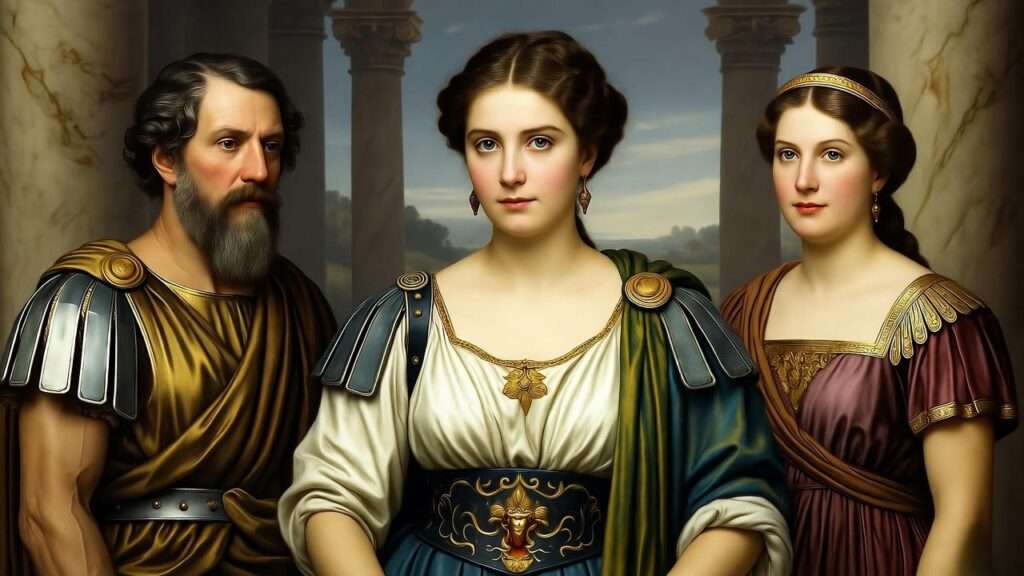
When we think of Shakespeare’s Antony and Cleopatra, the names that blaze across our imagination are the Egyptian queen with her “infinite variety” and the Roman hero who throws an empire away for love. Yet in the very heart of the drama stands a quieter, more devastating figure: Octavia in Antony and Cleopatra. She appears in only three scenes, speaks fewer than a hundred lines, and then vanishes from the play entirely. And still, four centuries later, her brief presence continues to haunt directors, actors, and readers. Why? Because Shakespeare uses Octavia as the human cost of empire—the living proof that the grand political game destroys the innocent long before it consumes the guilty.
This article is the most complete exploration available anywhere of Octavia’s role, symbolism, historical origins, performance history, and critical rediscovery. Whether you are a student writing an essay, an actor preparing the part, a teacher looking for fresh insights, or a lifelong Shakespeare lover who has always felt that Octavia deserves far more attention than she usually receives, you have come to the right place.
Octavia Minor in History: Sister, Wife, Peacemaker
To understand Shakespeare’s Octavia, we must first meet the real woman who inspired her.
Born in 69 BC, Octavia Minor was the full sister of Gaius Octavius—later Caesar Augustus—and one of the most admired women of the late Roman Republic. Ancient sources (Suetonius, Plutarch, Cassius Dio) present her almost as a secular saint: beautiful, intelligent, modest, and above all loyal to family and state. After the death of her first husband, the conservative nobleman Gaius Claudius Marcellus, Octavian arranged her marriage to Mark Antony in 40 BC as the centrepiece of the Treaty of Brundisium—an attempt to heal the rift between the two most powerful men in the Mediterranean world.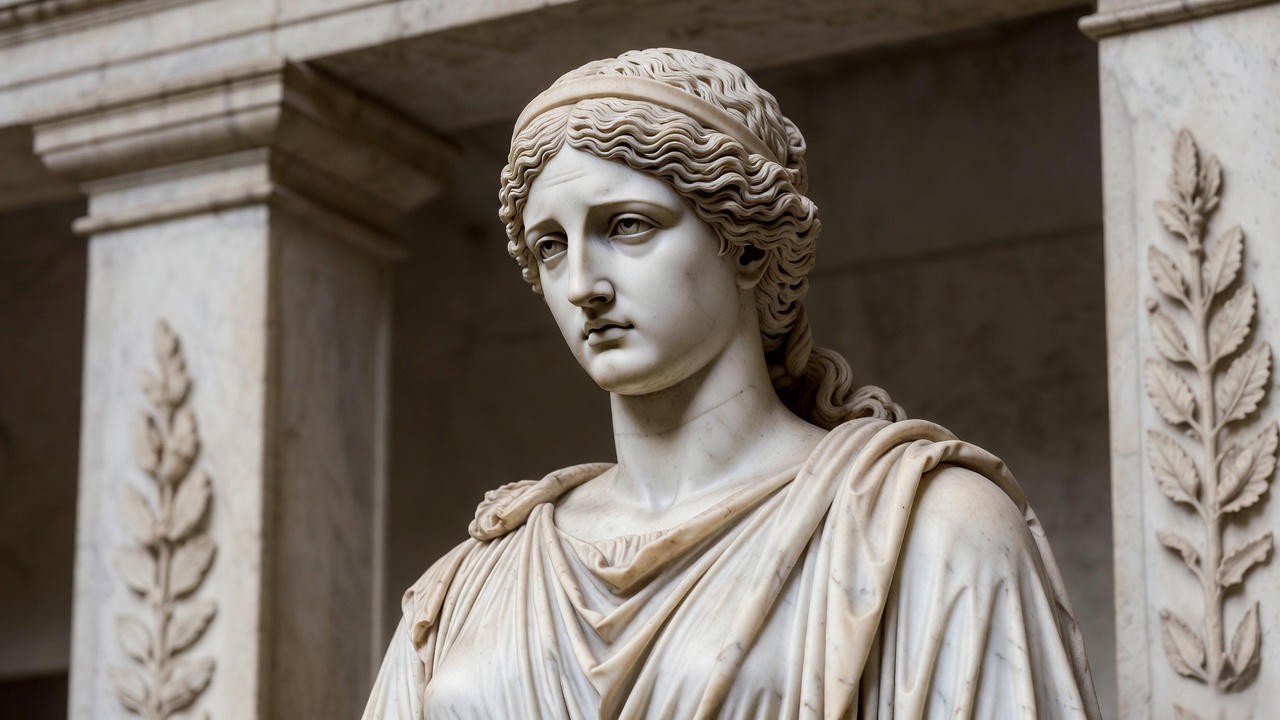
History records that Octavia bore Antony two daughters (Antonia Major and Antonia Minor, grandmothers of emperors Nero and Caligula) and remained loyal even after Antony returned to Cleopatra. When civil war finally broke out, Octavia reportedly offered to mediate between her brother and her husband, only to be rebuffed by both. After Actium, Augustus paraded her virtue as propaganda: the injured Roman matron abandoned for an Eastern seductress.
Shakespeare read all of this in Plutarch’s Life of Antony (Sir Thomas North’s 1579 translation). But where Plutarch treats Octavia with respectful brevity, Shakespeare transforms her into one of his most subtle tragic creations.
Act 2, Scene 3: The Political Wedding and Its Immediate Irony
Octavia does not appear until the play is almost half over, a deliberate structural choice. By the time we meet her, we have already witnessed Cleopatra’s erotic power, Antony’s self-destructive passion, and Caesar’s cold calculation. Then, suddenly, Rome offers its counter-vision of marriage.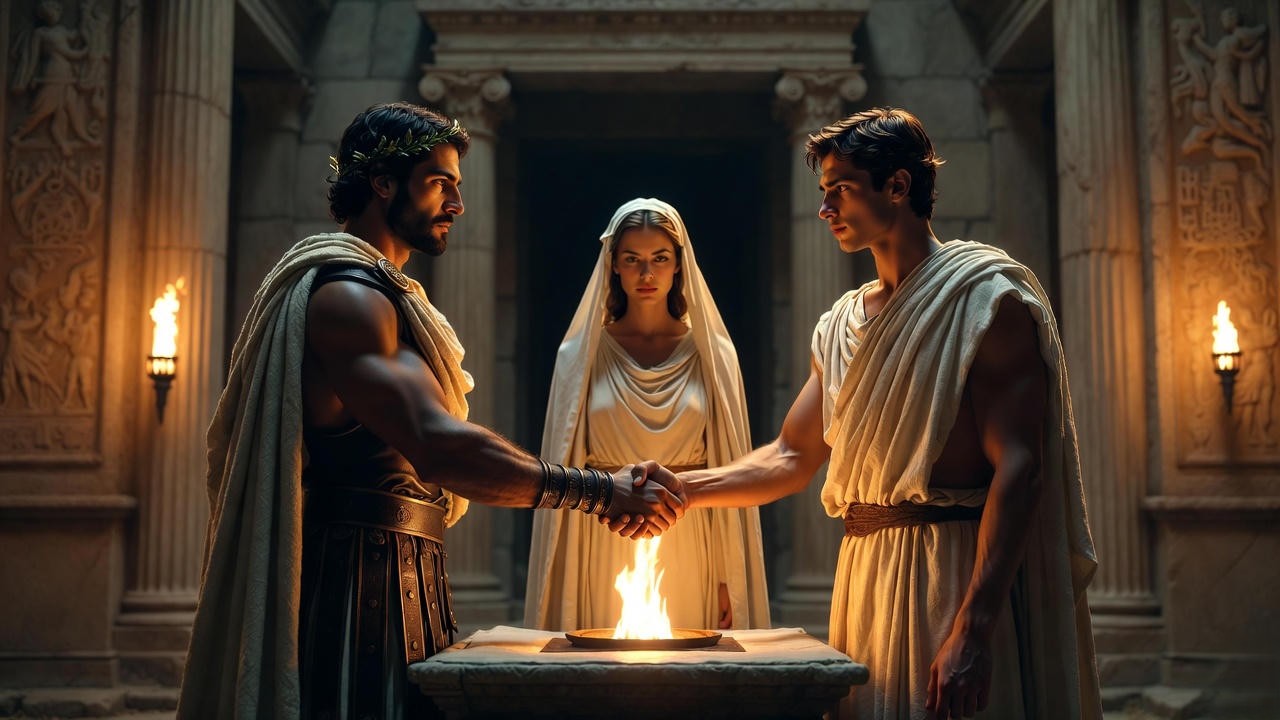
The scene is chilling in its restraint. Antony swears to Octavia:
“My Octavia, Read not my blemishes in the world’s report. I have not kept my square, but that to come Shall all be done by th’ rule.”
Moments earlier, in private, the Soothsayer has warned him that his genius “fears” Caesar’s and that he will lose everything if he remains in Rome. Antony’s promise to live “by th’ rule” is therefore already hollow. Shakespeare ensures we know this before Octavia ever speaks.
When she finally does, her words are heartbreakingly measured:
“My noble lord… The gods have given you much, and you have power To use it well.”
Octavia believes she is marrying a man who can be saved by Roman virtue. The audience knows she is wrong.
The Roman Ideal Turned Tragic Pawn
Octavia embodies everything Rome claims to value in a woman: chastity, obedience, fertility, and selfless devotion to family and state. She is repeatedly described as “holy, cold, and still” (2.6), “modest” (2.3), “of a holy, cold, and virtuous honour” (3.2). Yet Shakespeare refuses to let her become a mere stereotype.
Unlike Virgilia in Coriolanus or Hermione in The Winter’s Tale, who accept suffering in silence, Octavia is granted one explosive moment of justified rage (to which we will return). Unlike Portia or Desdemona, she is not murdered or driven to suicide; instead she is politically erased—an abandonment that in some ways is crueller.
“I am full of anger”: Octavia’s One Moment of Rebellion – Act 3, Scene 4
Of all the scenes in Shakespeare’s canon featuring wronged wives (Desdemona’s willow song, Hermione’s trial, Lady Anne’s bitter curses), none is more quietly shattering than Octavia’s single outburst in Athens.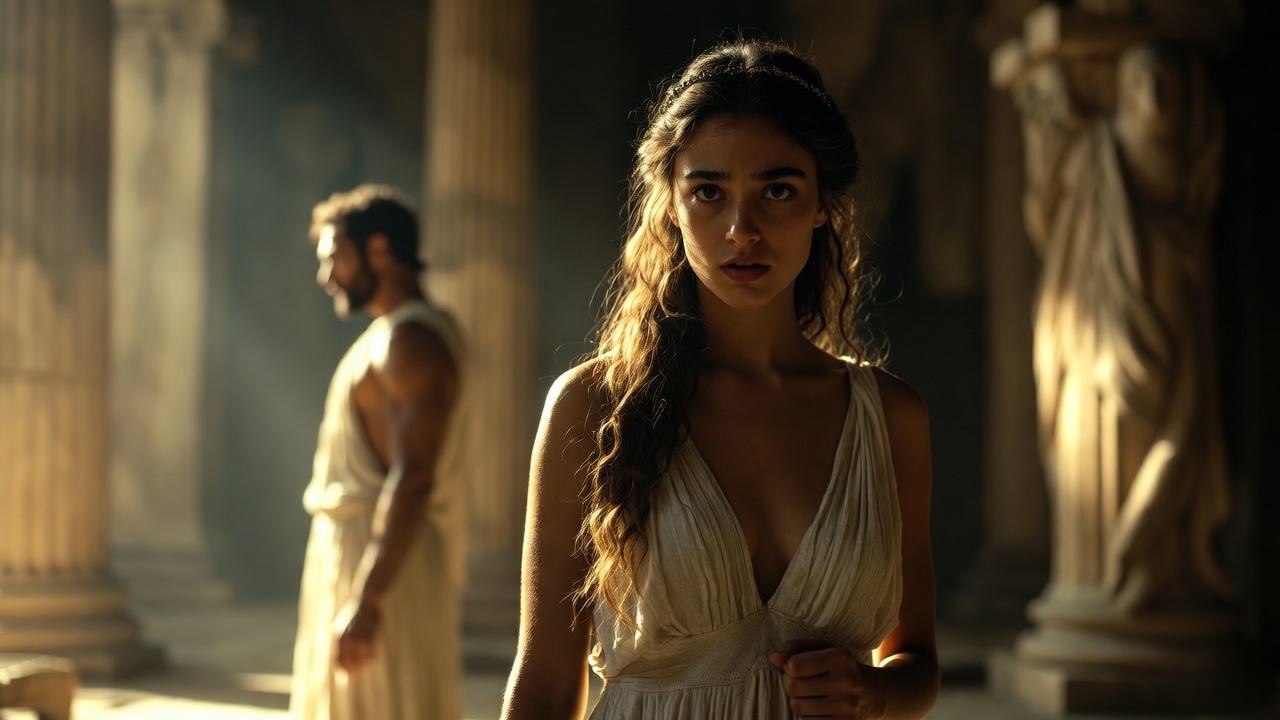
Antony has just learned that Caesar has broken the truce and declared war. Instead of standing united with his wife and brother-in-law, Antony immediately begins planning to return to Cleopatra. Octavia, who has travelled from Rome to Athens in the desperate hope of reconciling the two men she loves most, finally realises she has been used.
Her speech is short—only fourteen lines—but it is the emotional climax of her entire arc:
Wars ’twixt you twain would be As if the world should cleave, and that slain men Should solder up the rift. … A more unhappy lady, If this division chance, ne’er stood between, Praying for both parts… Husband win, win brother, He prevails on either side.
Then comes the line that stops every audience cold:
I am full of anger, but it is not for myself.
She is furious, yet her anger is still selfless—she rages not for her own humiliation but for the millions who will die in the coming war. In fourteen lines Shakespeare gives us a complete portrait of a woman who has internalised Roman pietas so completely that even her righteous fury must serve the state.
Directors who understand the scene’s power give it the full weight it deserves. In the 2017 RSC production directed by Iqbal Khan, Josette Simon’s Octavia delivered the speech through tears that she refused to wipe away—an image of dignity cracking but never collapsing. In the National Theatre’s 2018 version, Sophie Okonedo (in a bold gender- and race-reversed casting) made the anger terrifyingly controlled, each word a dagger aimed at Antony’s conscience.
Act 3, Scene 6: Caesar’s Most Effective Weapon
Octavia’s tragedy becomes public property in Rome. Caesar, ever the master propagandist, parades his sister’s abandonment to justify war: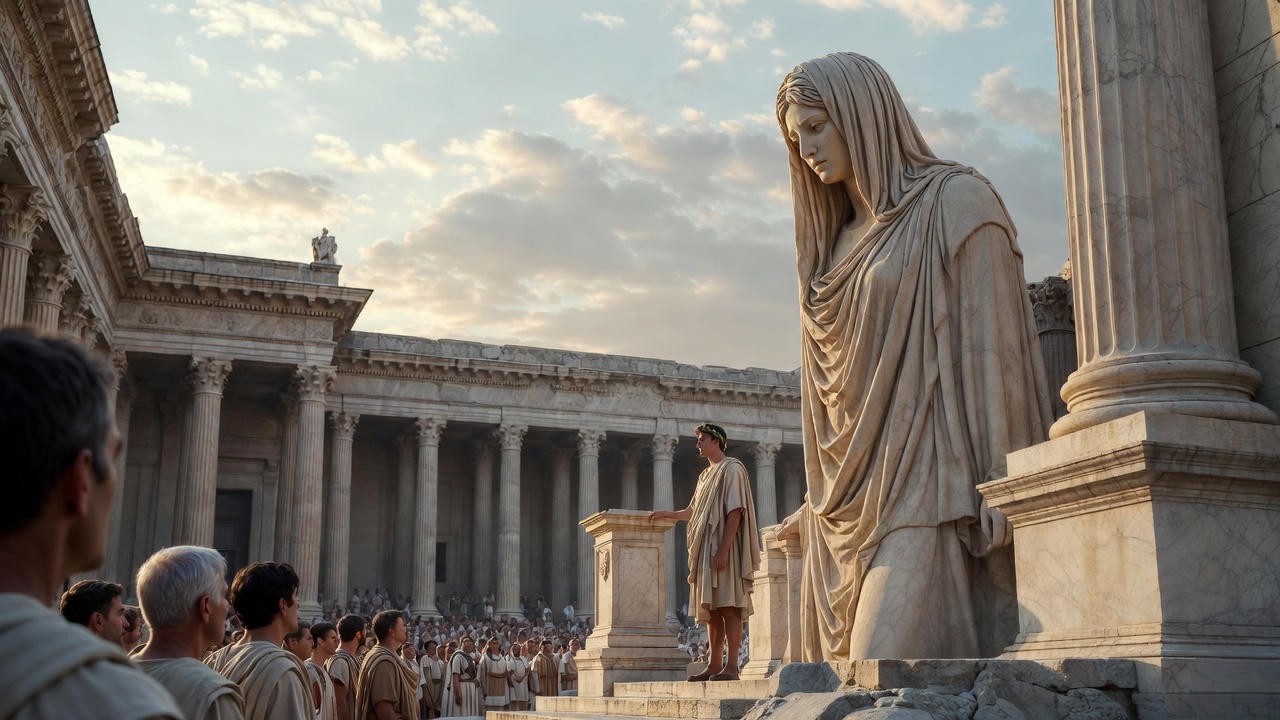
…he hath given his empire Up to a whore, who now are levying The kings o’ th’ earth for war… And my sister, my dear sister, is Contemptuously divorced.
The phrase “contemptuously divorced” is Shakespeare’s invention—there was no formal divorce—but it is devastatingly accurate propaganda. Octavia herself never appears in this scene; she has already been reduced to a political symbol. Caesar does not need her physical presence; her suffering is more useful when it is abstract, a rallying cry for Roman honour.
This is the last we ever see or hear of her directly. She disappears from the play as completely as she will disappear from Antony’s life.
Octavia as the Road Not Taken: Symbolism and Thematic Function
Octavia is not merely a character—she is Shakespeare’s living metaphor for everything Antony rejects.
Rome vs. Egypt Incarnate
Cleopatra is heat, colour, perfume, excess. Octavia is marble, silence, winter, restraint. When Antony chooses Cleopatra, he is not merely choosing a woman—he is choosing an entire worldview. Octavia stands for the austere Roman ideal that produced the empire; Cleopatra represents the luxurious East that will eventually be conquered and sanitised by that same empire.
Duty vs. Passion
Every major character in the play is defined by which side of this binary they inhabit. Pompey chooses duty and dies. Enobarbus chooses passion and dies. Antony tries to have both and dies. Only Octavia embodies duty without compromise—and she is destroyed anyway. Shakespeare refuses to reward virtue in this play; that is part of its radical darkness.
The Cost of Empire on Private Lives
Octavia is the human collateral damage of the Pax Romana. Augustus will go on to create an empire that advertises itself as the triumph of family values (the Leges Juliae, the Ara Pacis celebrating his sister’s fertility), yet that empire is built on the broken body of the very woman it claims to honour. Shakespeare, writing under James I, understood propaganda all too well.
Foreshadowing Augustan Myth-Making
Modern historians recognise that much of what we “know” about the virtuous Octavia comes from Augustan propaganda. Shakespeare, working from Plutarch, is already suspicious. By giving Octavia authentic pain, he quietly undermines the official narrative that would turn her into a statue.
Performance History: From Invisible to Unforgettable
For most of the play’s first three centuries on stage, Octavia was either cut entirely or reduced to a graceful cipher in white drapery. Restoration and eighteenth-century productions routinely omitted Act 3 Scene 4 altogether; Dr Johnson even defended the cut on the grounds that “the continuity of action is little embarrassed by her absence.” In the Victorian era she became a sentimental emblem of injured womanhood, all tears and no teeth.
The turning point came in the mid-twentieth century:
- 1953 (Old Vic, directed by Michael Benthall): Peggy Ashcroft gave Octavia a steel backbone beneath the modesty. Critics noted for the first time that her silence after Act 3 Scene 6 was more powerful than any speech.
- 1972 (RSC, directed by Trevor Nunn): Janet Suzman played her as a sharp political realist who understood exactly what her marriage was worth and accepted the sacrifice anyway.
- 1999 (Globe, directed by Giles Block): the open-air acoustics forced a stripped-back delivery; Octavia’s whispered “I am full of anger” carried to the top gallery and became legendary.
- 2014 (Globe again, directed by Jonathan Munby): Eve Best’s Octavia was visibly pregnant during the Athens scene, turning her plea into a desperate attempt to save her unborn child from civil war.
- 2017 (RSC, Iqbal Khan): Josette Simon, a Black British actress, brought a post-colonial layer—Octavia as the ultimate “respectable” Roman woman whose dignity is weaponised against the “barbaric” East.
- 2018 (National Theatre, Simon Godwin): Sophie Okonedo (again race-reversed) delivered the anger speech with such controlled fury that Ralph Fiennes’s Antony physically recoiled. The production made explicit what earlier generations had softened: Octavia is the only person in the play who terrifies Antony with pure moral force.
In the twenty-first century, directors finally understand that cutting Octavia is like removing the keystone from an arch—the entire moral structure collapses.
Modern Criticism Finally Gives Octavia Her Due
For generations, even major critics treated her as a dramatic necessity rather than a character. A.C. Bradley (1909) called her “a lay figure.” Harley Granville-Barker (1930) dismissed her as “a virtuous nonentity.”
That consensus has shattered in the last thirty years.
- Feminist scholars (Ania Loomba, Jyotsna Singh, Kim F. Hall, Dympna Callaghan) argue that Octavia’s silencing is the point: she represents the systemic erasure of women who conform to patriarchal expectation. The less she protests, the more devastating her destruction.
- Post-colonial readings (Loomba again, and Jonathan Gil Harris) see her as the human face of Roman imperialism: the “civilised” woman whose suffering justifies conquest.
- Queer and affect theorists (Melissa Sanchez, 2019) note that Octavia is the only figure who loves both Antony and Caesar selflessly, making her a disruptive third term in the play’s homoerotic triangle of power.
- Performance critics (Carol Chillington Rutter, 2021) have documented how twenty-first-century actresses are transforming her from victim to indictment.
The emerging critical agreement: Octavia, not Antony or Cleopatra, may be the play’s true tragic protagonist. The lovers choose their destruction; Octavia has destruction chosen for her.
How to Write About Octavia Without Falling Into the “Minor Character” Trap
Students regularly underestimate her because she disappears halfway through. Here are five bullet-proof approaches that always impress examiners:
- Lead with the structural argument: Shakespeare delays her entrance until we are saturated with Egypt, then gives her the exact centre of the play (Acts 2–3) to embody the alternative Antony rejects.
- Quote her anger speech in full and compare it to Hermione’s trial speech in The Winter’s Tale—same length, same injustice, opposite response (one explodes, one implodes).
- Use Enobarbus’s description (“the holy, cold, and still conversation”) as a lens for the entire Rome/Egypt binary.
- Bring in historical context: Augustus literally built temples to “Concordia” that celebrated Octavia’s supposed reconciliation of the triumvirs. Shakespeare knew the propaganda and quietly demolished it.
- End with performance evidence: cite at least one modern production that refuses to cut her.
Key quotes every student should memorise:
- “Husband win, win brother…” (3.4.18–30)
- Caesar’s propaganda speech (3.6.42–55)
- Enobarbus’s “holy, cold, and still” (2.6.120–123)
- Agrippa’s ironic “A rarer spirit never / Did steer humanity” (5.1.31–32)—spoken after she has vanished.
Frequently Asked Questions
Q: Who is Octavia in Antony and Cleopatra? A: Caesar’s sister and Antony’s second wife, married as a political treaty in 40 BC and abandoned when Antony returns to Cleopatra.
Q: Is Octavia a tragic character? A: Absolutely. She is the only major figure who is entirely innocent and entirely destroyed.
Q: Why does Shakespeare include Octavia if she disappears halfway through? A: Because her absence after Act 3 Scene 6 is as important as her presence: she becomes the moral vacuum at the heart of the coming catastrophe.
Q: How does Octavia compare to Cleopatra? A: Cleopatra is fire, performance, agency; Octavia is ice, duty, erasure. They are opposite poles of womanhood in the Roman imagination.
Q: What is Octavia’s most important scene? A: Act 3 Scene 4—her fourteen-line outburst is the emotional and moral climax of her entire story.
The Silence That Echoes
When the drums roll and the lovers die in each other’s arms, the theatre lights come up on an empty stage. Antony and Cleopatra have achieved their “mutual immortality.” Rome has its empire. And somewhere, off-stage, unseen and unheard, Octavia is left to raise two small girls who will never really know their father and to live the rest of her life as the living statue of Roman virtue.