
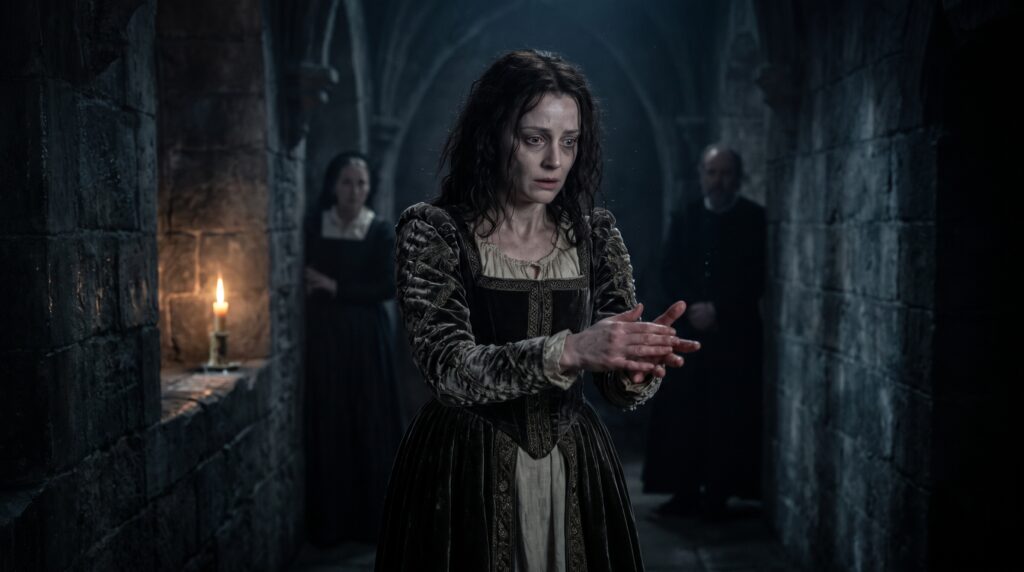
Picture a cold, stone corridor in the dead of night. A flickering candle casts long, erratic shadows against the walls. A queen, once fierce enough to call upon dark spirits to strip away her humanity, is now reduced to a trembling shell, obsessively washing invisible blood from her hands. For students, actors, and literary enthusiasts seeking to understand the psychological core of William Shakespeare’s darkest tragedy, mastering the out out damn spot macbeth scene is absolutely essential. It is not just a dramatic climax; it is one of the most profound depictions of psychological collapse in the history of English literature.
Often, readers casually conflate Lady Macbeth’s frantic cry of “Out, damned spot!” with Macbeth’s later, equally famous “Out, out, brief candle!” soliloquy. However, these are two entirely different manifestations of grief and guilt. While her husband retreats into a hollow, nihilistic numbness, Lady Macbeth is consumed by a hyper-active, inescapable trauma.
In this comprehensive literary analysis, we will decode Act 5, Scene 1 of Macbeth. We will explore the historical context of sleepwalking in Elizabethan theater, break down the psychological weight of her dialogue, trace the tragic irony of the play’s blood motif, and provide expert insights for both academic essays and theatrical performances.
Setting the Stage: The Context of Act 5, Scene 1
Before Lady Macbeth even utters a word in this scene, Shakespeare masterfully builds a suffocating atmosphere of dread. The audience is not allowed to simply watch the queen’s breakdown; we are forced to spy on her alongside two deeply unsettled witnesses.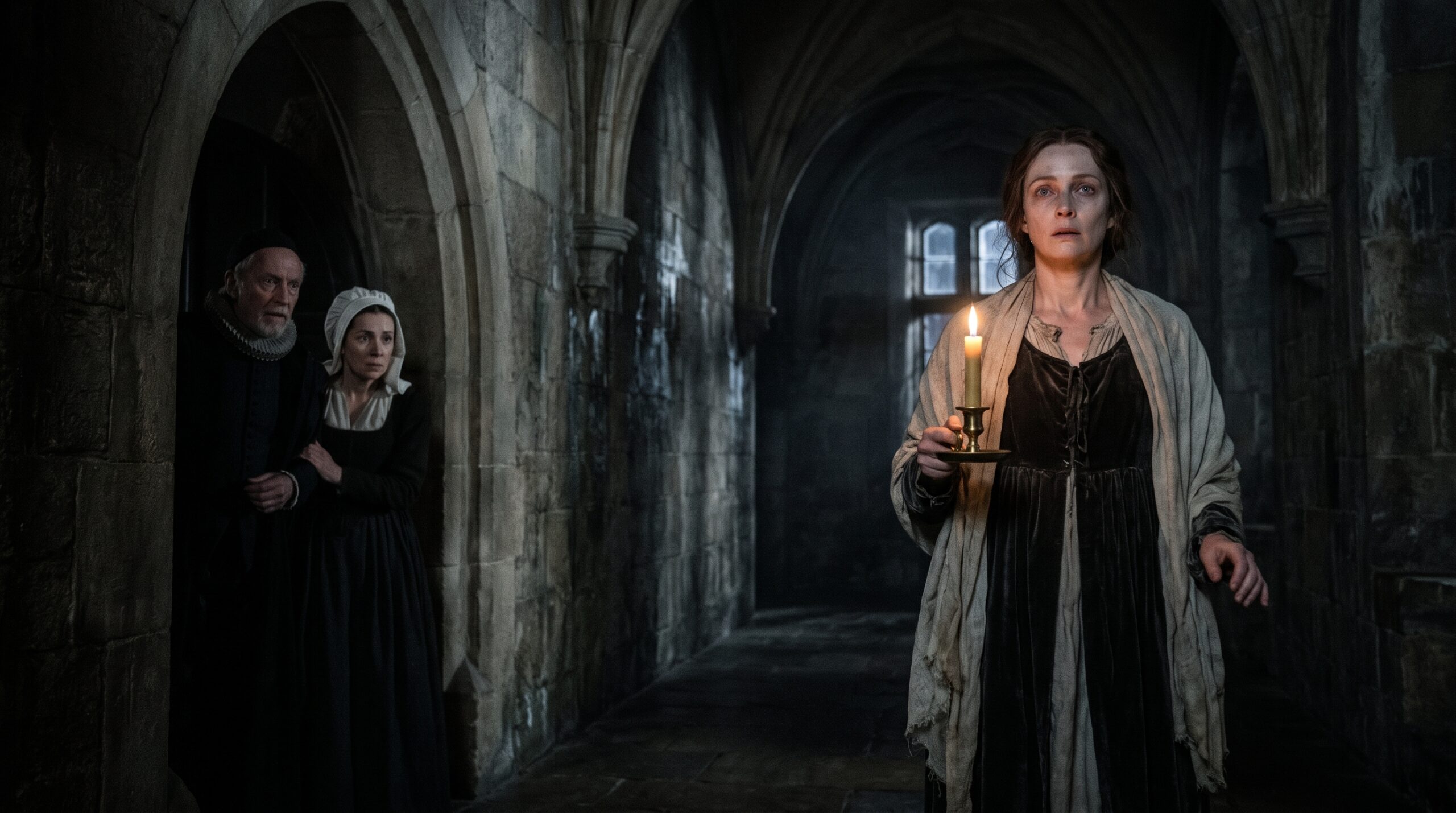
The Watchers in the Dark (The Doctor and the Gentlewoman)
The scene opens with a whispered conversation between a Doctor of Physic and Lady Macbeth’s waiting-gentlewoman. For days, the gentlewoman has watched the queen rise from her bed, unlock her closet, write on a piece of paper, and return to sleep—all while entirely unconscious.
Shakespeare uses these two characters as audience surrogates. The Doctor and the gentlewoman provide a framing device of voyeurism. The gentlewoman is terrified of what she has heard, refusing to repeat Lady Macbeth’s nighttime confessions to the Doctor because she has “no witness to confirm my speech.” This highlights the immense political danger of the moment: acknowledging the queen’s guilt is treason, punishable by death. When Lady Macbeth finally enters with her candle, the sheer terror of the watchers amplifies our own. We are watching a private, unfiltered confession of regicide.
The Significance of Sleepwalking in Elizabethan Theater
To fully grasp the impact of this scene, we must view it through the lens of a 17th-century audience. Today, we understand sleepwalking (somnambulism) as a parasomnia—a sleep disorder. However, to the Elizabethan and Jacobean audience, sleep was considered a sacred restorative gift from God, reserved for the innocent.
In Shakespearean theology, a disrupted sleep cycle was a symptom of a deeply corrupted soul, divine punishment, or even demonic possession. Macbeth himself foreshadowed this curse moments after murdering King Duncan in Act 2, crying out, “Macbeth does murder sleep.” By Act 5, this curse has fully manifested in his wife. Her sleepwalking is a visual representation of her severed connection to grace, nature, and the divine. The Doctor explicitly confirms this theological diagnosis, stating, “Unnatural deeds / Do breed unnatural troubles… More needs she the divine than the physician.”
Line-by-Line Analysis: Decoding the “Out Out Damn Spot” Quote
When Lady Macbeth finally speaks, her language is fragmented, repetitive, and broken. Crucially, Shakespeare strips her of the elegant iambic pentameter (blank verse) she commanded earlier in the play. In Act 5, she speaks entirely in turbulent, disjointed prose. This structural breakdown mirrors the collapse of her sanity.
The Illusion of the “Damned Spot”
“Out, damned spot! out, I say!”
This is arguably the most famous expression of guilt in Western literature. The “spot” she is frantically trying to wash away is the imagined blood of King Duncan. Earlier in the play, she boldly took charge of the murder’s aftermath, smearing blood on the sleeping guards to frame them. Now, that physical blood has transformed into a psychological stain that cannot be cleansed.
The use of the word “damned” is vital. It carries heavy religious weight. She is not just cursing the stubbornness of the stain; she is unconsciously acknowledging her own eternal damnation. She realizes that the blood is a mark of a mortal sin that has condemned her soul to hell.
“One, Two: Why, Then, ‘Tis Time to Do’t”
“One: two: why, then, ’tis time to do’t.—Hell is murky!—Fie, my lord, fie!”
In her delirium, Lady Macbeth is not experiencing a single, coherent memory. Instead, she is rapidly flashing back to different moments of trauma. When she counts “One, two,” she is reliving the night of Duncan’s murder, specifically the striking of the clock or the ringing of the bell that she used as a signal to tell Macbeth the guards were drugged and it was time to kill the king.
She is permanently trapped in the traumatic loop of the murder night. The past has become her eternal present.
“Hell is Murky”
This brief, chilling sentence represents a massive theological and psychological shift for the character. In Act 1, Lady Macbeth fearlessly called upon the “dunnest smoke of hell” to hide her knife. She believed she could manipulate darkness and use it as a cloak for her ambition.
Now, on the edge of the abyss, she realizes the true, terrifying reality of the darkness she invited in. “Hell is murky” is a moment of profound, paralyzing fear. The bravado is gone. She is staring into the spiritual void of her own afterlife, realizing that the darkness will not protect her—it will consume her.
4. The Tragic Irony of Water and Washing (The Blood Motif)
To fully appreciate the devastation of the out out damn spot macbeth scene, one must track Shakespeare’s brilliant use of dramatic irony, specifically through the contrasting motifs of water and blood.
Act 2 vs. Act 5: A Devastating Contrast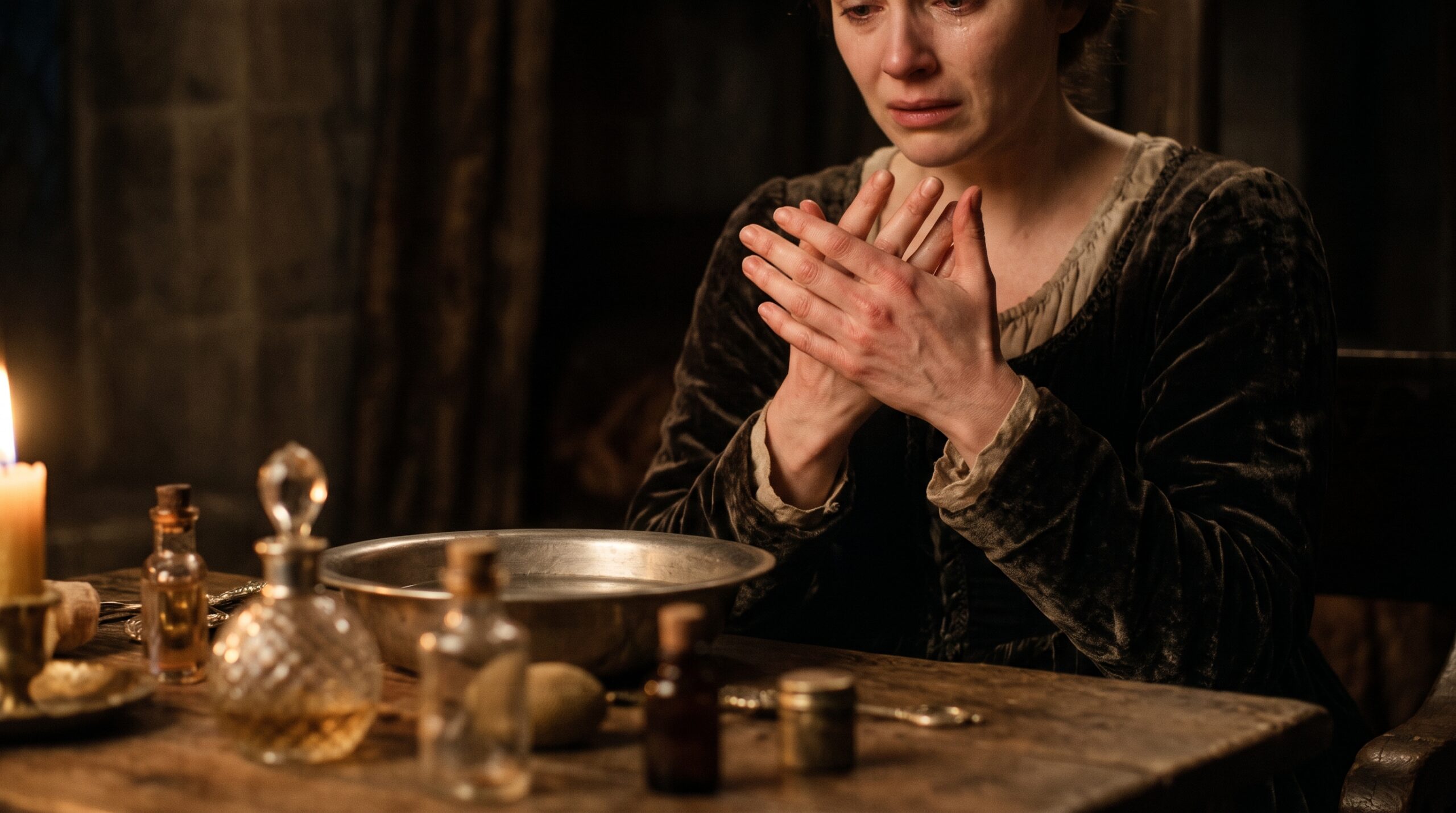
Immediately following the assassination of King Duncan in Act 2, Macbeth is paralyzed by the sight of his own bloody hands, famously asking if “all great Neptune’s ocean” could wash the blood away. Lady Macbeth, at that time, is the voice of cold, pragmatic reason. She takes the bloody daggers, smears the sleeping guards, and returns to her trembling husband with a chillingly dismissive rebuke:
“A little water clears us of this deed: / How easy is it, then!”
The tragic irony in Act 5 is palpable. That “little water” has completely failed her. The physical blood was easily washed from her skin, but the psychological stain has seeped into her very soul. In her sleepwalking delirium, she raises her hands to her face and cries out in despair:
“Here’s the smell of the blood still: all the perfumes of Arabia will not sweeten this little hand. Oh, oh, oh!”
This sensory shift from sight (seeing the spot) to smell (the inescapable stench of copper and death) highlights the inescapable nature of her guilt. Smell is a primal sense, deeply tied to memory and trauma. The hyperbole of “all the perfumes of Arabia” beautifully mirrors Macbeth’s earlier hyperbole about Neptune’s ocean, inextricably linking husband and wife in their shared, suffocating damnation.
Blood as an Ineradicable Stain
Throughout Macbeth, blood is a fluid, evolving symbol. In Act 1, it represents honor, bravery, and martial prowess (as seen when the bleeding Captain reports Macbeth’s battlefield victories). However, once Macbeth and his wife cross the moral event horizon by committing regicide, blood transforms. It is no longer a badge of courage; it becomes an ineradicable stain of guilt, paranoia, and tyranny. Lady Macbeth’s obsessive hand-washing is the physical manifestation of her realization that certain sins can never be cleansed.
5. The Psychology of Guilt: Lady Macbeth’s Mental Collapse
While Elizabethan audiences viewed Lady Macbeth’s affliction as spiritual corruption, modern readers and actors can find immense value in analyzing her breakdown through a modern psychological lens. Her collapse is a masterclass in the destructive power of repressed trauma.
Repressed Trauma Coming to Light
In Act 1, Lady Macbeth attempts to override her own humanity. In her terrifying “unsex me here” soliloquy, she actively begs dark spirits to “stop up the access and passage to remorse,” demanding that no natural human compassion shake her ruthless purpose. She believes she can simply turn off her conscience like a switch.
However, the human psyche cannot sustain that level of violent repression. For the middle acts of the play, she remains fiercely composed, holding her unraveling husband together during the disastrous banquet scene (Act 3, Scene 4) when he sees Banquo’s ghost. But pushing the trauma down only ensures that it ferments in the dark. By Act 5, her conscious mind has lost the battle. Her repressed guilt forcefully erupts when her psychological defenses are lowered during sleep.
A Modern Lens: Somatic Symptom Disorder and PTSD
Viewed through modern psychiatry, Lady Macbeth exhibits severe symptoms of Post-Traumatic Stress Disorder (PTSD) and Somatic Symptom Disorder.
-
Somatization: The psychological torment of her guilt is so unbearable that it manifests as a physical, somatic symptom—the hallucinated blood and the compulsive need to wash her hands.
-
Intrusive Memories: Her disjointed dialogue (“The thane of Fife had a wife: where is she now?”) reveals a mind subjected to rapid-fire, intrusive traumatic memories. She is not just haunted by Duncan’s death, but by the cascading slaughter that followed, including the murder of Lady Macduff, which she did not plan but for which she bears ultimate responsibility.
6. The Great Reversal: Macbeth and Lady Macbeth’s Shifting Dynamics
The sleepwalking scene finalizes one of the most brilliant structural elements of the tragedy: the complete character reversal between husband and wife.
From Mastermind to Broken Shadow
At the play’s inception, Lady Macbeth is the dominant force. She is the mastermind, the manipulator, and the driving engine of the plot. She taunts her husband’s masculinity and orchestrates the regicide with terrifying precision. Yet, as Macbeth embraces his own tyranny, she is slowly pushed to the margins. By Act 3, Macbeth stops consulting her on his murderous plots (“Be innocent of the knowledge, dearest chuck”).
In Act 5, the once-powerful queen is entirely isolated. She has no confidants, no allies, and not even the support of her husband, who is busy fortifying Dunsinane Castle. She is a broken, solitary shadow of her former self, trapped in a nocturnal purgatory of her own making.
Macbeth’s Descent into Numbness
Shakespeare heightens the tragedy by contrasting Lady Macbeth’s hyper-sensitivity with Macbeth’s total emotional numbness. While she is driven mad by the weight of a single drop of blood, Macbeth has waded so deep into a river of blood that he can no longer feel anything.
This juxtaposition reaches its devastating climax shortly after the sleepwalking scene. When Macbeth is informed that the queen is dead—presumably having taken her own life to escape the visions of the “damned spot”—he cannot even muster the capacity to mourn. He simply responds with the bleak, nihilistic realization that “She should have died hereafter,” launching into his famous “Tomorrow, and tomorrow, and tomorrow” soliloquy. Her total psychological overload is answered only by his total emotional emptiness.
7. Expert Tips: Studying and Performing the Scene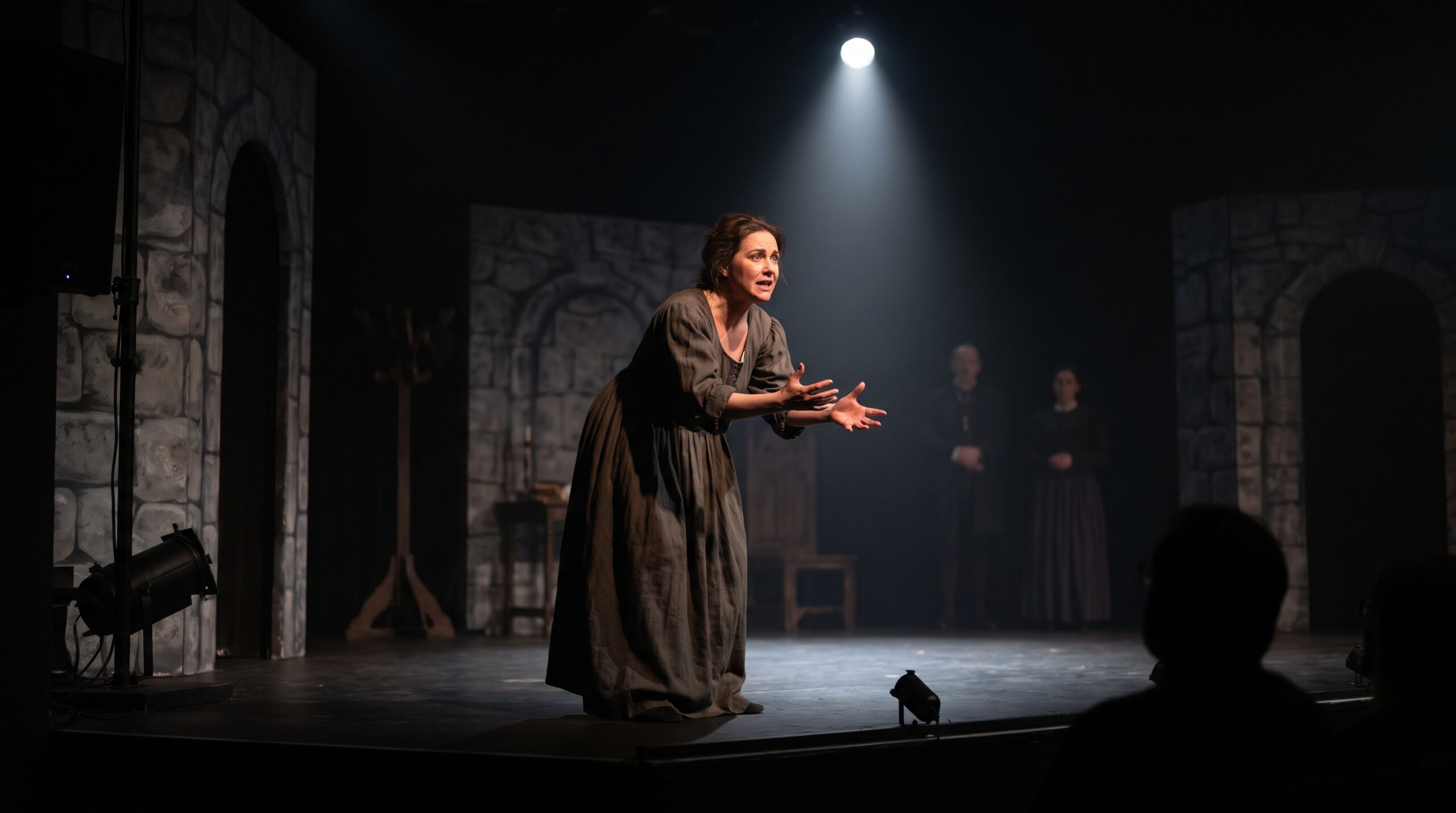
Whether you are writing a literary analysis paper for a university course or stepping onto the stage to bring the Queen of Scotland to life, mastering this scene requires digging beneath the surface of the text.
Essay Writing Tips for Students
For students analyzing the out out damn spot macbeth quote, avoid simply summarizing the plot. Instead, argue why Shakespeare wrote the scene this way. Here are three strong thesis directions:
-
The Failure of “Unsexing”: Argue that Lady Macbeth’s sleepwalking proves the impossibility of her Act 1 request to be “unsexed” and stripped of human remorse. Her subconscious ultimately rejects her conscious cruelty.
-
The Motif of Disease as State Corruption: Analyze how Lady Macbeth’s psychological “disease” mirrors the political and spiritual sickness of Scotland under Macbeth’s tyrannical rule. The Doctor cannot cure her, just as Macbeth cannot cure Scotland.
-
Theological Despair vs. Divine Grace: Focus on the religious language (“Hell is murky,” “damned spot”). Argue that the tragedy of Lady Macbeth is not just her guilt over regicide, but her complete despair and severed connection from divine forgiveness.
Acting Insights: Playing Lady Macbeth
For actors, the sleepwalking scene is the ultimate challenge. The temptation is to play it with grand, melodramatic despair. Resist this urge.
-
Embrace the Prose: Notice that Shakespeare drops her signature blank verse. She speaks in choppy, erratic prose. Let the punctuation and the fragmented sentences dictate a jagged, unpredictable breathing rhythm.
-
Play the Reality, Not the Madness: Lady Macbeth does not know she is mad. To her, the blood is incredibly real, the smell of copper is overpowering, and the terror of hell is imminent. Play the intense, hyper-focused physical task of washing the hands.
-
Keep it Intimate: Remember that it is the dead of night and she is sleepwalking. This is not a public broadcast; it is a private, deeply internalized nightmare. Whispered terror is often far more chilling than shouting.
8. Frequently Asked Questions (SEO Snippets)
To further clarify this pivotal moment in Shakespearean tragedy, here are brief, authoritative answers to the most common questions regarding Lady Macbeth’s psychological break.
What is the exact quote for “out out damn spot”? The exact quote from Act 5, Scene 1 of Shakespeare’s Macbeth is: “Out, damned spot! out, I say!—One: two: why, then, ’tis time to do’t.—Hell is murky!” It is often misquoted by combining it with Macbeth’s later soliloquy, “Out, out, brief candle!”
Why is Lady Macbeth sleepwalking? Lady Macbeth sleepwalks as a physical manifestation of her repressed guilt and severe psychological trauma following the assassination of King Duncan. In Elizabethan beliefs, such unnatural sleep disruption indicated a deeply corrupted soul cut off from divine grace.
Who is Lady Macbeth talking to when she says “out damned spot”? While she is physically being observed by the Doctor and her gentlewoman, Lady Macbeth is hallucinating and talking to herself. She is trapped in a traumatic loop, reliving past conversations with her husband on the night they committed regicide.
Why does Lady Macbeth speak in prose instead of poetry in Act 5? Shakespeare uses structural shifts to convey character development. Lady Macbeth speaks in controlled, commanding iambic pentameter early in the play. In Act 5, she speaks in erratic, fragmented prose to symbolize the complete deterioration of her logical mind and her loss of noble status.
9. The Lasting Legacy of the “Damned Spot”
The out out damn spot macbeth scene endures as a masterpiece of dramatic literature because it forces audiences to confront a terrifying universal truth: we cannot escape our own conscience. Through the visceral imagery of an un-washable bloodstain, Shakespeare perfectly captures the suffocating weight of guilt and the devastating psychological toll of unchecked, ruthless ambition.
Lady Macbeth begins the play believing she can manipulate morality and bend darkness to her will. By Act 5, the darkness has swallowed her whole. Her tragic descent from a cold, calculating mastermind into a fractured, sleepwalking shadow remains one of the most compelling character arcs ever written, offering endless depths for literary analysis, theatrical performance, and psychological study.
Ready to dive deeper into the tragedy of the Scottish King? Continue your journey through our Shakespearean archives by exploring our complete breakdown of Macbeth’s “Tomorrow and tomorrow and tomorrow” soliloquy, or discover the historical origins and cultural impact of the Weird Sisters.